Tag: quarterly review presentation

30 Apr 2026
Quarterly Review Presentation: CFO-Ready Structure for Executive Reviews

Quarterly Review Presentation: CFO-Ready Structure for Executive Reviews

Quick answer: A quarterly review presentation survives CFO pushback when it opens with a two-sentence performance headline, names the three most material variances before the CFO asks, frames forward commitments in CFO-aligned language (cash, margin, risk, timing), and reserves the closing slide for the decisions or support being requested. Divisional storytelling belongs in the appendix. The main deck exists to answer the financial leader’s first four questions before they are asked.

Mateus Oliveira had run the industrial coatings division of a FTSE 250 manufacturer for two years. The previous October, he was on slide three of his quarterly review, walking through divisional highlights, when the CFO lifted a hand and said, “Mateus, I’m going to stop you. I have no idea where we stand on gross margin. Can we come back when you can tell me?”

The meeting ended nine minutes after it started. Mateus walked out carrying a deck he had spent eleven hours building and a clear sense that his review structure had nothing to do with what finance leadership actually wanted to hear. His operations narrative had been thorough. His customer wins had been genuine. But he had buried the number the CFO cared about most under three slides of divisional context, and that was the only thing anyone remembered afterwards.

Two weeks before the January review, Mateus rebuilt the deck with a single question taped to his monitor: “What would the CFO ask in the first four minutes?” The answer reorganised everything. Slide one became a performance headline with revenue, margin, and cash conversion. Slide two became a variance summary naming the three biggest deltas before anyone could raise them. Slide three became forward commitments framed in quarters, not activities.

The January review ran for eighteen minutes. The CFO asked three follow-up questions — all anticipated and answered without hesitation. Sign-off was unanimous. What had changed was not Mateus’s performance, nor his analytical depth. It was the sequence in which he released information, and whose mental model that sequence served.

If you want a structured approach to CFO-facing quarterly reviews, the Executive Slide System provides templates and frameworks built for executive review scenarios where financial leadership will scrutinise every number.

Explore the Executive Slide System →

Why CFOs Derail Quarterly Reviews at Slide Three

The most common structural mistake in a quarterly review presentation is front-loading operational narrative before financial headlines. Division heads and operations leaders typically build their decks in the order they experienced the quarter — customer wins, team progress, projects delivered — and place the financial summary somewhere in the middle. From the presenter’s perspective, this feels like good storytelling. From the CFO’s perspective, it feels like withholding.

The CFO arrives with a specific mental model. They have pre-read the numbers. They know your revenue landed two points below plan and your gross margin slipped sixty basis points. What they do not know is whether you know, whether you understand why, and whether your forward plan addresses it. When you open with operational context, the CFO reads that as a presenter who either has not grasped the financial reality or is hoping the narrative will soften the numbers.

This is structurally identical to the challenge explored in quarterly business review structure, where the temptation to tell the story chronologically consistently loses against the discipline of telling it financially first. The executive audience wants the conclusion in the first minute and the evidence afterwards — not the other way around. When a CFO interrupts at slide three, it is rarely because the slide is wrong. It is because they have decided the deck does not respect their time. Pre-empting their questions is an act of professional courtesy that signals you understand how financial leadership reviews divisional performance.

Build a CFO-Ready Quarterly Review Deck in One Evening

The Executive Slide System includes 26 templates, 93 AI prompts, and 16 scenario playbooks — covering quarterly reviews, variance presentations, and board-level performance briefings. Stop rebuilding your review structure from scratch every quarter.

£39 — instant access. Designed for executives who present to CFOs and executive committees.

Get the Executive Slide System →

The Opening Summary That Pre-Empts the CFO’s First Question

The first slide of a quarterly review presentation is not an agenda, a team photo, or a customer quote. It is a two-sentence performance headline followed by three numbers and a verdict.

Sentence one states the quarter’s headline in plain financial language: “The division delivered revenue of £84.2m against a plan of £86.5m, gross margin of 37.4% against 38.0%, and cash conversion of 92% against 95%.” Sentence two states your verdict: “This is a below-plan quarter driven primarily by timing of two strategic customer contracts that have since closed.” No softening language. The CFO’s first question is now answered before it is asked.

Three financial metrics is the right number for this opening. Fewer, and the CFO will ask for the ones you left out. More, and you dilute the headline. Revenue, margin, and a third metric that reflects operational quality — cash conversion, working capital, customer retention, backlog coverage — will cover most quarterly review scenarios. The third metric is where you signal what you consider the true health indicator for your division, and that signalling is watched closely.

The verdict sentence is where presenters retreat into hedge language. Resist it. “Mixed quarter” and “progress against a challenging backdrop” communicate that you are not prepared to name reality. A clear verdict earns credibility that buys the room’s attention. A disciplined CFO presentation language pattern reinforces that across every slide.
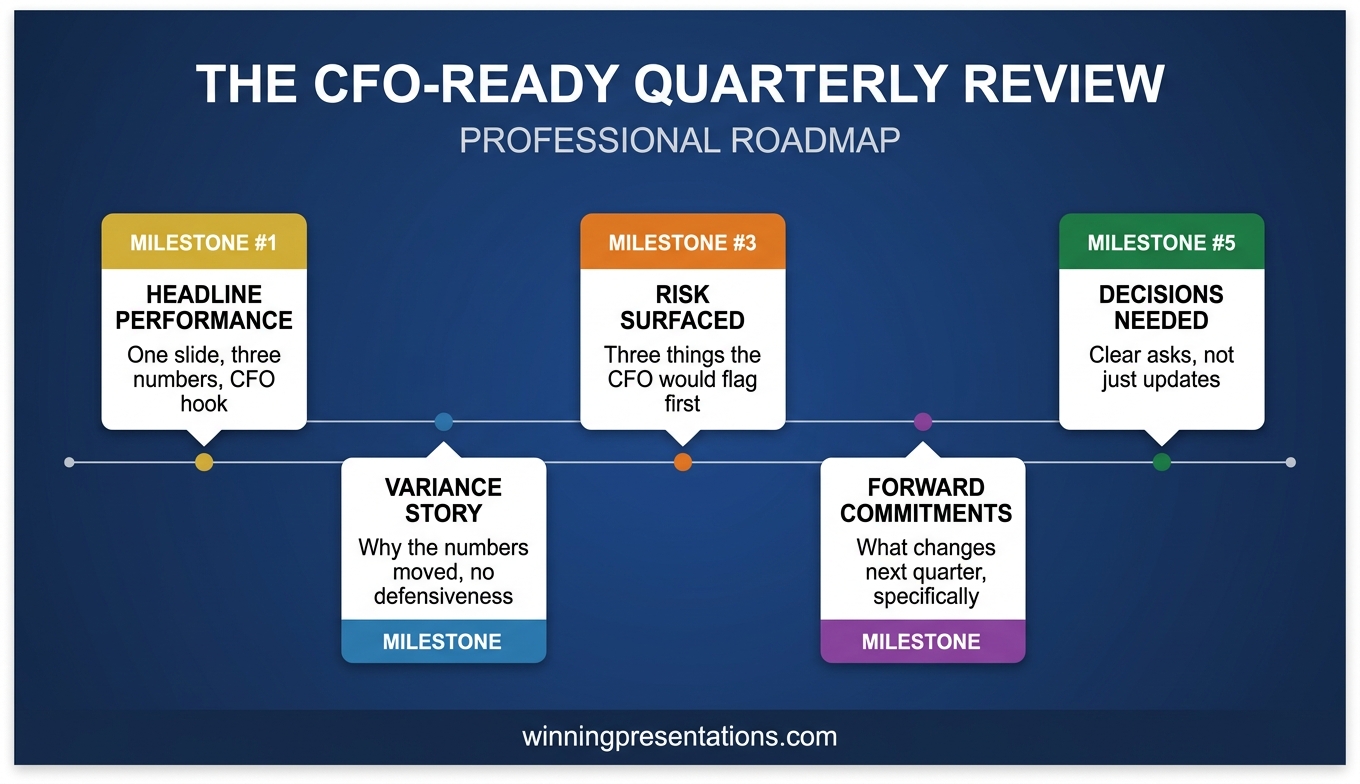

Quarterly review presentation opening slide framework showing two-sentence performance headline, three financial metrics, and executive verdict statement with example language

A Variance Framework That Removes Defensiveness

Once the opening summary has pre-empted the first question, the second slide must address the second: “why?” This is where most quarterly reviews lose control of the room, because variance explanation done badly reads as excuse-making. Done well, it reads as professional judgement. A CFO-ready variance slide uses three categories, in this order:

Timing variances. Revenue or cost movements that shifted between quarters but remain within the financial year. “£1.8m of revenue slipped from Q3 to Q4 as the Henderson contract moved its go-live date by six weeks. The contract has since signed.” Timing variances are least threatening because they imply the underlying business is intact.

Structural variances. Movements that reflect a real change in the underlying business — a lost customer, margin pressure, an expanded cost base. “Gross margin slipped 60 bps due to a 4% raw materials increase not fully passed through in contracts signed before the price review.” Name these clearly. Hiding them in aggregated categories triggers the CFO’s “what aren’t you telling me?” instinct.

Investment variances. Deliberate spending decisions that widen variance against plan in the short term but serve strategic objectives the executive committee has already approved. “Sales headcount is three positions above plan following the board’s October decision to accelerate European expansion. The incremental cost is £180k this quarter.” Investment variances should never be a surprise to the CFO.

This three-category structure mirrors how a financial leader already thinks about variance. When your slide uses their mental model, the conversation that follows is collaborative rather than adversarial. The discipline of executive variance explanation — naming timing, structural, and investment movements separately — is what converts a defensive Q&A into a governance conversation.

If you want a ready-made template for this variance slide — including language patterns and example framings — the Executive Slide System includes templates designed for quarterly review and CFO-facing scenarios.

Forward-Looking Commitments That Survive Scrutiny

After variance, the next question on the CFO’s mind is “what are you going to do about it?” This is where executive presenters most often make commitments they cannot keep, because the pressure of the room pushes them toward optimism. A deck that survives scrutiny builds forward commitments the presenter can defend twelve weeks later. Three principles make forward commitments durable:

Quantify or stay silent. Every forward commitment must have a number and a date attached. “We will recover the margin gap by Q2” is not a commitment. “We will recover 40 basis points of the 60 bps margin gap by end Q2 through the contract price review completing in March” is. If you cannot quantify something, do not commit to it — put it on a watchlist.

Name the dependencies. Every financial commitment rests on conditions that may not hold. State them explicitly. “Assuming the Henderson contract remains on the revised March timeline and raw materials pricing holds, we expect to close £2.1m of the £2.3m shortfall.” Naming dependencies is not hedging — it gives the CFO a clear basis for confidence and a clear trigger for escalation.

Separate commitments from ambitions. A CFO-ready deck uses two distinct labels: “we will” for commitments, “we aim to” for ambitions. Commitments are what the CFO can hold you to at the next review. Mixing them creates accountability problems that surface two quarters later when a stretch target has been quietly reinterpreted as a firm forecast.
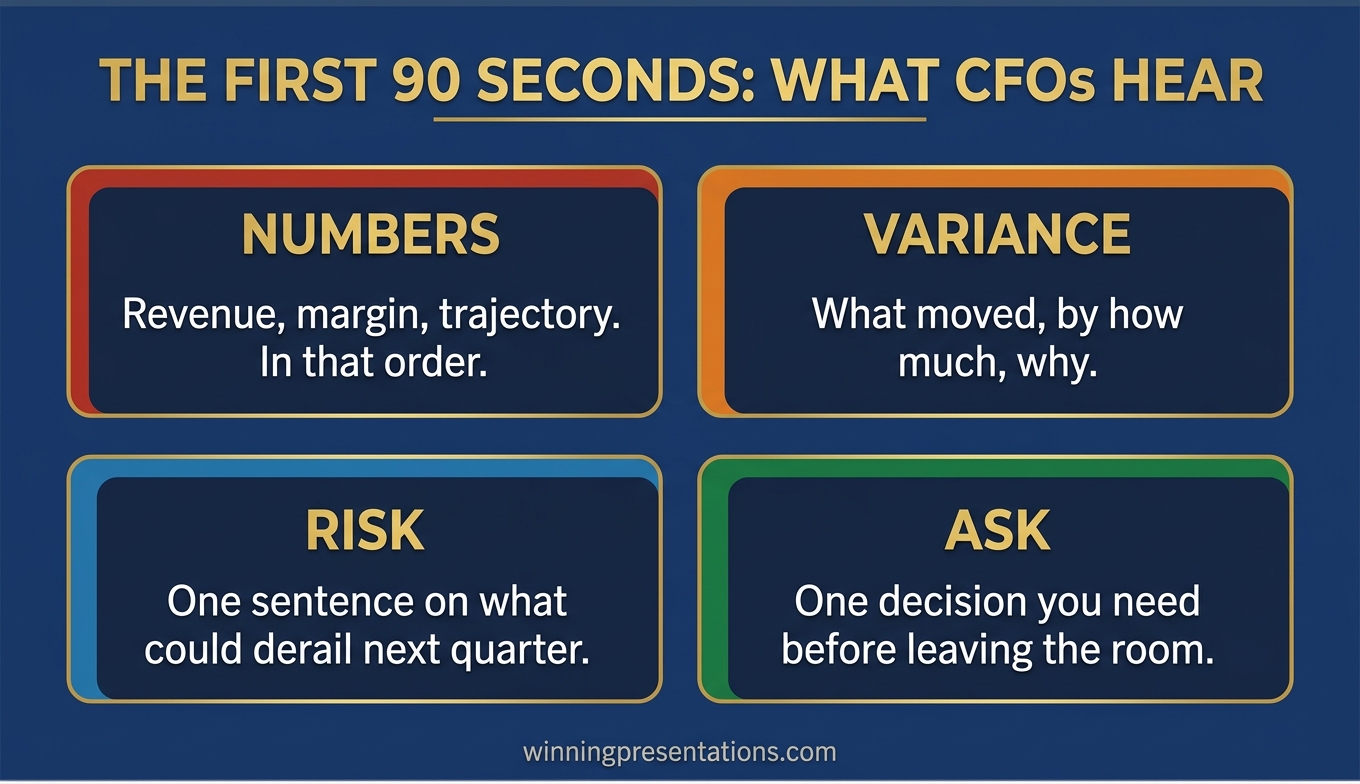

Three-principle framework for forward commitments in quarterly review presentations showing quantification, dependencies, and commitment-versus-ambition labelling with CFO-aligned example language

Quarterly Reviews That Earn Credibility Instead of Eroding It

The Executive Slide System gives you 16 scenario playbooks and 93 AI prompts to structure quarterly reviews, variance presentations, and CFO briefings that drive decisions instead of triggering interruptions. Templates for executive review decks and divisional performance reporting.

£39 — instant access.

Get the Executive Slide System →

Handling the “What’s Changed Since Last Quarter?” Question

Every experienced CFO asks some version of this question, and the quality of your answer determines the trajectory of the meeting. It is a credibility test: do you have a live mental model of your division, or did you simply refresh last quarter’s deck with new numbers? The best answer has three components, delivered in under ninety seconds:

What we said we would do last quarter, and what actually happened. Pull three specific commitments from the previous review and report on each one. “Last quarter we committed to signing the Henderson contract by January; it signed on 8 February. We committed to holding gross margin at 38%; we delivered 37.4%. We committed to closing two sales vacancies; both are now filled.” Directors who see a presenter report against prior commitments — including the missed ones — conclude that the next commitments are worth trusting.

What we now know that we did not know last quarter. Name one or two material insights from the past twelve weeks — a competitor move, a customer behaviour shift, a regulatory signal. This tells the CFO you are running the division with open eyes.

What we are doing differently as a result. Close the loop. “Because the Henderson go-live pattern reflects a broader procurement slowdown in the sector, we have adjusted Q2 pipeline conversion assumptions downwards by 8%.” Responding to new information with specific adjustments is the behaviour CFOs reward most consistently. Prepare this ninety-second answer in writing before every quarterly review — delivering it fluently transforms the rest of the conversation.

CFO-Aligned Language Patterns for Every Slide

The final discipline that separates a quarterly review that survives scrutiny from one that stalls is word choice. CFOs operate in a narrow vocabulary: cash, margin, risk, timing, dependencies, assumptions, variance. When your slide language matches that vocabulary, the conversation stays strategic. When it drifts into operational or aspirational language, the CFO starts translating and losing patience. Three language shifts make the largest difference:

Replace activity verbs with outcome verbs. “We launched a new training programme” is an activity. “Sales productivity improved 11% following the May training programme” is an outcome. CFOs listen for outcome verbs because activities cost money and outcomes justify it.

Attach numbers to every significant claim. “Strong pipeline progression” means nothing. “Pipeline coverage of 2.8x against the 2.5x threshold” means something. If you cannot attach a number to a claim, consider whether the claim belongs in an executive review at all.

Lead with risk and dependency before certainty. “We expect to deliver the Q2 revenue target, though this depends on two renewals closing by end March and raw materials pricing holding” earns more trust than “We will deliver the Q2 revenue target” — even though the second sentence sounds more confident. CFOs have been burned by confident sentences without dependencies.

Frequently Asked Questions

How long should a quarterly review presentation be?

Aim for 8 to 12 slides in the core deck, presented in 15 to 20 minutes, with the full divisional appendix available for questions. Most executive review slots allocate 30 to 45 minutes in total, and your presentation should consume no more than half of that — the remainder is for the CFO and executive committee to challenge, probe, and confirm commitments.

What should the first slide of a quarterly review presentation show?

The first slide should show a two-sentence performance headline, three financial metrics (typically revenue, margin, and a third operational quality metric such as cash conversion), each with plan and actual, and a clear verdict on whether the quarter was above plan, below plan, or mixed. Avoid opening with an agenda, a team photo, or customer logos. The CFO has already pre-read the numbers, and opening with anything other than the financial headline reads as delay.

How do you explain variance in a quarterly review without sounding defensive?

Separate variance into three named categories: timing variances that will reverse within the financial year, structural variances that reflect underlying business changes, and investment variances that are deliberate and already approved. Name each variance with a specific amount, cause, and recovery expectation. The professional signal is specific, categorised variance with named causes and dependencies.

Should you show divisional wins in a quarterly review presentation?

Yes, but only after the financial summary, variance, and forward commitments. Divisional wins belong in a short context section after the CFO-facing core, or in the appendix. Leading with wins reads as an attempt to soften the numbers. Putting wins after the numbers allows them to be appreciated on their own merits rather than discounted as spin.

Join The Winning Edge

Free weekly newsletter for executives who present to CFOs and executive committees. Practical frameworks, variance-explanation strategies, and slide structures that survive scrutiny — delivered every Thursday.

Subscribe Free →

Not ready for the full system? Start here instead: download the free Executive Presentation Checklist — a quick-reference guide for structuring any high-stakes executive review or board presentation.

Read next: If your quarterly review is being delivered to a multinational executive committee, see Cross-Cultural Virtual Presentation: How to Structure a Deck That Lands in Every Region for a complementary framework on presenting to distributed executive audiences.

Mary Beth Hazeldine is the Owner & Managing Director of Winning Presentations. With 25 years of corporate banking experience at JPMorgan Chase, PwC, Royal Bank of Scotland, and Commerzbank, she advises executives across financial services, healthcare, technology, and government on structuring presentations for high-stakes scenarios.

12 Apr 2026
Executive team gathered around a boardroom table presenting cross-department quarterly review data on a large screen

Cross-Department Quarterly Review: How to Stop the Blame Game

Quick Answer

A cross-department quarterly review stops becoming a blame session when you structure it around shared data, forward-facing language, and a single executive narrative — rather than individual departmental reports. The key shift is framing every slide around decisions and progress, not performance scores.

Marcus had been preparing for three weeks. As Head of Operations at a mid-size logistics company, he was responsible for presenting the cross-department quarterly review to the executive committee — a room that included the CFO, two divisional MDs, and the Group CEO.

The first twenty minutes went according to plan. Then the IT Director put up a slide showing system uptime metrics. Operations pushed back. Sales said the delays were causing client churn. Finance said the numbers didn’t reconcile with what they’d seen the previous month. Within thirty minutes, the review had become a tribunal — with every department defending its own data and attacking everyone else’s.

Marcus told me afterwards: “The executive sponsor sat there in silence for most of it. At the end he said, ‘I don’t need to know what happened. I need to know what we’re doing about it.’ Nobody had an answer.”

The problem wasn’t the data. It was the structure. Each department had prepared slides designed to demonstrate their own performance — which meant every difficult interdependency was someone else’s problem. The meeting had no shared narrative, no forward focus, and no mechanism for building agreement. What it produced instead was defensiveness, frustration, and a room full of executives who left with less confidence in the leadership team than when they’d arrived.

Cross-department quarterly reviews are among the most politically complex presentations in business. Done well, they demonstrate executive cohesion and strategic momentum. Done poorly, they become the stage on which leadership teams publicly undermine each other — often without realising they’re doing it.

Preparing for a cross-department review?

If you’re building the deck and wondering how to present shared data without triggering defensiveness, the Executive Slide System gives you a structured framework designed for exactly these scenarios. Explore the System →

Why cross-department quarterly reviews descend into blame

The blame game in quarterly reviews is almost always structural, not personal. It emerges when the meeting is designed around individual departmental accountability rather than shared organisational progress.

When each department prepares its own slides in isolation, a predictable dynamic emerges. Each presenter selects data that reflects well on their function. When there’s a performance shortfall, the natural response is to show how it connects to a dependency in another department. The other department does the same in reverse. The executive audience watches the cycle repeat and loses confidence in the entire leadership tier.

There’s also a presentation format problem. Most cross-department quarterly reviews use a round-robin structure — each department presents in sequence, each for ten to fifteen minutes. This format guarantees fragmentation. There is no shared narrative, no agreed baseline, and no common language for interpreting the data. The executive sponsor receives five separate stories with five separate recommendations that often contradict each other.

The cross-department quarterly review that works is built differently. It starts from a single agreed executive narrative, uses shared data presented once, and keeps every slide oriented towards future decisions rather than past performance. The departments aren’t gone — their data is there — but it’s been integrated into a unified story rather than a collection of individual defences.

For related structure thinking, see how to structure a monthly business review presentation — many of the same principles apply at the quarterly level.

Executive Slide System

Stop Building Slides. Start Building Agreement.

The cross-department quarterly review tests whether your executive communication can rise above departmental politics. The Executive Slide System — £39, instant access — gives you the templates and frameworks to structure a presentation that drives decisions rather than debate.

  • Slide templates for executive scenario presentations including reviews and approvals
  • AI prompt cards to build your quarterly narrative fast
  • Framework guides for structuring complex multi-stakeholder data
  • Scenario playbooks for high-stakes business reviews

Get the Executive Slide System →

Designed for executives who need clarity in complex, multi-stakeholder environments.

The four-part structure that prevents blame before it starts

The most effective cross-department quarterly reviews use a four-part structure that begins with agreement rather than individual data. This structure does something counterintuitive: it removes the incentive to defend departmental performance by framing the entire review as a shared challenge rather than a collection of individual report cards.

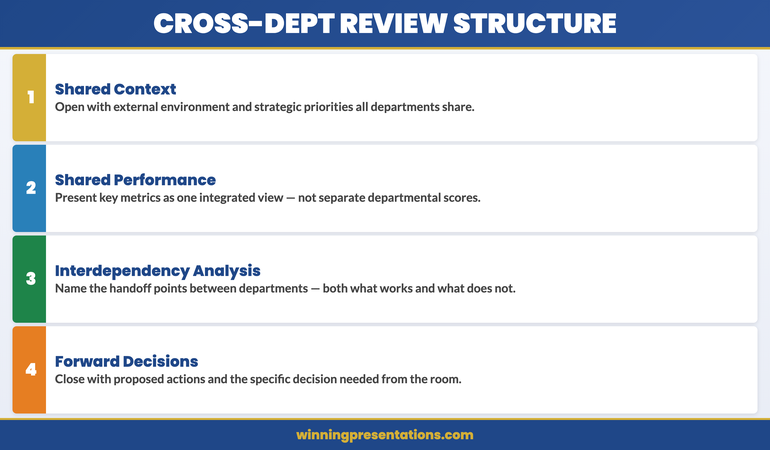
The four-part cross-department quarterly review structure: shared context, performance against shared goals, interdependency analysis, and forward decisions — infographic showing each stage

Part 1 — Shared context (2–3 slides). Open with the external environment and the strategic priorities that all departments are working towards. This reframes the review from “how did each department do?” to “how are we tracking as a business?” Senior executives respond well to this framing because it mirrors how they think about the quarter.

Part 2 — Performance against shared goals (4–6 slides). Present the key metrics that cut across all departments — revenue, customer satisfaction, operational efficiency, and any programme milestones — as a single integrated view. Show interdependencies explicitly. When performance is below target, name the shared nature of the gap before attributing it to any specific function.

Part 3 — Interdependency analysis (2–3 slides). This is the section most reviews skip — and it’s the section that prevents blame. Name the handoff points between departments explicitly. Where a handoff is working, show it. Where it’s not, frame the analysis as a systems question: what is the process that needs to change? Avoid framing any individual department as the cause of a failure.

Part 4 — Forward decisions (2–3 slides). End with a clear set of proposed actions and the decision you need from the executive sponsor. This is what senior audiences are waiting for. If the meeting ends without decisions, it will feel like a waste of time regardless of how good the data was.

The total deck for this structure is typically twelve to fourteen slides — well within the tolerance of most executive committees for a quarterly review.

How to present departmental data without triggering defensiveness

Data triggers defensiveness when it’s presented as a verdict. The moment a slide reads “Operations: underperforming against target,” the Operations Director is no longer listening to the rest of the review — they’re constructing a rebuttal.

The reframe is straightforward: present every metric as a question, not a conclusion. “We’re at 78% against our target of 85% — here’s what the data tells us about where the gap is sitting” is a fundamentally different proposition to “the Operations function missed its target by 7 percentage points.” Same data, different implication. One invites collaboration. The other triggers a territorial response.

A few specific techniques worth using:

Aggregate first, disaggregate second. Start with the combined business-level number, then break it down by function. This trains the audience to see the data as a shared issue before they see their own piece of it.

Use trend lines, not snapshot comparisons. A snapshot comparison (“Q3 vs Q4”) invites argument about what changed. A trend line invites conversation about direction. If the trend is improving, the story is encouraging even if the number is below target. If the trend is worsening, the question becomes what intervention is needed — not who is responsible.

Attribute causality to processes, not people or departments. “The delay in the customer onboarding cycle is sitting in the handoff between CRM and provisioning” is process language. It avoids naming a department as the cause, focuses attention on the system rather than the individual, and creates space for a collaborative solution.

If you’re presenting alongside colleagues from other departments, the cross-functional presentation translation framework covers how to communicate technical or functional data to mixed executive audiences without losing clarity.

The Executive Slide System includes prompt cards specifically designed to help you frame complex performance data in language that builds rather than disrupts executive confidence — see what’s included.

The language of shared accountability

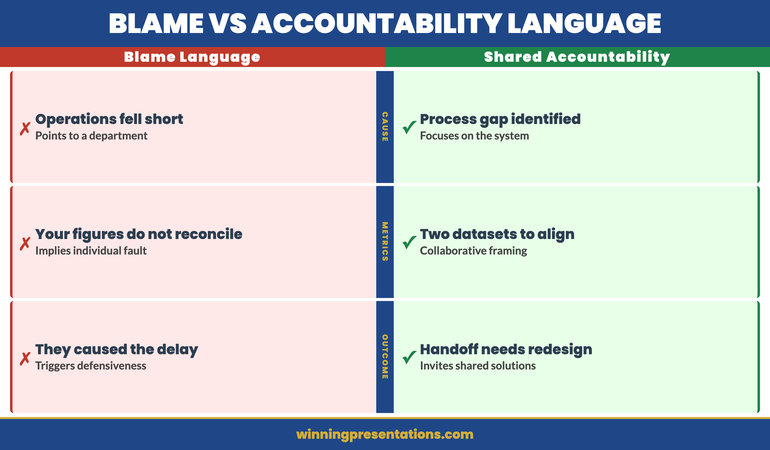
Language is the mechanism through which a cross-department review either builds or destroys alignment. There are specific word choices that consistently escalate defensiveness — and specific alternatives that consistently reduce it.

The highest-risk phrase in any cross-department review is the indirect attribution: “The delays in X were due to late sign-off from Y department.” Even if accurate, this kind of statement — particularly on a slide — puts Y on the defensive for the remainder of the meeting. They will spend the rest of their time accumulating evidence of their own competence rather than contributing to the forward conversation.

The replacement is accountability framing: “The sign-off process between X and Y has created delays in the pipeline. We’ve identified three points where the cycle time can be reduced, and we’re proposing to test a new protocol in Q1.” This acknowledges the same underlying reality but frames it as a shared process improvement rather than an individual failing.

Pronouns matter as well. “We” is always more constructive than “they” in this context. “Our performance in the quarter” is a better frame than “the performance of each function” — even when the reality is that some functions performed better than others. The executives in the room know that nuance exists. They don’t need the slides to dramatise it.

Comparison of blame language versus shared accountability language in cross-department quarterly reviews — infographic showing four before and after examples

What your executive audience actually wants from this meeting

Most presenters preparing for a cross-department quarterly review spend ninety per cent of their preparation time on what the data shows, and almost none on what the executive audience is actually trying to learn from the meeting.

Senior executives attending a cross-department quarterly review are typically trying to answer three questions. First: are we on track to achieve what we committed to, and if not, how far off are we? Second: do the people running this business understand the interdependencies well enough to manage them? Third: what decisions need to be made at this level, and are they being proposed clearly?

They are not trying to audit each department’s performance in granular detail. That level of operational review happens elsewhere. The quarterly review in front of the executive committee is a strategic conversation — and if it descends into operational detail, the room will disengage quickly.

This has a practical implication for your deck. The slides that matter most to a senior executive audience are the context slide (where are we against strategic goals?), the interdependency slide (what’s working, what’s not, what needs a decision?), and the forward-looking recommendation slide (what are we proposing to do, and what do we need from you?). Everything else supports those three moments.

For the board-level version of these principles, how to structure a department update presentation for senior leadership covers the specific adaptations needed when the audience includes non-executive directors.

Executive Slide System — £39

The Quarterly Review Deck That Works

The Executive Slide System — £39, instant access — gives you a structured approach to quarterly business reviews that keeps the focus on decisions, not departmental politics.

Explore the System →

Designed for cross-department reviews, board presentations, and multi-stakeholder updates.

Preparing for the difficult conversation ahead

Even with a well-structured deck and careful language choices, cross-department quarterly reviews sometimes surface genuine conflict that a presentation structure alone cannot contain. A department has significantly underperformed. A key project has stalled. Relationships between senior leaders are strained. In these circumstances, the presentation is only part of the solution — and in some cases, an important conversation needs to happen before the formal meeting.

The pre-meeting executive alignment conversation is one of the most underused tools in this situation. Before a quarterly review that you know will contain difficult news, a short conversation with the executive sponsor — not to rehearse the content, but to align on the narrative and the tone — is almost always worth the time. Sponsors who feel blindsided by difficult data in the room become a destabilising presence. Sponsors who have been briefed become a stabilising one.

When preparing your pre-meeting brief, keep it to three elements: what the challenging data shows, what you believe the underlying cause is (in systems language, not blame language), and what you’re proposing to do about it. That framing gives the executive sponsor everything they need to contribute constructively to the discussion.

Also worth considering: who else in the room needs a pre-meeting conversation? If you know that two department heads are in conflict over a shared metric, a brief alignment call between the three of you before the formal review can prevent thirty minutes of circular argument in front of the executive committee. It’s not about rehearsing a script — it’s about ensuring the room is focused on decisions rather than relitigating the past.

For parallel thinking on this approach when presenting strategic change, the article on structuring a digital transformation board presentation covers similar stakeholder alignment principles in a programme-led context.

Frequently Asked Questions

How long should a cross-department quarterly review presentation be?

For an executive committee audience, aim for twelve to fourteen slides and a sixty-minute meeting: twenty minutes for the presentation, twenty minutes for discussion, and twenty minutes for decisions. If the review is running longer than ninety minutes, the structure usually needs tightening — either there’s too much operational detail in the deck, or the forward-looking decision section is absent and the discussion is filling that gap.

What should I do if another department’s data contradicts mine during the review?

Address data discrepancies before the meeting, not during it. If you identify a conflict between datasets in the preparation phase, align with the relevant department head to agree a shared number and a brief explanation of the variance. Walking into a quarterly review with unresolved data conflicts creates exactly the kind of credibility problem that undermines the entire session. If a discrepancy surfaces unexpectedly in the room, name it calmly: “We’ll need to reconcile these two numbers — can we action that today and send an update to the committee?” This keeps the meeting moving and demonstrates competence rather than concealing the problem.

Who should present which sections of a cross-department quarterly review?

The most effective format is a single lead presenter who owns the shared narrative — usually the most senior executive responsible for cross-functional outcomes — with subject matter contributors speaking to specific technical or operational sections when genuine expertise is required. Avoid the round-robin format where each department presents its own section: it fragments the narrative, makes the meeting feel like a series of individual reports rather than a shared review, and creates the conditions for blame dynamics to emerge.

The Winning Edge — Weekly Insights for Executive Presenters

Every Thursday: one practical insight to sharpen your executive communication. No generic tips — only what works in real high-stakes rooms.

Join The Winning Edge →

Free resource: The Executive Presentation Checklist — a pre-meeting quality check for high-stakes presentations.

About the Author

Mary Beth Hazeldine — Owner & Managing Director, Winning Presentations

With 25 years of corporate banking experience at JPMorgan Chase, PwC, Royal Bank of Scotland, and Commerzbank, Mary Beth advises executives across financial services, healthcare, technology, and government on structuring presentations for high-stakes funding rounds and approvals. She is the creator of the Executive Slide System and the Conquer Speaking Fear programme.