

Quick Answer: A preemptive Q&A means naming the objections your audience is already thinking about and addressing them within your presentation—before the Q&A session begins. The key is positioning it as evidence of rigorous thinking, not defensiveness. Executives who use this technique see measurably higher approval rates and shorter Q&A sessions because they’ve eliminated the strongest objections before they’re asked.
You Need a Preemptive Q&A If: You’re asking for approval, funding, or buy-in on a proposal that has obvious risks or trade-offs. You know your stakeholders will object. You know what they’ll say. So why wait for them to say it? Name the objections yourself within the presentation, show you’ve thought them through, and build credibility by being transparent about the costs before anyone has to point them out.
Jump to Section
The Board Meeting That Flipped
Rachel, a CFO, walked into a board meeting asking for approval to invest £4.2 million in new systems infrastructure. She knew the objections before she opened her mouth. The board had rejected a similar proposal two years prior. They were risk-averse. They watched cash flow carefully. They would ask: “Why not wait another year?” “What if we lose a key person on the implementation team?” “How do we know this won’t be obsolete in three years?”
She could have presented the case for the investment and then fielded these questions when they inevitably came. Instead, she built them into her presentation.
Slide 6, buried in the business case section: “Why we’re not waiting another year.” Slide 8: “Implementation risk and mitigation.” Slide 10: “Total cost of delay vs. cost of investment.”
She named every objection she expected. She showed she’d thought about each one. She wasn’t defending—she was demonstrating thoroughness.
The board approved it unanimously. No hostile questions. No extended back-and-forth. Just: “Looks like you’ve covered the bases. Let’s go.”
What made the difference wasn’t new information. It was the signal that Rachel had anticipated every reasonable concern and built her case around addressing them. That signal—”this person has thought this through”—is more powerful than any single data point.
Why Naming Objections First Builds Credibility
When your audience disagrees with your proposal, they go through a predictable internal process. First, they notice a gap or risk in your logic. Then they wait for you to address it. If you don’t, they formulate an objection. Then they decide whether to voice it. The longer you go without addressing that gap, the stronger their objection becomes.
A preemptive Q&A stops this process early. You address the gap before they even formulate the objection. This does something crucial: it signals that you’re not avoiding difficult questions. You’re leading with them.
This has a specific psychological effect. When someone was expecting to find a flaw in your logic and you’ve named it first, they often reinterpret that as a sign of strength. You weren’t hiding the risk—you were confident enough to surface it. That confidence transfers to confidence in your proposal.
Compare two approaches:
Approach 1 (Reactive): You present the proposal. Someone in the room says, “But what about the cost overrun risk? New systems projects always go over budget.” You scramble to respond. Now it looks like you hadn’t thought about this obvious issue, and you’re defending after the fact.
Approach 2 (Preemptive): You present the proposal. Then you say: “I know what you’re thinking—systems projects always cost more than planned. We’ve built in a 18% contingency, benchmarked against three similar implementations in our sector. We’ve also limited scope to Phase 1, which reduces the variables.” Now if someone brings up cost overrun, they’re reinforcing a point you’ve already made, not catching you off-guard.
The credibility difference is dramatic. In Approach 1, you look reactive. In Approach 2, you look prepared.
How to Identify Which Objections to Address
Not every possible objection deserves preemptive attention. If you try to address every concern, your presentation becomes defensive and bloated. You need to identify the specific objections that will have the most weight with your particular audience.
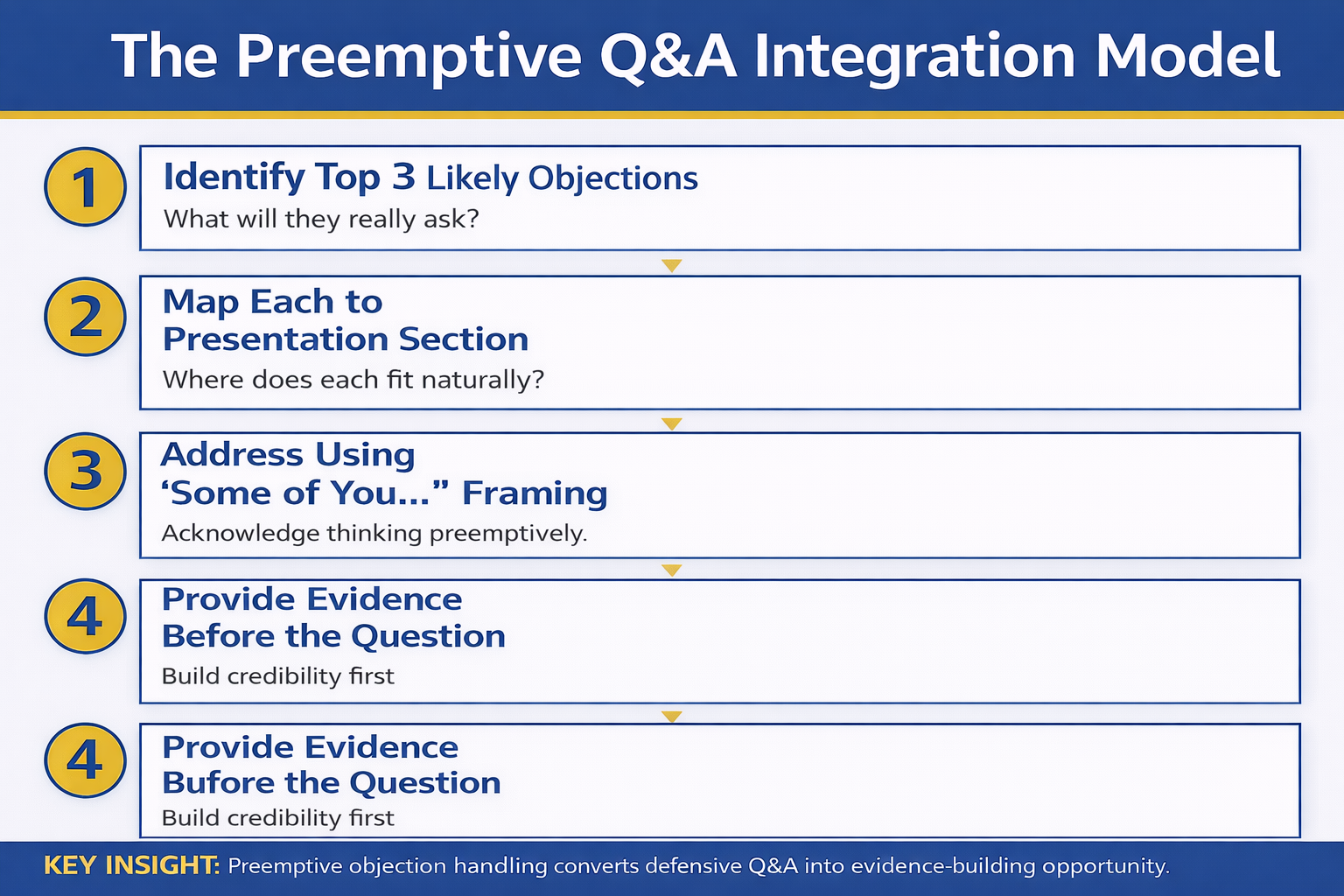
Step 1: List all possible objections. Spend 20 minutes writing down every criticism, concern, or doubt someone could raise about your proposal. Don’t filter. This is the raw list.
Step 2: Rank by likelihood and impact. Which objections will your specific audience care about? Which would, if raised, actually change their decision? A finance-focused board will weight cost objections more heavily than a growth-focused one. A risk-averse stakeholder will prioritise downside scenarios over upside potential.
Step 3: Select the top three to five. Choose the objections that combine high likelihood (your audience is thinking about this) plus high impact (it could influence their decision). These are your preemptive candidates.
Step 4: Map them to your presentation structure. Where in your narrative does each objection naturally sit? Don’t force them in. They should arise organically as you build your case.
For Rachel’s infrastructure investment, her top three objections were: timing risk (why now?), implementation risk (what if it goes wrong?), and replacement risk (will it be obsolete?). Each of these fit naturally into different sections of her presentation, so naming them didn’t feel forced.
Positioning Objections as Rigorous Thinking
The way you introduce a preemptive objection completely determines whether it lands as defensiveness or rigour.
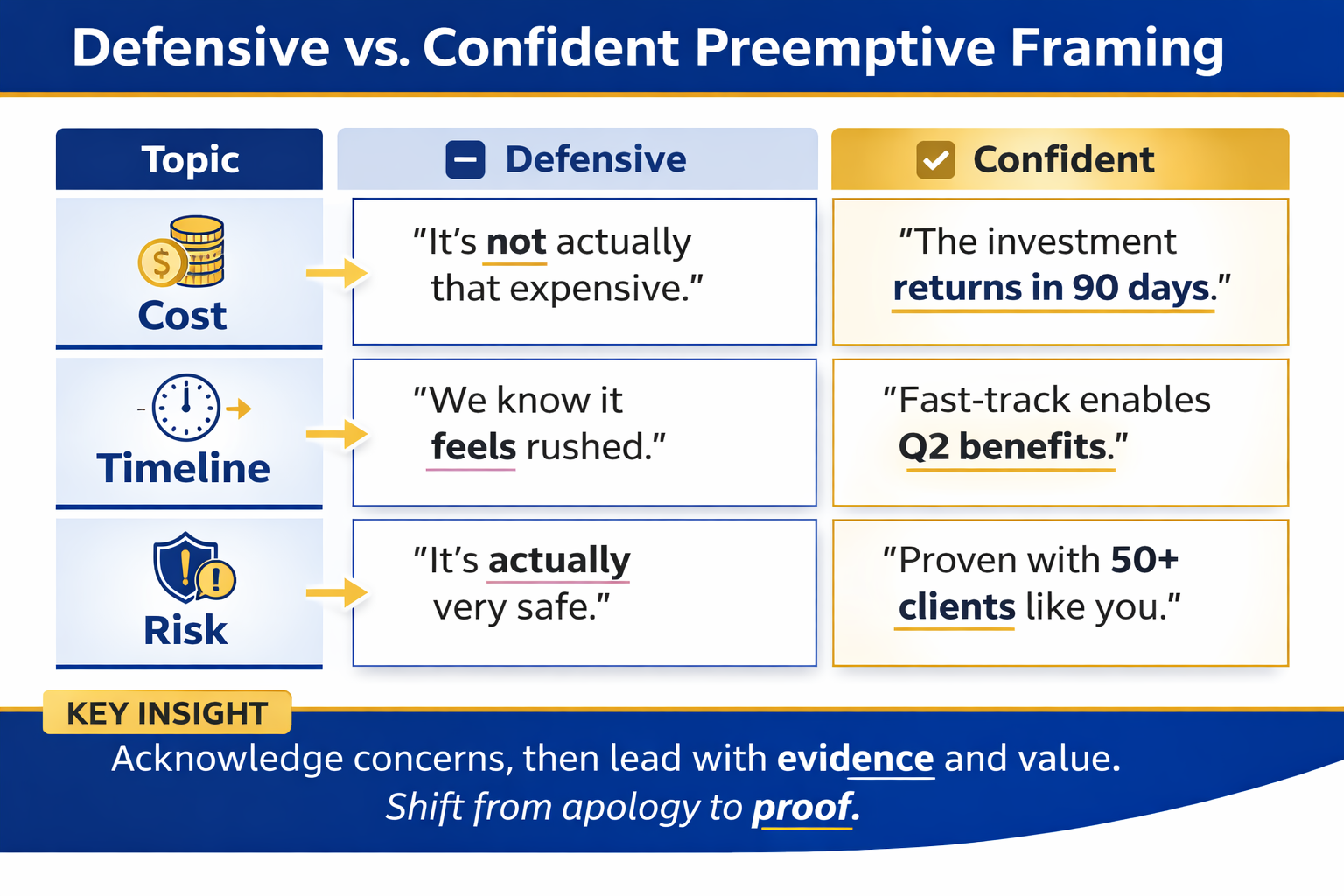
Defensive framing (avoid): “Some of you might be worried that…” This signals anxiety. It suggests you’re concerned the audience won’t trust you and you’re trying to reassure them. It backfires.
Rigorous framing (use this): “The implementation timeline raises a legitimate concern—if we don’t have the right team in place, we slip. Here’s how we’re addressing it.” This signals confidence. You’re not worried about the concern—you’ve already thought about it and solved for it.
Notice the difference: one sounds defensive, the other sounds prepared.
The phrase matters. Use language like:
- “The obvious risk here is…” (names the risk confidently)
- “This approach assumes we can… Let’s test that assumption.” (invites rigorous thinking)
- “The cost question is worth addressing directly.” (acknowledges the legitimacy of the concern)
- “You’ll notice we’ve built in a contingency because…” (shows planning, not anxiety)
Each of these frames the objection as something intelligent people would think about—not something you’re anxiously trying to prevent them from thinking.
The Framework: Name, Acknowledge, Respond
A preemptive Q&A follows a consistent three-part structure. Learn this and you can apply it to any presentation.
Part 1: Name the objection clearly. Don’t dance around it. Say exactly what the concern is. “The board will likely question whether we need £4.2 million or whether we could implement in phases.” This clarity signals you understand the landscape.
Part 2: Acknowledge why it’s a fair question. Show you understand the underlying concern. Don’t dismiss it. “Phasing makes sense on the surface—it feels more prudent financially and lower-risk operationally.” This validates the thinking behind the objection.
Part 3: Explain your response and the reasoning. Why aren’t you taking that approach? What did you consider and decide? “We looked at phasing. The problem: we’d be managing integration complexity across three separate implementations. Total cost would rise to £5.8 million. We’d also face staff turnover during a three-year rollout, which means key people leave and take domain knowledge with them. Full implementation now costs less and de-risks the human element.” This shows you’ve actually thought about the alternative and rejected it for specific reasons.
The entire structure is: you understand the objection, you understand why someone would think that, and you’ve already decided against it for specific, defensible reasons.
The Executive Q&A Handling System
The Executive Q&A Handling System includes the full preemptive Q&A framework, plus strategies for how to integrate objections into your presentation slides without looking defensive, how to anticipate hostile questions before they’re asked, and how to handle the Q&A session itself with confidence.
- The three-part name-acknowledge-respond structure (with 12 real-world examples)
- How to identify which objections deserve preemptive treatment (and which to skip)
- Slide integration templates (where to place objections in your deck for maximum credibility)
- Tone guide (the exact language that sounds prepared, not defensive)
Used by CFOs, VPs, and board members who present to investment committees, steering groups, and executive teams where handling objections directly impacts approval rates.
Your presentation is asking for buy-in?
Tone Matters More Than Content
The same objection can be received as defensive or rigorous depending entirely on how you deliver it. The content stays the same—the tone determines the interpretation.
Defensive tone: Hesitant voice. You sound unsure about the objection you’re raising. You rush through it. You don’t make eye contact. The room hears: “I’m worried about this, so I’m bringing it up preemptively.” This signals weakness.
Rigorous tone: Steady, direct voice. You name the objection matter-of-factly. You hold space around it. You make eye contact. The room hears: “This is worth addressing because I’ve thought about it.” This signals confidence.
The word “some people might worry” signals defensive tone. The word “the legitimate concern is” signals rigorous tone. But even more than words, it’s your physicality. If you’re visibly anxious while naming an objection, you’re telling the room something to be anxious about. If you’re calm and direct, you’re telling them it’s a question you’ve already solved.
Practice the preemptive objections the same way you practice your core narrative. The difference between sounding defensive and prepared is the difference between rehearsal and improvisation.
When Preemptive Q&A Backfires (And How to Avoid It)
Backfire 1: You raise an objection nobody was thinking about. You’ve just given people a reason to doubt your proposal that didn’t exist before. Solution: only preempt objections that are already “in the room.” If you overheard someone mention a concern, if it’s a known stakeholder worry, if it’s an obvious risk in your proposal—address it. If you have to invent an objection, skip it.
Backfire 2: You spend more time on the objection than the proposal itself. Your preemptive Q&A is meant to build credibility, not become the main argument. If you spend 10 minutes defending against one objection, you’re signalling that the objection matters more than the case itself. Keep preemptive responses brief. Name it, acknowledge it, respond, move on.
Backfire 3: You frame the objection in a way that makes it sound worse than it is. If you say, “This could completely derail the project,” you’ve amplified the concern. If you say, “There’s a timeline risk we’ve factored in,” you’ve managed it. How you frame the objection determines whether the audience sees it as a deal-killer or a managed variable.
Backfire 4: Your response isn’t actually responsive. If you name an objection and then give an answer that doesn’t address it, you’ve just drawn attention to a gap in your logic. Solution: make sure your response actually answers the objection you’ve raised. Test this by saying it aloud: “The concern is [X]. Here’s why that’s not a dealbreaker: [Y].” If Y doesn’t actually address X, rework your response.
How Preemptive Q&A Connects to Bigger Picture
A preemptive Q&A is one piece of a larger Q&A strategy. If you want to handle questions with real confidence, you need to know how to anticipate questions before they’re asked across your entire presentation, not just objections.
You also need to understand the specific dynamics of board meeting Q&A and director-level questions, which operate by different rules than general audience Q&A.
And if you find that despite your solid preparation, the pressure of being questioned is activating your anxiety system, learning how to handle questions you don’t have answers for without becoming defensive can shift the entire dynamic.
The Complete Q&A Mastery Framework
The Executive Q&A Handling System covers preemptive Q&A plus the full spectrum: anticipating questions your audience will ask, handling hostile questions in high-stakes settings, managing the Q&A session timing, and staying confident when you don’t know an answer.
- Question anticipation framework (the technique for mapping every likely question)
- Preemptive objection integration (where and how to place them in your presentation)
- Hostile question handling (board-level objections and how to respond without defensiveness)
- Confidence under pressure (managing your nervous system when questions get difficult)
Tested with executives presenting to investment committees, steering groups, and board meetings where approval rates depend on how well you handle difficult questions.
Building a Culture of Rigorous Thinking
When you use preemptive Q&A well, you’re not just building your credibility—you’re setting a standard for the organisation. You’re showing that it’s safe to name risks. That objections are part of rigorous thinking, not threats to be avoided. That strong leaders don’t hide uncertainty; they name it and explain how they’re managing it.
This shifts how your team approaches their own presentations. Instead of avoiding difficult questions, they anticipate them. Instead of getting defensive when someone disagrees, they’ve already thought about the disagreement and can explain their reasoning. That’s a completely different organisational culture.
Is This Right For You?
✓ This is for you if:
- You’re asking a board, investment committee, or senior stakeholder group for approval on a significant proposal
- You know what objections they’ll raise and you want to address them before they do
- You want to signal that you’ve thought through the risks, not just the benefits
- You present regularly in high-stakes settings where credibility determines outcomes
- You’re concerned that difficult questions might derail your proposal, so you want to defuse them early
✗ Not for you if:
- You’re presenting to a friendly audience that’s already bought in to your proposal
- You don’t actually know what objections might come up (in that case, focus on anticipation first)
- Your proposal doesn’t have meaningful risks or trade-offs worth addressing
- You’re concerned that naming risks will create doubt rather than build credibility
- Your audience isn’t sophisticated enough to appreciate preemptive risk discussion
Need the full Q&A framework?
Three Quick Answers
Won’t naming objections make the board more critical? The opposite. When you name an objection preemptively, you’re signalling that you’re not afraid of it. This tends to reduce the board’s critical energy around that specific point. They were looking for a trap; you just removed it. Now they have to look for other grounds to critique.
What if I address an objection and then someone raises it anyway? That’s fine. They’re reinforcing a point you’ve already made. You can simply say: “Exactly—which is why we’ve built the contingency in.” You’re not defending; you’re agreeing and showing that you’ve already solved for it.
How many preemptive objections should I include? Three to five is the sweet spot. More than that and your presentation becomes objection-focused rather than proposal-focused. Fewer than that and you’re missing opportunities to build credibility. The number depends on the stakes of the proposal and the nature of your audience.
The Credibility Advantage
Most executives present their proposal and then defend it against objections. That puts them in a reactive position. A preemptive Q&A puts you in a leadership position. You’re not responding to the board’s thinking—you’re leading it. You’ve already anticipated their concerns and built your response into your case.
That distinction—between reactive and leading—is the difference between credibility that’s earned and credibility that’s questioned. Use it well and your approval rates shift measurably. Use it poorly and you look defensive. The framework, the tone, and the practice make the difference.
Stay Updated
New Q&A frameworks for high-stakes presentations land in The Winning Edge newsletter every Friday. Subscribe for strategies you can use in your next board meeting.
About the Author
Mary Beth Hazeldine is the Owner & Managing Director of Winning Presentations. With 24 years of corporate banking experience at JPMorgan Chase, PwC, Royal Bank of Scotland, and Commerzbank, she has delivered high-stakes presentations in boardrooms across three continents.
A qualified clinical hypnotherapist and NLP practitioner, Mary Beth combines executive communication expertise with evidence-based techniques for managing presentation anxiety. She has trained thousands of executives and supported high-stakes funding rounds and approvals.
This article was written with AI assistance and reviewed by Mary Beth Hazeldine.


