
Quick Answer
Most online public speaking training programmes are calibrated for first-time speakers and conference presenters, not for senior professionals presenting to boards, executive committees, and investor panels. The training that works at senior level covers four distinct capability areas: nervous-system work for the embodied response, structural preparation for high-stakes content, in-the-moment recovery techniques for physical symptoms, and Q&A handling for hostile or testing questions. Programmes that cover only the first or only the third are partial. The structural questions to ask before enrolling in any online public speaking training are at the end of this article.
On this page
Bjarne — a regional MD for a Scandinavian engineering group — went through three online public speaking training programmes between 2023 and 2025 before he found one that addressed the actual problem he was trying to solve. The first programme was excellent for the kind of speaker who needed to learn how to deliver a TED-style talk; that was not what he did. The second was a corporate communication course that covered slide design but left the underlying anxiety untouched. The third was a small-group programme run by a former actor that improved his stage presence but had nothing to say about the executive committee dynamic that actually drove his nerves.
What Bjarne needed — and what most senior professionals looking for online public speaking training are actually looking for — is a different category of programme. The senior executive presentation context has its own physiology, its own structural demands, and its own performance criteria. The programmes calibrated for it are not always the most visible online, partly because they target a smaller audience and partly because the marketing language overlaps significantly with the broader public speaking market. Knowing what to look for is the difference between three years of partial fits and finding the right programme on the first try.
This article is written from inside the field. I have run senior-level presentation work for more than a decade, including online programmes specifically for senior professionals carrying years of meeting load. The framework below is the one I use to assess any programme — my own or anyone else’s — that claims to serve this audience.
Looking for online training built specifically for the senior nervous system?
Most online public speaking programmes do not address the embodied response that senior professionals carry. Conquer Your Fear of Public Speaking is a recorded clinical hypnotherapy programme calibrated for senior leaders with returning presentation anxiety — the layer that surface techniques cannot reach.
Why senior-level public speaking training is different
The standard public speaking training market is shaped by three audiences. The largest is professionals who occasionally have to give a talk and want to feel comfortable doing so. The second is people preparing for specific high-visibility moments — a wedding speech, a TEDx talk, a conference keynote. The third is sales professionals who deliver pitches as part of their core work. Most online programmes are designed for one of these three audiences. The senior executive presenter is a fourth audience with distinct needs, and the volume is small enough that few programmes are calibrated specifically for it.
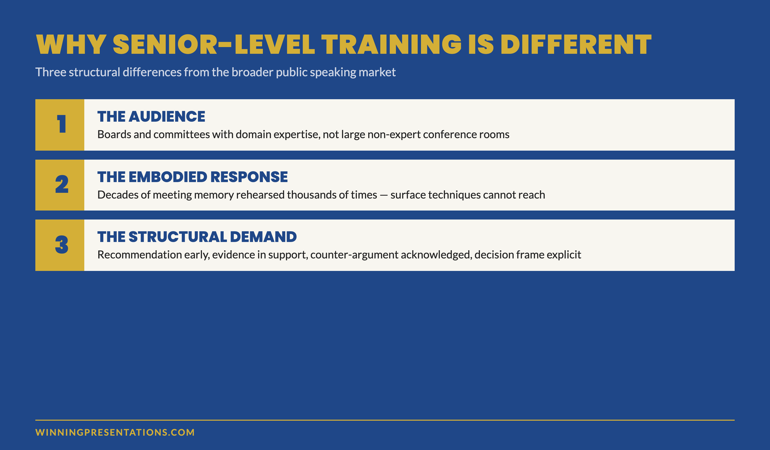
Three differences matter most.
The first is the audience. Senior executive presenters are speaking to boards, executive committees, investment panels, and other senior leaders. The audience already has substantial domain expertise. The questions are sharper. The tolerance for filler is lower. The performance criterion is decision quality, not entertainment value. A programme designed for TEDx speakers — where the audience is large, generally non-expert, and there for inspiration — is structurally calibrated for a different brief.
The second is the embodied response. Senior professionals carrying decades of meeting memory have a different anxiety physiology than first-time speakers. The body has practised the response thousands of times. Surface techniques designed for someone whose nervous system has not yet rehearsed the pattern do not reach the layer where the senior anxiety lives. The required intervention is closer to the clinical-hypnotherapy work used for chronic patterns than to the energy-management techniques used for first-time speakers.
The third is the structural demand. A board presentation has a structural shape that differs significantly from a keynote talk. Recommendation early. Evidence in support. Counter-argument acknowledged. Decision frame explicit. Programmes that teach the keynote shape — story arc, emotional build, climactic ending — produce decks that fail at executive level even when the speaker delivers them well. The structural training matters as much as the speaking training.
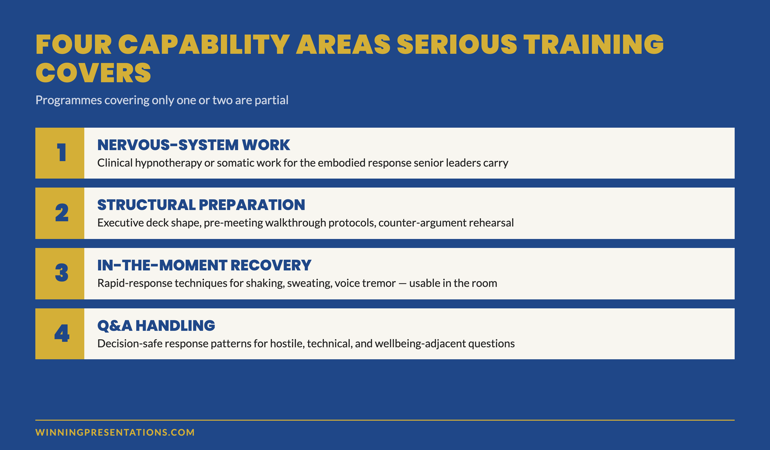
The four capability areas serious training covers
A serious online public speaking training programme for senior professionals covers four distinct capability areas. Programmes covering only one or two are partial — they may help with the area they cover but they leave gaps that show up in actual high-stakes meetings.
Capability 1 — Nervous-system work for the embodied response
The first capability area is the deepest. The body’s pre-meeting baseline, the activation level it carries into the room, and the recovery rhythms it uses between meetings — all of this is the underlying layer that determines how the rest of the work lands. Programmes that skip this area teach techniques that float on top of an over-activated baseline and the techniques never quite work as designed.
What good training in this area looks like: clinical hypnotherapy or evidence-based somatic work, calibrated for the senior nervous system rather than the first-time speaker. Recorded sessions used at home, ideally in combination with live work. Specific attention to the perimenopausal and post-menopausal nervous-system shifts that affect many senior professionals at midlife.
Capability 2 — Structural preparation for high-stakes content
The second capability area is the cognitive layer — the structural shape of the deck and the preparation work that happens in the 24 hours before the meeting. Senior professionals often skip this work because they consider themselves past it. The body knows otherwise. Fresh structural preparation for each high-stakes meeting is what gives the cognitive system an anchor to return to under pressure.
What good training in this area looks like: explicit teaching of the executive deck shape (recommendation early, evidence in support, counter-argument acknowledged), pre-meeting walkthrough protocols, and counter-argument rehearsal frameworks. Worked examples at the right level of seniority.
Capability 3 — In-the-moment recovery techniques for physical symptoms
The third capability area is the in-the-meeting layer — the rapid-response techniques for the physical symptoms of presentation anxiety. Shaking, racing heart, sweating, voice tremor, dry mouth. The techniques that work in this layer are different from the techniques that build the baseline; they need to be deployable while standing in front of slides, without anyone in the room noticing.
What good training in this area looks like: practical, physiologically grounded techniques calibrated for senior settings (not the box-breathing drills designed for school assemblies). Honest about which symptoms each technique addresses and which it does not. Calm Under Pressure is the dedicated programme in this category.
Capability 4 — Q&A handling for hostile or testing questions
The fourth capability area is the structural response to questions — particularly the harder categories of question that boards and executive committees produce. Hostile questions, premature challenges, technical curveballs, wellbeing-adjacent comments. Senior professionals who have only the public speaking layer of training often handle these questions emotionally rather than structurally, and the room reads the emotional response as a loss of authority.
What good training in this area looks like: explicit response patterns for each category of question, decision-safe answer formats (45-second structures, not improvised meanders), and worked examples drawn from actual board and committee dynamics.
For the nervous-system layer that surface techniques cannot reach
Conquer Your Fear of Public Speaking — clinical hypnotherapy programme
- Recorded clinical hypnotherapy sessions designed for senior professionals carrying years of accumulated meeting memory
- Works on the embodied response that conscious techniques cannot reach — the body’s pre-meeting baseline rather than the in-the-moment symptom
- Listen at home before the high-stakes meeting cycle — most senior participants notice a shift inside the first two weeks of regular use
- Built on five years of recovery work after my own presentation anxiety in financial services
Conquer Your Fear of Public Speaking — £39, instant access, lifetime use.
Get Conquer Your Fear of Public Speaking →
For senior professionals whose presentation anxiety has not responded to surface techniques.
What to avoid in online public speaking training
Three patterns tend to indicate a programme is not calibrated for the senior executive context, even when the marketing language suggests otherwise.
The first is heavy reliance on stage techniques borrowed from theatre or acting training. Voice projection drills, posture exercises, eye-contact patterns from the stage tradition — these have a place in delivering large-room keynotes. They are not the substantive work for someone who needs to chair an executive committee meeting twice a month. Programmes whose curriculum is more than 25% acting-derived are usually targeting a different audience.
The second is the absence of any nervous-system or anxiety work. Programmes that frame public speaking entirely as a performance skill, with no acknowledgement that senior professionals carry an embodied response that the work has to address, are usually written for an audience whose anxiety is mild and recent. They will not help with the chronic, accumulated pattern that midlife senior leaders typically carry.
The third is the absence of Q&A or audience-interaction training. Programmes that focus on the prepared portion of a presentation but say nothing about how to handle the discussion phase miss the part of senior meetings that produces the most anxiety and the most career consequence. The recommendation is delivered in 12 minutes; the consequence is decided in the 30 minutes of discussion that follow. A programme that does not address discussion is a programme that addresses 30% of the actual challenge.
For the in-the-room recovery techniques most programmes miss
Calm Under Pressure covers rapid-response techniques for the physical symptoms of presentation anxiety: shaking hands, racing heart, trembling voice, nausea, sweating. Methods you can use in the room, in the moment, without anyone noticing — the in-the-meeting layer that complements deeper training. £19.99, instant access.
Rapid-response techniques for shaking hands, racing heart, trembling voice — designed for senior leaders.
The questions to ask before enrolling
Before paying for any online public speaking training programme, ask these structural questions. The honesty of the answers tells you more than the marketing material.
Who is this programme designed for? A serious answer names a specific audience: senior leaders presenting to boards, sales professionals delivering pitches, conference speakers, first-time presenters. A vague answer (“anyone who needs to speak in public”) usually means the programme is not calibrated for any particular audience and will be partial for all of them.
How does the programme address the embodied response, not just the cognitive performance? A serious answer describes specific techniques (hypnotherapy, somatic work, breath protocols) and explains the physiological layer they operate on. A vague answer (“we cover confidence-building”) usually means the programme treats anxiety as a cognitive problem and skips the layer where the senior pattern lives.
What proportion of the curriculum covers Q&A and audience interaction? A serious answer is 30–40% of the programme. Programmes that spend less than 20% on the discussion phase have a structural mismatch with how senior meetings actually run.
Are there specific examples drawn from board, executive committee, or investor settings? A serious answer cites specific scenarios at the right level of seniority. Programmes that use sales-pitch examples or wedding-speech examples are calibrated for different audiences.
What is the format — recorded only, live only, or hybrid? A serious answer matches the format to the work. Embodied work generally benefits from recorded sessions used repeatedly. Q&A work generally benefits from live practice with feedback. Programmes that are 100% recorded for live skills, or 100% live for embodied work, are structurally suboptimal.
What are the realistic outcomes after the programme? A serious answer is specific and measured (“most participants report a measurable shift in pre-meeting baseline within two weeks of regular use”). A vague answer (“you’ll feel transformed”) or an extreme answer (“guaranteed to eliminate your anxiety forever”) indicates the programme is selling outcomes it cannot honestly deliver.
Frequently asked questions
Is online training as effective as in-person for senior public speaking?
For most of the four capability areas, yes — sometimes more so. Online format works well for the embodied work (recorded hypnotherapy sessions used repeatedly), the structural work (frameworks taught once and applied to many meetings), and the in-the-moment recovery techniques (technique libraries used as needed). The capability area where in-person adds genuine marginal value is Q&A practice, where live feedback on responses to harder question types is harder to replicate online. Many senior professionals use a hybrid approach — online for capabilities 1, 2, and 3; live small-group work for capability 4.
How long does professional public speaking training typically take to produce results?
The embodied work usually produces a measurable baseline shift within two weeks of regular use; the substantive change comes around week six. Structural work produces visible results from the first high-stakes meeting after the framework is applied — the deck is structurally tighter immediately. In-the-moment techniques work on first deployment. Q&A handling typically takes three to six months of practice in actual meetings to become automatic. The full capability set — all four areas integrated — usually settles into a sustainable new pattern within six to nine months of consistent application.
Can a single programme cover all four capability areas, or do I need to combine resources?
A few programmes attempt to cover all four; most cover one or two well and gesture at the others. The honest answer is that combining resources is usually more effective than expecting a single programme to be excellent at everything. Senior professionals often combine a clinical hypnotherapy programme for the embodied work, a structural-content programme for the deck preparation, an in-the-moment techniques resource for the physical symptoms, and a Q&A handling system for the discussion phase. Each is best from a different specialist source.
Is there value in cohort-based programmes or live group sessions?
For some senior professionals, yes — particularly for the Q&A handling work and for the social-accountability layer that helps maintain the new practices. The risk is that cohort-based formats with mandatory attendance fit poorly with senior schedules; high dropout in this population is common. The strongest hybrid is a self-paced core programme with optional live group elements that participants can attend or watch back recorded — preserving the cohort benefit without the attendance cost.
How much should serious senior-level online public speaking training cost?
The price range is wider than most other categories because the formats vary so much. Recorded specialist programmes (single capability area) typically run £19–£99. Comprehensive multi-capability programmes with live components typically run £400–£900. Bespoke 1:1 work with experienced practitioners typically runs £150–£400 per session. The price-per-value tends to be best in the recorded specialist range when used in combination — assembling a senior-grade capability set across three or four resources at £20–£50 each often outperforms a single £900 programme that promises everything.
The Winning Edge — weekly newsletter for senior presenters
One framework, one micro-story, one slide pattern — every Thursday morning, ten minutes’ read. For senior professionals who want my best material before it appears anywhere else.
Not ready for the full programme? Start here: download the free Executive Presentation Checklist — a one-page reference for the structural questions every executive deck must answer before the meeting.
For more on the deeper nervous-system work that surface techniques cannot reach, see what happens in a clinical hypnotherapy session for public speaking.
Mary Beth Hazeldine — Owner & Managing Director, Winning Presentations Ltd. After 24 years in corporate banking at JPMorgan Chase, PwC, Royal Bank of Scotland and Commerzbank, and five years recovering from her own presentation anxiety, she works with senior professionals across financial services, healthcare, and technology on the embodied side of high-stakes presenting.