

Quick answer: Presenting to your boss about compensation is not a negotiation — it’s an executive presentation. The professionals who get better outcomes treat it like a boardroom pitch: lead with impact, not with an ask. Structure your slides using a Value-First framework that positions what you’ve delivered before the compensation question even surfaces. Most people do it backwards — they open with what they want instead of what they’ve earned.
Jump to:
- The presentation that changed my own compensation conversation
- Why most compensation presentations fail before slide 2
- The Value-First framework for presenting to your boss
- The 6-slide structure that reframes the conversation
- What to say when your boss says “the decision isn’t mine”
- Common questions
- FAQ
The Compensation Conversation I Almost Ruined at JPMorgan
I walked into my manager’s office with a number in my head and nothing on paper.
This was early in my banking career at JPMorgan Chase. I’d delivered three major client presentations that quarter, each one securing significant renewals. I knew I deserved a better bonus. What I didn’t know was how to make that case without sounding like I was complaining.
So I did what most people do: I started talking about what I wanted. My manager listened politely, said he’d “look into it,” and nothing changed.
Six months later, a colleague in the same team got a significantly better outcome. The difference? She’d walked in with three slides. Not a deck — three slides. One showed her client retention numbers. One showed the revenue she’d influenced. The third showed her next-quarter pipeline. She never mentioned money once. Her manager brought it up.
That was the moment I understood: presenting to the person who decides your compensation isn’t a conversation. It’s a presentation. And the structure matters more than the ask.
After 24 years in corporate banking — across JPMorgan, PwC, Royal Bank of Scotland, and Commerzbank — I’ve seen this pattern play out in every team I’ve worked with. The people who present their value well get rewarded. The people who just “have a chat” get told to wait.
The difference isn’t talent or timing. It’s structure. And the professionals who consistently get recognised for their contributions all do the same thing: they present evidence before they present an ask. They make it easy for their manager to fight for them in the room where compensation decisions actually happen — which is rarely the room you’re sitting in. Here’s the framework I now teach to executives preparing for one of the highest-stakes presentations of their career — and one that most people never think to prepare for at all.
Stop Winging Your Most Important Presentation
The Executive Slide System gives you the exact slide structures that position your value before anyone has to ask. Built from 24 years of boardroom experience.
Get the Executive Slide System → £39
Built from 24 years in banking and consulting environments. Used in board updates, steering committees, and decision meetings.
Why Most Compensation Presentations Fail Before Slide 2
The biggest mistake isn’t asking for too much. It’s starting with the ask.
When you open a compensation conversation with “I’d like to discuss my bonus,” you’ve immediately put your manager in a defensive position. They’re now thinking about budget constraints, team equity, and how to manage your expectations — before you’ve given them a single reason to fight for you.
This is the same pattern I saw repeatedly across my years at PwC and Commerzbank. The professionals who struggled with compensation conversations all made the same structural error: they treated the meeting like a negotiation instead of a presentation.
Here’s what that looks like in practice:
❌ Wrong opening: “Thanks for making time. I wanted to discuss my compensation for this year. I’ve been here three years and I feel like my salary doesn’t reflect my contribution.”
✅ Right opening: “Thanks for making time. I put together a brief overview of what I’ve delivered this quarter and where I see the biggest opportunities next quarter. I’d value your perspective.”
The first version puts your manager on the back foot. The second gives them something to work with — and a reason to listen.
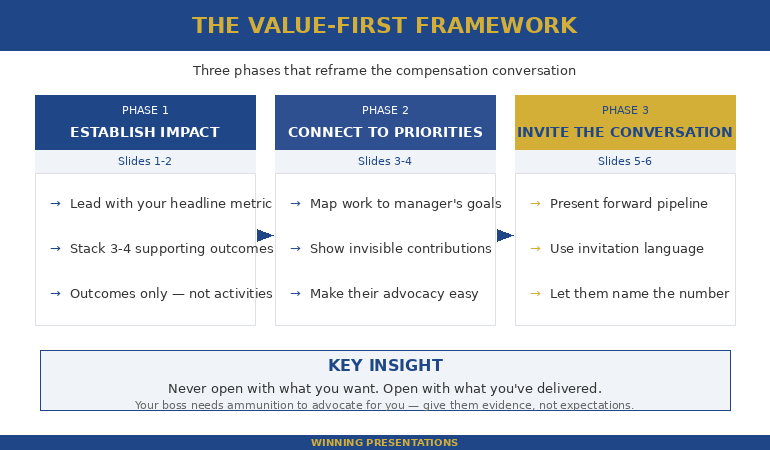
The Value-First Framework for Presenting to Your Boss About Compensation
The framework that consistently works for compensation presentations has three phases — and none of them start with money.
Phase 1: Establish Impact (slides 1-2). Open with what you’ve delivered in the current period. Not activities — outcomes. Not “I worked on the Q3 client review.” Instead: “Q3 client review retained £1.2M in renewals.” If you don’t have revenue numbers, use time saved, problems prevented, or stakeholders influenced. Your boss thinks in these units.
Watch the difference:
❌ Wrong: “I’ve been really busy this quarter. I worked on the client review, the onboarding project, and helped with the team offsite.”
✅ Right: “Three outcomes this quarter: £1.2M in retained client revenue, 40% faster onboarding cycle, and the new team structure that reduced escalations by half.”
The first is a list of activities. The second is a portfolio of results. Your boss can take the second version into their own review meeting. They can’t do anything with the first.
Phase 2: Connect to Their Priorities (slides 3-4). Show how your work maps directly to what your manager is measured on. Every manager has 3-4 things their boss asks them about. If your contributions connect to those things, you’ve just made it easy for your manager to justify your compensation — not to you, but to the person above them.
This is exactly the kind of structure the Executive Slide System helps you build — slide-by-slide frameworks that make your case before anyone has to ask.
Phase 3: Invite the Conversation (slides 5-6). You don’t ask for a number. You present your forward-looking value and let the compensation discussion emerge naturally. “Given the pipeline I’m building for Q2, I’d value your perspective on how my contribution is being recognised.” That’s not an ask — that’s an invitation. It works because your boss has just seen the evidence.
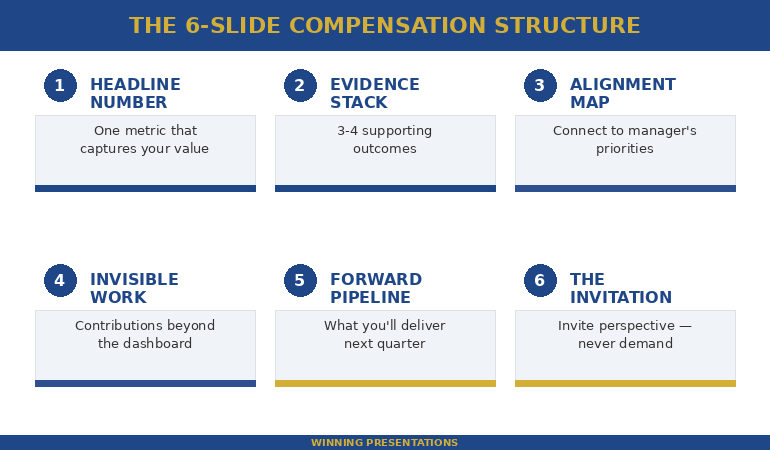
The 6-Slide Structure That Reframes the Entire Conversation
Here’s the exact slide-by-slide breakdown I recommend to executives preparing to present to the person who controls their compensation. Each slide has one job. No more.
Slide 1 — The Headline Number. One metric that captures your contribution this period. Not a paragraph. One number with context.
❌ Wrong slide 1 title: “Compensation Review Discussion — Q1 2026”
✅ Right slide 1 title: “£1.2M Retained Revenue From Three Client Renewals I Led”
The wrong version announces what you want. The right version announces what you’ve delivered. Your boss reads the second title and immediately thinks: “This person knows their value.” That’s the frame you want before a single word is spoken. This is your executive summary slide — the one that frames everything after it.
Slide 2 — The Evidence Stack. Three to four supporting outcomes that reinforce the headline. Each one should be a single line: metric + context.
❌ Wrong: A bulleted list of everything you worked on — “Participated in the Q3 client review process. Helped onboard new team members. Contributed to the offsite planning.”
✅ Right: Three lines only — “Client retention: 100% renewal rate (£1.2M). Onboarding: cycle reduced from 6 weeks to 3.5. Escalations: down 52% since new structure implemented.”
No explanations. No qualifiers. Your boss doesn’t need you to explain why retaining a client matters.
Slide 3 — The Alignment Map. Show how your outcomes connect to your manager’s stated priorities. If their boss asked them “what’s your team delivering?” — your slide should be the answer they’d give.
❌ Wrong: “My achievements this quarter” — a self-focused list with no connection to departmental goals.
✅ Right: A two-column slide: left column lists your manager’s stated Q1 priorities, right column shows your direct contributions to each one.
This is what separates professionals who get rewarded from those who get “we’ll revisit this next quarter.”
Slide 4 — The Invisible Work. Every professional does work that doesn’t show up in dashboards. Mentoring. Crisis management. Covering for absent colleagues. Political navigation. One slide acknowledging this work — with specifics — tells your boss you understand your full value, not just the measurable parts.
❌ Wrong: “I also do a lot of things that aren’t captured in my KPIs.”
✅ Right: “Three contributions beyond the dashboard: mentored two junior analysts through their first client presentations. Resolved the supply chain escalation before it reached the exec team. Stepped in to cover the Northern region when James was on leave for six weeks.”
Vague claims get nodded at. Specifics get remembered — and repeated upward.
Slide 5 — The Forward Pipeline. What are you set to deliver in the next quarter? This is the slide that changes the conversation from backwards-looking (“what have you done?”) to investment-oriented (“what will you do next?”). Managers who see a strong pipeline are more willing to invest in retaining you.
Slide 6 — The Invitation. No ask. No demand. Just: “I’d appreciate your perspective on how my contribution is being recognised going forward.”
❌ Wrong: “So based on all of this, I think a 15% increase is fair and I’d like to discuss how we make that happen.”
✅ Right: “I’d value your perspective on how this level of contribution is being reflected. I’m also happy to put together a summary you can share with [skip-level name] if that’s useful.”
The wrong version turns you into a negotiator. The right version turns you into a partner — and gives your boss a tool to advocate for you in the room you’re not in.
Build Your Compensation Presentation Tonight
The Executive Slide System includes ready-to-use frameworks for exactly this scenario — including slide structures for value positioning, stakeholder alignment, and decision presentations.
Get the Executive Slide System → £39
Built from 24 years of corporate banking experience and 15 years training executives for high-stakes conversations.
What to Say When Your Boss Says “The Decision Isn’t Mine”
This is the most common deflection — and the most misunderstood. When your boss says the compensation decision isn’t entirely theirs, they’re usually telling the truth. But they’re also telling you something else: they need ammunition.
The correct response is: “I understand it involves multiple stakeholders. Would it help if I put together a brief summary of my contributions this period that you could share?”
You’ve just offered to make their job easier. You’ve also ensured your value gets presented upward — in your words, not a second-hand summary that loses the impact.
This is the same dynamic I saw at Royal Bank of Scotland when working with directors who needed to justify team compensation to the executive committee. The directors who had structured summaries from their team members could advocate effectively. The ones who had to reconstruct contributions from memory couldn’t.
Having the right structure makes this effortless. The Executive Slide System gives you frameworks designed for presenting to senior decision-makers — including the people who control your pay.
One timing note: Present your value 4-6 weeks before the compensation cycle starts — not during it. By the time formal reviews begin, budgets are often already allocated informally. And if you’ve just delivered a visible win, don’t wait. Recency bias is real. Your boss’s memory of your value is at its peak right after a result, not three months later during the “proper” review window.
If the anxiety of these high-pressure conversations is what holds you back, you’re not alone — I spent five years terrified of exactly this kind of meeting before I found techniques that worked. Read more about managing high-stakes meeting nerves.
Common Questions About Presenting Your Value in a Pay Review
How do you present your case for a raise to your boss?
Present your case using a Value-First structure: lead with your measurable impact (revenue, savings, client retention), connect your contributions to your manager’s priorities, then invite the compensation conversation rather than making a direct demand. Three to six focused slides work better than a verbal request. Your boss needs evidence they can present upward — give them that evidence in a format they can use.
What should you include in a compensation presentation?
Include one headline metric that captures your contribution, three to four supporting outcomes with numbers, a slide showing how your work connects to your manager’s priorities, acknowledgement of your invisible contributions, your forward pipeline for next quarter, and a soft close that invites discussion. Avoid listing activities — focus on outcomes. Avoid comparing yourself to colleagues — focus on your own value. And keep it to six slides maximum.
How do you talk to your boss about a bonus without sounding entitled?
The key is structure. When you present documented evidence of your impact and then invite your boss’s perspective — rather than making demands — you position yourself as a professional seeking fair recognition, not someone complaining. The phrase “I’d appreciate your perspective on how my contribution is being recognised” works because it’s collaborative, not confrontational. It also gives your boss room to advocate for you rather than defend a position.
Your Next Compensation Conversation Deserves More Than a Chat
The Executive Slide System gives you proven slide frameworks for career-defining moments — including performance reviews, skip-level meetings, and compensation presentations. Built from 24 years of corporate banking experience.
Get the Executive Slide System → £39
Used in board updates, performance reviews, and compensation conversations across banking, consulting, and corporate teams.
Frequently Asked Questions
Can I use this 6-slide structure for a skip-level meeting?
Yes — and you should. Skip-level meetings are often even more important than direct manager conversations because the senior leader may have more influence over compensation decisions. Adjust the Alignment Map (slide 3) to reflect the skip-level leader’s priorities rather than your direct manager’s. Everything else applies exactly the same way. If anything, the structured approach matters more at skip-level because you have less time and need to make a stronger first impression.
What if I don’t have hard revenue numbers to show?
Revenue isn’t the only language bosses speak. Use time saved (“reduced reporting cycle from 3 days to 4 hours”), problems prevented (“identified the compliance gap before the audit”), stakeholders influenced (“aligned three department heads on the integration plan”), or quality improvements (“reduced client escalations by 60%”). The key is specificity. “I contributed to the project” is worthless. “I led the workstream that delivered the client migration two weeks early” is concrete evidence your boss can use.
What if my boss dismisses the presentation entirely?
This happens — and it usually means one of two things. Either the timing was wrong (present earlier in the cycle next time), or your boss genuinely doesn’t control compensation and hasn’t been transparent about it. In either case, the deck you prepared is not wasted. Ask if you can share it with HR or with the person who does influence the decision. Having a structured document of your contributions is always better than relying on memory — yours or theirs.
Should I include specific salary numbers in my slides?
No. Never put a specific number on a slide. The moment you anchor to a number, you’ve turned a value presentation into a negotiation — and you’ve likely anchored lower than what your boss might have offered. Your six slides are designed to build the case so compellingly that your boss initiates the compensation discussion. Let them name the number first. Your job is to make the case so strong that the number reflects your actual value.
📬 Get Weekly Presentation Intelligence
Slide structures, executive communication strategies, and career presentation techniques — delivered every week. No fluff. No spam. Just the frameworks that work in real boardrooms.
📋 Free: Executive Presentation Checklist
A quick-reference checklist for any high-stakes executive presentation — including compensation conversations, board updates, and stakeholder reviews.
Related: If the anxiety of a salary or bonus conversation is what’s really holding you back, read How I Learned to Present Under Extreme Pressure — the techniques that helped me stay calm in the conversations that mattered most.
Your next step: Open a blank deck tonight. Create six slides using the structure above. You’ll be surprised how much easier the conversation feels when you have evidence on screen instead of nerves in your head.
Want the proven frameworks that make this effortless? Build your salary review presentation in under an hour.
About the Author
Mary Beth Hazeldine is the Owner & Managing Director of Winning Presentations. With 24 years of corporate banking experience at JPMorgan Chase, PwC, Royal Bank of Scotland, and Commerzbank, she has delivered high-stakes presentations in boardrooms across the UK and Europe.
A qualified clinical hypnotherapist and NLP practitioner, Mary Beth combines executive communication expertise with evidence-based techniques for managing presentation anxiety. She has spent 15 years training executives and supporting high-stakes board presentations, steering committee updates, and decision meetings.