Tag: presentation

22 Apr 2026

Presentation Anxiety Treatment for Executives: Evidence-Based Approaches That Work

If you are searching for presentation anxiety treatment as an executive, Conquer Speaking Fear is a 30-day structured programme that combines nervous system regulation with clinical hypnotherapy — designed specifically for professionals whose anxiety shows up in high-stakes presenting situations rather than in everyday life. This is not general anxiety management. It is a targeted treatment approach for a specific pattern: the executive who is capable, experienced, and composed in most professional contexts, but whose body and mind respond to the presenting environment as though it were a genuine threat. It is available now at £39, instant access. This page covers what the programme addresses, how it works, and whether it fits your situation.

The Problem: Why Executive Presentation Anxiety Persists Despite Experience

Presentation anxiety at the executive level is counterintuitive — and that is partly why it persists. You have given hundreds of presentations. You know the content. You have navigated far more demanding situations than a 20-minute board update. And yet the anxiety remains, sometimes worsening as the stakes increase rather than diminishing with experience.

This happens because presentation anxiety is not a knowledge problem or a preparation problem. It is a nervous system response — a learned pattern in which the brain treats the act of presenting as a threat and triggers the same physiological cascade it would deploy in a genuinely dangerous situation. The voice tightens. Thoughts scatter. The body enters a mode designed for survival, not for articulate persuasion.

Most treatment approaches for executives stop at the cognitive level: reframe your thinking, prepare more thoroughly, practise in front of colleagues. These strategies have a role, but they do not reach the mechanism that drives the response. The nervous system operates faster than conscious thought — by the time you are telling yourself to stay calm, your physiology has already decided otherwise.

Understanding how anticipatory anxiety before presentations works at the physiological level helps clarify why willpower-based approaches so often fall short under genuine pressure.

The Solution: Conquer Speaking Fear

Conquer Speaking Fear is a 30-day structured treatment programme that works at two levels simultaneously: the nervous system (where the anxiety response originates) and the subconscious associations (where the brain has learned to classify presenting as threatening). It does not replace clinical therapy for generalised anxiety, but for presentation-specific anxiety — the pattern that shows up reliably in speaking contexts and not elsewhere — it is precisely targeted.

The nervous system regulation component gives you practical techniques that interrupt the physiological response before and during a presentation. These are not breathing exercises in the abstract — they are calibrated to the specific timeline of executive presenting: the days before, the minutes before entering the room, the moment a difficult question arrives, and the recovery period afterwards.

The clinical hypnotherapy sessions work at the subconscious level, gradually shifting the associations your brain has built around the presenting environment. This is where lasting change happens — not in what you consciously tell yourself, but in how your brain categorises the situation before conscious thought engages. The programme builds these sessions progressively over 30 days, creating durable change rather than temporary relief.

For executives who want to understand the cognitive dimension alongside the nervous system approach, the guide to cognitive restructuring for presentation anxiety covers the thinking-level techniques that complement this programme well.

What You Get

  • 30-day structured programme — daily modules building progressively, designed to fit around a senior professional’s schedule
  • Nervous system regulation techniques — practical methods for managing the physiological response at every stage of the presentation timeline
  • Clinical hypnotherapy audio sessions — targeted sessions that address subconscious threat associations with the presenting environment
  • In-the-moment symptom management — techniques for use during live presentations when the anxiety response activates
  • Post-incident recovery module — dedicated support for executives recovering from a presentation that went significantly wrong
  • Instant access — start immediately, work at your own pace within the 30-day structure

Price: £39 — instant access, no subscription.

Stop Managing Presentation Anxiety — Treat the Pattern That Drives It

Conquer Speaking Fear gives you a structured, 30-day treatment programme combining nervous system regulation and clinical hypnotherapy — designed specifically for executives whose anxiety shows up in the presenting environment, not in everyday professional life. £39, instant access.

  • ✓ 30-day programme with daily structured modules
  • ✓ Nervous system regulation for executive presenting contexts
  • ✓ Clinical hypnotherapy sessions targeting presentation anxiety
  • ✓ In-the-moment techniques for live high-stakes presentations

Get Conquer Speaking Fear → £39

Instant access · £39 · No subscription

Is This Right for You?

Conquer Speaking Fear is designed for executives and senior professionals who experience a consistent anxiety pattern specifically in presenting contexts. It is most relevant if you have tried cognitive approaches — more preparation, positive self-talk, generic confidence workshops — and found that they help in lower-pressure situations but do not hold reliably when the stakes are genuinely high.

It is right for you if: you experience physical symptoms under presentation pressure (voice tightening, mind blanking, elevated heart rate); anticipatory dread affects your preparation in the days before a significant presentation; you find yourself avoiding high-visibility speaking opportunities; or a past presenting experience has created a pattern that persists.

It is not designed for executives who want to improve their slide structure or delivery technique without an anxiety component — presentation skills training addresses those needs more directly. It is also not a replacement for clinical support if your anxiety extends significantly beyond presenting contexts into daily life. In that situation, working alongside a qualified therapist while using this programme is entirely appropriate.

The guide to grounding techniques for presentation anxiety covers practical in-the-moment methods that complement the nervous system work in this programme.

Frequently Asked Questions

Is this a clinical anxiety treatment?

Conquer Speaking Fear is a structured self-directed programme, not clinical therapy. It uses techniques drawn from clinical practice — specifically nervous system regulation and clinical hypnotherapy — applied to the presentation-specific anxiety pattern. If your anxiety is primarily triggered by presenting situations rather than being generalised across your daily life, this programme addresses that pattern directly. If you are experiencing broad anxiety that affects multiple areas of daily functioning, working with a qualified therapist alongside this programme is advisable.

How is this different from presentation skills coaching?

Presentation skills coaching focuses on delivery technique, slide design, and message structure — how to present well. Conquer Speaking Fear focuses on the anxiety response itself — why your body and mind react to presenting as a threat, and how to change that pattern at the nervous system level. Many executives have strong presentation skills but still experience significant anxiety. This programme addresses the anxiety directly, independent of skill level.

Will this work for someone who has presented for 20+ years?

Yes — and lengthy experience presenting is common among participants. Presentation anxiety often intensifies rather than diminishes with seniority, because the stakes increase faster than familiarity can compensate. The programme does not assume you lack experience. It addresses the nervous system pattern that operates independently of how many presentations you have given or how well you know the material.

Can I use this alongside medication for anxiety?

Yes. The techniques in Conquer Speaking Fear do not conflict with prescribed anxiety medication. If you are currently taking medication for anxiety — whether specifically for presenting situations or more broadly — this programme can complement that treatment by addressing the learned nervous system response that medication manages but does not retrain. Mention your use of this programme to your prescribing clinician so they have a complete picture of your anxiety management approach.

What if I have a major presentation before I finish the 30 days?

The programme is designed so that several techniques are immediately usable from the first week — particularly the nervous system regulation methods for the minutes before and during a presentation. You do not need to complete all 30 days before your next presentation. The early modules focus on in-the-moment management precisely because many participants begin the programme with an upcoming high-stakes presentation in mind. The deeper subconscious work develops over the full programme period.

The Winning Edge

Weekly insights on executive presentations, speaking confidence, and high-stakes communication — delivered every Thursday.

Subscribe Free

About the author

Mary Beth Hazeldine, Owner & Managing Director, Winning Presentations. With 25 years of corporate banking experience at JPMorgan Chase, PwC, Royal Bank of Scotland, and Commerzbank, and 16 years working with executives on high-stakes presentations, she advises senior professionals across financial services, healthcare, technology, and government on structuring and delivering presentations under pressure.

02 Mar 2026
Board directors asking questions in a corporate boardroom setting with presentation screen

Board Meeting Q&A: The 7 Questions Directors Always Ask (And What They’re Really Testing)

The CFO rejected it in 11 words. But it wasn’t the presentation that killed the deal. It was the answer to question three.

Quick Answer

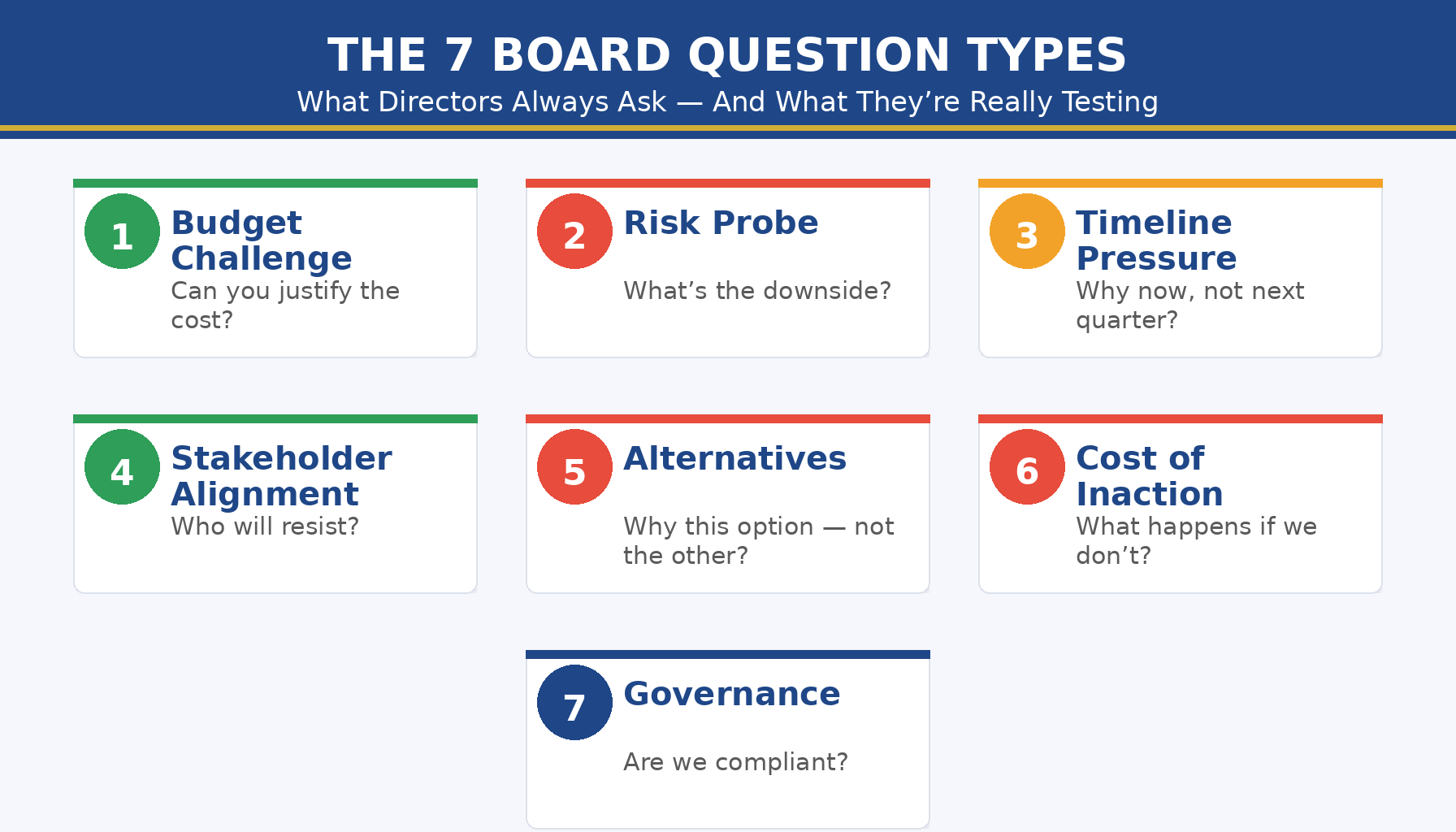
Board directors ask the same seven categories of questions in every Q&A session—budget challenges, risk probes, timeline pressure, stakeholder alignment, alternatives analysis, cost-of-inaction testing, and governance compliance. The directors are not testing your slides; they’re testing your judgment under pressure. If you can predict these seven question types and prepare topic-matched answers in advance, you’ll walk into the boardroom with the clarity that wins approval.

🚨 Rescue: Are You Getting Blindsided in Board Q&A?

Directors ask questions you should have anticipated. You don’t have a framework for predicting them. You answer reactively instead of strategically. Three immediate actions:

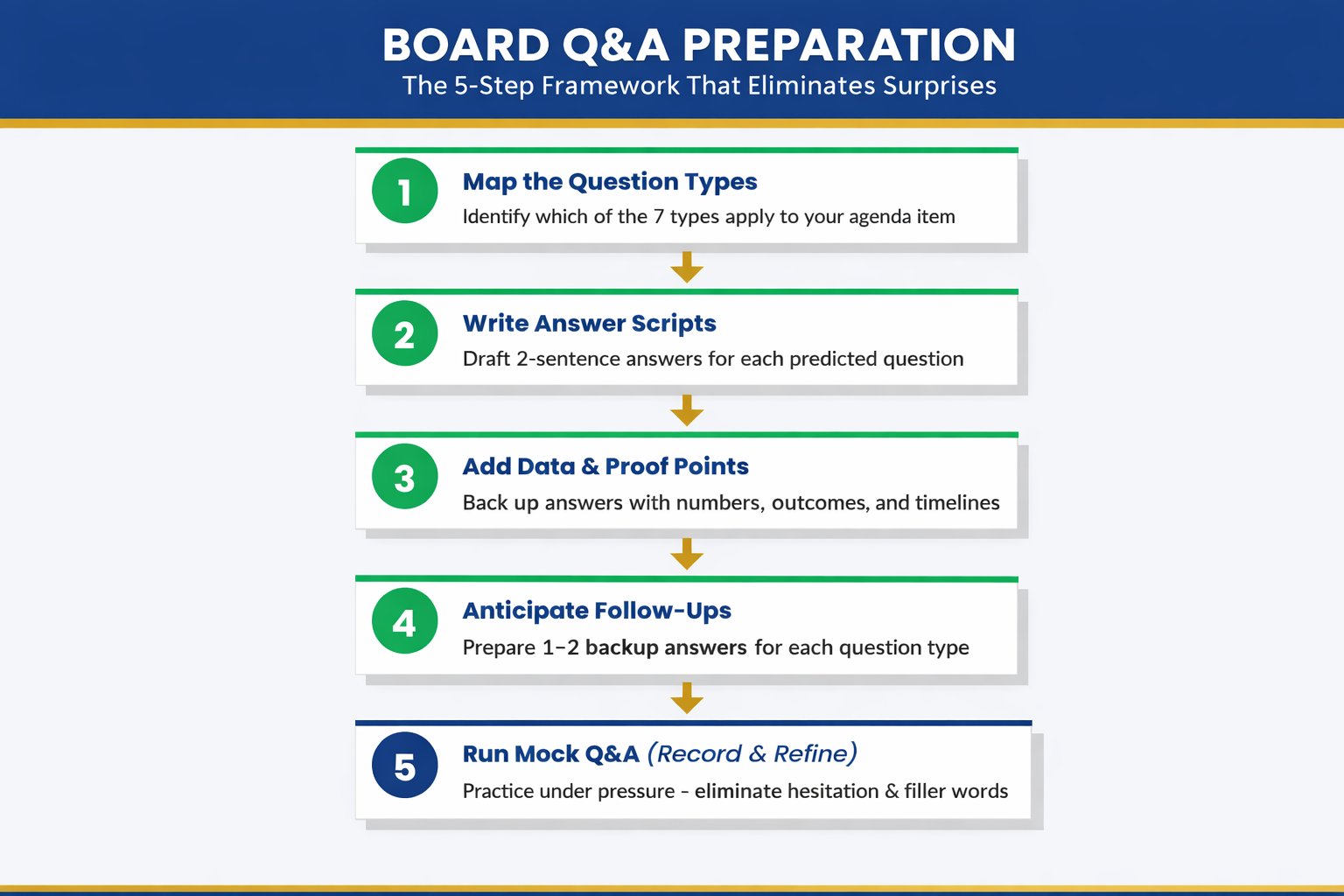
  1. Map the question types: Before your next board meeting, write down which of these seven categories will matter most to your specific director.
  2. Pre-write your answers: Don’t prepare talking points. Prepare exact answer scripts so you can deliver them under pressure without fumbling.
  3. Run mock Q&A: Have a colleague ask these seven question types back-to-back. Record yourself. Listen for hesitation, filler words, or pivoting—all signals the answer isn’t locked in.

Get the Executive Q&A Handling System → £39

Jump to Section

The £4M Question That Wasn’t About the Slides

A CFO from a biotech firm spent three weeks perfecting her board presentation. Forty-seven slides narrowed to twelve. Charts that sang. A narrative arc that built momentum. The deck was flawless.

She walked into the boardroom confident. The presentation went perfectly. Directors engaged, nodded, asked follow-up questions—all positive signals. Then the chair asked: “Walk us through your assumptions on customer acquisition cost if we hit 60% market penetration in year two.”

The CFO had numbers. Spreadsheets backed her up. But the way she answered—hedging, backtracking, diving into footnotes instead of speaking with conviction—signalled uncertainty. Not about the data. About her own judgment.

Three weeks of slide work collapsed in 40 seconds of Q&A. The board approved a smaller funding round. Later, the chair told her: “Your slides were excellent. But in Q&A, you sounded like you were presenting someone else’s work, not owning it as your own.”

She didn’t need better slides. She needed a framework to predict the question types directors ask, lock in answer scripts in advance, and deliver them with the authority that wins approval. The presentation didn’t kill the deal. The unpreparedness in Q&A did.


The 7 board question types directors always ask: budget challenges, risk probes, timeline pressure, stakeholder alignment, alternatives analysis, cost-of-inaction testing, governance compliance

The 7 Board Questions Directors Always Ask

Board directors operate from a playbook. Year after year, organisation after organisation, the same question categories appear. They shift in wording—sometimes sharper, sometimes softer depending on the chair’s style—but the underlying intent never changes.

Question Type 1: The Budget Challenge

The director looks sceptical. “How are you justifying this spend when we could allocate that budget elsewhere?” This question This question appears in most board Q&A sessions. Q&A sessions. Directors use it to test whether you understand the cost-benefit logic, not just the line items. They’re checking if you’ve competed against alternatives—even ones you didn’t present.

Question Type 2: The Risk Probe

“What happens if this assumption is wrong? What’s your downside scenario?” Directors live in risk. They ask this to see how you’ve stress-tested your thinking, whether you’ve prepared contingencies, and whether you’re overconfident about outcomes you can’t control.

Question Type 3: The Timeline Pressure

“Why this timeline? Could you accelerate it, or would delaying it be wiser?” This tests whether you’ve built slack into your schedule or whether you’re running on assumptions that evaporate under pressure. Directors know that execution delays cascade.

Question Type 4: The Stakeholder Alignment

“Have you confirmed buy-in from [HR / Finance / Sales]? What if they say no?” This uncovers whether you’ve done the pre-work or whether you’re asking the board to approve work that hasn’t been aligned below yet. Directors hate surprises downstream.

Question Type 5: The Alternatives Question

“Why this option and not the build/buy/partner approach instead?” Directors want evidence that you’ve evaluated other paths and chosen this one deliberately, not defaulted to it.

Question Type 6: The Cost-of-Inaction Test

“What happens if we don’t do this? What’s the cost of waiting?” This tests whether you understand the true business impact—not just what you’re proposing to build, but what’s at stake if you don’t.

Question Type 7: The Governance Compliance Question

“Does this align with our policy on [data / legal / regulatory / vendor management]? Have compliance and legal signed off?” Directors are gatekeepers. They ask this to confirm you haven’t built something that violates governance.

What Each Question Really Tests

Behind every question type is a hidden diagnostic. Directors aren’t listening for facts; they’re listening for the evidence of your judgment under pressure.

Budget Challenge tests: Your intellectual honesty. Can you say “This costs more, but here’s why it’s worth it” without sounding defensive? Can you acknowledge trade-offs?

Risk Probe tests: Your realism. Do you sound like you’ve war-gamed this, or are you presenting best-case assumptions as certainties?

Timeline Pressure tests: Your planning discipline. Have you built buffers and decision points, or are you hoping nothing goes wrong?

Stakeholder Alignment tests: Your organisational awareness. Do you understand who needs to move first, or are you presenting as if the board approval is the starting gun?

Alternatives Question tests: Your strategic thinking. Have you evaluated options, or did you arrive at this one by habit?

Cost-of-Inaction tests: Your business acumen. Can you quantify the risk of inaction, or are you asking the board to approve based on your assertion alone?

Governance Compliance tests: Your operational rigour. Do you move through the organisation systematically, or do you treat governance as an afterthought?

Notice what they’re not testing: the beauty of your slides. The eloquence of your storytelling. Your ability to read a room. Directors assume you’re competent at those things. They’re stress-testing your judgment.

Walk Into Board Q&A Knowing 80% of the Questions Before They’re Asked

Most executives enter board Q&A sessions unprepared for the actual questions that matter. They’ve rehearsed answers to what they think directors will ask, not what directors actually ask. The result: hesitation, backtracking, and the impression of judgment under fire.

The Executive Q&A Handling System flips this. You work through a proprietary question-mapping framework that identifies which of the seven question types matter most to your specific board composition. Then you build answer scripts—not talking points, but locked-in responses you can deliver under pressure without reaching for filler words or pivoting.

  • Predict the exact question categories your directors will ask, based on board composition and business context
  • Write answer scripts that acknowledge trade-offs and edge cases (the signals of strategic thinking)
  • Practise delivery until your answers sound conversational, not rehearsed—the hallmark of authentic authority

Get the Executive Q&A Handling System → £39

Used by executives preparing for high-stakes board Q&A in funding rounds, strategy approvals, and governance reviews.

If you’re presenting to a board for the first time, or you’ve noticed your Q&A answers lack the decisiveness directors expect, the Executive Q&A Handling System walks you through the exact process to map board questions and lock in your answers.

Stop Getting Blindsided by the Question You Should Have Predicted

Every director has a signature question type. Finance directors probe budget assumptions. Risk-focused directors stress-test downside scenarios. Operational directors test stakeholder alignment. When you walk into a board room unprepared for these predictable patterns, you’re already behind.

  • Know which question type matters most to each director on your board, before you sit down
  • Deliver answers that acknowledge complexity and edge cases—proof that you’ve genuinely thought this through

Get the Executive Q&A Handling System → £39

The framework includes a board profiling template and question-type checklists for finance, governance, risk, and operational directors.

Board Q&A often blends with hybrid presentation formats, where some directors are in the room and others are remote. Your Q&A framework needs to work across both delivery modes.


Board Q&A preparation checklist: question type identification, answer script writing, pressure delivery practice, stakeholder pre-alignment, downside scenario mapping, governance compliance review

How to Prepare Answers That Win Approval

Board approval doesn’t hinge on the quality of your slides. It hinges on your ability to answer the seven question types with authority and honesty. Here’s the preparation framework:

Step 1: Profile Your Board

Which directors are finance-focused? Which are risk-obsessed? Which care most about operations and execution? Map the board composition and predict which question types will dominate your Q&A. A board with strong finance and risk representation? Expect aggressive budget and risk probes. A board with operational executives? Expect timeline pressure and stakeholder alignment questions.

Step 2: Build Your Question Map

For each of the seven question types, write down the specific version that will appear in your board Q&A. Don’t write generic versions. Write the actual questions your board will ask, based on your business context. “Walk us through your CAC assumptions if we shift from direct sales to channel partnerships” is more useful than “How have you stress-tested your assumptions?”

Step 3: Write Answer Scripts (Not Talking Points)

Talking points are vague. “We’ve thought about budget and here’s why we’re confident” is a talking point. Answer scripts are specific and locked in. “Our budget assumes £2.8M in year-one implementation costs. That’s 2.4% of annual revenue—higher than our industry baseline, but necessary because we’re building custom integrations rather than using COTS software. If we used COTS, we’d cut implementation costs by 40%, but we’d lose the operational advantage we’ve modelled.”

That’s an answer script. It acknowledges the trade-off. It signals that you’ve weighed alternatives. It doesn’t overstate certainty.

Step 4: Pressure Test Your Delivery

Have a colleague sit across from you and ask these questions in rapid succession, the way a board does. Record yourself. Listen for:

  • Filler words (“um,” “uh,” “like,” “you know”)
  • Hedging language (“I think,” “probably,” “we hope”)
  • Pivoting instead of answering (starting to answer the question they asked, then pivoting to something you’d rather talk about)
  • Hesitation before you speak

These are all signals that your answer scripts aren’t locked in yet. Practise until you can deliver them conversationally, with the calm authority that comes from genuine preparation.

Step 5: Pre-Align Stakeholders

The stakeholder alignment question often catches executives off guard because they haven’t done pre-alignment work. Before your board Q&A, confirm that HR, Finance, Legal, and any other department affected by your proposal has actually signed off. Don’t let the board be the first place you hear “Wait, Finance didn’t agree to this timeline.”

3 Questions Board Executives Ask Us

Q: How far in advance should I prepare board Q&A answers?
A: At least two weeks before your board meeting. That gives you time to build scripts, run mock Q&A, refine your language, and pre-align with stakeholders. Preparing the morning of creates stress and shows in your delivery.

Q: What if a director asks a question that isn’t one of the seven types?
A: It rarely happens. But if it does, your response is the same: pause (don’t rush), acknowledge the question, and answer with specificity and intellectual honesty. Directors respect executives who take a moment to think before they answer.

Q: Should I memorise my answers or keep them conversational?
A: Memorise the core ideas and key numbers. Keep the delivery conversational. You want directors to hear someone who knows this subject deeply, not someone reciting a script. The script is your foundation, not your prison.

24 Years of Board Q&A. The 7 Questions Never Change. The Answers Do.

Over nearly a quarter-century, I’ve sat through hundreds of board Q&A sessions—as a CFO, as a founder, as an advisor, and as a director myself. The seven question types I’ve outlined in this article have never changed. Budget challenges, risk probes, timeline pressure, stakeholder alignment, alternatives analysis, cost-of-inaction testing, governance compliance. They’re constants.

What changes is the sophistication of the directors asking them, the complexity of the business context, and the stakes of the decision. Your board expects you to walk in with answers that reflect genuine strategic thinking—not hope, not assumption, but judgment that’s been pressure-tested and refined.

  • Learn the seven question types and how to map them to your specific board
  • Practise answer scripts until delivery is effortless and conversational
  • Walk into your next board meeting with the clarity that wins approval

Get the Executive Q&A Handling System → £39

Used by executives across finance, operations, strategy, and IT preparing for high-stakes board Q&A in funding rounds, governance approvals, and strategic reviews.

Is This Right For You?

The Executive Q&A Handling System is built for executives who:

  • Present to boards regularly and want to move from reactive to prepared
  • Know the questions are predictable but haven’t had a framework to map them
  • Have good slides but notice their Q&A answers lack the conviction directors expect
  • Want to understand what directors are actually testing, not just what they’re asking
  • Are preparing for high-stakes decisions (funding rounds, strategy approvals, governance reviews) where board confidence matters

Frequently Asked Questions

Do all directors ask the same seven question types?

The seven types are universal. But the emphasis varies. Finance directors will probe budget and risk aggressively. Risk-focused directors will stress-test downside scenarios. Operational directors will focus on timeline and execution risk. The framework helps you identify which types matter most to your specific board and prepare accordingly.

What if I don’t know the directors’ profiles in advance?

You can usually find their public profiles online—investor history, operational background, prior board roles. If not, use the generic board composition (assume you’ll face budget, risk, and stakeholder questions, because those appear in nearly every board Q&A). The Executive Q&A Handling System includes a profiling template that works for both prepared and unprepared situations.

Can I use this framework for investor pitches and presentations to other stakeholder groups?

Yes. Investors ask a variation of the same seven questions, with heavier emphasis on risk and alternatives. The framework is adaptable to investor Q&A, strategy review Q&A, and any high-stakes questioning scenario. The underlying logic—prediction, scripting, pressure testing—applies everywhere.

📬 Get weekly guidance on executive communication delivered to your inbox

Each week, I share frameworks for presenting to boards, handling difficult questions, and building your authority as a presenter.

Subscribe


Related articles from today:

Build on your foundation: If this is your first board presentation, read First Board Presentation: How New Directors Earn Authority in the Room. For deeper Q&A mastery, explore How to Handle Difficult Questions in Presentations and Predict Your Presentation Questions: The Question Map Framework.

About the Author

Mary Beth Hazeldine is Owner & Managing Director of Winning Presentations. Over nearly 25 years, She advises executives across financial services, healthcare, technology, and government on preparing for high-stakes board Q&A, funding rounds, and strategic approval presentations. She founded Winning Presentations to help executives move from hoping they’ll answer well under pressure to knowing they will.

Her frameworks—built on years of observation in real boardrooms—show executives how to structure their thinking, anticipate the questions that matter, and deliver answers with the authority that wins approval.

Book a discovery call | View services

Your next board Q&A will surface the same seven question types. The executives who win approval are the ones who walked in knowing this in advance. Map your board questions and lock in your answers today.