

Quick answer: Brilliant engineers lose their nerve under board pushback not because they doubt their work, but because they experience a challenge to their recommendation as a challenge to their competence — and the more expert you are, the more your identity is bound up in being right, so the harder the hit lands. This is the technical to executive translation gap: the board is almost always asking you to translate, not to defend, but a specialist under pressure hears “justify your existence” and drops into the one mode that loses the room — over-explaining the mechanism, voice climbing, eyes back on the slide. The steadying move is the Three-Second Reset: before you answer a challenge, silently name it as a request for translation rather than a test of your competence, take one slow breath to drop your voice back down, and answer the decision, not the detail. The nerve does not come from being unchallengeable. It comes from knowing, in the moment of challenge, that the question is smaller and kinder than your nervous system is telling you it is.
JUMP TO:
In 2018 I sat in on a rehearsal for a senior systems architect — one of the most technically respected people in his company — preparing to present a platform-migration proposal to the executive committee. In the rehearsal he was magnificent: fluent, precise, completely in command of material so complex that I, sitting beside him, understood perhaps a third of it. Then a colleague playing the chief financial officer interrupted him at minute six with a flat, slightly impatient question: “Why can’t we just keep what we’ve got and spend the money on sales instead?” I watched the change happen in real time. His shoulders rose. His voice climbed half an octave and sped up. He turned back to the architecture slide and began explaining, in escalating detail, why the existing platform was technically inadequate — to a room that had not asked a technical question. Ninety seconds later he had lost the thread, lost the room, and lost the colour in his face. He was the smartest person in the building, and a single ordinary question had emptied him out.
(This article was created with AI assistance; all stories and insights are based on 35 years of real client work.)
I have seen that exact collapse more times than almost any other in twenty-five years of this work, and it is the one that surprises people most, because it happens to the most capable, not the least. This piece is about why it happens and how to stop it. It explains the competence–confidence inversion — the reason deep expertise can make you more fragile under challenge, not less — and what board pushback almost always actually is, which is far smaller than it feels. Then it gives you the Three-Second Reset to steady yourself in the moment a challenge lands, and a way to rehearse the pushback rather than the pitch so the moment is familiar before you reach it. If you are brilliant at your work and yet find that a single sharp question can unspool you in front of senior people, the problem is not your nerve and it is not your competence. It is the gap between the two, and the gap can be closed.
Most of the nerve comes from uncertainty about what is coming — and a complete pre-flight check removes a surprising amount of it.
The free Executive Presentation Checklist walks you through the preparation that turns “what if they ask something I haven’t thought about” into “I have anticipated this.” Anticipated pushback is far less destabilising than pushback you walk in hoping to avoid. Free download, no email gate.
The competence–confidence inversion
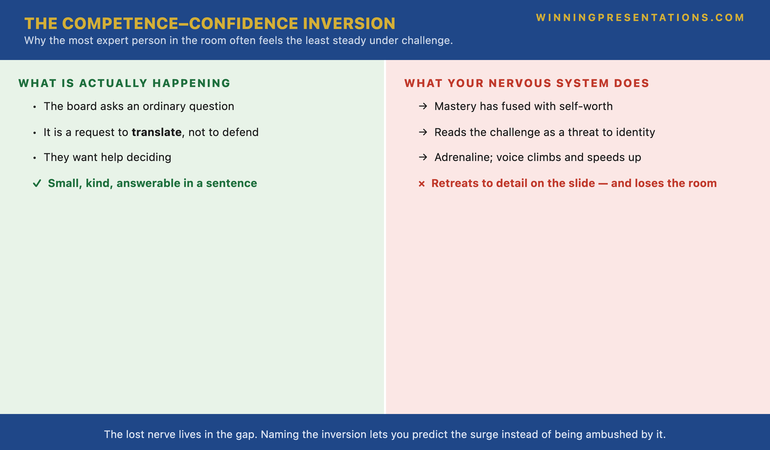
You would expect confidence under challenge to rise with competence. Often it does the reverse, and the reason is identity. When you are early in a field, your sense of self is not yet fused to your expertise, so a challenge to your work is just a challenge to your work. As you become genuinely expert — as being-good-at-this becomes part of who you are — a challenge to your recommendation starts to register, somewhere below conscious thought, as a challenge to your worth. The architect who froze was not afraid he was wrong. He was, without knowing it, defending his standing as the person who is right, and that is a far more frightening thing to have questioned than a technical point. The deeper your mastery, the higher the stakes your nervous system attaches to being doubted.
This is why the collapse hits the capable hardest, and why it feels so disproportionate from the outside. To the board, the chief financial officer asked an ordinary, even lazy, question. To the architect, a pillar of his identity had just been poked in public. His body responded to the threat his mind had silently registered — adrenaline, raised voice, the retreat to the home territory of technical detail where he felt safe — and every one of those responses made him look less authoritative, not more. The inversion is cruel precisely because it punishes the trait that should protect you: the more you have invested in being excellent, the more a routine challenge can feel like an attack. This is close cousin to the imposter feeling that surfaces in presentations, where competence and the fear of being found out rise together rather than cancelling out.
Naming the inversion is the first part of the cure, because it lets you predict your own reaction instead of being ambushed by it. If you know that the sharp question is going to feel, in your body, like a threat to your identity — and that the feeling is a misreading, not a fact — you can be ready for the surge rather than swept away by it. The architect, once he understood what had happened to him, described it as a relief: not “I lost my nerve because I am secretly a fraud,” but “my nervous system over-read an ordinary question because I care a great deal about being good at this.” The second reading is both truer and far easier to work with, because it points at a mechanism you can interrupt rather than a flaw you have to fix.
What board pushback almost always is
The second half of the cure is understanding what the challenge actually is, because the gap between what it is and what it feels like is enormous. When the chief financial officer asks “why not keep what we’ve got and spend on sales,” she is not testing whether the architect is competent. She is asking him to translate his technical recommendation into the language of a trade-off she has to weigh — platform investment against sales investment — because that is the decision in front of her. The question is a request for translation. It feels like an interrogation only because the specialist’s threatened identity rewrites it on the way in. The board wants help deciding. The nervous system hears a demand to justify your existence. These are not the same question, and almost all of the lost nerve lives in the gap between them.
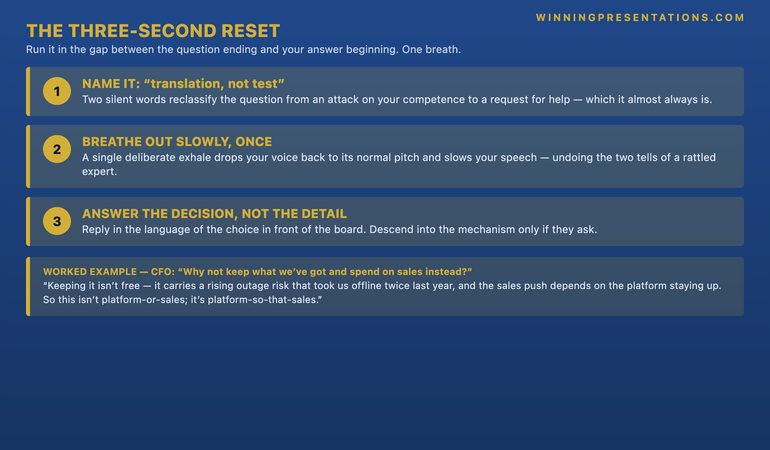
Once you see that board pushback is overwhelmingly a translation request rather than a competence test, the appropriate response changes completely. You do not need to prove the platform is inadequate; you need to translate the choice into the financial officer’s terms: “keeping what we’ve got isn’t free — it carries a rising outage risk that took us offline twice last year, and the sales investment depends on the platform staying up, so this isn’t platform-or-sales, it’s platform-so-that-sales.” That answer is calm, short, and in her language, and it is only available to someone who has understood that she was asking to be helped, not asking him to defend himself. The same translation gap appears across cultures and registers, where a style that reads as confident in one room reads as evasive in another, and the fix is again to translate rather than to dig in.
There is a small minority of genuinely hostile questions — the director with an agenda, the rival protecting a budget — and even those are best met as if they were translation requests, because answering a hostile question calmly and in the questioner’s terms is what disarms it. The aggressive questioner wants you rattled; meeting the question as a reasonable request for translation denies them the reaction they were fishing for and leaves the rest of the room seeing a composed expert rather than a cornered one. Treating all pushback as a translation request is therefore both true most of the time and the strongest tactic the rest of the time. There is no version of the meeting that goes better because you defended your competence rather than translated your point.
The Three-Second Reset
The Three-Second Reset is what you run in the moment a challenge lands, in the gap between the question ending and your answer beginning — the gap a panicking expert rushes to fill and a steady one learns to use. It has three steps and they fit inside one breath. First, name it: “translation, not test.” Two silent words that reclassify the question from an attack on your competence to a request for help, which is what it almost always is. The naming interrupts the identity-threat response before it can build. Second, breathe out slowly once — a single, deliberate exhale, which physically drops your voice back to its normal pitch and slows your speech, undoing the two changes that make a rattled expert sound rattled. Third, answer the decision, not the detail — reply in the language of the choice in front of the board, and only descend into the mechanism if they ask you to. Name, breathe, answer the decision. Three seconds, every time.
The reset works because it intervenes at the three points where the collapse actually happens: the misreading of the question, the physical surge, and the retreat into detail. Most advice for nerves addresses only the physical surge — breathe, slow down — which helps but leaves the misreading and the retreat untouched, so the expert breathes slowly and then still over-explains the architecture. By naming the question correctly first, you remove the thing the surge is responding to; by breathing you settle the body; by aiming your answer at the decision you avoid the retreat. The three steps in order do what any one of them alone cannot, which is to keep you not just calm but on target — calm and still answering the wrong question is not much of a rescue.
Three seconds of visible pause before answering is not a weakness; to a board it reads as consideration. Senior people distrust the answer that arrives before the question has finished, because it signals defensiveness or a rehearsed dodge. The presenter who takes a breath, looks at the questioner, and then answers in measured terms looks more authoritative than the one who fires back instantly. So the reset costs you nothing in the eyes of the room — the pause you need to steady yourself is the same pause that makes you look composed. You are not buying calm at the price of looking hesitant; the calm and the composure are the same three seconds.
When the nerve goes in the moment that matters most, the fix is a method — not more willpower.
Conquer Your Fear of Public Speaking is the programme for the racing heart, the climbing voice, and the mind that empties out under pressure — built by someone who spent five years dreading credit committees and client meetings before working out what actually steadies you in the room. It is the deeper work behind a single reset: understanding the fear well enough to stop it taking the wheel.
- Why the fear shows up most in the people who are best at their jobs — and what to do with that
- Practical techniques for the physical symptoms that hit when you are challenged in public
- The mental moves that keep you on the decision instead of retreating into defence
- Instant access, lifetime access, work through it at your own pace — £39
Rehearse the pushback, not the pitch
Most technical experts rehearse the presentation and not the challenge, which is exactly backwards, because the presentation is the part you are already good at and the challenge is the part that undoes you. You can deliver your material fluently — that was never in doubt. What you have not practised is the moment the chief financial officer cuts across you, and that is the moment your nerve fails. So rehearse that. Write down the three hardest questions a sceptical board could ask — the ones you are quietly dreading — and practise running the Three-Second Reset and answering each one out loud, to a real person, ideally one who is not in your field. Do it twice. The point is not to memorise answers; it is to make the moment of challenge familiar, so that when it comes it triggers recognition rather than panic.
Rehearsing to a non-expert is the key detail, because they will push back on exactly the things a board will: “I don’t understand why that matters,” “that sounds expensive,” “can’t you just do the cheap version.” A fellow specialist will not generate those challenges, because they already grant the technical premises a board will question. The non-expert recreates the real pressure: the demand to translate, in plain terms, under mild impatience. If you can run the reset and answer your three hardest questions calmly to a sceptical friend over coffee, the boardroom version will feel like something you have done before — because you have. The familiarity is the confidence. Stepping into a new function where you do not yet own the vocabulary produces the same nerve, and the same rehearsal closes it.
There is a deeper benefit to rehearsing the pushback: it forces you to find your translated answers in advance, at your desk, where it is cheap to think slowly, rather than in the room, where it is expensive to think at all. The architect who froze had never once said out loud, before the meeting, how he would answer “why not spend on sales instead.” Had he rehearsed it even twice, the answer — platform-so-that-sales — would have been sitting ready, and the question would have been a cue rather than a cliff. Rehearsing the pushback is not just emotional preparation; it is the practical work of pre-writing the translations you will need, so the reset has somewhere to land.
What your voice does when the nerve goes
The visible tell of the collapse is always the voice, and it is worth understanding because it is both a symptom and a lever. When the identity-threat response fires, two things happen to your speech almost instantly: the pitch rises and the pace quickens. Both are involuntary, both are read by the room as anxiety, and both feed back into your own nervous system as evidence that you are losing control — which deepens the response. The architect’s half-octave climb was not incidental; it was the audible signature of the threat his body had registered, and the moment he heard himself speeding up, some part of him concluded he was indeed in trouble, which made it worse.
The lever is that the loop runs in both directions. Because raised pitch and quickened pace are the body’s output, deliberately reversing them — the slow exhale of the reset, a consciously lower and slower first sentence — sends the opposite signal back: not in danger, in command. You cannot directly will yourself to feel calm, but you can will your voice down and slow, and the calm follows the voice more reliably than the voice follows the calm. This is why the second step of the reset is physical, not mental. The breath and the dropped pitch are a back door into the nervous system that thinking your way to calm cannot reach in the three seconds you have.
The first sentence after a challenge is the one that matters most, because it sets the register for everything after it. If your first sentence comes out high and fast, you have told the room and yourself that the question landed; if it comes out low and unhurried, you have told both the opposite, and the rest of your answer rides on that. So spend the reset’s breath specifically on the first sentence: make it short, make it low, make it slow, and make it answer the decision. “That’s the right question to ask” — said calmly, at half speed — buys you the register and the second you need, and is almost always true, because the board’s pushback usually is the right question, just not the attack it felt like.
One thing to do before your next high-stakes meeting
Before your next high-stakes presentation, write down the three questions you are most quietly dreading — the challenges that, if they came, would rattle you. For each one, write the translated answer: the response in the language of the board’s decision, not your mechanism, in two sentences or fewer. Then say each answer out loud, twice, to someone who does not work in your field, running the Three-Second Reset first each time: name it “translation, not test,” breathe out slowly, answer the decision. You are doing two things at once — pre-writing the answers so they are ready, and making the moment of challenge familiar so it triggers recognition rather than panic. Walk in knowing your three hardest questions already have calm, translated answers waiting, and the meeting becomes a conversation you have rehearsed rather than an ambush you are bracing for.
Frequently asked questions
I’m genuinely excellent at my work — why do I still lose my nerve when challenged?
Because the nerve is not a verdict on your competence; it is a side effect of it. The competence–confidence inversion means that the more your expertise has become part of your identity, the more a challenge to your recommendation registers, below conscious thought, as a challenge to your worth — and that is far more destabilising than a mere technical query. The collapse hits the capable hardest, not the least capable, which is why so many brilliant specialists are privately bewildered by it. Knowing this is genuinely steadying, because it reframes the nerve from “evidence I’m secretly not good enough” to “evidence I care a great deal about being good, and my nervous system over-reads a routine question as a threat.” The second reading is both truer and far easier to work with, because it points at a mechanism you can interrupt with the reset rather than a flaw you have to cure.
What if the question really is hostile — someone trying to kill my proposal?
Treat it as a translation request anyway, because that response is also the strongest tactic against genuine hostility. A hostile questioner wants you rattled; meeting their question calmly and answering it in the room’s terms denies them the reaction they were fishing for and leaves everyone else watching a composed expert rather than a cornered one. The Three-Second Reset works identically: name it (even a hostile question is, on the surface, a request to translate your case into terms the room can weigh), breathe, and answer the decision. You do not need to win a fight with the hostile director; you need to give the rest of the board a calm, clear answer, and let your composure do the persuading. Genuinely hostile questions are rarer than a rattled nervous system believes, and even the real ones are defused, not won, by refusing to treat them as a duel.
Does the Three-Second Reset actually work in the moment, or only in theory?
It works in the moment specifically because it is short, ordered, and partly physical. Advice that asks you to “stay calm” fails because calm is not something you can summon on command under adrenaline. The reset instead gives you three concrete actions that fit inside one breath — two silent words, one exhale, one decision-focused first sentence — and concrete actions are executable under pressure when abstract intentions are not. The physical second step matters most: deliberately lowering and slowing your voice sends a not-in-danger signal back to your own nervous system, and the calm follows the voice more reliably than you can think your way to it. Like any in-the-moment technique it works better with rehearsal, which is why practising it on your three hardest questions beforehand turns it from something you have read about into something your body already knows how to do.
Should I just learn to hide the nerves, or actually deal with the underlying fear?
The reset and the rehearsal manage the moment, and for many people that is enough to break the cycle — a few meetings that go calmly rebuild confidence faster than any amount of analysis. But if the fear is deeper and older — if it predates this job, shows up across every high-stakes situation, and the physical symptoms are severe — then managing the moment is treating the symptom, and the underlying fear is worth addressing directly. The two are not in competition; the in-the-moment tools buy you functioning meetings now, while the deeper work reduces the size of the surge over time so the moment needs less managing. Most people benefit from both: the reset for the next presentation, and the deeper understanding of the fear for the long arc of a career spent presenting to people who will keep pushing back.
The Winning Edge — weekly newsletter
The Winning Edge is a weekly (Thursday) newsletter for senior professionals who present under pressure. One short email a week on the structural and psychological moves that keep you steady when a room pushes back. Subscribe to The Winning Edge →
For the full set of skills behind presenting with composure — slides, storytelling, confidence, and delivery — the Complete Presenter bundle (seven products) brings them together as a single resource — £99 for everything, lifetime access.
About the author
Mary Beth Hazeldine is Owner & Managing Director of Winning Presentations Ltd. With 24 years of corporate banking experience at JPMorgan Chase, PwC, Royal Bank of Scotland, and Commerzbank, she coaches senior professionals across financial services, insurance, consulting, and technology on staying composed and credible when the room pushes back.