

Quick answer: A story freeze — blanking on your own anecdote mid-presentation, the one you have told a dozen times — is not a memory failure or a sign you are unprepared. It happens precisely because the story is over-learned: it is stored as a fixed sequence, and a stress response disrupts sequential recall, so the better you know a story the more abruptly it can vanish under pressure. The instinct that makes it worse is chasing the lost detail, which spikes the panic and stretches a two-second gap into a visible freeze. The recovery is the opposite: stop chasing, land the point (say what the story was for — the one-sentence lesson you prepared — skipping the missing middle), then advance to your next beat without apologising or explaining. Because your audience came for the point, not the plot, a recovery done this way is invisible: they never knew the ending you planned. The protection you build in advance is one sentence per story — its point, written so you can reach it even when the story itself has gone.
JUMP TO:
In 2019 I was in the audience when a senior director opened an industry conference to about two hundred people. She was good — warm, composed, clearly experienced — and three minutes in she began a client story I would later learn she had told many times. She got to the turn, the part where the client says the line that makes the whole story land, and it was gone. You could see the exact moment it happened: her eyes went up and to the left, she said “sorry — bear with me,” and she started again from a sentence back, as if a running jump would clear the gap. It did not. She tried twice more, the clicker turning over in her hand, and the silence stretched to perhaps eight seconds — an eternity from the stage, though barely noticed by half the room. She found the detail eventually and finished, but something had changed: she presented the rest more carefully, less freely, the looseness gone out of her. The story had not failed her because she was underprepared. It failed her because she knew it cold, and the one thing she had not prepared was what to do when it vanished.
(This article was created with AI assistance; all stories and insights are based on 35 years of real client work.)
That conference is the clearest example I have seen of a problem almost every experienced presenter eventually meets: the story freeze, where the anecdote you know best disappears mid-telling and the panic of chasing it does more damage than the gap itself. I spent five years of my own banking career frightened of exactly this kind of moment, and what I learned — first for myself, then teaching others — is that the freeze is not the problem. The problem is the chase. This piece explains why your most-rehearsed story is the one most likely to vanish under pressure, why the instinct to hunt for the lost detail is precisely the wrong move, and the three-step recovery that makes a blank invisible to a room — because the audience came for your point, not your plot, and you can always still give them the point.
Why you blank on the story you know best
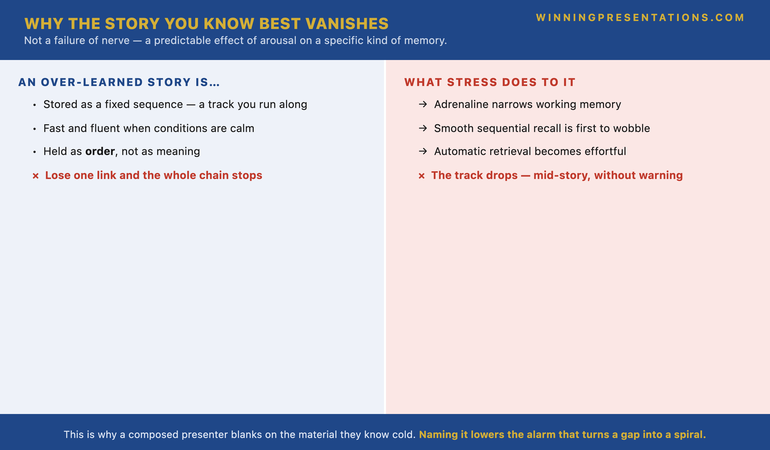
The story freeze feels like a betrayal because it strikes the material you are most sure of, and that is exactly the clue to what is happening. An over-learned story is stored differently from a point you understand: it becomes a fixed sequence, a track you run along rather than an idea you reconstruct. Running a track is fast and fluent when conditions are calm, which is why the well-told story feels effortless in rehearsal. But a sequence has a vulnerability a flexible idea does not — if you lose your place on the track, there is no other route to the next station, because you were never holding the meaning, only the order. Lose one link in a memorised chain and the whole chain stops, in a way that losing one supporting fact in an argument you understand never does.
The stress response is what knocks you off the track. Under the adrenaline of presenting, the part of the brain that handles smooth sequential recall is the first thing to wobble — working memory narrows, and the automatic retrieval that felt effortless at your desk becomes effortful and unreliable. This is why the freeze so often hits a presenter who is otherwise composed: it is not a failure of nerve in the ordinary sense, but a specific, predictable effect of arousal on a specific kind of memory. Senior presenters who struggle to tell their stories smoothly are very rarely underprepared; they are usually over-reliant on sequence and under-equipped with recovery. The skill cold has become the skill most exposed.
Understanding this changes the emotional weight of the moment, which matters more than it sounds. A presenter who believes a blank means “I’m failing” or “I wasn’t ready” adds a layer of self-judgement on top of the gap, and the self-judgement is what escalates a recoverable pause into a spiral. A presenter who knows that a blank is the ordinary, expected behaviour of an over-learned sequence under stress meets the same gap with far less alarm — “ah, the track dropped, I know what this is” — and that lower alarm is itself most of the recovery. You cannot stop the freeze from ever happening; the arousal of presenting will occasionally interrupt sequential recall no matter how experienced you are. What you can do is stop treating it as a verdict on you, because that interpretation is the fuel the spiral runs on.
The freeze is fed by fear. Take the fear down and the gap stops becoming a spiral.
Conquer Your Fear of Public Speaking is built from exactly the place this article describes — five years of presenting while frightened, and the methods that brought it under control. It works on the underlying anxiety response that makes a small gap feel catastrophic, so that when something does go wrong mid-presentation, you meet it from a steadier baseline instead of a spike.
- How the stress response actually works in the moment — and how to keep it from escalating
- Practical techniques for staying composed when something goes wrong on your feet
- The mindset shift that stops a single slip becoming a verdict on the whole talk
- Built for real high-stakes rooms — committees, clients, conferences — not stage performance. Instant access, £39
The chase that turns a gap into a freeze
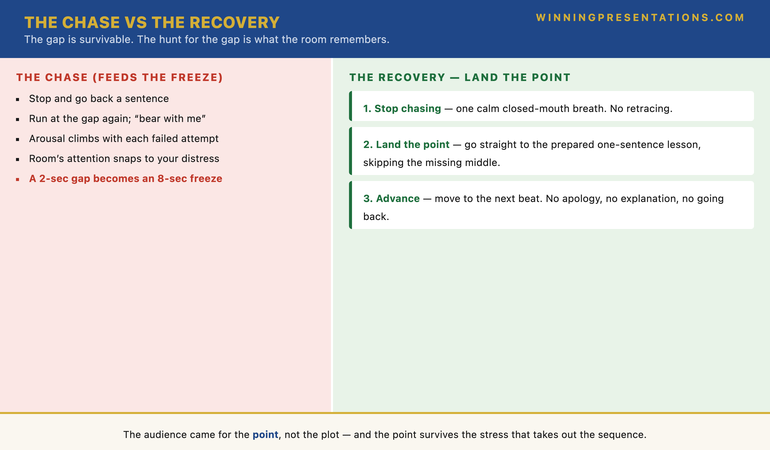
The moment the detail vanishes, almost everyone does the same thing: they chase it. They stop, look up, go back a sentence, and try to run at the gap again, on the assumption that retracing the track will deliver the missing piece. This is the single move that converts a brief, survivable gap into the visible freeze the audience remembers. Chasing fails for two reasons. First, it does not work — the detail is not missing because you took the wrong run-up; it is missing because stress has interrupted retrieval, and repeating the approach repeats the interruption. Second, and worse, the act of chasing escalates the very arousal that caused the blank. Each failed attempt confirms the threat, the body responds with more adrenaline, working memory narrows further, and you have entered a loop where the effort to recover is feeding the thing you are recovering from.
The visible part of the chase is what costs you in the room. While you hunt, you go silent, your eyes go up and inward, and your body language shifts from presenting to searching — and the audience reads all of it. A two-second pause that you fill with composure is invisible; a two-second pause that you fill with a visible hunt announces to the room that something has gone wrong, and the room’s attention snaps from your content to your distress. This is the cruel arithmetic of the freeze: the gap itself is almost never the problem, because audiences barely register a short silence. The hunt for the gap is the problem, because it broadcasts. The same pattern shows up when a presenter’s voice starts to shake — the recovery is never to fight the symptom harder, which amplifies it, but to do something that breaks the loop instead of feeding it.
Breaking the loop requires accepting something that feels wrong in the moment: you have to abandon the lost detail rather than retrieve it. Every instinct says the story is incomplete without the piece you have lost, and that you owe the room the version you planned. You do not. The room never knew your plan; they only know what you say next. The willingness to let the missing detail go — to decide, in the half-second after the blank, “that’s gone, and I don’t need it” — is what frees you to do the one thing that actually recovers the moment, which is to jump straight to the point. The chase keeps you trapped in the plot. The recovery lives in the point, and you can only reach it by giving up the chase.
The Land-the-Point recovery: three moves
The recovery is three moves, run in the second or two after you feel the blank arrive. It is simple enough to use under stress precisely because it is short and it does not require you to find anything you have lost. The whole method rests on one fact: your audience is there for the point of the story, not its plot, and the point is stored differently from the sequence — as meaning, which survives the stress that takes out the track.
The three moves are these. One, stop chasing. The instant you register the blank, abandon the hunt for the lost detail. Do not go back a sentence, do not run at it again, do not say “bear with me.” A single, calm, closed-mouth breath here does more than any retracing — it interrupts the arousal loop instead of feeding it. Two, land the point. Go straight to why you were telling the story — the one-sentence lesson you prepared — using a clean connector: “…and the thing that stayed with me from that was…” or “…and what it taught us was…” You skip the missing middle entirely and deliver the meaning, which is the part the room actually wanted. Three, advance. Move immediately to your next beat or slide. Do not apologise, do not explain that you lost your place, do not return to retrieve the detail once it comes back to you. The story is over; you landed it; you move on.
What makes the three moves work is that each removes one driver of the spiral. Stopping the chase removes the escalating arousal. Landing the point removes the obligation to complete a sequence you have lost, replacing “I must find the ending” with “I’ll give them the meaning,” which is always within reach. And advancing removes the dwell — the lingering on the gap that keeps the room’s attention on the mistake. The deepest reason it works is that it reframes the whole event: a blank is only a failure if the goal was to recite the story. If the goal was to make the point, a blank is a minor detour, because the point survived. The recovery is not a trick for hiding a failure; it is the correct response to the realisation that the failure was never as large as it felt.
The one sentence that makes you freeze-proof
The recovery only works if the point is ready to reach when the story is not, and that readiness is something you build before the room, not in it. The preparation is one sentence per story: the point, written out in plain words, separate from the story itself. For every anecdote in your talk, write the single sentence that says what it is for — “the lesson was that we’d been told it was fixed and it wasn’t” — and know that sentence the way you know your own name, independent of the plot that leads to it. Then, if the story vanishes mid-telling, the landing pad is already there: you do not have to compose the point under stress, you only have to reach for a sentence you already hold. This is the difference between a presenter who can recover and one who cannot — not nerve, but whether the point exists separately from the sequence.
There is a diagnostic that tells you, in advance, which of your stories are liabilities: the bridge-without-the-body test. Take each story in your talk and try to state its point in one sentence without telling the story at all. If you can — cleanly, in a breath — that story is freeze-proof, because you have a landing pad you can reach even if the whole anecdote disappears. If you cannot state the point without recounting the plot to get there, that story is dangerous under pressure, because its meaning is trapped inside its sequence, and when the sequence goes, the meaning goes with it. A story whose point you cannot extract is a story you are reciting rather than using, and reciting is exactly what fails under stress.
This preparation has a quieter benefit beyond recovery: it makes the story better even when nothing goes wrong. A presenter who knows the point of a story independently of its plot tells it more loosely and more confidently, because they are no longer running a fragile track — they are heading for a destination they can see, free to vary the route. The over-learned, recite-it-exactly version is brittle precisely because it has one path; the version anchored to a clear point is robust because it has many. Building the one-sentence point for each story is therefore not just insurance against the freeze. It is the move that converts a memorised sequence back into an idea you understand — which is both less likely to vanish and better to listen to.
Why the audience never sees what you see
In 2021 I coached a senior consultant who had a freeze in a high-stakes pitch six months earlier and had been rattled by it ever since. We rebuilt his three core stories around their points and rehearsed the recovery once, deliberately — I had him tell a story, stop dead in the middle on purpose, breathe, land the point, and move on. He hated it the first time and found it almost easy the third. A month later he used it for real in a client meeting: mid-story, the specific figure he was building to vanished. He paused, breathed, said “…and the upshot was that the delay cost them a full quarter,” and moved to his next slide. Afterwards he asked the colleague sitting beside him whether the gap had been obvious. She had not noticed anything. From the inside it had felt like a cliff; from two feet away it had looked like a presenter taking a breath. That gap between the two experiences is the whole point.
The reason the audience does not see what you see is that they have no access to your plan. You experience the freeze against the template of the story you intended to tell, so you feel the absence of the missing piece sharply — you know exactly what should be there. The room has no template. They only hear the words you actually say, and if those words move from a story to its point without visible distress, the room experiences a complete, slightly compressed story, not a failure. The catastrophe is entirely on your side of the lectern; it exists only in the comparison between what you said and what you meant to say, and you are the only person in the building who can make that comparison. Grounding techniques that keep you anchored in the moment work partly by pulling your attention out of that private comparison and back into the room, where the gap is far smaller than it feels.
This is worth holding onto, because the fear of freezing does more harm over a career than freezing itself. Presenters who have had one bad freeze often start to over-rehearse, grip their scripts tighter, and present more rigidly — all of which makes the next freeze more likely, not less, because rigidity is exactly what fails under stress. The way out is not to fear the gap less by willpower but to know, from the inside, that the gap is survivable and nearly invisible when you land the point. Once you have recovered cleanly even once, the fear loosens its grip, and the loosening is what restores the looseness that made you good in the first place. The recovery, practised, does not just save the occasional talk. It returns the freedom that the fear of freezing quietly takes away.
The fear of freezing does more damage over a career than freezing ever does. That fear is the thing to work on.
One bad freeze pushes people into over-rehearsing, gripping the script, and presenting rigidly — which makes the next freeze more likely, not less. Conquer Your Fear of Public Speaking works on the anxiety underneath, so a slip stops feeling like a catastrophe and starts feeling like a breath and a skip — and the looseness that made you good in the first place comes back.
- Lower the baseline anxiety that narrows the very memory the freeze depends on
- Stop a single slip turning into a spiral — and into a fear that follows you to the next talk
- Present from a steadier place, so you can be loose enough to recover cleanly when something goes wrong
- Drawn from five years of presenting while frightened. Instant access, lifetime use — £39
What to do before your next presentation
Before your next talk, take every story you plan to tell and write its point as one plain sentence on a single card or sticky note — the lesson, separate from the plot, in words you could say cold. Run the bridge-without-the-body test on each: if you cannot state the point without recounting the story, rework it until you can, because that story is your highest freeze risk. Then rehearse the recovery once, deliberately and out loud: tell one of your stories, stop dead in the middle on purpose, take one slow breath, say “…and the point of that was [your sentence],” and move straight to your next beat. Do it three times until the skip feels almost ordinary. You are not rehearsing the story; you are rehearsing what to do when the story is gone — which is the one thing the director at that conference had never practised, and the only thing that would have made her eight-second silence disappear.
Frequently asked questions
If I forget a key detail, won’t skipping to the point leave the story feeling incomplete?
It feels incomplete to you because you are comparing it to the version in your head; it does not feel incomplete to the room, because they never had that version. Audiences experience a story through its meaning, not its inventory of details — they remember the point and a couple of vivid moments, not the full sequence. When you land the point with a clean connector and move on, the room hears a complete, slightly tighter story, and a tighter story is usually a better one. The detail you lost almost always mattered far more to you, as the teller, than to anyone listening. If a genuinely load-bearing fact is missing and someone needs it, they will ask — and you can supply it then, calmly, rather than freezing to retrieve it mid-flow.
Should I just apologise and admit I’ve lost my place? Isn’t that more honest?
Apologising feels honest but it does the opposite of what you want: it tells a room that may not have noticed anything that something has gone wrong, and turns their attention from your content to your discomfort. There is nothing dishonest about landing the point and moving on — you are still telling the truth, just delivering the meaning rather than the full plot. Save explicit recovery language for genuine, unmissable breakdowns, where naming it briefly and moving on (“let me come back to that”) is cleaner than a visible struggle. For an ordinary blank on a detail, the most honest thing you can do is also the most composed: give the room the point, which is what you were actually there to deliver, and keep going.
Does this mean I should stop rehearsing my stories so thoroughly?
No — rehearse them, but rehearse them as ideas with a clear point, not as scripts to recite word for word. The freeze risk comes from over-relying on a fixed sequence, not from preparation itself. The strongest preparation does two things at once: it makes you fluent in the story and anchors you to its point so you can survive losing the sequence. So keep practising, but practise heading for the destination rather than memorising the exact path, and add the one deliberate rehearsal of the recovery itself. That combination — well-known story plus a reachable point plus a practised skip — is far more robust under pressure than a perfectly memorised script, which is brittle precisely because it has only one route.
I freeze because of anxiety, not memory. Will this still help?
It helps with both, because the two are connected: the anxiety narrows the working memory that the freeze depends on, and the freeze then feeds the anxiety. Having a clear, practised recovery breaks that loop from the memory side — knowing you can always land the point removes a large part of the fear, because the worst case is no longer a catastrophe, just a breath and a skip. That said, if the anxiety is the bigger driver — if the fear shows up long before any actual blank, or colours every presentation — it is worth working on the anxiety response directly, not only the recovery technique. The two approaches reinforce each other: a steadier baseline makes the freeze less likely, and a reliable recovery makes the baseline steadier.
The Winning Edge — weekly newsletter
The Winning Edge is a weekly (Thursday) newsletter for senior professionals who present under pressure. One short email a week on staying composed when something goes wrong on your feet — and on the structural habits that make a slip survivable. Subscribe to The Winning Edge →
For the full set of skills behind composed, confident presenting — confidence, storytelling, slides, and delivery — the Complete Presenter bundle of seven products brings them together as a single resource — £99 for everything, lifetime access.
About the author
Mary Beth Hazeldine is Owner & Managing Director of Winning Presentations Ltd. With 24 years of corporate banking experience at JPMorgan Chase, PwC, Royal Bank of Scotland, and Commerzbank, she advises senior professionals across financial services, insurance, consulting, and technology — and, having spent five years presenting while frightened herself, she teaches the methods that keep nerves from taking over the room.