

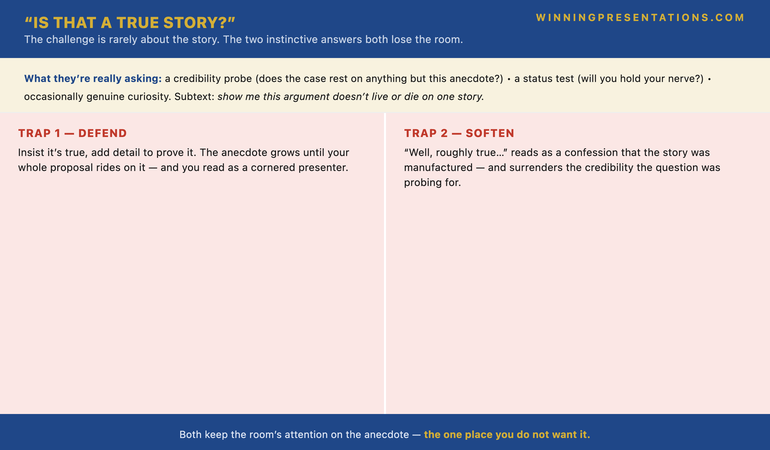
Quick answer: When an executive interrupts to ask “is that a true story?” the question is rarely about the story. It is a credibility probe — they are testing whether your case rests on a polished anecdote or on something firmer — and the two instinctive responses both fail: defending the story’s every detail makes your whole argument hostage to one example, and softening it (“well, roughly…”) reads as a retreat. The move that works is Source-and-Substance: source it honestly in one plain sentence (say exactly what the story is — a real case, a composite, an illustration — with no defensiveness), then move the weight off the anecdote and onto the evidence (“but I’m not asking you to decide on the strength of that story; the case rests on…”), then offer the harder proof and return to the decision. The protection you build beforehand is a single test: for every story in your talk, ask whether your argument would still stand if you deleted it. If yes, the challenge cannot hurt you. If the story is the evidence, a single “is that true?” can collapse the case.
JUMP TO:
In 2017 I watched a manager present a turnaround proposal to a senior leadership group, and he opened with a vivid customer story — a frustrated client, a specific complaint, a moment that crystallised everything wrong with the current process. It was a good story, well told, and about ninety seconds in a director near the end of the table cut across it: “Is that a real customer, or a hypothetical you’ve built to make the point?” The room went still. And the manager, who had been fluent until that second, made the mistake that the rest of the meeting never recovered from: he defended the story. He insisted it was real, added detail to prove it, named the month, described the call again — and the more he defended, the more the room’s attention fixed on whether the anecdote was genuine rather than on whether the turnaround was sound. By the time he got back to his proposal, four minutes had gone on the credibility of one story, and the director’s eyebrow had not come down. The proposal was reasonable. It was sent away for “firmer evidence,” which is what happens when a presenter lets a single anecdote become the thing the room is deciding about.
(This article was created with AI assistance; all stories and insights are based on 35 years of real client work.)
That meeting is the cleanest illustration I know of a specific Q&A trap: the moment a senior person challenges whether your story is true, and your instinct to defend it quietly hands them control of the room. After 35 years around boardrooms and committees, I can tell you the challenge is almost never really about the story — it is a probe of whether your case can stand on anything sturdier than a good anecdote. This piece sets out what the executive is actually asking, the two instinctive responses that both fail, and the Source-and-Substance move that answers the question honestly in a sentence, takes the weight off the anecdote, and steers the room back to the decision on ground that a single doubt cannot wash away.
What the executive is really asking
“Is that a true story?” sounds like a question about the story, and it almost never is. A senior person who interrupts to ask it is doing one of three things, and you need to hear which. Most often it is a credibility probe: they have noticed that your point is currently resting on a single vivid example, and they want to know whether there is anything underneath it or whether the anecdote is the whole case. Sometimes it is a status move — a test of whether you will hold your nerve or scramble — particularly in rooms where challenge is how seniority is exercised. Occasionally it is genuine curiosity. But in every version, the subtext is the same: show me this argument does not live or die on one story. Answer the literal question and miss the subtext, and you will satisfy no one.
This is why defending the story’s truth is a category error. The executive is not, in their own mind, asking you to prove the anecdote; they are asking you to demonstrate that you know the difference between an illustration and evidence. When you respond by piling on detail to prove the story really happened, you confirm their fear rather than dispelling it — you signal that the story is the case, because you are fighting for it as if everything depends on it. The same dynamic drives the executive question “why should I believe your numbers?” — the challenge is not really a demand for one more proof point, it is a test of whether your confidence rests on something or on nothing. The presenter who understands this answers a different question from the one that was asked, and answers the right one.
Hearing the subtext changes what a good answer looks like. If the real question is “does your case stand on anything but this story?”, then the winning response is not a better defence of the story — it is a calm demonstration that the story was only ever an illustration, and that the actual weight sits elsewhere, on evidence you are happy to turn to. That response does in one move what four minutes of defence could not: it tells the room you are not the kind of presenter who smuggles a conclusion in on the back of a nice anecdote. And that, not the literal truth of the customer call, is what the director at the end of the table was actually trying to find out.
The two responses that lose the room
There are two instinctive responses to “is that a true story?”, and they fail in opposite directions. The first is to defend — to insist on the story’s truth and add detail to prove it. This is the manager’s mistake, and it loses the room by escalation: every extra detail raises the stakes on the anecdote, so that the story becomes a larger and larger part of what the room is evaluating, until your entire proposal is riding on whether one example holds up. Defence also reads emotionally as threat-response — the room sees a presenter who feels cornered, and a cornered presenter looks less credible, not more, regardless of whether the story is true. You can win the argument about the anecdote and lose the decision about the proposal, which is the worst possible trade.
The second response is the opposite and just as costly: to soften, hedge, or retreat. “Well, it’s roughly true…”, “it’s based on something that happened…”, “I may have simplified it…” — each of these reads as a partial confession, and the room hears it as “the story was a bit manufactured and I’ve been caught.” Softening tries to lower the stakes on the anecdote but does it by surrendering credibility, which is exactly what the challenge was probing for. The presenter who retreats confirms the suspicion that the story was doing work it should not have been doing, and now the room discounts not just the story but the presenter’s judgement in having relied on it. An honest answer in Q&A builds credibility, but a half-honest, apologetic one does the reverse — it reads as evasion caught in the act.
What both failures share is that they keep the room’s attention on the anecdote, which is the one place you do not want it. Defence enlarges the story; retreat discredits it; neither moves the conversation back to the substance of your case. The whole art of handling this challenge is to answer it in a way that shrinks the anecdote back to its proper size — one illustration among the support, not the load-bearing wall — and redirects the room to the evidence that actually decides the matter. That requires a deliberate move, because the instinct in the pressure of the moment is always toward one of the two traps, and the move has to be ready before the question comes.
The challenge to your story is a Q&A moment like any other — and Q&A is a skill you can drill.
The Executive Q&A Handling System is built for exactly these moments: the pointed question that arrives mid-flow and decides how the room sees you. It teaches the patterns for staying in command — reading what a question is really asking, answering with calm authority, and steering back to the decision — so that a challenge becomes a chance to look surer, not a scramble.
- How to hear what a question is really probing for, and answer that — not just the literal words
- Structures for staying calm and decisive under a pointed or hostile challenge
- The technique for giving a clear, decision-safe answer in around 45 seconds and returning to your point
- Built for boards, committees, and senior rooms. Instant access, lifetime use — £39
The Source-and-Substance move: three steps
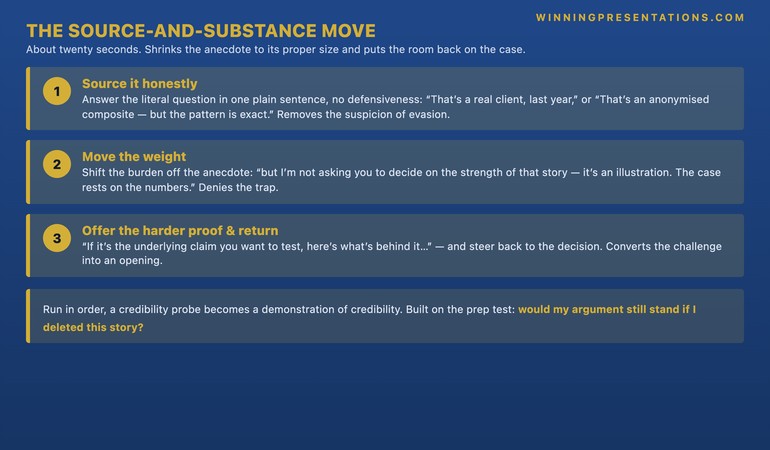
The Source-and-Substance move is three steps, and it takes about twenty seconds to run. It is designed to do the one thing both instinctive responses fail to do: shrink the anecdote to its proper size and put the room’s attention back on the case. Each step removes one of the ways the challenge can damage you, and the steps only work in order.
The three steps are these. One, source it honestly. Answer the literal question plainly, in a single sentence, with no defensiveness and no over-explaining: “Yes, that’s a real client, from last year” — or, just as cleanly, “That’s a composite of three situations I’ve seen, anonymised, but the pattern is exact.” The honesty is the whole credibility play; a calm, precise answer about what the story actually is settles the literal question in one breath and signals you have nothing to hide. Two, move the weight. Immediately and explicitly shift the burden off the anecdote: “but I’m not asking you to decide on the strength of that story — it’s an illustration. The case rests on the numbers.” This is the step that denies the trap, because it tells the room the story was never load-bearing. Three, offer the harder proof and return. Point to the evidence and steer back to the decision: “if it’s the underlying claim you want to test, here’s what’s behind it —” and go to your data, your slide, your decision. You have answered the question and put the room back where it belongs.
The reason the order matters is that each step sets up the next. Sourcing it honestly first removes the suspicion of evasion — you cannot move the weight credibly if you have just been seen to dodge the literal question. Moving the weight second reframes the anecdote as illustration before the room has decided it was your whole case — do it too late, after a defence, and the reframe sounds like a retreat. Offering the harder proof third converts the challenge into an opening: the director wanted to know if there was anything underneath, and you have just shown them there is, and invited them into it. Run in order, the move turns a credibility probe into a demonstration of credibility. The challenger gets a straight answer, the room gets a presenter who knows illustration from evidence, and the decision moves forward on the ground you wanted it on all along.
How to be honest about a composite story
The hardest version of this challenge lands when the story is a composite — a single anecdote built from several real situations — which is common and entirely legitimate in business presentations, where confidentiality often makes a literal single case impossible to tell. The fear is that admitting “it’s a composite” sounds like admitting “I made it up.” It does not, if you source it precisely. The honest answer is not a confession; it is a description: “That’s a composite — I’ve combined a few client situations and changed the details for confidentiality, but the pattern it describes is one I’ve seen repeatedly.” Delivered calmly, this reads as professional discretion, not invention, because it distinguishes clearly between the parts that are constructed (the surface details) and the part that is true (the pattern). The room hears someone who is careful with confidential material and precise about what they are claiming.
The discipline that makes this credible is to have decided, before you present, exactly what is true in each story and what is illustrative — so that when challenged, you describe rather than scramble. A presenter who has to work out on the spot how true their own story is will always sound shifty, because the hesitation reads as fabrication being caught. A presenter who has already drawn the line — “the figures are real, the names are changed”; “the pattern is exact, the single example is assembled” — answers instantly and cleanly, and the speed of the honest answer is itself reassuring. Know which of your stories are real-single, real-anonymised, or composite, and know it before the room asks, so that the sourcing step is a recall, not a calculation.
There is a line that genuinely matters here, and naming it protects you: a composite that compresses real patterns is legitimate; a story invented to manufacture a pattern that does not exist is not, and senior audiences can eventually tell the difference. The Source-and-Substance move only works when the underlying claim is genuinely supported — it shifts the weight onto evidence because the evidence is actually there. If a story is carrying weight precisely because there is no evidence behind it, no handling technique will save you, and you should not be making the claim. The move is not a way to dress up a hollow argument; it is a way to stop a sound argument from being mistaken for a hollow one because it happened to open with a story.
The test that makes a story un-challengeable
In 2014 I coached a director who had been burned by exactly this kind of challenge and had over-corrected into presenting with no stories at all, all data and no colour, which bored rooms into a different kind of failure. We rebuilt her presentations around a single test that let her use stories safely again: for every anecdote, she had to be able to answer yes to the question “would my argument still stand if I deleted this story entirely?” Where the answer was yes, the story stayed, as an illustration sitting on top of evidence that carried the weight. Where the answer was no — where the story was the argument — she either found the evidence to put underneath it or cut the claim. A few months later a board member challenged one of her examples, and she ran the Source-and-Substance move in about fifteen seconds and went straight to her data; the challenge died on the spot, because there was visibly something underneath. The challenger, she said, actually nodded.
The survive-without-the-story test is the preparation that makes the in-the-room move possible, and it is worth running on every high-stakes presentation. The principle is simple: a story should illustrate an argument, never carry it. When a story merely illustrates — when the evidence would stand on its own and the anecdote just makes it vivid and memorable — a challenge to the story’s truth cannot collapse your case, because the case does not depend on it. You can concede the story is a composite, even concede it is imperfect, and your argument is untouched. But when a story carries the argument — when removing it would leave nothing but assertion — a single “is that true?” is aimed straight at your foundation, and the room knows it. The test sorts your stories into safe and dangerous before you ever stand up.
Applying the test does not mean abandoning stories; it means putting them in their place. The strongest senior presentations use stories heavily — to open, to make a number felt, to lodge a point in memory — while keeping the actual weight on evidence the audience can examine. Handling a hostile question in a board meeting is far easier when your structure already separates illustration from proof, because you can give ground on the illustration without giving ground on anything that matters. The presenters who get rattled by “is that a true story?” are almost always the ones whose stories were quietly doing the work their evidence should have been doing. Fix that in preparation and the challenge loses its teeth before it is ever asked.
One pointed question should never be able to collapse your case. Whether it can is a skill, not luck.
The challenge to your story is one pattern among many that decide how a room sees you. The Executive Q&A Handling System drills the lot — reading what a question is really asking, staying composed under a probe, and steering back to the decision — so the moment a director tests you becomes the moment you look most in command, rather than the moment your proposal slips away.
- Recognise the question patterns that decide a room — the credibility probe, the status test, the trap
- Answer with calm authority instead of the defend-or-soften reflex that costs you the room
- Give a clear, decision-safe answer in around 45 seconds and return to your point
- Built for boards and committees. Instant access, lifetime use — £39
What to check before your next presentation
Before your next high-stakes presentation, go through every story you plan to tell and ask one question of each: would my argument still stand if I deleted this story entirely? Mark each one — illustration (the case holds without it) or load-bearing (the case collapses without it). For every load-bearing story, do one of two things before you present: put real evidence underneath it so it becomes an illustration, or cut the claim it was carrying. Then, for each story that remains, decide in one sentence exactly what it is — real and single, real but anonymised, or a composite — so that if you are challenged, the sourcing answer is instant and calm rather than improvised. You are not preparing to defend your stories. You are making sure that when someone asks “is that true?”, the honest answer costs you nothing — because the story was never the thing holding up your case.
Frequently asked questions
Is it damaging to admit a story is a composite or anonymised?
No — provided you describe it precisely and calmly rather than confessing it apologetically. In a business context, composites and anonymised examples are normal and expected, because confidentiality frequently rules out telling a single real case in full. “That’s a composite — details changed for confidentiality, but the pattern is one I’ve seen repeatedly” reads as professional discretion. What damages you is hesitation or vagueness about your own story, which sounds like fabrication being uncovered. The protective move is to decide before you present exactly what is real and what is illustrative in each story, so the answer is a clean description you can give in a breath. Honesty stated confidently builds credibility; honesty dragged out reluctantly destroys it.
What if the question is openly hostile — meant to undermine me, not to learn?
The Source-and-Substance move works the same way, and it is especially effective against a hostile challenge because it denies the challenger the fight they were looking for. A hostile questioner wants you to defend the anecdote so they can keep pulling at it; when you instead answer honestly in a sentence and immediately move the weight to your evidence, there is nothing left to attack — you have agreed the story is only an illustration and pointed at the substance. Stay calm and brief; do not match their edge with edge. The room reads the exchange as a composed presenter handling a sharp question well, which costs the hostile questioner status, not you. The worst response to hostility is the long defence, which is exactly what they are fishing for.
Should I just stop using stories to avoid the challenge altogether?
No — that over-correction creates a worse problem, which is a presentation with no colour, nothing that makes a number felt or memorable, and a room that disengages. Stories are one of the most powerful tools in a senior presentation; the goal is not to remove them but to keep them in their proper role as illustration sitting on top of evidence. A presenter who uses stories well and can show there is substance underneath is far more persuasive than one who relies only on data. The fix for the “is that true?” challenge is not fewer stories; it is the survive-without-the-story test, which lets you use stories freely because you know none of them is secretly carrying the case on its own.
How do I answer in the moment without sounding rehearsed or defensive?
Keep the sourcing answer to a single, plain sentence and let your tone stay level — the calm is what reads as genuine, not the wording. The reason a prepared move does not sound rehearsed is that it frees you from scrambling; because you already know what your story is and where your evidence sits, you can answer naturally instead of fumbling, and natural is what the room hears. The defensiveness people worry about comes from feeling cornered, and you only feel cornered when you have not decided in advance what is true in your story. Do that preparation, and the answer comes out as it should — unhurried, specific, and faintly uninterested in defending the anecdote, because you are already moving the room to the evidence that actually matters.
The Winning Edge — weekly newsletter
The Winning Edge is a weekly (Thursday) newsletter for senior professionals who present to boards and committees. One short email a week on handling the pointed question, the challenge, and the moment the room tests you — with calm authority rather than a scramble. Subscribe to The Winning Edge →
For the full set of skills behind a presentation that holds up under challenge — Q&A, slides, storytelling, and confidence — the Complete Presenter bundle of seven products brings them together as a single resource — £99 for everything, lifetime access.
About the author
Mary Beth Hazeldine is Owner & Managing Director of Winning Presentations Ltd. With 24 years of corporate banking experience at JPMorgan Chase, PwC, Royal Bank of Scotland, and Commerzbank, she advises senior professionals across financial services, insurance, consulting, and technology on staying in command of the room when a question is designed to test them.