

Quick answer: The “actually…” question is a correction attempt disguised as a question. The best response is neither to defend nor to fold — it is to acknowledge the point, verify the facts briefly, and return control of the presentation to you. Done well, it adds to your credibility. Done badly, it invites everyone else in the room to attempt their own correction.
A senior risk executive — I’ll call him Osman — was three slides into a board briefing in late 2023 when a non-executive director interrupted. “Actually, the figure you just quoted was the 2022 number, wasn’t it?” It wasn’t. It was the 2023 figure, which Osman had verified twice before the meeting. But the room had heard the correction, the director was highly regarded, and the rest of the presentation was hanging on whether Osman could respond cleanly.
He did. “Let me come back to that — the 2023 figure is the one on screen; happy to share the source after.” Then he moved on. Later in the meeting, during a private moment, the director nodded to him and said, “Good catch, you were right.” The correction attempt had landed, Osman had absorbed it without escalation, and the room’s trust in his material actually increased.
Most presenters mishandle the “actually…” question. They either defend too hard, fold too fast, or try to debate the point and lose twenty minutes of board time. The right response is narrower and more useful than any of those — and it works whether the correction is right, wrong, or somewhere in between.
Want the complete framework for Q&A like this?
The Executive Q&A Handling System covers correction attempts alongside bridge statements, deflection techniques, and composure protocols for the full range of hostile, unexpected, and high-stakes executive Q&A.
What an “actually…” correction actually is
The “actually…” question is a specific social move. It is a correction framed as a question, usually delivered at low emotional temperature, which puts the presenter in the position of either accepting the correction or disputing it in public. The word “actually” signals that the questioner believes they know the correct answer; the question form makes it harder for the presenter to simply disagree.
The move does different work depending on who is using it. Sometimes the questioner has genuinely caught an error. Sometimes they remember an older version of a figure and have not realised it was updated. Sometimes they are testing the presenter’s composure. And sometimes — less often than most presenters fear — they are actively trying to undermine.
The tricky part is that the response pattern is almost identical in all four cases. You do not need to diagnose the motive in real time; you need a clean response that handles the correction attempt regardless of intent. Trying to work out whether a questioner is being helpful or hostile usually slows your response enough to make it look defensive.
What makes the “actually…” pattern different from other Q&A challenges is that it is usually about a single specific fact — a number, a date, a source, a name. That narrow scope is both the threat and the opportunity. The threat: getting the fact wrong in front of the room is visible and memorable. The opportunity: if you handle the narrow fact cleanly, you close the exchange quickly and return to your material.
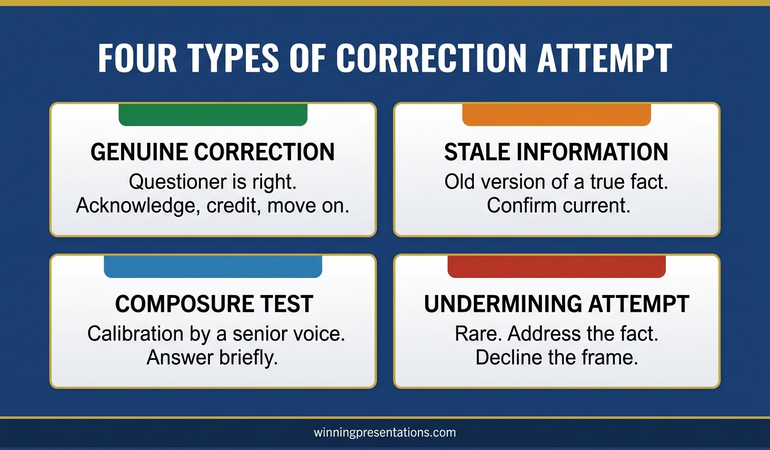
The four types of correction attempt
Every “actually…” correction fits into one of four categories. Recognising which one you are dealing with lets you calibrate the length of your response without changing the shape of it.
The genuine correction. The questioner is right. The figure was wrong, the date was off, the source was misattributed. This is the easiest case to handle and the hardest to handle badly. Senior presenters acknowledge genuine corrections quickly and clearly, credit the questioner briefly, and move on. The trap is over-apologising — which draws attention to the error far more than the error itself warranted.
The stale information correction. The questioner is working from an older version of the same fact. They remember the number from last quarter, or the structure from before the most recent reorganisation, or the policy from the previous version. They are not wrong — they are looking at the right answer for a previous point in time. The response is to confirm the current position without implying the questioner was careless.
The composure test. The questioner — often someone senior, sometimes a chair or NED — raises a correction they are not entirely sure about, partly to see how the presenter responds under pressure. This is not hostile; it is a calibration exercise. Senior listeners form a view about new presenters partly by watching how they handle small pressures. The response has to be calm, quick, and specific.
The undermining attempt. The questioner is trying to cast doubt on your material, often because your recommendation conflicts with their interests. This is the rarest of the four and the one that most presenters overestimate. Most of the time, a correction attempt that feels hostile is actually a composure test or a genuine correction delivered abruptly. The handling is the same — address the specific fact cleanly, then move on — but the presenter’s internal threat response is higher, which makes the execution harder.
The response pattern that holds the room
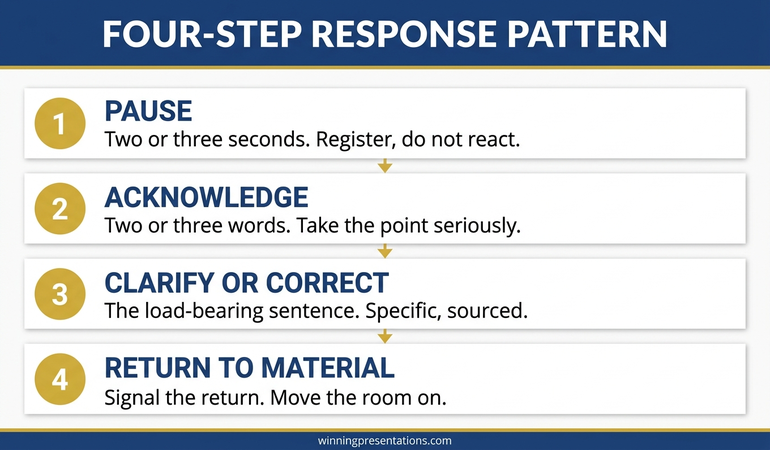
The response has four parts, each of them short. The full response should take between ten and twenty seconds. Going longer is almost always a mistake — it draws more attention to the correction attempt than it deserves and can turn a narrow fact exchange into a broader debate.
Pause. Two to three seconds. Long enough to register that you have heard the correction. Short enough that it does not read as uncertainty. Pause-first is almost always better than answer-first here; the pause communicates that you are thinking, not reacting. This is the same mechanism behind the buying-time techniques that senior presenters use in Q&A.
Acknowledge. Two or three words. “Good point.” “Let me check that.” “Thanks — worth clarifying.” Acknowledgement is not concession; it is a signal that you take the correction seriously enough to respond. Refusing to acknowledge feels dismissive, which invites the questioner to escalate.
Clarify or correct. The next sentence is the load-bearing one. If the questioner is right: “You’re right — that should be 2.3, not 2.4. Thanks for catching that.” If they are wrong: “The figure on the slide is the 2023 number — happy to share the source after.” If you are not sure: “I want to check that before I answer — I’ll come back to it at the end of this section.”
Return to your material. The final move is to bring the room back. “Let me continue with the recommendation.” “As I was saying, the second option.” Signalling the return explicitly prevents the questioner from asking a follow-up and tells the rest of the room that the correction has been handled.
This pattern is a specific application of the bridging technique for difficult questions — acknowledge, address, bridge back to your agenda.
Walk into your next Q&A with a framework that holds up
The Executive Q&A Handling System gives you the complete framework for managing hostile, unexpected, and high-stakes Q&A in executive settings — including correction attempts, bridge statements, deflection techniques, and the composure protocols that hold the moment together.
- Bridge statements for returning control of the exchange
- Deflection techniques that are professional, not evasive
- Composure protocols for the seconds before you answer
- Scenario playbooks for the question types senior presenters get most
Designed for senior professionals presenting to boards, investment committees, and executive sponsors.
£39, instant access.
What to do when you are actually wrong
Being corrected in a senior setting feels worse than it is. Most audiences are willing to forgive a narrow factual error if it is handled cleanly. What they cannot forgive is a presenter who either denies a real mistake or makes the mistake feel larger by over-apologising. The handling is more important than the error.
When you are wrong, three moves do the work.
Acknowledge quickly and specifically. “You are right — that should be 2.3, not 2.4.” Specific acknowledgement lands better than general acknowledgement. “You are right, sorry about that” is less reassuring than “you are right, the 2.3 figure is the one from the latest report, thanks for catching that”. Specificity demonstrates that you know the material.
Do not over-apologise. One acknowledgement is enough. Repeating the apology two or three times makes the error feel serious enough to warrant multiple apologies, which it usually is not. Senior audiences interpret heavy apology as a signal that the presenter is more concerned about their own standing than about the material.
Signal that the rest holds. “The underlying picture is the same — the direction of travel is consistent whether we use 2.3 or 2.4.” This move reassures the room that the error was narrow, not structural. It is only appropriate when true; inventing structural soundness you cannot demonstrate makes the second error worse than the first.
The broader principle worth remembering: an honest answer nearly always builds more credibility than a defended one. Senior audiences know that presenters occasionally get details wrong; they are primarily watching to see whether the presenter handles the moment like an adult.
Prevention: reducing the attack surface
The best response to an “actually…” correction is the one you never have to use, because the correction attempt did not arise in the first place. Reducing the attack surface is part of senior presentation preparation.
Source every number on screen. Either include the source inline in small text on the slide, or know the source by memory before you walk in. “The 2023 figure is the one from the July operating review” is more effective than “yes, that is correct” when a source is queried. This is the cheapest preventive measure available; it costs nothing in slide real estate and takes the wind out of most number-based challenges.
Use the most recent dating consistently. Correction attempts are often about data being out of date rather than being wrong. If the slide shows 2023 data, say “2023” out loud at least twice during the relevant section. If a key figure was updated in Q4, note it explicitly. Consistent dating pre-empts the “wasn’t that the 2022 number?” challenge.
Pre-circulate anything sensitive. If your recommendation hinges on a disputed or sensitive data point, include it in the pre-read rather than introducing it live. Senior audiences who have already seen a figure in a document are far less likely to challenge it in the room. Surprise is what invites correction.
Rehearse with a sceptic. Before a senior presentation, run through the deck once with a colleague whose job is to raise every “actually…” correction they can think of. Some will be right, some will be wrong, some will be composure tests. Treat the rehearsal as a sampling exercise — the goal is to surface the five or six possible challenges, not to anticipate every one.
Partner post: the neutral voice technique for broader authority challenges is the physiological companion to the narrow-fact handling of the “actually…” pattern.
Want the structural complement to Q&A handling?
The Executive Slide System (£39) gives you the slide structures that reduce the attack surface — decks designed so that sources, dates, and sensitivities are handled on the slide rather than exposed to in-room correction.
The composure behind the fact exchange
The “actually…” question is, in the end, less about the fact than about the presenter. Senior audiences are watching to see how narrow factual pressure is handled. Calm, specific, brief. Acknowledge, clarify, return. The presenter who does this reliably earns a kind of trust that content-only presenters do not — the audience starts to feel that if the presenter says the recommendation holds, the recommendation probably holds.
That trust is worth more than most of the slide design, the framework selection, and the rehearsal put together. It does not come from never being corrected. It comes from being corrected occasionally and handling the moment cleanly every time.
Start with the pause. The next time someone starts a sentence with “actually…” in any setting, pause before responding. Notice how the pause changes the shape of the exchange. That single move is the foundation of everything else in this response pattern.
The Q&A framework senior presenters rely on
Bridge statements, deflection techniques, composure protocols. Built for the hostile, unexpected, and high-stakes Q&A that senior presenters face.
Get the Q&A Handling System → £39
Instant access.
Frequently asked questions
What if the correction is technically right but irrelevant to the recommendation?
Acknowledge the correctness of the point, state its relevance to the recommendation in one sentence, and move on. “You are right on the Q3 figure — the point does not change the three-year payback, which is what we are asking you to approve.” This prevents the room from getting stuck on a minor accuracy issue while losing sight of the actual decision. The move respects the questioner without letting the exchange derail the meeting.
How do I handle it when I genuinely don’t know whether I’m right?
Say so, specifically. “I want to check that before I give you a firm answer — let me come back to it at the end of this section.” Commit to the follow-up and do it. Senior audiences prefer honest uncertainty followed by a verified answer to confident bluffing. The trap is saying “I’ll come back to that” and then never returning — make a note on your handout and use it.
What if the questioner keeps insisting they are right when they are not?
Hold your position calmly, once, with the source. “The figure on screen is 2.3 — I can share the source after the meeting.” If they continue to insist, offer to take it offline: “Happy to work through the numbers with you after.” Do not relitigate the point in front of the room. The audience reads a presenter who takes a disputed narrow point offline as senior; the presenter who keeps engaging looks drawn into the dispute.
Does the response differ when the questioner is junior to me?
The response shape is identical — acknowledge, clarify, return — but the tone is slightly warmer. Junior questioners who attempt “actually…” corrections are often learning how to raise challenges in senior forums, and a calm, specific response from a senior presenter is part of how they calibrate. Dismissing the junior correction is worse than handling it with the same neutrality you would offer a peer.
Get The Winning Edge
One email each Thursday. Named techniques from real boardroom work — corrections, composure, framing — that senior professionals can try in the next presentation.
Next step: practise the four-step response on the next low-stakes correction you receive this week, so the shape of the response is familiar before a senior one arrives.
About the author
Mary Beth Hazeldine is Owner & Managing Director of Winning Presentations Ltd. With 24 years of corporate banking experience at JPMorgan Chase, PwC, Royal Bank of Scotland, and Commerzbank, she advises executives across financial services, healthcare, technology, and government on structuring presentations for high-stakes funding rounds and approvals.