

Quick answer: Most senior leaders weigh presentation coaching against the wrong measure — “will it make me a better speaker?” — which is real but unmeasurable, so the decision stalls. The more useful question is the one-decision frame: what does a single deferred or diluted decision already cost you, in budget not approved, initiatives delayed, or rounds of rework? For a senior leader presenting decisions worth six and seven figures, the answer is usually that one cleaner approval more than covers years of development. The honest caveat: no coaching can be credited with a specific outcome, because too much sits outside it. But the right comparison is never the price of the course against zero. It is the price against the cost of the decisions currently going sideways.
JUMP TO:
A director I spoke with in 2021 had been circling the decision to invest in presentation development for the better part of a year. He was responsible for taking capital cases to his group’s investment committee — proposals routinely in the seven figures — and he had a sense, never quite proven, that he was leaving outcomes on the table when he presented. But every time he looked at the cost of structured coaching, he could not make the sum work, because he kept asking himself the same unanswerable question: how much better a presenter will this actually make me? He had no way to measure the answer, so he deferred the decision. For a year.
What finally moved him was not a better answer to that question. It was a different question, asked by a colleague over coffee: how much did the last case you got deferred cost you? He worked it through. A six-month delay on a single approved initiative — the kind of deferral he had seen more than once — was, in lost contribution, worth many multiples of any development programme he had been agonising over. He had been comparing the course price against zero, as though the alternative to investing was free. It was not free. The status quo had a running cost, and he had simply never put a number on it.
(This article was created with AI assistance; all stories and insights are based on 35 years of real client work.)
That is the error at the centre of the ROI question, and almost every senior leader makes it. They evaluate the investment against an unmeasurable benefit (“better speaking”) and an imaginary alternative (“doing nothing, for free”). Both are wrong. The benefit that matters is measurable — it is the decisions currently going sideways — and the alternative is never free, because those decisions keep going sideways while you deliberate.
If your presentations carry real money:
The Executive Buy-In Presentation System is the structured programme for senior professionals who present decisions to boards, investment committees, and executive sponsors. 7 self-paced modules on the structure and psychology that earn serious approval, optional recorded Q&A calls. £499, lifetime access — set against the cost of one deferred case, the comparison usually answers itself.
Why the obvious ROI question is unanswerable
“Will this make me a better presenter?” feels like the right question, but it is unanswerable in a way that quietly defeats the decision. There is no unit of “better presenter.” You cannot weigh it, so you cannot compare it to a price, so the decision has nothing to resolve against and defaults to deferral. The question is not wrong because the benefit is not real — it is wrong because it is framed in a currency you cannot count, against a price you can, and an uncountable benefit always loses to a countable cost.
Worse, the unanswerable framing invites the most expensive bias in decision-making: treating the status quo as the free, safe default. Doing nothing feels costless because the cost is invisible — it is spread across deferred approvals, diluted proposals, and rounds of rework that you never attribute to your presenting because each one had a dozen other plausible causes. The cost is real and recurring; it simply never appears as a line item, so the brain files it at zero. Against a zero-cost status quo, almost no investment clears the bar.
The leaders who actually decide do not find a better way to measure “better presenter.” They abandon that question and replace it with one that uses a currency they can count. That is not a sales trick — it is the only way the decision becomes a decision rather than a year of circling.
The one-decision frame: a more honest comparison
Here is the frame I give senior leaders who are stuck on the ROI question. I call it the one-decision frame, and it works by changing what you compare the investment against. Instead of weighing the price against an unmeasurable improvement, you weigh it against the cost of a single decision you have recently lost or watered down. The frame has three steps, each a concrete number you can actually produce.
First, name a real deferral. Pick one specific decision in the last two years that was deferred, diluted, or sent back for rework after you presented it. Not a hypothetical — a real one you can picture. Second, put a cost on the delay. What did the deferral actually cost: months of lost contribution on an initiative, a budget cycle missed, the rework hours of your team, the opportunity that moved on? You do not need precision; an order of magnitude is enough, and for senior decisions the order of magnitude is almost always large. Third, compare that figure to the price of development. Not the improvement — the price. A development programme in the hundreds, even structured coaching in the low thousands, set against a single deferral worth tens or hundreds of thousands, makes the comparison concrete in a way “better presenter” never can.
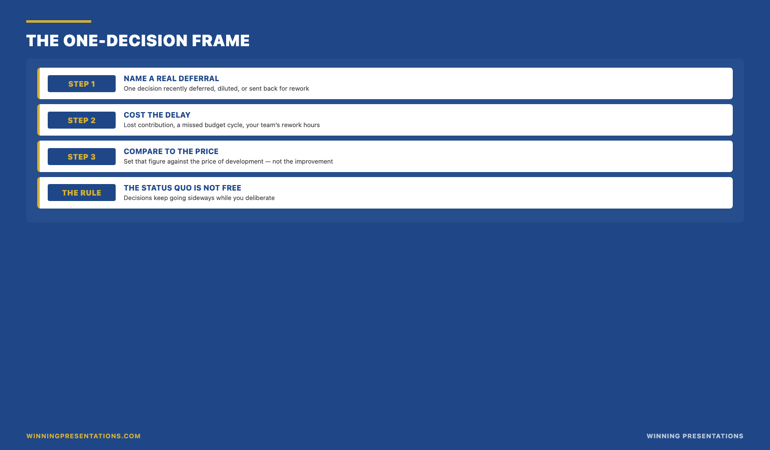
The frame does not promise that development will recover that decision — nothing can promise that, and the next section is honest about why. What it does is correct the comparison. It stops you measuring an investment against an uncountable benefit and a free alternative, and starts you measuring it against the very real, very countable cost of the decisions that are already going sideways. Most senior leaders who run the frame honestly find the deferral cost dwarfs the development cost by an uncomfortable margin — which is usually the moment the year of circling ends. The same logic applies whenever a board weighs one investment against another; the structural version is in how to answer “why fund this over X”.
Set the price against the cost of one lost decision.
The Executive Buy-In Presentation System gives you the framework for securing senior approval — stakeholder analysis, case construction, and the structures that hold up to board-level scrutiny. 7 self-paced modules, monthly cohort enrolment, optional recorded Q&A calls. £499, lifetime access to materials. Built on 24 years in corporate banking and 16 years coaching senior professionals across financial services, insurance, consulting, and technology — the same rooms where the deferred decisions happen.
- The structure and psychology that move senior decisions, not generic presentation tips
- 7 self-paced modules — no deadlines, no mandatory live attendance
- Optional live Q&A / coaching calls, fully recorded so you can watch back anytime
- £499, lifetime access — a fraction of what a single deferred case tends to cost
What you can and cannot honestly attribute
An honest ROI discussion has to admit what cannot be claimed, because the inflated version — “this coaching will win you the deal” — is both false and the reason serious people distrust the whole category. No development can be credited with a specific approval. Too many factors decide a senior decision: the merits of the proposal, the politics of the room, the budget environment, the competing priorities, the mood of the chair on the day. The presentation is one input among many, and pretending it is the deciding one is dishonest.
What you can honestly attribute is narrower and still worth a great deal. Better structure makes your argument easier to follow, which removes one specific reason decisions get deferred — the room could not track the case. Better question handling means a single hard question is less likely to derail an otherwise sound proposal. Better preparation reduces the rework cycles that eat your team’s time whether or not the decision lands. None of these guarantees an outcome. All of them shift the things that are within your control, and the cumulative effect of shifting the controllable inputs, across many decisions over a career, is real even though no single decision can be pointed to as proof.
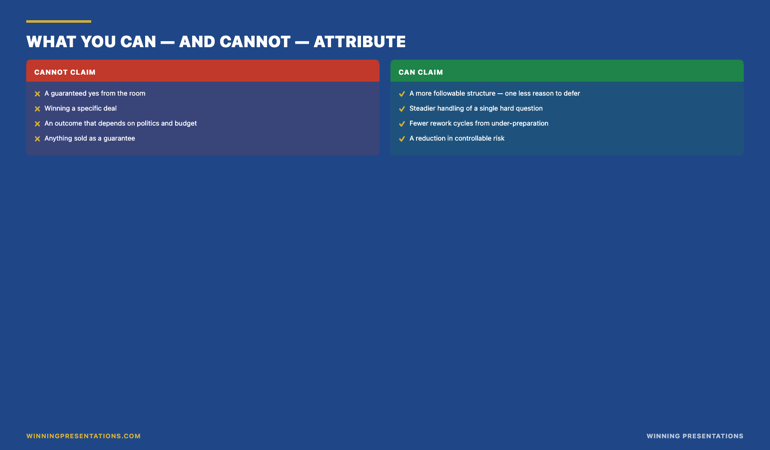
So the honest version of the ROI case is this: you are not buying a guaranteed yes from the room, because no such guarantee exists. You are buying a reduction in the avoidable reasons your decisions go sideways — the unfollowable structure, the unhandled question, the under-prepared case. Against the running cost of those avoidable failures, the investment is straightforward. Sold as a guarantee, it is a lie. Sold as a reduction in controllable risk, it is simply accurate. The clearest place to see that risk reduction at work is the board room, where the influence happens before the meeting — covered in how to influence board members in a presentation.
If the figure makes the case, this month’s cohort is open.
Once the one-decision frame has answered the worth-it question, the Executive Buy-In Presentation System opens a new cohort enrolment every month — this month’s is open now. 7 self-paced modules, optional recorded Q&A calls, lifetime access. £499, set against the cost of a single deferred case.
Matching the spend to the problem
Worth-it is not a single answer, because the right level of investment depends on the problem. There is a ladder of options, and overspending on a small problem is as much a waste as underspending on a large one. The skill is matching the spend to what is actually going wrong.
If the issue is purely structural — your cases are sound but built in an order the room cannot follow — the lowest rung may be enough. A template-and-prompt resource like the Executive Slide System, at £39, fixes the structure of the deck without the cost of a programme. If the issue is broader — structure plus storytelling plus delivery, several things at once — a bundle of assets is the efficient middle. And if the issue is the hard layer, the contested board-level decision where structure, psychology, and composure all have to hold together, that is where a structured programme earns its higher price, because that is the problem worth solving properly. Diagnose the problem first, then spend at the matching rung. For the plateau version of “I have already done the cheap fix and it stopped working,” see the presentation training plateau problem.
If the problem is structure, start at the lowest rung:
The Executive Slide System is the £39 entry point — 26 templates, 93 AI prompts, and 16 scenario playbooks for senior decision presentations. If your cases are sound but built in the wrong order, this fixes that without a programme. Move up the ladder only if the problem turns out to be deeper. £39, instant access.
For the middle of that ladder — several assets across slides, storytelling, confidence, and delivery — the £99 Complete Presenter bundle collects seven products plus three bonuses, worth £190+ separately. Match the spend to the problem, and the worth-it question stops being a leap of faith and becomes a straightforward fit.
Frequently asked questions
Is presentation coaching actually worth the money for a senior leader?
For a senior leader whose presentations carry real decisions — budgets, capital cases, strategic approvals — it usually clears the bar comfortably, but only when you measure it correctly. Compared against an unmeasurable “better speaker” benefit, it never resolves. Compared against the cost of a single decision that was recently deferred, diluted, or sent back for rework, the development cost is almost always a small fraction of what one delay already cost. The worth-it answer depends entirely on which comparison you make, and the deferred-decision comparison is the honest one.
How do I measure the return on presentation development?
You cannot measure it as a guaranteed return on a specific decision, and anyone who promises that is overselling. What you can do is estimate the running cost of the avoidable failures — the deferrals caused by an unfollowable structure, the proposals derailed by one unhandled question, the rework cycles from under-preparation — and weigh the development cost against that. The return shows up across many decisions over time as a reduction in controllable failures, not as a single attributable win. That is a real return; it is just measured as risk reduced, not outcomes guaranteed.
Why not just do nothing and rely on the quality of my proposals?
Because doing nothing is not free, even though it feels like it. The status quo has a running cost spread invisibly across every deferred approval and round of rework, and because each one has other plausible causes, you never attribute it to how the case was presented. A strong proposal that the room cannot follow still gets deferred. The choice is not between spending and saving — it is between a visible, one-time development cost and an invisible, recurring cost of decisions that keep going sideways.
How much should I spend — a £39 resource or a £499 programme?
Match the spend to the problem. If your cases are sound but built in an order the room struggles to follow, a structural resource in the tens of pounds may be all you need. If the difficulty is the contested, high-stakes room where structure, psychology, and composure all have to hold together, that is the problem a structured programme is built for, and the higher price is proportionate to the size of the decisions at stake. Diagnose first, then spend at the matching rung — overspending on a small problem is as wasteful as underspending on a large one.
The Winning Edge — weekly newsletter
The Winning Edge is a weekly newsletter for senior professionals who present at the executive level. One short email a week on the structural moves that separate decks committees back from decks they defer. Subscribe to The Winning Edge →
About the author
Mary Beth Hazeldine is Owner & Managing Director of Winning Presentations Ltd. With 24 years of corporate banking experience at JPMorgan Chase, PwC, Royal Bank of Scotland, and Commerzbank, she advises executives across financial services, healthcare, technology, and government on structuring presentations for high-stakes funding rounds, board approvals, and strategic decisions.