
Quick answer: Senior presenters keep coaches because the feedback they need is structurally unavailable inside the organisation. Direct reports cannot give it without political cost. Peers cannot give it without competitive edge. Boards will not give it because their job is judgement, not coaching. A coach is the only role where the relationship is configured for honest correction — which is why CEOs, NEDs, and senior partners are usually the people most likely to retain one, not least.
Jump to:
Adekunle had been a CEO for eleven years across two FTSE-listed businesses. He was a confident presenter — keynote-trained, board-comfortable, and genuinely respected by analysts. Late in his second tenure, three months before a strategic capital markets day, he hired a presentation coach for the third time in his career. His head of corporate affairs found this confusing. The CEO was already, by any reasonable measure, the most polished presenter in the building. Why bring in someone external?
The reason was specific. The capital markets day was the first since a major acquisition that had not been universally welcomed by the analyst community. Adekunle could feel that his usual instinct for the room was no longer reliable in this scenario. The narrative was new. The scrutiny was sharper. The coach was not there to fix delivery. The coach was there to be the only person in the building who could tell him the parts of his draft that were going to fail in the room.
It is the most common pattern at senior level. The further up an executive goes, the harder it becomes to get honest feedback on a presentation. The coach is the structural answer to that problem. Almost every senior presenter who continues to improve into their fifties and sixties has found a version of this answer. The ones who plateau usually have not.
If you do not yet have a coach
The Executive Buy-In Presentation System is the structured, self-paced framework senior professionals use when an external coach is not on retainer. 7 modules, monthly cohort enrolment, optional recorded Q&A. Often used as a precursor or supplement to 1:1 coaching.
Why senior presenters keep a coach
The first answer is the obvious one and it is largely wrong. Senior presenters do not keep coaches because they cannot present. Most of them present perfectly well, and many present better than the coaches they hire. The skill gap is not why the relationship exists.
The right answer involves three structural problems that get harder, not easier, as seniority increases. The first is the feedback problem — at executive level, almost everyone in the room has a reason not to tell you the truth. The second is the rehearsal problem — there is no longer a safe place inside the organisation to test a draft and have it dismantled in front of you. The third is the scenario problem — at senior level, the same person presents the same kind of content repeatedly, and patterns become invisible to the person inside them.
A coach exists outside all three problems. The relationship is configured for the work. The hour is paid for so the conversation can be uncomfortable without becoming political. The room is private so a draft can be dismantled without damage. And the coach has seen enough other senior presenters to recognise patterns the presenter cannot see in themselves.
The senior feedback gap
A senior professional sits at the centre of an organisational feedback gap. Direct reports will not say “the third slide is unclear and the chair will hate it” — they will say “I think it lands well, just check the wording on page three”. The substance is the same. The framing is filtered. After fifteen years of receiving filtered feedback, most executives can no longer hear the substance through the filter.
Peers do better but not by much. A peer at a similar level is rarely incentivised to point out a structural weakness in your deck. They will be polite. They will offer one or two specific edits. They will not deliver the kind of structural rewrite a coach will. The relationship is not configured for it.
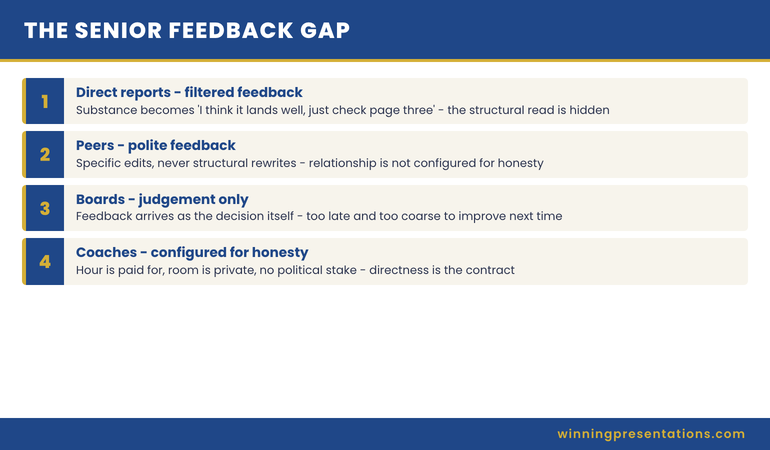
Boards are the worst. The board is not in the room to coach you. The board is in the room to assess. Feedback from a board arrives as the decision itself — approved, deferred, declined — and that feedback is far too late and far too coarse to improve the next presentation in time. By the time a board signals it is unhappy with the cadence of your updates, you have lost three quarters.
A coach closes the gap. The hour is configured for honesty. The relationship is not contaminated by political stakes. The coach has nothing to gain from being polite and nothing to lose from being precise. That structural design is what senior presenters are paying for. It is the only role in the system where directness is the contract.
For senior professionals who want a structured outside view
The Executive Buy-In Presentation System — the framework before, alongside, or after 1:1 coaching
The Executive Buy-In Presentation System is a self-paced programme for senior professionals who need to secure approval from boards, executive sponsors, and reluctant stakeholders. 7 modules, no deadlines, no mandatory session attendance. Optional live Q&A calls are fully recorded so you can watch back at any time. Many participants use it before engaging a 1:1 coach, or as a structural framework that lets coaching focus on delivery rather than rebuilding the deck.
- 7 self-paced modules covering stakeholder analysis, case construction, and the presentation structures that hold up under board scrutiny
- Optional live Q&A / coaching calls — fully recorded, watch back at your own pace
- No deadlines, no mandatory live attendance, lifetime access to materials
- Monthly cohort enrolment — enrol any time, start with the next cohort
£499 · Self-paced · Lifetime access to materials · Next cohort enrolment opens monthly
What coaching actually changes
The casual assumption is that coaching changes delivery — voice, pace, presence on stage. At senior level it rarely does, because senior presenters arrive already calibrated on those dimensions. The work is elsewhere. Five things change reliably under coaching, and most of them are upstream of delivery.
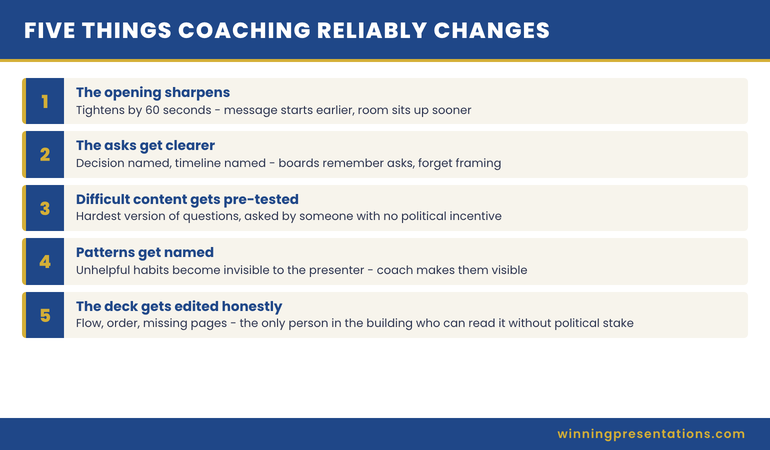
The opening sharpens. Senior presenters tend to drift into a familiar opening they have used for years. A coach catches the drift in the first session. The opening tightens by sixty seconds, the message starts earlier, and the room sits up sooner. The improvement is structural, not stylistic.
The asks get clearer. Most senior presentations end vaguely. The presenter knows what they want from the room but does not name it. A coach surfaces this in rehearsal — what is the ask, what is the decision, what is the timeline — and the presenter learns to land it. Boards remember the ask. They forget the framing around it.
Difficult content gets pre-tested. A coach is the safe place to rehearse the slide where the numbers are uncomfortable, the recommendation is contested, or the politics are visible. The presenter walks into the meeting having already heard the hardest version of the questions, asked by someone with no incentive to be polite. The room rarely produces a worse version.
Patterns get named. A senior presenter who has run two hundred meetings over fifteen years has developed both useful habits and unhelpful ones. The unhelpful ones become invisible to the person doing them. A coach names the pattern, the presenter recognises it, and an entire category of small failures disappears in the next quarter.
The deck gets edited by someone with no political stake. The single most underrated thing a coach does is read the deck. Not the slides — the deck. The flow, the order, the pages that should not exist, the missing page that should. A senior presenter rarely has anyone in the building who can do this honestly. The coach can.
When a structured cohort substitutes for a coach
Not every senior presenter needs a coach on retainer. The economics only make sense for people who present in high-stakes contexts repeatedly — quarterly earnings, capital markets days, frequent board outings, regulatory hearings. For senior professionals who present meaningfully four to eight times a year, a structured cohort programme often delivers seventy per cent of the value at five to ten per cent of the cost.
A structured programme replaces the 1:1 with three things. First, modular content — a coach would walk you through the same material in conversation; a programme structures it once and lets you work through it at your own pace. Second, group Q&A — a coach answers your questions; a programme lets you hear the questions other senior presenters are asking, which often surfaces gaps you would not have asked about yourself. Third, structural feedback — through templates, checklists, and the discipline of working through a coherent framework.
The trade-off is real. A programme cannot read your specific deck and tell you what is wrong. A 1:1 coach can. For most senior presenters, the right pattern is to start with the structured programme, internalise the framework, and then engage 1:1 coaching for the highest-stakes meetings — the capital markets day, the regulatory hearing, the activist investor pitch. Use the programme for the standing rhythm. Use the coach for the consequential moments.
There is also the timing question. Coaches are usually engaged late — three weeks before the meeting, when there is too little time to do real structural work. A cohort programme is the inverse. It builds the framework slowly, in advance, when the pressure is low. By the time the high-stakes meeting arrives, the structural work is already done. Coaching can then focus on the two or three things that are specific to that one meeting.
For senior professionals who also present AI-assisted or AI-generated decks, a parallel question arises about whether AI tools change the calculation. They do not replace coaching, but they alter where coaching effort lands — see the related discussion of board-ready presentation structures for senior presenters working at this altitude.
Companion programme for AI-assisted senior presenters
Maven AI-Enhanced Presentation Mastery — for senior professionals using AI to build executive-grade decks
A self-paced programme on prompt engineering, AI workflows, and the editorial judgement that separates AI-drafted slides from board-ready ones. 8 modules, 83 lessons, 2 optional live coaching sessions (fully recorded). £499, lifetime access. Explore the AI-Enhanced programme →
How to find a coach who works at this level
Finding a coach who works at senior level is harder than the market suggests. Three filters narrow the field quickly. The first is industry context. A coach who has only worked with TED-style speakers will not understand the rhythms of a board meeting, the politics of a capital markets day, or the specific scrutiny of a regulator. Senior presentation work is its own discipline. Generalists struggle.
The second filter is willingness to dismantle a draft. The polite coach is the wrong coach. The right coach will tell you, in the first hour, that page four does not work and page seven should be page two. If you finish a session feeling reassured, you have probably hired the wrong person. The session should leave you with structural work to do.
The third filter is the relationship architecture. A coach engaged for a single meeting works on delivery. A coach engaged across cycles works on patterns. The latter is dramatically more valuable but requires the coach to stay close enough to your work to see what is changing and what is not. Most senior presenters who derive long-term value from coaching have found a coach they have used for three or more cycles.
There is a fourth, less discussed filter. The coach must have nothing to gain from being polite. Coaches who work primarily within your organisation, your sector, or your peer network are structurally compromised. The right coach is far enough outside that the only currency in the relationship is the work itself. That is the configuration that produces honest feedback. Anything closer dilutes it.
Frequently asked questions
Do most CEOs actually have presentation coaches?
More than the public assumes. Most listed-company CEOs have at least episodic coaching arrangements, particularly around earnings, AGMs, and capital markets days. Many private-equity-backed CEOs use coaching more continuously because investor presentations recur on a tighter cycle. The pattern is not about ability — it is about the structural feedback gap that coaching solves.
Can a coach be replaced by a senior peer or mentor?
Partially, but rarely fully. A peer can give you a directional read. A mentor can give you context about the room. Neither will dismantle a draft on a paid hour with no political stake. The combination of structure, time, and incentive alignment is what makes coaching different. A peer cannot replicate the relationship architecture, even when the underlying skill is similar.
When is a structured programme the better fit than 1:1 coaching?
When you present meaningfully four to eight times a year and need a framework you can apply repeatedly. A 1:1 coach is best for high-stakes one-off events — capital markets days, regulatory hearings, activist investor pitches. A structured programme like the Executive Buy-In Presentation System gives you the framework, then 1:1 coaching can be reserved for the few meetings where the marginal value is highest.
How much does a senior-level presentation coach cost?
A senior-level 1:1 coach typically costs in the low thousands per engagement for a single high-stakes meeting, and rises into mid-five-figure annual retainers for executives who use coaching across cycles. The economics make sense above a certain stake threshold. For senior presenters with lower presentation frequency, a structured programme at £499 covers the framework needs without the retainer cost.
Maven cohort enrolment — closing this week
The structured framework most senior presenters use before engaging 1:1 coaching
The Executive Buy-In Presentation System is the self-paced framework for senior professionals who present to boards, executive sponsors, and reluctant stakeholders. 7 modules, monthly cohort enrolment, optional live Q&A calls (fully recorded). The current cohort closes this week — enrolment then re-opens with the next monthly cohort.
- 7 self-paced modules — work through at your own pace, no deadlines
- Optional live Q&A calls — fully recorded, watch back any time
- Monthly cohort enrolment — enrol any time, start with the next cohort
- Lifetime access to all materials, no subscription, no expiry
£499 · Self-paced · Lifetime access · Next cohort enrolment opens monthly
The Winning Edge — weekly
One short note each Thursday on board-level presentation patterns, structural shortcuts, and the behaviours senior presenters use under scrutiny. Written for professionals who do not have time for newsletters that read like newsletters.
Want a starting point first? The free Executive Presentation Checklist covers the structural fundamentals senior presenters use before booking coaching time.
For a wider view of how this fits into board-level presentation work, see the related piece on presenting to the board with confidence — the behavioural ground that coaching builds on.
Next step: Map your next four senior presentations. Identify which one carries the highest stake. That is the meeting worth a coach. The other three are the meetings worth a structured framework. Book the coaching for the first. Enrol in the framework for the rest.
Mary Beth Hazeldine is the Owner & Managing Director of Winning Presentations. With 25 years of corporate banking experience at JPMorgan Chase, PwC, Royal Bank of Scotland, and Commerzbank, she advises senior professionals across financial services, healthcare, technology, and government on structuring presentations for high-stakes board meetings, investment committees, and executive sessions. She speaks German and works extensively with the German-speaking financial markets.