

Ngozi had been rehearsing her investor pitch for six weeks. Everything was locked down—data, timings, even her opening joke. But thirty minutes before the call, she opened her laptop camera and her hands were shaking so badly she could barely read the screen. Not from doubt. From her nervous system reading the moment as a threat. The body scan technique was the first thing that reset that signal in under two minutes.
Presenting this week and need a technique that works fast?
If breathing exercises haven’t been enough and your anxiety starts in your body before it reaches your mind, the body scan technique targets the physical layer where presentation fear actually lives. Conquer Speaking Fear is a programme built from clinical hypnotherapy approaches that include the body scan alongside deeper nervous system regulation techniques.
Jump to Section
- How Ngozi Discovered Body Scanning Under Pressure
- Why Your Body Panics Before Your Mind Does
- The 90-Second Body Scan: Step by Step
- Why This Works When Breathing Exercises Don’t
- When to Use the Body Scan (and When You Need Something Deeper)
- Making It Automatic: The 7-Day Practice Protocol
- Frequently Asked Questions
Ngozi spent weeks preparing her Series A pitch. Financials perfect. Slide transitions polished. She could recite her story in her sleep. But thirty minutes before the Zoom call with three partners, her hands started shaking. Not trembling—visibly shaking. She could barely click her mouse. Her mind knew she was ready. Her nervous system didn’t agree. She’d heard about body scanning somewhere—a LinkedIn article, a podcast—and had nothing to lose. She gave herself ninety seconds. Shoulders down. Jaw unclenched. One slow breath. By the time the call started, her hands were steady and her voice was clear. She secured £1.2 million that day. The body scan was the first technique that told her nervous system it was safe to let her mind do its job.
Reset Your Nervous System Before Your Next Presentation—Without Medication
- A programme using clinical hypnotherapy techniques to retrain your body’s response to presentation pressure—starting with the body scan and building to deeper nervous system regulation
- Techniques designed for the 90 seconds before you present, not 90 minutes of meditation you don’t have time for
- Methods that target the physical layer of anxiety (shaking, voice cracking, racing heart) because that’s where presentation fear actually lives
- Evidence-based approaches from clinical hypnotherapy, not generic “just breathe” advice that hasn’t worked
Explore Conquer Speaking Fear →
Built from nervous system regulation techniques developed with clinical hypnotherapy methods—approaches that address the physical foundations of presentation anxiety.
Why Your Body Panics Before Your Mind Does
Presentation anxiety doesn’t start in your head. It starts in your body.
Your amygdala detects a threat—a room full of senior executives watching you—and triggers the sympathetic nervous system before your conscious mind even registers what’s happening. By the time you think “I’m nervous,” your body has already decided: heart rate up, muscles tense, blood diverted from your digestive system to your limbs, vocal cords tightening.
This is why telling yourself to “calm down” doesn’t work. Your conscious mind is trying to override a survival response that operates faster than thought. The body scan technique works because it doesn’t try to override anything. It redirects your brain’s attention from external threat scanning to internal body awareness—and that attention shift is enough to interrupt the cascade.
The neuroscience is straightforward: your brain can’t simultaneously scan for threats and observe its own physical sensations in detail. When you systematically notice “my shoulders are tense, my jaw is clenched, my hands are gripping,” you’re occupying the neural circuits that were busy amplifying the alarm signal. The fight-or-flight response doesn’t stop—but it drops to a level where your prefrontal cortex can function again.
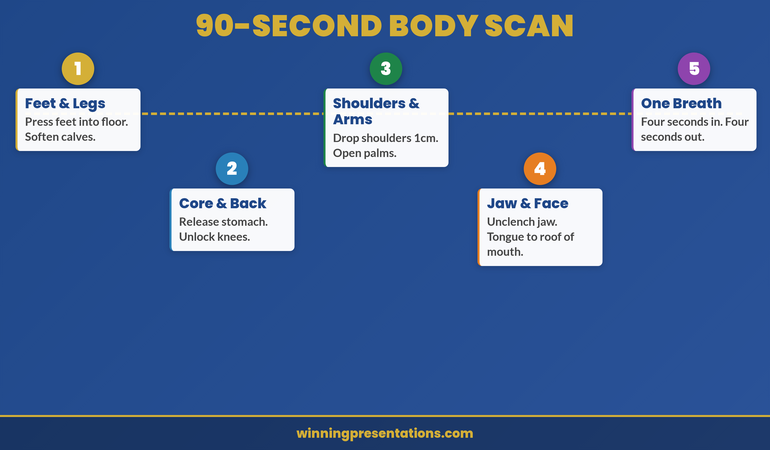
The 90-Second Body Scan: Step by Step
You can do this standing in a corridor, sitting in a waiting area, or in the toilets two minutes before your slot. Nobody will notice. That’s the point.
Seconds 1-15: Feet and legs. Press your feet deliberately into the floor. Notice the weight distribution—are you leaning forward? Shift back slightly. Feel the contact between your shoes and the ground. Notice your calf muscles. Are they braced? Let them soften. Not relax—soften. There’s a difference. Relaxing implies effort. Softening implies permission.
Seconds 16-30: Core and back. Notice your stomach. Is it clenched? Most anxious presenters brace their core without realising it—as if preparing for a physical impact. Let it release. Notice your lower back. If you’re standing, unlock your knees slightly. Your body will interpret this micro-adjustment as “we’re not in danger” because locked muscles signal threat readiness to your nervous system.
Seconds 31-50: Shoulders and arms. Drop your shoulders one centimetre. That’s all. Most people carry their shoulders closer to their ears when anxious—a defensive posture your body adopted before you noticed. Let your arms hang. If you’re holding notes or a laptop, set them down briefly. Open your palms for three seconds. Your nervous system reads open hands as “no threat detected.”
Seconds 51-70: Jaw and face. Unclench your jaw. Touch your tongue to the roof of your mouth—this is a clinical trick that relaxes the masseter muscle and sends a calm signal through the vagus nerve. Let your forehead smooth. If your brow is furrowed, it’s because your brain is in problem-solving mode. You don’t need to solve anything right now.
Seconds 71-90: One breath. Take one slow breath through your nose. Not deep—slow. Four seconds in, four seconds out. This single breath is the capstone, not the foundation. The body scan has already done the heavy lifting. The breath just confirms to your nervous system: we’re ready.
Why This Works When Breathing Exercises Don’t
When working with executives on presentation anxiety, the most common feedback is: “I tried breathing exercises and they didn’t fully resolve the physical symptoms.”
Here’s why. Breathing techniques target one symptom (rapid breathing) and hope the rest of the anxiety cascade follows. Sometimes it does. Often it doesn’t—because your body is still braced for impact in every other muscle group. You’ve slowed your breathing, but your shoulders are still at your ears, your jaw is still clenched, and your hands are still gripping the clicker like a weapon.
The body scan works differently. Instead of targeting one symptom, it addresses the entire physical anxiety pattern systematically. By the time you reach the breath at the end, your body has already shifted out of high alert. The breath becomes confirmation, not intervention.
There’s another reason. Breathing exercises require you to do something—and when you’re anxious, “doing something” can feel like another performance demand. The body scan asks you to notice, not to perform. Noticing is passive. Your anxiety can’t turn noticing into another source of pressure.
This distinction matters in the context of NLP anchoring techniques too. The body scan creates a foundation state that anchoring techniques can build on. Without the physical reset first, anchoring a confident state onto a tense body doesn’t hold.
Breathing Exercises Haven’t Been Enough?
The body scan is just the entry point. Conquer Speaking Fear builds the complete nervous system regulation system—body scan, reframing, and approaches from clinical hypnotherapy.
When to Use the Body Scan (and When You Need Something Deeper)
The body scan is a pre-presentation tool. It works in the 90 seconds before you walk into the room. It doesn’t fix what happens the night before, the week before, or the career-long pattern that makes presenting feel dangerous.
Use the body scan when your anxiety is situational—it spikes before the presentation and settles afterward. It works well for quarterly reviews, team updates, client meetings, and any scenario where you know you can present competently but your body doesn’t seem to agree.
You need something deeper when the anxiety starts days before the presentation. When you’re losing sleep on Sunday night because of a Tuesday meeting. When you’re rehearsing not the content but the escape routes—which door is closest, what excuse gets you out. When the anxiety has shifted from “I’m nervous about this presentation” to “I’m a person who can’t present.”
That shift—from situational anxiety to identity-level anxiety—is where the body scan reaches its limit and clinical-grade techniques become necessary. The body scan can interrupt a fight-or-flight response. It can’t reprogram the belief system that triggers the response in the first place.
If this resonates, you’re not failing at anxiety management. You’re using the right technique for the wrong layer of the problem.
Making It Automatic: The 7-Day Practice Protocol
The body scan is a skill. Like any skill, it gets faster and more effective with practice. Here’s how to make it automatic before your next presentation.
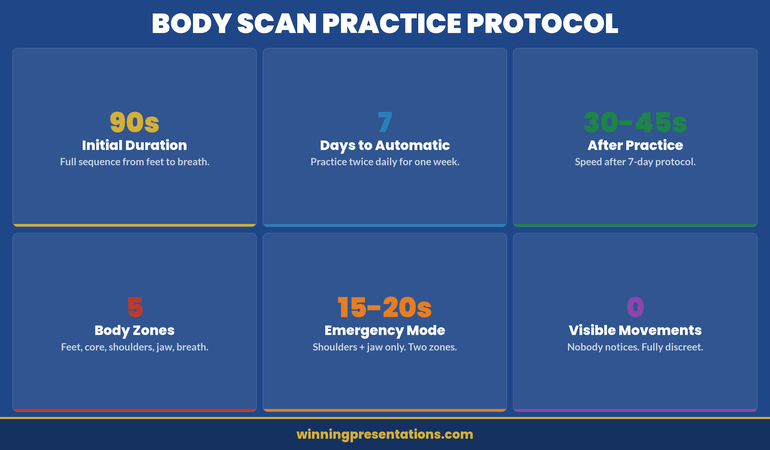
Days 1-2: Practice at home. Do the full 90-second body scan twice daily—morning and evening. You’re training the neural pathway, not managing anxiety. Do it when you’re already calm so your body learns the sequence without the interference of real stress.
Days 3-4: Practice in low-stakes moments. Before a team meeting. Before a phone call. Before opening your laptop in the morning. You’re teaching your body that the scan is a normal transition, not an emergency measure.
Days 5-6: Speed it up. By now, you know the sequence. Try completing it in 60 seconds, then 45. Your body will start anticipating each zone—feet, core, shoulders, jaw, breath—before you consciously direct attention there. This is the automaticity you need.
Day 7: Test under mild pressure. Use it before a slightly uncomfortable conversation—a feedback session, a negotiation, a meeting with someone senior. Not a boardroom presentation yet. This intermediate step builds confidence in the technique before high stakes demand it.
After seven days, most people report that the body scan takes 30-45 seconds and produces a noticeable shift in physical state. Some report that simply thinking “body scan” triggers a micro-release in their shoulders and jaw—the sequence has become a mental shortcut.
Stop Dreading the Physical Symptoms That Derail Your Presentations
- Programme that builds from the body scan technique to deeper nervous system regulation—so physical anxiety symptoms become manageable, then minimal
- Clinical hypnotherapy methods that target the root cause, not just the symptoms—for executives who’ve tried breathing exercises and need something that goes further
Designed to address the root patterns of presentation anxiety—because managing symptoms and resolving underlying patterns require different approaches.
People Also Ask
Can the body scan technique work for severe presentation anxiety?
Is the body scan technique the same as mindfulness meditation?
What if I don’t have 90 seconds before my presentation?
Is This Approach Right for You?
This is for you if:
- Your presentation anxiety shows up physically—shaking hands, tight chest, racing heart, voice changes—before you’ve even started speaking
- Breathing exercises help a little but don’t fully resolve the physical symptoms
- You want a technique you can use discreetly in any setting, without anyone noticing
- You’re willing to practise for 7 days to make the technique automatic
This is NOT for you if:
- Your anxiety is primarily cognitive (racing thoughts, catastrophising) with minimal physical symptoms—you may benefit more from cognitive reframing techniques
- You need a technique that works immediately with zero practice—the body scan requires a 7-day training period to become fast and automatic
- Your presentation anxiety is managed well by current techniques—if what you’re doing works, keep doing it
Frequently Asked Questions
I’ve tried body scans before and they didn’t help with my presentation nerves. What’s different about this approach?
Can I combine the body scan with beta blockers or medication?
Will people notice I’m doing a body scan before presenting?
The Winning Edge — Weekly
Presentation confidence strategies, anxiety management techniques, and executive communication insights. One email weekly. Built for executives who take presenting seriously.
Read These Next
About the Author
Mary Beth Hazeldine is Owner & Managing Director of Winning Presentations. With 24 years of corporate banking experience at JPMorgan Chase, PwC, Royal Bank of Scotland, and Commerzbank, she advises executives across financial services, healthcare, technology, and government on structuring presentations for high-stakes funding rounds and approvals.