

Quick answer: Most senior leaders evaluating a ChatGPT prompts course online are confusing two distinct purchases: a tactical prompt library (what to type) and a strategic AI presentation programme (how to integrate AI into the executive workflow). They are not the same product and they have very different price points. The tactical purchase is a prompt library — typically twenty to a hundred prompts, instant download, under fifty pounds. The strategic purchase is a programme — typically modules, structured lessons, optional coaching, several hundred pounds. This guide separates the two, names what to look for in each, and helps you avoid paying programme prices for a prompt library or vice versa.
Jump to
The ChatGPT prompts course market for senior leaders is genuinely confusing right now. A search returns results ranging from nine-pound prompt downloads to nine-thousand-pound executive AI programmes. The marketing copy across the range uses overlapping language — “executive prompts”, “advanced techniques”, “boardroom-ready” — and most of it does not give a clear enough description of the actual deliverable to support a confident purchase. Senior leaders end up buying based on price (cheapest looks risky, most expensive feels safer) rather than based on fit.
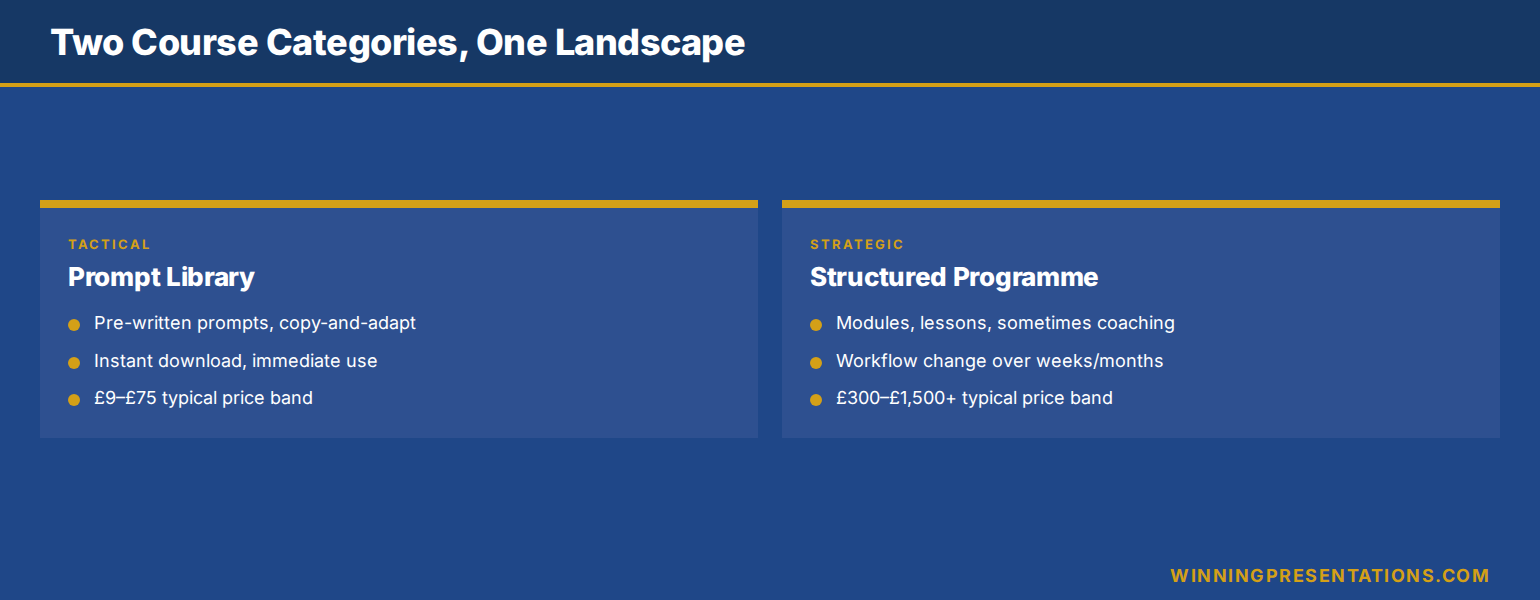
The clarity that helps is recognising that the underlying market has split into two distinct product categories. Tactical: a prompt library you copy and adapt, designed for immediate use, low price, instant access. Strategic: a structured programme that teaches the workflow and judgement around AI use, designed for sustained adoption, higher price, modular learning. Both are legitimate. Neither is a substitute for the other. The first question for any senior leader evaluating a ChatGPT prompts course is which of the two they are actually shopping for.
This guide covers both, names what to look for in each, gives the quality tests that separate strong courses from weak ones, and is honest about what no course can fix. We sell products in both categories — the Executive Prompt Pack at nineteen ninety-nine, and the Maven AI-Enhanced Presentation Mastery course at four hundred and ninety-nine — and we will explain where each sits in the landscape rather than pretending one product is the answer to every question.
Looking for the tactical prompt library now?
The Executive Prompt Pack is a seventy-one-prompt library for ChatGPT and Copilot, designed specifically for executive presentations. Instant download, copy-and-adapt format, voice-constrained for senior audiences. Useful in the next presentation you have on your calendar.
Two purchases that look like one
The first thing to clarify before evaluating any ChatGPT prompts course for executives is which of the two underlying products you are buying. Both call themselves courses. Both will mention prompts. The difference is what you walk away with.
A prompt library is a finished resource — typically a PDF, a Notion page, or a downloadable pack — containing pre-written prompts you can copy and adapt for your own work. The pricing tends to sit between nine and seventy-five pounds. The use case is immediate: you have an executive presentation on Wednesday, you need a prompt that produces a board-grade executive summary, and a strong prompt library has the prompt ready to copy. The value is delivered the moment you open the file.
A structured programme is a course in the traditional sense — modules, lessons, possibly live or recorded coaching, a community or peer cohort, structured progression. The pricing typically sits between three hundred and several thousand pounds. The use case is longer-term: you are integrating AI into the way your function operates, you need to build judgement about when to use AI and when not to, and you want a coach or peer group to test your work against. The value is delivered over the weeks and months you spend working through the material. A structured AI presentation mastery course sits in this category — the deliverable is the workflow change, not the prompts themselves.
Buying the wrong one for your need is the most expensive mistake. A senior leader who needs a prompt library and pays four hundred pounds for a programme will resent the time commitment. A senior leader who needs the workflow change and pays nineteen pounds for a prompt library will get short-term productivity but no durable shift in how they use AI. Naming the actual need first — tactical or strategic — saves both money and time.
What a prompt library buys you
A well-built executive prompt library buys you back time on the structural drafting work that AI is genuinely good at. The first draft of an executive summary, the bridge slide on a budget presentation, the variance commentary in a finance pack, the board pre-read paragraph for a strategic decision — all of these are tasks where a structured prompt cuts the drafting time from hours to minutes. The quality of the output depends almost entirely on the prompt; a strong prompt produces a usable draft, a generic prompt produces a generic output.
What a prompt library does not buy you is judgement about when to use AI. The prompts work; the discipline of when and where to apply them is yours. A senior leader with a strong prompt library still needs to decide which work goes through AI and which does not, where the editing pass needs to be heaviest, and when a prompt’s output is the right starting point versus when it is sending the work in the wrong direction. The library is a multiplier on that judgement, not a substitute for it.
The best use case for a prompt library is the senior leader who already knows roughly what they want from AI and just needs the tactical input to get there faster. Most CFOs, finance directors, programme leaders, and sales directors fit this profile. They are not asking how AI works. They are asking what the prompt is that produces the output they want, and they want that prompt now, not after a six-week course.
The 71-prompt library built for executive presentations
The Executive Prompt Pack is a practical seventy-one-prompt library for ChatGPT and Copilot, built specifically for senior professionals producing executive presentations. £19.99, instant download, copy-and-adapt format. Useful in the next deck on your calendar.
- 71 ChatGPT and Copilot prompts engineered for PowerPoint presentations
- Strategic narrative, variance framing, executive summary, risk and Q&A pre-empt prompts
- Voice-constrained — built to avoid the generic AI tone senior audiences reject
- Works inside ChatGPT and Copilot for PowerPoint — copy, paste, adapt
- Designed for executive presentations: budget, board, investment committee, steering
Get the Executive Prompt Pack →
Built for senior professionals presenting executive material under time pressure.
What a structured programme buys you
A structured AI programme for executives buys you the workflow change rather than the prompts themselves. The deliverable is not “here is the prompt”; the deliverable is “here is how you think about integrating AI into the way your function works, with the prompts and structures and judgement calls that go with that thinking”. The output is a sustained change in how you and your team use AI, not a stack of copy-paste resources.
The case for the programme purchase is strongest when the senior leader is in a position to influence not just their own AI use but their team’s. A function head deciding how AI gets adopted across a finance team, a CIO building an AI-literate operating model, a sales VP standing up an AI-assisted forecast cadence — all of these need the strategic frame the programme provides, because the deliverable they are after is organisational rather than personal. The prompts matter; they are not the load-bearing element.
The Maven AI-Enhanced Presentation Mastery course is the structured programme in our catalogue. It is a self-paced programme, not a live cohort — eight modules, eighty-three lessons, two optional live coaching sessions that are fully recorded so you can watch back anytime. New cohort opens every month, no deadlines, no mandatory session attendance, lifetime access to materials. The price is four hundred and ninety-nine pounds. It is the right purchase if you are integrating AI into a function or team; it is over-specified if you just need prompts for next week’s presentation.
Five quality tests for a prompt course
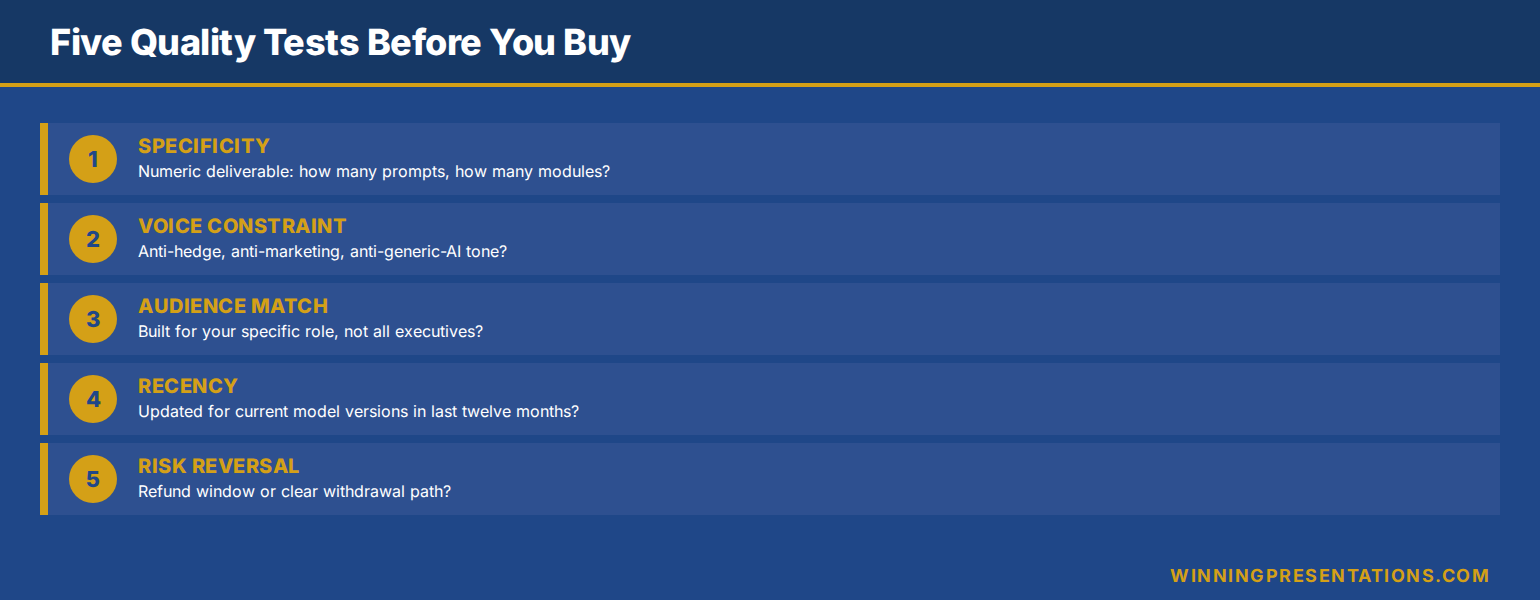
Whichever category you are shopping in — prompt library or programme — five tests separate the strong courses from the weak ones. Run a course past these five tests before paying.
The first test is specificity. Strong courses describe their actual deliverable in concrete numeric terms: “seventy-one prompts” or “eight modules, eighty-three lessons” or “twelve scenario walk-throughs”. Weak courses describe their deliverable in language: “comprehensive prompt library”, “executive-grade content”, “advanced techniques”. If you cannot count what you are getting, the deliverable is probably under-specified. A clear ChatGPT prompts library specification always tells you exactly what is in the file before you buy.
The second test is voice constraint. Strong prompt courses are explicit about constraining the output voice — anti-hedge, anti-marketing, anti-generic-AI tone. The marketing language gives this away: it talks about producing output “senior audiences read fluently” or “without the generic AI feel”. Weak courses produce prompts that yield Copilot’s defaults dressed in different clothes. If the demo prompts use phrases like “drive sustainable growth” or “leverage strategic capability”, the voice constraint is not in the prompt.
The third test is audience match. Strong courses are explicit about who they are for: CFOs, programme managers, sales leaders, board chairs. Weak courses target “executives” generally. The difference shows up in the prompt structure — a prompt for a CFO budget presentation needs different framing from a prompt for a CIO architecture review. If the course’s prompts read as one-size-fits-all, the structural work has not been done.
The fourth test is recency. AI tools change quickly; prompts that worked in early 2024 may not work as cleanly with current Copilot or ChatGPT versions. Strong courses are explicit about when they were last updated and which model versions they have been tested against. Weak courses are silent on this. The marketing copy giveaway is whether the course names a specific version date in the last twelve months.
The fifth test is the refund or risk-reversal stance. Strong courses offer either an instant download with a refund window or a clear cohort-enrolment policy with a withdrawal clause. Weak courses sell forward into a multi-week programme with no withdrawal path, which is the structure that traps senior leaders into completing a course they realised in week two was not what they needed. Risk reversal is a quality signal because it requires the course author to stand behind the deliverable.
Picking the right one for your role
The role-by-role read on which category to buy is reasonably stable. CFOs, finance directors, and senior finance professionals tend to need the prompt library — the executive presentation work is the bottleneck, AI use is already familiar enough, the structural change has happened. The prompt library buys back the drafting time. Function heads and senior people leaders integrating AI into a team’s standing workflow tend to need the programme — the deliverable is organisational, the prompt library is necessary but not sufficient.
Programme managers and PMO leaders fall in either category depending on scope. For a single programme manager rebuilding their own status reporting, the prompt library is the right purchase. For a head of PMO standing up an AI-assisted reporting cadence across twenty programmes, the programme is the right purchase — the strategic judgement about when to use AI matters more than any individual prompt.
Sales directors and commercial leaders tend to need the prompt library first and the programme later. The pipeline deck, QBR, and forecast presentations have predictable structures and the prompts close the gap fast. The programme becomes valuable later, when the leader is rolling AI workflows out across a regional or country team rather than just using them personally. The Executive Prompt Pack is the right starting point for the personal-use case; the Maven AI-Enhanced course is the right next step when the use case becomes team-wide.
For the team-wide AI workflow, not just personal prompts.
The Maven AI-Enhanced Presentation Mastery course is the self-paced programme for senior professionals using AI to build executive-grade presentations. 8 modules, 83 lessons, 2 optional recorded coaching sessions. £499, lifetime access — monthly cohort enrolment, no deadlines, no mandatory attendance.
What no course will fix for you
Three things sit outside what any ChatGPT prompts course or AI programme can fix, and being honest about them protects you from courses that pretend otherwise.
The first is the editorial judgement that distinguishes usable AI output from publishable AI output. Every prompt produces a draft. The draft becomes a finished executive document only after the editor — you — has read it, weighed it against the audience and the political weather, and rewritten the parts that do not land. No course will give you that judgement; it is built through the work itself, by editing AI output across enough situations to know what to keep and what to cut.
The second is the proof discipline that makes claims defensible. AI will state things confidently that the underlying source data does not support. The verification step — checking every numeric claim against the budget pack, every strategic assertion against the actual plan, every commentary line against the sourced evidence — is where AI use lives or dies in executive contexts. The senior leader who skips this step ends up with a beautifully drafted deck containing one fabricated number that derails the meeting. Courses can teach the discipline; only the working habit makes it real.
The third is the political read of the room. The strongest prompt in the world cannot tell you whether your CFO’s mood today is open to a stretch budget or insistent on a tight one. AI does not know your colleagues. The structural drafting it produces will be technically correct and politically blind. The senior leader’s job is to bend the structurally correct draft around the political reality of the audience. That bending is the irreducible human work, and no course or prompt library is going to remove it.
Start with the prompt library, not the programme.
The Executive Prompt Pack — £19.99, instant download — is the practical seventy-one-prompt library for ChatGPT and Copilot built specifically for executive presentations. Use it in your next deck this week, not in your next quarter’s training plan.
Get the Executive Prompt Pack →
For senior professionals who want the prompts now, not a six-week course.
FAQ
What is the difference between a ChatGPT prompts course and a Copilot prompts course?
For executive presentation work, very little. The prompt structures that work in ChatGPT generally work in Copilot for PowerPoint with minor adjustments — Copilot has tighter integration with the Microsoft 365 file context, ChatGPT has slightly stronger handling of long-form analytical text. Strong prompt libraries are written to work in both, with model-specific notes where the prompts need to differ. If a course claims to work only in ChatGPT or only in Copilot, that is a quality signal in the wrong direction; the underlying prompt structures should transfer.
How quickly can I see value from a ChatGPT prompts course as a senior leader?
From a prompt library, value should arrive within the first week — typically the first executive presentation or report you produce after downloading the prompts. If a prompt library has not produced a measurable time saving on a real piece of work within ten days, the prompts are probably not specific enough to your use case. From a structured programme, expect three to six weeks before the workflow change is visible in your output, and three to six months before it is visible in your team’s. The programme purchase is a longer arc; the prompt library is a faster one.
Are free ChatGPT prompts available online a substitute for a paid course?
For general-purpose prompts, the free libraries are reasonable. For executive presentation work specifically, they tend to be too generic — written for any business audience, no voice constraint, no scenario tuning. The cost difference between free prompts and a paid library is usually small in absolute terms (twenty pounds versus zero) but the quality difference shows up immediately in the output. The honest answer is that free prompts are fine for low-stakes work and a small paid library is worth it for executive presentations where the audience is reading for fluency markers.
If I buy the prompt library and later want the programme, do I lose the prompt-library spend?
In our case, no — the Executive Prompt Pack is a stand-alone resource at nineteen ninety-nine, and the Maven AI-Enhanced Presentation Mastery course is a separate purchase at four hundred and ninety-nine that does not require or build on the prompt pack. They are complementary purchases for different needs. If you buy the prompt pack first and find yourself needing the programme later, the spend on the pack is not wasted — the prompts continue to be useful inside the programme’s workflow framework. Other vendors structure this differently; check the upgrade path before assuming.
The Winning Edge — Thursday newsletter
Every Thursday, The Winning Edge delivers one structural insight for executives presenting to boards, investment committees, and senior stakeholders. No general tips. No motivational framing. One specific technique, one executive scenario, one action. Subscribe to The Winning Edge →
Not ready to buy? Start here: download the free Executive Presentation Checklist — a single-page review you can run on any executive presentation before you walk in.
Next step: name your actual need. Tactical (you have a presentation this week and need a prompt that produces a usable draft) or strategic (you are integrating AI into a team’s workflow over months). The honest answer to that question is the answer to the buying decision, and the answer rarely changes once you have it.
Related reading: a working ChatGPT prompts library for PowerPoint presentations, and copilot prompts for executive presentations across the wider executive deck library.
About the author. Mary Beth Hazeldine is Owner & Managing Director of Winning Presentations Ltd, founded in 1990. With 25 years of corporate banking experience at JPMorgan Chase, PwC, Royal Bank of Scotland, and Commerzbank, she advises executives across financial services, healthcare, technology, and government on structuring presentations for high-stakes funding rounds, approvals, and board-level decisions.