

Off-topic questions in presentations are rarely accidental. They signal that someone in the room has an agenda that doesn’t align with yours, a concern that your presentation hasn’t addressed, or a need to demonstrate their own knowledge. How you redirect determines whether the room stays with you or fractures into competing conversations. Here’s how to handle it with authority and respect.
Soren was presenting a supply chain resilience update to the operations committee when the CFO interrupted with a question about headcount reductions in the logistics team. It had nothing to do with supply chain resilience—it was a budget question that belonged in the financial review the following week. But Soren had been in enough of these meetings to understand what was really happening. The CFO wasn’t confused about the agenda. He was signalling to the committee that cost management was his priority, regardless of the topic on the table. Soren had a choice: answer the headcount question and lose fifteen minutes of his allocated time, or dismiss it and create an adversary. He did neither. “That’s an important question, and I want to give it the detail it deserves,” he said. “The headcount numbers sit within the broader workforce planning paper for next week’s financial review. I’ll make sure you have the breakdown before that meeting. Can I continue with the resilience framework for the remaining time?” The CFO nodded. Soren kept the room. Crucially, he followed up the next morning with the headcount data. The CFO never interrupted him again.
Want a structured approach to handling difficult Q&A? The Executive Q&A Handling System includes frameworks for redirecting, bridging, and managing challenging questions in high-stakes meetings.
Jump to section:
Why Off-Topic Questions Happen: The Four Hidden Motives
Understanding why someone asks an off-topic question changes how you respond. Most presenters treat off-topic questions as confusion—the asker didn’t understand the scope, didn’t read the agenda, or simply drifted. That’s occasionally true. More often, off-topic questions are strategic, and recognising the strategy allows you to respond with precision rather than frustration.
Motive 1: Territory marking. The asker wants to signal their own priority to the room. The CFO’s headcount question in Soren’s meeting wasn’t about headcount—it was about asserting that financial discipline is never off the table. Responding to the content of the question misses the real communication. Acknowledging the importance of the topic whilst redirecting to the appropriate forum addresses the motive without derailing your presentation.
Motive 2: Genuine concern that your presentation hasn’t addressed. Sometimes the off-topic question is a signal that your scope was too narrow for the audience. If three people in the room are worried about budget implications and your presentation only covers operational metrics, the “off-topic” budget question is actually the most important question in the room. Recognise this and adapt. “I can see the cost dimension is important to this group. Let me address that briefly before continuing.”
Motive 3: Status assertion. Some stakeholders ask off-topic questions to demonstrate their breadth of knowledge or their seniority. The question is not seeking information—it’s seeking acknowledgement. The response that works here is brief validation followed by a redirect: “You’re raising an important point about regulatory implications. That’s being addressed separately by the compliance team. Let me continue with the operational framework.”
Motive 4: Deliberate disruption. Occasionally, a stakeholder uses off-topic questions to derail a presentation they oppose. This is the most difficult motive to address because responding to each question consumes time, which is exactly the disruptor’s objective. The technique here is pattern recognition: after the second off-topic question from the same person, name the pattern gently. “I notice we’re pulling into several areas outside today’s scope. Can I suggest we complete the resilience framework first, then open the floor for broader discussion?”
Handle Every Q&A Scenario With Confidence
The Executive Q&A Handling System gives you frameworks for redirecting off-topic questions, bridging to your key messages, and managing challenging Q&A dynamics in high-stakes meetings.
- ✓ Question redirection and bridging frameworks
- ✓ Scenario guides for difficult Q&A situations
- ✓ Preparation templates for anticipating challenging questions
Get the Q&A Handling System → £39
Designed for executives who face challenging Q&A sessions
The Acknowledge-Redirect Framework
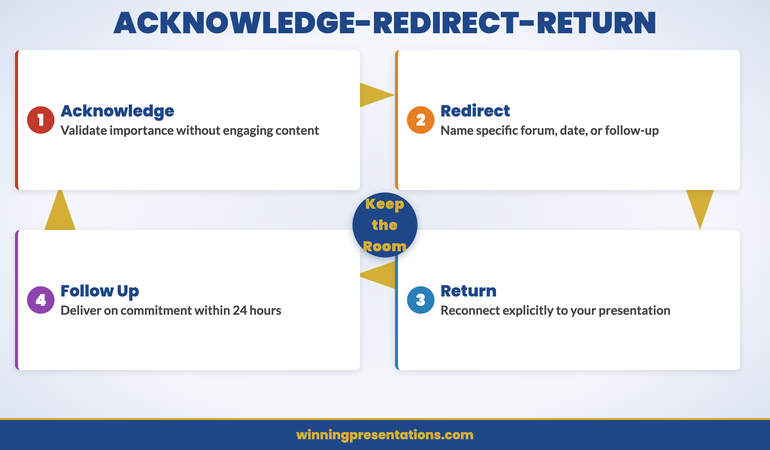
The most effective technique for handling off-topic questions in presentations is the three-step Acknowledge-Redirect-Return framework. It takes ten to fifteen seconds when executed well, and it accomplishes three objectives simultaneously: it respects the asker, it protects your time, and it keeps the room focused.
Step 1: Acknowledge. Validate the question’s importance without engaging with its content. “That’s an important area.” “I can see why that’s on your mind.” “Good question—it connects to a broader issue.” The acknowledgement must be genuine, not dismissive. A perfunctory “good question” followed by an immediate redirect reads as patronising. Take half a second to make eye contact with the asker and ensure your tone conveys respect.
Step 2: Redirect. Name where and when the question will be addressed. Not “we’ll get to that later” (vague and often untrue) but “that sits within the workforce planning review next Thursday” or “I’d like to address that with you directly after the meeting, because it deserves more time than I can give it here.” Specificity is the difference between a redirect that satisfies and one that frustrates.
Step 3: Return. Explicitly bring the room back to your presentation. “Let me continue with the third element of the resilience framework.” Use a transitional phrase that reconnects to where you were, not where the question took you. This signals to the entire room that the presentation has a structure and that structure is being protected.
Soren’s response to the CFO followed this framework precisely. He acknowledged the importance (“That’s an important question”), redirected to a specific forum (“the financial review next week”), offered a concrete follow-up action (“I’ll make sure you have the breakdown”), and returned to his topic (“Can I continue with the resilience framework?”). The whole exchange took twenty seconds. For more on the bridging technique that underpins this framework, our guide on the bridging technique for difficult questions covers the full methodology.
The Parking Lot Technique: When and How to Use It
The “parking lot” is a well-known facilitation technique: capture off-topic questions on a visible list (a whiteboard, a shared document, a slide) and commit to addressing them at a specific time. It works in workshop and training settings. It can also work in executive presentations, with modifications.
In executive settings, a literal parking lot list can feel patronising—senior leaders don’t appreciate seeing their questions written on a board to be dealt with later. The modification is to use a verbal parking lot: acknowledge the question, state that you’re noting it for the post-meeting follow-up, and then actually follow up. The “noting it” must be visible—write it down in your own notes so the asker sees the physical act of recording. This transforms the parking lot from a dismissal into a commitment.
When to use the parking lot: when the off-topic question is genuinely important but would consume more than two minutes of your allocated time. When not to use it: when the question is from the most senior person in the room (they expect an immediate response, even if brief), or when the question reveals a fundamental concern about your proposal that the room needs to hear addressed. Parking lot the former and you’ve protected your time. Parking lot the latter and you’ve avoided a conversation the room was ready to have.
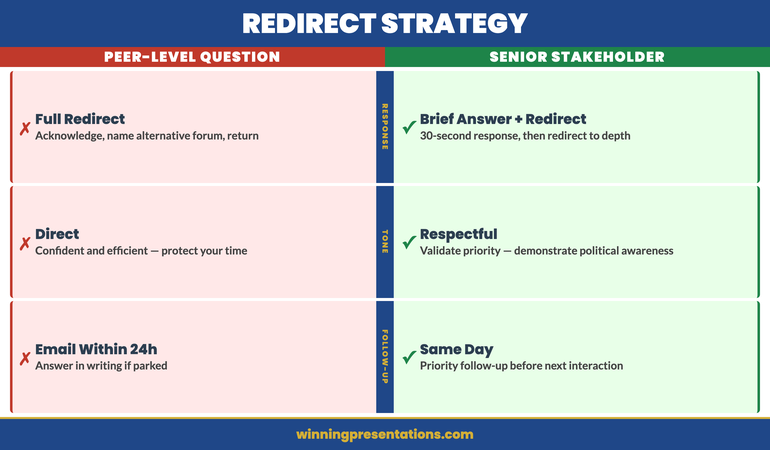
The critical discipline is follow-through. If you park a question and never return to it, you’ve taught the room that the parking lot is where questions go to die. Send a follow-up email within 24 hours addressing every parked question in detail. This builds a reputation as someone who respects questions enough to answer them properly, even when the meeting didn’t allow time.
When the Off-Topic Question Comes From Someone Senior
Redirecting a peer is straightforward. Redirecting your CEO, your board chair, or your most important client requires a different calibration. Senior stakeholders operate with an implicit understanding that their questions take priority, regardless of the agenda. Dismissing their off-topic question—even politely—can be interpreted as poor political judgement.
The technique here is the “brief answer plus redirect.” Give a concise, thirty-second response to the substance of the question, then redirect to the appropriate depth. “The short answer is that headcount is flat year-on-year, with a reallocation of three roles from warehouse to analytics. The detailed breakdown is in next week’s workforce paper, and I’ll send you the summary tonight. Shall I continue with the resilience metrics?” You’ve answered the question, demonstrated knowledge, committed to follow-up, and asked permission to continue. The senior stakeholder feels heard. The room stays on track.
What you must never do is ignore the political dimension. If the CEO asks about headcount during your supply chain presentation, the correct response is not “that’s off-topic.” It’s politically astute to treat the CEO’s question as worthy of a brief answer, even if it technically doesn’t belong. The room is watching how you handle the power dynamic, not just how you handle the content. Handle it well and you build credibility. Handle it badly—either by capitulating entirely or by being dismissively efficient—and you lose political capital regardless of how good your presentation is.
Our guide on handling all-hands Q&A ambush scenarios covers the additional complexity of managing off-topic questions in large-audience settings, where senior stakeholders may use questions to make statements rather than seek answers.
For a complete library of Q&A handling frameworks—including redirection, bridging, and managing senior stakeholder dynamics—the Executive Q&A Handling System provides the structured approach that turns difficult Q&A sessions into opportunities to demonstrate executive judgement.
The Follow-Up That Prevents Repeat Offenders
The most overlooked element of handling off-topic questions in presentations is what happens after the meeting. Most presenters redirect the question, finish the presentation, and move on. The asker is left with an unresolved question and a memory of being redirected. Next meeting, they ask again—often more insistently.
Soren’s follow-up the next morning was the decisive action. By sending the CFO the headcount breakdown before the financial review, he accomplished three things. First, he honoured his commitment—which builds trust. Second, he provided the information in a format the CFO could review at his own pace—which is more useful than a rushed verbal answer in the wrong meeting. Third, he demonstrated that he takes the CFO’s priorities seriously—which transformed a potential adversary into a neutral participant.
Build a follow-up discipline: within 24 hours of any meeting where you redirect a question, send a targeted response to the person who asked it. Not a mass email to all attendees—a direct message to the individual. “Following up on your question about headcount during yesterday’s resilience review—here’s the breakdown.” This personal attention costs five minutes and prevents the question from resurfacing in your next three meetings.
For persistent off-topic questioners—people who consistently raise the same tangential concerns—a pre-meeting conversation is the structural fix. “I know workforce planning is a priority for you. I’m covering resilience metrics tomorrow. Would it be helpful if I included a one-slide summary of how workforce changes affect resilience, so we address both in one session?” This transforms the off-topic question into an on-topic element, satisfying the asker’s need without disrupting the flow. Our guide on trick questions in presentations covers the related skill of recognising when a question is testing your credibility rather than seeking information.
Master the Q&A That Makes or Breaks Your Presentation
Off-topic questions, hostile challenges, and senior stakeholder dynamics—the Executive Q&A Handling System gives you the frameworks for every scenario, for £39.
FAQ: Off-Topic Questions in Presentations
What if the off-topic question is actually more important than my presentation topic?
This happens more often than presenters acknowledge. If the room visibly engages with the off-topic question—heads nodding, other people adding to it—the room is telling you what matters to them right now. In this situation, rigid adherence to your agenda is counterproductive. Acknowledge the shift: “It’s clear this is the priority for this group right now. Let me address it directly, and we can return to the resilience framework in the remaining time or schedule a follow-up session.” Adapting to the room’s energy is a leadership skill, not a presentation failure.
How do I redirect without sounding dismissive?
Tone and specificity are the two factors. A dismissive redirect sounds like: “That’s not what we’re covering today.” A respectful redirect sounds like: “That’s an important area—the compliance team is working on that and I know they’re presenting next week. I’ll make sure your question is flagged for their session. Can I continue with the third element?” The difference is validation (important area), a specific alternative forum (compliance team, next week), a concrete action (I’ll flag it), and a request rather than a command (Can I continue?). All four elements together prevent the perception of dismissal.
Should I set ground rules about questions at the start of my presentation?
In workshop or training settings, yes—ground rules are appropriate. In executive meetings, explicit ground rules about questions can sound controlling and may undermine your credibility with senior participants. A better approach is to set implicit expectations through your introduction: “I’ll cover the resilience framework in three sections over the next twenty minutes, and I’d welcome questions on each section as we go.” This implicitly defines the scope without restricting anyone. If someone goes off-topic despite this framing, the Acknowledge-Redirect framework handles it. The introduction simply makes your redirect more natural: “That’s outside the resilience scope I outlined, but I’ll follow up directly.”
The Winning Edge
Weekly insights on executive presentations, Q&A strategy, and boardroom communication.
If you’re also managing the physical anxiety that off-topic questions can trigger, our guide to grounding techniques for presentation anxiety covers the sensory anchoring methods that keep you composed when the unexpected arrives.
About the author
Mary Beth Hazeldine, Owner & Managing Director, Winning Presentations. With 24 years of corporate banking experience at JPMorgan Chase, PwC, Royal Bank of Scotland, and Commerzbank, she advises executives across financial services, healthcare, technology, and government on structuring presentations for high-stakes funding rounds and approvals.


