

Quick answer: A business presentation works as a story only when it has a villain as well as a hero. Most pitches are all hero — here is our plan, here is how good it is — and a room with nothing to fear approves nothing, because there is no threat the decision is needed to defeat. The Villain-Hero Structure fixes this in four moves: name the villain (the specific threat the decision exists to beat — a cost, a risk, a rival, the slow damage of doing nothing); make the stakes felt in the audience’s own currency; cast the hero correctly (the hero is the business or the decision-maker, never your product, which is only the weapon); then show the turn — the single move that lets the hero win, which is your recommendation. Test it with the villain-first test: read your deck until you hit your first solution, and count the sentences before the villain appears. If the solution comes first, or the villain never arrives, the structure is inverted and the room has no reason to act.
JUMP TO:
In 2012 I sat in on a rehearsal the afternoon before a head of product pitched a new line to her company’s investment committee. She was sharp, the work was strong, and the deck was confident from the first slide: here is the product, here is the roadmap, here are the margins, here is why it is good. She ran it twice, crisply, and asked me what I thought. I asked her one question — “what happens to this business if they say no?” — and she did not have an answer on a slide. The next afternoon the committee listened politely, asked three questions about cost, and deferred the decision “pending a clearer rationale.” I still remember her printed deck on the table afterwards, three lines circled in blue ink by the finance director, none of them about the product. The pitch failed not because the idea was weak but because she had given the room a hero with no villain to defeat — and a committee that feels no threat has no reason to act today rather than next quarter.
(This article was created with AI assistance; all stories and insights are based on 35 years of real client work.)
That deferral taught me the rule I have spent years teaching senior people who pitch for money, sign-off, or change: a business presentation only moves a decision when it is built as a story, and a story needs a villain as much as a hero. We are trained to do the opposite — to lead with the solution, prove its quality, and treat the problem as throat-clearing on the way to the good part. But an executive audience does not approve solutions; it approves the defeat of threats. This piece sets out the Villain-Hero Structure — the four moves that turn a competent pitch into a decision the room wants to make — the villain-first test that tells you in thirty seconds whether your structure is inverted, and the single most common error that quietly makes your product the hero of the story when it should only ever be the weapon.
Every persuasive presentation runs on one of a small number of narrative shapes. Most presenters have never seen them laid out.
The free 7 Presentation Frameworks Quick Reference Card puts the core structures — including the problem-stakes-resolution arc behind the Villain-Hero shape — on a single page you can hold beside your deck while you build it. It is the fastest way to check your pitch is built on a structure that carries a decision, not just a sequence of slides. Free download, no email gate.
Why an all-hero pitch leaves a board cold
The instinct to lead with the hero is reasonable and almost always wrong. You have done good work, you are proud of it, and the natural move is to show how good it is as soon as possible. So the deck opens on the solution: the product, the plan, the strategy, the numbers that prove it works. The flaw is that quality is not a reason to act. A board can agree that your plan is excellent and still defer it, because “excellent” answers the question “is this good?” when the question that releases money and sign-off is “what goes wrong if we don’t do this, and when?” An all-hero pitch never asks that second question, so the room never feels the pressure that turns approval from optional into necessary.
This is the mechanism behind the polite deferral. A decision-maker holds a simple, mostly unconscious sum: the cost and risk of acting now, set against the cost and risk of not acting. A pitch that only describes the hero loads one side of that sum — it shows the cost of acting (money, disruption, opportunity cost) in full detail and leaves the cost of not acting blank. Faced with a visible cost on one side and a blank on the other, the safest move is always to wait. The board is not rejecting your idea. It is doing the only rational thing available when no one has shown it what waiting costs. The broader craft of storytelling in business presentations exists to fill that blank — to make the cost of inaction as concrete and present as the cost of action, so the sum finally tips toward yes.
The reframe that fixes it is uncomfortable for people who like to be positive. You are not there to celebrate a solution; you are there to make a threat feel urgent and then show the room how to defeat it. The threat — the villain — is not negativity or scaremongering. It is the honest answer to “why now?” Every proposal worth funding exists because something is wrong, getting worse, or about to be lost: a cost that compounds, a competitor that is moving, a risk that is one bad quarter from arriving, a window that is closing. Name that, make it felt, and the same solution you were going to present anyway arrives as a rescue rather than a nice-to-have. Nothing about the plan changes. Everything about the room’s reason to act does.
The Villain-Hero Structure: four moves
The Villain-Hero Structure is a four-move sequence you run on the spine of any pitch before you build a single slide. It is not a storytelling flourish layered on top of the content; it is the order the content arrives in. A pitch that runs the four moves in sequence gives the room a threat to fear and then a way to win. A pitch that skips or reorders them reverts to the all-hero default and leaves the cost of inaction blank.
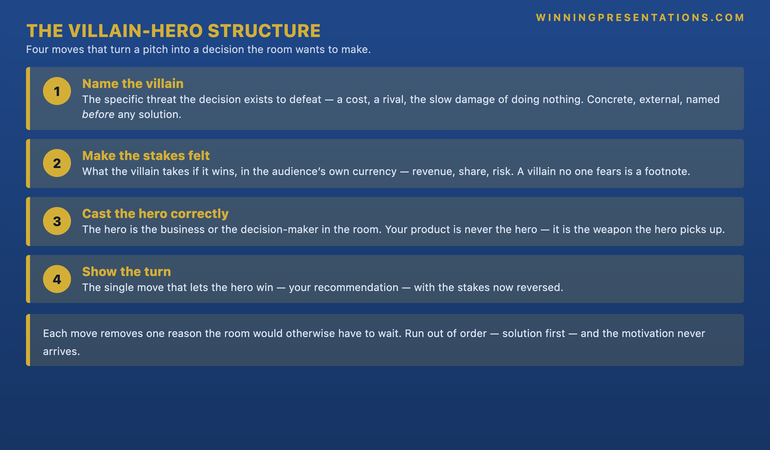
The four moves are these. One, name the villain. State the specific threat the decision exists to defeat — a cost that is compounding, a competitor that is moving, a risk you are one event away from, the slow erosion of doing nothing. It must be concrete, external to your solution, and named before any solution appears. Two, make the stakes felt. Show what the villain takes if it wins, in the audience’s own currency: revenue, market share, risk exposure, the number on the page the board is accountable for. A villain no one fears is not a villain; it is a footnote. Three, cast the hero correctly. The hero is the business, the team, or the decision-maker in the room — the people who will act. Your product, your plan, your strategy is never the hero. It is the weapon the hero picks up. Four, show the turn. Present the single move that lets the hero defeat the villain — your recommendation — as the thing that changes the outcome, with the stakes from move two now reversed.
What makes the four moves work together is that each removes one reason the room would otherwise have to wait. Naming the villain removes the “why now?” gap. Making the stakes felt removes the “why does this matter to me?” gap. Casting the hero correctly removes the “why is this person selling me something?” resistance — because you have handed the heroism to the room, not kept it for your product. And the turn removes the “what exactly do you want me to do?” gap. Run in order, the four moves convert a description of something good into a decision the room is motivated to make. Run out of order — solution first, threat later, or never — and the motivation never arrives.
Build the villain, the stakes, and the turn into every pitch — without sounding like a TED talk.
The Business Storytelling Mini-Course teaches the narrative shapes that move executive decisions — how to structure conflict and stakes around real business content so a pitch lands as a rescue, not a sales deck. It is built for senior people who need their numbers and recommendations to carry a story, without the theatrics that make a serious room switch off.
- Frameworks for building narrative around data and recommendations, so the structure carries the decision
- How to set up conflict and stakes without melodrama — the difference between a real villain and scaremongering
- The shapes behind openings, turns and closes that hold a senior audience to the last slide
- Instant access, lifetime use, on demand — £29
The villain-first test
The Villain-Hero Structure needs a test that tells you, before the meeting, whether you have actually built it or whether you only think you have. The test is mechanical and it takes thirty seconds. Open your deck and read it from the first slide, in order, until you reach the first place you propose a solution — the first recommendation, product slide, or “here’s what we should do.” Stop there. Now look back at everything before it and ask one question: has the villain been named, and have the stakes been made felt? If the answer is yes, your structure is the right way round. If you reached a solution before you reached a clearly named threat — or if you scrolled the whole deck and the villain never properly arrived — the structure is inverted, and the room will feel exactly what the investment committee felt in that 2012 rehearsal: a good idea with no reason to act now.
The test works because it simulates the order the audience experiences. A board does not read your deck the way you wrote it, holding the whole argument in mind at once; it meets each slide in sequence, and it forms its “why should I care?” verdict early, usually within the first few minutes. If the villain has not landed by the time the solution appears, the solution arrives to a room that has not yet been given anything to fear — and a room with nothing to fear treats the solution as one option among many, to be weighed at leisure. Once the solution has been seen, naming the villain afterwards never fully recovers the urgency, because the room has already filed the proposal under “interesting, not urgent.” Order is not a stylistic choice here. It is the difference between a decision and a deferral.
The test also tells you which move is missing, not just that something is wrong. If you reached the solution and a threat had been mentioned but you felt nothing reading it, your villain is named but the stakes are not felt — move two is thin. If a vivid problem was described but it was your own product’s absence (“without our tool, you can’t do X”), you have a false villain — the threat is manufactured to sell the solution, and senior audiences detect that instantly. The discipline of building genuine narrative anchors into a board presentation is what keeps the villain real rather than rhetorical. Run the test on every pitch and you will catch an inverted structure days before the board does — with time to rebuild rather than a deferral to recover from.
When the decision is a major buy-in — a board, an investment committee, a senior stakeholder group — the structure of the whole case matters as much as the story inside it.
The Executive Buy-In Presentation System is the self-paced programme behind securing agreement from senior stakeholders — seven modules covering how to frame the threat, build the case, and structure the ask so a room of decision-makers can say yes. It enrols in monthly cohorts with optional, fully recorded Q&A sessions you can watch back at your own pace, and lifetime access to the materials. £499.
Naming a villain that is real, not melodramatic
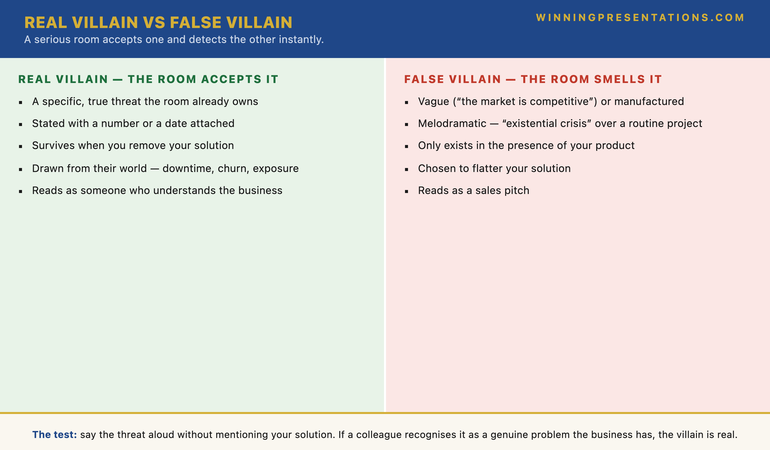
The hardest part of the structure is naming a villain that a serious room will accept, because there are two ways to get it wrong and they pull in opposite directions. Name it too weakly and there is no threat — “the market is competitive” is not a villain, it is wallpaper. Name it too theatrically and you lose credibility — “this is an existential crisis” about a routine efficiency project makes a board trust you less, not more. The villain that works sits between: a specific, true threat, stated plainly, with a number or a date attached. “The manual reconciliation costs us about nine working days a month and one of those errors reached a client last quarter” is a villain. It is concrete, it is owned by the room, and it does not need a drumroll.
The craft is to draw the villain from the audience’s own world, not from your solution’s marketing. A board of operators fears downtime, rework, and key-person risk; a board of commercial leaders fears churn, margin erosion, and a competitor’s move; a board of risk and finance fears exposure, a control failure, and the audit finding. The same project needs a different villain named for each, because the threat only lands if the room already feels accountable for it. The mistake is reaching for the villain that most flatters your solution — the problem your product happens to be perfect for — rather than the threat the room actually loses sleep over. A villain chosen to sell the solution reads as a sales pitch. A villain chosen because it is the room’s real fear reads as someone who understands their job.
One discipline keeps the villain honest: you should be able to name it without mentioning your solution at all, and have the room nod. If the threat only exists in the presence of your product — if it evaporates the moment you stop selling — it was never a real villain. Test it by saying the threat out loud to a colleague who has not seen your pitch and watching whether they recognise it as a genuine problem the business has, independent of anything you are proposing. If they do, you have a villain the board will accept. If they look puzzled, or hear a product advertisement, you have a manufactured one, and a senior audience will hear the manufacture before you reach the turn. The same honesty applies when the villain lives inside your data — the trend that is bending the wrong way is often the most credible villain of all, precisely because the numbers, not the presenter, are making the case.
The mistake that makes your product the hero
In 2016 I worked with a finance director preparing a case to replace a creaking billing system. His first draft was a model of the all-hero pitch: eleven slides on the new platform’s features, its architecture, its dashboards, with the new system cast unmistakably as the hero riding in to save the day. We rebuilt it around a single villain he had buried on slide nine — a silent revenue leak from billing errors that, once he totalled it honestly, came to a figure large enough to make the room go quiet. The new structure named the leak first, made the room feel the annual cost of leaving it, cast the company — not the software — as the one that would stop it, and presented the platform as the means. The board approved the spend in the same meeting. Nothing about the platform had changed. What changed was who the hero was: in the failed draft it was the product, and in the approved one it was the business deciding to defend its own revenue.
This is the error that quietly sinks more pitches than any other, because it feels like good salesmanship. When your product is the hero, the story’s emotional centre is the thing you are selling, and the room is cast as a passive audience watching your solution be wonderful. People do not approve money to watch someone else’s product be the hero; they approve money to be the hero themselves — to be the team that saw the threat and acted, the board that protected the business, the leader who made the call. Cast your product as the hero and you steal the heroism the room wants for itself, and the room feels, without quite naming it, that it is being sold to. Cast the room as the hero and your product as the weapon it picks up, and the same proposal becomes the room’s own victory.
Getting the casting right is mostly a matter of language, and it is fixable in an afternoon. Wherever your draft says “our solution does X,” rewrite it as “this lets you do X” or “with this, the team stops Y.” The grammatical subject of your key sentences should be the business or the people in the room, with your product appearing as the instrument, not the actor. It is a small shift on the page and a large one in the room, because it moves the agency — and the credit — from your product to the people who have to approve it. A board that hears itself cast as the hero leans in. A board that hears your product cast as the hero leans back and asks about price.
If your pitches keep getting a polite “let us think about it,” the structure is usually the reason — not the idea.
The Business Storytelling Mini-Course works on the exact failure behind the all-hero pitch: a narrative with no villain, no felt stakes, and a product cast as the hero instead of the room. It gives you the shapes to fix that on your own material, so a competent proposal stops reading as optional and starts reading as something the room needs to decide on now.
- Diagnose why a strong proposal still gets deferred — and the narrative move that changes it
- Set the stakes in the audience’s currency, so the cost of waiting is finally visible on the page
- Cast the room as the hero and your recommendation as the weapon, in the actual wording of your slides
- Instant access, lifetime use — £29
One sentence to write before your next pitch
Before you build a single slide of your next pitch, write one sentence and put it at the top of your first working slide: “If we do nothing, [the villain] costs us [specific stakes, with a number or a date] by [when].” Fill in the three brackets honestly, using the audience’s own currency, not your product’s marketing. Then read it aloud to a colleague who has not seen the pitch and watch their face: if they react — if the number or the date makes them pause — you have a real villain, and the rest of the deck can be built behind it. If they shrug, the villain is too weak or too vague, and no amount of polish on the hero will save the pitch. Do this before you design anything, because the sentence decides the order of everything that follows: the villain goes first, the stakes go second, and your solution — the weapon, not the hero — arrives only once the room has something it wants to defeat.
Frequently asked questions
Doesn’t opening with a villain make my presentation negative or alarmist?
It only feels that way if the villain is exaggerated or manufactured. A real villain is the honest answer to “why now?” — the cost, risk, or erosion that already exists in the business, stated plainly and with a number attached. That is not negativity; it is the context that makes your recommendation matter. The alarmist version — “this is a crisis,” “we face an existential threat” — is what damages credibility, and that comes from inflating a routine problem, not from naming a genuine one. Keep the villain true and proportionate, attach it to the audience’s own numbers, and it reads as clear-eyed rather than dramatic. A senior room respects a presenter who can name what is actually at stake far more than one who only ever brings good news.
What if my proposal is genuinely just an improvement, with no real threat behind it?
This is worth examining honestly, because a proposal with no villain at all is often a proposal that does not need to be made now — which is exactly why the board defers it. Look harder before concluding there is no threat: the villain is frequently an opportunity cost or a slow erosion rather than a dramatic risk. The competitor pulling ahead while you stand still, the compounding inefficiency, the talent you lose to a better-run process, the window that closes — these are real villains even when nothing is on fire. If, after looking, there genuinely is no cost to waiting, that is useful information: it tells you the proposal is a “when convenient” item, not a “decide today” one, and you should pitch it as such rather than dressing it up as urgent.
How is the Villain-Hero Structure different from just stating a problem and a solution?
Problem-solution is the skeleton; the Villain-Hero Structure is what makes it move. The difference is in the two moves most problem-solution decks skip: making the stakes felt, and casting the hero correctly. A flat problem statement (“reconciliation is manual”) names a fact; a villain (“manual reconciliation costs nine days a month and put an error in front of a client last quarter”) makes the room feel the cost. And a problem-solution deck almost always casts the solution as the hero, which triggers the sense of being sold to. The structure deliberately hands the heroism to the room and keeps your solution as the weapon. Same bones, but the stakes give it urgency and the casting gives the room a reason to want to act, rather than merely agreeing the problem exists.
Is this worth learning if I already present confidently and know my material?
Confidence and command of the material are what make an all-hero pitch so convincing — and so quietly ineffective. The presenters who most need this structure are usually the polished ones, because their delivery is good enough to hide the fact that the room was never given a reason to act now. If your strong pitches still get met with “let us think about it” or “come back with more detail,” the problem is rarely delivery; it is almost always a missing or mis-ordered villain. The structure does not replace your existing skill — it points it at the thing that actually releases a decision. For most experienced presenters it is the difference between being persuasive and being acted upon.
The Winning Edge — weekly newsletter
The Winning Edge is a weekly (Thursday) newsletter for senior professionals who pitch to boards, committees, and investors. One short email a week on the structural moves that separate the pitches that get approved from the ones that get a polite “let us think about it.” Subscribe to The Winning Edge →
For the full set of skills behind a pitch that gets approved — slides, storytelling, confidence, and delivery — the seven-product Complete Presenter bundle brings them together as a single resource — £99 for everything, lifetime access.
About the author
Mary Beth Hazeldine is Owner & Managing Director of Winning Presentations Ltd. With 24 years of corporate banking experience at JPMorgan Chase, PwC, Royal Bank of Scotland, and Commerzbank, she advises senior professionals across financial services, insurance, consulting, and technology on the structural moves that turn a strong proposal into a decision a board can act on.