

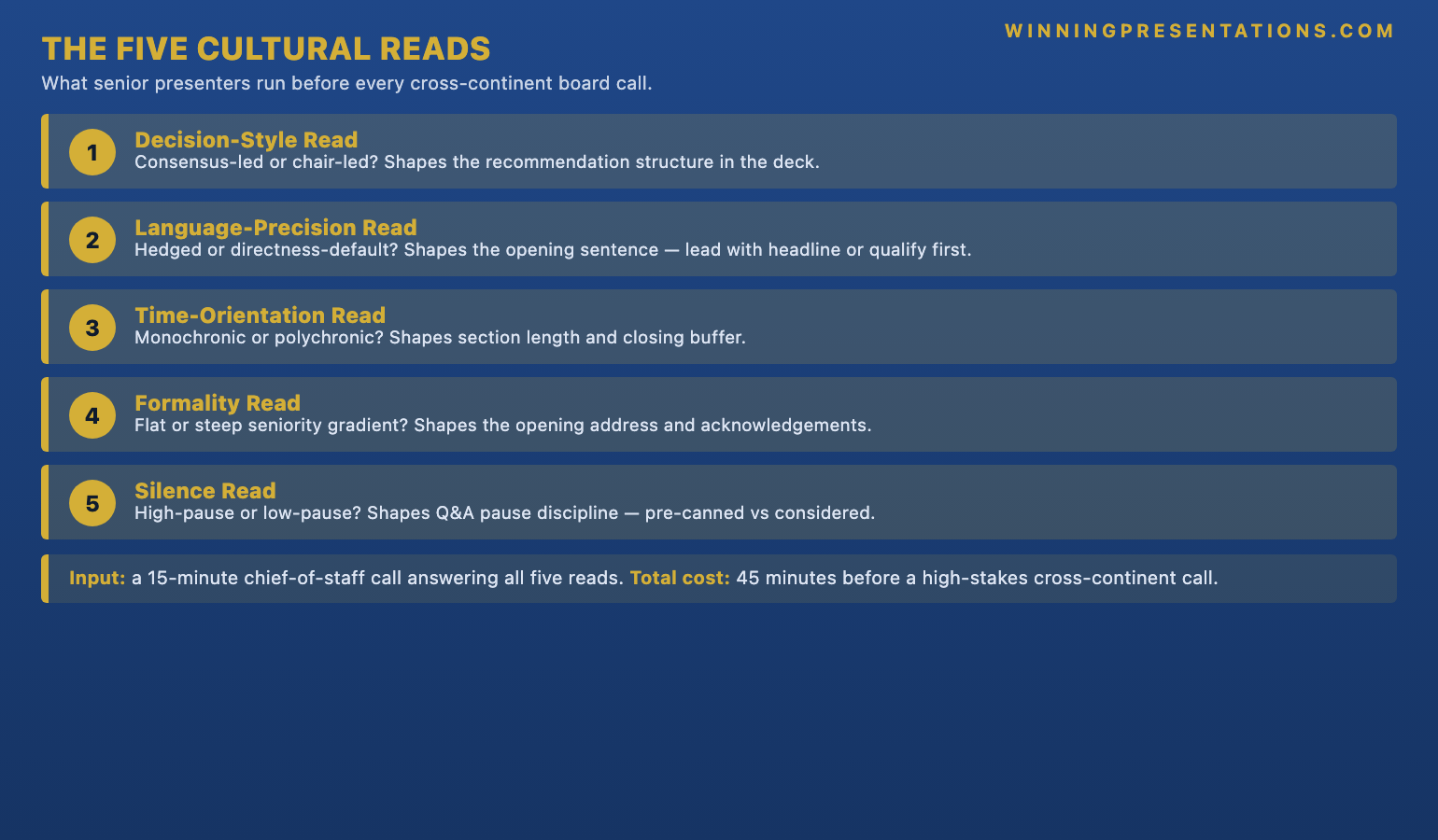
Quick answer: A global executive presentation lands or fails on the five cultural reads the presenter runs in the hour before the call. The five reads are: the decision-style read of the dominant committee culture (consensus-led versus chair-led), the language-precision read of how British understatement and American directness translate inside the room, the time-orientation read of how the committee handles agenda compression, the formality read of how seniority gradient is expressed in the local culture, and the silence-read of what a pause means in the dominant cultural pattern at the table. Senior presenters spend forty-five minutes on the five reads before a high-stakes cross-continent call. Junior presenters skip the reads and find out which cultural pattern was operating in the room while the call is already in progress and the recovery window has closed.
JUMP TO:
- Why the cultural reads matter more than the slide content
- Read 1: The decision-style read of the committee
- Read 2: The language-precision read
- Read 3: The time-orientation read
- Read 4: The formality and seniority-gradient read
- Read 5: The silence read
- The forty-five-minute pre-call diagnostic
- One thing to do before the next cross-continent call
- Frequently asked questions
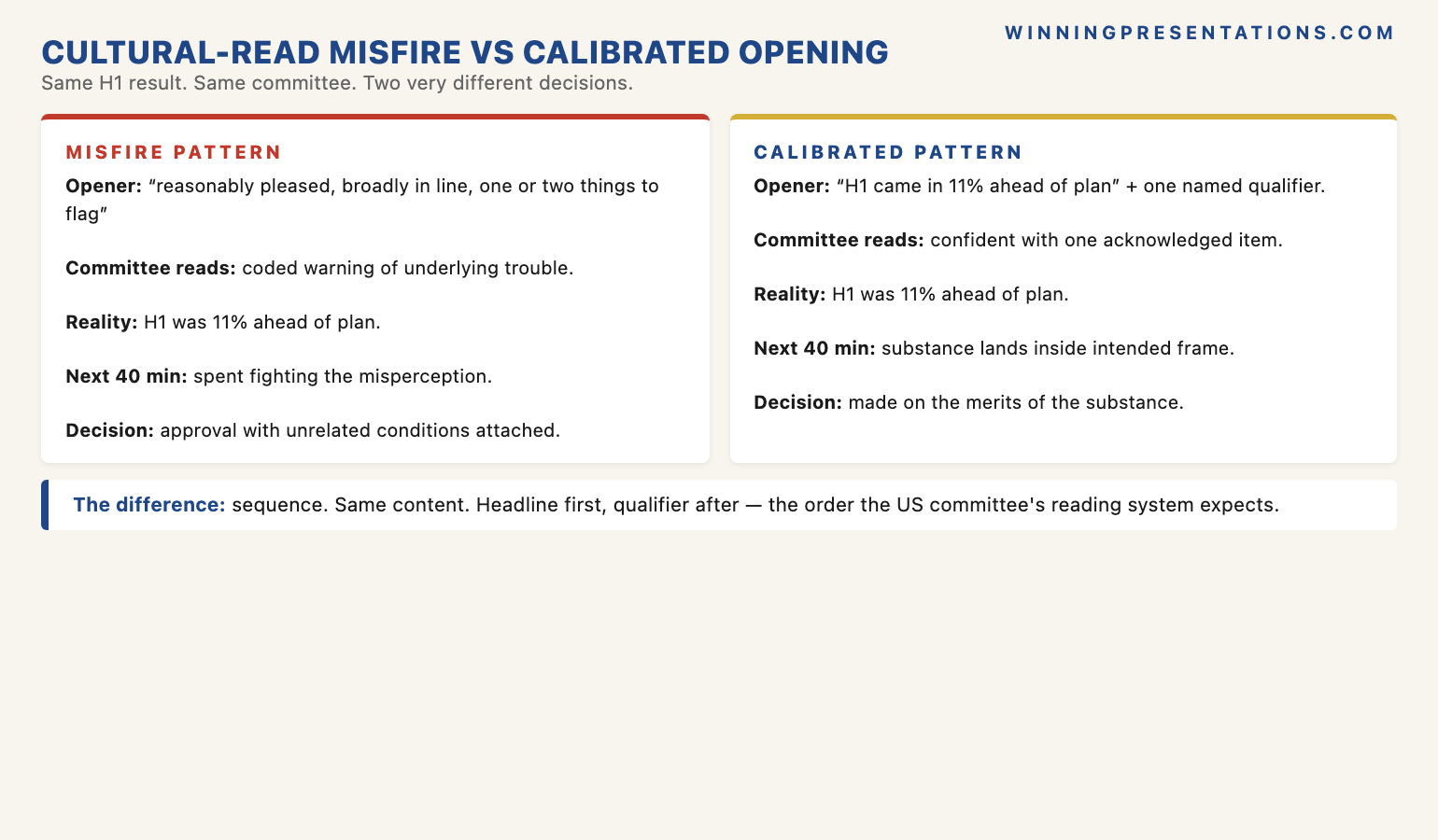
In November 2018 I observed a senior partner at a UK-based professional-services firm present to an investment committee of a North American parent group. The presentation was the half-year update on a European acquisition the parent had funded three years earlier. The committee was eight people: the parent CEO, a CFO, two non-executive directors based in New York, the chair of the audit committee based in Toronto, and three rotating regional heads dialled in from Chicago, Houston, and San Francisco. The partner had been in the role for fourteen years, knew the deal intimately, and had presented to the committee twice before. He opened with a measured British-professional-services opening: “We’re reasonably pleased with where the acquisition is sitting at the half year. There are one or two things we’d like to flag, and a couple of areas where the integration has been slightly slower than we’d hoped, but on the whole the trajectory is broadly in line with what was set out in the original committee paper.” The committee’s read of those forty-three words was: the acquisition is in serious trouble and the partner is signalling problems without naming them. The actual H1 result was 11% ahead of original plan. The next forty minutes of the partner’s presentation were spent fighting the perception frame the first sentence had installed, and the recovery never fully landed. The committee approved the second-half plan with conditions attached that had nothing to do with the substance of what the partner had presented.
(This article was created with AI assistance; all stories and insights are based on 35 years of real client work.)
This piece walks through the five cultural reads senior presenters run before a cross-continent board call — the reads that would have caught the British-understatement misfire in advance and let the partner open with an opener calibrated to the North American committee culture rather than to his own. Each of the five reads is a specific, structured question the presenter answers in the forty-five minutes before the call. None of the reads requires the presenter to learn a new culture deeply; the reads require the presenter to identify which cultural pattern is dominant in the room and adjust the opening, the language register, the pacing, the formality, and the silence handling to match that pattern. The five reads are not cultural sensitivity training. They are a mechanical preparation framework for the perception cost of running a high-stakes cross-continent call without the cultural read in advance.
Before your next cross-continent board call, a structural pre-call review is worth running.
The Virtual Presentation Quick-Start Checklist includes the cultural-read prompts senior presenters run before high-stakes international calls — the questions to answer before the camera comes on. Free download, no email gate.
Why the cultural reads matter more than the slide content
The slide content is the substance the presenter is delivering. The cultural reads are the perception frame the substance lands inside. In a single-culture room, the perception frame is mostly invisible because everyone in the room shares it; the presenter and the committee read the same signals the same way, and the substance carries straight through. In a cross-continent committee, the perception frame is the single most expensive variable. The same forty-three-word opening that reads as appropriate professional caution to a London committee reads as a coded warning of underlying trouble to a New York committee, and the substance of the next forty minutes is filtered through whichever frame the opening set.
The five reads cost forty-five minutes to run. The cost of skipping them on a single high-stakes call is the kind of conditioned approval the Toronto-Chicago-Houston committee landed on the partner’s acquisition update in 2018 — a decision shaped by the perception frame rather than by the substance, with consequences that propagated into the second half of the year. The cost of running them is the difference between a presentation that lands inside the committee’s cultural frame and a presentation that fights that frame for forty minutes. The camera-frame decision senior leaders make before joining the board call covers the parallel structural work in the camera-and-frame dimension; the cultural reads are the equivalent work in the language-and-pacing dimension.
Read 1: The decision-style read of the committee
The first read is the decision-style read. The question is: does this committee tend to reach decisions by consensus across the participants, or does the chair set the direction and the committee endorse it? The answer shapes how the presenter structures the recommendation. A consensus-led committee expects the recommendation to be presented as one option among the trade-offs, with the analytical work that lets the committee construct the decision visible in the deck. A chair-led committee expects the presenter to land the recommendation clearly, signal confidence in it, and treat the deck as the substantiation that backs the recommendation rather than the raw material the committee will assemble into a decision.
The decision-style read is correlated with cultural pattern but is not the same as nationality. A German Aufsichtsrat tends consensus-led; a US Fortune-500 investment committee tends chair-led; a French conseil d’administration tends chair-led but with formal protocol around how the chair’s direction is signalled; a Japanese ringi-style committee tends extreme consensus-led with pre-call alignment carrying most of the decision weight. The presenter does not need to memorise the patterns. The presenter needs to identify which pattern this committee operates by — usually by asking the chief of staff or the deal sponsor in advance, “Does this committee tend to debate the trade-offs in the room, or does the chair set the direction and the committee endorse it?” The five-minute answer reshapes the recommendation structure in the deck.
Read 2: The language-precision read
The second read is the language-precision read. The question is: in the dominant cultural pattern at the table, what does “broadly in line” mean, what does “reasonably pleased” mean, what does “one or two things to flag” mean? British professional-services language uses a vocabulary of measured qualifications that, in a British committee, reads as appropriate professional caution and is interpreted as a confident report with a few normal items to acknowledge. The same vocabulary in a North American committee — particularly a US investment committee — is read as a warning. “Broadly in line” reads as “not actually in line.” “Reasonably pleased” reads as “not actually pleased.” “One or two things to flag” reads as “there are problems I am not yet ready to name.”
The 2018 Toronto-Chicago-Houston committee call was a textbook language-precision misfire. The British partner used the vocabulary he would have used to a London committee and assumed it would translate. The committee’s read of the opening forty-three words constructed a frame in which the H1 result was in trouble, and every subsequent slide was interpreted through that frame even when the actual numbers were strong. The partner spent the remainder of the call presenting good results into a committee that had decided in the first minute the results were not good. The conditioning attached to the second-half plan approval was the committee’s rational response to a presentation it had read as concerning. The presentation was not concerning. The presentation’s opening language was read as concerning by a committee that did not share the British professional-services vocabulary.
The fix is simple and mechanical. Before a cross-continent call into a directness-default culture (US, Dutch, German, Israeli), the presenter rewrites the opening sentence to lead with the actual headline result in unhedged language and then qualifies afterwards. “H1 came in 11% ahead of plan. The integration is running about a quarter slower than we’d hoped on the back-office side, which I’ll come to on slide six. Otherwise the acquisition is delivering the case we made to the committee three years ago.” Same content. Different perception frame. The directness-default committee reads the opening as confident with one acknowledged issue; the British committee, if the same opener were used in London, would read it as appropriately direct without seeming aggressive. The directness-default opener is the lower-risk default across mixed cross-continent committees. The structural opening moves senior executives make on Zoom presentations covers the complementary perception work in the camera-and-framing dimension.
The cultural reads work only when the slide structure is built to support the chosen cultural register.
Stop guessing what your cross-continent committee needs to engage with the substance. The Executive Slide System gives you slide layouts engineered for both consensus-led and chair-led decision cultures, with the visual hierarchy that lets the chosen language register carry without being undercut by competing slide noise. Built on 24 years in corporate banking and 16 years coaching senior professionals across financial services, insurance, consulting, and technology.
- 26 Executive Templates — including recommendation-led structures (for chair-led committees) and trade-off-led structures (for consensus-led committees)
- 93 AI Prompts — reshape an opening slide from British-understatement register into directness-default register for a cross-continent committee
- 16 Scenario Playbooks — including the cross-continent investment committee, the multi-region group exec update, and the parent-subsidiary half-year review
- 7 Checklists — the cultural-reads pre-call list, the opening-language rehearsal, and the post-call calibration routine
- Instant download, lifetime access — usable across every cross-continent cycle, not just the one in front of you now — £39
Read 3: The time-orientation read
The third read is the time-orientation read. The question is: how does this committee handle agenda compression when the call runs long? A monochronic committee (US, German, Swiss, Dutch tendency) treats the agenda as a contract; if the call runs ten minutes long, the committee experiences it as a breach and engagement quality drops sharply in the overrun minutes. A polychronic committee (Mediterranean, Latin American, Middle Eastern tendency) treats the agenda as a guide; an overrun is normal and the committee adjusts. The presenter who runs eight minutes long into a monochronic committee loses the substance of the closing minutes; the presenter who runs eight minutes short into a polychronic committee leaves the room expecting more substance than was delivered.
The fix is to calibrate the section lengths and the closing buffer to the committee’s time-orientation. For a monochronic committee, build the deck to finish at minute forty-three of a fifty-minute slot, leaving seven minutes of unused buffer the committee will reward with engaged Q&A. For a polychronic committee, build the deck to fill the full fifty-minute slot with content that scales up or down based on how the room reads the engagement — the committee will appreciate the optionality and the willingness to give them the time the substance warrants. The same deck delivered in the opposite committee culture produces friction the substance does not deserve.
Read 4: The formality and seniority-gradient read
The fourth read is the formality read. The question is: how is the seniority gradient expressed in the dominant cultural pattern at the table? A flat-formality culture (US, Australian, Nordic tendency) opens the call with first names and treats the chair as a peer-among-peers in the conversation. A steep-formality culture (German, French, Japanese, Korean tendency) opens with titles, addresses the chair explicitly before other participants, and signals deference at the opening and closing of the segment. A mixed-formality committee — common in cross-continent groups — requires the presenter to calibrate to the dominant culture in the room while not under-addressing the participants who expect more formality than the dominant culture provides.
The practical move is the opening address. In a flat-formality committee, the opener is “Good morning, everyone — thank you for the time today.” In a steep-formality committee, the opener is “Chairman, members of the committee — thank you for the opportunity to present the half-year update today.” The two openers are five seconds apart in length but produce very different perception frames. The flat opener into a steep-formality committee reads as casual or under-prepared; the steep opener into a flat-formality committee reads as overly formal or potentially obsequious. The five-minute pre-call check with the chief of staff — “What’s the addressing convention in this committee?” — is the structural input that sets the opener correctly.
Read 5: The silence read
The fifth read is the silence read. The question is: what does a five-second pause mean in the dominant cultural pattern at the committee table? In Japanese, Finnish, and Korean meeting cultures, a five-second pause is normal and signals consideration; rushing to fill it reads as nervousness or shallow thinking. In US, Italian, and Brazilian meeting cultures, a five-second pause feels unusually long; the committee may interpret it as the presenter losing the thread or as an invitation to interject. The presenter who holds a long pause in a low-pause culture loses control of the room; the presenter who fills every short pause in a high-pause culture reads as not allowing the committee thinking room.
The silence read matters most in the Q&A. A question from the committee in a high-pause culture expects two or three seconds of considered silence before the answer begins; the answer that lands immediately reads as defensive or pre-canned. A question from the committee in a low-pause culture expects the answer to begin within a second; a three-second pause reads as uncertainty or evasion. The presenter does not need to change their personality; the presenter needs to know what pause length the room expects so the pause works for them rather than against them.
If the cross-continent call is the warm-up to a contested decision the committee is going to make in the same session, the structural method matters even more.
Walk into your next cross-continent board call prepared. The Executive Buy-In Presentation System is the self-paced framework senior professionals use when the half-year update is the prelude to a buy-in decision the committee will make in-session — budget reallocations, channel pivots, capital allocation asks, strategic redirects. 7 modules. No deadlines. No mandatory session attendance. Optional live Q&A calls, fully recorded. Self-paced with monthly cohort enrolment. Lifetime access to materials. £499.
The forty-five-minute pre-call diagnostic
The pre-call diagnostic takes forty-five minutes the day before the cross-continent call. Five minutes per read on the analytical work, plus a fifteen-minute call with the chief of staff or the deal sponsor to confirm the reads against actual committee behaviour. The order matters: do the decision-style read first because it shapes the recommendation structure in the deck. Do the language-precision read second because it shapes the opening sentence. Do the time-orientation read third because it sets the section lengths. Do the formality read fourth because it sets the opening address. Do the silence read fifth because it sets the Q&A discipline.
The chief-of-staff call is the load-bearing structural input. The chief of staff has watched the committee operate across many calls and can answer the five questions in fifteen minutes with calibrating accuracy: “The chair sets the direction and the committee endorses — they don’t debate trade-offs in the room. They’re directness-default; lead with the result and qualify after. They run the agenda tight; finish two minutes early. They expect ‘Chairman’ in the opening address. They’re low-pause culture; don’t leave more than a second between question and answer.” Five answers. Fifteen minutes. The structural reshape of the deck and the rehearsal of the opening forty seconds takes another thirty minutes. Total cost: forty-five minutes the day before. The cost of skipping it is the perception cost the 2018 Toronto-Chicago-Houston committee landed on the British partner’s acquisition update.
Why the reads matter more for senior presenters than for junior ones
Senior presenters are not forgiven the cultural-read misfires that junior presenters get a generous read on. A junior presenter who hedges into a directness-default committee is reading as inexperienced; the committee makes an allowance and engages with the substance anyway. A senior presenter who hedges the same way is reading as evasive, because the committee’s expectation is that a senior operator presenting half-year results knows the cultural pattern of the committee and would not have led with hedged language unless there was something they were not yet ready to name. The same opening sentence carries an entirely different perception cost at senior level than at junior level.
The cost compounds across multiple cross-continent calls. A senior presenter who misfires the language-precision read once on a single call is paying a perception cost the committee will mostly absorb and discount; the second or third time the same pattern shows up, the committee’s narrative shifts from “the substance is in trouble” to “this presenter is consistently underselling.” The narrative is harder to recover from than a single call’s misperception. The pre-call diagnostic is the cheapest insurance available against the narrative shift. Forty-five minutes the day before a cross-continent call. Five reads. One fifteen-minute chief-of-staff conversation. The structural cost is small. The narrative cost of skipping it across a year of quarterly committee cycles is significant.
The cultural reads are easier to apply when the deck is built to flex between cultural registers in the first place.
Designed for senior professionals who present to cross-continent investment committees, multi-region group execs, and international boards — the Executive Slide System gives you the slide structures, opening templates, and recommendation frameworks that let the cultural reads carry into the deck without rebuilding the deck for every committee. Built on 24 years in corporate banking and 16 years coaching senior professionals across financial services, insurance, consulting, and technology. 26 templates, 93 AI prompts, 16 scenario playbooks, 7 checklists. £39, instant download, lifetime access.
One thing to do before the next cross-continent call
Forty-five minutes before the next cross-continent committee call, run the five reads in order. Decision-style first — consensus or chair-led. Language-precision second — hedged or directness-default. Time-orientation third — monochronic or polychronic. Formality fourth — flat or steep. Silence fifth — high-pause or low-pause. Get the five answers from the chief of staff or the deal sponsor in a fifteen-minute call. Reshape the opening sentence to the language-precision read. Reshape the section lengths to the time-orientation read. Reshape the opening address to the formality read. Rehearse the Q&A pause discipline to the silence read. Walk into the call having done the structural cultural preparation the room will reward. The substance you are presenting deserves to land inside the cultural frame it was built for.
Frequently asked questions
Isn’t this just stereotyping cultures? The reads sound reductive.
The reads are pattern-matching, not stereotyping. They identify which dominant cultural pattern is operating in the room based on the committee’s observed behaviour, not based on the nationalities of the participants. A US-headquartered Fortune-500 investment committee with two German non-executive directors will usually run chair-led because the chair sets the operating pattern, even though German committees tend consensus-led in their own home cultures. The reads ask the chief of staff how this specific committee actually operates, not how a generic committee from the participants’ cultural backgrounds might operate. The pattern-matching is to the room, not to the passports in the room. That is why the chief-of-staff call is the load-bearing input — it surfaces the actual operating culture of the specific committee rather than relying on cultural generalisations.
What if the committee is genuinely mixed and there is no dominant cultural pattern?
This is rare in practice because committees develop a dominant operating pattern over time, usually shaped by the chair and the chief of staff. When it does happen — typically in newly-formed committees or committees that have rotated several seats recently — the default is to calibrate to the directness-default, chair-led, monochronic, formal-opening, low-pause pattern. This is the lowest-risk calibration because it tends to be understood across cultures even when it is not the local default. A directness-default opener will not offend a hedged-language culture; a hedged opener will be misread by a directness-default culture. The asymmetry favours defaulting to directness when the dominant pattern is unclear. Refine the calibration on subsequent calls once the committee’s operating pattern becomes legible.
How do I run the reads if I don’t have a chief of staff to brief me?
Then the structural input is the deal sponsor, the secondee from the parent group, or the previous presenter into the same committee. The question is the same: how does this committee actually operate across the five reads. A fifteen-minute call with anyone who has watched the committee in action three or four times will give you the calibrating answers. Failing that, watching a recording of the committee’s previous session — if recorded internal sessions exist — is the next best input. The structural risk of skipping the input entirely and presenting from your own cultural default is exactly the risk the 2018 Toronto-Chicago-Houston session crystallises: the perception frame your own default produces may be the wrong frame for the room, and the substance will land into the wrong perception.
Do the reads change when the call is virtual versus in-person?
The reads themselves do not change — the same five questions apply — but the cost of getting them wrong increases on a virtual call because the committee has fewer calibrating signals to soften a misfire. In a physical room, a British-understatement opener that misreads the committee can be partially recovered by body language and tone of voice that signal confidence the words alone do not carry. On a Zoom call, the tile flattens those signals and the committee reads the words almost in isolation; the misread compounds faster and the recovery window is shorter. The virtual cross-continent call is the highest-risk version of this work. The cultural-read preparation is correspondingly more important.
The Winning Edge — weekly newsletter
The Winning Edge is a weekly (Thursday) newsletter for senior professionals who present at the executive level. One short email a week, focused on the structural moves that separate the cross-continent presentations that land inside the right cultural frame from the ones that fight an unintended frame for forty minutes. Subscribe to The Winning Edge →
For the broader picture across slides, storytelling, confidence, and delivery, the Complete Presenter bundle of seven products is the resource most senior professionals find useful as a single library — £99 for everything, lifetime access.
About the author
Mary Beth Hazeldine is Owner & Managing Director of Winning Presentations Ltd. With 24 years of corporate banking experience at JPMorgan Chase, PwC, Royal Bank of Scotland, and Commerzbank, she advises senior professionals across financial services, insurance, consulting, and technology on the structural cultural reads that separate the cross-continent presentations committees engage with from the ones they politely tolerate.