

Quick answer: The half year strategy refresh that holds the executive committee’s engagement avoids the word “refresh” on slide one because the word itself signals the wrong thing — it cues the room to expect cosmetic adjustment, not a leadership read on whether the strategy is on course or off it. The session is one of two things: a pivot session, where leadership is recommending a change in direction with evidence, or a continuation session, where leadership is recommending the original plan stand with evidence. Slide one names which session this is, with the verb that fits, and the rest of the deck argues for it. The pivot session opens with “I am recommending we change direction on X, here is why” and the continuation session opens with “I am recommending we hold the course on X, here is the evidence”. Neither opens with “this is the strategy refresh”. The decks that open with refresh-the-word almost always do neither in substance, and the committee reads that accurately in the first ninety seconds.
JUMP TO:
- Why the word “refresh” is the trap
- The pivot session: named change, with the evidence
- The continuation session: hold the course, with the evidence
- The mid-pattern: the deck that does both badly
- The pivot-or-continuation diagnostic, with the third option
- One thing to do before the next strategy session
- Frequently asked questions
In late June 2019, I was working with a strategy director at a senior-leadership offsite for one of the European asset-management groups I have advised at intervals over the years. The offsite was the firm’s mid-year strategy session, run over a Tuesday and Wednesday in a country-house venue an hour outside London, with the group executive committee, the heads of the four business lines, the chief operating officer, and the chief investment officer in the room. The strategy director had prepared a 41-slide deck labelled, on the cover, “H1 Strategy Refresh — Mid-Year Review and Forward View”. The CEO opened the deck at 9am on the Tuesday, read the cover, looked up at the strategy director and said, without irritation, “Are we changing the strategy or not.” The strategy director took twenty seconds to answer. The pause was the most consequential silence of the offsite. By the end of that twenty seconds the room knew the deck was not going to give them the answer the CEO had just asked for. The next six hours of the offsite went through the deck cordially, generated useful working-group items, and produced no strategic decision the chief executive could act on. The autumn followed with a parallel piece of work led from the CEO’s office to do what the strategy session should have done. The strategy director left the firm eight months later.
(This article was created with AI assistance; all stories and insights are based on 35 years of real client work.)
This piece walks through why the word “refresh”, on the cover slide and in the framing of the session itself, is the trap that catches most half-year strategy sessions in the mid-pattern between a pivot and a continuation. The word implies a tidying-up exercise — small adjustments to a strategy fundamentally still in force. Senior committees do not need tidying-up exercises at the half-year. They need a leadership read on whether the strategy is on course (continuation) or off it (pivot), with the evidence to back the read, presented in a form the committee can act on. Both reads are legitimate; the worst answer is the mid-pattern that does neither cleanly. The fix is to remove the word “refresh” from slide one, replace it with the verb that fits the leadership read, and let the rest of the deck argue for it.
Before the next strategy session, a structural check on the slide-one verb is worth ten minutes.
The Executive Presentation Checklist walks through the openings senior committees actually engage with — the named-pivot opener, the continuation-with-evidence opener, and the mid-pattern that fails both tests. Free download, no email gate.
Why the word “refresh” is the trap
The word “refresh” sits on the cover slide of more than half the half-year strategy sessions I have watched over the years, and it does the same structural damage in nearly every instance. The word signals cosmetic adjustment. It primes the room to expect a deck whose recommended action is — in spirit — “keep going, with minor changes to the slide framing of what we are already doing”. Senior committees that arrive expecting cosmetic adjustment engage cosmetically. The conversation operates at the level of the slide framing rather than the level of the underlying strategy. The committee notices a phrase that needs tightening, a sub-pillar that needs renaming, a market segment that needs adding to a quadrant. The work feels productive; nothing changes structurally; the committee leaves having spent six hours generating tidying items rather than addressing the substantive question the half-year was supposed to answer.
The substantive question the half-year is supposed to answer is always one of two things. Is the strategy on course, in which case the leadership team is asking the committee to acknowledge the evidence and continue. Or is the strategy off course, in which case the leadership team is asking the committee to approve a specified change in direction with the evidence for it. The two questions look adjacent and are operationally very different. Committees engage with the first question by reviewing evidence; they engage with the second by examining the proposed change and the case for it. The deck that opens with “refresh” invites neither engagement. It invites the third, lowest-value committee mode: marginal feedback on the strategy framing without ever testing the underlying direction. This mode is the most expensive use of a senior committee’s half-day — not because the feedback is bad, but because the underlying question goes unanswered and the work re-emerges in a worse form three or four months later, often after the operating environment has moved past the point where either answer is still feasible.
The 2019 asset-management offsite was a textbook refresh-trap session. The strategy director had spent six weeks preparing what was, structurally, a continuation deck: an evidence pack showing the original strategy was still broadly on track, with three or four areas of mid-pillar adjustment proposed at the level of go-to-market emphasis. The deck did not say “we recommend continuing the strategy”. It said “H1 strategy refresh”, left the leadership read implicit, and asked the committee to absorb the analytical work and arrive at the continuation conclusion themselves. The committee declined. The CEO’s opening question — “are we changing the strategy or not” — was an attempt to surface the implicit leadership read and put it on the table. The strategy director’s twenty-second pause was the structural cost of the refresh framing: the leadership read existed but had not been written down, named, or owned, and the strategy director could not produce it under direct CEO questioning. The rest of the session inherited the structural ambiguity.
The pivot session: named change, with the evidence
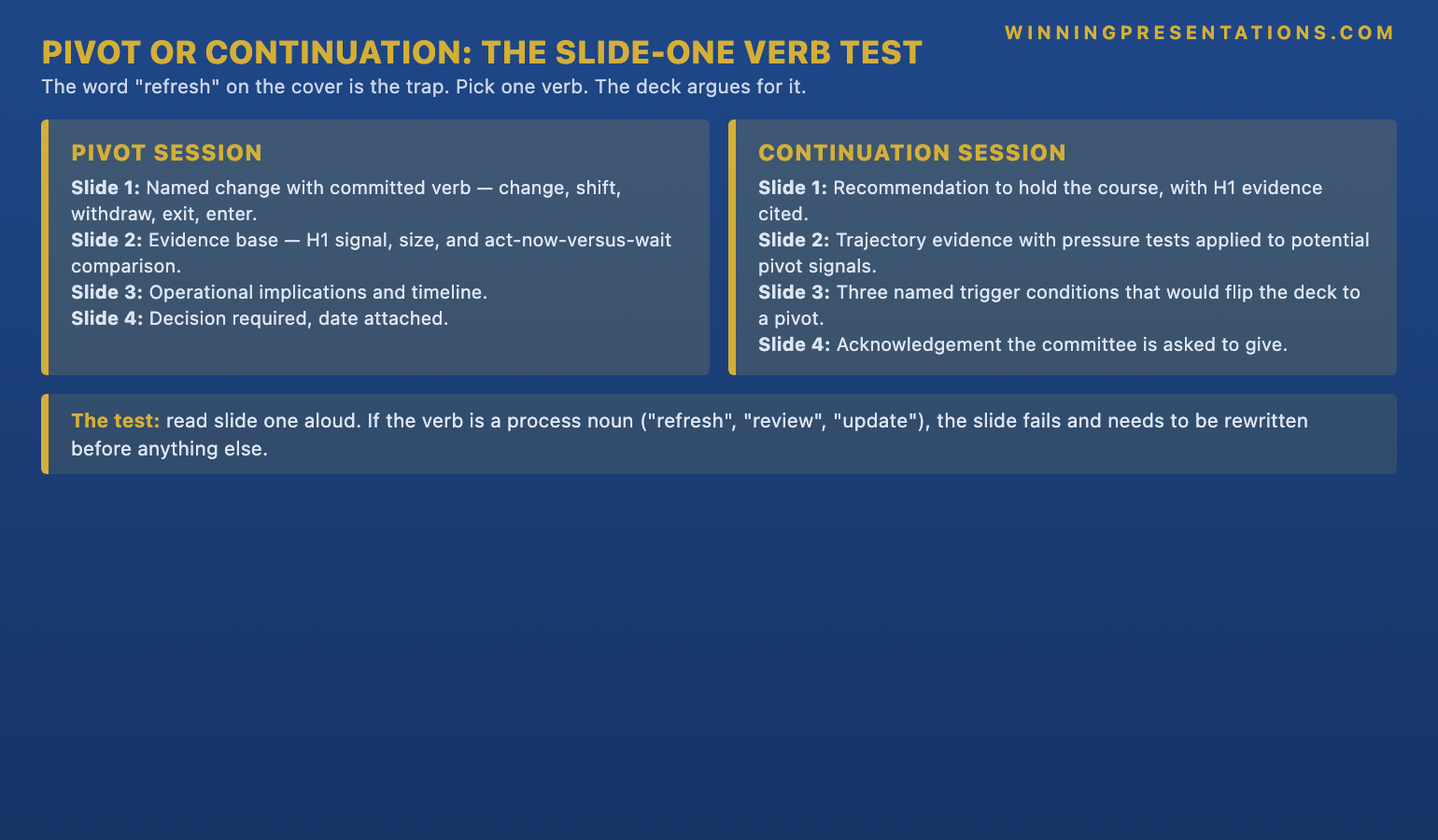
The pivot session is the session where leadership is recommending a change in direction on at least one of the strategy’s core pillars. The slide-one verb is “change” or “shift” or “withdraw” or “exit” or “enter” or, occasionally, “rebalance” — the verb that names what is being changed and signals the size of the change. The pivot is not a refresh. The pivot is a decision the committee is being asked to approve, with the evidence and the operational plan attached. Slide one names the recommended change in one sentence. Slide two names the evidence base — the H1 signals from the market, the customer, the competition, or the firm’s own delivery capability that triggered the recommendation. Slide three names the operational implications — what changes for which functions, on what timeline, with what capital and headcount adjustments. Slide four names the decision the committee is being asked to take, with the date by which it is required.
The discipline of the pivot session is the discipline of owning the recommendation. Pivot decks frequently fail because the leadership team is uncomfortable with the pivot itself; the recommendation gets framed in conditional language — “the team has identified a possible adjustment to the X pillar that the committee may wish to consider”. The committee reads the conditional framing accurately as un-owned recommendation and declines to take the decision on the leadership team’s behalf. The pivot decks that pass commit the leadership team to the recommendation directly: “leadership is recommending the X pillar shift to an emphasis on Y, with the operational implications outlined on slide three and the decision required by the end of this session”. The directness is uncomfortable to write when the leadership team is internally divided on the pivot, which is often the case in genuine pivot sessions. The directness is also the only structural form that gets the committee’s actual engagement, and the leadership team that has not landed on the directness has not yet done the work the session is supposed to surface.
The evidence base on slide two of a pivot deck is the slide that carries most of the analytical weight. The committee is being asked to approve a change; the question they will ask is what the evidence is that the change is justified now rather than at the next planning cycle. The evidence base needs three things on it. A specific H1 signal that has materialised since the original strategy was set — a customer-cohort behaviour change, a competitor capability shift, a regulatory move, an internal-delivery shortfall. The size of the signal relative to the assumptions in the original strategy. And an explicit comparison of the consequences of acting now versus waiting one or two planning cycles. The “act now versus wait” comparison is the element pivot decks most often skip, and it is the element the committee is most likely to probe in the room. The leadership team that arrives with the comparison done passes the probe; the team that arrives without it gets deferred. The executive buy-in framework for walking pivots through the committee covers the upstream discipline in detail.
A pivot deck or a continuation deck is faster to build when the slide structure is already built.
The Executive Slide System is the slide library senior professionals use to build the named-pivot opener, the continuation-with-evidence opener, the evidence-base slide, and the operational-implication page that strategy committees actually engage with — without rebuilding the structure from scratch every half-year cycle. Built on 24 years in corporate banking and 16 years coaching senior professionals across financial services, insurance, consulting, and technology.
- 26 Executive Templates — including pivot-session, continuation-session, and strategy-committee deck formats
- 93 AI Prompts — rewrite the slide-one verb, the evidence-base sentence, and the operational-implication page in the leadership team’s vocabulary
- 16 Scenario Playbooks — including the half-year strategy session, the annual strategy refresh, and the board strategy update
- 7 Checklists — the pivot-or-continuation diagnostic, the evidence-base pressure test, and the operational-implication readiness check
- Instant download, lifetime access — usable across every strategy cycle, not just the one in front of you now — £39
The continuation session: hold the course, with the evidence
The continuation session is the session where leadership is recommending the original strategy stand — not because nothing has changed in H1, but because the changes that have materialised remain inside the envelope the strategy already accounts for. The slide-one verb is “hold” or “continue” or “stay the course” or “maintain”. The verb names a leadership read, not a default. Continuation is a decision the leadership team is asking the committee to back, and it has to be backed with evidence in the same way a pivot does. The continuation session that fails is the one that treats hold-the-course as a non-decision — “no major changes proposed, we’ll continue executing” — and asks the committee to absorb a status update rather than acknowledge a recommendation. Committees engage with named recommendations; they absorb status updates and forget them by the next meeting.
The evidence base for a continuation deck is structurally different from a pivot deck. The committee is not being asked to approve a change; they are being asked to acknowledge that the trajectory the original strategy assumed is still on track, and that the H1 signals that might have suggested otherwise have been pressure-tested and remain inside the envelope. Slide two of a continuation deck shows the original strategy’s H1 expectations and the H1 actuals next to them, framed in the same vocabulary the original strategy used. Where the actuals materially differ from expectations, the page shows the pressure-test the leadership team applied to determine whether the difference signals a pivot or a continuation. The page reads as evidence the leadership team did the work to consider the pivot and concluded the continuation. That framing is the difference between a continuation that holds the room and a continuation that reads as institutional inertia.
The third element a continuation deck needs — and the element continuation decks most often skip — is the named set of trigger conditions that would flip the deck to a pivot. The committee will ask “what would have to change for us to revisit this”, and the leadership team that has the answer ready passes the test cleanly. The leadership team that does not arrives with a continuation that reads as un-tested, and the committee defaults to a follow-up session three months later to test it. The trigger conditions need to be specific, measurable, and pre-committed: if the new-customer acquisition cost runs more than 15% above the H1 plan for two consecutive months, the leadership team will return to this committee with a pivot recommendation on the channel strategy. Specific, dated, with the leadership team committing in advance to bring the question back. Committees back continuation decks much more readily when the trigger conditions are visible. The 3Ps framework rehearsal cadence walks through where the trigger-condition work happens before the deck goes to print.
The narrative arc of a pivot or continuation deck is what makes the verb on slide one credible.
The Business Storytelling Mini-Course is the short, self-paced module for senior professionals who need the evidence base and the operational implication slides to read as a coherent narrative the committee can hold in their heads after the deck closes. Turn the H1 signals, the pressure tests, and the trigger conditions into a story that justifies the leadership read on slide one. £29, instant download, lifetime access.
The mid-pattern: the deck that does both badly
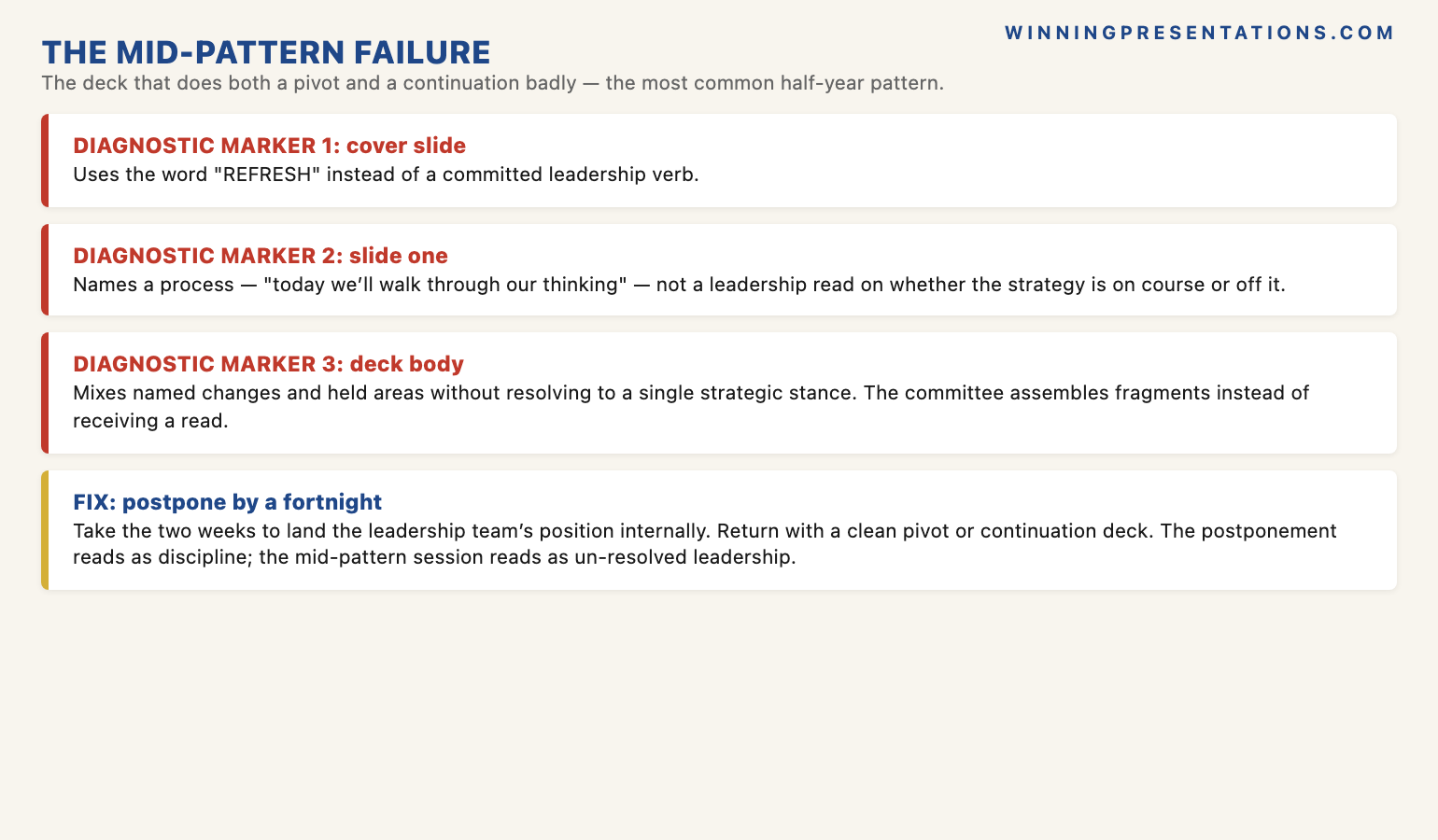
The mid-pattern is the half year strategy refresh deck that tries to do both a pivot and a continuation at once and lands cleanly as neither. It is the most common pattern I have seen in fifteen years of these sessions, and it is the pattern the refresh-the-word framing on the cover slide most reliably produces. The mid-pattern deck names two or three areas where the leadership team is proposing changes, two or three where the original direction is being held, and a handful of cross-cutting adjustments that sit somewhere between the two. The committee opens the deck looking for the leadership read and finds a mosaic. Each individual change looks reasonable; the overall picture does not resolve to a strategic stance. The session generates a long list of working-group items, the leadership team leaves believing the committee has engaged, and the committee leaves believing the leadership team has not made up its mind on whether the strategy is on course or off it. Both impressions are accurate to the deck as written.
The mid-pattern is structurally different from a clean continuation with named adjustments. A continuation deck with three or four mid-pillar adjustments still has a clear slide-one verb — “continue” or “hold the course” — and the adjustments are framed as operational refinements within an unchanged strategic direction. A pivot deck with continuity in some areas still has a clear slide-one verb — “shift” or “rebalance” — and the continuity areas are framed as the load-bearing parts of the strategy that remain in force around the named pivot. The mid-pattern deck has neither verb on slide one; the cover says “refresh” and the leadership read is left to the committee to assemble from the pieces. Senior committees, particularly at the half-year, do not assemble strategic reads from pieces. They ask for the read, do not get it, and conclude the leadership team is not yet ready to be asked the strategic question.
The reason the mid-pattern persists is that it is the deck that gets written when the leadership team is internally divided, when the operating environment is genuinely ambiguous, or when the strategy director is reluctant to commit to a pivot or a continuation without the committee’s air cover. All three are real conditions. None of them are reasons to walk into the committee with a mid-pattern deck. The disciplined response is to postpone the strategy session by a fortnight, take that fortnight to resolve the leadership team’s internal position, and walk into the session with a clean pivot or continuation deck. A postponement, communicated honestly, costs less than a mid-pattern session. The mid-pattern session burns the committee’s strategic attention for the half-year without delivering a decision, and there is rarely a second slot to recover.
The pivot-or-continuation diagnostic, with the third option
The diagnostic to run on the deck before the strategy session is three questions long. Read slide one aloud. Is the verb on slide one a committed leadership read — “change”, “shift”, “withdraw”, “enter”, “hold”, “continue”, “stay the course” — or is it a process noun like “refresh”, “review”, “update”? If the verb is a process noun, the slide is failing the test and needs to be rewritten before any other work happens. The second question is whether the slide-one verb is consistent with the body of the deck. A deck that opens with “continue” and then proposes structural changes on six of the eight strategy pillars is incoherent; the slide-one verb needs to change, or the body needs to change, but the two need to agree. The third question is whether the body of the deck has the trigger conditions (if continuation) or the act-now-versus-wait comparison (if pivot) in the explicit form the committee will ask for.
The third option the diagnostic surfaces — the option strategy directors most often resist — is the postponement. If the diagnostic shows the deck is in the mid-pattern, the disciplined response is not to fix the slide one and force the body to align around it. The body of the deck reflects the actual state of the leadership team’s thinking, and the mid-pattern body almost always means the leadership team has not yet resolved the pivot-or-continuation question internally. Forcing the deck to look like a clean pivot or continuation when the leadership team is internally divided produces a deck that does not survive the committee’s questioning. The disciplined response is to postpone the session, take the time to land the leadership team’s position internally, and walk in the following fortnight with a clean deck. The postponement reads as discipline; the mid-pattern session reads as the leadership team not knowing its own answer. The committee’s response in each case is dramatically different.
One thing to do before the next strategy session
Read the cover slide of the current draft deck aloud. If it contains the word “refresh”, “review”, or “update”, remove the word and replace it with the single verb that names what the leadership team is recommending: change, shift, withdraw, enter, exit, hold, continue, stay the course. If you cannot land on the single verb, the leadership team has not finished its own work, and the session needs to be postponed until the verb is clear. The verb on slide one is the smallest possible test of whether the deck is ready for the committee. Decks with the verb pass; decks without it do not. Twenty minutes of leadership-team discussion on the right verb, two weeks before the session, is the difference between a strategy session the committee acts on and one the committee absorbs and forgets.
Frequently asked questions
What if the leadership team genuinely cannot agree on pivot or continuation — isn’t the strategy session the place to surface that?
It is the place to surface the disagreement, but the leadership team needs to walk in with the disagreement named, the two competing reads on the table, and a specific request for the committee’s adjudication. That is a defensible deck and a legitimate use of the committee’s time. The undefendable deck is the one that hides the disagreement behind a refresh-the-word cover and presents a mid-pattern body that the committee is supposed to read as either a pivot or a continuation depending on their own judgment. The committee declines that. A named-disagreement deck reads as honest leadership escalation; a mid-pattern deck reads as leadership avoidance. Both come from genuine internal division; only the first one earns the committee’s engagement.
Is “rebalance” a clean verb or a polite version of “refresh”?
It can be either, and slide one needs to make clear which. A clean rebalance names what is being shifted from and to, in specific operational terms — capital, headcount, channel emphasis, customer segment. We are rebalancing £30 million of the H2 distribution budget from the broker channel to the direct channel is a clean rebalance. A polite-refresh use of “rebalance” sounds the same on slide one but does not have the operational specificity attached anywhere in the deck. The committee can tell the difference within two minutes of opening the document. Specificity on slide three (operational implications) is the test: if the rebalance is real, the implications are concrete; if the rebalance is rhetorical, the implications are abstract. Build slide three before you let “rebalance” stay on slide one.
How long should the half-year strategy deck be?
The working norm is twelve to twenty slides for a half-year strategy session at the senior committee level. The slide-one verb, the evidence base, the operational implications, the decision the committee is being asked to take, the trigger conditions (if continuation) or the act-now-versus-wait comparison (if pivot), and the supporting material for each. Decks above twenty-five slides almost always indicate a mid-pattern problem; the analytical pages are doing the work the leadership read is supposed to do. Most decks above thirty pages can be cut to fifteen without losing anything the committee was going to engage with. The fifteen-page version forces the leadership read to do its work; the thirty-page version lets the leadership read hide behind the analysis.
Does this pivot-or-continuation framing work for a strategy refresh that is genuinely cosmetic — an annual update with no leadership read attached?
If the leadership read is genuinely “no read — the strategy is on course and we have nothing material to add”, the session should not be on the senior committee’s calendar in the first place. Senior committees do not have time for sessions where the leadership team has nothing to recommend. A cosmetic refresh belongs in an operating-committee or strategy-team working session, with a brief memo to the senior committee summarising the work and confirming the strategy stands. Putting a cosmetic refresh on the senior committee agenda burns the committee’s strategic attention for a session whose substance does not warrant it, and the leadership team loses credibility for the next session where genuine pivot-or-continuation work needs the committee’s engagement. Use the senior committee slot for the work that requires it.
The Winning Edge — weekly newsletter
The Winning Edge is a weekly (Thursday) newsletter for senior professionals who present at the executive level. One short email a week, focused on the structural moves that separate the strategy sessions committees act on from the ones they absorb and forget. Subscribe to The Winning Edge →
For the broader picture across slides, storytelling, confidence, and delivery, the seven-product Complete Presenter library is the bundle most senior professionals find useful as a single resource — £99 for everything, lifetime access.
About the author
Mary Beth Hazeldine is Owner & Managing Director of Winning Presentations Ltd. With 24 years of corporate banking experience at JPMorgan Chase, PwC, Royal Bank of Scotland, and Commerzbank, she advises senior professionals across financial services, insurance, consulting, and technology on the structure of half-year strategy sessions, mid-year pivot decisions, and the continuation decks senior committees engage with.