

A regional operations director received pushback on a distribution network expansion in three consecutive Q&A sessions. Same outcome: “We’ll think about it.” After the third deferral, she changed her approach. Approved in one email.
Got a “we’ll think about it” after your last Q&A?
If the Q&A ended without a decision and you’re not sure what to write in the follow-up, the Executive Q&A Handling System includes post-session follow-up frameworks designed to help move deferred decisions forward within 48 hours.
Jump to Section
- The Distribution Network Expansion That Got Approval on the Fourth Attempt
- Why “We’ll Think About It” Is a Q&A Failure, Not a Decision Delay
- The Three-Part Follow-Up Email Structure
- Answering the Question They Didn’t Ask Out Loud
- The 24-Hour Window: Why Timing Matters More Than Content
- Framing the Next Step So Small They Can’t Say No
- Frequently Asked Questions
Ines, a Regional Operations Director at a logistics company, presented a distribution network expansion across three board meetings. Each time, the Q&A went well—solid ROI projections, clear cost analysis, detailed implementation timeline. Each time, the result was identical: “We’ll think about it.” After the third deferral, she changed tactics entirely. Instead of requesting another board slot, she sent a follow-up email within 24 hours. Not a meeting recap. Not a gratitude note. A pivot. She zeroed in on one question the CFO had asked repeatedly—”What’s our exposure if demand forecasts don’t hit targets in Year 2?”—and provided a specific scenario analysis. Then she reframed the ask: “Would you be comfortable approving the network expansion for Year 1 only, with Year 2 contingent on Q4 demand validation?” The CFO responded within two hours. “Yes. Let’s lock in Year 1 and review in October.”
Turn Post-Q&A Silence Into Decisions That Move Forward
- A complete Q&A handling system that covers preparation, in-session responses, AND the post-session follow-up that most Q&A training ignores entirely
- Follow-up email frameworks designed to convert “we’ll think about it” into approval within 48 hours—with templates for each common deferral pattern
- Question prediction methods that help you anticipate objections before the Q&A starts, so your follow-up addresses concerns before they crystallise into blockers
- The reframing technique that turns partial objections into partial approvals—getting movement instead of stalling
Explore the Executive Q&A Handling System →
Designed for executive presentations where structured follow-up conversations help move decisions forward—because the real decision work often happens after the Q&A closes.
Why “We’ll Think About It” Is a Q&A Failure, Not a Decision Delay
“We’ll think about it” feels like a polite deferral. It’s actually diagnostic information. It tells you that the Q&A session failed to resolve the one concern that mattered most to the decision-maker.
In most cases, that concern was never voiced directly. The CFO asked about implementation timelines, but the real concern was risk. The VP asked about team capacity, but the real concern was whether this initiative competes with their own priorities. The CEO asked for “more data,” but the real concern was confidence—they didn’t trust the recommendation enough to put their name on it.
If you walk out of a Q&A with “we’ll think about it” and send a standard follow-up—”Thank you for the discussion, please find the deck attached”—you’ve wasted the most valuable conversion window in the entire decision cycle. The 24 hours after a Q&A session is when the decision-maker’s concerns are fresh, their memory of your answers is sharpest, and their willingness to engage is highest.
Your Q&A preparation needs to include a follow-up strategy, not just an in-session strategy. The follow-up email is where deferred decisions become approved ones.
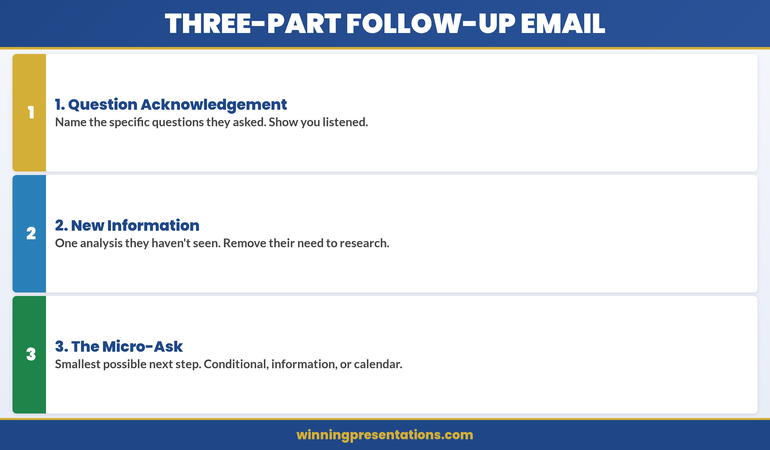
The Three-Part Follow-Up Email Structure
The post-Q&A follow-up email that converts deferrals into approvals has three parts. Not a summary. Not a recap. A conversion instrument.
Part 1: The Question Acknowledgement (2-3 sentences)
Name the specific questions that were asked. Not all of them—just the ones that revealed the decision-maker’s real concern. “You raised two important questions during our discussion: the implementation risk if the vendor timeline slips, and the impact on the Q3 reforecast if we start before Q2 results are final.” This tells the reader: I was listening to what you actually care about, not what I wanted to talk about.
Part 2: The New Information (3-5 sentences)
This is the critical section. Provide one piece of information, analysis, or framing that wasn’t in the presentation or the Q&A. Not something you forgot—something you’ve now prepared specifically in response to their concern. “Since our meeting, I’ve modelled the scenario where the vendor timeline slips by 6 weeks. The financial impact is £40k in additional parallel running costs—within our contingency budget of £75k. The attached one-page analysis shows the three trigger points where we’d escalate.” This demonstrates responsiveness and removes the decision-maker’s need to do their own analysis.
Part 3: The Micro-Ask (1-2 sentences)
Don’t ask for the full approval again. Ask for the smallest possible next step. “Would you be comfortable giving a conditional go-ahead for Phase 1, with Phase 2 contingent on the Q2 review?” Or: “Can we schedule 15 minutes next Tuesday to review the updated risk analysis? I can have it ready by Monday.” The micro-ask works because it reduces the decision from “approve everything” to “agree to this small thing.” And small agreements compound.
Answering the Question They Didn’t Ask Out Loud
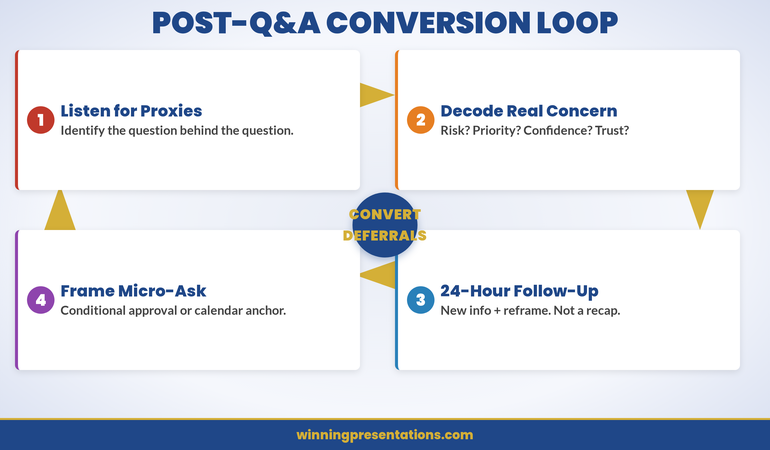
The most important question in any Q&A session is the one that wasn’t asked. Decision-makers rarely voice their deepest concern directly. Instead, they ask proxy questions—questions that circle the real issue without naming it.
Here’s how to decode common proxy questions:
“Can you walk me through the implementation timeline again?”
They’re not confused about the timeline. They’re worried the project will overrun and they’ll be associated with a failure. Your follow-up should address implementation risk explicitly—not repeat the timeline.
“Have you considered any alternatives?”
They’re not suggesting you missed options. They’re testing whether you’re married to one solution or capable of pivoting if it doesn’t work. Your follow-up should show flexibility: “If the initial approach encounters [specific obstacle], we have two fallback options already scoped.”
“What does the team think about this?”
They’re not asking for a poll. They’re worried about execution capability—does the team have capacity and willingness to deliver? Your follow-up should name specific people and their commitments.
If you predicted these questions before the session, you’ll recognise the proxy pattern in real time. Your follow-up email becomes the place where you answer the real question directly—something that’s difficult to do in the social dynamics of a live meeting but perfectly natural in a written follow-up.
Want to Predict the Questions Before They’re Asked?
The Executive Q&A Handling System includes the question prediction framework that maps likely objections to specific decision-maker roles—so your follow-up can address concerns when they arise.
The 24-Hour Window: Why Timing Matters More Than Content
You have 24 hours after a Q&A session to send the follow-up that converts the deferral. After 24 hours, two things happen that work against you.
First, the decision-maker’s memory of your answers starts to degrade. They remember their own questions clearly—but your answers blur. If you don’t reinforce your strongest answers in writing within 24 hours, the decision-maker reconstructs their own version of what you said. That reconstruction is rarely favourable.
Second, other priorities fill the gap. The urgency you created in the presentation dissipates. By Wednesday, your Monday Q&A feels like last week’s problem. The decision-maker’s calendar fills with new requests, new presentations, new decisions. Your proposal moves from “I need to decide on this” to “I should revisit this when I have time.” That time never comes.
The 24-hour follow-up breaks this pattern. It arrives while the decision-maker still remembers the conversation, still feels the momentum, and still has mental space for your proposal. It gives them a reason to act now instead of later.
If you missed the 24-hour window, a 48-hour follow-up still works—but you need to create a new urgency. “Since our discussion, I’ve learned that the vendor pricing expires end of month” or “The project team I’ve reserved will be reassigned to another initiative on Friday.” Genuine time pressure, not manufactured scarcity.
Framing the Next Step So Small They Can’t Say No
The biggest mistake in post-Q&A follow-ups is asking for the same decision that was deferred. If the decision-maker said “we’ll think about it” to a £500k investment, asking again for £500k produces the same result.
Instead, shrink the ask. There are three ways to do this:
The Conditional Approval: “Would you be comfortable approving Phase 1, with Phase 2 contingent on [milestone]?” This works because it turns one big decision into two smaller ones. The first decision feels lower risk.
The Information Request: “Would it be helpful if I prepared a one-page risk analysis addressing the scenario you raised? I could have it ready by Thursday.” This works because you’re not asking for a decision—you’re asking for permission to be helpful. Nobody says no to “can I give you more information?”
The Calendar Anchor: “Can we block 15 minutes next Tuesday to review the updated analysis together?” This works because it commits the decision-maker to a specific follow-up moment. Without a calendar anchor, “we’ll think about it” means “we’ll forget about it.”
Each of these micro-asks does the same thing: it creates forward momentum without requiring the decision-maker to overcome the inertia of the full commitment. And once they’ve said yes to the small step, the full approval becomes a natural continuation, not a new decision.
This is why understanding how to handle situations where you don’t know the answer during the Q&A itself is so valuable—because “I’ll research that and send you the analysis by tomorrow” becomes a natural bridge to the follow-up email. The gap in your knowledge becomes your conversion opportunity.
Stop Losing Approvals to Post-Q&A Silence
- Follow-up email frameworks that convert “we’ll think about it” into approval within 48 hours—with templates for conditional approvals, information bridges, and calendar anchors
- Question decoding guide that helps you identify the real concern behind proxy questions—so your follow-up addresses what the decision-maker actually cares about
Get the Executive Q&A Handling System →
Designed for the critical 24 hours after Q&A sessions where you can build momentum—because follow-up strategy often determines whether a deferral becomes a decision.
People Also Ask
How long should a post-Q&A follow-up email be?
Should I copy everyone who was in the Q&A session?
What if the decision-maker doesn’t respond to my follow-up email?
Is This Approach Right for You?
This is for you if:
- You’ve had Q&A sessions that went well but ended with “we’ll think about it” instead of a decision
- You’re sending standard “thank you for the meeting” follow-ups and not getting traction
- You want a structured approach to the post-presentation phase that most Q&A training ignores
- You’re presenting proposals that require multiple stakeholder approvals and need to keep momentum between meetings
This is NOT for you if:
- Your Q&A sessions consistently end with clear decisions—your current process is working
- You’re in a context where follow-up emails aren’t culturally appropriate (some organisations require formal proposal resubmission instead)
- The deferral is genuinely about budget timing, not about unresolved concerns—in that case, a follow-up email won’t change the fiscal calendar
Frequently Asked Questions
I’m worried that a follow-up email will seem pushy. How do I avoid that?
What if there were multiple decision-makers and they had different concerns?
Should my follow-up email include the presentation deck as an attachment?
The Winning Edge — Weekly
Q&A strategies, executive communication frameworks, and the presentation techniques that get decisions approved. One email weekly. Built for executives who present to other executives.
Read These Next
- Q&A Preparation Checklist for Executive Presentations
- What to Say When You Don’t Know the Answer in a Presentation
- How to Predict Presentation Questions (The Question Map)
- The Capital Expenditure Presentation That Made the CFO an Ally
- The Body Scan Technique: 90 Seconds to Reset Before Any Presentation
About the Author
Mary Beth Hazeldine is Owner & Managing Director of Winning Presentations. With 24 years of corporate banking experience at JPMorgan Chase, PwC, Royal Bank of Scotland, and Commerzbank, she advises executives across financial services, healthcare, technology, and government on structuring presentations for high-stakes funding rounds and approvals.