
Tag: investment committee

20 Apr 2026
Female executive presenting proof-of-concept results to an investment committee in a corporate boardroom, data charts on screen, composed and authoritative, navy and gold tones, editorial photography style

Proof-of-Concept Presentation: Securing the Next Stage of Approval

Quick Answer

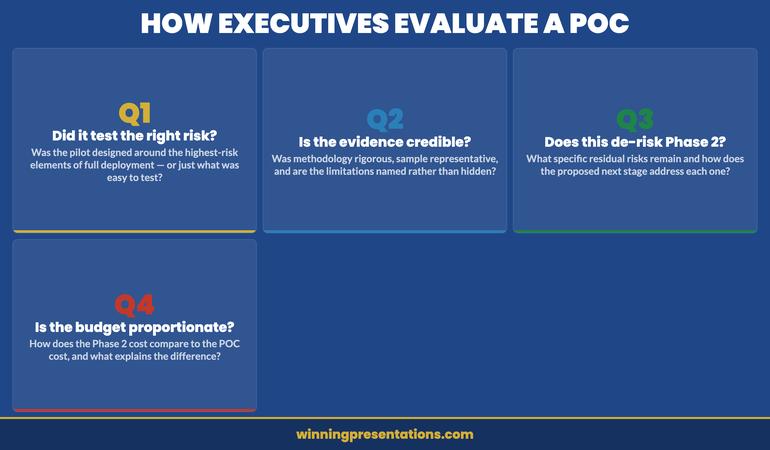
A proof-of-concept presentation must answer three questions for an executive audience: did the POC do what it was designed to test, is the evidence sufficient to de-risk the next stage, and is the investment required for that next stage proportionate to what has been demonstrated? Executives are not evaluating your work so far. They are evaluating whether the case for the next decision has been made.

Ingrid had led the pilot for fourteen weeks. The system integration had worked. User adoption in the test group had exceeded the original forecast. Customer satisfaction scores had improved by a measurable margin. By any internal metric, the proof of concept had been a success.

She walked into the investment committee certain that the results would speak for themselves.

They did not. The committee asked why the pilot group had been selected rather than a random sample. One board member questioned whether the cost overrun in month eleven was a structural issue or an anomaly. Another asked why the proposed Phase 2 budget was forty percent higher than the original POC cost when the scope was described as “similar.” Ingrid had answers to all of these questions, but they were not in her slides. She improvised. The committee asked for a revised submission.

The problem was not her results. The problem was her framing. She had presented a success report. What the committee needed was a decision document.

Building a case for executive approval of the next stage?

The Executive Slide System includes slide frameworks and scenario playbooks for proposal and approval presentations, including how to structure a POC business case for an executive decision meeting.

Explore the System →

What Executives Actually Evaluate in a POC Presentation

A proof-of-concept presentation sits at a peculiar intersection. The presenter has completed something and is proud of the outcome. The executive audience is starting something and needs to know whether to proceed. These are different conversations, and conflating them is the source of most POC presentation failures.

Executives evaluating a POC are not assessing past performance. They are assessing forward risk. The specific question in their minds is: does the evidence produced by this pilot reduce the probability of failure in the full deployment to a level we are willing to accept? That is a different question from “did the pilot succeed?” A pilot can succeed on its own terms and still fail to make the case for the next stage — if the methodology was too narrow, if the sample was unrepresentative, or if the next stage introduces risks that the pilot did not test.

This means a POC presentation must be built around the decision-maker’s risk calculus, not the execution team’s achievement narrative. The framing is: “Here is what we set out to test, here is what we learned, here is why that learning reduces the risk in what we are proposing next.” Not: “Here is everything we accomplished and how hard we worked.”

Understanding this distinction also clarifies what to leave out. Results that are impressive but irrelevant to the next-stage decision dilute the argument. Features that were tested but are not part of the next-stage scope add confusion. An appendix exists for detail; the main presentation exists for the decision.

The Three-Part POC Presentation Structure

A proof-of-concept presentation that secures executive approval for the next stage follows a specific logical sequence. It does not begin with results; it begins with objectives. It does not end with a summary; it ends with a decision request.

Part 1: The original test design. Restate what the POC was designed to test and what success criteria were agreed at the outset. This matters because an executive audience may not remember — or may never have been fully briefed on — the original parameters. Starting with the design reanchors the conversation around the agreed framework rather than allowing retrospective judgements based on assumptions that were never part of the scope.

Part 2: Results against those criteria. Present each agreed success criterion and the actual result. Be explicit about which criteria were met, which were partially met, and which were not assessed. The last category requires a brief explanation: why was it not assessed, and does that create a risk for the next stage? Leaving unexplained gaps invites speculation from an audience trained to find risk.

Part 3: The next-stage case. Make the explicit argument for why the results from Part 2 are sufficient to proceed. This is where most POC presentations fail — they stop at presenting results and assume the committee will draw the inference. They often will not, or not in the direction you expect. Spell out the chain of reasoning: the POC tested the highest-risk elements of the full deployment, those elements performed as required, therefore the residual risk in proceeding is X, and the next stage is structured to manage X through Y mechanism.
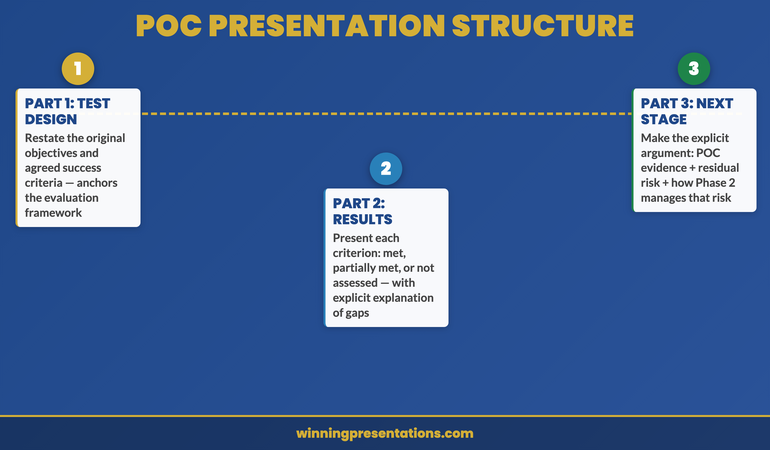
POC presentation three-part structure: Part 1 Original Test Design, Part 2 Results Against Criteria, Part 3 Next Stage Case — with the key question each part answers for the executive audience

Framing Evidence for a Risk-Averse Audience

Executive audiences in investment or approval settings are calibrated for risk detection. They have been in meetings where over-confident presentations produced expensive failures. The result is a scepticism that is not personal and not irrational — it is institutional. Your evidence presentation needs to account for this.

The most credible approach to evidence framing in a POC context is to lead with methodology before results. Presenting what you measured and how you measured it before presenting what you found signals rigour. It also pre-empts the methodology questions that will otherwise arrive as objections after you have finished.

Acknowledge limitations explicitly and early. If the pilot sample was small, say so and explain why it is still representative for the purpose it served. If there were external variables that affected results, name them rather than leaving the committee to discover them in questions. An executive audience that discovers a limitation you did not mention loses confidence in the integrity of the entire presentation. An executive audience that hears you name a limitation clearly and then explain why it does not undermine the core finding respects the analytical honesty.

Use comparative context where possible. Raw numbers are harder to evaluate than numbers with a benchmark. If user adoption in the pilot reached 73%, that tells the committee little unless they know that comparable pilots in this sector typically land at 55–65%, or that the original forecast was 60%. Comparison makes data meaningful without overstating it.

The Executive Slide System

Proposal presentations that win approval are built around the decision, not the evidence. The Executive Slide System — £39, instant access — includes slide frameworks and scenario playbooks for business case and approval presentations.

  • Slide templates for executive approval scenarios
  • AI prompt cards to structure complex business cases fast
  • Scenario playbooks for POC, pilot, and phase-gate decisions
  • Framework guides for risk framing and evidence presentation

Get the Executive Slide System →

Designed for executives presenting business cases and proposals to senior decision-makers.

The Scope Creep Problem: What Not to Present

One of the most common structural errors in POC presentations is expanding the scope beyond what was originally agreed. During a pilot, the team almost always discovers adjacent opportunities, interesting edge cases, and potential future features. Including these in the approval presentation creates three problems.

First, it dilutes the core argument. The committee came to evaluate a specific proposal. Every additional element they are asked to consider creates a new decision variable and increases the cognitive load of the meeting. A presentation that covers more than it needs to is harder to approve than one that is precisely scoped.

Second, it signals uncertain scope management. If the pilot uncovered so many adjacent possibilities that the team felt compelled to include them all, a cautious executive will wonder whether the next stage will suffer from the same expansive thinking — and whether the budget being requested reflects that expansion.

Third, it opens new objections. Every new element you introduce is a new surface for scrutiny. Features or opportunities that you raise in passing may be the very things a sceptic seizes on to complicate the approval. If something is not essential to the next-stage decision, it belongs in a separate document or a future meeting.

The discipline required is to present only what the committee needs to make the specific decision in front of them: proceed to the next stage, at this scope, at this cost, on this timeline. Everything else is scope creep, regardless of how genuinely interesting it is.

Before the formal presentation, consider conducting stakeholder alignment conversations to understand which elements of the proposal are most important to each decision-maker — this often reveals where to focus and what to leave out.

Structuring the Next-Stage Ask

The next-stage ask is the most consequential slide in a POC presentation. It is also the most frequently underprepared. Most presenters treat it as a natural conclusion: here are the results, and now here is what we need next. But the logic connecting those two things must be made explicit, because it is exactly where an unconvinced committee member will intervene.

A well-structured next-stage ask has four components. First, a clear statement of what is being requested: not a “move forward” but a specific approval with named scope, budget, and timeline. Second, a direct link to the POC findings: “the results from Phase 1 demonstrate X, which means the primary risk in Phase 2 is Y, and we have structured Phase 2 to manage Y through Z.” Third, a risk summary: what are the remaining unknowns, how significant are they, and how will Phase 2 address them? This is not pessimism — it is the language of rigour that risk-aware executives respond to. Fourth, a cost-of-delay argument: what does waiting another quarter cost, in financial terms, strategic terms, or competitive terms?

The cost-of-delay argument is often omitted because it feels presumptuous. In practice, it is one of the most useful elements of any approval presentation because it reframes the decision. Without it, “defer” appears to be a low-cost option. With a concrete cost attached, deferral becomes a choice with a price — and most committees prefer to make that choice explicitly rather than implicitly.

For a broader view of how to close a proposal and secure commitment, the Executive Slide System includes scenario-specific frameworks for phase-gate and approval presentations.

Presenting When Results Are Mixed or Partial

Not every proof of concept produces clean results. Sometimes a key metric was not achieved. Sometimes the pilot ran into external factors that affected results. Sometimes the technology performed but the change management did not. How you handle mixed or partial results will significantly affect the committee’s confidence in your integrity — which, in turn, affects their confidence in your next-stage proposal.

The worst approach is to obscure partial results in favourable framing. An experienced executive audience will notice if positive results are presented in detail and negative results are glossed over with qualifying language. This creates a credibility problem that is far more damaging than the underlying result.

The most effective approach with mixed results is to acknowledge them directly, explain what caused them, and then make the case for why they do not undermine the next-stage proposal. If the CRM integration was slower than planned but the customer-facing functionality performed exactly as required, say so. Explain why the integration timeline will be different in Phase 2 (different resources, pre-built connectors, lessons incorporated). The argument is: “We encountered this, we understand why, and here is how Phase 2 is structured to avoid it.”

This approach is more persuasive than a purely positive presentation because it demonstrates analytical honesty, which is the quality that executive audiences most need to trust before they commit significant resources.
Handling mixed POC results: three-step approach — Acknowledge directly, Explain the cause, Make the Phase 2 case showing how the issue is addressed in the next stage

Common POC Presentation Mistakes

The most common mistake is presenting outputs rather than outcomes. Outputs are the things your team produced: the integration was built, the training was delivered, the data was collected. Outcomes are what those outputs achieved in terms that matter to the executive: customer retention improved, processing time reduced, error rate declined. Executive audiences make decisions based on outcomes, not outputs. A presentation that emphasises what was built over what it achieved misses the point of the exercise.

The second mistake is treating scope ambiguity as a minor detail. If there is genuine uncertainty about what is included in the next-stage budget or timeline, addressing it vaguely in a presentation will produce a much more painful discussion when it surfaces as a formal question. Be precise about what the next-stage scope includes and explicitly state what is excluded. “Phase 2 covers X, Y, and Z. The integration with the legacy finance system is out of scope for Phase 2 and will be addressed as a separate initiative.” That clarity signals control.

The third mistake is presenting to the wrong level of detail. A POC presentation to an investment committee should contain the evidence and argument necessary to make the next-stage decision. It should not contain every data point collected during the pilot. If the committee wants detail, they will ask; the appendix exists for that purpose. An overly detailed main presentation signals either poor judgement about audience needs or a lack of confidence in the top-level argument.

If you need to structure a broader executive presentation outline for the full business case, use the approved POC summary as your evidence anchor rather than repeating the pilot analysis in full.

The Executive Slide System

Slide templates and scenario playbooks for approval presentations, including POC and business case structures. £39, instant access.

Get the Executive Slide System →

Designed for executives presenting complex proposals and phase-gate decisions to senior audiences.

Frequently Asked Questions

How long should a proof-of-concept presentation be?

For a senior executive or investment committee setting, fifteen to twenty minutes of presentation time is appropriate, with ten minutes reserved for questions. In slides, this typically means twelve to eighteen slides: two or three on the original POC design and objectives, four to six on results and evidence, and four to six on the next-stage case and ask. Everything else belongs in the appendix. If you find yourself with significantly more slides than this, the presentation has not yet been edited to its decision-relevant content.

Should you mention the budget for the next stage in the POC presentation?

Yes — always. An approval presentation that does not include a specific budget request is incomplete. Executives cannot approve a next stage without understanding its cost, and leaving that number until it is asked for signals either that you are not confident in it or that you expect it to create a problem. Present the next-stage budget with a brief breakdown of its main components and a direct comparison to the POC cost, with an explanation of why the numbers differ if they differ significantly. Transparency about cost is a signal of financial competence, not vulnerability.

What if the committee is split on whether to proceed?

If you identify or suspect a split in the committee during the meeting, do not try to resolve it in real time by negotiating a compromise. Instead, acknowledge the different perspectives clearly: “It sounds like there are two different views on the timeline risk — one that the pilot has sufficiently de-risked it, and one that would want to see the vendor contract confirmed first. Is that a fair summary?” This reframes the disagreement as a structured problem rather than a conflict, and often surfaces a specific resolution — such as conditional approval subject to a named milestone — that neither side had proposed explicitly.

The Winning Edge — A Newsletter for Executives Who Present

Every Thursday: one structured technique for executive presentations, business cases, and high-stakes decision meetings. Practical and direct.

Subscribe to The Winning Edge →

Also available: the Executive Presentation Checklist — a free pre-presentation checklist for senior decision meetings.

If you are preparing for an executive decision meeting and need to align stakeholders in advance, read the companion article on running a stakeholder alignment workshop before the formal session.

About the Author

Mary Beth Hazeldine is the Owner and Managing Director of Winning Presentations. With 25 years of corporate banking experience at JPMorgan Chase, PwC, Royal Bank of Scotland, and Commerzbank, she advises executives across financial services, healthcare, technology, and government on structuring presentations for high-stakes funding rounds and approvals.

27 Feb 2026
A professional woman standing alone at the end of an empty corporate boardroom after her presentation, surrounded by vacant leather chairs, capturing the silence and isolation when no one asks questions

No Questions After Your Presentation? That Silence Isn’t Approval

When nobody asks questions after your presentation, it rarely means unanimous agreement. It almost always means your audience disengaged before you finished. The silence feels comfortable in the moment — but the decision that follows is usually “deferred,” “let’s revisit,” or a quiet no. This article gives you three techniques to prevent post-presentation silence and one recovery protocol for when it’s already happened.

Eight executives. Forty-five minutes. Zero questions.

I was 18 months into my role at JPMorgan Chase, presenting a credit facility to the investment committee. I’d prepared for weeks. The analysis was tight. The recommendation was clear. When I finished and said “any questions?” — silence. Complete, polite, devastating silence.

I walked out thinking it went well. No pushback meant agreement, right?

The decision came back “deferred” — which in investment banking means nobody cared enough to engage. My presentation hadn’t failed on content. It had failed on engagement. The committee hadn’t disagreed with me. They’d stopped listening to me somewhere around slide 11.

The second time I presented to that committee, I planted three decision hooks throughout the deck — specific moments designed to make them lean in. Five questions in Q&A. Approved same meeting.

That was the day I learned: silence after a presentation isn’t the absence of objections. It’s the absence of interest. And interest is something you have to engineer deliberately.

Committee or leadership presentation this week?

Quick diagnostic: count the moments in your deck where you deliberately invite the audience to react — not at the end, but during the presentation. If the answer is zero, silence in Q&A is almost guaranteed. A structured engagement protocol fixes this before you walk in. See the Executive Q&A Handling System →

Why Silence Is Worse Than Tough Questions

Most professionals fear hostile questions. They shouldn’t. The most dangerous Q&A outcome isn’t a difficult question — it’s no questions at all.

Here’s why. When someone asks a tough question, they’re telling you three things: they listened, they care about the outcome, and they’re mentally engaged with your recommendation. Even a hostile question is a form of investment. That person is spending cognitive energy on your proposal.

Silence means none of those things happened.

In 25 years of corporate banking — across JPMorgan Chase, PwC, Royal Bank of Scotland, and Commerzbank — I’ve sat in hundreds of committee meetings. The presentations that got approved almost always generated questions. The ones that got deferred or quietly rejected? Silence.

Why does nobody ask questions after my presentation?

There are three common reasons: your content was too dense for the audience to process in real time, your structure didn’t create natural engagement points, or your conclusion didn’t require a decision. In all three cases, the fix is structural — not about your delivery or confidence. You need to build question-generating moments into your deck, not hope they emerge after it.

The pattern across executive presentations is consistent: silence is almost never about content quality. It’s about structural engagement. A brilliant 35-slide analysis that doesn’t create tension, choice points, or moments of surprise will get silence every time — regardless of how good the data is.

This is exactly what kills engagement in most corporate presentations — the assumption that good content automatically produces good discussion.

The Silence Protocol: 3 Prevention Techniques

After that JPMorgan experience, I spent years studying what separated presentations that generated rich Q&A from those that got polite silence. The difference was never the presenter’s confidence or charisma. It was always structural.

The presentations that generated questions had something built into them — deliberate engagement architecture. I call these the three prevention techniques.

Each one works by creating what psychologists call “knowledge gaps” — moments where the audience’s brain recognises it needs more information. When you create enough of these gaps during your presentation, questions become inevitable. The audience isn’t choosing to engage. They can’t help it.


Diagram showing The Silence Protocol with three prevention techniques: decision hooks, open loops, and planted controversy, plus one recovery method for post-presentation silence

Technique 1: Decision Hooks

A decision hook is a moment in your presentation where you explicitly frame a choice — and then move on without resolving it completely.

Here’s what this looks like in practice. Instead of presenting your recommendation as a conclusion, you present it as one of two possible paths: “There are two ways we could approach this implementation — a phased rollout over 12 months, or a full deployment in Q3. I’m recommending the phased approach, and I’ll show you why in the next three slides.”

The audience now has something to evaluate. They’re not passively receiving information. They’re mentally testing your recommendation against the alternative you just planted. By the time you reach Q&A, at least one person will ask about the path you didn’t recommend.

Where to place decision hooks: Slide 3 (after your executive summary), at the midpoint of your presentation, and one slide before your recommendation. Three hooks is the minimum. I plant them at the same points where I’d forecast likely questions using a question map — because the same structural moments that generate questions are the ones where hooks land hardest.

The formula: “There are [two/three] ways to approach [specific decision]. I’m recommending [option] because [one-sentence reason]. Let me show you the evidence.”

Diagram showing where to place decision hooks in a presentation: after the executive summary at slide 3, at the midpoint, and before the recommendation, with the decision hook formula and three reasons why it works

Turn Post-Presentation Silence Into Engaged, Productive Questions

The Executive Q&A Handling System (£39, instant access) gives you the complete framework for engineering audience engagement — including the question forecasting method, decision hook templates, and the Headline → Reason → Proof → Close structure that creates natural question points throughout any presentation.

  • The Question Forecasting method — predict and plant the exact questions your audience will ask
  • Engagement trigger templates that create knowledge gaps your audience can’t ignore
  • Recovery scripts for when silence has already happened (the “redirect and re-engage” protocol)
  • The 4-part answer structure that turns every question into a credibility-building moment

Get the Executive Q&A Handling System → £39

Built from 25 years of investment committee presentations. £39, instant access — no subscription.

Technique 2: Open Loops

An open loop is a piece of information you introduce but don’t complete. Your audience’s brain will hold that loop open until it gets resolved — and if you don’t resolve it fully during the presentation, they’ll ask about it in Q&A.

This isn’t manipulation. It’s how the brain processes incomplete information. Psychologists call it the Zeigarnik effect: unfinished tasks create cognitive tension that demands resolution.

Here’s an example from a real client presentation. A director was presenting a restructuring plan to the board. Instead of laying out every detail sequentially, she opened with: “This restructuring will affect three departments — but the impact on each is very different. I’ll walk you through engineering and operations today. The third department is where the real decision sits, and I’ve saved it for the end.”

The board was leaning forward by slide 4. By the time she reached the third department, two members had already prepared questions. The Q&A ran 20 minutes — exactly what she wanted.

How to create open loops:

  • The preview loop: “I’ll share the data that changed our recommendation — but first, let me show you what we originally assumed.”
  • The exception loop: “This approach works in every scenario except one. I’ll get to that exception in a moment.”
  • The contrast loop: “Our competitor took the opposite approach. The results are striking — and I’ll show you why our path is different.”

Each of these creates a gap your audience needs filled. And if you leave even one loop partially open, someone will ask about it. That’s not a risk — that’s the entire point.

The Executive Q&A Handling System includes engagement trigger templates for all three loop types — pre-written, ready to adapt to your specific presentation context.

Is silence after a presentation good or bad?

In almost every corporate context, silence after a presentation is a negative signal. It typically indicates one of three things: the audience didn’t understand enough to form questions, the content didn’t create enough engagement to provoke curiosity, or the decision-makers have already mentally checked out. The rare exception is when the recommendation is so clear and well-supported that immediate approval follows — but in 25 years, I’ve seen that happen perhaps five times. If silence is followed by “we’ll come back to you” rather than an immediate decision, it wasn’t agreement. It was disengagement.

Technique 3: Planted Controversy

This is the technique most executives resist — and the one that works most reliably.

A planted controversy is a moment where you deliberately present a counterargument to your own recommendation. Not to undermine yourself — to create intellectual tension that demands discussion.

Here’s why it works. When you present a recommendation with no counterpoint, the audience has nothing to push against. Agreement is passive. But when you say “The strongest argument against this approach is X — and here’s why I still recommend it,” you’ve given the audience something to evaluate. You’ve shown intellectual honesty. And you’ve created a natural question point.

At Commerzbank, I watched a risk director use this brilliantly. He was recommending a credit line extension that the committee was likely to reject. Instead of pretending the risk didn’t exist, he opened his recommendation slide with: “The obvious concern with this extension is the sector’s volatility over the past two quarters. If I were sitting where you are, I’d ask why we’re recommending increased exposure.”

He then answered his own planted question with three data points. The committee didn’t need to voice the objection — he’d already addressed it. But the technique had a secondary effect: it opened the door for more nuanced questions. Instead of “isn’t this too risky?” they asked “what’s the exit strategy if volatility continues?” — a far more productive conversation.

How to plant controversy effectively:

  • Identify the strongest objection to your recommendation before you present
  • State it directly: “The biggest risk with this approach is…”
  • Answer it with evidence — but leave 10% of ambiguity
  • That 10% becomes a Q&A question you’ve already prepared for

This technique connects directly to question forecasting — if you can predict what the audience will object to, you can plant that controversy deliberately and control the conversation.

Stop Hearing Silence After Every Presentation You Give

The silence problem isn’t about your delivery or your data. It’s about structure — and structure is fixable. The Executive Q&A Handling System (£39, instant access) gives you the complete engagement architecture so you never face dead silence again.

  • Decision hook templates you can drop into any presentation in 10 minutes
  • The open loop formula that makes your audience need to ask questions
  • Planted controversy scripts for high-stakes committee presentations
  • The complete recovery protocol for when silence has already happened

Get the Executive Q&A Handling System → £39

Designed for executives presenting to investment committees, boards, and senior leadership — where silence means a deferred decision. £39, instant access.

The Recovery: When Silence Has Already Happened

Prevention is ideal. But sometimes you’re standing at the front of a room and it’s already happened. You’ve said “any questions?” and you’re staring at eight faces that aren’t going to speak.

First: do not fill the silence yourself. The instinct is to keep talking — to summarise, to add caveats, to ramble into your own recommendation. Every word you say in that moment reduces the pressure on the audience to engage. The silence is uncomfortable for them too. Let it work.

Wait a full five seconds. It will feel like thirty. Then use one of these recovery lines:

he Silence Recovery Protocol showing Step 0 wait 5 seconds followed by three recovery options: The Redirect, The Specific Question, and The Stakeholder Call, each with the exact script to use and why it works

The redirect: “Let me ask this a different way — if you were going to push back on one part of this recommendation, which part would it be?”

This works because it reframes the question from “do you have anything to say?” (which allows passivity) to “which specific thing would you challenge?” (which assumes engagement).

The specific question: “The implementation timeline is where I expect the most debate. What’s your reaction to the Q3 target?”

This works because it removes the paradox of choice. Instead of asking the audience to generate a question from nothing, you’re giving them a specific anchor to respond to.

The stakeholder call: “[Name], I know this affects your division directly — what’s your initial reaction?”

This works because it shifts from an open-room question (where diffusion of responsibility means nobody speaks) to a direct, personal invitation. One person speaking breaks the silence for everyone.

How do you encourage questions after a presentation?

The most effective way to encourage questions isn’t to ask for them differently at the end — it’s to build question-generating moments throughout the presentation itself. Decision hooks, open loops, and planted controversies all create cognitive gaps that the audience needs resolved. By the time you reach Q&A, the questions already exist in their minds. You don’t need to encourage them. You just need to create the space for them to emerge. If you’re already at the “any questions?” moment and facing silence, redirect with a specific prompt: “If you were going to challenge one part of this, which part would it be?” This reframes from passive to active and almost always breaks the silence.

Is This Right For You?

The Executive Q&A Handling System is built for you if:

  • You present to committees, boards, or senior leadership where Q&A determines the outcome
  • You’ve experienced post-presentation silence and the “deferred” decisions that follow
  • You want to engineer engagement into your presentation structure rather than hope it happens
  • You need recovery scripts for when silence has already occurred

It’s probably not right if you already get strong audience engagement and your Q&A sessions run long. In that case, you might benefit more from handling the difficult questions that do come up.

Frequently Asked Questions

What if the silence genuinely means they agree?

It’s possible but rare. In my experience, genuine agreement after a presentation is followed by an immediate decision — “approved,” “let’s proceed,” or a direct next-step conversation. If the silence is followed by “we’ll come back to you,” “let’s take this offline,” or “deferred for further review,” it wasn’t agreement. It was disengagement. The safest approach is to build engagement architecture into every presentation. If they genuinely agree, the techniques in this article won’t harm your outcome. If they don’t agree, the techniques will surface the real objections before the meeting ends.

Won’t planting controversy make me look uncertain about my own recommendation?

The opposite. Addressing the strongest counterargument to your own recommendation demonstrates intellectual honesty and thoroughness. Investment committees and senior leadership teams respect presenters who acknowledge risk rather than pretend it doesn’t exist. The key is in the execution: state the counterargument clearly, then answer it with evidence. You’re not expressing doubt — you’re showing you’ve already considered and resolved the most likely objection.

How many decision hooks is too many?

Three is the sweet spot for a 20–30 minute presentation. One after your executive summary, one at the midpoint, and one before your final recommendation. More than five and the audience feels manipulated — each hook creates cognitive work, and too many will exhaust rather than engage. Fewer than two and you’re relying on the content alone to generate questions, which rarely works in committee settings.

📬 The Winning Edge — Weekly Newsletter

One executive presentation insight per week. Real scenarios, real scripts, zero filler. Written for professionals who present to decision-makers.

Subscribe Free →

📊 Presenting a budget defence this quarter? When finance wants to cut your team’s funding, the wrong slide structure guarantees you lose. Read: The Budget Defence Presentation: When Finance Wants to Cut Your Team’s Funding

Your next step: Before your next committee or leadership presentation, count the engagement moments in your deck. If you have fewer than three decision hooks, open loops, or planted controversies, add them now. The difference between silence and five productive questions isn’t talent or confidence — it’s structure.

About the Author

Mary Beth Hazeldine is the Owner & Managing Director of Winning Presentations. With 25 years in corporate banking — including roles at JPMorgan Chase, PwC, Royal Bank of Scotland, and Commerzbank — she advises executives across financial services, healthcare, technology, and government on high-stakes presentations and committee-level Q&A. A qualified clinical hypnotherapist and NLP practitioner, Mary Beth combines boardroom experience with evidence-based psychology to help professionals present with authority and close with confidence.