

Quick answer: A thick deck feels like preparation to the person who built it and reads as the opposite to the room receiving it. When you add slides to feel covered, a senior audience does not see thoroughness — it sees someone who could not decide what mattered and offloaded the sorting onto them. The most senior presenters do the reverse: they cut, and they present from the fewest slides the decision needs, because restraint is the visible evidence that they have already done the hard work of deciding what is important. The discipline is the load-bearing slide — every slide must either carry the decision or come out of the main deck and go to the appendix. To apply it, run the would-I-defend-this-slide test: for each slide, ask whether you could justify in one sentence why it is in front of the board rather than in the appendix. If you cannot, it is padding, and padding dilutes the slides that matter. A lean deck is not less work than a thick one. It is more — it is the thick deck after the thinking has been finished.
JUMP TO:
In 2012 I sat through two presentations to the same executive group on the same afternoon, and the contrast has stayed with me ever since. The first presenter, a capable department head, brought forty-one slides for a thirty-minute slot. He was clearly well prepared — every claim had a supporting chart, every chart had a backup, every objection he could imagine had a slide ready in case it came up. He never reached slide forty-one. Around slide nineteen the room stopped following and started flicking ahead in the printed pack, and the chair eventually said, not unkindly, ‘Can you just tell us what you’re recommending?’ The second presenter, an operations director, took the same length of slot and used six slides. Six. She stated the situation, the recommendation, the two risks that mattered, the cost, and the decision she wanted — and then she stopped, and let the room ask. The room spent the rest of her slot in a focused discussion of the actual decision, and she got her approval before the meeting ended. I remember one of the non-executives, a former chief executive, glancing at her short deck and nodding slightly, the way you nod at someone who has clearly done this before.
What separated them was not preparation. The first presenter had, if anything, prepared more — he had built three times the material. What separated them was that the second presenter had finished her preparation and the first had stopped halfway. He had done the work of gathering; she had done the further, harder work of deciding what mattered and cutting the rest. His forty-one slides were the visible residue of a decision he had not made. Her six were the residue of one he had.
(This article was created with AI assistance; all stories and insights are based on 35 years of real client work.)
This is the counterintuitive truth about slides and seniority: the more senior the presenter, the fewer slides they tend to use, not because they have less to say but because they have done more of the thinking before they walk in. The discipline that produces the lean deck is the load-bearing slide — the principle that a slide earns its place in the main deck only if it carries weight in the decision, and everything else belongs somewhere other than the screen.
If your decks keep growing because cutting a slide feels riskier than keeping it, and the room loses focus before you reach the point:
The Executive Slide System ships 26 executive templates built around the way senior rooms actually decide — a lean spine of slides that carry a decision (situation, recommendation, the risks that matter, the ask) plus a structured appendix for everything that supports without belonging on screen. It also includes 16 scenario playbooks covering board approval and executive updates, and 93 AI prompts for working out which slides are load-bearing and which are padding. You stop adding slides to feel safe and start presenting from the few the decision actually needs.
Why the thick deck reads as weakness
The instinct to add slides comes from fear, and it is a reasonable fear: the fear of being caught without an answer. If someone asks about the third quarter, I want a third-quarter slide. If anyone challenges the assumption, I want the assumption on the screen. So the deck grows, each addition a small insurance policy against a question that might come. The logic is sound for the individual slide and disastrous for the deck as a whole, because the thing you are insuring against — looking unprepared — is precisely the impression the resulting thick deck creates.
A senior room reads a forty-slide deck not as forty answers but as one signal, and the signal is: this person has not decided what matters. Experienced decision-makers know that almost any topic could fill forty slides; the skill they are looking for is the judgement to know which six carry the decision. When you present all forty, you are not demonstrating thoroughness — you are demonstrating that you have left the prioritising undone and handed it to the room. And the room resents that, quietly, because prioritising is your job. They came to make a decision, not to pan for it in a deck. The thick deck does not read as ‘look how much I prepared’. It reads as ‘I could not tell what was important, so here is everything’.
There is a deeper signal underneath, and it is about command. Restraint is hard, and everyone in a senior room knows it is hard, because they have all felt the pull to add the extra slide. So when a presenter resists that pull — when they stand up with six slides and the confidence to stop — the room reads it as evidence of someone who is in command of their material rather than buried in it. The lean deck signals that the presenter has a point of view and is willing to be held to it, rather than hiding behind volume. This is the visible end of the same discipline that runs through being able to state your whole argument in a single sentence — if you know the one thing you are saying, you can cut everything that is not saying it, and the cutting is what the room sees as authority.
Present from the few slides that carry the decision, and the room reads restraint as command instead of reading volume as panic.
The Executive Slide System gives you a board-ready deck structure as a starting point, not a blank page: a lean front-of-deck spine that carries the decision — answer-first opening, the recommendation, the risks that matter, the ask — and a structured appendix for the supporting detail a question might need. It ships 26 executive templates, 93 AI prompts for separating load-bearing slides from padding, 16 scenario playbooks covering board approval and executive updates, plus 7 checklists. Built for senior presenters who would rather walk in with six slides they can defend than forty they are hiding behind. £39, instant download, lifetime access.
- 26 executive templates — a lean decision spine plus a structured appendix for supporting material
- 93 AI prompts — for testing which slides carry the decision and which are insurance
- 16 scenario playbooks — board approval, executive update, capital allocation, investment committee
- 7 checklists — including a cut pass that flags any slide you cannot defend in one sentence
The load-bearing slide
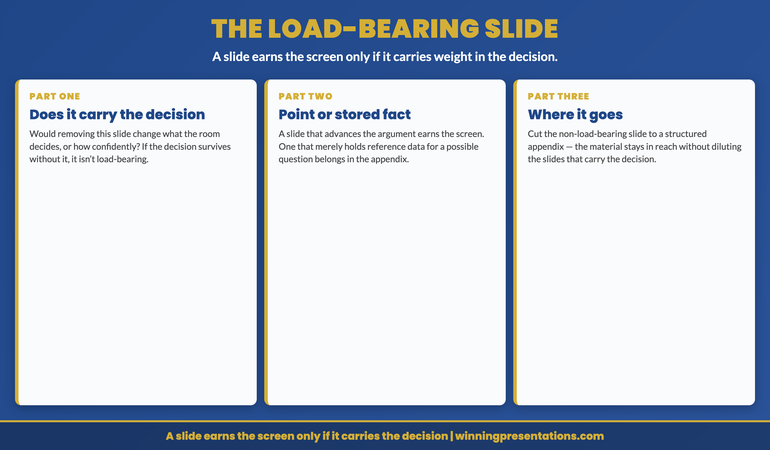
The load-bearing slide is a structural idea borrowed from the way buildings work: some walls hold the building up and some merely divide rooms, and you can remove the dividing walls without the structure failing. A deck is the same. Some slides carry the decision — remove them and the room cannot reach a conclusion. Some slides merely store information — remove them and the argument stands, with the stored facts available elsewhere if a question reaches for them. The skill of the lean deck is telling the two apart, and the test is simple to state: would the room’s decision change, or its confidence in that decision change, if this slide were not on the screen? If yes, the slide is load-bearing and it stays. If no, it is a dividing wall, and it belongs in the appendix.
The mistake most presenters make is treating ‘this fact is true and relevant’ as the bar for inclusion, when the real bar is ‘this slide changes the decision’. Almost every fact in your analysis is true and relevant — that is why you gathered it — which is exactly why ‘true and relevant’ cannot be the filter, or nothing ever gets cut. A great deal of true, relevant material supports the decision without needing to be in the room: it sits behind the recommendation, available if challenged, but not occupying the audience’s attention by default. Moving it to the appendix does not throw it away. It puts it within reach without putting it on the screen, which is precisely where supporting detail should live. The front of the deck is for the decision; the appendix is for the defence of it. This is the natural partner of building a deliberate appendix the room can be sent to — the lean front deck only works because there is a well-organised back deck holding everything you cut.
What a load-bearing front deck looks like is remarkably consistent across senior settings, because the decision a room makes has a stable shape: where are we, what do I recommend, what are the risks that genuinely bear on it, what does it cost, and what am I asking you to decide. That is five or six slides for most decisions. Not because there is a magic number — a complex decision may need eight, a simple one four — but because the decision itself has only so many load-bearing parts, and once you have a slide for each of them, every further slide is supporting a part that is already carried. The lean deck is not an aesthetic preference for minimalism. It is the deck that has exactly one slide per load-bearing element of the decision and not one more.
Cutting to that deck is harder than building the thick one, and this is the part that surprises people. Adding a slide is easy — you have the material, you drop it in, you feel safer. Cutting a slide requires you to decide that the decision survives without it, and that decision is a judgement you can be wrong about, which is uncomfortable. So the thick deck is, in a real sense, the lazy deck: it is what you are left with when you decline to make the hard calls about what matters. The lean deck costs more because every slide that is not there represents a call you made and are standing behind. That cost is exactly what the room is reading when it sees six confident slides instead of forty hedged ones.
When the deeper challenge is holding a senior room’s confidence through a high-stakes decision, not just trimming the deck:
A lean deck is one expression of a larger skill: presenting in a way that earns a reluctant board’s trust and moves it toward a decision. The Executive Buy-In Presentation System is a self-paced programme of 7 modules giving you the complete framework for securing buy-in from senior stakeholders, boards, and executives — including how to decide what a room genuinely needs to see, how to hold the floor with confidence rather than volume, and how to structure a case that reads as command. It runs with monthly cohort enrolment, no deadlines and no mandatory attendance, and its optional live Q&A calls are fully recorded so you can watch back anytime. Lifetime access to materials. £499.
The would-I-defend-this-slide test
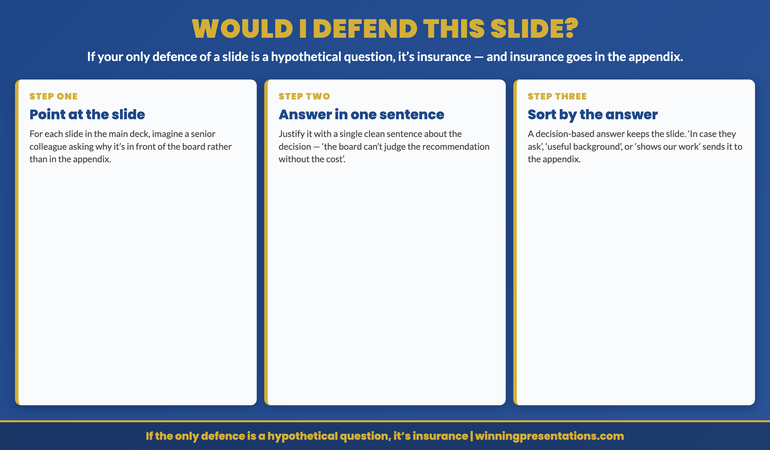
Knowing that slides should be load-bearing does not make them easy to cut, because every slide feels load-bearing to the person who built it — you remember why you added each one. The would-I-defend-this-slide test is the diagnostic that breaks the attachment, by forcing you to justify each slide’s presence to an imagined sceptic rather than to your own memory of building it.
The test is a question you put to every slide in the main deck: if a senior colleague pointed at this slide and asked ‘why is that in front of the board rather than in the appendix?’, could you answer in one clean sentence that refers to the decision? A good answer sounds like ‘because the board cannot judge the recommendation without seeing the cost’ or ‘because this risk is the one most likely to be the room’s first objection’. A bad answer sounds like ‘because it’s useful background’, ‘because someone might ask’, or ‘because it shows the work we did’ — every one of which is an argument for the appendix, not the screen. The test is unforgiving in a useful way: ‘someone might ask’ justifies having the material somewhere; it never justifies having it in the main deck. If your only defence of a slide is a hypothetical question, the slide is insurance, and insurance belongs in the appendix where it can be produced if the question actually arrives.
I ran this with a head of strategy in 2019 who was preparing for a board that had a reputation for tough, detailed questioning — and his instinct, understandably, was to arm himself with a slide for every conceivable question. His draft deck was thirty-four slides. We went through it with the defend-this question, slide by slide, and the pattern was immediate: about ten slides carried the decision and he could defend each in a sentence about what the board needed to decide; the other twenty-four were defended with some version of ‘in case they ask’. We moved all twenty-four to a clearly tabbed appendix, organised so he could jump to any of them in seconds, and presented from the ten. The board did ask hard questions — it always did — and three or four times he turned calmly to an appendix slide and answered with the exact detail they wanted. But he was presenting from a deck of ten, in command of it, and the questions landed as a conversation rather than a hunt through his pack. Afterwards the chair told him it was the sharpest he had seen him. He had not prepared less. He had simply put the insurance where insurance goes. For the high-stakes boards where the deck itself is read as a signal of the presenter, the executive presentation coaching work runs the defend-this test across every slide before a deck is finalised.
Buy the structure once and every future deck starts as a lean spine plus an appendix, instead of a pile of slides you are afraid to cut. No subscription, nothing to renew.
The Executive Slide System is a one-time £39 with lifetime access — 26 templates, 93 AI prompts, 16 scenario playbooks, 7 checklists. There is nothing to track and nothing to renew; you buy it once and every future deck starts from a structure that separates the load-bearing front from the supporting appendix, rather than a blank slide that quietly tempts you to keep adding. Built for the senior presenter who would rather defend six slides than hide behind forty. The cut pass in the checklists flags any slide you cannot justify in one sentence, before the board does it for you.
Frequently asked questions
If I cut slides to look confident but then get a question I have no slide for, won’t I look unprepared?
That is exactly why the cut material goes to a structured appendix rather than into the bin. A lean deck is not an under-prepared deck; it is a fully prepared deck with the supporting material moved off the screen and into reach. When the hard question comes, you turn to the appendix slide that answers it — which actually reads as more impressive than having pre-empted it, because the room sees both that you anticipated the question and that you had the discipline not to clutter the main deck with it. The risk is not cutting too much; it is cutting without keeping the appendix organised enough to find what you need quickly. Build the appendix well and you get the confidence of the lean deck with none of the exposure.
Is there a right number of slides for a board presentation?
No, and chasing a number is the wrong way to think about it. The right number of front-deck slides is one per load-bearing element of the decision — the situation, the recommendation, the risks that genuinely matter, the cost, the ask — which for most decisions lands somewhere around five to eight, but a genuinely complex decision may need more and a simple one fewer. The discipline is not ‘use six slides’; it is ‘use a slide for each part of the decision and not one more’. If you arrive at twelve load-bearing slides because the decision genuinely has twelve distinct parts, that is a lean deck. If you arrive at twelve because four of them are insurance, it is not. Count the parts of the decision, not the slides.
My organisation’s culture expects detailed decks — won’t a short one look like I cut corners?
Cultures that expect detail are usually expecting the detail to exist and be available, not necessarily to be walked through slide by slide in the room. A well-built appendix satisfies a detail-oriented culture completely: the depth is all there, tabbed and ready, and you can go to any of it on demand. What you change is what you present from, not what you prepare. In practice, the presenters who shift a detail-heavy culture are the ones who walk in with a lean front deck and a deep appendix and then demonstrate, by answering every question instantly from the back of the pack, that the short front deck was a choice rather than a shortcut. The room learns quickly that fewer slides did not mean less work.
How do I cut slides when every one of them feels essential?
They all feel essential because you remember why you added each one, which is exactly the bias the would-I-defend-this-slide test is built to break. Stop asking ‘is this slide useful?’ — almost everything is useful — and start asking ‘would the decision change if this slide were not on the screen?’ That question separates the slides that carry the decision from the ones that merely support it, and the supporting ones can move to the appendix without anything being lost. If you genuinely cannot tell which slides are load-bearing, that is usually a sign you have not yet decided what your single recommendation is — and once that is clear, the slides that serve it become obvious and the rest fall away. The difficulty in cutting is almost always an unfinished decision wearing the disguise of a full deck.
The Winning Edge — weekly newsletter
The Winning Edge is a weekly newsletter for senior professionals who present at the executive level. One short email a week on the structural moves that separate a deck a board follows from one it flicks ahead through. Subscribe to The Winning Edge →
For the wider library of presentation assets senior leaders draw on — slide system, storytelling primer, Q&A taxonomy, delivery references — the complete presenter library (£99) bundles seven products plus three bundle-only bonuses, worth over £190, covering slides, storytelling, confidence, and delivery in one place. See the wider work on the services page, and the companion article on sizing the ask a board can actually approve.
About the author
Mary Beth Hazeldine is Owner & Managing Director of Winning Presentations Ltd. With 24 years of corporate banking experience at JPMorgan Chase, PwC, Royal Bank of Scotland, and Commerzbank, she advises executives across financial services, healthcare, technology, and government on structuring presentations for high-stakes funding rounds, board approvals, and strategic decisions.
Before your next board meeting, open your deck and go through it once with a single question for every slide: could you defend, in one sentence about the decision, why it is in front of the room rather than in the appendix? Keep the slides that pass. Move the ones defended by ‘in case they ask’ to a tabbed appendix where you can reach them in seconds. Then present from what is left. You will walk in with fewer slides than the version of you that was afraid to cut — and like the operations director with her six slides while the room nodded along, you will find that the room reads the short deck not as someone who did less, but as someone who already knew what mattered. The thick deck is the work half-finished. The lean deck is the work done.