Tag: handling tough questions

07 May 2026

“Why Should I Believe Your Numbers?” — Answering the Hardest Q&A Challenge

Quick answer: The credibility-attack question — “why should I believe your numbers?” — is not a request for data. It is a test of composure and source transparency. The response that works has three moves in 30 seconds: name the specific source, surface the one limitation the questioner has not yet seen, and invite them to a deeper follow-up. Attempting to defend the numbers on their merits loses the moment. Attempting to counter-challenge the questioner loses the room.

Ines was presenting a market analysis to the investment committee at a mid-size asset manager. She had been at the firm eight months. Her analysis recommended reducing exposure to a specific sector by four percent. The work was careful. The sources were solid. The conclusion was defensible.

Partway through, the senior partner — who had championed the sector for twenty years — put down his pen. “Ines. Why should I believe your numbers?” Not “where did you get that figure” or “how did you account for the recent regulatory change.” The broader challenge. To her analysis, her judgement, and by implication her presence on the committee.

She had thirty seconds. What she did in those thirty seconds decided not just whether the recommendation got approved that day but whether she would be invited to present to the committee again. She chose the response that held. The sector reduction was not approved, but Ines was asked to lead the follow-on analysis the same afternoon. The senior partner later told her manager, “She handled the challenge well.”

Want a structured approach to handling tough executive questions?

The Executive Q&A Handling System covers the frameworks for predicting, preparing, and delivering composed responses to executive challenges — including the credibility-attack pattern described in this article.

Explore the Executive Q&A Handling System →

Why this question is never really about the numbers

Senior executives who ask “why should I believe your numbers?” are almost never asking you to walk them through the data. They have been in rooms with data their whole career. They know what careful analysis looks like. The question is a different kind of probe.

It is a composure test. The question is deliberately broader than it needs to be. It forces the presenter to choose between defending the data in detail — which reads as not quite understanding the question — and responding at a higher level, which reads as confident. Most presenters reach for the detail, because the detail is comfortable ground. Reaching for the detail is exactly what the questioner is watching for.

It is also a source transparency check. Part of what the executive wants to see is whether you know, at a speaking-level fluency, where your numbers came from. Not the page number. The underlying dataset, the methodology, and the known limitations. If you have to pause to look these up, the executive has their answer — your ownership of the analysis is not as deep as it needs to be.

And it is sometimes a signalling move to the rest of the room. A senior executive who questions a junior presenter’s numbers in front of the committee is reminding everyone who holds the final judgement on analysis. This is not malicious. It is an organisational norm in many firms. The presenter’s job is not to resent it. The presenter’s job is to pass the test cleanly.

The three-move response that holds

The response needs to happen inside 30 seconds. Not because speed is impressive, but because a longer response extends the zone in which the presenter can make a mistake. The shorter, cleaner response closes the moment and returns control to the meeting.

Move one: name the source precisely. Not “the data came from our market team.” Specific. “The underlying data is from the MSCI sector attribution series, February 2026 release, cross-referenced against the Bloomberg consensus forecast for the same period. I pulled the cuts myself on the 28th.” That sentence does three things. It signals specific source knowledge. It signals recency. It signals personal ownership of the analysis. A presenter who says “I pulled the cuts myself” is not outsourcing the defence.

Move two: name the limitation before they do. “The piece I would flag is that the MSCI series does not yet reflect the March regulatory change. For the sector we are discussing, that adjustment would move the estimate by roughly 1 to 1.5 percentage points in the same direction.” This is the move that separates strong presenters from everyone else. Surfacing your own analytical limitation, unprompted, is the fastest way to restore credibility under a credibility attack. It tells the executive you have thought about what could be wrong, not just what is right.

Move three: invite the deeper follow-up. “I can walk through the full source methodology and sensitivity analysis in a separate 30-minute session if that would be useful, or I can return with a written note by end of day.” Now the decision of how much further to probe sits with the executive. You have offered both a rapid deliverable and a deeper one. Most executives will accept one or the other, or ask one tightened follow-up question. The credibility-attack pattern has ended.

The three-move response framework shown as a 30-second timeline infographic: name the source precisely, name the limitation before they do, invite the deeper follow-up, with each move's function annotated

Four failure modes (and why each one loses the room)

The credibility attack generates predictable failure modes. Knowing them by name helps you catch yourself in the moment.

Failure mode 1: the data defence. The presenter reaches for specific numbers and starts walking through methodology. “Well, the four percent comes from taking the MSCI data on slide 14 and adjusting for…” This extends the moment and signals that the presenter has not understood the question. The room reads defensiveness. The executive’s concern is confirmed rather than answered.

Failure mode 2: the appeal to authority. The presenter cites who approved the analysis — “this was reviewed by the quant team and signed off by head of research last week.” This deflects responsibility away from the presenter and onto an absent third party. Executives read this as unwillingness to own the analysis. The sign-off may have happened. The presenter’s name is still on the work.

Failure mode 3: the counter-challenge. The presenter pushes back — “what specifically are you concerned about?” — or worse, questions the questioner’s assumptions. In some rooms this works. In most executive settings it reads as lack of composure. The credibility attack is social, not analytical, and responding with a social counter-attack escalates rather than de-escalates.

Failure mode 4: the apology. The presenter says some variant of “I understand if the analysis is not where you want it to be.” This concedes the attack on the presenter’s behalf. Executives rarely expect the presenter to concede. They expect a composed defence. The apology forfeits the ground the presenter was standing on.

The three-move response is designed to avoid all four failure modes. It does not defend the data, appeal to authority, counter-challenge, or apologise. It owns the source, names the known limitation, and offers a deeper session. That is the exit the room is looking for.

Preparing the response before the meeting

You cannot compose the three-move response live, under pressure, in front of a senior executive. The response has to be drafted before the meeting, for the two or three pieces of analysis most likely to be challenged.

Step one is to identify the attackable numbers. Usually three or four in any deck. They tend to cluster around one of three things: a central recommendation figure (the percentage change, the revenue estimate, the risk-adjusted return), a comparative benchmark (how the proposed option stacks up against the status quo), or a forward-looking projection (any number with a future date attached). For each attackable number, assume a credibility attack will come. If no attack comes, you have wasted thirty minutes of preparation. If an attack comes and you have not prepared, you have lost thirty minutes of meeting time and an unknowable amount of credibility.

Step two is to write the three moves for each attackable number. Specifically. With the exact phrasing you will use. “The underlying data is from the MSCI sector attribution series…” is a line you rehearse, not improvise. Read it aloud three times. Make sure the sentence is delivered as a single unit — if you have to pause mid-sentence to remember the next word, the pause itself reads as hesitation. Keep the sentences short enough to survive being spoken under pressure.

Step three is the limitation. Most presenters find this step uncomfortable. They are trained to present strength, and surfacing limitations feels like conceding ground. In the credibility-attack context, the opposite is true. The limitation is the strongest move you have. For each attackable number, identify one real, material, currently unresolved limitation. Not a trivial caveat. A real one. Write the limitation in the form you will say it. Practise saying it without apologising. “The piece I would flag…” is the opener that works. “I have to be honest with you…” is the opener that does not.

The Executive Q&A Handling System covers the structured preparation process for these responses in more detail, including the scenario playbooks for different executive meeting types.

Harder variants and how they shift the response

The pure “why should I believe your numbers?” is the standard form. Several variants are harder and require response adjustments.

Variant 1: “I have seen this analysis before, and I did not believe it then either.” This adds a historical layer. The response has to acknowledge the earlier context without litigating it. “That is useful context — I was not involved in the earlier piece, and my version uses the February MSCI release rather than the previous year’s. The piece I would flag…” Then continue into the three-move structure. Do not ask about the earlier work. Do not defend the earlier work. Acknowledge and redirect.

Four Q&A failure modes shown as a grid infographic: the data defence, the appeal to authority, the counter-challenge, and the apology — each with the reason it loses the room

Variant 2: “Your analysis assumes something I do not think is true.” This is sharper because it names a specific assumption. The response is adjusted. Move one becomes the assumption you used, specifically, and the reason you chose it. Move two becomes what happens to the conclusion if the assumption is wrong — you have already done the sensitivity analysis, haven’t you? Move three stays the same: offer the deeper session.

Variant 3: “What would change your mind about this?” This is actually the most respectful variant, and the easiest to underestimate. It sounds like an attack but it is an invitation. The response is direct. Name two or three specific pieces of evidence that would update your analysis. “Three things would move me. A regulatory development in the opposite direction. A change in the baseline rate assumption above 250 basis points. Or confirmation that the MSCI methodology revision, expected in Q3, materially changes the sector attribution.” Presenters who cannot answer this question usually have not done the full analysis.

The full system for handling executive Q&A

The Executive Q&A Handling System — £39, instant access — gives you the frameworks for predicting, preparing, and delivering composed responses to executive challenges. Covers the credibility-attack pattern, the detailed technical question, the hostile challenge, and the ambiguous meta-question. Designed for senior professionals presenting to boards, investment committees, and executive sponsors.

  • Response frameworks for the most common executive challenge patterns
  • Preparation protocols for predictable question types
  • Scenario playbooks covering boardroom, investment committee, and executive sponsor settings
  • Master checklist and framework reference materials
  • Instant download, lifetime access, no subscription

Get the Executive Q&A Handling System →

Designed for senior professionals facing structured executive questioning.

When the follow-up session matters more than the original meeting

If you offer the deeper 30-minute follow-up session and the executive accepts, the follow-up matters more than the original meeting. It is the moment you demonstrate, on your own terms, that the credibility concern was unfounded.

Prepare the follow-up differently from the original presentation. Strip the slides to two or three, at most. Bring the source files, the sensitivity analysis, and the specific methodology documentation. Open the session by naming the question that triggered the follow-up. “We are here because you raised a credibility question on the sector attribution. I want to address that directly.” Then walk through the three elements: exact source, specific methodology steps, complete sensitivity analysis.

The executive’s behaviour in this session tells you which of two things is happening. If they engage deeply with the detail, they were genuinely interested in the analysis and will likely update their view. If they engage lightly and move quickly to other topics, the original question was primarily a composure test and you have now passed it. Either outcome is good. Both require the same preparation.

Need the slide layouts that support defensible analysis?

The Executive Slide System — £39 — includes 26 templates, 93 AI prompts, and 16 scenario playbooks, including layouts for source-transparent analysis slides that make the three-move response easier to execute.

Get the Executive Slide System →

FAQ

What if I genuinely do not know the exact source of a number in my deck?

Do not guess. Do not improvise a source. Say so, honestly: “I can confirm the exact source and methodology within the next two hours — let me come back with a precise answer rather than approximate it now.” This preserves credibility. Approximating a source that turns out to be wrong loses it permanently. Executives do not expect presenters to know every detail live. They expect presenters to know what they do and do not know.

Is it ever correct to push back on the question itself?

Occasionally, and only with a specific form. If the question contains a factual error — for example, the executive has misremembered which dataset you used — a brief, neutral correction is appropriate. “Just to clarify, the data is from MSCI not FactSet — and the February release, not the December one.” Delivered flat, without defensiveness. This is a correction, not a counter-challenge. It protects the accuracy of the exchange without escalating the social dynamic.

How do I prepare if I do not know which numbers will be attacked?

Attackable numbers cluster predictably around the recommendation, comparative benchmarks, and forward-looking projections. For a deck of any length, there are usually three to five such numbers. Prepare the three-move response for each. Yes, you will not use most of them. That is the point. Having the response ready for numbers you were not attacked on is the price of being ready for the one that matters.

What if the credibility attack comes from someone other than the most senior person in the room?

The three-move response is the same. What changes is whether the senior person interjects. Sometimes a chair will step in to redirect after a junior committee member has pushed a credibility attack too hard. If that happens, accept the redirect and continue. Do not return to the earlier question unless directly invited. The chair has already signalled that the moment is over.

The Winning Edge — Thursday newsletter

The Winning Edge covers one specific technique per Thursday — Q&A handling, slide structure, executive communication, and delivery under pressure. Subscribe to The Winning Edge →

Want a simpler place to start? Download the free 7 Presentation Frameworks Quick Reference Card — useful for matching the right structure to the right kind of executive meeting before the Q&A preparation begins.

Next step: take the next deck you are preparing, identify the three most attackable numbers, and draft the three-move response for each one. Thirty minutes of preparation you may not use. The one time you do use it is the one time it matters.

Related reading: How to preempt objections in executive Q&A before they are raised.

About the author. Mary Beth Hazeldine is Owner & Managing Director of Winning Presentations Ltd, founded in 1990. With 24 years of corporate banking experience at JPMorgan Chase, PwC, Royal Bank of Scotland, and Commerzbank, she advises executives across financial services, healthcare, technology, and government on structuring presentations for high-stakes funding rounds, approvals, and board-level decisions.

06 Apr 2026
An executive presenting with calm authority at a boardroom table while a committee member leans forward with a pointed question, editorial photography style

Fishing Questions in Presentations: How to Respond Without Being Pinned Down

A fishing question is not asked because the questioner wants information. It is asked because the questioner wants a commitment — on record, in a room full of witnesses — before you are in a position to give one responsibly. Recognising a fishing question when it arrives, and responding in a way that is honest without being pinned down, is one of the most practically valuable Q&A skills an executive can develop.

Rafaela had been presenting the preliminary findings of a regulatory review to a committee that included two members with strongly opposing positions on the outcome. The presentation was going well — the data was solid, the structure was clear, and the room seemed engaged. Then one of the committee members, a senior partner who had been quiet throughout, leaned forward and asked: “So based on what you’ve found, would you say this falls within acceptable parameters or not?” Rafaela knew the question immediately for what it was. The analysis was not yet complete. She had flagged that explicitly in the introduction. But the question was framing the preliminary data as if it were a conclusion, and asking her to confirm a verdict that would effectively end the debate before the final report was delivered. A simple yes or no would have been wrong — not because she was hiding anything, but because the analysis genuinely did not support a definitive conclusion yet. What she needed was a response that was truthful, specific, and firm without being dismissive of the question. What she gave instead was a hedged non-answer that left the room uncertain about whether she was evading or genuinely uncertain. The committee member pressed again. She felt the moment slip. This guide covers what she should have done instead.

Facing high-stakes Q&A sessions where the questions are designed to corner you? The Executive Q&A Handling System gives you a structured system for predicting and responding to the questions that executives find hardest to handle. Explore the System →

What Fishing Questions Are — and How to Recognise Them

A fishing question has a specific structural signature: it frames a binary or forced choice and presents it as a neutral request for your assessment. “Would you say this is a risk or not?” “Is this on track or not?” “Do you think this is acceptable?” The framing appears reasonable — it sounds like the questioner is simply asking for your professional opinion. What it is actually doing is asking you to adopt a position publicly, in conditions that are designed to make the position hard to walk back.

The recognition signals are consistent. First, the question arrives before the relevant analysis is complete or before you are in a position to answer definitively. Second, it offers a binary or forced choice that does not reflect the genuine complexity of the situation. Third, it is asked in front of an audience — because a commitment made privately carries far less weight than one made in a room. Fourth, the questioner already has a preferred answer, and the question is structured to produce it.

Not every blunt or direct question is a fishing question. “What do you think will happen to margin in Q3?” is a direct question that deserves a direct answer. A fishing question is characterised by the mismatch between the certainty implied by its framing and the certainty that your evidence actually supports. When someone asks you to confirm a conclusion that your analysis does not yet justify, that is a fishing question — regardless of how reasonable it sounds.

The distinction matters because the response to a genuine direct question and the response to a fishing question are different. Responding to a genuine question with the caution appropriate for a fishing question signals evasiveness. Responding to a fishing question with the directness appropriate for a genuine question hands the questioner exactly what they were angling for.

Prepare for the Questions Designed to Corner You

The Executive Q&A Handling System gives you a structured approach to predicting, preparing for, and responding to the most challenging executive Q&A scenarios — including the fishing questions, stress tests, and loaded questions that catch executives off guard.

  • ✓ System for predicting and preparing for difficult Q&A questions
  • ✓ Response frameworks for high-stakes executive questioning
  • ✓ Scenario playbooks for board, investor, and committee Q&A

Get the Q&A Handling System → £39

Designed for executives managing high-stakes Q&A sessions

Why Fishing Questions Work: The Psychology of Public Commitment

Fishing questions exploit a well-documented psychological dynamic: public commitments are sticky. Once you have stated a position in front of a group, you are motivated — consciously and unconsciously — to maintain consistency with that position. This is not a weakness. It is a social and professional norm that makes functioning organisations possible. But it can be leveraged against you by a questioner who understands its power.

The dynamic operates in two directions. If you answer “yes, this is within acceptable parameters,” and the final analysis reveals it is not, you are now on record as having misjudged the situation. If you answer “no, it is not acceptable,” you may have committed to a position that the full data does not support, foreclosing options that the complete analysis might have kept open. The questioner wins either way — they have created a record that serves their position, and they have done it using your words.

The social pressure of the room amplifies this dynamic. When a question is asked in front of an audience, silence feels evasive, qualification sounds weak, and refusal to engage appears defensive. The questioner has created conditions in which the most comfortable response — giving a direct answer — is also the most dangerous one. This is why fishing questions are effective: not because they are logically compelling, but because they make the responsible answer psychologically difficult to deliver.

Understanding this mechanism is the first step toward managing it. When you recognise that the discomfort you feel is a function of the question’s design rather than a signal that you should comply with its framing, you can respond from a position of clarity rather than pressure. For a wider framework on recognising questions that are designed to set you up before they are even fully asked, our guide to recognising loaded questions in presentations covers the full taxonomy of adversarial question types.

The Response Framework: Honest, Specific, and Not Pinned Down

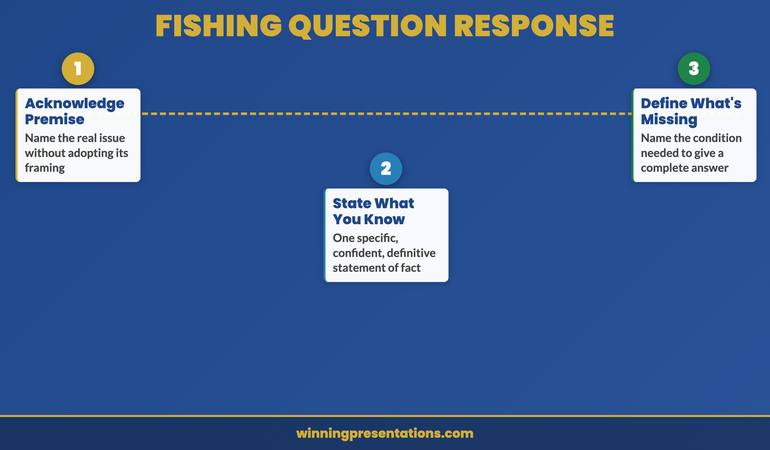
The effective response to a fishing question has three components, delivered in sequence. The first is an acknowledgement of the question’s premise — not agreement with its framing, but recognition that a real issue is being pointed at. “That is a central question, and it is one I want to answer accurately.” This buys a moment and signals engagement rather than evasion.

The second component is a statement of what you can say definitively, based on what you know. Not a hedge, not a qualification — a specific statement of fact. “What I can tell you with confidence is that the data we have reviewed to date shows X.” This demonstrates that you are not avoiding the question, you are giving the questioner the most accurate information available. Specificity is credibility. A vague non-answer and a precisely framed limitation are received very differently by a room.

The third component is a statement of what would be required to answer the full question. “A definitive assessment of whether this falls within acceptable parameters requires the completion of the analysis in section four, which we expect to have by the end of this month.” This is not a delay tactic. It is a statement of epistemic honesty — you are telling the room what you do not yet know and what would change that. This framing converts apparent evasion into professional rigour.

Together, these three components produce a response that is honest, specific, and firm without handing the questioner the commitment they were seeking. The key is the absence of hedging language in the second component. “What I can tell you with confidence is…” is a strong statement. “I think, based on what we have seen so far, it might suggest…” is a weak one that signals uncertainty and invites the questioner to push harder.

The Executive Q&A Handling System provides the full response architecture for fishing questions and other adversarial Q&A patterns, with scenario playbooks for the contexts where these question types most frequently appear.

Fishing question response framework infographic: three steps — acknowledge the premise, state what you know definitively, and specify what is needed for a complete answer

Common Forms of the Fishing Question and How Each Works

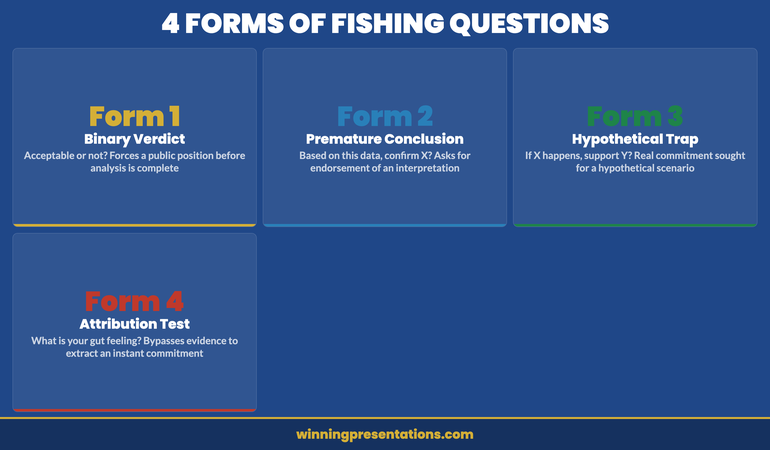
Fishing questions appear in several recurring forms, each with a slightly different mechanism. Recognising the form helps you identify the intent faster, which gives you more time to compose the response before the pressure of the room builds.

The binary verdict request. “Is this acceptable or not?” “Is this on track or not?” This is the most direct form. It offers two options and implies that a refusal to choose one is itself a choice — specifically, a suspicious one. The effective response names the binary as a false choice: “The right answer to that question is more nuanced than a yes or no, and I want to give you the accurate one.”

The premature conclusion invitation. “So based on what you’ve shown us, would you say this confirms X?” This form presents a tentative interpretation as if it flows naturally from your data, and invites you to confirm it. The problem is that the interpretation may go further than your data supports. The response: “The data is consistent with X as one interpretation, but it is also consistent with Y — the full analysis will allow us to distinguish between them.”

The hypothetical commitment trap. “If the final figures come in below target, would you support restructuring?” This asks you to commit to a future action based on a hypothetical — which is doubly problematic, because the hypothetical may not materialise, but the commitment is real and immediate. The response: “I would want to see the complete picture before making a recommendation on restructuring. What I can say is that if figures come in below target, we will need a structured response, and I am prepared to be part of developing that.”

The attribution test. “You’re the expert here — what’s your gut feeling?” This flatters you into bypassing analytical rigour and substituting intuition for evidence. The answer your gut provides is then on the record, divorced from any analytical caveat. The response: “My professional assessment is that we need the full analysis before I can be confident in a recommendation — and a gut feeling in a situation this consequential is not a substitute for that.”

Four common forms of fishing questions in executive presentations: binary verdict, premature conclusion, hypothetical commitment, and attribution test — with response approaches for each

When the Questioner Presses After Your First Response

A skilled fishing questioner will press after your first response. They know that most people will hold their ground once but will concede under repeated pressure — particularly in a public setting where silence is uncomfortable and the questioner appears persistent. The second press is often the moment that matters most.

When a questioner presses, resist the instinct to soften your position or offer additional qualification. Softening signals that your first response was not fully confident, and invites a third attempt. Instead, hold your original framing and restate the key point more briefly: “As I said, I cannot give you a definitive answer on this until the analysis is complete. I understand that is frustrating, and I will make sure you have the full picture as soon as it is available.” Brevity signals confidence. A longer explanation of why you cannot answer suggests you feel you need to justify the position, which creates the impression that it is negotiable.

If the questioner continues to press, naming the dynamic is a legitimate tool — used carefully, and without accusation. “I notice we are coming back to this question, and I want to be transparent about why I am holding the same position: the analysis is not yet at the stage where I can responsibly give you the answer you are looking for. That is not evasion — it is professional accuracy.” This shifts the frame from “the presenter is being difficult” to “the presenter is being rigorous,” and it does so in a way that the room can follow.

For guidance on the structured short-answer approach that works in high-pressure Q&A, our guide to the short answer framework for executive Q&A covers the technique of answering completely and confidently in fewer words — which is the single most effective defence against a questioner who uses repetition as pressure. And for the critical period after a difficult Q&A session, our guide to Q&A follow-up in the 48-hour decision window covers how to manage the aftermath when commitments were sought but not given.

Walk Into Every Q&A Session With a System

The Executive Q&A Handling System gives you the structured approach to predict, prepare for, and respond to every difficult question type — including fishing questions, stress tests, and loaded questions. £39.

Get the System Now → £39

Frequently Asked Questions

Is it ever appropriate to answer a fishing question directly?

Yes — when your analysis is complete and your evidence supports a definitive answer. A fishing question is only problematic when it asks you to commit to a position that your evidence does not yet justify. If you have the full data and the answer is clear, give it directly and with confidence. The distinction is not about the form of the question — it is about the relationship between the question’s framing and the state of your analysis. When the evidence supports the answer, there is no reason to withhold it.

How do I avoid appearing evasive when I decline to give a direct answer?

The key is specificity. Evasion sounds vague: “It is complicated, there are a lot of factors…” Professional accuracy sounds precise: “What I can confirm is X. What I cannot yet confirm is Y, because we do not have the Z data.” Specificity about what you know and what you do not know reads as rigour, not evasion. Vagueness reads as evasion regardless of your intent. Always name the specific thing you cannot yet confirm and the specific condition that would allow you to confirm it.

Can I prepare for fishing questions before a presentation?

Yes — and this is one of the highest-value forms of Q&A preparation. Before any high-stakes presentation, identify the two or three questions where someone who disagreed with your preliminary findings or wanted to force a premature conclusion would most likely press you. For each one, prepare your three-component response in advance: what you can confirm, what you cannot, and what would change that. Practising this structure before the session means that when the fishing question arrives, you are not improvising under pressure — you are delivering a prepared response that sounds thoughtful and confident because it is.

The Winning Edge

Weekly insights on executive presentations, Q&A strategy, and boardroom communication.

Subscribe Free

If the morning of a Q&A-heavy presentation is a source of anxiety for you, our guide to the morning presentation protocol covers the two-hour routine that builds readiness and manages the physiological stress response before you walk into the room.

About the author

Mary Beth Hazeldine, Owner & Managing Director, Winning Presentations. With 24 years of corporate banking experience at JPMorgan Chase, PwC, Royal Bank of Scotland, and Commerzbank, she advises executives across financial services, healthcare, technology, and government on structuring presentations for high-stakes funding rounds and approvals.

25 Feb 2026
Executive pausing with raised finger during boardroom Q&A, composing a structured response to a question he wasn't expecting, presentation screen visible behind him

When You Don’t Know the Answer: The 3 Responses That Save You in Executive Q&A

Quick Answer: When you don’t know the answer in a presentation, the worst response is a rambling attempt to fill the silence. The best response is one of three scripts: the Honest Redirect (“I don’t have that number — I’ll confirm by end of day”), the Bridge (“That’s an important question — here’s what the data does show”), or the Scope Shift (“That falls outside what we analysed, but here’s what’s relevant to today’s decision”). Each takes under 15 seconds and preserves your credibility completely.

If you’ve ever hit the “don’t know the answer” presentation moment in executive Q&A, these three scripts solve it fast.

⏰ Presenting in the Next 24 Hours?

☐ Memorise the 3 response scripts below — pick one as your default

☐ Pre-write one follow-up sentence you can paste after the meeting (“Following up from today — [data point] is…”)

☐ Write “I will send by ___” on your notes so you never miss a commitment made in Q&A

At JPMorgan, I was presenting a risk assessment to the credit committee — twelve senior people, two managing directors, one question that changed how I handle Q&A forever.

“What’s the correlation between the counterparty’s default probability and the sector exposure in our current portfolio?”

I didn’t know. I had the counterparty analysis. I had the sector exposure data. But I hadn’t calculated the correlation between the two. It wasn’t in my model.

My mind went blank. Twelve faces waiting. The silence felt like it lasted a minute — it was probably four seconds.

What I wanted to say: “I don’t know.” What I almost said: a rambling attempt to sound knowledgeable that would have made everything worse.

What I actually said: “I don’t have that specific correlation calculated. I’ll run it and have it to you by end of day. What I can tell you is the sector exposure is concentrated in three counterparties representing 68% of the book — which is the more immediate risk.”

The managing director nodded. “That’s the number I actually need. Send me the correlation when you have it.”

I’d admitted I didn’t know — and answered the question they actually cared about. My credibility went up, not down.

Why Going Blank in Q&A Destroys More Credibility Than a Wrong Answer

Here’s the counterintuitive truth about Q&A: a wrong answer delivered confidently is recoverable. Going blank is not.

When you give a wrong answer, you can correct it later — “I misspoke on the margin figure; it’s 23%, not 28%.” The room accepts this. You’re human. You corrected it. Trust maintained.

When you go blank — the visible freeze, the “um,” the rambling non-answer that everyone in the room recognises as a stall — something different happens. The room doesn’t just question your knowledge of that specific topic. They question your competence. “If they didn’t know this, what else don’t they know?”

This is why the stakes of not knowing the answer in a presentation feel so disproportionate. It’s not about one question. It’s about the credibility cascade — the room’s trust in everything you’ve already said starts to erode.

But here’s the thing: it’s not the not-knowing that causes the damage. It’s the response to not knowing. The right response actually builds credibility. The wrong response destroys it.

What should you say when you don’t know the answer in a presentation?

Use one of three scripts depending on the situation: the Honest Redirect (admit + commit + bridge), the Bridge (acknowledge + pivot to what you do know), or the Scope Shift (reframe the question within your presentation’s scope). Each takes under 15 seconds, each preserves credibility, and each gives the room a substantive response instead of silence. The key is having the script ready before Q&A begins — so you’re choosing a response, not searching for one.

The 3 Responses That Preserve Credibility

In 25 years of presenting in banking — and 16+ years training executives since — I’ve found that every “don’t know” moment falls into one of three categories. Each has a specific response that works. The scripts are short, specific, and designed to be memorised before you walk into the room.

For handling difficult questions in presentation Q&A, the 4-part response system (Headline → Reason → Proof → Close) works. But “don’t know” moments are a specific subset — and they need specific scripts.

Response 1: The Honest Redirect

When to use it: You genuinely don’t have the data, but you can get it.

The script: “I don’t have [specific data point] in front of me. I’ll [specific action] and have it to you by [specific time]. What I can tell you is [the related data point that IS relevant to their decision].”

Why it works: Three things happen in this response. First, you demonstrate honesty (which builds trust). Second, you commit to a specific follow-up (which demonstrates reliability). Third, you bridge to something you DO know that’s relevant (which demonstrates competence). The room gets honesty, a commitment, and a useful answer — all in under 15 seconds.

Example: “I don’t have the year-on-year comparison for Q3 specifically. I’ll pull it from the dashboard and send it to you by 3pm. What I can tell you is the Q3 absolute figure was £2.1M, which is above the threshold we set in the business case.”

Critical rule: The follow-up must happen. If you say “by end of day,” it arrives by end of day. If you say “by 3pm,” it arrives by 3pm. One missed follow-up after an “I don’t know” moment erases the credibility you preserved in the room.

⭐ Walk Into Q&A With Response Scripts Ready — Not Just Slides

The Executive Q&A Handling System gives you the complete framework for handling every type of question — including the ones you can’t answer. Pre-built response scripts, bridging phrases, and the Headline → Reason → Proof → Close structure that keeps you in control for 20-45 seconds per answer.

Your Q&A toolkit:

  • “I Don’t Know” response frameworks — three scripts for three situations, ready to memorise
  • Bridging phrases — exact language for pivoting from unknown to known
  • Question forecasting framework — predict 80% of questions before you walk in
  • 7 question type handlers — ROI, Risk, Trade-off, Timing, Capability, Evidence, Political

Get the Executive Q&A Handling System → £39

Built from 25 years of high-stakes executive Q&A. £39, instant access.

Response 2: The Bridge

When to use it: You don’t have the specific answer they asked for, but you have related information that addresses their underlying concern.

The script: “That’s an important question. The specific [metric/data/detail] isn’t in this analysis, but what the data does show is [the related finding that addresses the concern behind their question].”

Why it works: Most questions aren’t about the literal data point. They’re about the concern the data point represents. When the CFO asks “What’s the ROI timeline?” they’re really asking “Is this a safe investment?” If you don’t have the exact ROI timeline but you have the payback period, the cost savings, or the comparable benchmark — that answers the real question.

Example: “The specific ROI timeline isn’t calculated in this model. What the data does show is a payback period of 14 months at current volumes, which compares to an 18-month average for similar implementations in the sector.”

When NOT to use it: Don’t bridge when the specific data point is clearly what they need and nothing else will do. If the CFO asks “What’s the exact spend to date?” and you don’t know, that’s an Honest Redirect, not a Bridge. Bridging away from a number they genuinely need reads as evasion.

Response 3: The Scope Shift

When to use it: The question falls outside the scope of your presentation — they’re asking about something you weren’t tasked with analysing.

The script: “That falls outside the scope of this analysis — we focused specifically on [your scope]. But the relevant finding for today’s decision is [the data point that connects their question to the decision at hand].”

Why it works: It sets a boundary without sounding defensive, and it redirects to the decision the room is there to make. Not every question needs an answer — some need a scope clarification.

Example: “The competitive analysis falls outside this review — we focused on internal process efficiency. But the relevant finding is that the current process costs £380K more than our internal benchmark, regardless of what competitors are doing.”

When NOT to use it: If the question IS relevant to the decision and you simply didn’t include it. In that case, use the Honest Redirect. Scope Shifting a legitimate question reads as deflection.


Don’t want to write the recovery scripts from scratch?

The Executive Q&A Handling System includes all three response scripts — Honest Redirect, Bridge, Scope Shift — plus the bridging phrases that connect them. £39, instant download — lifetime access.

Get the Q&A Handling System →

The 4 Responses That Make It Worse

“Great question.” This is a stall tactic that every executive recognises. The moment you say “great question,” the room knows you’re buying time. It adds nothing and signals that you’re struggling.

The ramble. Talking without direction in the hope that something relevant emerges. This is the most common response to not knowing — and the most damaging. Every second of unfocused talking erodes the structured credibility your presentation built.

“I think…” followed by a guess. If you’re guessing, the room is guessing too — about whether everything else in your presentation was also a guess. A confident “I don’t have that number” is worth ten uncertain “I think it’s roughly…”

The deflection. “That’s really more of a question for the finance team.” Unless it genuinely is outside your scope, redirecting to another team reads as finger-pointing. If you presented the data, you own the Q&A on that data.

For a comprehensive view of the common Q&A mistakes that destroy deals, see the full breakdown of executive Q&A errors.

Three response scripts for when you don't know the answer in a presentation showing Honest Redirect, Bridge, and Scope Shift with exact language

⭐ Stop Dreading the Question You Can’t Answer

The Executive Q&A Handling System was built for the 4-second moment when your mind goes blank and twelve faces are waiting. Pre-loaded response scripts, bridging language, and the Forecast → Build → Control → Protect framework that handles every question type.

Your “I don’t know” recovery toolkit:

  • Three “don’t know” response scripts — Honest Redirect, Bridge, and Scope Shift with exact language
  • Bridging phrase library — pivoting from unknown to known without sounding evasive
  • Executive response structure — Headline → Reason → Proof → Close for every answer type
  • Decision capture sheet — tracking commitments you make during Q&A so follow-ups happen

Get the Executive Q&A Handling System → £39

Built from 25 years of high-stakes executive Q&A. £39, instant access — no subscription.

How to Reduce “Don’t Know” Moments by 80%

The three response scripts handle the moment. But the best strategy is reducing how often that moment happens.

Most “don’t know” moments are predictable — because most executive questions fall into predictable patterns. In my experience, 80% of Q&A questions fall into four categories: challenge questions (questioning your data or assumptions), clarification questions (wanting more detail), scope creep questions (asking about things beyond your presentation), and political questions (testing your alignment with someone in the room).

Before any presentation, take 20 minutes and map the four question types against each major section of your deck. For each section, ask: “What would a sceptic challenge? What would need clarification? What adjacent topic might someone raise? What political angle could this trigger?”

Write two-sentence answers for the top five predicted questions. The ones you can’t answer in two sentences — those are your “don’t know” candidates. Now you can prepare for them specifically: either get the data, or pre-load the appropriate response script (Honest Redirect, Bridge, or Scope Shift).

Is This Right For You?

✓ This is for you if:

  • You’ve experienced the “blank mind” moment in Q&A and want it never to happen again
  • You want specific language to use when you don’t know the answer — not just “be honest”
  • You present to senior leadership and the stakes of fumbling a question are career-level

✗ This is NOT for you if:

  • Your presentations don’t include Q&A (rare in executive settings, but possible)
  • You’re looking for slide templates rather than Q&A frameworks (see the Executive Slide System)

🎓 25 Years of Boardroom Q&A. One System.

The Executive Q&A Handling System is built from 25 years of corporate banking and 16 years coaching senior professionals across financial services, healthcare, technology, and government. Every framework — the three response scripts, the bridging phrases, the prediction techniques — comes from real boardroom situations where the wrong answer (or no answer) cost the deal.

Designed for senior professionals who present to boards, investment committees, and executive sponsors where every answer carries weight.

Get the Executive Q&A Handling System → £39

Instant download — lifetime access to every framework and template.

Frequently Asked Questions

Is it ever okay to say “I don’t know” in a presentation?

Yes — but never as a standalone answer. “I don’t know” followed by silence is a credibility killer. “I don’t have that specific figure — I’ll confirm by 3pm, and here’s what the data does show” is a credibility builder. The admission of not knowing isn’t the problem. The absence of a follow-up, a bridge, or a next step IS the problem. Executives respect honesty. They don’t respect uncertainty that offers nothing in return.

What if the question is deliberately hostile?

Hostile questions and “don’t know” moments require different responses. If someone is testing you or trying to expose a weakness publicly, the Bridge response works best — acknowledge the question, then pivot to the strongest data point you have. For hostile questions specifically, the Executive Q&A Handling System includes a full section on managing politically motivated questions. For a broader overview, see the guide to handling difficult questions in presentations.

How do I follow up after admitting I don’t know?

Same day, without exception. If you committed to “by end of day,” it arrives before close of business. The follow-up should be brief: “Following up from today’s presentation — the Q3 year-on-year comparison is 12.4%, in line with the trend I described. Let me know if you need any additional detail.” Short, specific, and it demonstrates that you were listening, that you committed, and that you delivered. This single follow-up repairs any credibility gap from the moment itself.

What if I genuinely have no related information to bridge to?

Use the Honest Redirect without the bridge. “I don’t have that data. I’ll get it to you by [specific time].” Then move to the next question. A clean, confident admission with a specific follow-up commitment is always better than a forced bridge to something irrelevant. The room can tell when you’re bridging to unrelated data, and it looks worse than a simple “I’ll get back to you.”

📬 The Winning Edge — Weekly Newsletter

One executive presentation insight per week. Real Q&A scenarios, real response scripts, no filler. Written for professionals who present to people who ask hard questions.

Subscribe Free →

Read next: Q&A is only half the battle. If the slides themselves need work, read The Sandwich Feedback Trap: Why It Fails When You Critique Up (And the Mirror Structure That Works).

Read next: If AI is helping you build slides but the structure isn’t landing, read AI Can Write Your Slides. It Can’t Structure Your Argument.

Your next Q&A is coming. The question you can’t answer is coming too. Get the response scripts that turn “I don’t know” from a career risk into a credibility moment.

About the Author

Mary Beth Hazeldine is the Owner & Managing Director of Winning Presentations. With 25 years of corporate banking experience at JPMorgan Chase, PwC, Royal Bank of Scotland, and Commerzbank, she has delivered high-stakes presentations in boardrooms across three continents.

A qualified clinical hypnotherapist and NLP practitioner, Mary Beth combines executive communication expertise with evidence-based techniques for managing presentation anxiety. She advises executives across financial services, healthcare, technology, and government on high-stakes Q&A and presentation structure.

Read more articles at winningpresentations.com

10 Feb 2026
Executive confidently answering difficult question in boardroom presentation

How to Handle Difficult Questions in a Presentation: The 4-Part Executive System

The CFO leaned forward. “What’s the ROI, and how confident are you in that number?”

I knew the answer. I’d calculated it myself. But in that moment — with twelve executives watching — my mind went blank. I started talking. And talking. Sixty seconds of rambling later, I could see the energy draining from the room.

We lost the deal. Not because of the presentation. The deck was solid. The strategy was sound. We lost it in Q&A, in the space between a reasonable question and an answer that never quite landed.

That was fifteen years ago. Since then, I’ve helped hundreds of executives prepare for exactly these moments — the high-stakes questions that can make or break a decision. What I’ve learned: handling difficult questions is a skill, not a talent. And it’s entirely learnable.

Quick answer: Handle difficult presentation questions using the 4-part system: Forecast the questions before the meeting, Build executive-ready answers using the Headline → Reason → Proof → Close framework, Control the room with bridging phrases and deliberate pacing, and Protect the decision by capturing open loops. Most presenters fail in Q&A because they prepare their slides but not their answers.

Here’s what nobody tells you about executive presentations: the deck is the easy part. You control the narrative. You choose the sequence. You decide what to emphasise and what to minimise.

Q&A is different. Someone asks a question you didn’t anticipate. The room shifts. Suddenly you’re not presenting — you’re defending. And if you don’t have a system for handling that moment, even the best presentation can unravel in sixty seconds.

I’ve watched it happen to brilliant people. Subject matter experts who know their content cold but freeze when challenged. Senior leaders who’ve delivered the same presentation a dozen times but still dread the questions at the end.

The good news: there’s a system that works. I’ve used it myself and taught it to executives facing boards, investors, regulators, and hostile stakeholders. It doesn’t require you to predict every question. It requires you to be ready for any question.

Prefer a ready-made system? The Executive Q&A Handling System gives you the full 4-part framework — forecasting templates, response structures, and bridging phrases — so you don’t have to build it from scratch.

Why Q&A Derails Good Presentations

Most presentation training focuses on delivery. Slide design. Story structure. Eye contact. Voice modulation. All important — but all useless if you lose the room in the last ten minutes.

Q&A derails presentations for predictable reasons:

You answer the question you heard, not the question they asked. Executive questions often have subtext. “What’s the timeline?” might really mean “I’m worried this will slip.” If you answer only the surface question, you miss the real concern.

You go too detailed. When challenged, the instinct is to prove you know your stuff. So you dive into methodology, caveats, edge cases. The executive wanted a 20-second answer. You gave them two minutes. Their eyes glaze over. Your credibility drops.

You get defensive. A sharp question feels like an attack. Your body language shifts. Your tone hardens. Now you’re in a confrontation instead of a conversation. Even if you “win” the exchange, you’ve lost the room.

You ramble while thinking. You don’t know the answer immediately, so you start talking to fill the silence. The longer you talk without landing somewhere, the less confident you appear.

You let one question derail the agenda. Someone asks about a tangent. You engage fully. Twenty minutes later, you’ve never returned to your core message, and the decision you needed hasn’t been made.

Every one of these failures is preventable. Not with more subject matter expertise — with a system.

The 4-Part System That Keeps You in Control

After years of coaching executives through high-stakes Q&A, I’ve distilled the approach into four parts. Each takes 10-20 minutes of preparation. Together, they transform how you handle difficult questions.

Part 1: Forecast the Questions (10 minutes)

Before every high-stakes presentation, spend 10 minutes forecasting the questions that could kill your decision.

Not every possible question — the dangerous ones. The questions that, if answered badly, will derail the meeting.

These cluster into six categories:

  • Money: “What’s the ROI?” / “Why is this the best use of budget?” / “What happens if costs overrun?”
  • Risk: “What could go wrong?” / “What’s your contingency?” / “Why should we believe this will work?”
  • Priorities: “Why this over other initiatives?” / “What are we saying no to?”
  • Time: “Why now?” / “What if we wait six months?” / “Can this be done faster?”
  • People: “Do we have the capability?” / “Who’s accountable?” / “What about the team impact?”
  • Credibility: “How do you know?” / “What’s this based on?” / “Who else has done this?”

Write down the 5-10 questions most likely to come from your specific audience. If you’re presenting to a CFO, weight toward Money and Risk. If you’re presenting to a board, weight toward Credibility and Priorities.

🎯 Get the Complete Q&A Preparation System

The Executive Q&A Handling System — £39, instant access — includes a question forecasting framework, a library of executive challenge questions organised by category (Money, Risk, Trade-offs, Timing, Capability, Evidence, Politics), and a one-page prep sheet you can use before every high-stakes meeting. Stop dreading Q&A — start controlling it.

Get the Executive Q&A Handling System → £39

Instant download. Use it for your next presentation.

Part 2: Build Executive Answers (20 minutes)

For each forecasted question, write a headline answer using this framework:

Headline → Reason → Proof → Close

This structure keeps your answers between 20-45 seconds — long enough to be substantive, short enough to maintain attention.

Example question: “What’s the ROI and how confident are you?”

Headline: “We project 3.2x return within 18 months.”

Reason: “That’s based on conservative estimates of cost reduction in three areas.”

Proof: “We’ve validated these numbers with Finance and they align with what we saw in the pilot.”

Close: “I’m confident in the methodology. Happy to walk through the assumptions if helpful.”

Total time: 30 seconds. The executive got a clear answer, understood the basis, and has an option to go deeper if they want.

Write these out. Don’t just think them through — write them. The act of writing forces clarity. When the question comes live, you won’t remember the exact words, but you’ll remember the structure.

Part 3: Control the Room (Live)

When you’re in the room, three techniques keep you in control:

Pause before answering. A 2-3 second pause signals confidence, not uncertainty. It shows you’re considering the question rather than reacting to it. This is counterintuitive — most people rush to fill silence — but it transforms how you’re perceived.

Use bridging phrases. When a question is hostile or off-topic, bridge back to your message:

  • “That’s an important consideration. The way we’ve addressed it is…”
  • “I understand the concern. What I’d focus on is…”
  • “That’s worth exploring. Before we do, let me make sure we’ve covered…”

These phrases acknowledge the question without letting it hijack the conversation.

Park questions safely. Not every question needs an immediate answer. “I want to give that the attention it deserves. Can I come back to you with a fuller answer by Friday?” This is not weakness — it’s professionalism.

Don’t want to build the bridging library from scratch?

The Executive Q&A Handling System gives you the bridging phrases, parking techniques, and control language ready to use in any live Q&A. £39, instant download — lifetime access.

Get the Q&A Handling System →

Part 4: Protect the Decision (After Q&A)

Q&A doesn’t end when the meeting ends. Questions create open loops — concerns raised, information promised, follow-ups needed. If these aren’t captured, decisions drift.

Within 24 hours of every high-stakes presentation, send a brief follow-up:

  • Questions raised and answers provided
  • Open items with owners and deadlines
  • Clear next steps toward the decision

This isn’t administrative busywork. It’s decision protection. It shows you’re organised, reliable, and driving toward action — exactly the qualities that make executives say yes.


4-part Q&A handling system showing Forecast, Build, Control, Protect framework

The 7 Question Types Executives Ask

Once you recognise the patterns, executive questions become predictable. Here are the seven types you’ll encounter most often:

1. The ROI Challenge: “What’s the return?” / “Justify this investment.” / “Why is this worth the money?”

2. The Risk Probe: “What could go wrong?” / “What’s your contingency?” / “What if this fails?”

3. The Trade-off Question: “Why this over X?” / “What are we not doing if we do this?” / “Is this the best option?”

4. The Timing Question: “Why now?” / “Can we wait?” / “Is this urgent?”

5. The Capability Question: “Can we actually do this?” / “Do we have the skills?” / “Who’s going to deliver?”

6. The Evidence Question: “How do you know?” / “What’s this based on?” / “Where’s the data?”

7. The Political Question: “Who else supports this?” / “What does [stakeholder] think?” / “Is this aligned with [initiative]?”

Before any high-stakes presentation, scan your content through these seven lenses. Where are you weakest? That’s where the tough questions will come.

📋 50+ Executive Challenge Questions — Ready to Use

The Executive Q&A Handling System (£39, instant access) includes a curated library of tough questions organised by category — Money, Risk, Trade-offs, Timing, Capability, Evidence, and Politics. Use it to stress-test every presentation before you deliver it.

Get the Executive Q&A Handling System → £39

Instant download. Includes response frameworks for each question type.

The Response Framework That Works Every Time

The Headline → Reason → Proof → Close framework works for most questions. But some situations need variations:

For Hostile Questions

When the tone is sharp or the question feels like an attack:

Acknowledge → Reframe → Answer → Bridge

“I understand why that’s a concern [acknowledge]. The way I’d frame it is [reframe]. Here’s what we’re doing [answer]. What matters most for this decision is [bridge].”

This defuses tension without being defensive. You’re not fighting the questioner — you’re redirecting the conversation.

For Complex Questions

When a question has multiple parts or requires nuance:

Clarify → Chunk → Answer → Check

“Let me make sure I understand — you’re asking about X and Y? [clarify] I’ll take those separately [chunk]. On X… On Y… [answer] Does that address what you were looking for? [check]”

Breaking complex questions into parts prevents rambling and ensures you actually answer what was asked.

For Questions You Weren’t Expecting

When something comes from left field:

Pause → Acknowledge → Partial Answer → Commit

“[Pause] That’s not something I’d considered from that angle [acknowledge]. My initial thought is [partial answer]. Let me give that more thought and come back to you with a fuller response by [date] [commit].”

This is far better than making something up or rambling while you think.

How to Handle “I Don’t Know” Moments

The question every presenter dreads: what if you genuinely don’t know the answer?

First, recognise that this isn’t failure. No one knows everything. The executives asking questions don’t expect omniscience. What they do expect is honesty, competence, and follow-through.

Here’s how to handle it:

Don’t bluff. Executives detect BS instantly. A made-up answer destroys credibility far more than admitting uncertainty. If you don’t know, don’t pretend you do.

Don’t over-apologise. “I don’t know” is fine. “I’m so sorry, I really should know this, I can’t believe I don’t have that information” is weak. State it simply and move on.

Offer what you do know. “I don’t have the exact figure, but I know it’s in the range of X to Y based on [source]. I’ll confirm the precise number and send it by end of day.”

Commit to a specific follow-up. “Let me find out and get back to you by [specific time].” Then actually do it. Reliable follow-through builds more credibility than knowing everything on the spot.

Use the room. Sometimes the answer is in the room. “I don’t have that detail — Sarah, do you know?” This shows collaboration, not weakness.

The magic phrase: “I want to give you an accurate answer rather than a quick one. Let me confirm and get back to you.”

What Changes When You Have a System

I recently worked with a VP preparing for a board presentation. She’d delivered the same content twice before — and both times, Q&A had gone sideways. The board had concerns she couldn’t address cleanly, and the decision kept getting deferred.

We spent 90 minutes applying this system. We forecasted the likely questions (six of them, mostly in the Risk and Capability categories). We wrote headline answers for each. We practised bridging phrases for the one board member who always went off-topic.

The third presentation took 25 minutes. Q&A took 15 minutes. She answered every question in 30-45 seconds, using the frameworks. The decision was approved that day.

Same presenter. Same content. Same board. Different result — because she had a system.

🎓 25 Years of Boardroom Q&A. One System.

The Executive Q&A Handling System is built from 25 years of corporate banking and 16 years coaching senior professionals across financial services, healthcare, technology, and government. Every framework — the 4-part system, the bridging phrases, the parking techniques, and the post-Q&A capture process — comes from real boardroom situations where Q&A decided whether the room said yes.

Designed for senior professionals who present to boards, investment committees, and executive sponsors where Q&A is the deciding moment.

Get the Executive Q&A Handling System → £39

Instant download — lifetime access to every framework and template.

Frequently Asked Questions

How much time should I spend preparing for Q&A?

For a high-stakes presentation, spend 30-45 minutes on Q&A preparation: 10 minutes forecasting questions, 20 minutes writing headline answers, and 5-10 minutes reviewing bridging phrases. This investment pays off dramatically. Most presenters spend hours on slides and zero time on Q&A — then wonder why they lose momentum at the end.

What if someone asks a question I haven’t prepared for?

Use the Pause → Acknowledge → Partial Answer → Commit framework. A 2-3 second pause buys thinking time. Acknowledge the question is valid. Give the best partial answer you can. Commit to a specific follow-up if needed. This handles 90% of unexpected questions professionally.

How do I handle a questioner who’s clearly hostile?

Use Acknowledge → Reframe → Answer → Bridge. Don’t get defensive — it never helps. Acknowledge their concern as valid, reframe to the substance of the issue, give a clear answer, then bridge back to your core message. Stay calm, maintain eye contact, and keep your voice steady. Hostility often dissolves when met with professionalism.

Should I take questions during the presentation or save them for the end?

For executive audiences, it’s usually better to take questions as they arise — executives don’t like waiting. But set a boundary: “I’m happy to take questions as we go. If something requires a longer discussion, I’ll note it and we’ll come back to it at the end.” This keeps you in control while respecting their time.

📬 The Winning Edge Newsletter

Weekly frameworks for executive presentations and high-stakes communication. Join senior professionals who receive actionable techniques every week.

Subscribe free →

Related: If difficult questions trigger physical anxiety — racing heart, shallow breathing, mind going blank — the techniques in The Fight or Flight Hack I Learned From Hypnotherapy can help you stay calm under pressure.

You can have a perfect deck and still lose the room in Q&A. The difference between presenters who maintain control and those who don’t isn’t subject matter expertise — it’s preparation and system.

Forecast the questions. Build executive answers. Control the room with deliberate technique. Protect the decision with clear follow-through.

The next tough question doesn’t have to derail you. You just need a system.

About the Author

Mary Beth Hazeldine is the Owner & Managing Director of Winning Presentations. With 25 years of corporate banking experience, she has faced — and helped clients prepare for — high-stakes Q&A sessions with boards, investors, regulators, and senior leadership teams.

A qualified clinical hypnotherapist and NLP practitioner, Mary Beth combines executive communication expertise with evidence-based techniques for staying calm under pressure. She advises executives across financial services, healthcare, technology, and government on high-stakes presentation structure and Q&A preparation.