

Quick answer: Mid year performance anxiety hits senior leaders harder than the annual review for three specific reasons that are structurally different from annual-cycle anxiety. The H1 review surfaces the gap between the year-start commitments and the actual H1 trajectory while there is still time to be held responsible for the gap; the annual review surfaces the same gap when the year is over and the responsibility is, in practice, fixed. The H1 review usually happens in a smaller, more probing room than the annual cycle, with the leader on the hook live rather than reading a summary into the record. And the H1 review is the moment the leader has to commit, in writing, to the H2 trajectory — another six months of personal accountability, made visible to the people who carry the firm-wide commitments. Naming these three structural drivers is the first move; the rehearsal pattern that works against them is the second; the verdict-first deck structure (so the anxiety has less ambiguity to feed on) is the third.
JUMP TO:
- The three drivers of mid-year anxiety in senior leaders
- Why impostor feelings resurface at H1 specifically
- The rehearsal pattern that works on H1 anxiety
- The structural fix: less ambiguity, less feed
- The three-question diagnostic the morning of the review
- One thing to do the night before the review
- Frequently asked questions
In June 2022, I was coaching a senior managing director at a UK consulting firm through her H1 review with the firm’s executive board. She had been promoted into the role nine months earlier from a peer regional position; the H1 review was her first time presenting the half-year for a region she had inherited mid-cycle, with the second half’s plan already partly committed by her predecessor. We met on the Friday afternoon before the Wednesday review. She came into the room composed, walked me through the deck efficiently, and then, when I asked one question about the H2 commitments slide, said something I have heard from senior leaders in roughly the same form at roughly the same career moment about a dozen times over the years: I am terrified the board is going to realise I shouldn’t be in this seat. I’ve been waiting for it for nine months. The H1 review is when it happens. She was a managing director with a long track record in the firm, two specific wins in her first nine months in the new region that the board itself had publicly acknowledged, and a clean H1 trajectory against the inherited plan. The anxiety was not about the deck; the anxiety was about the structural moment the H1 review represented — the first formal accountability checkpoint, in a senior role she had been carrying privately as a probationary one.
(This article was created with AI assistance; all stories and insights are based on 35 years of real client work.)
This piece walks through why mid year performance anxiety is a structurally different beast from annual-cycle review nerves, in senior leaders specifically, and the rehearsal and structural moves that work against it. The anxiety is not a sign of incompetence or under-preparation; it is a sign of paying attention to what the H1 review actually represents at the senior level. The pattern is one I have watched in a dozen senior leaders — managing directors, partners, line heads, division leaders — across consulting, banking, insurance, and biotech, over fifteen years of preparing leaders for these sessions. The drivers are consistent. The rehearsal patterns that work are consistent. The structural deck moves that reduce the ambiguity the anxiety feeds on are consistent. Naming the pattern is the first step.
If the physical symptoms are running ahead of the deck preparation, there is a faster route than working harder on the deck.
Calm Under Pressure is the short, practical set of rapid-response techniques for the physical symptoms of presentation anxiety — shaking hands, racing heart, trembling voice, nausea — that you can use in the room, in the moment, without anyone noticing. Free preview, £19.99 to download.
The three drivers of mid-year anxiety in senior leaders
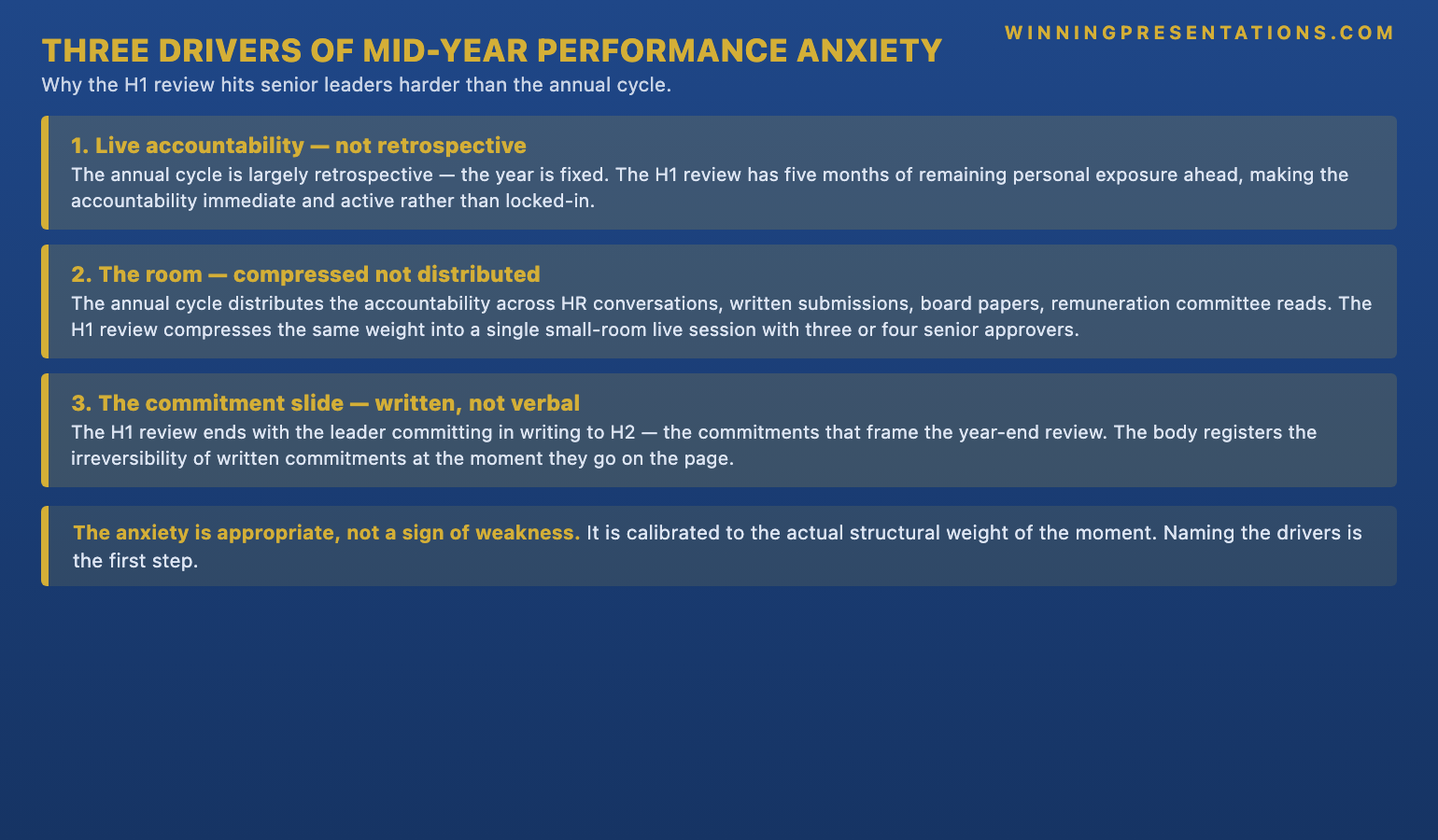
The first driver is the live-accountability difference between H1 and the annual cycle. The annual review is, at the senior level, mostly a record-setting exercise — the year has happened, the outcomes are known, the conversation is largely about how to frame what already occurred. The accountability is real but largely retrospective; the room is, in practice, locking in the verdict on a year that cannot be changed. The H1 review is different. The year is half over. The trajectory is established but the outcome is not yet fixed. The leader is being held accountable for a partially-formed result with five months of remaining personal exposure ahead of them. The accountability is live in a way the annual review’s is not. The body reads that difference even when the mind has not articulated it. The result is a physical anxiety response — raised heart rate, shallow breathing, hand tremor, throat constriction — that is calibrated, accurately, to a higher-stakes interpersonal moment than the annual cycle delivers.
The second driver is the room. The annual review for senior leaders is often a structured cascade across multiple sessions: an HR-led conversation, a written submission, a board paper, a remuneration-committee read. The information is distributed. No single moment carries the full weight. The H1 review compresses the equivalent weight into a single live session, typically in a smaller room than the annual cycle’s board paper goes through, often with three or four of the most senior people in the firm directly probing the leader on H2. The probing is appropriate to the function; it is also a more concentrated form of accountability than most senior leaders experience in any other recurring slot in the year. Leaders who present cleanly in larger settings — investor calls, all-hands meetings, conference keynotes — can find the H1 review’s small-room directness more difficult than any of those larger settings, because the small room offers nowhere to spread the cognitive weight of the moment across an audience. There are five faces in the room and they are all looking at the leader.
The third driver is the commitment slide. The H1 review concludes, structurally, with the leader committing to H2 in writing — the next-six-months exposure page, the H2 guidance, the named commitments that will frame the year-end review when it comes. The act of writing the commitments down, in front of the senior approvers, is itself the moment most leaders register as the high-anxiety point of the session. Verbal commitments at the senior level are reversible by qualification; written commitments are not. The body registers the irreversibility of the moment with a calibrated physical response that, again, is appropriate to the situation rather than a sign of weakness. The senior leaders I have coached through repeated H1 reviews report the same physical signature in roughly the same moments of the session: shoulders tighten on the verdict slide, hands cool on the H2-guidance slide, mouth goes dry on the commitment page. The pattern is consistent enough that experienced rehearsers can sequence the response and prepare for it.
Why impostor feelings resurface at H1 specifically
Impostor feelings in senior leaders are commonly assumed to be a feature of early career and to recede with seniority. The pattern I have watched in the leaders I coach — partners, MDs, division heads, line leaders — is closer to the opposite. The feelings recede in the middle of the year, when the work is operating and the leader is in the rhythm of their role, and resurface at structural inflection points: the start of a new role, a major deal, a public announcement, and, very consistently, the H1 review. The H1 review is an inflection point because it is the first formal moment in a fiscal year where the leader’s leadership of the half is held against the leadership commitments they made at the start of the year. The gap between the commitments and the half-year trajectory — in either direction — surfaces a comparison the leader cannot usually duck. The room sees the gap; the leader sees the room seeing the gap; the impostor narrative finds the air it needs.
What is harder to name, but consistent across the leaders I work with, is that the H1 review is also the moment leaders compare themselves to the version of themselves they intended to be when they accepted the role or the year-start plan. The internal comparison is harder than the external one. The leader walks into the H1 review with their own original ambition for the half attached — the leadership posture they intended to bring, the team they intended to build, the cultural change they intended to begin. By the half-year, almost all senior leaders are running behind the version of themselves they planned to be. The gap is normal; the discomfort is not weakness; the resurfacing of impostor narratives at the half-year is a structurally predictable response to an internal comparison the leader cannot avoid making. Naming the comparison — saying it out loud to a coach, a trusted peer, or a journal — reduces its weight in the room. Suppressing it amplifies it.
The senior managing director in the 2022 consulting case was not, in any objective reading, an impostor in her seat. The board had promoted her on a clean record, the H1 trajectory in the inherited region was positive, the two specific wins the board had publicly acknowledged were real. The impostor narrative was operating on a different axis from the objective evidence. It was operating on the gap between the leader she had intended to be by month nine and the leader she was at month nine. The board would not see that gap; the leader saw it constantly. Once we named the comparison — with eight specific examples she could not have refuted — the anxiety in the room reduced visibly within fifteen minutes. The deck did not change. The internal framing did. She walked into the review on Wednesday and presented cleanly. The board confirmed the H2 plan in the same session. The leader called me on Friday and said, paraphrasing, “the moment I stopped trying to be the leader I should have been by month nine and started being the leader I actually was, the H1 review became a meeting rather than a verdict.” The 3Ps framework for executive presentation coaching covers the deeper rehearsal version of this same translation between intended-self and presenting-self.
The senior leaders who walk into the H1 review with the anxiety named and the technique rehearsed present the version of themselves they actually are — not the version their nerves try to present.
Conquer Your Fear of Public Speaking is the practical course for senior professionals who present cleanly in most settings but feel the specific compression of the high-stakes, small-room, live-accountability review — the H1 review, the board paper, the investor update. It is built around the rehearsal patterns that work on the physical anxiety response, in the moment, without trying to suppress the underlying cognitive signal.
- Techniques for the physical anxiety response — calibrated to small-room, high-accountability sessions, not generic stage-fear
- The rehearsal pattern that surfaces the three or four sentences most likely to trigger the body’s response, and works on them specifically
- The verdict-first deck structure that reduces the ambiguity anxiety feeds on, applied to the H1 review and the H2 commitments page
- The named-comparison move that translates the intended-self comparison into a sentence the leader can release before walking into the room
- Built on 24 years in corporate banking and 16 years coaching senior professionals through career-stage anxiety inflections — £39, instant download
The rehearsal pattern that works on H1 anxiety
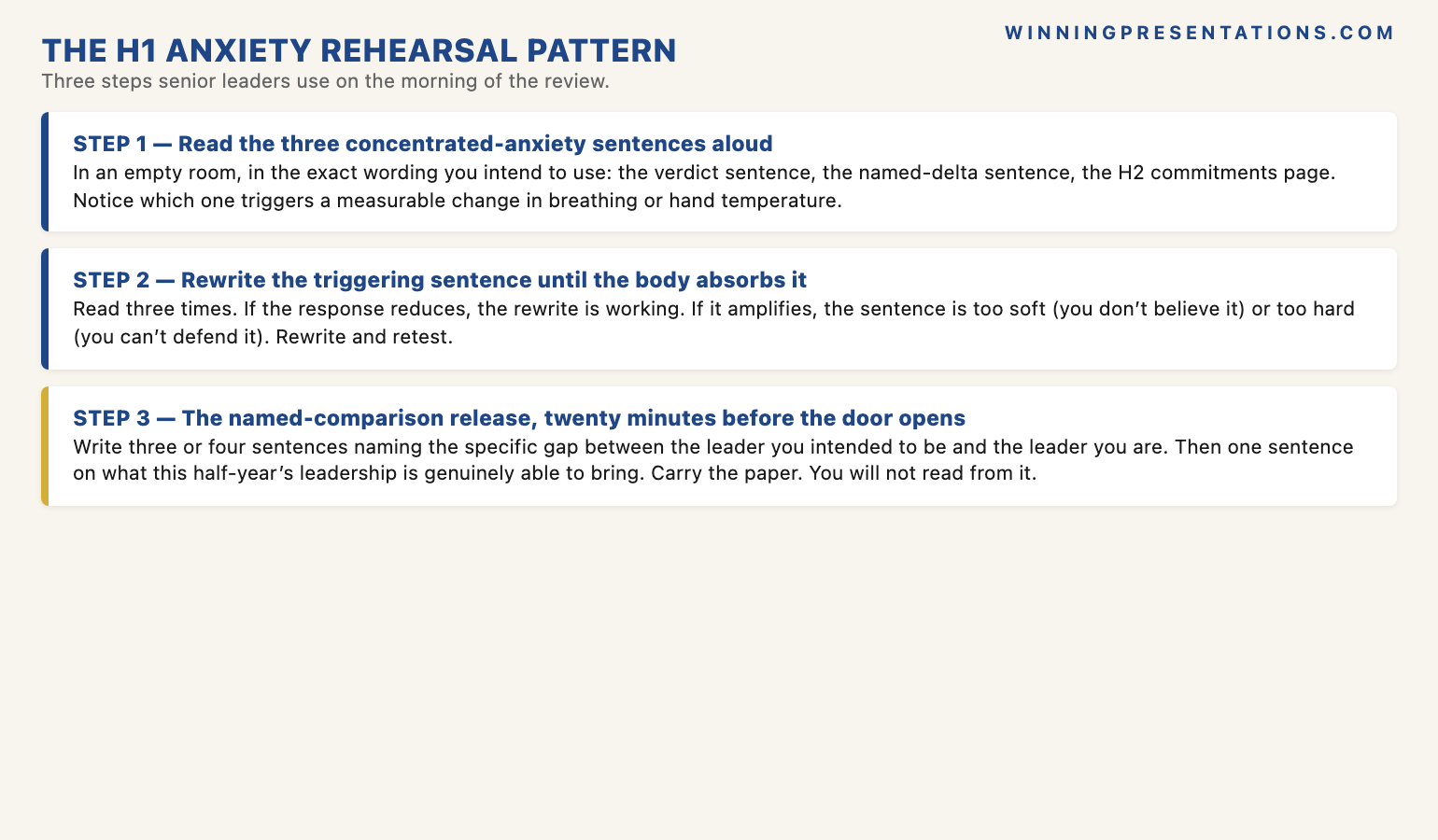
The rehearsal pattern that works against the H1 review’s specific anxiety pattern is different from the rehearsal pattern that works on generic presentation nerves. Generic rehearsal — walk through the deck, smooth out the transitions, time the run-through — helps marginally but does not address the moments where the body’s response is most concentrated. The H1 anxiety is concentrated in three specific places: the verdict sentence on the cover or slide three, the named-delta sentence in the H1 bridge, and the H2 commitments page. Rehearsal that helps is rehearsal that targets those three specific sentences. Walk into a quiet room two days before the review, stand up, and read each of the three sentences aloud, in the exact wording you intend to use in the session. Notice which of the three triggers a measurable change in your breathing or your hand temperature. That is the sentence the body has not yet absorbed.
The work on the triggering sentence is to rewrite it — not to change its substance, but to change the wording until the body absorbs it. The triggering sentence is almost always either too soft (the body knows the soft framing is not what the leader actually means) or too hard (the body resists committing to a harder framing than the leader is prepared to defend). The right wording is the one the leader can read aloud, in the empty room, without the body changing. Read the sentence three times. If the body responds the third time the same way as the first, the sentence is right. If the response reduces with each reading, the sentence is right and the rehearsal is doing its work. If the response amplifies with each reading, the sentence is wrong — either too soft and the leader does not believe it, or too hard and the leader is not yet willing to defend it. Rewrite it and run the test again.
The other element of H1-specific rehearsal is the named-comparison release. Twenty minutes before walking into the room, write down, in three or four sentences, the specific gap between the leader you intended to be at this half-year and the leader you are. The gap is rarely as large as the impostor narrative suggests; writing it down makes the actual size of the gap visible against the inflated internal version. Then write, in one sentence, what the leadership you are this half-year is genuinely able to bring into the room. The sentence becomes the internal frame the leader carries through the door. The work is private; it does not appear anywhere in the deck. It changes the version of the leader who walks into the session, which is what the committee actually engages with. The same work, done five minutes before the door opens, is the difference between a leader presenting the version of themselves their nerves want to present and a leader presenting the version of themselves they actually are.
The structural fix: less ambiguity, less feed
The third move — alongside naming the drivers and rehearsing the triggering sentences — is the structural fix to the deck itself. Anxiety feeds on ambiguity. A deck with a clear four-line verdict, a single named delta, an explicit H2 ask, and three hard commitments offers less ambiguity for the body’s anxiety response to grip onto than a deck with a hedged verdict, a balanced delta list, and three options for H2. The clearer the deck, the less the leader has to defend ambiguity under questioning, and the less the leader’s anxiety has to work to anticipate where the room might push back. The deck structure that works for the H1 review’s analytical purpose is therefore also the deck structure that works for the leader’s anxiety management. The two needs align; building one builds the other.
The same is true at the level of the H2 commitments page. Hard commitments — specific, measurable, dated — are uncomfortable to write because they leave the leader visibly accountable at year-end. They are also the version of the commitments page the body absorbs better than the soft version. The soft commitments page — “focus on margin recovery, continue to improve channel mix” — reads in the rehearsal room as something the body does not trust, because the body knows the committee will probe the softness and the leader will have to defend ambiguity live. The hard commitments page — “deliver the H2 motor combined ratio at or below 98.5%, complete the broker-to-direct reallocation within the existing H2 expense envelope, ship the new product capability with at least one signed pilot client by end of October” — reads in the rehearsal room as something the body can either commit to or refuse. Either outcome is workable. The soft version offers neither. Specificity reduces anxiety because it commits to a defendable position; vagueness amplifies anxiety because it commits to nothing and has to be defended live.
The combined effect of the three moves — named drivers, rehearsed triggering sentences, structurally clear deck — is a leader who walks into the H1 review with the anxiety response reduced to a manageable level rather than eliminated. The aim is not to eliminate the response. The response is appropriate to the moment; eliminating it would mean the leader had stopped paying attention to what the H1 review represents. The aim is to reduce the response to a level where the leader can speak clearly, hold the room, and engage with the committee’s questions without the body’s response interfering with the cognitive work. The senior leaders I have watched do this work over multiple H1 cycles report that the anxiety does not disappear with experience — it becomes a recognised signal the body sends in advance of the moment, and the rehearsal pattern becomes the routine that translates the signal into focused performance. The executive buy-in framework for the structural deck moves covers the deck-side of the work in more depth.
The three-question diagnostic the morning of the review
The diagnostic to run the morning of the H1 review is three questions long. Read the verdict sentence aloud in the bathroom mirror — one minute, in the exact wording. Read the named-delta sentence aloud. Read the H2 commitments page aloud. If any of the three triggers a measurable change in breathing or hand temperature, that sentence needs ten more minutes of rehearsal or a small rewording before the session. If none of the three triggers a response, the leader is ready in the technical sense. If the diagnostic surfaces a fourth sentence — somewhere else in the deck — that triggers a response, that sentence is the one to rehearse next. The body knows where the cognitive load is concentrated; the diagnostic surfaces what the body has identified.
The diagnostic is not a substitute for the rehearsal in the days leading up to the review; it is the morning-of pressure test that confirms the rehearsal worked. Leaders who skip the morning-of diagnostic often walk into the room with one un-addressed triggering sentence that surfaces under live questioning, and the body’s response in the room can spread from that single sentence to the rest of the session. Leaders who do the morning diagnostic find the spread does not happen, because the triggering sentence has been worked on or removed in time. Five minutes of bathroom-mirror rehearsal is the smallest possible investment with the largest possible return on the day.
One thing to do the night before the review
Write down, in three or four sentences on a piece of paper you can keep in your jacket pocket, the gap between the leader you intended to be by this half-year and the leader you are. Then write, in one sentence, what the leadership you are this half-year is genuinely able to bring into the room. Read the four sentences once before bed and once in the morning. Carry the paper into the session. You will not read from it. The work was done in writing it; the paper is there as a reminder the work was done. The H1 review is not the moment your impostor narrative resurfaces; it is the moment you have already absorbed it and chosen to bring the leader you actually are into the room. That choice, made in writing the night before, is the difference between the H1 review you walk into and the H1 review you walk out of.
Frequently asked questions
Isn’t naming the anxiety just feeding it? Shouldn’t I push through and not focus on it?
The push-through approach works for a small subset of senior leaders and fails for the majority I have coached. Anxiety the body has registered does not disappear when the mind refuses to name it; it operates underneath the conscious work, surfaces in the moments the mind is most occupied, and tends to produce a less controlled version of the leader in the room than the one who has named the anxiety in private beforehand. Naming the anxiety, in writing, with the specific gap surfaced, is not feeding the anxiety. It is releasing the cognitive load the unnamed version creates. The body responds differently to a named pattern than to an unnamed one. The released cognitive load goes back into the leadership work the leader actually needs to do in the room.
If I have been promoted recently, am I more likely to feel this at the H1 review?
Materially yes. The H1 review for a leader in a role they have been in for nine months or less is structurally higher-stakes than the same review for a leader in their fourth or fifth year in the same seat. The newer leader is being assessed against commitments they may have inherited or made with limited operational knowledge of the role; the H1 review is the first formal moment that gap surfaces. The discomfort is appropriate. The rehearsal pattern is the same; the named-comparison work is more important and tends to take longer in the first H1 of a new role than in subsequent ones. Leaders who do the work in their first H1 report that the second H1 in the same seat carries materially less of the response, because the named comparison is no longer the same comparison.
What if the physical symptoms are severe — not just nerves but full-body anxiety?
The rehearsal pattern in this article is calibrated to the calibrated anxiety response most senior leaders experience — the high-end-of-normal response to a high-stakes professional moment. If the physical symptoms are running outside that range — sustained sleep disruption for more than two weeks, panic-attack signatures, or symptoms that persist between sessions when the H1 review is not on the calendar — the work to do is upstream of the H1 review itself, with a coach or a clinician who handles anxiety specifically. The H1 review is the symptom; the underlying pattern is what the work needs to address. Calm Under Pressure covers the rapid-response techniques for the physical symptoms specifically; Conquer Your Fear of Public Speaking covers the structural work on the cognitive pattern. Most leaders find one of the two products is the right starting point. Severe sustained symptoms are different work and need a different starting point.
Does this pattern reduce with experience, or does it just change shape?
Both, in different proportions for different leaders. The intensity of the response usually reduces with each H1 review in the same seat, particularly after the third or fourth cycle. The shape of the response shifts — from a broad pre-meeting anxiety to a narrower, more localised response in the three specific moments described above. Experienced leaders report the response becoming a recognised signal the body sends before the verdict slide, the named-delta sentence, and the commitments page, and the rehearsal pattern becoming a routine that translates the signal into focused performance. The response does not disappear entirely; the leaders who report it disappearing are usually the leaders who have stopped paying attention to the structural weight of the moment, and their performance in the room tends to suffer for it.
The Winning Edge — weekly newsletter
The Winning Edge is a weekly (Thursday) newsletter for senior professionals who present at the executive level. One short email a week, focused on the moves that make high-stakes review sessions feel manageable rather than overwhelming. Subscribe to The Winning Edge →
For the broader picture across slides, storytelling, confidence, and delivery, the seven-product Complete Presenter library is the bundle most senior professionals find useful as a single resource — £99 for everything, lifetime access.
About the author
Mary Beth Hazeldine is Owner & Managing Director of Winning Presentations Ltd. With 24 years of corporate banking experience at JPMorgan Chase, PwC, Royal Bank of Scotland, and Commerzbank, she advises senior professionals across financial services, insurance, consulting, and technology on the rehearsal patterns and structural moves that hold up under the live accountability of high-stakes review sessions.