Tag: governance presentation

29 Apr 2026
Businesswoman presents financial dashboards to a diverse team in a modern conference room around a long table.

Risk Committee Presentation: How to Brief the Board When Every Metric Demands Attention

Quick answer: A risk committee presentation should open with three to five headline risks ranked by severity and likelihood, move into a clear summary of risk appetite versus current exposure, and close with specific decisions the committee needs to make. The board does not need an encyclopaedic tour of every risk on your register. They need a prioritised view that enables governance-level decisions within a focused meeting window.

Adriana Vasquez had been Chief Risk Officer at a mid-cap pharmaceutical company for three years, and she had never once left a risk committee meeting feeling that the board had fully grasped the risk landscape she had presented. It was not for lack of effort. Her quarterly packs ran to 45 pages. Every risk category was represented. Every heat map was colour-coded. Every trend line was annotated.

The problem crystallised during a January committee meeting when the non-executive chair interrupted her on slide 14 to ask a question she had already answered on slide 3. Two other directors were scrolling their iPads, clearly reading ahead. The committee approved her recommendations in eleven minutes after a 40-minute presentation — not because they agreed with her analysis, but because they were fatigued by it.

That evening, Adriana sat in her office and wrote a single question on a Post-it note: “What does this committee actually need from me?” The answer was uncomfortable. They did not need a comprehensive tour of 87 risks across nine categories. They needed her professional judgement on which five risks required their attention, what had changed since last quarter, and what decisions she needed from them. Everything else was reference material.

Her next committee pack was eight pages. The chair described it as the most useful risk report he had received in four years of governance. What changed was not the quality of her analysis. It was the structure of her communication.

If you want a structured approach to board-level risk presentations, the Executive Slide System provides templates and frameworks designed for governance scenarios where clarity and prioritisation matter most.

Explore the Executive Slide System →

Why Risk Committee Presentations Overwhelm Instead of Inform

The fundamental problem with most committee-level risk briefings is volume masquerading as thoroughness. Risk officers compile exhaustive registers, categorise every conceivable threat, and present the lot — because leaving something out feels professionally dangerous. If a risk materialises that was not in the pack, the CRO looks negligent. So the instinct is to include everything, rank nothing, and let the committee decide what matters.

This instinct is understandable but counterproductive. A committee that receives 50 risks with equal visual weight cannot exercise meaningful governance over any of them. Their job is to challenge your judgement on the risks you have elevated, test your appetite recommendations, and approve or redirect your mitigation strategies. When you present everything, you are implicitly asking the committee to do your prioritisation work for you.

This pattern is structurally identical to the challenge that surfaces in audit committee presentations, where the temptation is to walk through every finding rather than leading with the governance implications. In both contexts, the committee loses confidence not because the analysis is weak, but because the communication forces them to work too hard to extract what matters.

There is also a psychological dimension. Non-executive directors carry personal liability for governance failures. When presented with 45 pages of undifferentiated risk data, their cognitive response is defensive scanning — looking for the item that might personally expose them, rather than engaging with the strategic picture. A well-structured governance risk briefing reduces this anxiety by making the presenter’s professional judgement visible and explicit.

Build Board-Ready Risk Slides in Under an Hour

The Executive Slide System includes 26 templates, 93 AI prompts, and 16 scenario playbooks — covering governance presentations, committee briefings, and high-stakes executive scenarios. Stop building risk committee packs from scratch every quarter.

£39 — instant access. Designed for executives who present at board and committee level.

Get the Executive Slide System →

A Prioritisation Framework That Cuts Through Noise

Effective risk committee communication starts with a decision about what to elevate. Before you open PowerPoint, apply a three-filter test to your risk register:

Filter 1: Movement. Which risks have changed in severity, likelihood, or velocity since the last committee meeting? A risk that was amber three months ago and is now red demands committee attention. A risk that has been amber for six consecutive quarters does not — unless you are recommending a change to the mitigation strategy. Static risks belong in the appendix, not the main deck.

Filter 2: Decision required. Does this risk require a committee decision? If you are asking for approval of a new mitigation approach, an adjustment to risk appetite, or additional resource allocation, the risk belongs in the core presentation. If the committee simply needs to note it, a summary table is sufficient.

Filter 3: Emerging or interconnected. Has a new risk emerged that the committee has not previously considered? Or have existing risks begun to interact in ways that change the aggregate exposure? Interconnected risks — for example, a supply chain disruption compounding a cyber vulnerability — are where the most dangerous blind spots develop, and they are precisely the risks that a flat register fails to surface.

Apply these three filters honestly, and your 87-item register typically produces five to eight risks that warrant committee-level discussion. That is the right number. It is few enough to enable genuine deliberation and many enough to demonstrate that your risk function has breadth of vision.

How many risks should you present to a risk committee? Between five and eight elevated risks in the core presentation, with the full register available as an appendix. This gives the committee enough material for substantive governance without overwhelming the meeting’s limited time.
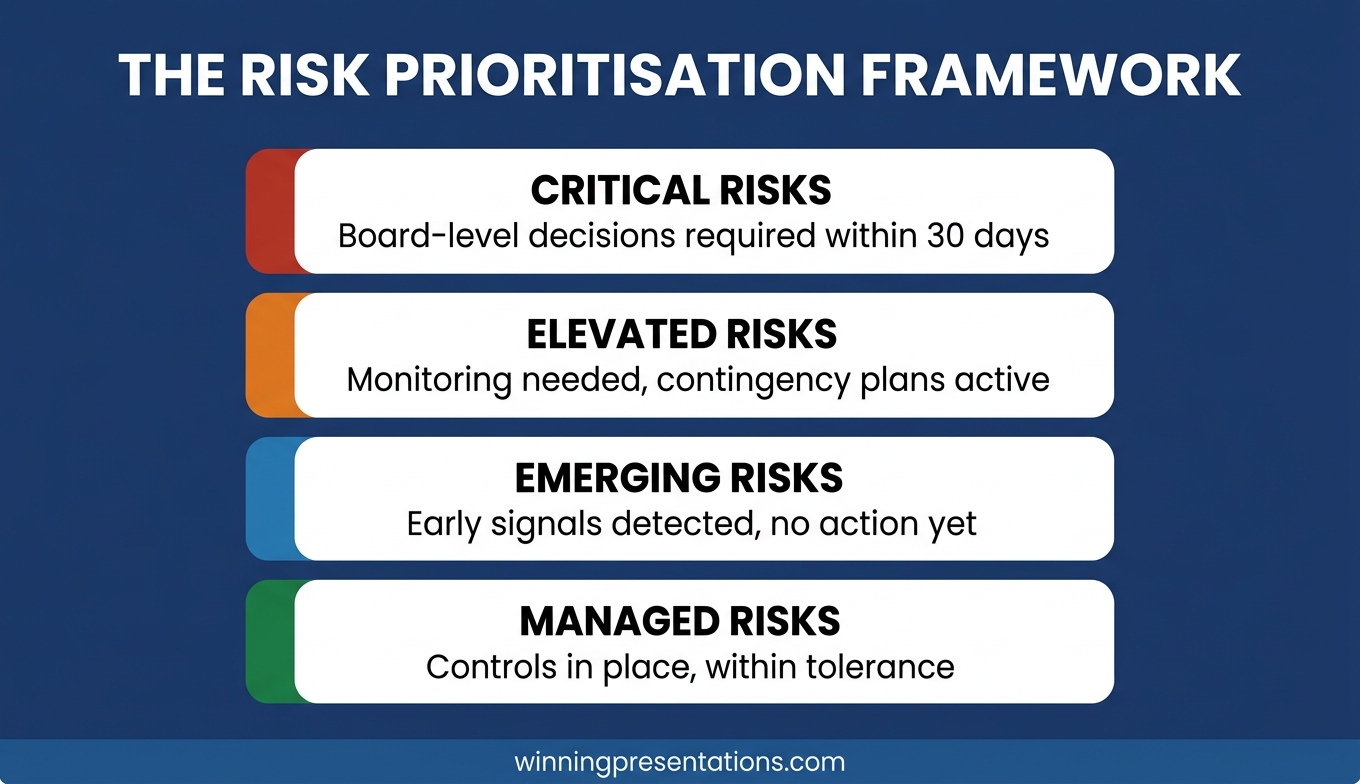

Three-filter prioritisation framework for risk committee presentations showing movement filter, decision-required filter, and emerging risk filter with example applications

Structuring Your Risk Committee Slides for Clarity

Once you have identified the risks that warrant committee attention, the slide structure needs to serve a specific purpose: enabling the committee to challenge, question, and decide — not just absorb. Each elevated risk should follow a consistent four-part format across a single slide or a slide pair:

Risk description — two sentences maximum. What the risk is and what it would affect if it materialised. Avoid technical jargon; write for non-executive directors who may not share your domain expertise.

Movement and context — what has changed since the last reporting period and why. This is the most important element. A risk rated as “high” means very little in isolation. A risk that has moved from “medium” to “high” because a key supplier failed a security audit tells a governance story that the committee can engage with.

Current mitigation — what controls are in place, whether they are performing as expected, and any gaps. Be honest about gaps. A committee that discovers unreported mitigation failures after an incident will lose trust in the entire risk function, not just the individual report.

Decision or action required — what the committee is being asked to do. Approve a revised appetite? Allocate budget? Note a new emerging risk? If no decision is required, say so explicitly: “For noting — no committee action requested.” This prevents the meeting from stalling on risks that need acknowledgement rather than deliberation.

This structure works because it mirrors the governance mindset. Directors think in terms of “what is it, what has changed, what are we doing about it, and what do you need from us.” When your slides follow that sequence, the committee engages at the right level without translating your material into their own framework. The same principle applies when structuring any ESG board presentation where non-financial data must be made governance-ready.

If structuring governance-level slides feels time-consuming, the Executive Slide System includes templates designed for committee briefings and board-level reporting scenarios.

Presenting Risk Data Without Drowning the Room

Risk professionals love heat maps. Boards tolerate them. The standard five-by-five likelihood-versus-impact matrix has become so ubiquitous in governance reporting that many directors have stopped actually reading it — they glance at the cluster of dots in the top-right corner and move on. If your entire risk narrative depends on a heat map, you are relying on a tool that has lost much of its communicative power through overuse.

More effective approaches include:

Movement arrows. Instead of plotting risks on a static matrix, show the direction and speed of change. A simple table with risk name, previous rating, current rating, and a directional arrow communicates more governance-relevant information than a crowded heat map.

Risk appetite overlay. What is a risk appetite statement? It is the board-approved level of risk the organisation is willing to accept in pursuit of its strategic objectives. Show where current exposure sits relative to stated appetite. This is the single most governance-relevant data point you can present — it answers “are we within the boundaries we set for ourselves?” If exposure exceeds appetite in any category, that becomes an automatic agenda item.

Scenario narratives. For your two or three most significant risks, replace data visualisation with a brief scenario: “If this risk materialises, the impact would be [specific consequence]. Our current mitigation reduces the likelihood to [level], but residual exposure remains because [specific gap].” Narrative scenarios engage directors more effectively than abstract probability ratings because they create a concrete mental model of what the risk means in practice.

The goal is not to eliminate data from your presentation — data is essential for credibility. The goal is to make every data point answer a governance question rather than simply demonstrating analytical effort.
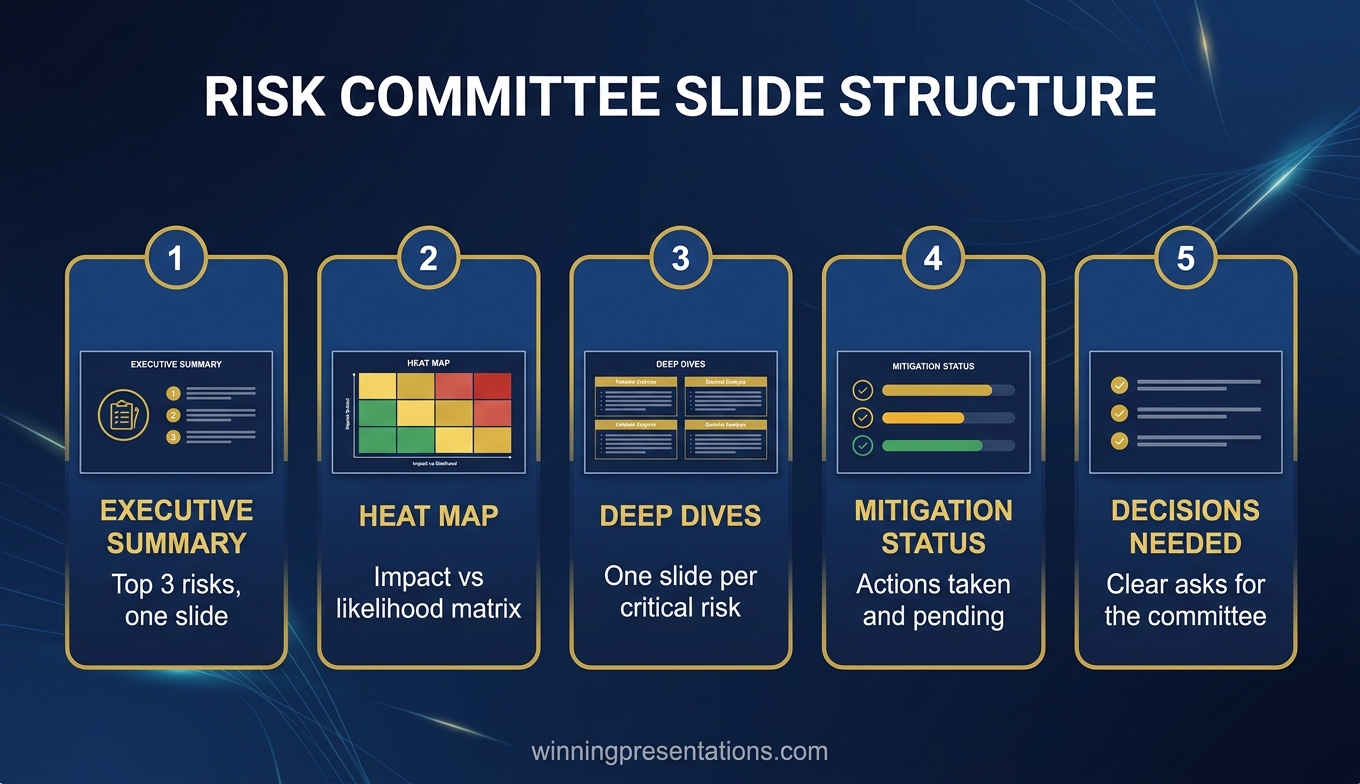

Comparison of risk data presentation methods showing traditional heat map versus movement arrows and risk appetite overlay with governance-level annotations

Governance Slides That Communicate, Not Just Report

The Executive Slide System gives you 16 scenario playbooks and 93 AI prompts to structure committee presentations that drive decisions instead of passive nodding. Templates for risk reporting, board briefings, and governance scenarios.

£39 — instant access.

Get the Executive Slide System →

Handling Challenge Questions from Non-Executive Directors

Risk committee meetings are adversarial by design. Non-executive directors are discharging their governance obligations by testing the quality of your analysis and the adequacy of your mitigations. The quality of your answers determines how much credibility your risk function retains between reporting periods.

The most common challenge questions fall into predictable categories:

“What are you not telling us?” This is the question behind every other question. The best response is structural: explain your escalation criteria transparently. “Any risk above [threshold] is automatically elevated to this committee. Risks below that threshold are managed within the executive risk committee and reported in the appendix.” When the committee understands your filtering logic, they trust the output.

“How do we compare to our peers?” Peer risk data is rarely public, but you can reference sector-level trends and regulatory themes. “The FCA’s latest supervisory statement highlights operational resilience as a sector-wide concern, which aligns with our elevation of that risk this quarter” demonstrates awareness without inventing comparative data.

“Is our risk appetite still appropriate?” This is a governance question, not a technical one. Your role is to present evidence — has the operating environment changed in ways that make the current appetite too aggressive or too conservative? Prepare a brief assessment of appetite adequacy for each elevated risk, but resist answering the question definitively on the committee’s behalf.

The approach to handling these questions is closely related to the discipline of structured board presentation follow-up — where the quality of your post-meeting actions determines whether the committee’s confidence grows or erodes over successive reporting cycles.

Your Pre-Meeting Preparation Protocol

The quality of a board-level risk briefing is determined before the meeting, not during it. A disciplined preparation protocol separates presenters who inform from presenters who influence.

Two weeks before: Finalise your risk register review. Apply the three-filter test to identify elevated risks. Brief the committee chair informally on your headline risks — no chair wants to be surprised in a formal meeting, and this pre-brief allows them to shape the agenda around your most significant items.

One week before: Circulate the committee pack with a one-page executive summary listing elevated risks, key changes since last quarter, and decisions sought. This page is the most important in your pack. Many directors will read only this page before the meeting — make it comprehensive enough to stand alone.

Two days before: Prepare for challenge questions. For each elevated risk, identify the three hardest questions a non-executive director could ask and draft structured responses. Pay particular attention to questions about mitigation effectiveness, residual risk levels, and appetite adequacy. How should you prepare for a risk committee meeting? Write out your three most difficult answers in full — the act of writing forces clarity that mental rehearsal alone cannot achieve.

Day of the meeting: Review the previous meeting’s minutes and action items. Nothing undermines credibility faster than being unable to report progress on assigned actions. If something is overdue, address it proactively in your opening remarks rather than waiting for a director to raise it.

This protocol takes discipline, but it transforms the committee meeting from a reporting obligation into a strategic conversation — and that is the environment where the best governance decisions are made.

Frequently Asked Questions

How long should a risk committee presentation be?

Aim for 8 to 12 slides in the core presentation, with the full risk register available as an appendix. Most committee meetings allocate 60 to 90 minutes, and your presentation should consume no more than a third of that time — the rest is for discussion, challenge, and decision-making. If your slides take longer than 25 minutes to present, move supporting analysis to the appendix.

Should you use a heat map in a risk committee presentation?

Heat maps remain a useful visual shorthand, but they should not be the centrepiece of your presentation. Their limitation is showing position without movement or context. If you use one, supplement it with a movement summary showing which risks have changed position since last quarter and why. Better still, use the heat map as an appendix reference and lead with the elevated risks and their governance implications. The committee will engage more deeply with narrative context than with colour-coded dots.

What is the difference between a risk committee and an audit committee presentation?

A risk committee focuses on forward-looking risk exposure, appetite, and mitigation strategy — what might happen and how prepared the organisation is. An audit committee focuses on backward-looking assurance — whether controls are operating effectively and compliance obligations are being met. The key structural difference is that a risk committee expects professional judgement about future exposure, while an audit committee expects factual findings about past performance. Tailor your language and evidence accordingly.

Join The Winning Edge

Free weekly newsletter for executives who present at board and committee level. Practical frameworks, governance communication strategies, and slide structure guidance — delivered every Thursday.

Subscribe Free →

Not ready for the full system? Start here instead: download the free Executive Presentation Checklist — a quick-reference guide for structuring any high-stakes board or committee presentation.

Read next: If you are preparing financial presentations alongside your risk reporting, see Annual Budget Presentation: How to Present Your Numbers with Confidence for a complementary framework on presenting financial data to senior leadership.

Mary Beth Hazeldine is the Owner & Managing Director of Winning Presentations. With 24 years of corporate banking experience at JPMorgan Chase, PwC, Royal Bank of Scotland, and Commerzbank, she advises executives across financial services, healthcare, technology, and government on structuring presentations for high-stakes scenarios.

05 Apr 2026
Executive at a boardroom table reviewing a follow-up slide deck after a board meeting, with printed action items and a laptop open to a presentation

Board Presentation Follow-Up: The 24-Hour Protocol That Keeps Decisions Moving

Quick Answer: An effective board presentation follow-up sends a concise recap email within 24 hours, attaches a short follow-up deck of four slides, and documents every commitment, outstanding question, and next action with a named owner and deadline. Acting inside this window keeps board momentum alive and reduces the risk of decisions drifting or stalling between meetings. The protocol below shows you exactly what to include and how to frame it.

Valentina had just delivered what felt like the best presentation of her career. Forty minutes in the boardroom, a capital investment proposal that had taken her team six weeks to build, and a room of non-executive directors who had asked all the right questions. She left feeling confident — and sent a three-line email that evening: “Thank you for your time today. Happy to answer any further questions. Best, Valentina.”

Three months later, the investment was still awaiting sign-off. Two board members had forgotten the key financial assumption that underpinned the whole case. A third had circulated a competing proposal. Valentina’s capital request eventually went through — but the delay cost her team an entire planning cycle, and the project launched six months behind the original schedule.

The presentation itself was not the problem. The follow-up was. And Valentina is far from alone in making that mistake.

If you want a structured approach to every stage of a board presentation — including the follow-up — in one place, the Executive Slide System gives you the slide frameworks, email templates, and meeting structures that keep governance presentations moving from room to resolution. Explore the System →

Why Board Decisions Rarely End in the Meeting Room

There is a persistent misconception that a well-received board presentation produces a decision on the day. In practice, formal governance processes rarely work like that. Board members vote, deliberate, or defer — but even a positive room requires a paper trail before approval becomes official. Understanding this dynamic is the first step to managing it.

Boards operate on cycles. Minutes need to be written and circulated. Approvals may require a quorum that was not present. Legal, finance, or risk sign-offs often run in parallel and are not complete on the meeting date. Presenters who treat the meeting as the finish line are almost always disappointed.

What actually moves a decision forward after the room empties is a clear record of where things stand: what was agreed, what remains open, who owns each outstanding item, and what the next formal trigger will be. Without that record, the natural entropy of a busy board agenda — three weeks of emails, two additional meetings, one director on annual leave — erodes whatever momentum you created in the room.

The other factor worth understanding is that board members form their final views over time, not at a single moment. They may leave your presentation broadly supportive but want to check a financial model, speak with a colleague, or review a comparable case before they commit. A well-structured board presentation follow-up gives them the information they need to do exactly that — on your terms, not through recalled fragments of memory.

This is also why the 24-hour window matters so much. Research into decision-making and memory recall consistently shows that detail fades quickly after a meeting. Acting within a day keeps your framing intact and your narrative in the driving seat. Leave it three days, and a competing narrative may already be forming.

For executives new to formal governance settings, it is also worth noting that boards distinguish between a presenter who is thorough and one who is needy. The goal of your follow-up is not to lobby or apply pressure. It is to serve the board’s decision-making process — providing clarity, removing obstacles, and making it easy for members to act. That framing will shape every element of the protocol that follows.

The 24-Hour Window: What to Send and Why Timing Matters

Your follow-up email is not a thank-you note. It is a governance document. It should go out within 24 hours of the meeting — ideally the same evening or early the following morning — and it should do three things clearly: confirm what was discussed and agreed, identify what remains open, and state the next step with a specific date.

Keep the email itself short. Two to three short paragraphs, plus a structured list, is the right length for a busy non-executive director. You are not re-presenting; you are leaving a clean record. Attach the follow-up deck (covered in the next section) and reference it explicitly so board members know the fuller picture is available without having to ask for it.

A strong follow-up email has five elements:

  • Opening line: A single sentence confirming the meeting date, the subject matter, and your thanks for the board’s time. Factual and brief.
  • Decisions and agreements: A numbered list of anything that was formally agreed, endorsed in principle, or noted for the record. Be precise — “the board approved the capital request subject to finance committee review” is useful; “the board was supportive” is not.
  • Outstanding items: A separate numbered list of questions raised that require further information, plus who is responsible for providing it and by when.
  • Next steps: One or two sentences naming the next formal action, who owns it, and when it will happen. If there is a follow-up meeting, confirm the proposed date.
  • Attached follow-up deck: A brief note that the attached slides summarise the key data and provide the supporting detail the board may wish to review before the next meeting.

Copy the company secretary or governance lead, as appropriate. This creates an audit trail that supports the formal minutes process and signals that you are operating within, rather than around, proper governance channels. If your organisation uses a board portal such as Diligent or BoardVantage, upload the follow-up deck there as well so that all members have easy access regardless of their email habits.

One thing to avoid is the instinct to over-explain or re-argue your case in the follow-up email. If the board asked a difficult question in the room, the place to address it properly is in the follow-up deck or a dedicated briefing note — not in a rambling paragraph that reads as defensive. Clarity and economy of language are the hallmarks of an executive who understands how boards work.

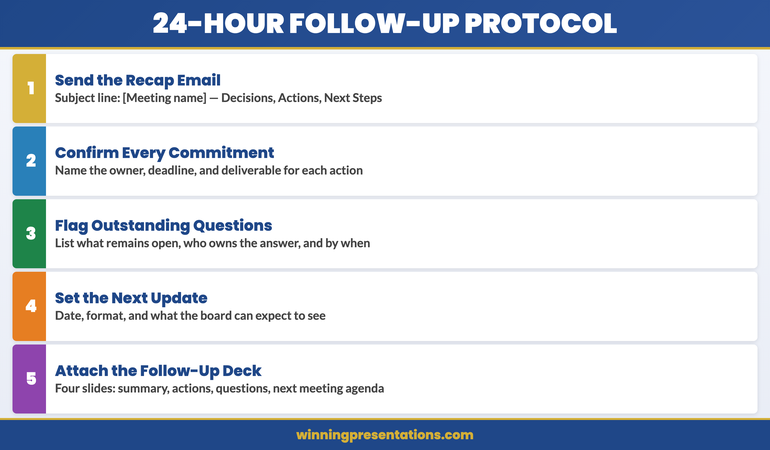
Stacked cards showing the five steps of a board presentation follow-up protocol: opening confirmation, decisions list, outstanding items, next steps, and attached deck

Turn Your Board Presentation Into a Decision — Not Just a Meeting

The Executive Slide System gives you a complete set of slide frameworks and communication templates for every stage of a board presentation — from your opening slide through to the follow-up deck that keeps decisions moving.

  • ✓ Slide-by-slide frameworks for board and governance presentations
  • ✓ Follow-up deck templates with pre-built slide structures
  • ✓ Prompt cards to structure your narrative and handle board questions

Get the Executive Slide System → £39

Designed for executives preparing high-stakes presentations

Building the Follow-Up Deck: Four Slides That Do the Work

The follow-up deck is not a repeat of your original presentation. It is a working document — designed to be read rather than presented, and built to serve the board’s decision-making process rather than to impress. Four slides is typically the right length. Longer than six slides and busy directors will not read it.

Here is what each of the four slides should contain:

Slide 1: Decision Status. A one-slide summary of where the decision stands. Include the motion or request as originally framed, the board’s response (approved, deferred, subject to conditions, or pending further information), and any formal conditions attached to an in-principle approval. This slide becomes part of the governance record and should be precise enough to stand alone as a reference document.

Slide 2: Actions and Owners. A table or structured list showing every action arising from the meeting. Each row should have: the action, the named owner (an individual, not a team or department), the delivery date, and a status column that you will update at the next meeting. Resist the temptation to be vague — “further analysis” is not an action; “finance team to provide revised three-year model incorporating 8% interest rate assumption by [date]” is.

Slide 3: Outstanding Questions. A dedicated slide for every question raised in the meeting that you were unable to answer fully in the room. For each item, note the question as asked, your proposed response or the additional work required to provide one, and the date by which you will provide it. This slide demonstrates competence rather than weakness — it shows the board that you have listened, recorded accurately, and are managing the process rigorously.

Slide 4: Proposed Next Step. A single slide stating clearly what needs to happen next for the decision to progress. This might be a follow-up meeting with a specific agenda, a paper to be tabled at the next scheduled board meeting, a finance committee review, or a bilateral conversation with the chair. Include a proposed date, a named facilitator, and a one-sentence summary of what the next step is designed to achieve. Make it easy for the board to say yes.

The deck should be formatted consistently with your original presentation — same fonts, same colour scheme, same level of visual polish. Sending a scrappy Word document after a polished board presentation creates an impression of inconsistency that can undermine the credibility you built in the room.

If your original presentation referenced data that has since been updated — a market figure, a cost estimate, a regulatory change — this is the right place to note the revision. Do not wait for the next full presentation to introduce material changes. A brief note on Slide 1 or Slide 3 keeps the record clean and demonstrates that you are actively managing the information, not just responding to prompts.

For a deeper look at how to structure what goes into the presentation before the follow-up, the board presentation 15-minute framework covers how to build a tight, decision-focused narrative that makes the follow-up process significantly simpler.

How to Frame Outstanding Questions Without Looking Unprepared

One of the most common anxieties executives have about the follow-up process is how to handle the questions they could not answer in the room. The instinct is to either over-explain why the information was not available, or to avoid referencing the gap altogether and hope it goes away. Neither approach serves you well.

The board is not expecting you to know everything. What it is expecting is that you know what you do not know, that you have a clear plan to address it, and that you will follow through. An executive who says “I don’t have that figure to hand but I will provide a detailed breakdown by Thursday” is demonstrating exactly the kind of rigour that builds board confidence. An executive who fumbles for an answer, gives an estimate with no acknowledgement of its limitations, or fails to follow up at all is the one who loses credibility.

When framing an outstanding question in your follow-up deck or email, use this structure: restate the question as it was asked, confirm the date by which you will provide the answer, and — where possible — give a brief indication of what type of answer to expect. For example: “Q: What is the projected impact on working capital in Year 2? We will provide a detailed working capital model incorporating the revised revenue assumptions by [date]. The preliminary estimate is within the range discussed at the meeting, pending confirmation from the finance team.”

That level of transparency does something important: it removes uncertainty from the board member’s perspective. They know the question has been heard, they know when they will have an answer, and they have a rough anchor for what to expect. That is a far more reassuring position than silence.

There is also a category of question that is better addressed through a bilateral conversation before the follow-up deck goes out. If a board member raised a concern that is sensitive — a governance issue, a conflict of interest question, or a concern about the competence of a named individual — it is usually more productive to speak with them directly before responding in writing to the full board. Use your judgement, but do not let that bilateral conversation become a substitute for the written record: once the conversation has happened, the key point and any agreed action should still appear in the follow-up documentation.

For a broader view of how seasoned executives manage their relationship with a board throughout the full presentation lifecycle, the guide on how to present to a board of directors covers the interpersonal and structural dimensions that the follow-up process sits within.

If you are preparing presentations that require both a strong initial structure and a robust follow-up process, the Executive Slide System includes ready-to-use frameworks for both stages.

The Follow-Up Meeting: Structure That Gets a Decision

Not every board presentation requires a dedicated follow-up meeting — some decisions are resolved through the paper trail alone, or picked up at the next scheduled board meeting. But when a follow-up meeting is needed, how you structure it determines whether you leave with a decision or another round of deferral.

The single most important principle for a follow-up meeting is to treat it as a working session, not a presentation. The board has already seen your slides. What they need now is a forum to ask the remaining questions, review the responses you have prepared, and reach a conclusion. Coming into the room with another 30-slide deck signals that you have not internalised that distinction — and it is one of the most common ways executives inadvertently reset the clock on a decision.

A well-structured follow-up meeting has three phases:

Phase 1: Orientation (5 minutes). Open with a brief verbal summary of where the decision stands, what has happened since the last meeting, and what you are asking the board to do today. Do not re-present the original case. One paragraph or three bullet points on a single slide is sufficient. The goal is to give board members who have reviewed your follow-up deck a rapid anchor, and to bring anyone who has not read it up to speed quickly.

Phase 2: Outstanding items (15-20 minutes). Work through the outstanding questions slide from your follow-up deck. For each item, briefly state the question, present your response, and then open the floor. Manage this section actively — you want dialogue, not a lecture. If a question generates significant discussion, note it explicitly and propose a way to resolve it: “This seems to be the key point of contention. Can we agree to [specific action] and come back to the board with a final recommendation by [date]?” Having a clear resolution mechanism for each item keeps the meeting from running indefinitely.

Phase 3: Decision and next step (5-10 minutes). Close by explicitly asking for a decision or a clearly defined next step. Too many follow-up meetings end with vague affirmation — “very helpful, we will consider” — rather than a concrete outcome. You can facilitate a cleaner close by framing a direct question: “Based on the responses provided today, is the board in a position to approve the capital investment? If not, what specific information or conditions would allow you to do so?” That framing forces a concrete answer and, if the answer is still a deferral, gives you precise guidance on what the final hurdle is.

Following the follow-up meeting, send a second, shorter version of the follow-up email within 24 hours. Update the decision status, close out any action items that have been resolved, and document the specific conditions or information required if a final decision is still outstanding. This layered documentation approach — original follow-up, then updated follow-up after subsequent meetings — creates a clean governance record that protects you if the decision later comes under scrutiny.

For executives who also manage ongoing client or stakeholder presentations alongside their board responsibilities, the approach to structuring a client account review presentation uses a similar decision-facilitation framework and may offer useful parallels.

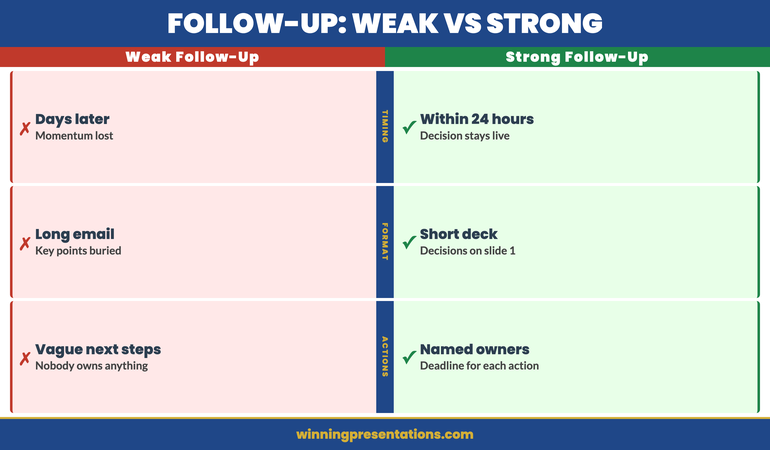
Split comparison showing weak board presentation follow-up on the left (vague email, no deck, no actions) versus a strong structured follow-up on the right (24-hour email, four-slide deck, named owners)

Already Have the Deck — But the Follow-Up Is Where Things Stall?

The Executive Slide System includes the follow-up slide structures and communication frameworks that most presentation tools leave out — so you can manage the full cycle from first slide to final approval.

Get the Executive Slide System → £39

Designed for executives preparing high-stakes presentations

Frequently Asked Questions

How long should a board presentation follow-up email be?

A follow-up email to the board should be concise — typically two to three short paragraphs plus a structured list of decisions and actions. The purpose of the email is to leave a clear record, not to re-present your case. Most of the substantive detail belongs in the attached follow-up deck, which board members can review at their own pace. A long email is unlikely to be read carefully by time-pressed directors and can come across as over-eager rather than thorough. Aim for something that can be read and understood in under two minutes. Reference the attached deck explicitly so members know where the fuller picture is.

What should you do if the board deferred a decision rather than approving it?

A deferral is not a rejection — but it does require active management. The first step is to understand precisely why the decision was deferred. If the chair or a board member gave explicit reasons, document them exactly as stated. If the deferral was less specific, it is appropriate to follow up directly with the chair or company secretary to understand what information or conditions would allow the board to reach a decision at the next meeting. Once you have that clarity, your follow-up deck should explicitly address each condition or information gap, and your proposed next step should map directly to removing each outstanding obstacle. Treat the deferral as a checklist, not a setback — and your follow-up process as the mechanism for working through that checklist systematically.

How many times should you follow up after a board presentation before it becomes counterproductive?

There is no fixed number, but the guiding principle is that each follow-up communication should add new information or move the process forward — it should never simply repeat what has already been said. A structured board presentation follow-up typically involves an initial 24-hour email with follow-up deck, a second update after any subsequent follow-up meeting, and then a brief status note at each scheduled board meeting until the decision is closed. Beyond that, if a decision has been in limbo for several board cycles, the right move is usually a direct conversation with the chair to understand whether the proposal needs to be restructured or whether there are governance or priority factors that are not visible to you. Persistent written follow-up without new substance quickly becomes noise — and erodes the credibility you are trying to protect.

Get The Winning Edge

Weekly insights on executive presentations, stakeholder strategy, and high-stakes communication — straight to your inbox.

Subscribe to The Winning Edge →

Not ready for the full system? Start here instead: download the free Executive Presentation Checklist — a one-page checklist covering the essentials before your next board meeting.

About Mary Beth Hazeldine

Mary Beth Hazeldine is Owner & Managing Director of Winning Presentations. With 24 years of corporate banking experience at JPMorgan Chase, PwC, Royal Bank of Scotland, and Commerzbank, she advises executives across financial services, healthcare, technology, and government on structuring presentations for high-stakes funding rounds and approvals.

Book a discovery call | View services