

Quick answer: “Walk me through the numbers” is not a request for narration. It is a diagnostic. The CFO is testing whether you built the model or whether someone else did. The pattern senior presenters use is four steps: state the headline outcome, name the two or three drivers, name the most sensitive assumption, and state where the model is most likely to be wrong. The walk-through that wins the room is concise, structured, and honest about the limit. The walk-through that loses the room is comprehensive, sequential, and reads as if the presenter is reading the model for the first time.
Jump to:
Idris had built the deck. He had not built the model. The model had been built by a finance analyst on his team six weeks earlier, refined twice, signed off by his CFO partner. Idris had read it carefully, understood the logic, and could speak to the headline numbers. When the new CFO asked him “walk me through the numbers”, he started at slide three and worked through every line. Six minutes in, the CFO interrupted: “I have read the deck. What I am asking is — show me you built this.” Idris had not built it, and the room could tell.
“Walk me through the numbers” is one of the most-misread questions in finance committee meetings. It is not a request for the presenter to narrate the model. It is a test — usually conscious, sometimes intuitive — of whether the presenter is genuinely the author of the case or merely the deliverer of someone else’s work. CFOs ask this question because the answer reveals more than any single line of analysis. The presenter who has built the model can speak to it conversationally, mention the assumption they almost changed, and name the driver they spent the longest debating. The presenter who has not built it walks through it sequentially.
The good news is that the question is preparable. A presenter who has not personally built every line of the model can still answer it well — by understanding what the question is actually testing and structuring the answer accordingly. The pattern is four steps. Most senior presenters who have lost a meeting on this question have lost it because they did not know what the question was for.
If “walk me through the numbers” has knocked you off pace before
The Executive Q&A Handling System covers the answer patterns senior presenters use under finance committee pressure — including the four-step walk-through structure, the recovery routine when an answer has not landed, and the patterns for hostile follow-ups. Built around 25 years of presenting under finance scrutiny.
What the question is actually testing
CFOs do not ask “walk me through the numbers” because they need a narration of the model. They have read the model. They have a finance team that has read it more thoroughly than the presenter. The question is testing three things at once: whether the presenter has internal authorship of the case, whether the case has been pressure-tested, and whether the presenter knows where the model is most likely to be wrong.
A presenter who has built the model — or who has been deeply involved in building it — answers the question without leaning on the slides. They speak to the model conversationally, mention the assumption they revised twice, and identify the variable they are least confident in. The CFO can hear the authorship in the tone. A presenter who has not built it tends to read from the deck or from a mental copy of the deck. The CFO can hear that too.
The reason the question is consequential is that finance audiences distinguish sharply between authored cases and delivered cases. Authored cases are easier to commit to because the room is confident that someone in the room actually understands the model. Delivered cases require additional evidence — usually in follow-up correspondence with the analyst who built it — before sign-off can happen. A clean walk-through compresses this verification work into the meeting, which is exactly why CFOs ask the question.
The four-step walk-through pattern
A walk-through that wins the room follows four steps in sequence. Each step is short — typically one to two sentences. The full answer takes ninety seconds to two minutes. Anything longer reads as the presenter narrating the model. Anything shorter reads as the presenter dodging the diagnostic.
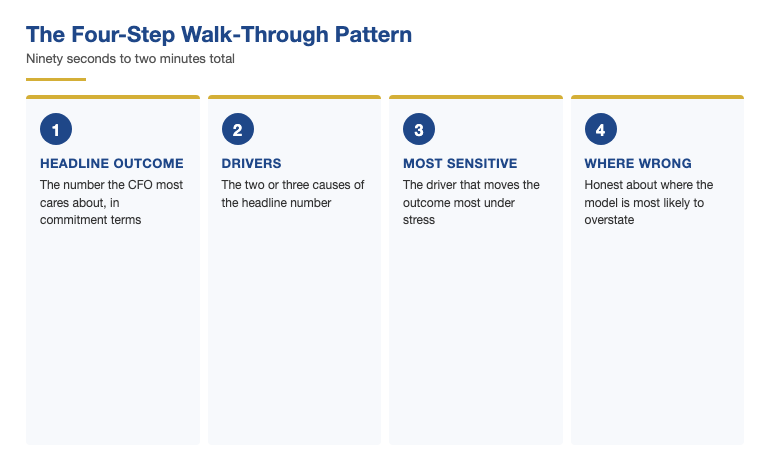
Step one — state the headline outcome. One sentence. The number the CFO most cares about, in commitment terms. “The proposal delivers £8.4 million of NPV over five years at the central case, with payback in year three.” The headline outcome is what the CFO is mentally testing the rest of the answer against. Stating it first gives the CFO an anchor for the walk-through and signals that the presenter is not narrating sequentially.
Step two — name the two or three drivers. Each in one phrase. “The number is driven by three things: the volume assumption from the operations team, the unit economics derived from the pilot, and the implementation cost which we modelled bottom-up.” Naming the drivers tells the CFO that the presenter has decomposed the model rather than just memorised the output. The phrasing matters — drivers, not inputs. Drivers are causal. Inputs are mechanical.
Step three — name the most sensitive assumption. “The most sensitive of the three is the volume assumption — a 20% miss takes the NPV from £8.4m to £4.6m, but the case still earns its place at that level.” Sensitivity reveals authorship. A presenter who knows which assumption is most sensitive has spent time inside the model. A presenter who does not is usually reading the cover page. The sensitivity callout is also reassurance — the case still works at a stressed assumption.
Step four — name where the model is most likely to be wrong. “Where I think the model is most likely to overstate is the speed of ramp in year two — we have used a benchmark from a similar but not identical programme. We are doing a deeper market validation in the next six weeks.” Honesty about the limit is the single highest-impact element of the walk-through. CFOs respond to it more strongly than to any other piece of the answer. It signals authorship, intellectual honesty, and active management of the residual uncertainty.
Three wrong answers (and why each one fails)
Wrong answer one — sequential narration. “Sure, so we started with the volume assumptions on slide three, then on slide four we calculated the revenue contribution, and on slide five we deducted the costs…” This is the most common wrong answer. It signals that the presenter is reading the deck rather than speaking from the model. CFOs disengage within ninety seconds. The right move is to stop, restart with the headline outcome, and route through the four-step pattern.
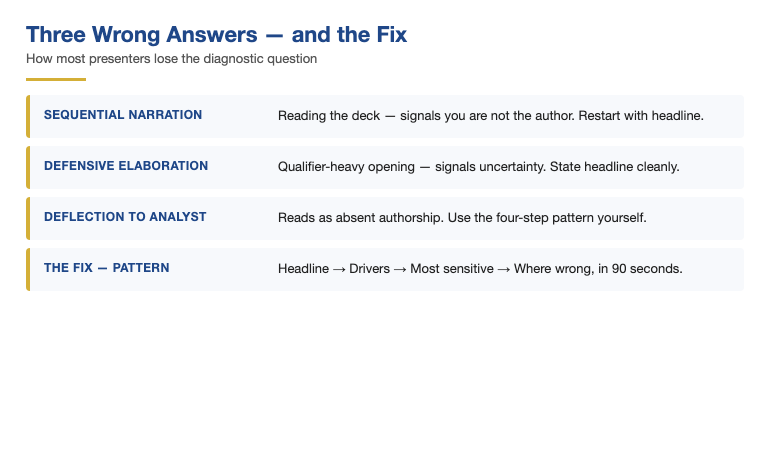
Wrong answer two — defensive elaboration. “Well, the numbers are based on a number of assumptions that I want to walk you through carefully because each of them has been tested…” Defensive openings signal that the presenter is anticipating challenge rather than offering authorship. The CFO reads this as a sign that the presenter is uncertain about the case. The walk-through becomes a justification rather than a diagnostic, and the room shifts into testing mode. Avoid the qualifier-heavy opening. State the headline outcome cleanly.
Wrong answer three — deflection to the analyst. “Excellent question — Yusuf on my team built the model, and he can walk you through the detail.” Deflection in a finance committee meeting reads as absence of authorship. Even when an analyst has built the model, the presenter is the senior person in the room and is expected to be able to speak to it. Deferring to the analyst is sometimes appropriate for a specific technical question — but never as the answer to “walk me through the numbers”. The right move is the four-step pattern delivered confidently, with a follow-up offer to bring the analyst in for a deeper discussion if needed.
For senior professionals who get tested on the numbers in finance committee meetings
The Executive Q&A Handling System — answer the diagnostic questions calmly
Stop losing control in Q&A. The Executive Q&A Handling System gives you decision-safe answer patterns for tough questions in 45 seconds — including the four-step walk-through, the patterns for trap questions, and the recovery technique when an answer has not landed.
- The 45-second answer structure for diagnostic and trap questions
- Patterns for the most common finance committee follow-ups
- Recovery techniques when the first answer has not landed
- The pattern library that handles hostile, comparative, and trap questions
£39 · Instant download · Lifetime access · 30-day refund if it doesn’t fit your next presentation
Handling the follow-up questions
A clean four-step walk-through usually triggers one or two follow-ups. The follow-ups are not a sign that the answer failed — they are a sign that the answer earned engagement. The presenter who handles the follow-ups well usually closes the line of questioning and the meeting moves on. The presenter who flounders on follow-ups confirms the diagnostic the original question was testing.
Follow-up A — “Can you tell me more about the volume assumption?” The CFO is checking that the presenter can go one level deeper than the walk-through suggested. Pattern: name the source, name the validation method, name the limit. “The volume came from the operations team’s bottom-up forecast, validated against the pilot data and against benchmark X. The limit is that we have only one quarter of pilot data, which is why we ran the sensitivity at minus 20%.”
Follow-up B — “How confident are you in the implementation cost?” The CFO is testing the second-most-sensitive driver. Pattern: state the build-up basis, name the largest cost component, state the confidence band on it. Confidence bands without an interrogation method underneath sound speculative. Confidence bands with a method sound disciplined.
Follow-up C — “What would change in the model if X happened?” The CFO is constructing a scenario the model has not been formally run on. Pattern: state the directional impact, state the rough magnitude, commit to a follow-up if the scenario is genuinely material. CFOs do not expect a presenter to run a new scenario in real time. They do expect a directional answer and a follow-up commitment if the scenario warrants it.
Follow-up D — silence. Sometimes the CFO simply pauses after the walk-through. The instinct under nerves is to fill the silence with elaboration. The instinct is wrong. Hold the silence. The pause usually means the CFO is processing — not that the answer was insufficient. Filling the silence with extra detail almost always weakens the answer. Composed presenters wait. Anxious ones over-explain.
Preparing for the question before the meeting
Most senior presenters can be ready for “walk me through the numbers” in about thirty minutes of focused preparation. The work is not memorisation — it is decomposition. Break the model down into the four elements the answer pattern needs, write a one-paragraph version, and read it aloud once. The act of writing the four elements is what produces the conversational fluency the CFO is testing for.
Spend an hour with whoever built the model. If a finance analyst built it, sit with them for an hour while they walk through it. Not formally. Conversationally. Ask them which assumption they almost changed, which input they argued about, where they think the model is weakest. The conversation gives you the language an author would use, which is exactly the language the CFO is listening for. The analyst is rarely in the meeting. You are. The hour with them transfers some of their authorship to you.
Write the four-step answer down. One paragraph. Headline outcome, drivers, most sensitive assumption, where the model is most likely to be wrong. Read it aloud. Then read it aloud again the morning of the meeting. The written paragraph is the rehearsal. The spoken delivery in the meeting is unscripted, but the structure is fluent because the writing has done the work.
Anticipate the two most likely follow-ups. If the most sensitive assumption is volume, the most likely follow-up is “tell me about the volume number”. If the most sensitive assumption is implementation cost, the most likely follow-up is “how confident are you in the cost build-up”. Pre-write a paragraph for each. The pre-writing is rarely needed verbatim — but it produces the calm response that an unprepared presenter rarely manages.
For a wider view of the diagnostic structure behind senior finance questioning, see the related discussion of why-believe-your-numbers as the meta-question behind every finance walk-through.
If the next walk-through question is what you are bracing for
Try the Q&A system on your next presentation — 30-day refund if it doesn’t fit
The Executive Q&A Handling System is £39, instant download, with a 30-day refund if it doesn’t hold up against the questions in your next finance committee meeting. Use it once before your next CFO conversation and decide afterwards. Try the Q&A system →
Frequently asked questions
What if I genuinely did not build the model and cannot pretend I did?
Do not pretend. The pretence is what the question is designed to surface. The right approach is to spend an hour with whoever built it, internalise the logic, and then answer in the four-step pattern as if you had built it — because by the time the answer happens, you understand the model well enough to author the answer even if not the underlying analysis. CFOs distinguish between presenters who memorised the cover page and presenters who actually understand the model. The hour-with-the-builder is what closes the gap.
What if I do not know the most sensitive assumption?
Find out before the meeting. The most sensitive assumption is usually identifiable from a one-page sensitivity table — most models have one, even if it does not appear in the deck. Spend twenty minutes with the analyst or the model itself to identify the variable that moves the headline outcome the most for a given percentage change. The number itself is rarely the point. The act of having identified the most sensitive variable is the point. CFOs read it as a sign that the model has been interrogated rather than just produced.
Should I admit where the model is most likely to be wrong?
Yes, and the admission is one of the highest-leverage elements of the walk-through. Honesty about the limit signals authorship and rigour. CFOs respond to it more strongly than to defensive answers. The admission has to be paired with a sentence about active management — what is being done to reduce the uncertainty, by when, with what confidence. Admission without an active-management sentence reads as undermined. Admission with the sentence reads as disciplined.
How is “walk me through the numbers” different from “talk me through the deck”?
“Talk me through the deck” is a request for narration. “Walk me through the numbers” is a diagnostic test of authorship. The two questions sound similar and are sometimes used interchangeably, but the appropriate response is different. For “talk me through the deck”, a sequential narration is acceptable, particularly if the audience has not read it in advance. For “walk me through the numbers”, sequential narration is the wrong answer. Listen carefully to the exact wording — “the numbers” almost always signals the diagnostic version of the question.
For senior leaders preparing for the diagnostic finance questions
Walk into the next CFO meeting with the answer patterns senior leaders use under diagnostic pressure
The Executive Q&A Handling System covers the four-step walk-through, the patterns for trap questions, and the recovery technique when an answer has not landed. £39, instant download.
£39 · Instant download · Lifetime access
The Winning Edge — weekly
One short note each Thursday on board-level presentation patterns, structural shortcuts, and the behaviours senior presenters use under scrutiny. Written for professionals who do not have time for newsletters that read like newsletters.
Want a structural starting point first? The free Executive Presentation Checklist covers the structural fundamentals senior presenters use before designing the deck.
For the broader audience considerations behind the diagnostic questions, see the related piece on the CFO presentation checklist — what to verify in the deck before the questions begin.
Next step: Pick the next finance committee or CFO meeting on your calendar. Spend an hour with whoever built the model. Write the four-step walk-through paragraph. Read it aloud. Identify the two most likely follow-ups and pre-write each. The thirty to sixty minutes of preparation will be the difference between a meeting that pivots on the diagnostic question and a meeting that moves cleanly past it toward the decision.
Mary Beth Hazeldine is the Owner & Managing Director of Winning Presentations. With 25 years of corporate banking experience at JPMorgan Chase, PwC, Royal Bank of Scotland, and Commerzbank, she advises senior professionals across financial services, healthcare, technology, and government on structuring presentations for high-stakes board meetings, investment committees, and executive sessions. She speaks German and works extensively with the German-speaking financial markets.