
Tag: finance presentations

16 Apr 2026
Male finance director presenting a live dashboard to senior executive team in a corporate boardroom, data screens visible behind him, navy and gold tones

Dashboard Presentation: How Executives Structure Live Data Reviews

Quick answer: A dashboard presentation is not simply a data walkthrough — it is a structured briefing designed to help senior decision-makers interpret numbers in context, draw the right conclusions, and agree on a clear next step. The most effective format opens with a concise framing slide before the data, uses a consistent annotation structure to guide interpretation, and closes with a decision prompt rather than a summary. The data itself rarely does the persuading. The framing around it does.

Henrik had run finance review meetings every quarter for three years. Each time, the pattern was the same: he opened the dashboard, walked the senior team through each metric in sequence, answered the questions that came up, and then the meeting ended with no clear resolution. Whether the numbers were good or bad, the outcome was similar — a polite discussion, a few action items, and a vague sense that nothing had really been decided.

After a particularly inconclusive Q2 review, the CFO pulled him aside. The data was fine, she said. The structure was the problem. Senior leaders were being asked to process numbers without a frame. They were drawing their own conclusions, independently, and arriving at different interpretations of the same dashboard. The meeting was not producing alignment — it was producing confusion dressed as agreement.

Henrik redesigned the next review entirely. He opened with a single slide that established the three things the room needed to decide — before any data appeared. He annotated each chart with a directional headline rather than a neutral label. He ended with an explicit options slide rather than an open-ended “any questions?” The Q3 review ran twelve minutes shorter. It ended with three decisions documented. That had never happened before.

If you are structuring data presentations for senior decision-makers and want a sharper framework for framing, annotating, and closing with clarity, the Executive Slide System contains slide templates and AI prompt cards for exactly these scenarios.

Explore the System →

Why a Dashboard Presentation Is Not a Report Meeting

The most common error in dashboard presentations is treating them like reporting sessions. A report session transfers data from one party to another. A dashboard presentation is a structured decision-making meeting with data as evidence. The difference in purpose requires a fundamentally different structure.

In a reporting session, the presenter owns the data and the audience receives it. Questions emerge from curiosity or confusion, and the session ends when the data has been presented in full. There is no inherent decision requirement. The meeting is complete when the numbers have been shared.

A dashboard presentation is different in structure, purpose, and outcome. The audience is not there to receive data — they are there to interpret it, align on what it means, and make a decision about what happens next. This requires the presenter to do the interpretive work before the meeting, not during it. If you walk into a dashboard presentation and expect the room to draw its own conclusions from charts, you have misunderstood your job.

Senior decision-makers do not have the time, nor in many cases the context, to interpret raw metrics on the spot. They rely on the presenter to have already done that work — to have identified which numbers matter, why they have moved, and what the business should do about it. When that framing is absent, the room does the interpretation independently. And different people in the same room will reach different conclusions from the same data.

The practical implication is this: your role in a dashboard presentation is not to show the data. Your role is to make the data legible and to guide the room to a decision. Every structural choice — what you put on slide one, how you annotate charts, where you place your recommendation — should serve that goal. The dashboard is your evidence. The presentation is your argument.

Executive Slide System — £39, instant access

Structure Data Presentations That Drive Decisions — Not Just Discussion

The Executive Slide System gives you professionally structured slide templates built around the scenarios finance leaders and board presenters face most. It includes dashboard and data review formats, AI prompt cards to help you frame metrics and annotate charts, and scenario playbooks for finance and governance contexts.

  • Slide templates for data reviews, board updates, and finance briefings
  • AI prompt cards to build directional headlines and frame complex metrics
  • Framework guides for structuring decisions in live review meetings
  • Scenario playbooks for quarterly, mid-year, and exception-based reviews

Get the Executive Slide System →

Designed for finance directors, CFOs, and executives presenting data to boards and senior leadership teams.

The Three-Slide Framing Sequence Before Your First Chart

The most reliable structural improvement to a dashboard presentation costs you no additional data analysis — it simply changes what happens before the first chart appears. Senior audiences who arrive in a data meeting without a shared frame tend to interpret metrics through their own individual priorities. The result is discussion rather than alignment.

A three-slide framing sequence before the dashboard data establishes the shared interpretive frame the room needs. The first slide states the decisions the meeting is designed to reach — not questions to explore, but specific choices the room needs to make before it finishes. This gives senior attendees a mental structure for evaluating everything that follows. They are no longer processing data in abstract; they are processing it in relation to a decision they know they need to make.

The second slide provides the performance context: what the targets were, what the comparison period was, and what external conditions are relevant. This slide does the audience’s contextualising work for them. Without it, different people in the room will apply different baselines — last quarter, last year, the original plan, the revised forecast — and arrive at different assessments of the same number.

The third slide is your headline summary: two or three interpretive statements about where the business stands, written as conclusions rather than observations. Not “revenue is up 4%” but “revenue growth is on track and the margin contraction warrants a response this quarter.” This third slide is the slide most presenters omit. It is also the slide that does the most work. It means the room does not need to draw their own interpretive conclusion from each chart — you have already provided it. The charts become confirmation of your interpretation rather than a puzzle the room must solve.

For executives building a clearer structure across all board-facing slides, the principles of a strong executive summary slide apply equally to dashboard framing: lead with the conclusion, support with evidence, and leave no interpretive work for the audience to do independently.


The three-slide framing sequence for dashboard presentations showing: decisions needed, performance context, and headline interpretive summary before the data

How to Present Data That Has Moved Against You

The hardest moment in a dashboard presentation is not when the data is good. It is when the data has moved in the wrong direction since the last review — and you are the person who has to present it to a senior room that expected better results.

The most common response to adverse data is to bury it — to sequence the dashboard so that stronger metrics come first, and the problematic numbers appear later when the room is already in a more positive frame. This approach is understandable and almost always counterproductive. Senior audiences notice when data has been sequenced to soften a finding. The act of sequencing itself communicates that the presenter is uncertain about the data or unwilling to address it directly. Both perceptions are worse than the underlying numbers.

A more effective approach is to introduce adverse data directly and immediately — but to introduce it with your interpretation already attached. The difference between “cost overruns increased 18% this quarter” and “cost overruns increased 18% this quarter, driven by two project-specific items we have already addressed” is the interpretive sentence. The first invites the room to speculate about cause. The second forecloses the most damaging speculative paths before they open.

For each adverse metric in your dashboard, prepare the following in advance: the cause (specific and verifiable), the action already taken or planned, and the expected impact on future performance. These three elements — cause, response, trajectory — give the room something to engage with constructively rather than a problem to diagnose in real time. You remain in control of the interpretive frame even when the numbers are unfavourable.

Annotating your charts matters here too. A dashboard chart presented without annotation is an open question. One annotated with directional language — “margins stabilising following supply chain correction” or “cost variance narrowing from Q1 peak” — provides an interpretive anchor. Even if someone in the room disagrees with your annotation, you have shaped the starting point for that conversation. An unannotated chart starts from nowhere.

For related reading on structuring data and financial evidence for governance meetings, see the companion article on audit committee presentation frameworks — the same principles of direct disclosure and interpretive pre-framing apply in compliance contexts where adverse findings carry regulatory weight.

Managing Live Questions on Data You Cannot Fully Explain

Every dashboard presentation contains at least one data point the presenter cannot fully explain in real time. Perhaps a metric has moved in a direction that the modelling did not predict. Perhaps there is a discrepancy between two figures that was not visible before the meeting. Perhaps a senior leader has access to external data that conflicts with the numbers on screen.

The instinct when this happens is to speculate — to offer a plausible cause on the spot rather than admit uncertainty. For data-confident presenters, this usually means offering three possible explanations and letting the room choose between them. This approach tends to generate more discussion than resolution, and it transfers interpretive authority from the presenter to the room.

A stronger response to live unexplained data is a clear structure: acknowledge the question directly, state what you know and what you do not, name the earliest point at which you can confirm the explanation, and move the meeting forward. This response pattern — acknowledge, scope, commit, continue — keeps you in control without requiring you to speculate or deflect. Senior audiences respond well to a presenter who knows the limits of their current data and can state them plainly.

The most important discipline here is maintaining the forward momentum of the meeting. Dashboard presentations that stall on a single unexplained data point often fail to reach their decision objective. When a question cannot be resolved in the room, parking it formally — noting it as a post-meeting follow-up, assigning it clearly — preserves the meeting’s purpose without dismissing the concern.

If you are building the executive slide system to cover data-heavy scenarios, the Executive Slide System includes AI prompt cards for annotating metrics and framing difficult data points before high-stakes finance meetings.

Ending With a Clear Decision Request

The most common structural failure in a dashboard presentation is the ending. Most data meetings end with a summary of what was covered and an open invitation for questions. Neither produces a decision. What ends a dashboard presentation effectively is an explicit decision slide: a structured choice frame that presents the options the room must choose between, the relevant considerations for each, and a prompt for the meeting to reach a conclusion before it closes.

The decision slide is not the same as a recommendation slide. A recommendation slide tells the room what you think they should do. A decision slide structures the choice and makes the act of deciding explicit. In some contexts — particularly where the room contains decision-makers with different views on the options — a decision frame is more effective than a recommendation, because it invites the room into the process rather than asking them to endorse your conclusion.

A well-structured decision slide for a dashboard presentation typically presents two or three options, names the decision owner for each, and states a clear timeline. It should not require further data analysis to evaluate — if the room needs more numbers before they can choose, the presentation has not done its preparatory work. The decision slide is the point at which everything that preceded it — the framing sequence, the data, the annotations, the adverse metric handling — either pays off or reveals a gap.

Connecting your dashboard presentation to the board’s formal agenda structure is also important. For guidance on how board agenda presentations build the context that makes finance review decisions easier for senior committees, the principles of sequence and pre-alignment apply directly.


Dashboard presentation structure showing the closing decision frame: options presented, decision owner, timeline, and criteria for each path forward

The Pre-Session Preparation That Changes Everything

The quality of a dashboard presentation is determined largely before the presenter enters the room. What happens during the meeting is shaped by the preparation that precedes it — specifically, the conversations you have with key stakeholders in the 24 to 48 hours before the session.

Pre-briefing the most senior decision-maker in the room is standard practice in effective executive communication — but it is often skipped for data reviews because the data is assumed to speak for itself. It does not. A brief conversation with the CFO, committee chair, or most influential attendee before the dashboard meeting serves three functions: it surfaces any concerns that might otherwise emerge disruptively in the meeting, it aligns on what decisions the meeting is expected to reach, and it allows you to calibrate your framing for the room’s current priorities.

It is also worth preparing for the questions that are statistically most likely to emerge. For finance review meetings, these tend to cluster around trend questions (“is this a one-time variance or a structural shift?”), comparison questions (“how does this compare to the same period last year or to the sector?”), and action questions (“what are we doing about this?”). If your dashboard presentation is structured to address these three question types within the main deck, rather than waiting for them in Q&A, the meeting runs faster and reaches its decision objective more reliably.

The preparation that matters most is not building better charts. It is knowing, before you enter the room, which decisions the meeting needs to reach, which data points are most likely to generate resistance, and what the interpretive answers are to the most predictable questions. For more on structuring the opening of a data or strategy presentation, see the framework for how to start a presentation with a frame that orients senior audiences before the main content begins.

The pre-session conversation is also your best opportunity to learn whether the agenda has shifted — whether a new concern has emerged in the business that changes how the room will interpret the data. Dashboard presentations that feel misaligned with the room’s current priorities almost always suffered from the same preparation gap: the presenter built the deck for the problem they expected, not the one the room is currently focused on.

Executive Slide System — £39, instant access

Build Finance and Data Presentations That Move Senior Rooms to a Decision

The Executive Slide System includes slide templates, AI prompt cards, and framework guides designed for finance directors and data presenters who need to brief senior audiences, committees, and boards.

Get the Executive Slide System →

Designed for finance leaders, board presenters, and executives managing high-stakes data review meetings.

Frequently Asked Questions

What is the most important structural difference between a dashboard presentation and a report?

A report transfers data. A dashboard presentation is structured to produce a decision. The key structural difference is the closing section: a report ends when the data has been covered; a dashboard presentation ends when the room has agreed on a clear next step. If your meeting ends with “let’s continue this discussion,” it has not functioned as a decision meeting. Adding an explicit decision slide — with options, decision owners, and a timeline — is the single most impactful structural change most finance presenters can make.

How should I handle a dashboard metric I cannot fully explain in the room?

Use a four-part structure: acknowledge the question directly, state what you currently know, state clearly what you do not yet know and when you will be able to confirm it, and then move the meeting forward. Avoid speculating in the room — offering possible explanations you are not confident in shifts interpretive authority to the audience and often generates more questions than it resolves. “I want to get you a confirmed answer on that by Thursday” is more authoritative than three speculative hypotheses.

When is the right moment to introduce your recommendation in a dashboard presentation?

Your recommendation or decision prompt should come at the end of the presentation, after the data has been presented in full and the room has had the opportunity to absorb the key findings. In hostile or resistant rooms, a recommendation that comes before the data is often dismissed before it has been heard. In aligned rooms, placing your recommendation early can accelerate agreement — but for dashboard presentations with mixed or uncertain stakeholder views, the end is the safer and more reliable position.

The Winning Edge — Weekly Newsletter

One Insight Per Week on Executive Communication

Each week, The Winning Edge delivers one focused insight on executive communication — structure, delivery, influence, and the mechanics of getting senior audiences to yes. Straightforward, applicable, and written for people who present under pressure.

Subscribe to The Winning Edge →

Free download: The Executive Presentation Checklist — a structured pre-presentation review covering structure, evidence sequencing, and delivery preparation.

About the Author

Mary Beth Hazeldine — Owner & Managing Director, Winning Presentations

With 25 years of corporate banking experience at JPMorgan Chase, PwC, Royal Bank of Scotland, and Commerzbank, Mary Beth now advises executives across financial services, healthcare, technology, and government on structuring presentations for high-stakes funding rounds, board approvals, and finance reviews. Winning Presentations is her specialist advisory practice.

16 Apr 2026
Female CFO presenting to audit committee members with external auditors present, formal governance meeting room, confident and precise delivery, navy tones

Audit Committee Presentation: The Framework Finance Leaders Use for Compliance Briefings

Quick answer: An audit committee presentation requires a different structure from a standard board presentation because the audience includes external auditors with specific procedural expectations alongside board members focused on governance outcomes. The most effective format follows a four-section sequence: scope and methodology, key findings with management response, control environment assessment, and recommended actions with owners and timelines. Directness is essential — audit committee members are specifically looking for any sign that material risks are being minimised or deflected.

Priya had presented to the main board six times. She understood the rhythm of those meetings — the expectation of confidence, the preference for brevity, the implicit protocol around how findings were framed. When the CFO asked her to lead the audit committee presentation for the first time, she assumed it would be similar. It was not.

Halfway through her second slide, the external audit partner interrupted. He wanted to understand the basis for a judgement call she had described as “management assessment.” Priya had expected questions at the end, not in the middle of the narrative. The audit committee chair then asked whether any of the three findings she had characterised as low-risk had been escalated for a second opinion. She had not expected that question either. The meeting did not go badly — but it went differently from every board presentation she had done before.

Afterwards, a more experienced colleague explained the dynamic. Audit committee presentations operate under a different set of expectations. The external auditor is not a passive observer — they are a participant with their own professional obligations. The committee chair is not simply a board member — they are accountable for governance in a way that makes them systematically more sceptical of management framing. And the standard of evidence required for a finding to be accepted without challenge is higher, not lower, than in a commercial presentation. Priya restructured her entire approach for the following quarter.

If you present regularly to audit committees, risk committees, or governance bodies and want a clearer structure for each section, the Executive Slide System includes slide templates and framework guides for finance and compliance presentations.

Explore the System →

Why Audit Committee Presentations Are Not the Same as Board Presentations

Finance leaders who present confidently to their main board often find audit committee meetings unexpectedly difficult. The audience composition is similar — senior people in a formal governance setting — but the dynamics and expectations are structurally different in ways that catch prepared presenters off guard.

The first distinction is the presence of external auditors. In a board presentation, the presenter controls the information flow. In an audit committee meeting, external auditors bring their own independent assessment of the same material. This means the committee has access to a second view on the findings before or during the meeting. Management presentations that omit, minimise, or frame findings too favourably will often be corrected by the auditors in the same session — a dynamic that is visible to the committee and damaging to the presenter’s credibility.

The second distinction is the committee’s governance accountability. Board members attend meetings to make commercial and strategic decisions. Audit committee members attend specifically to provide oversight of financial reporting, internal controls, and risk management. Their professional orientation is fundamentally sceptical — they are there to ensure that material risks and control weaknesses are being surfaced, not managed away from view. A presentation that emphasises positive findings at the expense of a frank assessment of what is not working will strike an audit committee as evasive rather than balanced.

The third distinction is the standard of precision required. Board presentations often use directional language that is understood to be indicative rather than exact. Audit committees require definitional accuracy — a finding described as “low risk” will be interrogated on the basis of how “low risk” was defined and who made that assessment. Management judgements presented as facts will be challenged on their evidential basis. This is not hostility — it is the committee performing its governance function. The presenter who understands this dynamic in advance is far better positioned than one who experiences it as an unexpected challenge.

Understanding the difference between how a board receives information and how an audit committee interprets it is foundational. For background on the broader governance dynamic between management and board members, the article on presenting to non-executive directors covers the sceptical oversight posture these audiences bring to every management presentation.

Executive Slide System — £39, instant access

Structure Governance and Finance Presentations That Withstand Audit Committee Scrutiny

The Executive Slide System contains slide templates and framework guides specifically built for high-accountability governance contexts — including audit committee, risk committee, and compliance briefing formats where the standard of evidence and precision is higher than in commercial presentations.

  • Slide templates for governance and compliance briefings
  • AI prompt cards for framing findings and management responses
  • Framework guides for structuring four-section audit presentations
  • Scenario playbooks for sensitive findings and control environment assessments

Get the Executive Slide System →

Designed for finance leaders, CFOs, and internal audit heads presenting to governance committees and external auditors.

The Four-Section Structure Your Audit Committee Expects

Audit committees generally bring a procedural expectation to management presentations. They have seen enough poorly structured briefings to have formed a view about what constitutes a credible presentation of findings. A four-section structure is consistent with best practice in governance communication and provides the committee with the logical flow they expect.

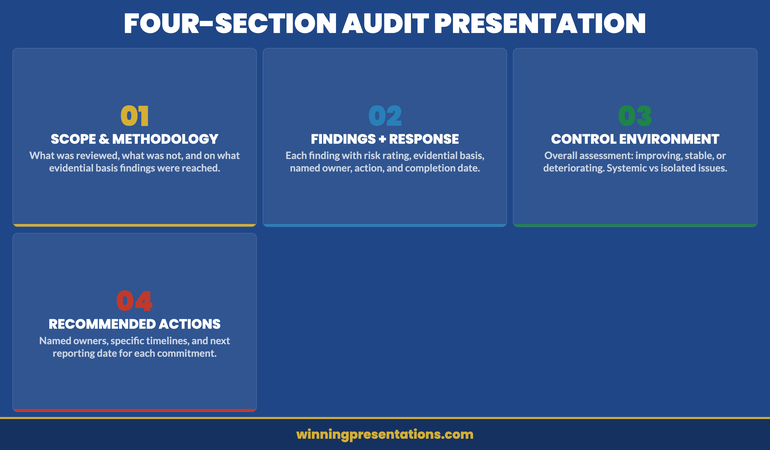
Section one is scope and methodology. This section tells the committee what the review covered, what it did not cover, and on what basis the findings were reached. Committees are particularly attentive to scope because the scope of a review determines whether a finding of “no issues identified” is meaningful or simply a function of a narrow remit. If your methodology relied on sampling rather than full population testing, say so. If the scope was determined jointly with the external auditor, say so. Committees treat unexplained methodological choices as potential gaps.

Section two presents key findings with management response. Each finding should be stated with its risk rating, the evidential basis for that rating, and the management response already attached. The management response should be specific — a named owner, a completion date, and a description of the remediation action. Findings presented without responses invite the committee to ask what management is doing about them, which shifts the dynamic from a managed briefing to a reactive Q&A.

Section three assesses the overall control environment. This section steps back from individual findings to give the committee a view of whether the control framework as a whole is fit for purpose. Is the control environment improving, stable, or deteriorating? Are there systemic factors behind the findings, or are they isolated incidents? This section is where experienced presenters demonstrate that they are thinking about governance at a structural level, not just reporting individual deficiencies.

Section four proposes recommended actions with named owners and timelines. The committee should leave the meeting knowing what will happen, who is responsible for it, and when it will be reported back. Recommendations without owners and timelines are observations, not governance commitments. Audit committee members have an accountability function that extends beyond the meeting — they need to be able to verify that what was agreed has been delivered.


The four-section audit committee presentation structure: scope and methodology, key findings with management response, control environment assessment, and recommended actions with owners and timelines

How to Handle Auditor and Committee Member Questions Simultaneously

One of the most distinctive challenges of an audit committee presentation is that questions can come from two distinct sources with different roles and different interests: the committee members who are providing oversight, and the external auditors who are providing independent assurance. Managing both simultaneously requires a different discipline from managing questions in a standard executive meeting.

Committee member questions tend to focus on governance adequacy — whether the control environment is sufficient, whether risks have been appropriately assessed, and whether management responses are proportionate. These questions often have a slightly adversarial quality not because the committee member is hostile, but because their governance role requires them to probe for gaps. Respond to these questions with the same four-part structure used for adverse data in any governance context: acknowledge the question, state the current position clearly, note any uncertainty, and confirm the action or timeline.

Auditor questions operate differently. The external audit partner is not challenging management from an oversight position — they are providing professional context based on their own independent review. When the auditor and management have reached different assessments of the same finding, that difference will emerge in the meeting. The most effective approach is to acknowledge the difference directly rather than contest it: “The external auditors have rated this as medium risk; management’s current assessment is low risk on the basis of [specific evidence]. We are in discussion to align our views before the next cycle.”

The most important discipline when managing dual-source questioning is maintaining the committee’s confidence in management’s objectivity. If the committee perceives that management is systematically minimising findings that the auditor has rated more seriously, the meeting dynamic shifts in a way that is difficult to recover from. Transparency about differences in assessment — presented as a professional dialogue rather than a dispute — preserves that confidence far more effectively than a unified narrative that the auditor then contradicts.

For related reading on managing live questions from senior governance audiences, the companion article on the difference between a board paper and a board presentation covers how written documentation and live briefings serve different governance functions and require different levels of precision.

Presenting Sensitive Findings Without Signalling Weakness

Every audit committee presentation includes at least one finding that management would prefer to frame more favourably than the raw assessment warrants. The challenge is to present that finding with the directness the committee requires without communicating that management is uncertain, defensive, or unable to manage the underlying issue.

The critical structural discipline is to lead with the finding’s factual description before providing any interpretive framing. Committees are experienced at recognising when a presentation is sequenced to soften a finding — when context and mitigating factors appear before the finding itself. This sequencing invites scepticism even when the mitigating factors are genuinely relevant. A finding stated directly and then contextualised is received as honest. A finding preceded by extensive context is received as hedged.

For high-sensitivity findings — particularly those that touch on compliance failures, regulatory risk, or senior personnel — the presentation format should include three specific elements: the finding stated in neutral, precise language; the management assessment of its significance with the rationale explained; and the immediate response already taken or the specific action committed to. The sequence matters. The committee’s primary concern is not the finding itself but whether management understands its significance and is responding to it appropriately. A presentation that demonstrates both qualities will generally satisfy the committee even when the finding is serious.

There is also a strategic discipline around what to proactively disclose versus what to wait for questions on. In audit committee presentations, proactive disclosure of sensitive findings is nearly always the stronger approach. Committees that learn of a sensitive issue through their own questioning — rather than through management’s upfront disclosure — draw a straightforward conclusion: management did not consider it important enough to lead with. That conclusion is often more damaging than the finding itself.

If you regularly use slide-based presentations for governance briefings and want a cleaner framework for structuring sensitive disclosures, the Executive Slide System contains slide templates designed specifically for high-accountability governance contexts including audit, risk, and compliance committees.


How to present sensitive audit findings without signalling weakness: lead with the finding, provide management assessment with rationale, state immediate action taken or committed

Pre-Briefing the Chair: The Step Most Finance Leaders Skip

The audit committee chair holds a specific governance role that differs from the role of a standard board chair. They are accountable for the committee’s oversight function and are personally exposed if material risks are not surfaced or if management responses are inadequate. This accountability shapes the chair’s posture in committee meetings — they tend to probe more systematically and are less likely to accept management framings at face value than a board chair in a commercial presentation.

Pre-briefing the audit committee chair before the meeting is the single most effective preparatory step that most finance leaders skip. A conversation of twenty to thirty minutes before the meeting achieves several things: it alerts the chair to any sensitive findings before they encounter them in the session, it allows the chair to indicate whether they have any specific areas of focus the committee has agreed to prioritise, and it gives you the opportunity to align on how the meeting will run procedurally.

A pre-briefed chair is also more likely to help manage the meeting constructively. When a committee member raises a question that has the potential to derail the session’s agenda, a chair who already has context can redirect the discussion more authoritatively. When an external auditor and management are in tension on a particular finding, a pre-briefed chair can frame the discussion in a way that acknowledges the difference without letting it dominate the meeting.

The pre-briefing conversation should not be used to negotiate the framing of findings or to secure the chair’s endorsement of a particular management position. Its purpose is alignment on process and context, not agreement on substance. A chair who feels that a pre-briefing conversation was used to pre-empt scrutiny rather than facilitate it will approach the full committee meeting with heightened scepticism.

For more on managing post-presentation follow-through with audit and board committees, the article on board presentation follow-up protocols covers how finance leaders structure the commitments made in governance meetings and report back reliably to the same audience at the next cycle. The same rigour that applies to audit committee presentations extends to the follow-through process. Also worth reading alongside this: the related article on dashboard presentations for finance directors, which covers the data framing principles that apply to all senior data and finance briefings.

Executive Slide System — £39, instant access

Build Governance Presentations That Demonstrate Credibility Under Scrutiny

The Executive Slide System includes slide templates, AI prompt cards, and scenario playbooks for finance leaders who present to audit committees, risk committees, and governance bodies where the standard of evidence and precision is higher than in commercial settings.

Get the Executive Slide System →

Designed for CFOs, internal audit heads, and finance leaders presenting to governance and compliance committees.

Frequently Asked Questions

How long should an audit committee presentation typically run?

Most audit committee presentations run between 20 and 40 minutes for the management briefing section, with additional time allocated for the auditor’s independent update and committee discussion. The management presentation itself should not exceed 25 minutes — audit committee time is heavily protected and committees will be frustrated by presentations that run over their allocated slot. The four-section structure helps with pacing: if you know each section has roughly five minutes, you can calibrate your level of detail accordingly.

What is the most common mistake finance leaders make in their first audit committee presentation?

The most common error is applying the framing conventions of a board presentation — where positive findings are emphasised and sensitive matters are contextualised before they are stated — to an audit committee context where that approach reads as evasive. Audit committee members are specifically trained to notice when material risks are being managed rather than disclosed. The correction is simple: state findings directly and then provide context, rather than leading with context to soften what follows.

Should the CFO always present to the audit committee, or can another finance leader lead?

The CFO typically leads the management presentation to the audit committee, but it is increasingly common — and strategically useful — to have a direct report lead specific sections or the entire briefing, particularly for routine quarterly reviews. This serves two functions: it develops governance presentation capability in the finance leadership team, and it demonstrates to the committee that the control environment is being managed at an operational level rather than being supervised only from the CFO level. Where a direct report leads, the CFO should remain present and available to contribute on questions of judgement or materiality.

The Winning Edge — Weekly Newsletter

One Insight Per Week on Executive Communication

Each week, The Winning Edge delivers one focused insight on executive communication — structure, delivery, influence, and the mechanics of getting senior audiences to yes. Straightforward, applicable, and written for people who present under pressure.

Subscribe to The Winning Edge →

Free download: The Executive Presentation Checklist — a structured pre-presentation review covering structure, evidence sequencing, and delivery preparation.

About the Author

Mary Beth Hazeldine — Owner & Managing Director, Winning Presentations

With 25 years of corporate banking experience at JPMorgan Chase, PwC, Royal Bank of Scotland, and Commerzbank, Mary Beth now advises executives across financial services, healthcare, technology, and government on structuring presentations for high-stakes funding rounds, board approvals, and governance meetings. Winning Presentations is her specialist advisory practice.