

In this article:
- Why Global Calls Fail Seven Minutes In
- Time Zone Diplomacy: Who Sacrifices Sleep and How to Say So
- The Slide Density Framework for Non-Native English Audiences
- Pacing a Virtual Agenda Across Four Time Zones
- Cultural Q&A Dynamics: Silent Cultures Meet Direct Cultures
- The Protocol for Running the Call Itself
- Frequently Asked Questions
Priya Raghavan, Group Head of Strategy at a London-headquartered industrial group, was asked to lead the company’s first quarterly update to a merged executive audience spanning London, Frankfurt, Hong Kong, and Boston. One hour, one deck, four regions. She built the deck the way she always had — British English prose, dense slide bodies, analyst-style phrasing — and scheduled the call for 9 a.m. London: 10 a.m. Frankfurt, 4 p.m. Hong Kong, 4 a.m. Boston.
Seven minutes in, Priya watched the Hong Kong cameras switch off one by one. She kept going. By minute fifteen, the Frankfurt CFO had typed a clarification into the chat, asking her to restate “material headwinds” in plain terms. She finished her prepared remarks in 42 minutes. When she opened for questions, Hong Kong said nothing. Boston, running on three hours of sleep, asked two polite questions. Frankfurt asked seven.
That afternoon, her Hong Kong country manager sent a short message: the team had not disengaged because they were disinterested. They had disengaged because the slides were moving too fast, the idioms were too specific, and there was no structural pathway to ask a clarifying question in a room full of senior directors from two other cultures. The call had been technically bilingual. Culturally, it had been monolingual.
Priya rebuilt her approach the next quarter. The second call did not run longer and was no less sophisticated, but it was structured around the reality that four regions were on the call — not one region presenting to three. What changed was not Priya’s content. It was her chairing.
If you want a structured approach to designing slides that work for mixed-culture, mixed-language executive audiences, the Executive Slide System includes templates and frameworks designed for global presentation scenarios where clarity across languages and cultures matters most.
Why Global Calls Fail Seven Minutes In
Most cross-cultural virtual presentations do not fail because the content is weak. They fail because the presenter designs for the dominant culture in the room and assumes the others will adjust. That adjustment is significant: second-language participants are processing your vocabulary, interpreting idioms, reading slides written for native-speaker speed, and calculating whether their question is worth the cost of interrupting senior executives speaking in rapid, colloquial English.
The seven-minute threshold is not arbitrary. Sustained listening in a non-native language becomes unsustainable above roughly 150 words per minute when idioms and sector vocabulary are layered on top. Most executives present at 160 to 180. The gap is where attention collapses. Cameras switching off on a Hong Kong or Frankfurt screen are not rudeness — they are cognitive triage.
This pattern has structural parallels in global presentation delivery, where in-person presenters also lose international audiences when material is pitched at native-speaker density. The virtual format compounds the problem because informal side-clarifications between colleagues are stripped away. The second-language participant can interrupt publicly, or disengage. Most choose disengagement, and most presenters mistake that for agreement.
Build Slides That Work Across Four Time Zones
The Executive Slide System includes 26 templates, 93 AI prompts, and 16 scenario playbooks — covering global executive calls, cross-cultural updates, and international briefing scenarios. Stop designing decks for one region and forcing the rest of the world to adapt.
£39 — instant access. Designed for executives who present to multinational and cross-cultural audiences.
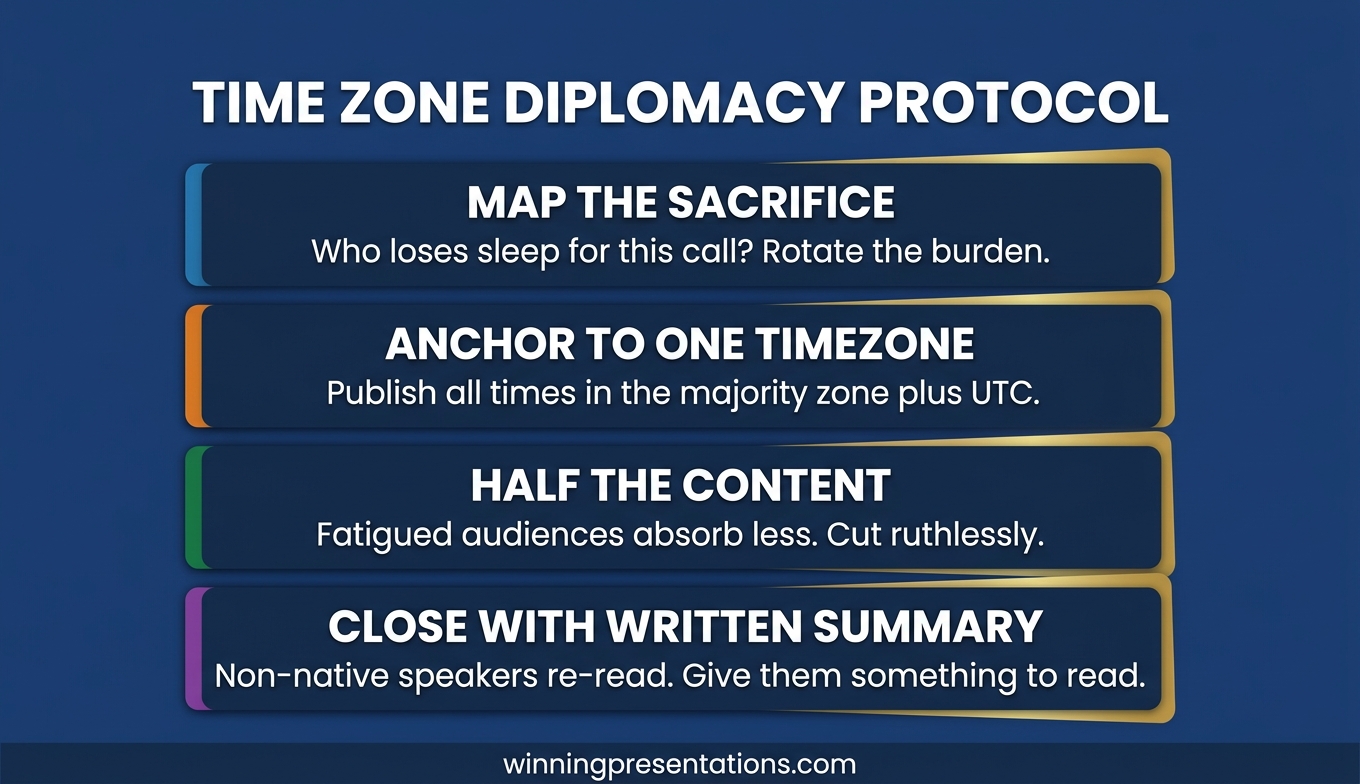
Time Zone Diplomacy: Who Sacrifices Sleep and How to Say So
The hidden political signal in a global call is the meeting time. A recurring 9 a.m. London slot tells Boston and Hong Kong where they sit in the hierarchy — even if the scheduling was thoughtless rather than deliberate. Treat the meeting time as a governance question, not an administrative one.
The rotation principle. For a recurring cross-regional meeting, rotate the inconvenience. Quarter one runs at a London-friendly time. Quarter two at a Hong Kong-friendly time. Quarter three at a Boston-friendly time. This distributes the cognitive tax of attending at an unnatural hour across every region. When your Asia colleagues know their inconvenient 4 a.m. this quarter will be London’s 10 p.m. next quarter, they engage differently.
The explicit acknowledgement. When a region is attending at an unsociable hour, say so at the top of the call. “I want to acknowledge this time works for London and Frankfurt but is difficult for Boston and Hong Kong today. We will rotate the slot next quarter.” This takes ten seconds and converts an implicit imposition into an explicit choice.
The recording protocol. For the most extreme time zones, offer an asynchronous alternative: a recording, pre-distributed slides, and a dedicated 48-hour written Q&A window. Do not pretend a 4 a.m. attendance is equivalent to a 10 a.m. one.
The three-zone rule. If a call spans more than three time zones with more than a four-hour gap between earliest and latest, consider whether it should be a single call at all. Two regional calls with a consolidated executive summary often produce better governance than one where a third of the participants are cognitively impaired by sleep disruption.
The Slide Density Framework for Non-Native English Audiences
Slide density is the single most controllable variable in a cross-cultural virtual presentation. Native English speakers can read a dense slide and listen to your narration simultaneously. Second-language participants must choose between the two — if your slide is dense and your narration fast, they will do neither well. Apply a simple density test before the call:
The 30-word ceiling. No single slide should carry more than 30 words of body text when your audience includes second-language participants. Supporting detail moves to the speaker notes or a pre-read, where it can be processed at the participant’s own reading speed.
The idiom audit. Highlight every idiom, phrasal verb, or culturally specific reference in your deck. “Kick the tyres,” “move the needle,” “low-hanging fruit,” “circle back” — invisible to a native speaker, opaque to a second-language listener. Replace each with a literal phrasing. “Move the needle” becomes “produce a measurable change.” Clarity is not condescension.
The one-concept slide. One concept per slide, supported by one visual or one data point. Three concepts require three slides. The deck gets longer; cognitive load drops; comprehension rises.
The headline-as-conclusion rule. Each slide headline states the conclusion of the slide, not its topic. “Asia-Pacific revenue” is a topic. “Asia-Pacific revenue grew 14 per cent, driven by Hong Kong and Singapore enterprise wins” is a conclusion. A participant who reads only the headlines should still understand the argument of the presentation.
If you want a starting point for slide structures that carry across languages, the Executive Slide System includes templates designed for international executive audiences.
Pacing a Virtual Agenda Across Four Time Zones
Virtual attention decays faster than in-person, and the rate varies by time of day. Participants in their normal working day sustain focus for 20 to 25 minutes. Participants attending late at night or early morning may fragment at 10 to 15. Design your agenda around the weakest region’s attention window.
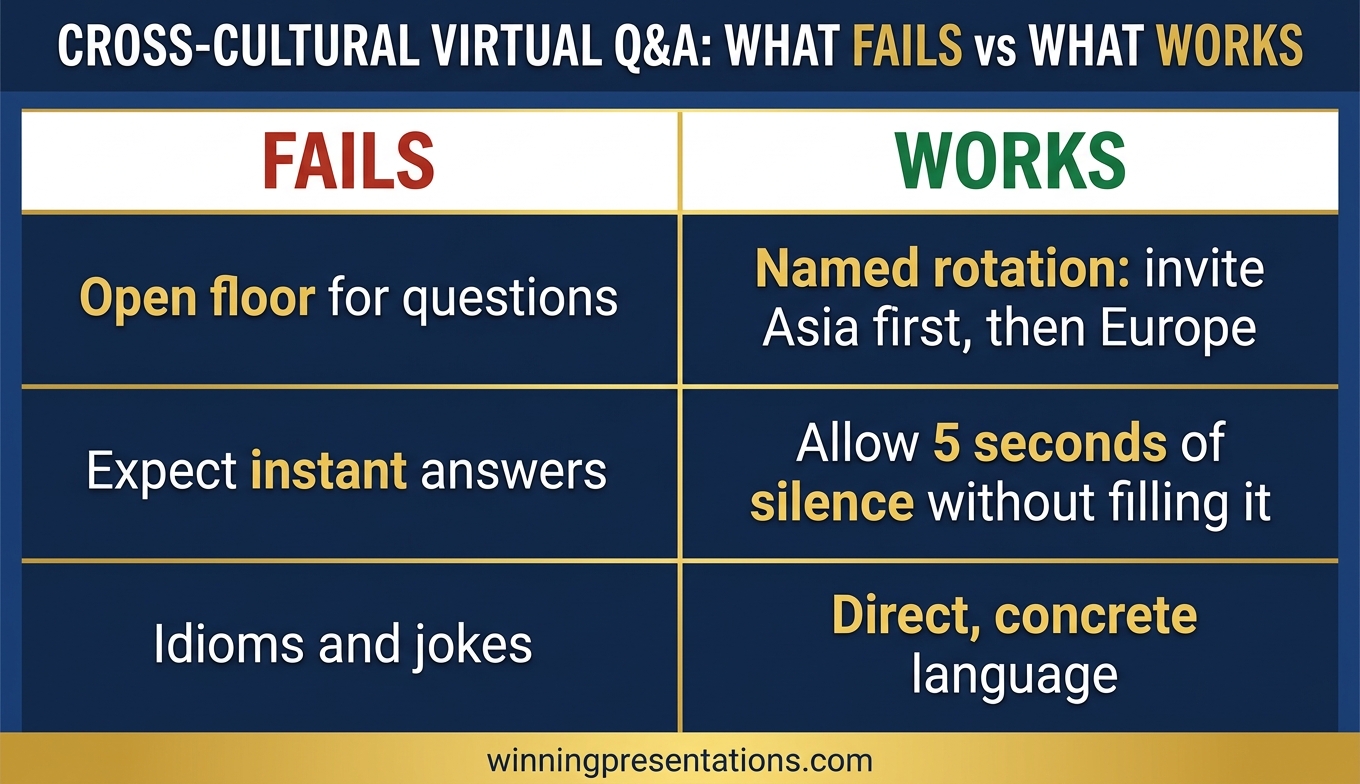
Segmented blocks. Break a 60-minute agenda into three or four 12 to 15-minute blocks, each ending with a question to a specific region. “Before we move to the Americas section, I want to hear from Hong Kong on how the Q3 numbers compare to local forecasts” gives that team permission and a specific invitation — not the vague “any questions from Asia?” which almost always produces silence.
Explicit pauses. After each major data point, pause for five to seven seconds. Native English speakers find this uncomfortable. Second-language speakers find it essential — it is the window in which they catch up, formulate a question, and decide whether to unmute. If you fill it with “okay, moving on,” you have just closed the door that was about to open.
The chat parallel channel. Treat the chat as a legitimate question channel. Announce at the top: “If you would prefer to ask in the chat rather than unmute, please do — I will read every question aloud and respond.” This gives participants in consensus cultures an acceptable route to contribute without public interruption.
The same principles apply across any virtual presentation, but structural pacing becomes non-negotiable when your audience is attending at 4 a.m. or processing a second language.
Slide Structures That Cross Languages and Cultures
The Executive Slide System gives you 16 scenario playbooks and 93 AI prompts for structuring presentations where second-language comprehension, cultural differences, and virtual attention spans must all be addressed — without diluting the content.
£39 — instant access.
Cultural Q&A Dynamics: Silent Cultures Meet Direct Cultures
The Q&A segment is where cross-cultural calls most visibly break down. A presenter opens for questions, hears from the German team, and concludes — having heard nothing from Japanese, Korean, Singaporean, or Chinese participants. The silence is read as agreement. It almost never is.
Direct-questioning cultures (Germany, Netherlands, Israel) treat public questioning as engagement. Consensus-oriented or hierarchy-respecting cultures (Japan, Korea, parts of China, much of South-East Asia) treat public questioning as disrespect. When the two frames collide in a single Q&A window, the louder frame wins. Structural moves that level the field:
Named invitations. Instead of “any questions?” call on specific regional heads by name and role. “Kenji, from your perspective in Tokyo, how does this guidance align with what you are seeing in the domestic market?” This is not putting someone on the spot — it is a culturally sanctioned invitation to contribute.
Pre-seeded questions. In your pre-call communication, ask each regional head to prepare one question in advance. Silent-culture participants can then enter Q&A with a prepared contribution, avoiding improvisational pressure and guaranteeing geographic diversity in the live discussion.
Written follow-up windows. Close every call with an explicit 48-hour written Q&A window. “If you would prefer to raise anything in writing, please email me before close of business Wednesday and I will respond to the whole group.” This normalises the written route as equivalent to the live route.
Reading the silence correctly. When a silent-culture region does not speak, do not assume agreement. A five-minute one-to-one with the regional head within 24 hours frequently surfaces substantive concerns that would never have been raised in plenary.
For adjacent preparation techniques for mixed-culture executive rooms, see the companion framework on presenting to an international audience.
The Protocol for Running the Call Itself
Preparation is necessary but not sufficient. Real-time chairing determines whether your cross-cultural design survives contact with live participants.
Minute zero to two. Acknowledge the time zones, thank the regions attending at unsociable hours by name, restate the rotation commitment, and state the three points on which you will be seeking regional input.
Minute two to forty. Deliver content in 12 to 15-minute blocks at 130 to 140 words per minute, not your natural 170. Pause seven seconds after each headline conclusion and invite a specific regional head by name. Monitor the chat actively — read written questions aloud verbatim, attribute them, and answer fully. This tells every silent-culture participant that the written channel is a respected route.
Minute forty to fifty-five. Open plenary Q&A with named invitations to regions that have not spoken. If no one answers after ten seconds, say “happy to come back to you in writing, Kenji — let me move to Frankfurt for their view.” This protects the participant without excluding them from the record.
Minute fifty-five to sixty. Close with the written follow-up window, a summary of decisions, and the date and rotated time of the next call. Send a written summary within 24 hours in plain, literal English.
Frequently Asked Questions
How do you choose a meeting time for a call spanning four time zones?
Rotate the time across recurring sessions so no single region is permanently inconvenienced. For a one-off call, pick a slot where the extreme regions are at the edges of their working day rather than the middle of their night — for a London, Frankfurt, Hong Kong, Boston group, 1 p.m. London distributes the cost more evenly than a London morning. Acknowledge the sacrifice explicitly at the start of the call.
How dense can slides be if the audience is mixed native and non-native English?
Design to the least native-speaker-friendly comprehension level in the room. Aim for 30 words maximum per slide, one concept per slide, and headlines that state conclusions rather than topics. Audit out idioms, phrasal verbs, and culturally specific references and replace them with literal phrasings.
What should you do if one region stays silent throughout Q&A?
Do not interpret silence as agreement. Follow up individually with the regional head within 24 hours. Structure future calls with named invitations, pre-seeded questions, and a written Q&A route — silence in Q&A is usually a structural problem with the meeting design, not agreement with the content.
Should you translate slides for non-English-speaking executive audiences?
For senior audiences where English is the working language but not the first language, translated slides are usually counterproductive — they introduce nuance disputes and slow the call. Instead, send English-language pre-read materials 48 hours in advance so participants can pre-process vocabulary at their own pace.
Join The Winning Edge
Free weekly newsletter for executives who present across regions, cultures, and time zones. Practical frameworks, virtual communication strategies, and slide structure guidance — delivered every Thursday.
Not ready for the full system? Start here instead: download the free Executive Presentation Checklist — a quick-reference guide for structuring any high-stakes executive presentation, including global and cross-cultural scenarios.
Read next: If your global call is a quarterly review with financial content, see Quarterly Review Presentation: How CFOs Present Numbers the Board Actually Reads for a complementary framework on structuring the financial narrative inside a cross-regional update.
The next step is mechanical. Look at your next global call. Check the time against the rotation principle. Check the deck against the 30-word ceiling and idiom audit. Write three named invitations for Q&A. Small structural changes, applied before the call starts, produce outsized improvements in how every region engages.
Mary Beth Hazeldine is the Owner & Managing Director of Winning Presentations. With 24 years of corporate banking experience at JPMorgan Chase, PwC, Royal Bank of Scotland, and Commerzbank, she advises executives across financial services, healthcare, technology, and government on structuring presentations for high-stakes scenarios — including cross-cultural and cross-regional executive calls.