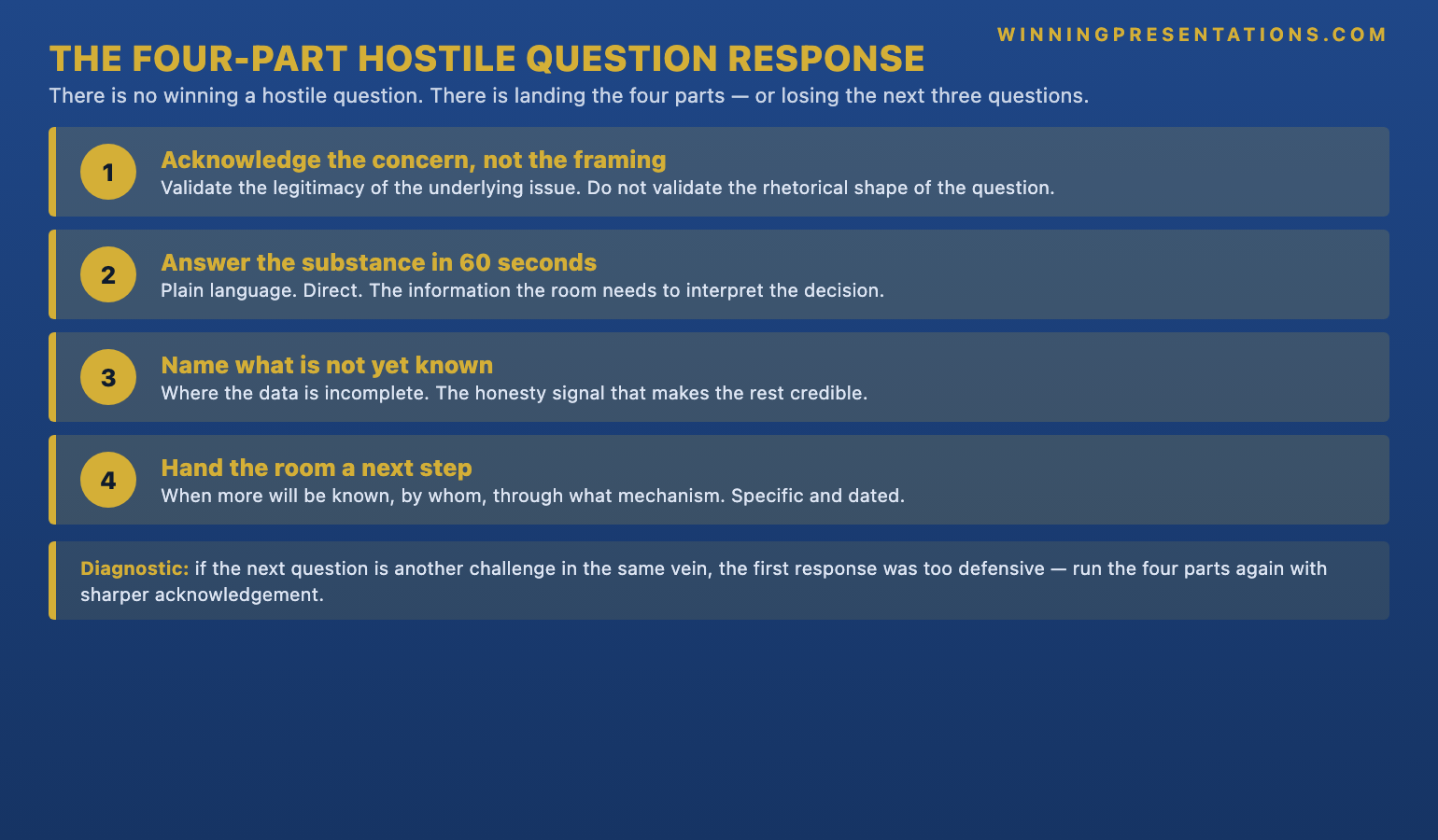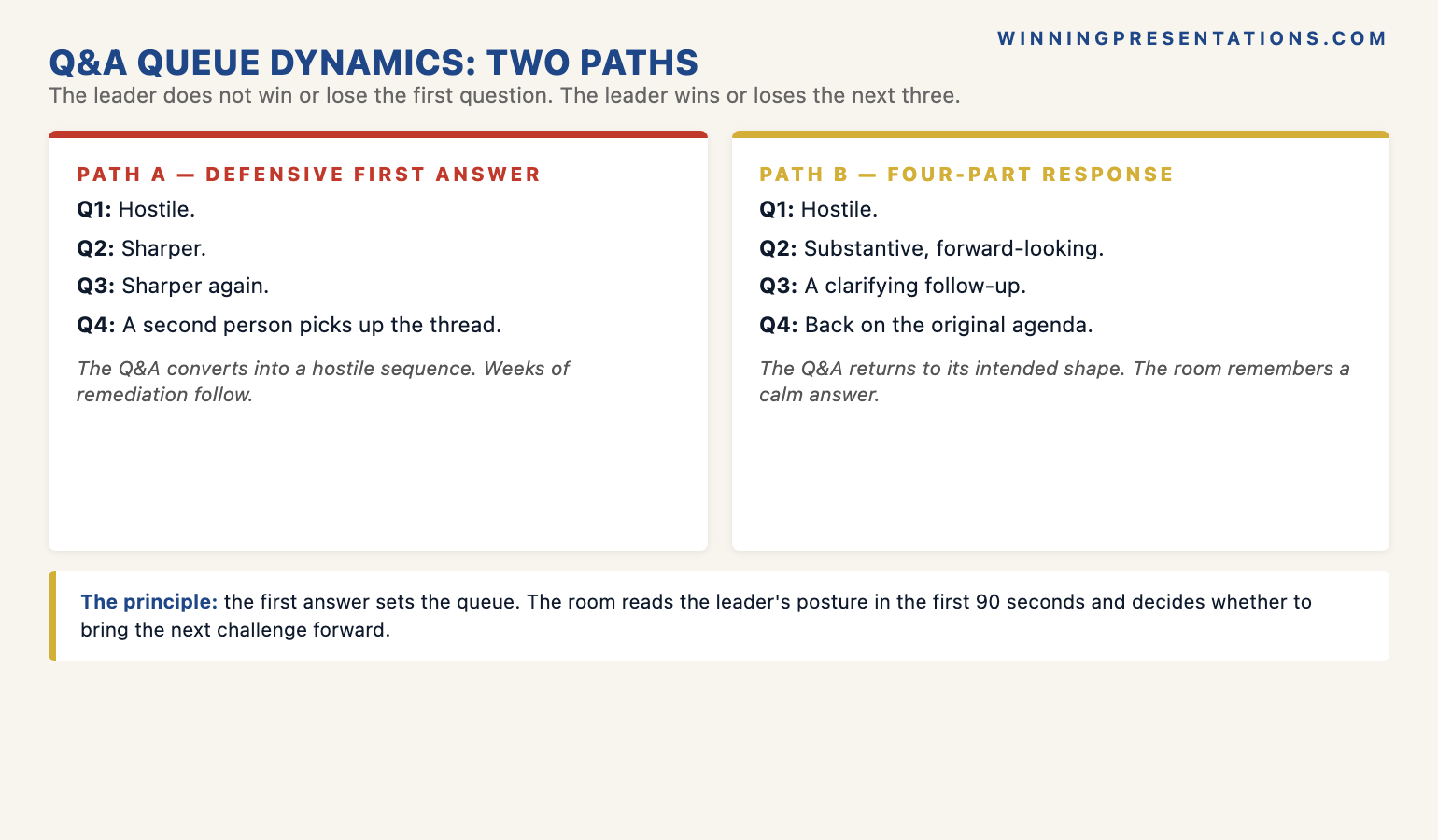
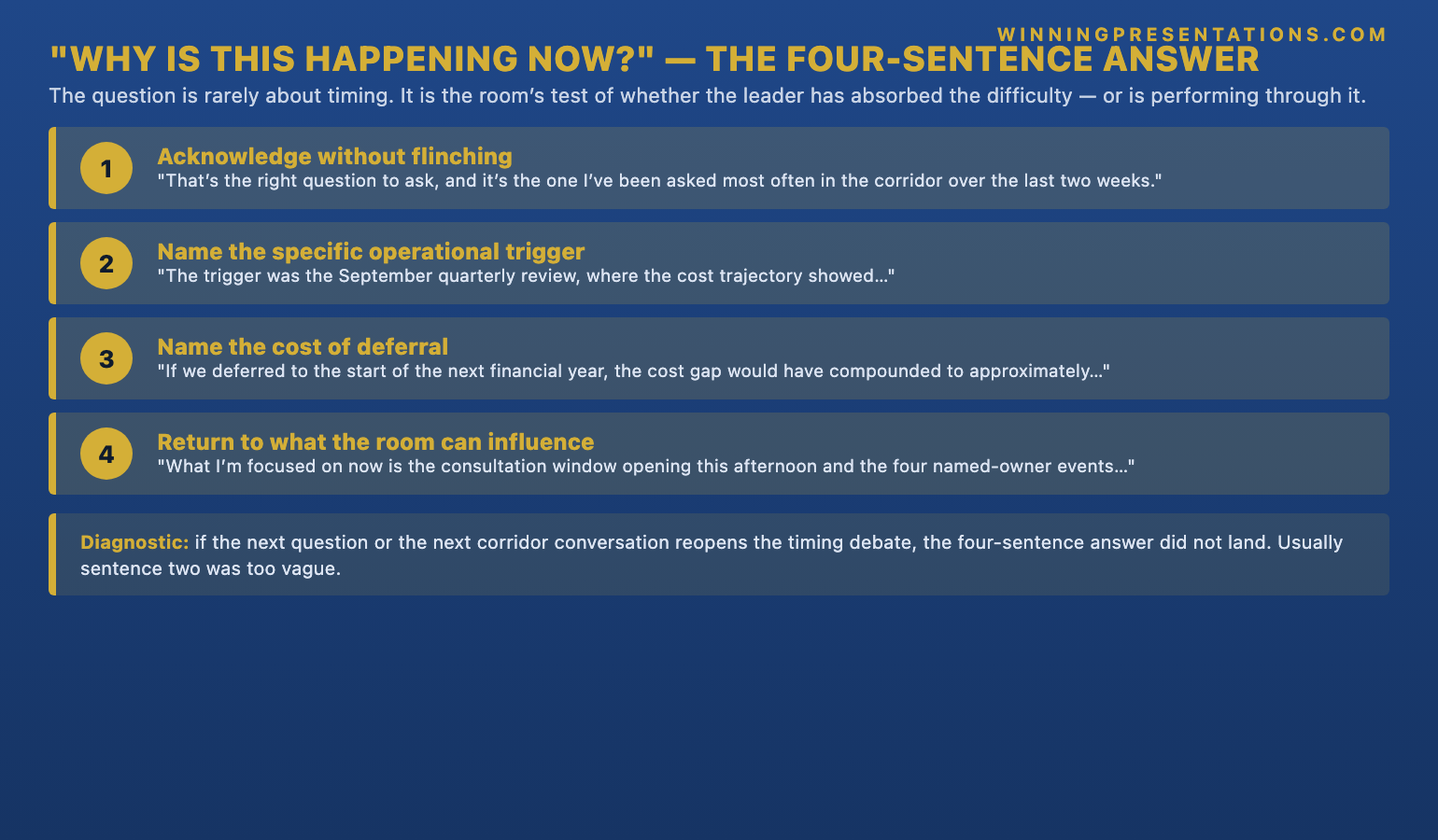
Quick answer: When the room asks “why is this happening now?” in a change announcement, the question is almost never about timing. It is the room’s test of whether the leader has absorbed the difficulty of the decision or is performing through it. The four-sentence answer senior leaders rehearse: (1) acknowledge the legitimacy of the question without flinching — “That’s the right question to ask, and it’s the one I’ve been asked most often in the corridor over the last two weeks”; (2) name the specific operational trigger that crystallised the timing — “The trigger was the September quarterly review, where the cost trajectory showed…”; (3) name what would have happened if the timing had been deferred — “If we deferred to the start of the next financial year, the cost gap would have compounded by approximately…”; (4) return the focus to the consultation period the room can influence — “What I’m focused on now is the consultation window opening this afternoon and the four named-owner events between now and the next review.” Four sentences, said in the same calm voice as the announcement. The answer closes the “why now” question cleanly and prevents the corridor speculation that defensive answers reliably trigger.
JUMP TO:
- What the question is actually asking
- Sentence one: acknowledge without flinching
- Sentence two: name the specific operational trigger
- Sentence three: name the cost of deferral
- Sentence four: return to what the room can influence
- The defensive answers that trigger corridor collapse
- Variants: when the timing is genuinely externally driven
- Frequently asked questions
In autumn 2017, a divisional COO at one of the publicly-listed European industrial-services groups I was supporting walked into the all-hands announcement of a consolidation programme she had been preparing for ten weeks. The room held about 230 people in the converted training centre at the back of the company’s northern headquarters, with another 280 on the company’s video bridge from the continental sites. The substantive announcement landed cleanly — the consolidation logic was sound, the implication by function was specific, the personal commitment for the consultation period was named and dated. About fourteen minutes into the Q&A, a long-tenured operations director in the back of the room raised his hand and asked, in the conversational tone the room had been operating in: “Why is this happening now?” The COO paused, took a small breath, and gave the answer she had not prepared for. “That’s a fair question. The executive committee has been looking at this for some time, and we felt that with the current environment, the timing was right to act now rather than wait. I think you’ll find that the consolidation will deliver the benefits we’re looking for if we all work together to make it happen.” The answer took 22 seconds. The room registered it within five. The operations director nodded politely, did not follow up, and the Q&A moved on. Three days later, the consultation feedback that began filtering up from the affected functions showed a pattern: the “why now” question was the question every team huddle the day after the announcement had spent half its time on, and the COO’s answer was the answer nobody could repeat back to their team because it had said nothing specific enough to translate. The consultation period inherited two weeks of speculation that the COO had to spend personal time in one-to-one conversations to neutralise.
(This article was created with AI assistance; all stories and insights are based on 35 years of real client work.)
This piece walks through the four-sentence answer senior leaders rehearse for the “why is this happening now?” question in change announcements, why each of the four sentences has to be there, the defensive answers that trigger corridor collapse instead of closing the question, and the variants for the cases where the timing is genuinely driven by an external factor rather than an internal trigger. The four-sentence answer is structural, not motivational. It does not require the leader to have invented a new defence of the timing; it requires them to have done the preparation work to name what the room is actually asking and to answer that question rather than the one whose words the room used.
Before the next change announcement Q&A, a one-page structural check is worth a look.
The Executive Presentation Checklist walks through the questions senior leaders need to have rehearsed answers for before any change announcement — the “why now” question, the “who decided” question, the “what does this mean for me” question, and the “what happens if it doesn’t work” question. Free download, no email gate.
What the “why now” question is actually asking
The “why is this happening now?” question, in the context of a change announcement, is almost never a question about timing. The asker rarely cares about the specific calendar date, the financial quarter, or the project-management logic that determined when the announcement was scheduled. What the asker is doing — usually unconsciously — is running a fast test on the leader to see whether the leader has absorbed the difficulty of the decision themselves or whether the leader is presenting a smooth surface over an institutional position they have not fully internalised. The asker is listening for whether the answer comes with the specificity of someone who has lived inside the decision-making, or with the smoothness of someone who has been briefed on it. The room reads the difference within the first sentence of the answer, and the leader who fails the test on the first sentence cannot recover with the second, third, or fourth.
The reason this particular question carries the test so reliably is that “why now” is the question that most cleanly separates leaders who personally shaped the decision from leaders who inherited it without the operational context. A leader who shaped the decision can name the specific operational trigger that crystallised the timing, the specific projection that made deferral worse than action, the specific conversations in the executive committee where the timing was debated. A leader who was briefed on the decision typically cannot — they were given the decision as an output, not as a process they participated in, and the “why now” question exposes the difference. The fix is not to fake the operational context; the fix is to do the preparation work, in the days before the announcement, to learn enough of the operational specificity that the four-sentence answer can be delivered with the same calm specificity as the announcement itself.
The other thing the question is testing is whether the leader will treat the asker with respect or with deflection. A leader who reads the question as a challenge to be handled rhetorically will produce a defensive answer; a leader who reads the question as a legitimate operational question deserving a substantive answer will produce the four-sentence response. The room reads the leader’s reading of the question within the first half-second of the response, before any words have been said, in the leader’s body language and the small pause before they speak. The leader who takes a calm breath, makes eye contact with the asker, and begins with acknowledgement is signalling the legitimate-question reading. The leader who shifts their weight, glances sideways at a colleague, or starts with “Well…” is signalling the rhetorical-challenge reading. The body language is the meta-answer that frames the answer that follows.
Sentence one: acknowledge without flinching
Sentence one acknowledges the legitimacy of the question without flinching from it. “That’s the right question to ask, and it’s the one I’ve been asked most often in the corridor over the last two weeks.” Or: “That’s the question I expected to come up first today, and it’s a fair one to start with.” Or: “That’s the question the executive committee debated for the longest in the discussions that led to this decision, so let me answer it the way we answered it inside the committee.” The sentence has two structural jobs: it signals to the asker that the leader has heard the question and treats it as legitimate, and it signals to the rest of the room that the leader is not going to deflect. Both signals matter equally. The asker is unlikely to push back if the acknowledgement is honest; the rest of the room is unlikely to start its own private speculation if the acknowledgement is genuine.
The discipline of sentence one is the absence of hedging language. “That’s a fair question” is fine. “I think that’s a fair question” introduces a hedge that the room reads as the leader buying time. “Well, that’s certainly something worth discussing” is hedging compounded by deferral. “I’m glad you asked that” is acknowledgement with the wrong content — it signals the leader is performing the answer rather than delivering it. The sentence works when it acknowledges without performing and without hedging, and when the leader delivers it in the same calm voice as the rest of the announcement. The voice consistency is what signals the leader is treating the question as a normal operational question rather than as a hostile one, and the room mirrors the leader’s reading.
The second discipline of sentence one is brevity. The acknowledgement is one short sentence, not a paragraph. Leaders who extend the acknowledgement into a longer reflection on why the question is important typically do so because they are using the extension to think about the substantive answer they have not yet prepared. The room can tell. The fix is to have the substantive answer prepared in sentences two through four, so that sentence one can do its acknowledgement job cleanly and the substance can land immediately afterwards. The leader who has done the preparation work delivers sentence one in about three seconds, pauses for half a beat, and moves into sentence two without losing the room. The leader who has not done the preparation work delivers sentence one in fifteen seconds and the room registers the difference.
Sentence two: name the specific operational trigger
Sentence two names the specific operational trigger that crystallised the timing. “The trigger was the September quarterly review, where the cost trajectory for the regional operations function showed a 3.2 percent gap to budget that the executive committee judged would compound to approximately 8 percent by the end of the financial year if the operating model was not changed.” Or: “The trigger was the customer-onboarding readiness review in late August, where the engineering team flagged that the product-launch sequence we had committed to in March was not going to be deliverable without a structural change to the team’s focus.” Or: “The trigger was the year-end audit recommendations published in July, which identified a structural risk in the way the regional teams were running parallel versions of the same five processes.” The sentence names a specific date, a specific operational forum, a specific finding, and the executive committee’s reading of what the finding meant. The room reads the specificity as evidence that the leader was inside the decision-making rather than briefed on it afterwards.
The discipline of sentence two is that every element of the sentence has to be true and operationally sourceable. Inventing a specific operational trigger that did not actually crystallise the timing is the single fastest way to lose the room’s trust permanently. The asker may well know the actual trigger, the long-tenured operations directors in the room almost certainly do, and the chief of staff in the back of the room definitely does. The leader who invents a trigger that did not happen, or attributes the timing to a forum that did not actually take that decision, will be caught within 48 hours by the operating sponsors who were in the original conversations. The fix is to do the preparation work in advance: ask the executive-committee chair or the chief of staff what the actual operational trigger was, write it down accurately, and rehearse the sentence with the real detail. The real detail is almost always more compelling than an invented one, because the real detail carries the specificity of an actual conversation that actually happened.
The other discipline of sentence two is that the specificity has to be calibrated to what the room is allowed to hear. Some operational triggers involve confidential commercial information, individual personnel matters, or board-level discussions that cannot be disclosed in an all-hands forum. The leader who cannot name the specific trigger fully needs to name as much of it as can be named honestly, and explicitly signal where the disclosure stops. “The trigger was a confidential commercial review in late August that surfaced a structural risk to the operating margin; the executive committee judged that the risk required action by the end of this quarter, and I’m not in a position to disclose the commercial detail in this forum, but the operations directors in the room have been briefed individually on the specifics.” The honest acknowledgement of where the disclosure stops is read by the room as integrity, not as evasion, because the leader is naming the constraint explicitly rather than hiding behind it. The version the room reads as evasion is the version where the leader pretends there is no specific trigger, or attributes the timing to vague “market conditions” that anyone in the room could have invented for themselves. The change management presentation that aligns senior stakeholders before announcement day covers the upstream version of the same disclosure-calibration work.
Sentence three: name the cost of deferral
Sentence three names what would have happened if the timing had been deferred. “If we deferred to the start of the next financial year, the projected cost gap would have compounded from 3.2 percent to approximately 8 percent, and the consultation window would have collided with the year-end planning cycle, which would have made the change harder to land cleanly with the affected teams.” Or: “If we deferred to the next quarterly cycle, the product-launch sequence would have slipped by another quarter, which would have triggered the commercial commitments to clients we made in March, and the cost of breaking those commitments would have been significantly higher than the cost of restructuring the team now.” Or: “If we deferred this decision past the year-end audit cycle, the regulatory implications of the structural risk the audit identified would have moved from an internal management matter into a formal regulatory submission, which would have constrained our options for handling the change with the affected teams.” The sentence answers the unspoken second question every “why now” question carries: “Why not later, then?” The room reads the answer to the second question as evidence that the leader has thought about the timing as a real choice with real alternatives rather than as a date the executive committee picked at random.
The discipline of sentence three is the specificity of the counterfactual. “If we deferred this, things would have been worse” is not sentence three; it is the version of sentence three that confirms the asker’s suspicion that the leader has not thought about the deferral option seriously. The specific version — the 3.2 percent compounding to 8 percent, the launch-sequence slipping by another quarter, the regulatory submission becoming formal — signals that the deferral was considered as a real option, evaluated against specific projections, and ruled out for specific reasons. The room respects the leader who treats the deferral option seriously enough to name what it would have cost. The room reads the genericness of an unspecific counterfactual as evidence that the deferral was not seriously considered, which is precisely the doubt the “why now” question is testing.
The other discipline of sentence three is honest acknowledgement of the trade-offs the timing chose. Most timing decisions in change announcements involve real trade-offs — doing it now hurts in certain ways that doing it later would not have hurt, and vice versa. The leader who pretends the chosen timing was unambiguously the right call signals to the room that they have not done the work to weigh the trade-offs honestly. The leader who acknowledges the trade-offs while explaining why the chosen timing was the better balance signals the opposite. “Doing it now does land the consultation period during the busy commercial season, which is a real cost we considered; the alternative was to defer to a quieter period and let the cost gap compound, which we judged would damage the operating capacity we need for next year’s commercial cycle.” The acknowledgement of the trade-off is the structural artefact that makes the rest of the answer credible. The restructuring board briefing that gets the executive committee comfortable before the announcement uses the same trade-off discipline in the upstream approval meeting.
A change announcement holds the room through the Q&A because the four-sentence answer was rehearsed — not because the leader is naturally good under pressure.
The Executive Q&A Handling System is the structured framework senior leaders use to prepare the four-sentence answer to the “why now” question, the “who decided” question, the “what does this mean for me” question, and the other high-friction questions that surface in change announcement Q&As. The system covers the question-pattern library, the four-sentence structure, the acknowledgement language that closes questions cleanly, and the trade-off acknowledgement discipline that makes counterfactual answers credible. £39, instant download, lifetime access.
- Question-pattern library for the high-friction questions in change announcement Q&As — the “why now” question, the “who decided” question, the “what happens if it doesn’t work” question, and the question patterns specific to restructurings, reorganisations, and difficult institutional positions
- Four-sentence answer framework — the structural template for closing questions cleanly without triggering corridor speculation, with worked examples for each question pattern
- Acknowledgement language library — the specific sentence-one openings that signal legitimacy without hedging or performing
- Trade-off acknowledgement discipline — the structural move that makes counterfactual answers credible in front of senior operating audiences
- Designed for senior leaders, not for first-time presenters — built around the structural patterns of senior Q&A under pressure
- Instant download, lifetime access, lifetime updates — £39
Sentence four: return to what the room can influence
Sentence four returns the focus to the part of the change the room can influence. “What I’m focused on now is the consultation window opening this afternoon, the four named-owner events between now and the next review, and making sure every affected person gets a fair hearing and the right operational outcome.” Or: “What we’re focused on now is the implementation plan opening Monday, the function-by-function workshops the week after, and the post-implementation review at the start of next quarter.” Or: “What I’m focused on now is the redeployment process opening Monday, the personal one-to-ones I’ll be in this week with the affected leaders, and the consultation feedback session in this room on 12 April.” The sentence answers the unspoken third question every “why now” question carries: “Given that this is happening now, what comes next that I can engage with?” The room reads the return-to-action as the leader signalling that the question has been answered fully and the meeting is moving forward.
The discipline of sentence four is that the events named in it have to be events the asker can verify and engage with. Naming the consultation window opening this afternoon is verifiable because it opens this afternoon. Naming the four named-owner events between now and the next review is verifiable because the events are on the calendar and the owners are named. Naming the redeployment process opening Monday is verifiable because Monday is three days away. The room reads named-and-dated events as the leader committing operationally rather than rhetorically, which is what closes the “why now” question and prevents the corridor speculation. Naming aspirational activities — “we’ll be supporting everyone through the change”, “we’re focused on making this work for the team”, “we’ll be running a comprehensive engagement process” — reads as the rhetorical version of the same posture and reopens the corridor speculation rather than closing it.
The other discipline of sentence four is the “we” calibration. In some change announcements, the appropriate pronoun is first-person singular — “What I’m focused on now is…” — because the leader is the named owner of the consultation period. In others, the appropriate pronoun is first-person plural — “What we’re focused on now is…” — because the consultation period is being chaired by a named team with the leader as one member. The room reads the wrong pronoun choice as a small signal of either over-claiming or under-committing, both of which weaken sentence four. The fix is to know in advance which pronoun is appropriate for the specific announcement, and to use it consistently across sentence four and the slide-five thirty-day window of the original announcement. The pronoun consistency across the announcement and the Q&A answer is the structural artefact the room reads as evidence the leader has rehearsed the answer in the same voice as the announcement, which closes the question cleanly. The acquisition-integration board briefing structure covers the equivalent pronoun discipline in M&A integration announcements, where the “we” calibration is particularly load-bearing.
The defensive answers that trigger corridor collapse
The defensive answers that the four-sentence answer is specifically built to prevent fall into four recognisable patterns. The first is the deflection-to-process answer — “The executive committee has reached this decision after a thorough review” — which acknowledges the question rhetorically without naming any operational specificity. The room reads it within five seconds as a non-answer, and the corridor conversations the next morning fill the gap with private speculation about why the leader could not name the operational trigger. The second is the appeal-to-uncertainty answer — “In the current environment, with everything that’s happening externally, we felt the timing was right” — which substitutes vague external context for specific operational reasoning. The room reads this as the leader hiding behind macroeconomic vagueness rather than naming the specific internal trigger, and the corridor speculation focuses on what the leader was trying to obscure.
The third defensive pattern is the over-reassurance answer — “I want to assure everyone that we’ve thought about this very carefully, and we’re confident this is the right call at the right time” — which substitutes emotional reassurance for operational specificity. The room reads this as the leader trying to close down the question through tone rather than through substance, and the asker typically does not follow up because the social cost of pressing harder on a senior leader who has just expressed confidence is high. The non-follow-up is not agreement; it is the asker registering the answer as performative and reserving the question for the corridor conversation the next day. The fourth defensive pattern is the apologetic answer — “I know the timing is difficult, and I’m sorry for the disruption this is causing, but this is a decision we have to make” — which acknowledges the impact of the change without addressing the specific timing question, and which signals to the room that the leader is uncomfortable with the timing themselves. The apology, however well-intentioned, becomes the structural signal the corridor conversations latch onto, and the consultation period inherits the framing.
The four defensive patterns share one structural feature: they substitute one kind of content for the operational specificity the question is actually asking for. Process replaces specificity; macroeconomic vagueness replaces internal trigger; emotional reassurance replaces counterfactual reasoning; apology replaces honest trade-off acknowledgement. The fix in each case is the same: the four-sentence answer, prepared in the days before the announcement, rehearsed three times the night before, delivered in the same calm voice as the rest of the announcement. The leader who has done the preparation work does not fall into the defensive patterns under pressure because they have an alternative ready to deliver. The leader who has not done the preparation work falls into one of the four patterns nearly every time, because under the pressure of a senior operating audience asking a structurally difficult question, the brain reaches for the rhetorical move it has practised most often, and the four defensive patterns are the ones most senior leaders practise most often without realising they are practising them.
Variants: when the timing is genuinely externally driven
The four-sentence structure adapts when the timing is genuinely driven by an external factor rather than an internal operational trigger — a regulatory deadline, a market-collapse response, a parent-company decision, an acquisition close. The adaptation is in sentence two specifically. Instead of naming the internal operational trigger, sentence two names the external trigger honestly and specifically. “The trigger was the FCA consultation paper published in early September, which set a March 2027 implementation deadline for the regulatory changes that the consolidation enables us to comply with at scale.” Or: “The trigger was the parent-company strategic review concluded in August, which set a six-month timeline for the divisional realignment that this announcement is part of.” Or: “The trigger was the market-share data from the second quarter, which showed a structural decline in the segment the affected product line was serving, against the projections we made in the original investment case.” The room reads external triggers, named specifically, as easier to absorb than internal ones, because the external trigger removes the implicit question of whether the leader could have prevented the timing pressure.
Sentence three adapts in parallel. Instead of naming the cost of deferral against an internal projection, sentence three names the cost of missing the external deadline or response window. “If we deferred past the FCA implementation deadline, we would have been operating under non-compliant arrangements through the second quarter of 2027, with the regulatory consequences that carries.” Or: “If we deferred past the parent-company six-month timeline, the divisional realignment would have collided with the next group-wide strategic review, which would have constrained our ability to shape the divisional outcome.” Or: “If we deferred past the second-quarter market-share data, we would have entered the third quarter with the affected product line absorbing investment we could not justify against the structural decline.” The specificity of the external counterfactual is what makes sentence three credible; the version that says “we needed to act to stay competitive” reverts to the defensive patterns and triggers the corridor speculation rather than closing the question.
Sentences one and four do not adapt when the timing is externally driven; they work identically in both cases. The acknowledgement is the same legitimacy signal regardless of the trigger; the return-to-action is the same operational commitment regardless of why the action is happening now. The room reads the consistency of sentences one and four across internal-trigger and external-trigger answers as evidence that the leader has rehearsed the four-sentence structure rather than improvising under pressure, and the consistency itself is part of what makes the answer land cleanly in both cases. The leader who delivers sentence one with hedging in the externally-driven version but with confidence in the internally-driven version is signalling that they themselves are uncertain about the external trigger, and the room reads the uncertainty as the gap to push into in the corridor conversations the next day.
One thing to do before the next change announcement Q&A
Block thirty minutes, the afternoon before the announcement, with a piece of paper and no screen. Write the four-sentence answer to the “why is this happening now?” question, in the leader’s own voice, with the specific operational trigger named, the specific counterfactual named, and the specific named-owner events for the consultation period named. Say it aloud three times, in the same calm voice as the rest of the announcement. Walk into the Q&A with the answer rehearsed. When the question comes — and it will come, in nearly every change announcement Q&A — deliver the four sentences in about thirty-five seconds, take a small breath at the end, and let the moderator take the next question. The corridor conversations the next morning will be about the specific operational trigger and the named-owner events the answer surfaced, not about the speculation a defensive answer would have triggered. The consultation period inherits the difference, and the difference compounds across the next twelve weeks.
Frequently asked questions
Won’t the four-sentence answer feel rehearsed and therefore inauthentic to the room?
The four-sentence answer feels rehearsed only when it is delivered as a recitation rather than as a considered response. The fix is in the rehearsal discipline: rehearse the structure and the specific operational detail, not the exact wording. The leader who has rehearsed the structure and the specifics can deliver the answer in slightly different words on the day, with the natural pauses and emphasis of a person thinking the answer through rather than reciting it, while still hitting the four structural beats the room needs to hear. The version that sounds inauthentic is the version where the leader memorised the exact sentences word-for-word and delivers them in a slightly artificial cadence; the version that sounds genuine is the version where the leader knows the four beats and the specific operational detail and lets the wording form naturally on the day. The difference is in the rehearsal target. Rehearse the structure and the substance, not the exact wording.
What if the “why now” question doesn’t come up in the Q&A?
If the “why now” question does not come up in the Q&A, it almost certainly came up in the corridor walk in the next 48 hours, or in the team huddles the line managers ran the next morning, or in the one-to-ones the affected-function leaders held over the following week. The question rarely fails to appear; it sometimes fails to appear in the formal Q&A and appears instead in the informal forums afterwards, which is often worse than appearing in the Q&A because the leader is not in the informal forums to deliver the four-sentence answer. The fix is to deliver the four-sentence answer in the corridor walk in the first 48 hours after the announcement, to the long-tenured operations director the leader makes informal contact with, even if the “why now” question was not explicitly asked. The same answer that would have closed the question in the Q&A will close the question in the corridor conversation, and the operations director will carry the answer back into the function over the following week.
Does this work for a 50-person team meeting versus a 500-person all-hands?
The four-sentence structure does not change with audience size; the level of operational detail in sentence two and the specificity of the named-owner events in sentence four do. In a 50-person team meeting, sentence two can name the specific operational trigger at the level of the team’s own work, and sentence four can name events at the named-individual level — “the one-to-ones I’m holding with each of you this week, and the team session on Thursday”. In a 500-person all-hands, sentence two operates at the divisional or programme level, and sentence four names events at the workstream or function level with named senior owners. The principle is the same in both cases: the room reads specificity as the leader having absorbed the decision and reads genericness as evasion. The calibration of the specificity to what the room can hold is what determines whether the answer lands cleanly.
What if I am asked a follow-up question that pushes harder on the timing?
If the asker presses harder on the timing — “But why couldn’t this have been done six months earlier?”, “Why didn’t the September quarterly review trigger the action then, rather than now?”, “What about the trade-offs you didn’t mention?” — the structure of the follow-up answer is the same four sentences, applied to the specific framing of the follow-up. Acknowledge the legitimacy of the follow-up (“That’s the right follow-up question, and it’s one we debated inside the committee”), name the specific reason the earlier or alternative timing was considered and ruled out (“We did consider acting on the June review, and at that point the operating-model paper was not yet complete enough to land the change cleanly”), name the cost of that alternative (“If we had acted in June with the operating model only half-complete, the consultation period would have been confused about what was actually being decided, which is a worse outcome than the cost of waiting”), and return to action (“What I’m focused on now is making sure the consultation period gives every affected person a fair hearing”). The four-sentence structure works recursively. The leader who has rehearsed the first answer can usually deliver the follow-up answer in the same structural shape without additional preparation.
Won’t the operating sponsors in the room think the four-sentence answer is too structured to be honest?
The opposite reaction is the consistent one. Operating sponsors — the chiefs of staff, the long-serving operations directors, the senior HR business partners — have sat through more change announcement Q&As than the leader has, and they read a defensive or wandering answer as a sign that the leader has not done the preparation work for the most predictable question of the meeting. A structured four-sentence answer, delivered in the same calm voice as the announcement, reads to those sponsors as evidence the leader has done the work to anticipate the question and prepare an honest answer. The pencil note in the back of the room — the small annotation the chief of staff makes during the Q&A — tends to be positive when the “why now” question gets the four-sentence answer. The format earns the operating sponsors’ tacit endorsement for the rest of the Q&A, which is the endorsement that carries the consultation period that follows.
The Winning Edge — weekly newsletter
The Winning Edge is a weekly (Thursday) newsletter for senior professionals who present at the executive level. One short email a week, focused on the structural moves that separate change announcement Q&As the room remembers as honest from Q&As that trigger the corridor speculation a defensive answer reliably produces. Subscribe to The Winning Edge →
For the broader picture across slides, storytelling, confidence, and delivery, the seven-product Complete Presenter library covers the full set of structural disciplines — £99 for everything, lifetime access.
About the author
Mary Beth Hazeldine is Owner & Managing Director of Winning Presentations Ltd. With 24 years of corporate banking experience at JPMorgan Chase, PwC, Royal Bank of Scotland, and Commerzbank, she advises executives across financial services, healthcare, technology, and government on structuring presentations and handling Q&A for change announcements, restructurings, and difficult institutional positions.