

Quick Answer
Large-audience Q&A is fundamentally different from boardroom dialogue. When 50–500 people are watching, questions become performative, hostile questioners play to the crowd, and silence reads as weakness. The format that protects you involves curating questions in advance, sequencing them strategically, and controlling the narrative before anyone stands up to challenge you.
Feeling Exposed Before Your Next All-Hands?
You’ve prepared your slides. But you haven’t prepared for the executive from operations who’s been silent all week—the one about to ask a loaded question in front of 150 people.
The Executive Q&A Handling System walks you through the three-step framework that lets you predict 80% of questions before they’re asked—so you’re never ambushed again.
Get the Executive Q&A Handling System → £39
Built on 25 years of high-stakes Q&A — banking, consulting, and senior leadership.
Jump To
- The Boardroom Is Chess. The All-Hands Is a Stadium.
- Why Large-Audience Q&A Is So Different
- The Three Dangerous Dynamics You’re Up Against
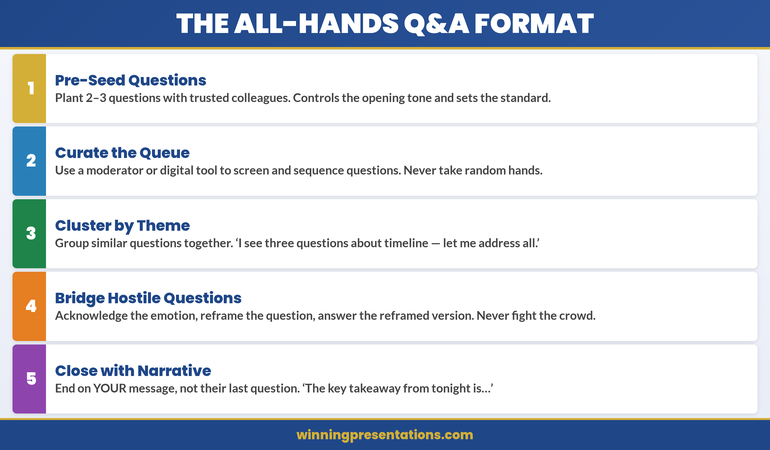
- Curating Questions Before They Become Weapons
- Sequencing Strategy: Order Determines Narrative
- Managing the Hostile Questioner in the Room
- The Recovery Protocol When It Goes Wrong
A senior executive froze for 47 seconds during a board presentation. But this wasn’t a board of eight—it was an all-hands of 200. The recovery technique she’d practised worked. But afterwards she said something that changed how we think about Q&A at scale:
“The boardroom is chess. The all-hands is a stadium. You need different rules.”
She was right. The techniques that work in a boardroom become liabilities in a stadium. This article is about the different rules.
The Boardroom Is Chess. The All-Hands Is a Stadium.
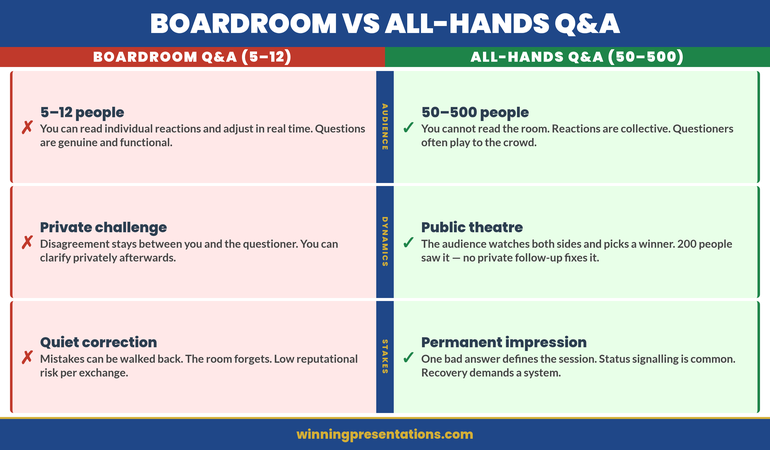
In a boardroom of eight, a question is a conversation. The questioner is looking for information. You can push back, ask for clarification, admit uncertainty. The conversation stays private, stays at the table, shapes only the opinions of those eight people.
In an all-hands of 200, a question is a performance. The questioner isn’t primarily asking you—they’re communicating to the 199 other people in the room. They’re establishing credibility, testing your resolve, signalling to their peers. And silence, hesitation, or an answer that doesn’t land reads to the entire room as weakness.
This is why boardroom Q&A strategy fails catastrophically at scale. You can’t engage in real-time dialogue with 200 people. You can’t afford genuine pauses. You can’t admit uncertainty without 199 people watching your stock price drop.
The all-hands requires a completely different architecture: one built on curation, sequence, and narrative control.
Why Large-Audience Q&A Is So Different
Four psychological forces change how Q&A functions at scale.
Performative Dynamics — The questioner is performing for their peers, not seeking information from you. A hostile question in a boardroom is a challenge. A hostile question in an all-hands is a bid for status. The audience becomes part of the conversation whether you acknowledge it or not.
Audience Inference — 200 people will interpret your answer not in isolation but against a narrative being written live. If you answer one question confidently and hesitate on the next, the hesitation is read as exposure. If you answer the same type of question differently when posed by different people, that inconsistency echoes through the room.
The Silence Problem — In a smaller room, a thoughtful pause signals reflection. In a stadium, a pause is dead air. It’s anxiety. It’s been-caught. Even three seconds of silence before an answer can shift the room’s perception from “she’s thinking” to “she doesn’t know.”
The Contagion Effect — One strong question can trigger others. If someone asks a loaded question and the room responds (even non-verbally—a nod, a shift forward), other questioners become emboldened. What begins as one hostile line can cascade into a perceived ambush within 60 seconds.
Understanding these forces is the first step to protecting yourself against them.
The Framework That Stops Ambush Before It Starts
You can’t prevent someone from raising their hand. But you can prevent ambush. The executive Q&A system teaches you the exact three-step framework that lets you predict the difficult questions before they’re asked—so when they come, you’re already composed, already prepared, and already ahead of the room.
- Identify the hidden agendas—what questions are really being asked beneath the surface
- Map the question vectors—who will ask, from which angle, and why
- Build your pre-composed, flexible responses that work across variations
Get the Executive Q&A Handling System → £39
The framework that lets you walk into Q&A with 80% of the questions already mapped.
The Three Dangerous Dynamics You’re Up Against
Before you design a Q&A strategy, you need to understand what you’re actually defending against.
1. The Ambush Through Sequence
A hostile questioner will often wait until later in the Q&A, after you’ve built confidence and credibility, to drop a loaded question. By then, you’re thinking faster, checking less of your internal logic, more likely to contradict something you said earlier. The sequence of questions matters far more than the individual questions themselves. If hostile questions arrive early, you’re locked into caution for the entire session. If they arrive late, they can unpick everything you’ve already built.
2. The Echo and Amplification
One person asks a critical question. Someone else nods. A third person leans forward. Within 30 seconds, the room has decided this is a serious issue, whether or not it actually is. This is the contagion effect at work. A single poorly answered question doesn’t just affect that one interaction—it becomes the permission structure for the next questioner to press harder.
3. The Trap Through Specificity
An experienced hostile questioner will ask for specific data you don’t have in your head at that moment—revenue from a specific customer, headcount in a specific region, a specific decision date that hasn’t been finalised. They’re not asking because they don’t know the answer. They’re asking to force you to either admit you don’t know (weakness in front of 200 people) or guess (and potentially say something contradicted by documents the room has already seen).
Understanding these dynamics lets you build defences before the Q&A even begins.
Curating Questions Before They Become Weapons
The most sophisticated executives don’t leave Q&A to chance. They curate it.
This doesn’t mean scripting the room or planting friendly questions. It means actively managing which questions surface and when. In a large all-hands, you have several legitimate levers:
The Pre-Submission Window — Many large all-hands now invite questions via email or Slack in advance of the session. This gives you 24–48 hours to think through the difficult questions before you’re on stage. You can also use this to shape the types of questions that will be asked: if you explicitly invite “strategic challenges and alternative perspectives,” you set the frame differently than if you say “we welcome all questions.”
The Moderator’s Discretion — If there’s a moderator or chair (often there is, in all-hands at companies over 100 people), the moderator has genuine discretion about question order. You can brief your moderator in advance: “If anyone asks about the acquisition timeline, I’d prefer that comes later in the session when I’ve had time to establish context.” This is legitimate curation, not suppression.
The Format Choice — A written Q&A (submitted via chat) gives you seconds to read each question before it’s asked. A live hand-raising Q&A gives you no warning. A hybrid format—written questions with live follow-ups—gives you the advantages of both. If you have any control over format, this is where it starts.
The Pre-Briefing of Allies — You don’t need to plant questions. But you can ensure that people who are informed and genuinely supportive of your strategy are ready to ask clarifying questions if needed. A well-placed question from someone respected in the room—not a softball, but a genuine question your ally already knows the answer to—can shift narrative momentum at a critical moment.
Curation is not manipulation. It’s architecture. You’re building a structure where truth can surface more effectively.
Ready to walk into your next all-hands knowing 80% of the questions before they’re asked?
Sequencing Strategy: Order Determines Narrative
If curation is about which questions surface, sequencing is about when they surface. This is where most executives lose control.
A hostile questioner wants to ask their loaded question when you’re off balance. An unprepared executive let’s questions come in whatever order they naturally arise. An experienced executive controls the sequence.
The architecture looks like this:
Open with Softballs, Establish Credibility — The first two to three questions should be ones you’re ready for, that you can answer with absolute clarity and confidence. This isn’t dodging. These questions genuinely exist. But you’re choosing to answer them first. The room watches you nail the opening questions. Your body language settles. Your pacing stabilises. By question three, you’ve established that you know what you’re talking about.
Sequence Difficulty in a Staircase, Not a Cliff — If the first three questions are softball and the fourth is “Why did you fail to deliver the acquisition?” you’ve created a cliff. The room notices the shift. You appear less confident. Instead, gradually escalate: first straightforward strategic questions, then deeper strategic questions, then the hardest questions. A staircase climbed looks like progress. A cliff-jump looks like you’ve lost control.
Place Your Hardest Question Second-to-Last — Not last. If you answer your hardest question at the end, the session ends on ambiguity. Place it second-to-last, then deliberately choose an easier final question. You take the hit on the hard question, recover visibly on the final one, and the room leaves remembering your composure on the recovery, not your struggle with the hard one.
Never Let Questions Cluster by Theme — If three questions in a row are about revenue projections, you’re locked into one lane of conversation for three straight minutes. The room stops hearing your answers and starts hearing repetition. Vary the themes: a question about strategy, then culture, then operations, then long-term vision. Each theme-shift keeps the audience’s attention and prevents any single challenge from building momentum.
Sequencing isn’t about softballing the audience. It’s about intelligent narrative design. You’re the executor of that design.
Managing the Hostile Questioner in the Room
Sometimes curation and sequencing aren’t enough. Someone raises their hand with a genuinely hostile question. How do you handle that in front of 200 people?
The principle is this: never respond to the emotion in the question. Respond to the legitimate underlying concern.
A hostile question often contains two layers: the surface aggression and the real question underneath. An example:
Hostile surface: “How can you claim we’re on track when the data clearly shows we’ve missed the last three milestones?”
Real question: Am I right to be concerned about execution?
If you respond to the hostility (“I think we’ve been very clear about this” or “The data actually shows…”), you’re now in an argument with one person in front of 199 others. Instead, acknowledge the concern and reframe the narrative:
“You’re asking whether we’re actually on track—whether the gap between plan and reality is something we’re managing or something that’s managing us. That’s the right question. Here’s what’s happened: we’ve missed three milestones, and we’ve recovered on two of them. Here’s the third one and our plan to close it.”
You’ve stripped away the hostility, validated the underlying concern, and answered the real question. The room watches someone raise a challenge, watch you take it seriously, and watch you respond not with defensiveness but with clarity. That’s not weakness. That’s leadership.
The five-step protocol for hostile questions:
- Pause for one full breath (not three seconds—one breath). Longer pauses read as defeat in a stadium. One breath reads as composure.
- Thank the questioner for raising a legitimate concern (and make clear it is legitimate, even if the delivery was hostile).
- Rephrase the real question underneath the aggression in neutral language.
- Answer the real question with data, context, or clear reasoning.
- Invite follow-up in a way that signals you’re not threatened—”Does that address your concern?” or “What’s the specific data point that would help here?”
This protocol works because it moves the frame from “executive vs. hostile questioner” to “executive and audience, jointly looking for truth.” That’s a frame you always win in.
Predict 80% of Questions Before They’re Asked
The system that lets you walk into high-stakes Q&A with absolute confidence. Learn how to map question vectors, predict hostile challenges, and build responses that work across variations—so you’re never caught off guard.
Get the Executive Q&A Handling System → £39
Designed for funding rounds, board approvals, and company all-hands.
The Recovery Protocol When It Goes Wrong
Sometimes despite your preparation, despite curation and sequencing, you’ll stumble. You’ll give an answer that doesn’t land. You’ll be asked something you genuinely don’t know. You’ll get tangled in language. And 200 people will watch it happen.
The recovery is more important than the stumble.
The protocol: acknowledge, clarify, commit, move forward.
Acknowledge: “I didn’t explain that clearly.” Or “That’s a good point and I didn’t address it well.” Or “I don’t have the specific data on that and I should.” Be explicit. The room already knows something didn’t work. Naming it directly proves you’re aware and in control.
Clarify: Give a shorter, clearer version of what you meant to say. Or, if you don’t have the answer, say so: “That’s the right question. I don’t have the headcount breakdown by region off the top of my head, but I’ll send it to you after this.” Specificity here matters enormously. “I don’t know” is worse than “I don’t have that data with me, but here’s who to ask and when you’ll get it.”
Commit: If you’ve committed to follow up (send data, circle back with an answer, investigate something), state it again. “So I’m committing to send you that breakdown within 24 hours.” The room needs to see that you’ve made a commitment and that you’re tracking it.
Move forward: Don’t dwell. Don’t over-apologise. Don’t loop back to the same question three turns later. The quickest way to make a stumble memorable is to keep referencing it. Instead, move to the next question with the same composure you started with.
The senior executive who froze for 47 seconds used this exact protocol. She said: “I lost my train of thought—apologies. Let me restart that answer.” She restarted. She nailed it. And after the all-hands, most people didn’t even remember the freeze. They remembered the recovery.
Three Questions About All-Hands Q&A You’re Probably Asking
Should you ever admit you don’t know the answer in front of 200 people?
Yes—but only if you commit to finding it. “I don’t know, and here’s who has the answer and when you’ll get it” is strength. “I don’t know” without the commit is weakness. The room isn’t judging whether you know everything. They’re judging whether you’re in control and competent. An honest “I don’t know” with a clear path to the answer proves competence. An evasive “we’re looking at that” proves the opposite.
What if someone asks a question that’s actually a political move against you?
It happens. Someone uses the all-hands to signal to their allies or to undermine you publicly. Don’t take the bait. Treat it as a legitimate question (even if it’s not), answer it with data and reason, and move on. Responding to the political subtext (“I know what you’re doing”) only amplifies it. Responding to the surface question denies them the conflict they’re after and proves your focus is on substance, not politics.
How do you handle a question you’ve specifically asked your moderator to avoid?
The moderator was supposed to keep it off the table, but it came anyway. Don’t blame the moderator or show frustration. You asked for curation, curation failed, now you adapt. This is exactly what composure looks like in real time. Answer the question you didn’t prepare to answer—and do it well enough that the room never knows you wanted to avoid it.
Want the three-step framework that lets you predict 80% of questions before they’re asked?
Master Large-Audience Q&A With Absolute Confidence
The difference between an executive who gets ambushed and one who doesn’t isn’t luck or natural talent. It’s preparation. The Executive Q&A Handling System teaches you the exact framework that lets you walk into any Q&A—board meeting, all-hands, investor presentation—knowing you’ve predicted the questions, prepared your responses, and designed a narrative that protects you.
- Predict difficult questions before they’re asked using the question-mapping system
- Build flexible, pre-composed responses that work across question variations
- Control the narrative through strategic curation and sequencing
- Recover with composure when things don’t go to plan
Get the Executive Q&A Handling System → £39
Built from 25 years inside boardrooms, all-hands, investor decks, and high-stakes Q&A.
People Also Ask: How do you handle hostile questions in front of a large audience?
Acknowledge the emotion behind the question without validating the hostility. Say “I can see this is important to you” or “That’s a fair concern.” Then reframe: restate the question in neutral terms that you can answer constructively. Answer the reframed version. The audience hears you being respectful and substantive. The hostile questioner gets heard without controlling the narrative. Never argue with someone in front of 200 people — the crowd always sides with the person who stays composed.
People Also Ask: Should I use a moderator for all-hands Q&A?
Yes, whenever possible. A moderator serves three functions: they screen questions for relevance and tone, they sequence questions so hostile or emotional ones don’t cluster together, and they give you a natural pause between questions (which your nervous system needs). Even an informal moderator — “Sarah will be collecting questions” — changes the dynamic. You’re no longer fielding random hands from a crowd. You’re responding to a curated, sequenced list.
People Also Ask: What if nobody asks questions at an all-hands meeting?
Silence after “Any questions?” in a room of 200 people is common and not necessarily a bad sign. Large audiences are reluctant to be the first person to speak. Pre-seed two or three questions with trusted colleagues. After those are asked and answered, the room usually opens up. If it doesn’t, close with your narrative: “The key thing I want you to take away from today is…” Silence isn’t failure. It’s often a sign that your presentation answered the questions before they were asked.
Is This Right For You?
The Executive Q&A Handling System is designed for executives and leaders who regularly face Q&A in high-stakes environments:
- You present to company all-hands of 50+ people regularly
- You’ve had the experience of being asked something hostile and wishing you’d been better prepared
- You know some questions are coming but you’re not quite sure how to respond
- You want to move from anxious about Q&A to completely composed
- You’re leading through change, restructure, or challenges and expect scrutiny
- You’re preparing for funding pitches or investor presentations
- You want to shift from “hoping it goes well” to “knowing exactly what will happen”
If most of these resonate, this system will change how you approach every Q&A you do from now on.
Frequently Asked Questions
How much time does the system take to learn?
The core framework takes about 30 minutes to understand. The real work—applying it to your specific upcoming Q&A—takes one to two hours. Most executives do this prep 24–48 hours before a big all-hands or presentation. You’re not adding complexity to your process; you’re structuring the prep you should be doing anyway.
What if I work in a culture where Q&A is very open and unstructured?
Curation and sequencing still apply. You can’t control which questions get asked, but you can brief your moderator on preferred sequencing, you can influence what gets submitted in advance, and you can absolutely apply the response protocols in this system. The system works whether your Q&A is hyper-structured or completely free-form.
Does this system teach me how to dodge difficult questions?
No. The opposite. This system teaches you how to answer difficult questions in a way that’s honest, clear, and maintains your credibility. Questions you can’t answer get an honest “I don’t know, here’s the path to the answer.” Questions you can answer but were worried about get a structured response that lands with confidence. The goal is never to dodge. The goal is to protect yourself while being truthful.
Can I use this before my all-hands next week?
Yes. You get access immediately. Many executives use this as a just-in-time prep tool: buy it Wednesday, use it to prepare for Thursday’s presentation. It’s designed to be actionable in hours, not weeks.
Stay Sharp: The Winning Edge Newsletter
Practical Q&A and presentation techniques delivered every week
Each week, The Winning Edge covers real situations: how to handle hostile questions in front of investors, how to recover when something goes wrong, how to read a room and adjust in real time. Subscribe and get patterns that work in the boardroom, the all-hands, and the high-stakes conversation.
Free resource: Download the Executive Presentation Checklist (PDF) — the pre-presentation validation that ensures nothing gets overlooked before you present.
About the Author
Mary Beth Hazeldine is the Owner & Managing Director of Winning Presentations. With 25 years of corporate banking experience, she has delivered high-stakes presentations in boardrooms across three continents.
A qualified clinical hypnotherapist and NLP practitioner, Mary Beth combines executive communication expertise with evidence-based techniques for managing presentation anxiety. She advises senior professionals across financial services, consulting, technology, and government on high-stakes Q&A.

