

- Why Most Executive Presentations Fail Before the First Slide
- The Five-Part Executive Presentation Outline
- The Context Statement: One Sentence That Changes Everything
- Building Your Evidence Structure Around the Decision
- Risk Framing: The Section Most Executives Leave Out
- Testing Your Outline Before You Build
- Frequently Asked Questions
Kwame had a reputation in his division for building decks fast. When colleagues had a board submission due Friday, they would glance over at his desk by Tuesday and see a nearly finished presentation sitting in PowerPoint, polished and structured. They assumed it was natural fluency — some innate ability with slides he had always possessed.
Then came the quarterly review that changed his thinking entirely. He had built the deck in his usual way — starting with the title slide and working forward, slide by slide. The content was solid. The data was accurate. But in the room, the CFO stopped him eleven slides in and asked, “Kwame, what are you actually asking us to decide today?” He didn’t have a clean answer. The meeting ended without resolution and he was asked to come back the following month.
That week, he stopped opening PowerPoint first. Instead, he drafted a five-line outline on paper before touching his laptop. Context. Recommendation. Three evidence points. Risk. Next steps. Every deck he built from that point started on a single sheet. His reputation for speed didn’t change — but the outcomes in the room did. Decisions started being made on the day, not deferred.
If your decks are taking too long to build — or landing without the clarity you intended — it’s rarely a slide design problem. It’s a structure problem. The Executive Slide System gives you the frameworks, outline templates, and AI prompt cards to plan and build high-stakes presentations with confidence.
Why Most Executive Presentations Fail Before the First Slide
The most common mistake in executive deck preparation is opening PowerPoint before you have clarity on structure. It feels productive — templates fill up, slides get labelled, transitions get applied. But without a deliberate outline in place first, you are essentially writing the second draft before completing the first one.
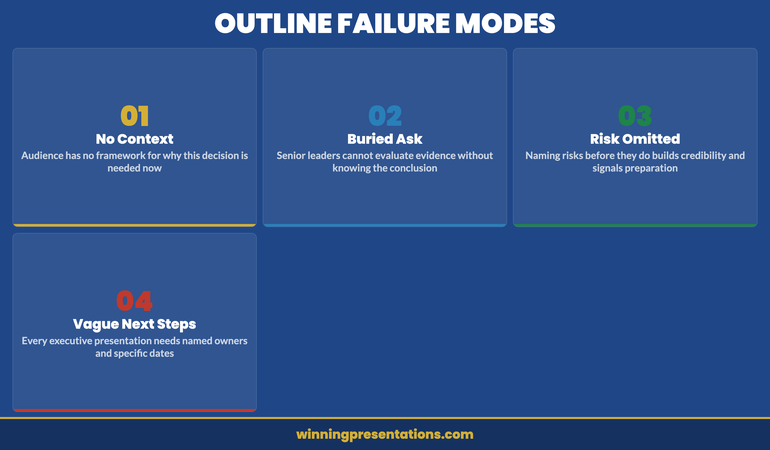
Senior decision-makers — board members, investors, C-suite stakeholders — evaluate presentations not just on content quality but on structural logic. They want to know, within the first two minutes, what you are asking them to consider and why it matters now. If your deck buries the recommendation in slide fifteen, you have already lost the room’s sharpest thinkers, who will have jumped ahead, formed their own conclusions, and stopped listening to your narrative.
Structure also protects you against scope creep. When you begin building slides without an outline, every interesting data point feels includable. Every supporting chart earns its place. Before long, a 10-slide board presentation becomes a 28-slide information dump. The outline is the editing tool — it forces you to decide what is load-bearing and what is background noise. For a deeper look at how to frame the beginning of any executive presentation, this guide on how to start a presentation covers the critical first moments in detail.
The five-part framework described in this article applies across presentation types: capital allocation requests, strategic updates, operational reviews, project sign-offs, and investor briefings. The components stay constant; only the content within them changes.
STOP REBUILDING DECKS FROM SCRATCH
Build executive slides that get past slide 3
The Executive Slide System gives you 26 templates, 93 AI prompts, and 16 scenario playbooks designed for senior presenters. Drop your content into a structure that already works — finance committees, board approvals, steering meetings, capital reviews. £39, instant access, lifetime updates.
Get the Executive Slide System →
£39, instant access. 26 templates, 93 AI prompts, 16 scenario playbooks. Designed for executive presenters.
The Five-Part Executive Presentation Outline
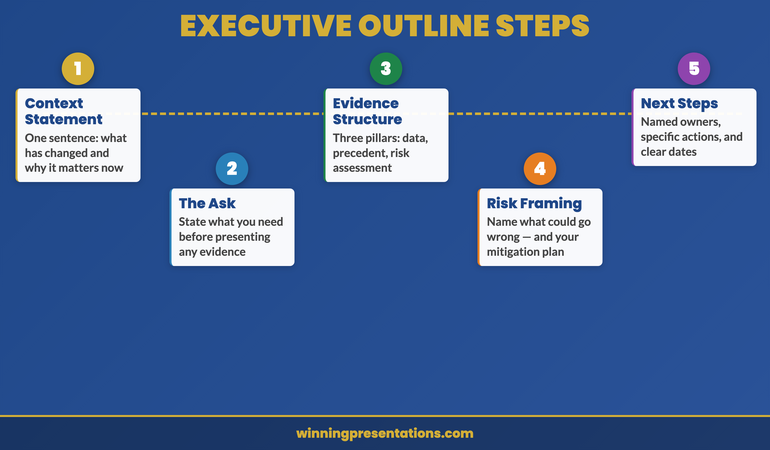
Every effective high-stakes deck shares the same underlying architecture, regardless of topic or audience. The five components below form the load-bearing structure. Remove any one of them and the deck becomes harder to follow, easier to challenge, and less likely to generate a decision on the day.
1. Context statement. One to three sentences establishing why this topic matters now. Not background — context. The context statement answers the question “Why are we having this conversation today?” It connects the presentation to a specific business condition, deadline, or strategic pressure.
2. Recommendation. A single, clearly stated ask or proposed course of action. This comes second — not at the end. Senior audiences do not need to be walked to a conclusion; they need to know where you are headed so they can evaluate your evidence against your recommendation as they listen.
3. Three-part evidence structure. Three distinct reasons, data points, or strategic rationales that support your recommendation. Not two, not seven. Three is the cognitive limit for retention under pressure, and it forces you to prioritise your strongest arguments rather than presenting everything you know.
4. Risk framing. An honest acknowledgement of what could go wrong, what you have considered, and how you propose to manage it. This section is frequently omitted. Its omission is what causes the sharpest person in the room to derail your presentation with a challenge you have not addressed.
5. Next steps. Specific, time-bound actions that follow a yes decision — or clarity on what happens if the decision is deferred. This closes the loop and transforms a presentation into a decision instrument rather than a status update.
The Context Statement: One Sentence That Changes Everything
Most presenters open with background. They explain the history of a project, recap previous decisions, or summarise the market landscape before getting to the point. This approach respects the audience’s knowledge less than it should. Board members and senior leaders do not need a history lesson — they need to know immediately why this presentation is happening today and what it requires from them.
A well-formed context statement is crisp and specific. Compare these two openings:
Weak: “As you will know, our operations in the northern region have been under review for the past eighteen months following the restructure in 2024. Today I want to take you through where we have landed.”
Strong: “The northern region restructure closes on 30 April. This presentation outlines the three decisions that need board approval before that date.”
The second version creates a decision frame immediately. It tells the audience what kind of meeting this is — a decision meeting, not a status update — and it makes the deadline explicit. Every executive in the room now knows what is expected of them before the second slide appears.
When writing your context statement during the outlining phase, ask yourself two questions: What is the specific business pressure creating urgency? And what kind of response do I need from this audience? Your answers should shape a single, declarative sentence that opens your deck. For context on how the executive summary slide fits into this structure, see this guide on the executive summary slide.
Building Your Evidence Structure Around the Decision
The evidence section is where most presentations either earn or lose their credibility. The instinct — particularly for analytically trained leaders — is to present all the data and let the audience draw their own conclusions. This approach hands control of the narrative to whoever in the room is most inclined to challenge you.
An effective evidence structure is built backwards from the recommendation. Start with what you are recommending, then ask: what are the three most compelling reasons a rational, sceptical senior executive should agree with this? Those three reasons become your evidence pillars. Each pillar should be expressible as a single, declarative sentence before you attach any data or analysis to it.
In practice, this means your outline for the evidence section looks like this before you open a single data file:
Evidence 1: The financial case — [one sentence stating the financial rationale]
Evidence 2: The strategic fit — [one sentence connecting to existing priorities]
Evidence 3: The timing imperative — [one sentence explaining why now and not later]
Each of these then becomes a section of your deck, with supporting data underneath. The discipline is in the ordering: you state the point first, then support it — not the other way around. This is the pyramid principle applied to outline architecture, and it is the difference between a deck that reads as a confident recommendation and one that reads as a hesitant data dump.
The Executive Slide System gives you pre-built outline frameworks for the executive presentations most likely to need structural clarity — including capital requests, strategic reviews, and board sign-offs where the evidence structure is the difference between a yes and a deferral.
Risk Framing: The Section Most Executives Leave Out
Omitting the risk section from your presentation outline is one of the most common — and most costly — errors in high-stakes communication. The instinct behind the omission is understandable: you are trying to build confidence in your recommendation, and explicitly surfacing risks feels counterproductive. But senior decision-makers operate differently. They are looking for evidence of judgement, not just advocacy.
A well-structured risk section demonstrates three things simultaneously: that you understand the complexity of the decision you are asking for; that you have done the work to anticipate objections; and that you are a trustworthy steward of the organisation’s resources. These three signals matter as much as the financial case.
In your outline, plan for two to three specific risks — not generic disclaimer language. Vague risk acknowledgements (“there are of course some uncertainties we will monitor”) read as evasion. Specific ones (“the primary execution risk is integration timeline, which we have addressed by bringing the programme manager’s start date forward by six weeks”) read as competence.
For each risk in your outline, draft three elements: the risk itself, your mitigation, and the residual exposure after mitigation. This three-part format prevents the risk section from feeling like a panic list. It shows that you have thought past identification to management. When a board member raises a risk you have already addressed, the credibility gain is significant. When they raise one you have not, your mitigation instinct has to work much harder.
If you are presenting to an audience that may be hostile to your recommendation, the risk framing section becomes even more important. See this article on presentation structure for hostile audiences for specific techniques when the room is divided.
Executive Slide System — £39, instant access
Stop Starting From Scratch. Build Faster With the Right Templates.
The Executive Slide System includes outline templates specifically structured for the moments where clarity matters most — board approvals, capital allocation, strategic pivots, and operational reviews. Each template is pre-loaded with the five-part framework so you start every deck in the right place.
Testing Your Outline Before You Build
The outline is a testable document — and testing it before opening PowerPoint is where the real time saving happens. A five-minute outline review at the planning stage is worth sixty minutes of deck revision at the delivery stage. There are three tests worth running on every outline before you commit to building.
The “so what” test. Read your recommendation aloud to someone outside your immediate team — a trusted colleague, a coach, a peer from another division. If their immediate response is “so what?” or “what are you asking me to do?”, your recommendation is not specific enough. A good recommendation names an action, an amount, and a timeline. “I am recommending we proceed” is not a recommendation. “I am recommending board approval of £2.4m for Phase 2, with a go-live target of Q3 2026” is.
The coverage test. Does your evidence section cover financial, strategic, and operational dimensions — or is it heavily weighted towards one category? A purely financial case is vulnerable to strategic objections. A purely strategic case is vulnerable to financial ones. The most resilient outlines have evidence that addresses multiple decision-making lenses so that different stakeholders in the room find their priorities served by at least one pillar.
The one-minute summary test. Can you summarise your entire outline — context, recommendation, three evidence points, primary risk, and next step — in under sixty seconds, out loud, without notes? This is not a presentation rehearsal. It is a clarity check. If you cannot summarise the outline in a minute, the deck will not land cleanly in thirty. Conduct this test before you build a single slide. The clarity you develop in this sixty-second exercise will shape every content decision that follows.
If your presentation is heading to a board or a senior governance committee, the testing phase also needs to include a stakeholder mapping review. Who in the room will champion the recommendation? Who will probe hardest? Where does the power to say yes actually sit? These political considerations belong in the outline phase — not discovered mid-delivery. For board-specific structural guidance, see this article on board agenda presentations.
The outline is not a planning formality. It is the most important document you will produce in the presentation process — and it is the one most leaders skip. The leaders who do not skip it are the ones whose decks consistently drive decisions rather than deferring them.
Need the outline templates rather than building from scratch? The Executive Slide System (£39, instant access) ships with the five-part outline pre-loaded across 26 slide templates, 93 AI prompt cards, and 16 scenario playbooks — including capital requests, board sign-offs, and strategic pivots.
Frequently Asked Questions
How long should an executive presentation outline be?
An effective executive presentation outline should fit on a single page — typically five to eight bullet points covering context, recommendation, three evidence pillars, risk, and next steps. It is a planning document, not a content document. If your outline runs to multiple pages before you have built any slides, you are writing the presentation twice. The outline exists to establish the logic and sequence of your argument; detailed supporting content belongs in the deck itself, not the planning document.
Should the recommendation come at the start or end of an executive presentation?
For executive audiences, the recommendation comes at the start — specifically, as the second element after your context statement. This is the direct opposite of the narrative build used in consumer or public-facing communication. Senior decision-makers are time-pressured, context-rich, and scepticism-prone. They evaluate your evidence more effectively when they know what they are being asked to approve. Burying the recommendation at slide fifteen signals that you are not confident in your ask, or that you are hoping to build enough momentum to make the recommendation impossible to refuse — both of which undermine trust.
How do you outline a presentation when you don’t know the outcome yet?
When the recommendation is genuinely uncertain — exploratory briefings, scenario planning sessions, or strategic option reviews — the five-part structure adapts rather than breaks. Replace the recommendation slot with a “decision frame”: a clear statement of what options you are asking the audience to consider and what criteria they should use to evaluate them. Your evidence section then presents the case for each option rather than a single path. The risk and next steps sections remain the same. This approach maintains the structural clarity of the framework while respecting the genuinely open nature of the decision.
Ready for the deeper buy-in framework?
The Executive Buy-In Presentation System
A self-paced programme on Maven covering the structure, psychology, and stakeholder analysis behind senior approvals. 7 modules with optional recorded Q&A sessions — no deadlines, no mandatory attendance. £499, lifetime access to materials.
Get more executive communication strategies every Thursday. The Winning Edge is a weekly newsletter for senior leaders who want sharper presentations, stronger boardroom presence, and clearer communication under pressure.
Free resource: The Executive Presentation Checklist — a one-page reference covering the key structural and delivery checks before any high-stakes presentation. Download it and use it before your next board or leadership team meeting.
About the Author
Mary Beth Hazeldine
With 25 years of corporate banking experience at JPMorgan Chase, PwC, Royal Bank of Scotland, and Commerzbank, Mary Beth Hazeldine has spent 16 years coaching senior leaders to communicate with the clarity and authority their roles demand. She works with executives who need to perform under pressure — in board rooms, investor meetings, and high-stakes leadership settings where the quality of the presentation determines the outcome.