

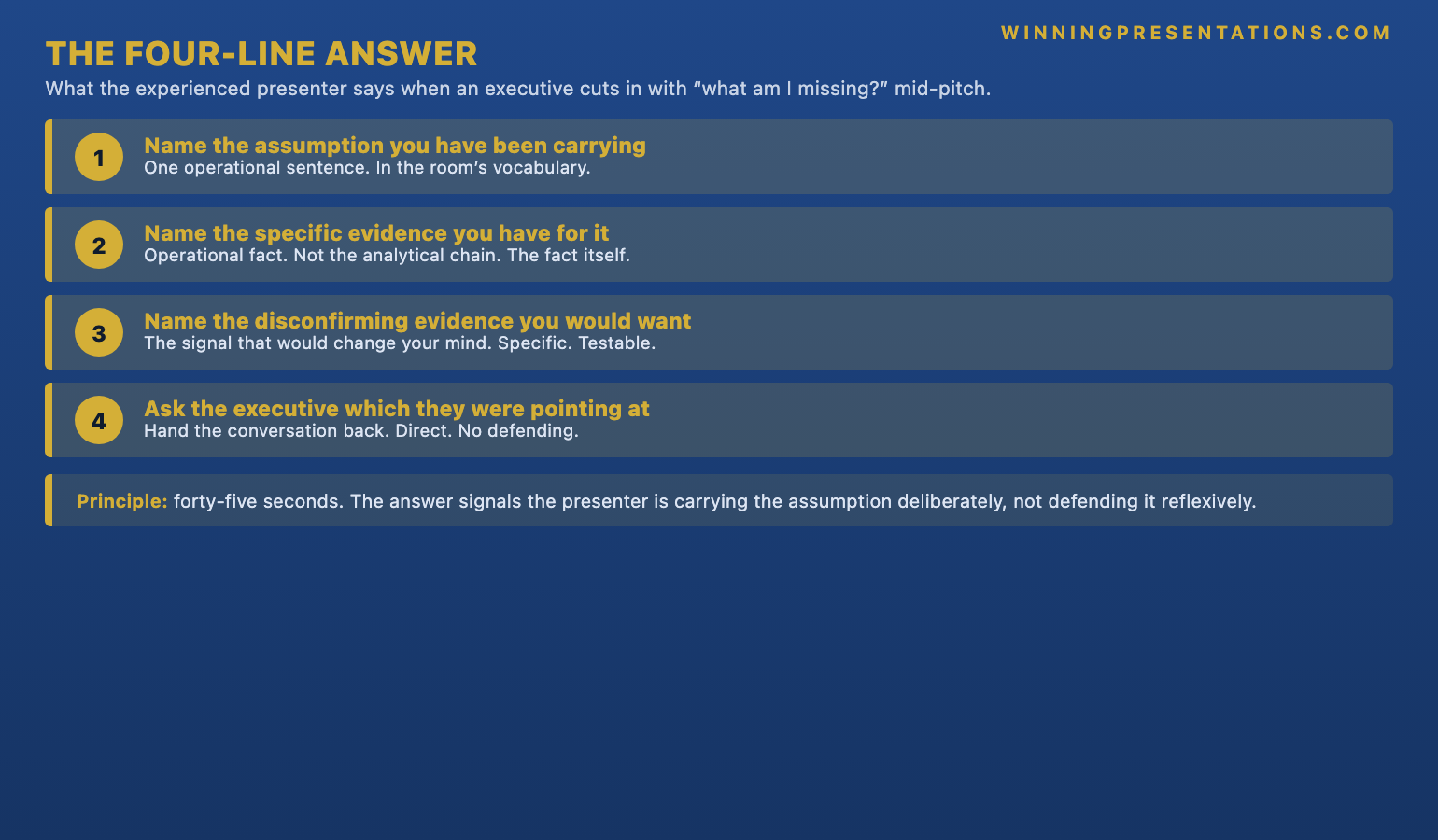
Quick answer: When a senior executive interrupts a pitch with “what am I missing?”, it is almost never a hostile move. It is an invitation to honest assessment, usually delivered by the most experienced person in the room at the moment they have spotted a gap the deck is not addressing. The four-line answer the senior presenters who handle this question well actually use: (1) name the assumption you have been carrying that the question is pointing at, in one sentence, before reframing or defending; (2) name the specific evidence you have for the assumption, in operational terms the room will recognise, not the deck’s language; (3) name the one piece of evidence you would want to see to feel more confident in it, signalling you have already thought about where the assumption could break; (4) ask the executive directly which of those three the question was pointing at, in one sentence, with no padding. Forty-five seconds. Delivered calmly, said while still standing, and answered before the room has decided whether the presenter is defensive. The presenter who follows the four-line answer earns the room. The presenter who answers with a five-minute defence loses it before slide eight.
JUMP TO:
- What the question actually signals
- Line one: name the assumption
- Line two: name the operational evidence
- Line three: name the disconfirming evidence
- Line four: ask which of the three
- The diagnostic test for a real answer
- The panic pattern: the five-minute defence
- One thing to do before your next pitch
- Frequently asked questions
In spring 2003, a director on the corporate-finance side of one of the City institutions I was working alongside sat in an investment-committee room on the fifth floor of an Edwardian office block off Lothbury, pitching a balance-sheet-restructuring mandate to the committee. The committee was eight people: the chair, two senior managing directors, a credit officer, the head of risk, the head of capital, and two non-executive observers who had been invited because the mandate touched the bank’s own funding position. The director was forty-one, eight years into his managing-director track, and had been preparing the pitch for three weeks with a team of four analysts. At minute seven of his twelve-minute slot, he was on slide nine of fourteen — the slide showing the proposed transaction structure with its three tranches, the indicative pricing, and the modelled return on capital. The chair of the committee, a sixty-two-year-old former clearing-bank treasurer who had run the funding desk through two recessions and had been on the committee for nine years, leaned back from the table, set his pen down on his pad, and said, in the level voice he used for everything: “What am I missing here?” Five words. The director froze for what felt like a long time and was probably about three seconds. He could feel the head of risk, two seats down from the chair, lift his head from his own pad and watch the moment. He opened his mouth, started to defend the pricing assumption on the second tranche, caught himself halfway through the first sentence, started again on the credit assumption, caught himself a second time, and then defaulted to a five-minute walk back through the analytical workings on slides four through seven. By minute twelve, his time was up. The chair thanked him politely. The committee declined the mandate the following Tuesday in a one-line memo that did not reference the question at all.
(This article was created with AI assistance; all stories and insights are based on 35 years of real client work.)
This piece is about the question the chair asked and what the director should have done with it. “What am I missing?” is one of the most misread questions in senior-executive Q&A. Most presenters read it as a challenge to be defended against, or as a hostile interrogation requiring a rebuttal. It is almost never either. It is an invitation, delivered by the most experienced person in the room at the moment they have spotted a gap the deck is not addressing — an assumption they suspect is doing more work than the slide is acknowledging, a piece of evidence they think is missing, or a downside scenario they expect the presenter to have considered and want to test whether the presenter has. The presenters who handle the question well use a four-line answer that takes about forty-five seconds and signals to the room that the presenter has been carrying the assumption deliberately, knows where it could break, and is genuinely interested in the executive’s steer. The article covers what the question signals, the four lines of the answer, the diagnostic test for whether the answer was a real one, the panic pattern the director above fell into, and the single thing to do before the next pitch to make the four-line answer available when the moment arrives.
Before the next senior-executive pitch, a one-page Q&A readiness check is worth a look.
The Executive Presentation Checklist walks through the openings senior presenters are using to handle the “what am I missing?” question, the calm-authority pause, the assumption-naming sentence, and the disconfirming-evidence line. Free download, no email gate.
What the question actually signals
“What am I missing?” is a question senior executives ask when they have been listening carefully, have followed the analytical line of the pitch, and have arrived at a gap they cannot fill from what is on the slides. The phrasing is deliberately soft. It does not say “you have missed something”. It does not say “your assumption on tranche two is wrong”. It says “what am I missing” — positioning the gap as the executive’s, not the presenter’s, which is the most generous opening a senior person can offer in a high-stakes room. The phrasing is a courtesy, not a concession. The executive almost always has a specific gap in mind. They are inviting the presenter to name it themselves rather than be told what it is. The presenters who treat the question as a hostile move — bracing, defending, walking back through the workings — mistake the courtesy for a setup and produce exactly the defensive answer the question was designed to avoid.
What the executive is testing, when they ask the question, is not the analytical work but the presenter’s relationship to it. Specifically, three things. First, whether the presenter is carrying the underlying assumption knowingly — that is, whether they can name it, in one sentence, when invited to. Second, whether the presenter has tested the assumption against any operational evidence beyond the deck’s own internal logic, and can say so without rehearsed defensiveness. Third, whether the presenter has considered where the assumption might break, and is willing to acknowledge the disconfirming case rather than treat the question as an attack on the central thesis. The four-line answer is designed to address all three in forty-five seconds, in roughly that order. A presenter who walks through those three signals calmly tends to be treated, for the rest of the session, as someone the room can do business with. A presenter who skips any of the three tends to be remembered as someone whose pitch the room had to talk past rather than engage with.
The question almost always comes from the most experienced person in the room and almost always at a specific moment in the pitch — the slide where the central assumption sits, usually three or four slides into the recommendation. Senior executives have a strong intuition for where assumptions are doing structural work in a deck. They have built enough decks themselves, and sat through enough, to spot the slide where the rest of the pitch is hanging from a single load-bearing premise. “What am I missing?” is the question they ask at that slide because they want to know whether the presenter has spotted the same thing and is comfortable naming it. The question is not random. It is targeted at the structural pressure point of the pitch. The presenter who understands which slide they are most likely to be asked the question on, and who has rehearsed the four-line answer for that specific assumption, walks into the session with the moment already handled.
Line one: name the assumption you have been carrying
Line one names the assumption. One sentence, said before any reframing or defending, in the operational vocabulary the room would use rather than the deck’s analytical vocabulary. “The pitch is hanging on the assumption that the second-tranche pricing holds at SONIA plus 185 across a three-year horizon, which is roughly thirty basis points tighter than the comparable issuance we saw out of the German Landesbank market in Q4.” Or: “The recommendation rests on the assumption that the customer-acquisition cost in the second-tier markets converges to the first-tier benchmark inside eighteen months, which is faster than any precedent we have looked at outside the two B2C examples on slide six.” The sentence does the structural work of acknowledging, in the same breath as the executive’s question, that the presenter knows the assumption is there and can name it without flinching. That single sentence resets the room.
The discipline of line one is that it must come before the defence. The instinct, when the question lands, is to argue for the assumption immediately — to walk the room through why the pricing is robust, why the comparable supports the view, why the credit committee should be comfortable. That instinct is exactly the move the question is built to expose. The executive already knows the analytical workings; they were on slide seven. What the executive does not know is whether the presenter is carrying the assumption deliberately and consciously, or whether the assumption has been smuggled into the deck under the analytical workings without the presenter quite realising how much weight it is bearing. Naming the assumption first, before the evidence, signals the former. Skipping straight to the evidence signals the latter, and the executive’s judgement about the presenter’s relationship to the deck is set in the first ten seconds of the answer.
The hardest part of writing line one, in the rehearsal hours before the pitch, is identifying which assumption the question will land on. Most pitches have three or four load-bearing assumptions and senior presenters can usually narrow it to one or two by walking the deck slide by slide and asking, for each slide, “if the room argued back on this slide, which sentence would they argue back on?” The sentence the answer keeps returning to is the assumption the “what am I missing?” question is most likely to target. Write the line-one sentence for that assumption in advance, in operational language, and rehearse it aloud. A Q&A preparation checklist for executive pitches walks through the slide-by-slide pressure-point exercise in more detail. The work is uncomfortable because it forces the presenter to acknowledge which assumption is doing the most work, but it is the work that makes the four-line answer available in the room.
Line two: name the operational evidence in the room’s language
Line two names the evidence. Two sentences on the assumption, said in the operational vocabulary the room would use, not in the deck’s analytical vocabulary. The evidence is the same evidence the deck contains, restated. The translation is the work. “The evidence for the pricing assumption is three comparable issuances inside the last six months — the Dutch retail-bank trade in March at SONIA plus 178, the French mutualist trade in April at SONIA plus 182, and the indicative term sheet the syndicate desk circulated last Friday at SONIA plus 188. Those three trades, in our view, bracket the second-tranche pricing inside the range the deck shows, with the caveat that the Dutch trade had a stronger guarantor structure.” Two sentences. Three specific data points. One acknowledged caveat. That is the line-two pattern.
The discipline of line two is the translation from deck-vocabulary to room-vocabulary. Most decks arrive in front of a presenter with the analytical workings written by an analyst team using the team’s internal vocabulary — the model column names, the precedent-comparable codes, the structural-feature shorthand the team uses among themselves. That vocabulary is fine for the workings; it is the wrong vocabulary for the answer to a senior-executive question in the room. The presenter’s job, in the rehearsal hours, is to take the evidence on the relevant slides and translate it sentence by sentence into the language a sixty-two-year-old former treasurer would use about the same evidence in the same room. The chair of the investment committee reads line two for that translation specifically. If the translation is honest, the chair nods through the line and the answer can continue. If the translation is missing and the deck’s vocabulary has been pasted in verbatim, the chair registers the failure and the rest of the answer inherits the loss.
What line two is also doing structurally is showing that the presenter knows which two or three specific pieces of evidence are the most load-bearing for the assumption, rather than gesturing vaguely at “the analysis on slides four through seven”. The specificity is the signal. The chair of the committee, who has been on it for nine years, has heard hundreds of presenters defend assumptions by waving at slide ranges; the presenter who names the three trades that bracket the pricing, by issuer category and basis-point spread, is the presenter who has internalised the evidence rather than relied on the deck to carry it. That internalisation is what the question was probing for. Line two is the answer to it.
Line three: name the disconfirming evidence — and the counter-example
Line three names the one piece of evidence you would want to see to feel more confident in the assumption — the disconfirming case the presenter has already considered and is willing to name in front of the room. One sentence. “What I would want to see, to feel more confident on the second-tranche pricing across the full three-year horizon, is the next syndicate-desk indication out of the German Landesbank market, where the supply pipeline for the second half of the year is meaningfully heavier than the first half and might compress comparable spreads by another fifteen basis points before our trade prints.” The sentence is the one most counter-intuitive to deliver, because it appears to concede the executive’s point. It does not. It demonstrates that the presenter has held the assumption against the most likely disconfirming evidence and is comfortable naming where the assumption could break. That demonstration is what the question was structurally probing for.
The counter-example is worth illustrating. In autumn 2017, a different senior presenter I was working alongside — a director in her second year on the managing-director track at one of the European corporate-banking houses — sat in a near-identical investment-committee setting pitching a near-identical balance-sheet structure. At minute six of her twelve-minute slot, the chair of her committee — a different chair, a different bank, but a similar profile, late fifties, twenty-five years of experience in funding markets — asked the same five-word question. She paused for two full seconds. She put down the laser pointer she had been holding. She said: “The pitch is hanging on the assumption that the second-tranche pricing holds at SONIA plus 190 across a three-year horizon. The evidence for that is three comparable trades inside the last six months, which I can talk you through in operational terms. The piece of evidence I would want to see, to feel more confident in the assumption, is the next syndicate-desk indication out of the supply-heavier German market that may price tighter before our trade prints. Which of those three was the question pointing at?” Forty-two seconds. The chair smiled, said “the third one”, and the conversation that followed was a working dialogue about the supply pipeline rather than a defence of the pricing. The committee approved the mandate the following Tuesday. The two pitches, fourteen years apart in the same kind of room, differed in their analytical work by almost nothing. They differed in the answer the presenter gave to the same five-word question, and the difference was structural.
The discipline of line three is that the disconfirming evidence must be the real one. Picking a soft, easily-dismissed counter-example — “I suppose if rates moved 200 basis points overnight things might look different” — is worse than skipping the line entirely. The room reads a soft counter-example as evasion in disguise, and the answer collapses on the third line rather than holding through to the fourth. The fix is to identify, in the rehearsal hours, the disconfirming evidence the presenter would actually find most concerning if it surfaced in the market over the next four weeks, and to name that one in the room. The discomfort of naming it is exactly what makes line three a credible signal of judgement.
The four-line answer takes forty-five seconds. The work that makes it available takes about two hours per pitch — and most presenters never do it.
The Executive Q&A Handling System is the structured library senior presenters use to prepare the four-line answer for every load-bearing assumption in the deck, identify which slides are the most likely “what am I missing?” pressure points, and rehearse the calm-authority pause so the answer is available in the room when the question lands. Tough questions, calm authority, decision-safe answers in 45 seconds. £39, instant download, lifetime access.
- Question-pattern library — including the “what am I missing?” invitation, the assumption-probe, the scope-challenge, the hostile-rebuttal, and the pile-on de-escalation patterns
- The four-line answer template — with prompts to draft line one, line two, line three, and line four for each load-bearing assumption in the deck before the meeting
- Pressure-point identification exercise — the slide-by-slide method for finding the assumption the senior person in the room is most likely to probe
- Calm-authority pause drill — the two-second reset that prevents the panic-pattern five-minute defence
- Lifetime access, lifetime updates — £39, instant download
Line four: ask the executive which of the three the question was pointing at
Line four hands the conversation back. One sentence, no padding: “Which of those three was the question pointing at?” Or: “Which of those three is closest to what you had in mind?” The sentence does two things at once. It signals that the presenter is not defending; the presenter is collaborating. It invites the executive to name the specific gap they had in mind, which is the conversation the executive was offering when they asked the question in the first place. The presenter who hands the conversation back at the right moment turns the question into a working dialogue. The presenter who keeps talking past line three, defending the assumption or pre-empting the executive’s answer, closes the door the question opened and ends up back in the five-minute defence the panic pattern produces.
The discipline of line four is the brevity. The instinct, having delivered lines one through three, is to keep talking — to add reassurance, to walk through the supporting analysis, to pre-empt the executive’s likely follow-up. That instinct is the same instinct that produces the matrix on slide one. The presenter who trusts that the three previous lines have done their work, and who stops on one short question handed back to the room, signals the calm authority that the executive’s original question was looking for. The two-second pause after line four is uncomfortable for the presenter and entirely useful to the room. Let the pause sit. The executive will answer.
What line four also signals is that the presenter is in a position to act on the executive’s steer rather than treat the answer as a personal challenge to push back against. The most experienced senior people in committee rooms know the difference between a presenter who asks for the steer in order to act on it and a presenter who asks for the steer in order to argue with it. The former gets the working dialogue; the latter gets the polite thank-you and the one-line memo declining the mandate. Line four is the structural artefact that places the presenter on the right side of that distinction, audibly, in the first forty-five seconds of the answer.
The diagnostic test for whether the answer was a real one
The diagnostic test for the four-line answer is what happens in the thirty seconds after line four. The test is brutal in its simplicity. If, after line four, the executive answers the question directly — “the third one”, “the disconfirming evidence”, “I was thinking about the German Landesbank pipeline” — and a working dialogue opens between the presenter and the executive about the named assumption, the answer was a real one. The conversation continues for two or three exchanges; the assumption is examined in the room; the pitch resumes from a stronger position because the load-bearing assumption has now been collaboratively pressure-tested in front of the rest of the committee. If, after line four, the executive looks down, makes a small note, and says “please carry on”, the answer was good enough to clear the question but not strong enough to open the dialogue. The presenter can resume the pitch with the room intact, and the committee will revisit the assumption privately afterwards.
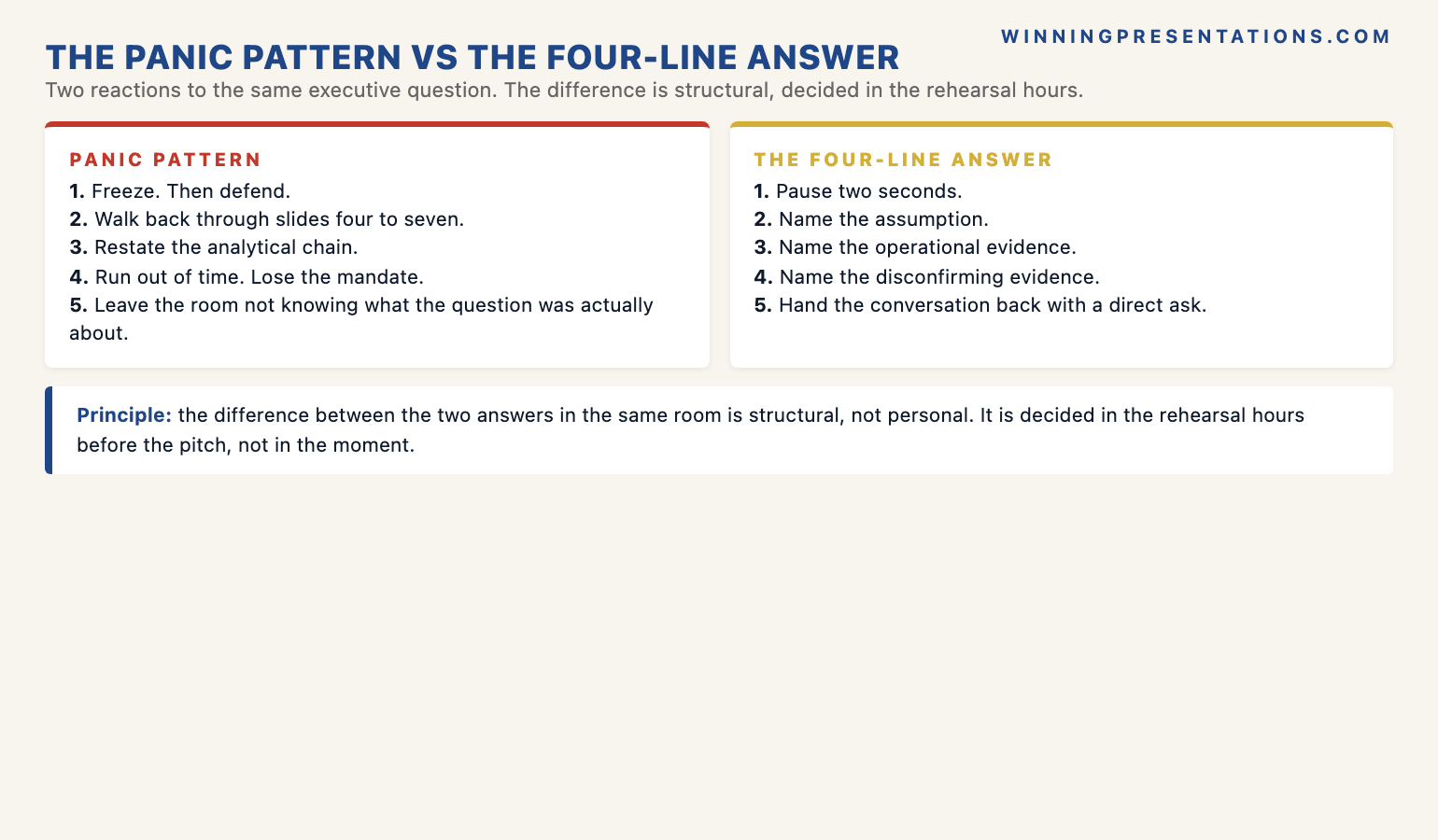
The failure mode the diagnostic catches is the answer that sounds good in delivery but produces no executive engagement afterwards. That is the answer that has named lines one through three plausibly but has slipped into rehearsed-defensive territory somewhere in the middle — usually on line two, where the deck’s analytical vocabulary tends to leak in if the translation work has not been done thoroughly. The executive registers the slip, declines to engage with the substantive dialogue line four invites, and the presenter walks away believing the answer landed when in fact the committee has decided privately that the assumption is weaker than the deck suggests. The polite-thank-you and the one-line memo follow. The diagnostic, applied honestly in the rehearsal hours rather than in the room itself, is to ask whether each line in the answer would sound to the chair like the presenter’s own observation or like the deck’s sentence read aloud. Where the answer is the latter, rewrite the line.
The second part of the diagnostic, worth running once the four lines have been drafted, is whether the answer would still hold if the executive’s question had been phrased more sharply — “what assumption are you carrying on slide nine that I haven’t seen tested?” rather than “what am I missing?”. A presentation objection-handling structure that holds across the question patterns covers the sharper-phrased equivalents in more detail; the underlying four-line answer is structurally the same, and the rehearsal logic is the same. If the four lines hold against the sharper phrasing, they will hold against the softer phrasing the “what am I missing?” question almost always comes in. The presenter who has rehearsed against the sharper version walks into the room over-prepared, which is the right side of the prepared-overprepared trade-off in this category of moment.
The panic pattern: the five-minute defence and what produces it
The panic pattern is the five-minute defence the director in the spring 2003 scene fell into. It has four stages and is worth naming explicitly because most senior presenters who fall into it do not recognise it as it is happening. Stage one: the freeze. The question lands; the presenter’s instinct registers it as an attack rather than an invitation; the presenter pauses for two or three seconds while the brain searches for a response. Stage two: the false start. The presenter opens with a defence of a specific analytical point — the pricing on tranche two, the credit assumption, the comparable on slide six — without first naming the underlying assumption. Stage three: the catch-and-restart. Halfway through the first defence, the presenter realises the answer is not landing, abandons it, and restarts on a different specific analytical point. Stage four: the walk-back. With the catch-and-restart having burned a further thirty seconds, the presenter defaults to walking the room back through the analytical workings of the preceding three or four slides, which is the safest content because it is the content the presenter has rehearsed the most. By minute twelve, the time is gone, the room has not had its question answered, and the chair’s polite thank-you is the only response left available to the committee.
What produces the panic pattern is almost never the presenter’s lack of analytical mastery. The director in the spring 2003 scene knew the pricing analysis cold; he could have walked the committee through any of the three comparable trades from memory; he had drafted the credit memo himself. What he did not have available, in the moment, was the line-one sentence — the operational naming of the assumption the deck was carrying. He had never rehearsed it. The line-one sentence is not the kind of sentence that arrives in the moment; it is the kind of sentence that arrives only if it has been written in advance, said aloud once, and held in working memory for the duration of the meeting. The rehearsal hours that produce it are the structural difference between the director in the spring 2003 scene and the director in the autumn 2017 scene. The differential is roughly two hours of preparation, applied to the single most likely “what am I missing?” pressure point in the deck. A hostile-question playbook covering the related board-room patterns walks through the rehearsal logic in more detail for the sharper-phrased versions of the same question.
The other thing that produces the panic pattern is the absence of a calm-authority pause between the question and the answer. The director in spring 2003 paused for three seconds and used the pause to search for a response, which the room reads as freezing. The director in autumn 2017 paused for two seconds and used the pause to set down her laser pointer, breathe once, and recall the line-one sentence she had rehearsed. Same pause length, structurally different use. The pause is what makes the four-line answer available. Without it, the brain skips line one and defaults to the line-two defence directly, which is the move the panic pattern is built around. The two-second deliberate pause is the single most underrated technique in senior-executive Q&A and the single hardest one to install in presenters who are good enough at the analytical work to believe they should be able to answer immediately. The cost of the pause is two seconds. The benefit is the four-line answer.
The risk a senior-executive pitch carries is the assumption you have not yet rehearsed naming.
The Executive Q&A Handling System is the resource senior presenters use to identify, in advance, which assumption on which slide is most likely to draw the “what am I missing?” question — and to draft the four-line answer for that assumption before the meeting rather than improvise it under pressure. The cost of preparation is two hours per pitch. The cost of being asked the question without the answer rehearsed is the mandate. £39, instant download, lifetime access.
One thing to do before your next pitch
Before your next senior-executive pitch, draft three specific “what am I missing?” answers — one for each of the three most load-bearing assumptions in the deck. Block ninety minutes. Walk the deck slide by slide. On each slide, ask the rehearsal question: “if the chair stopped me on this slide and asked what they were missing, which assumption would they be pointing at?” Pick the three slides where the answer comes back fastest. For each of those three, write the four lines in order: name the assumption in operational vocabulary, name the two or three specific pieces of evidence in the room’s language, name the one piece of disconfirming evidence you would actually find concerning, draft the one-sentence question handing the conversation back to the executive. Read each set of four lines aloud once. Walk into the pitch with the three drafts in your pocket and the two-second pause rehearsed. When the question lands — and on a senior-executive pitch with a load-bearing assumption, it lands more often than not — the four-line answer will be available because it was already there. The difference between the director in spring 2003 and the director in autumn 2017 was two hours of rehearsal applied to the right assumption. Do the two hours. The mandate is in the answer.
Frequently asked questions
Isn’t “what am I missing?” sometimes a genuinely hostile question, designed to expose the presenter rather than invite dialogue?
It can be, in a small minority of cases, but it is much rarer than presenters tend to assume in the moment. The hostile version of the question almost always comes with different paralinguistic markers — a sharper tone, less eye contact with the presenter and more with the rest of the room, a closed body posture rather than the leaning-back-from-the-table posture senior people use when they are inviting honest assessment. Even in the hostile version, the four-line answer is the right response, because the structural move — name the assumption, name the evidence, name the disconfirming case, hand back the conversation — is what disarms a hostile question as well as it engages an inviting one. The presenter who assumes hostility and pre-emptively defends is the presenter who turns an inviting question into a hostile dynamic. The presenter who answers as if the question is genuine almost always converts it into a working exchange, even when the original intent was sharper than it sounded.
What if I genuinely don’t know which assumption the executive is pointing at?
This is more common than presenters realise, and the four-line answer handles it cleanly. If the load-bearing assumption is genuinely ambiguous — for instance, the deck has three or four assumptions of roughly equal weight and the executive’s question doesn’t signal which one — the structure becomes: name the two or three candidate assumptions in line one, name the evidence for each briefly in line two, name the most-likely disconfirming evidence across them in line three, and ask the executive directly in line four which of the candidates the question was pointing at. The total time is closer to sixty seconds than forty-five, but the structural signal is the same. What the executive reads is that the presenter has thought about where the pressure points are and is comfortable surfacing them honestly. That signal carries the answer regardless of which specific assumption the executive had in mind.
How long should the pause before line one actually be? Two seconds feels like an eternity in a committee room.
Two seconds is the right length and it does feel like an eternity to the presenter; it does not feel like an eternity to the room. The room reads a two-second pause as composure. It reads a no-pause immediate answer as defensiveness or rehearsed deflection, and it reads a four-or-five-second pause as freezing. The two-second mark is structurally right because it allows the presenter to set down whatever they were holding (laser pointer, deck, water glass), breathe once, and recall the line-one sentence from working memory without rushing. The rehearsal trick is to install the physical anchor — the setting-down of the laser pointer is what cues the pause — rather than try to count two seconds in your head, which is unreliable under pressure. Senior presenters who have built the physical-anchor habit can produce a clean two-second pause in any committee room without thinking about it.
What if the chair’s answer to line four reveals that I have, in fact, missed something material I cannot defend?
The four-line answer holds in this case too, and is in fact the best available structure for handling it. The chair’s answer surfaces the gap; the presenter’s next move is to acknowledge it directly — one short sentence: “That’s a fair point and one we have not stress-tested at the depth your question implies; the right next step is to bring you the analysis on that specific question within the week.” That sentence does the work of acknowledging the gap, naming the timeline, and reframing the pitch from a yes-or-no committee decision to a working dialogue that continues outside the room. Senior executives respect that move much more than they respect a presenter who tries to argue against the gap once the chair has named it. The mandate is rarely lost on the gap itself; it is much more often lost on how the presenter handles the gap once the chair has surfaced it. The four-line answer is what creates the conditions for the gap to be surfaced collaboratively rather than adversarially, and the working-dialogue follow-up is what closes the mandate even when the gap is real.
The Winning Edge — weekly newsletter
The Winning Edge is a weekly (Thursday) newsletter for senior professionals who present at the executive level. One short email a week, focused on the structural moves that separate Q&A moments the committee remembers from Q&A moments the committee processes through to a one-line memo. Subscribe to The Winning Edge →
For the broader picture across slides, storytelling, confidence, and delivery, the seven-product Complete Presenter library is the bundle most senior presenters find useful as a single resource — £99 for everything, lifetime access.
About the author
Mary Beth Hazeldine is Owner & Managing Director of Winning Presentations Ltd. With 24 years of corporate banking experience at JPMorgan Chase, PwC, Royal Bank of Scotland, and Commerzbank, she advises executives across financial services, healthcare, technology, and government on handling high-stakes Q&A moments in investment-committee, board, and senior-leadership rooms.