

Quick answer: “How will we actually do this?” is the question senior committees ask after a strategy presentation, and it is not the same question as “what is the change programme?” It is a credibility test of whether the leader has thought past the slides into execution. The answer that works has four parts, in this order: (1) the named first commitment, (2) the operating model change that supports it, (3) the capability or resource gap that is currently the binding constraint, and (4) what the committee will see in the next 90 days. Sixty seconds. Four moves. Then stop.
JUMP TO:
Mei was 22 minutes into the strategic refresh she had spent two months building. Three slides remained. The chair of the executive committee — a senior partner with 30 years in the firm — interrupted with one question: “Mei, this all sounds reasonable, but how will we actually do this?” Mei opened her mouth to talk through the change programme. The chair raised a hand. “Not the change programme. The execution. Walk me through it.” Mei paused. The slides she had built did not contain the answer the chair was asking for. Forty-five seconds passed. Then she said, “Let me come back to that,” and continued the presentation. The strategic refresh was deferred two weeks later for “a more developed execution case”.
The slide deck was good. The strategy was sound. The change programme document — 80 pages, sitting on a server somewhere — was thorough. None of that mattered. The chair had asked the question that decides whether senior committees back a strategy or defer it, and the answer he got was hesitation. In senior decision-making, hesitation on the execution question is a stronger signal than any slide.
“How will we actually do this?” is the question every committee asks at the strategic level. It looks like a clarification request. It is not. It is a credibility test of whether the leader has thought past the deck into execution — and whether they can articulate that thinking in the room without retreating to a document. This article walks through the four-part answer that signals execution credibility, why each part matters, and what to do when the question lands without warning.
If you want a structured system for handling executive Q&A:
The Executive Q&A Handling System gives you the response structures, bridge statements, and preparation patterns senior professionals use to handle the questions that decide whether decks get backed or deferred.
What the question actually is
“How will we actually do this?” is structurally different from “what is the change programme?” The change programme question is asking for content — the full plan, with workstreams and timelines and ownership. It is the right question to ask when the committee has already decided to back the strategy and now wants the detailed view. It is the wrong question to ask before that decision.
The execution question is asking something else. It is asking whether the leader has internalised the path between strategy and operating reality, and whether they can speak about that path without retreating to a document. The committee is not actually asking for the document. They have, or will have, the document. They are using the question to test something the document cannot tell them — whether the leader who would be executing the strategy has the operational instincts to do it.
This is why the answer that works is short. A leader who can compress the execution case into a 60-second four-part answer demonstrates the instincts. A leader who launches into a 10-minute walk-through of the change programme demonstrates that the case lives in the document, not in the leader. Senior audiences are extremely sensitive to this distinction. They tend to read long answers as evidence that the underlying thinking has not been compressed, which suggests it has not been internalised.
Part 1: The named first commitment
Part 1 of the answer names the first concrete commitment the organisation would make if the committee backed the strategy. Not the change programme. Not the workstreams. The single decision that, if made, would put the organisation on the path the strategy describes.
The first commitment is something the committee can recognise as load-bearing. It is one of: a major capital allocation, a senior leadership appointment, a market entry or exit, a portfolio decision, a partnership or acquisition, or a structural reorganisation of a business line. It is large enough that the organisation cannot quietly walk it back, and concrete enough that the committee can imagine the announcement.
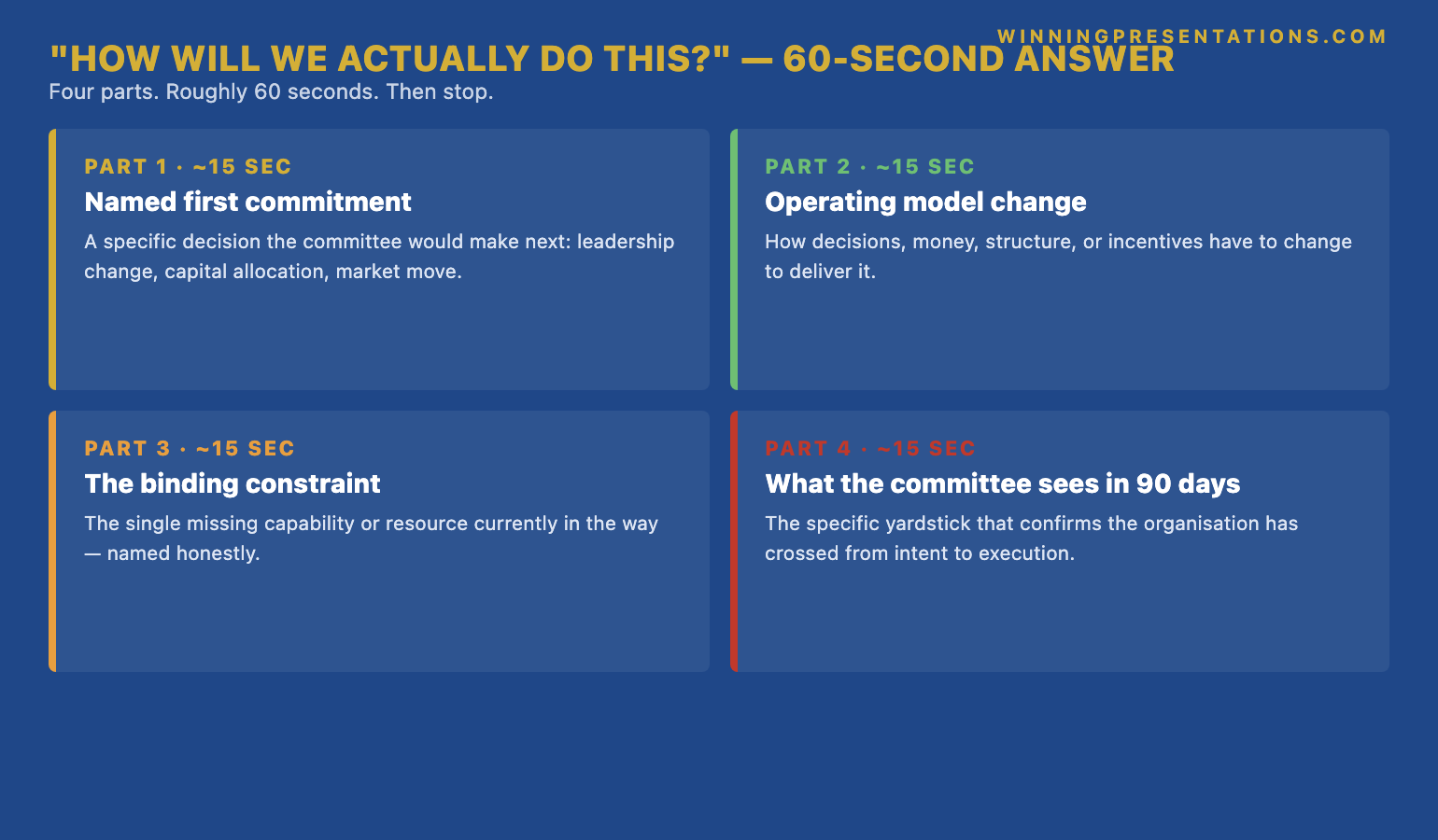
Naming the first commitment first does important work. It signals that the leader has decided what would actually happen if the strategy is backed — they are not deferring to “the team will work out the details”. It also gives the committee a yardstick. A vague answer (we will mobilise the change programme) commits the leader to nothing. A named first commitment commits the leader to something specific the committee can hold them to in the next quarter.
Stop losing strategy decks to the execution question.
The Executive Q&A Handling System teaches the response structures that work for the questions senior committees actually ask — including the load-bearing execution question that decides whether strategy decks get backed or deferred. £39, instant access, no subscription.
- Response structures designed for the question types senior committees use
- Bridge statement patterns that buy thinking time without sounding evasive
- Preparation frameworks for predicting and pre-answering the hard questions
- Designed for senior professionals presenting at the executive level
Part 2: The operating model change
Part 2 names the operating model change the first commitment would force. Most senior strategies fail at this layer — the strategy is sound but the existing operating model cannot deliver it, and nobody on the leadership team has worked out which structural change is required to bridge the gap.
The operating model question covers how decisions get made, how money flows, how teams are structured, and how performance is measured. Strategies that require fundamentally different decision rights, capital allocation patterns, organisational structures, or performance incentives need that change to be named explicitly. A strategy that requires daily pricing decisions cannot be delivered by an organisation that takes pricing decisions annually. A strategy that requires substantial in-house capability cannot be delivered by an organisation whose default is partnership and outsourcing.
Naming the operating model change in the answer does two things. It demonstrates that the leader has thought through the structural implications of the strategy, not just the tactical ones. And it gives the committee a clear view of the second-order consequences they would be backing. Senior audiences fund strategies more readily when they can see the operating model implications named upfront, because the alternative is discovering them six months later as crises.
Part 3: The binding constraint
Part 3 names the capability, resource, or organisational gap that is currently the binding constraint on execution. Every strategy has one — the single missing piece that, if it existed, would make the rest of the execution comparatively straightforward, and that, in its absence, makes everything else slower than it needs to be.
The binding constraint is usually one of: a senior capability the organisation does not yet have (e.g., a head of digital channels with credible international experience); a resource gap the strategy depends on (e.g., a step-change in technology investment that current budgets do not support); an organisational reality that needs to change (e.g., a cultural pattern of consensus decision-making that conflicts with the pace the strategy requires); or a partnership the strategy requires that does not yet exist.
Naming the binding constraint demonstrates honesty. Strategies presented as if they have no constraints lose credibility because senior audiences know that every strategy has constraints. The leader who names the binding constraint clearly — and has thought through how to address it — signals seniority. The leader who pretends the strategy has no constraints signals the opposite. For more on the underlying preparation discipline, see strategic presentation skills training online.
Part 4: What the committee sees in 90 days
Part 4 closes the answer with what the committee will visibly see in the next 90 days if they back the strategy. This is the move that converts the answer from theoretical to operational. It is also the move that gives the committee a near-term yardstick — the difference between “we will mobilise” (no near-term accountability) and “in 90 days you will see X, Y, and Z” (near-term accountability the committee can assess).
The 90-day items should be specific and tied to the first commitment named in Part 1. If the first commitment is a senior leadership appointment, the 90-day item is that the appointment is made and announced. If it is a capital allocation, the 90-day item is that the first tranche has been deployed and the first set of operational changes it funds are visible. The pattern is the same: name what the committee will be able to see, by when, that confirms the organisation has crossed from intent to execution.
The closing 90-day frame also gives the committee permission to defer or refuse the strategy on cleaner terms. A committee that backs a strategy on the basis of a 90-day yardstick can revisit the decision in 90 days if the yardstick is missed. A committee that backs a strategy on the basis of “we will mobilise” cannot. The clean yardstick reduces the risk the committee feels in saying yes — which usually increases the probability that they say yes.
What not to do when this question lands
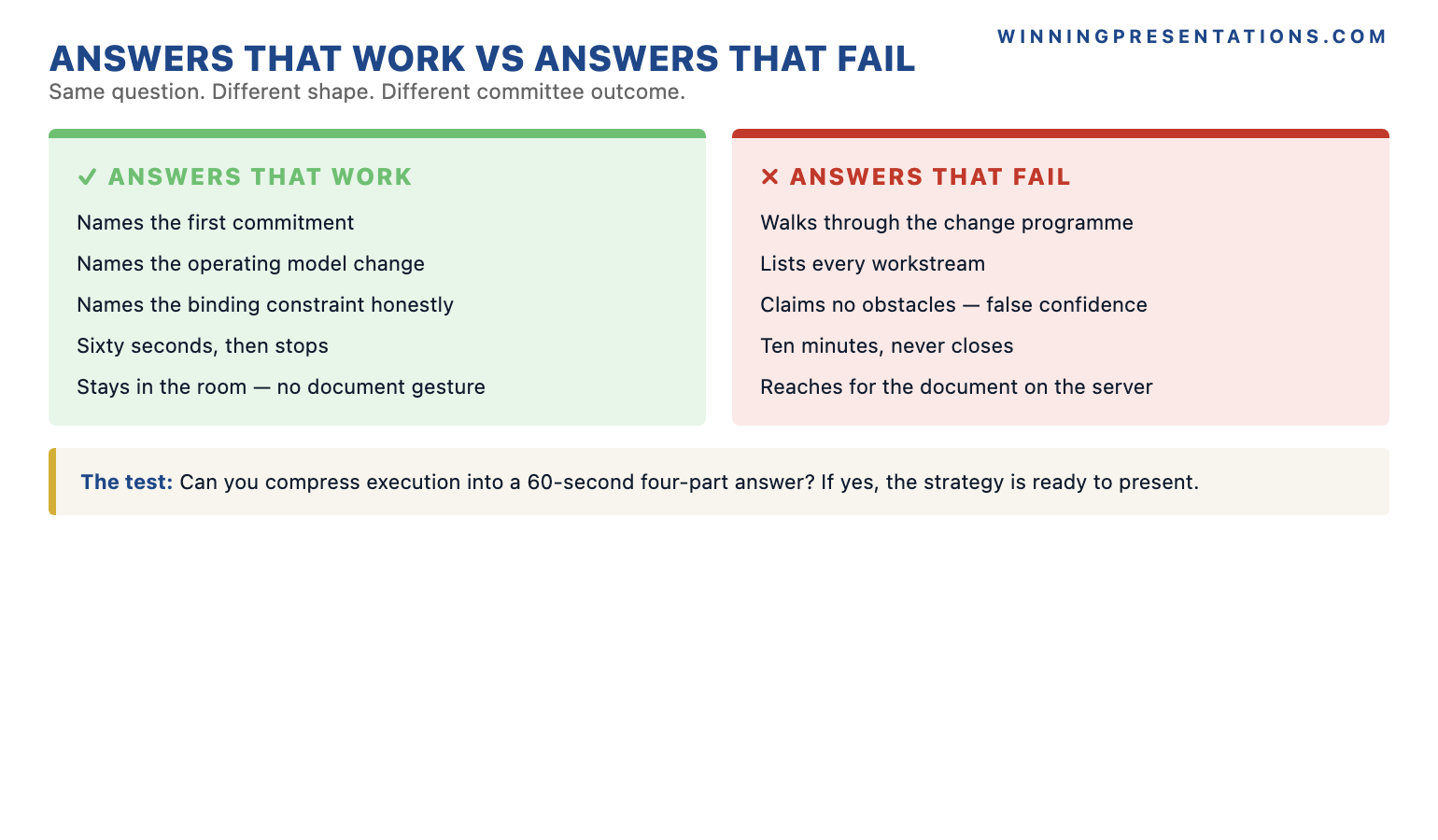
Three patterns kill the execution answer. The first is reaching for the change programme document. Senior audiences read this gesture as evasion — the leader is not answering the question; they are deferring to a document. Even when the document is excellent, the gesture undermines the answer. The disciplined move is to keep the answer in the room, with the leader speaking, and let the document exist as a separate artefact for the committee to read afterwards if they want.
The second is over-elaboration. The instinct under pressure is to demonstrate thoroughness by listing every workstream, every dependency, every milestone. Senior audiences read length as inverse to credibility on this specific question. A 60-second answer that hits four clear parts demonstrates execution credibility. A 10-minute walk-through of the programme architecture demonstrates that the leader has not internalised the case. The discipline is brevity that signals confidence — not brevity that signals shallowness.
The third is the false confidence move. Some leaders, sensing the test, respond with absolute certainty: “We will absolutely deliver this. The team is fully aligned. There are no obstacles.” Senior audiences know this is false. Every strategy has obstacles. The leader who claims none has either not looked or is performing for the room. Either signal lowers credibility. The disciplined version is honest about the binding constraint while clear about the path through it.
How to prepare for this question specifically
The preparation discipline is to write out the four-part answer in advance — for every strategy you are about to present — and rehearse it aloud. Not as part of the deck. As the answer to the predicted question. Twenty minutes the day before. Then again the morning of. The repetition embeds the answer at the level of speech, not just at the level of intent. When the question lands in the room, the answer is available without the leader having to compose it under pressure.
The other useful preparation move is to deliberately ask the four-part question of yourself two weeks before the presentation. If the answer does not come together cleanly, the strategy may not yet be ready to present. The execution question is a useful diagnostic for the strategy, not just for the presentation. Strategies that survive the four-part test usually survive the committee. Strategies that do not survive the four-part test rarely survive the committee — and the committee is a much more expensive place to discover the gap. For more on the underlying structure, see how five-year strategy presentations build the narrative arc the committee follows.
Frequently asked questions
What if I genuinely do not know the answer to one of the four parts?
Say so. “The honest answer on the binding constraint is that we are still working through whether the missing capability is the senior product hire or the platform investment — both are candidates and we will have a clearer view in the next 30 days.” Senior audiences respect direct admissions of uncertainty far more than fabricated certainty. The admission also signals that the leader knows what they do not know, which is a stronger executive signal than pretending otherwise. Avoid this only on Part 1 (the first commitment) — if you do not know the first commitment, the strategy is not yet ready to present.
Should the four-part answer be in the deck itself?
Not as a slide. The answer is conversational — it works in the moment when the question lands, not as part of the structured pitch. If you put it on a slide, it pre-empts the question and removes the test. The committee will not ask “how will we actually do this?” if you have already shown them a slide called “how we will actually do this”. They will ask a different, harder question instead, and you will have lost the chance to deliver the prepared answer to the predicted question.
How long should the full answer take?
Sixty seconds, give or take ten. Each part is roughly one short sentence — 12 to 18 seconds of speech. Together that is a 60-second answer that reads as both compressed and complete. Above 90 seconds, the answer starts to feel like an over-explanation. Above two minutes, the leader has lost the credibility advantage that compression confers and is back in change-programme territory.
What if a follow-up question goes deeper into one of the four parts?
Welcome it. Follow-up questions on the binding constraint or the operating model change are signals the committee is engaging with the strategy, not dismissing it. Answer the follow-up directly, in two or three sentences, then stop. Do not over-extend by chaining into the other three parts. The follow-up is a separate question; treat it as one. The committee will return to the other parts in their own questions if they want to.
The Winning Edge — weekly newsletter
The Winning Edge is a weekly newsletter for senior professionals presenting at the executive level. One short email a week covering the structural moves that make high-stakes presentations and Q&A land. Subscribe to The Winning Edge →
Working on the questions a senior committee will ask? Start with the free 10 Questions Every CFO Asks (+ Scripts) — the question patterns and response structures that come up most often in finance-led committee Q&A.
About the author
Mary Beth Hazeldine is Owner & Managing Director of Winning Presentations Ltd. With 24 years of corporate banking experience at JPMorgan Chase, PwC, Royal Bank of Scotland, and Commerzbank, she advises executives across financial services, healthcare, technology, and government on structuring presentations for high-stakes funding rounds, board approvals, and strategic decisions.