

Quick Answer
A digital transformation board presentation succeeds when it leads with strategic context rather than technical capability, frames the investment in terms of risk and competitive position rather than feature sets, and gives the board a clear choice with a recommended direction — not a technology briefing to absorb.
In this article:
- Why digital transformation presentations fail at board level
- The presentation structure that works for board audiences
- How to build the business case without losing the room
- Framing risk: the argument boards actually respond to
- The questions boards ask — and how to prepare for them
- Preparing the room before you enter it
- Frequently asked questions
Priya had spent four months on the business case. As Chief Digital Officer at a mid-size financial services firm, she had commissioned an independent vendor review, benchmarked against three competitors, and built a financial model that showed a clear return within thirty months. The board presentation was scheduled for ninety minutes. She had allocated the first forty to walking through the technology landscape.
The Chair stopped her at slide nine. “Priya, we appreciate the detail, but can you take us to the decision? What are you actually asking us to approve?”
She had a recommendation on slide twenty-three. By the time she reached it, the board had mentally disengaged. The investment wasn’t approved that day — it was deferred for “further consideration,” which, in practice, meant another quarter of delay and a request for a shorter, clearer paper.
The problem wasn’t the quality of the analysis. It was the sequencing. Priya had built a presentation for an audience that wanted to understand the technology — but boards don’t want to understand the technology. They want to understand the risk, the opportunity cost, and the decision in front of them. The more technical context you provide before reaching the ask, the more confused and disengaged a board audience becomes.
Digital transformation is one of the most common investment decisions reaching boardrooms today. It is also one of the most frequently mishandled presentations — not because the analysis is weak, but because the story is told in the wrong order for a board audience.
Building a board-ready transformation deck?
If you’re preparing a digital transformation investment case for a board or executive committee, the Executive Slide System includes templates and frameworks for exactly this type of high-stakes approval presentation. Explore the System →
Why digital transformation presentations fail at board level
The most common failure mode in a digital transformation board presentation is technology-first sequencing. The presenter builds the story from capability outwards — here is what the technology can do, here is how we would implement it, here is the projected return. This is a logical order for a project team. It is the wrong order for a board.
Boards operate from a different frame of reference. Their primary concern is not operational capability — it’s fiduciary responsibility and strategic positioning. When a presentation opens with technology, it triggers a set of questions in the board’s collective mind that have nothing to do with the slides: Is this within our strategic priorities? Who is accountable if this goes wrong? What happens if we don’t do it? A technology-first presentation typically never answers these questions, because it was built around the solution rather than the decision.
The second failure mode is scope ambiguity. “Digital transformation” is a phrase that means different things to different people in the same boardroom. Without an explicit definition of what is and isn’t included in the scope of the investment, board members will import their own interpretations — and the discussion will fragment along those lines. A clear scope statement, positioned early in the deck, prevents this.
The third failure mode is the absence of a clear ask. Many digital transformation presentations end with a roadmap or a phased plan — but without a specific, bounded decision for the board to make. Boards are accustomed to approving specific things: a budget envelope, a mandate to proceed to the next phase, a vendor selection. An open-ended “we’d welcome the board’s thoughts on the direction” creates uncertainty about what is actually being requested and typically results in deferral.
For related thinking on how transformation programmes should be communicated to executive audiences, the article on how to structure a transformation programme presentation covers the ongoing communication layer that sits alongside the initial investment case.
Executive Slide System
Build the Board Case — Not Just the Deck
Digital transformation investments fail at board level when the presentation is built for the project team rather than the approving body. The Executive Slide System — £39, instant access — gives you the templates and frameworks to build a board-ready investment case that leads with strategic context, not technical capability.
- Slide templates for investment approval and business case presentations
- AI prompt cards to build your strategic narrative fast
- Framework guides for structuring risk, ROI, and stakeholder impact
- Scenario playbooks for high-stakes board and executive committee presentations
Get the Executive Slide System →
Designed for executives preparing complex investment cases for board and executive committee approval.
The presentation structure that works for board audiences
The most effective digital transformation board presentations follow a decision-first structure. The ask is on slide one or two — not at the end. This is counterintuitive for many executives who have been trained to build to a conclusion, but for board audiences it is almost always the right approach.
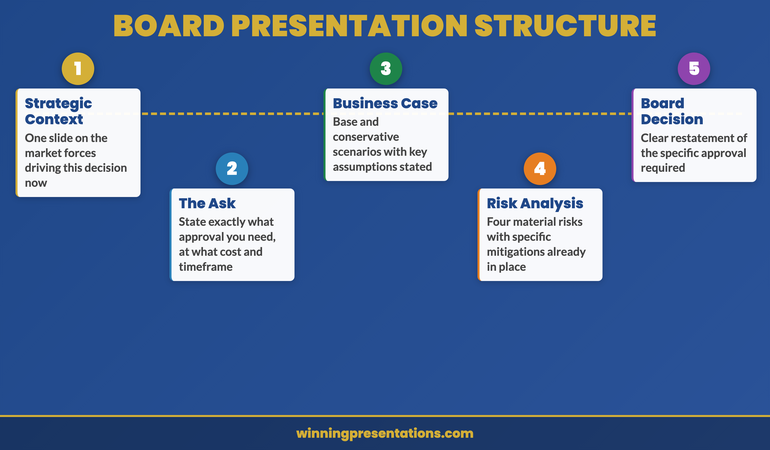
A seven-to-ten slide structure that reliably works for this type of presentation:
Slide 1 — Strategic context. One slide that frames the market or competitive position that makes this investment relevant now. This is not a market research presentation — it’s a single compelling observation that positions the decision in the context of the board’s existing strategic priorities.
Slide 2 — The decision. State clearly what you are asking the board to approve, at what cost envelope, over what timeframe, and with what accountability. Boards respond well to precision at this stage. Vagueness here creates anxiety throughout the rest of the presentation.
Slides 3–4 — Business case. The quantified case for the investment: revenue protection or growth, cost efficiency, operational risk reduction, or competitive positioning. Boards are not looking for exhaustive financial modelling — they’re looking for confidence that the numbers have been stress-tested and the assumptions are defensible.
Slide 5 — Risk analysis. What are the three or four material risks, and how are they being managed? A board that sees no risks on a transformation deck becomes more concerned, not less. Acknowledging risk credibly is a sign of programme maturity.
Slides 6–7 — Implementation approach. A high-level phased plan with clear milestones, governance structure, and accountability. Boards don’t need a Gantt chart — they need to see that there is a credible delivery framework.
Slide 8 — Alternatives considered. What other approaches were evaluated, and why is this the recommended option? A single slide on this prevents the question “have you considered X?” from derailing the discussion.
Slide 9 — The ask. A clear restatement of the specific decision required: budget approval, mandate to proceed to Phase 1, or endorsement of the vendor recommendation. This is the action slide — it should specify what happens next and who is responsible.
How to build the business case without losing the room
The business case section of a digital transformation presentation is where most presenters spend disproportionate time and where most boards switch off. The mismatch arises because the presenter is presenting the full analytical process — here is how we built the model, here is every assumption — when the board wants the conclusions and the confidence level behind them.
A practical approach: present the business case as a range rather than a point estimate. “The base case shows X, the conservative case shows Y, and the optimistic case shows Z — and here is the single factor that most significantly determines which scenario we’re in.” This demonstrates analytical rigour without requiring the board to follow detailed financial modelling, and it prepares them for the risk conversation that follows.
The business case should also address the cost of not acting. Many transformation investment cases focus entirely on the projected return from the investment, without quantifying the risk of the status quo. For a board audience, the cost of inaction is often the most compelling part of the argument — particularly where the competitive context shows that peers or competitors are already investing in the same capabilities.
For guidance on how to present technology evaluation decisions to mixed executive and finance audiences, the article on technology evaluation presentations for IT and finance covers the specific adaptations needed when multiple executive functions share the decision.
The Executive Slide System includes AI prompt cards specifically designed to help you pressure-test a business case narrative before the board meeting — see what’s included.
Framing risk: the argument boards actually respond to
Risk is the most important and most frequently mishandled section of a digital transformation board presentation. There are two failure modes: presenting no risks (which destroys credibility), and presenting an exhaustive list of every possible risk (which creates paralysis).
The format that works best for a board audience is a focused risk register with three columns: the risk, the likelihood and impact assessment, and the specific mitigation measure already in place or proposed. Limit this to four or five material risks. The board does not need to see operational delivery risks that sit below the programme governance threshold — only the risks that genuinely have strategic or financial significance.
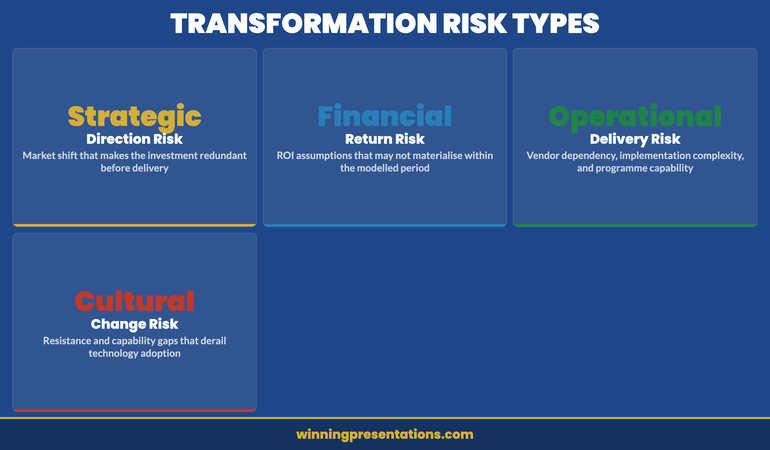
The framing of risk in this context also matters. A risk presented as “technology implementation failure” triggers a generalist anxiety in the boardroom. A risk presented as “vendor dependency risk — mitigated by contractual break clauses and a parallel in-house capability build in Phase 2” is specific, manageable, and demonstrates programme maturity. The specificity is what builds confidence.
One risk that boards consistently want to see addressed — and that is frequently absent from transformation decks — is organisational change risk. Technology implementation is typically not what derails digital transformation programmes. Cultural resistance, capability gaps, and middle management inertia are. Acknowledging this explicitly and showing that the people-side of the programme has a plan demonstrates the kind of executive maturity that boards look for in a programme sponsor.
Executive Slide System — £39
The Investment Case That Gets Approved
The Executive Slide System — £39, instant access — gives you a structured framework for building the kind of board-ready investment case that gets a decision rather than a deferral.
Designed for executives presenting investment cases, strategic initiatives, and transformation programmes to boards.
The questions boards ask — and how to prepare for them
Experienced non-executive directors ask a fairly consistent set of questions in digital transformation presentations. Preparing for these in advance — and, where possible, pre-empting them in the deck — removes the most common sources of discussion that extend meetings beyond their allocated time.
The most frequent board questions in this context are: Why now? What happens if we don’t do this? How confident are you in the vendor? What does Phase 1 actually cost and what does it prove? Who is the senior accountable person, and what authority do they have? What does success look like at the twelve-month mark?
Each of these questions should have a clear, brief answer in the presenter’s head before the meeting — ideally with a corresponding slide or appendix page they can reference. The ability to answer “who is accountable?” with a specific name and a description of their authority is a more confidence-building answer than “we’re working through the governance structure.” Boards approve investments in people as much as in programmes.
For a broader discussion of how to anticipate and handle the difficult questions that arise in high-stakes presentations, the article on stakeholder buy-in psychology covers the underlying dynamics of executive decision-making in complex investment contexts.
Preparing the room before you enter it
The single most effective thing you can do to improve the outcome of a digital transformation board presentation is to have a brief, informal conversation with the Chair or Senior Independent Director before the formal meeting. This is not about lobbying — it’s about understanding whether there are specific concerns, recent experiences with similar investments at peer organisations, or governance questions that are likely to surface in the discussion.
Board members bring their external perspectives to every investment discussion. A non-executive who has recently seen a high-profile digital transformation failure at another company will bring that context into the room. A Chair who has a background in technology will have different questions to one whose career is in finance. Understanding the composition of the room allows you to calibrate your presentation — not to change the substance, but to sequence the content in a way that addresses the concerns most likely to arise.
A pre-meeting brief to the executive sponsor — not the full presentation, but a two-page summary of the ask and the key risks — is also worth considering for complex investment cases. It prevents the sponsor from hearing the analysis for the first time in the room and gives them the foundation to contribute constructively to the discussion rather than asking orientation questions.
For the cross-department alignment that often needs to happen in parallel with a transformation investment case, see also the approach covered in how to structure a cross-department quarterly review — the stakeholder alignment principles transfer directly to programme governance communications.
Frequently Asked Questions
How many slides should a digital transformation board presentation have?
For a ninety-minute board session, aim for eight to ten primary slides with an appendix of three to five supporting slides available for deep-dive questions. The board should be able to understand the investment case, the risks, and the decision from the primary deck alone. The appendix demonstrates rigour without slowing down the main presentation. If your primary deck is running beyond twelve slides, review whether each slide contains a decision-relevant point or whether it’s presenting process information that belongs in a supporting document rather than the presentation itself.
Should I include a financial model in the board presentation?
Include the outputs of the financial model — a single slide showing base, conservative, and optimistic scenarios with the primary assumptions stated — but not the model itself. Boards need to understand the logic and the confidence level behind the numbers, not to audit the spreadsheet. If a board member wants to review the model in detail, that conversation should happen in a pre-meeting briefing or a designated working session rather than during the formal presentation. Walking a board through financial modelling assumptions in real time typically results in the discussion getting stuck on technical detail rather than the strategic decision.
What if the board asks for a delay to “consider further”?
A deferral request usually signals one of three things: a specific unanswered question, an unresolved concern about governance or accountability, or a need for broader board alignment that hasn’t happened yet. The most useful response to a deferral is to ask directly what information or assurance would allow the board to make the decision at the next meeting. This converts a vague delay into a specific action list — and it demonstrates the programme maturity that boards are implicitly testing for when they ask for more time.
The Winning Edge — Weekly Insights for Executive Presenters
Every Thursday: one practical insight to sharpen your executive communication. No generic tips — only what works in real high-stakes rooms.
Free resource: The Executive Presentation Checklist — a pre-meeting quality check for high-stakes presentations.
About the Author
Mary Beth Hazeldine — Owner & Managing Director, Winning Presentations
With 25 years of corporate banking experience at JPMorgan Chase, PwC, Royal Bank of Scotland, and Commerzbank, Mary Beth advises executives across financial services, healthcare, technology, and government on structuring presentations for high-stakes funding rounds and approvals. She is the creator of the Executive Slide System and the Conquer Speaking Fear programme.