

Quick answer: When a key stakeholder dislikes you, the presentation has to do different work. The case must be designed so it stands without your sponsorship of it — so a sceptical stakeholder is voting on the substance, not on you. That requires depersonalising the framing, anchoring the case to shared strategic ground, and giving the room a way to approve the proposal without it feeling like a vote of confidence in you. Done well, the reframe removes the politics. Done badly, the politics swallow the proposal.
Jump to:
Bea had been promoted into a strategy role that one of her current peers had wanted. The peer was now on the steering committee that would decide whether her first major proposal was approved. The dislike was not theoretical. It had surfaced in three previous meetings — the tone, the question framing, the body language. Bea knew, walking in, that one influential person in the room was actively hoping the proposal would not land.
She rebuilt the deck around a simple principle. The presentation could not look like Bea’s proposal. It had to look like a proposal that the organisation needed, and Bea happened to be the person presenting it. The framing was strategic, not personal. The case was anchored to objectives that the steering committee had already endorsed. The recommendation was specific enough that disagreeing with it would require the hostile peer to publicly disagree with strategy they had already signed off on. The proposal was approved. The peer voted yes. The discomfort did not disappear, but the proposal did not pay for it.
Almost every senior career produces this situation. A stakeholder dislikes you for reasons that are sometimes legitimate, sometimes political, often historical, and rarely fully explicable. The question is not whether to address the dynamic — addressing it directly almost always backfires. The question is whether the presentation can be built so that the dynamic does not get to vote on the substance. It can.
If you are presenting to a stakeholder you know is hostile
The Executive Buy-In Presentation System covers the case-construction and stakeholder dynamics that make a presentation work when the room is harder to read. 7 self-paced modules, monthly cohort enrolment, optional recorded Q&A. Designed for senior professionals who need to secure approval from boards, executive sponsors, and reluctant stakeholders.
Why naming the dynamic privately matters
Most senior professionals try to suppress the awareness that a stakeholder dislikes them. They tell themselves the relationship is fine, that the discomfort is in their head, that they should not let it influence the work. Suppression is the wrong strategy. The dynamic exists. The presentation will be shaped by it whether or not the presenter acknowledges it. The question is whether it is shaped consciously or unconsciously.
Naming the dynamic privately — to yourself, to a sponsor, to one trusted peer — does three things. First, it allows you to plan around it rather than be surprised by it. Second, it removes the cognitive load of pretending. The energy that was going into managing the appearance of the relationship is freed for the work. Third, it gives you the discipline to ask the right preparation question — not “how do I make this person like me” (you cannot, in the timescale of a single meeting) but “how do I make the proposal survive this person’s dislike”.
Naming privately is different from raising the issue with the stakeholder directly. The latter rarely helps. A direct conversation about the dynamic tends to harden it, particularly when the stakeholder is senior and the relationship is already strained. The dynamic has to be navigated structurally — through the design of the presentation and the design of the room — rather than confronted relationally. The relational work, where it exists at all, happens over much longer timescales than a single meeting allows.
The presentation reframe — depersonalise the case
The reframe is structural. Three moves do most of the work, and senior presenters who use them consistently find that hostile stakeholders rarely block proposals on personal grounds even when they would like to.
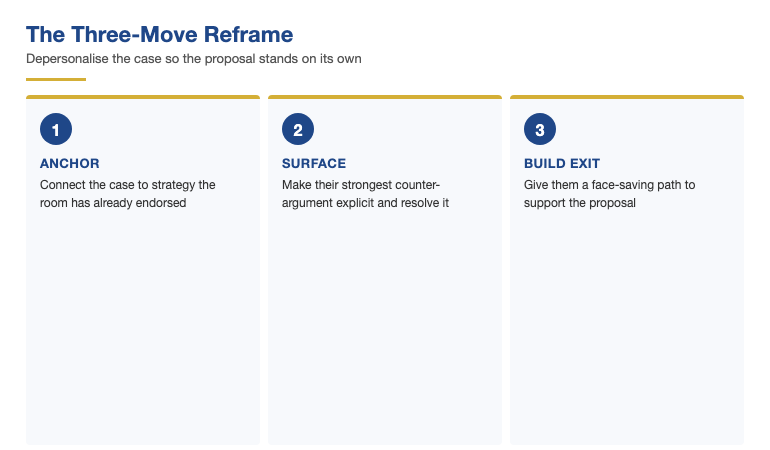
Move one — anchor the case to shared strategic ground. The opening of the deck must connect the proposal to objectives that the room — including the hostile stakeholder — has already endorsed. This is not flattery. It is structural. A proposal that lives downstream of an already-approved strategy is harder to oppose than a free-standing proposal, because opposing it would require the hostile stakeholder to disagree with strategy they have signed off on. Anchor explicitly. Use their language where appropriate.
Move two — surface the strongest counter-argument explicitly. A hostile stakeholder is most dangerous when they hold an unspoken objection. They will surface it in the meeting, with the time and framing of their choosing, in front of an audience. Pre-empt it. Put their strongest argument into the deck, address it on its own terms, and resolve it before they have a chance to deploy it. This is hard. It requires you to make their strongest case better than you would prefer to. It also disarms them — once their argument is named and addressed, raising it in the room becomes redundant rather than oppositional.
Move three — give them a face-saving path to support. Even a stakeholder who would prefer the proposal to fail will often vote for it if the alternative is being seen as petty. Build that exit. The recommendation should be sufficiently aligned with the organisation’s stated direction that opposing it would require the stakeholder to be conspicuously contrarian. Most senior figures will not pay that cost. The reframe makes it possible for them to support the proposal without it feeling like a personal endorsement of you.
Designing the room around you, not against you
Beyond the deck, three structural choices shape how the room reads the proposal. None of them are about the hostile stakeholder directly. All of them dilute their influence by changing the room’s centre of gravity.
Pre-brief the chair. The chair sets the tone of the discussion. A chair who has been pre-briefed will frame the proposal in a way that makes hostile interventions feel out of step with the meeting’s intent. Pre-briefing the chair is rarely about lobbying. It is about giving the chair the strategic context, the recommendation, and the shape of likely objections, so the chair can run the meeting confidently. A confident chair is unlikely to indulge an unproductive hostile line of questioning.
Pre-brief at least two non-hostile senior figures who will be in the room. Not the hostile stakeholder. Two people who can credibly endorse the proposal in the discussion. Their endorsement, particularly if it comes early, dramatically reduces the political cost of joining the supporters and dramatically increases the political cost of opposing. The hostile stakeholder is usually unwilling to be the first dissenting voice if two senior figures have already supported. They will moderate, abstain, or fall silent.
Position your sponsor strategically. If your sponsor is in the room, agree in advance who opens, who closes, and who answers which questions. Hostile stakeholders sometimes target the more junior of two presenters as a way of diminishing the proposal. A clear answering protocol — strategic and political questions to the sponsor, substantive and operational questions to you — denies them that target. Your sponsor’s confidence in answering political questions also signals to the room that the proposal sits on senior endorsement, not on yours alone.
For senior professionals who present in politically uneven rooms
The Executive Buy-In Presentation System — the structured framework for difficult stakeholder rooms
Stop guessing what your stakeholders need to say yes. The Executive Buy-In Presentation System is the self-paced framework for decoding resistance and building the case that addresses it — 7 modules covering stakeholder analysis, case construction, and the presentation structures that hold up when the room is hostile. Monthly cohort enrolment, optional recorded Q&A.
- 7 self-paced modules covering stakeholder analysis, case construction, and the structures that earn senior approval
- Optional live Q&A / coaching calls — fully recorded, watch back at your own pace
- No deadlines, no mandatory live attendance, lifetime access to materials
- Monthly cohort enrolment — enrol any time, start with the next cohort
£499 · Self-paced · Lifetime access to materials · Next cohort enrolment opens monthly
Delivery rules when one person in the room is hostile
Delivery in a politically uneven room is different from delivery in a friendly one. Four rules apply consistently, and senior presenters who follow them tend to find that hostility softens through the meeting rather than hardening.
Rule one — distribute eye contact widely, do not over-correct toward the hostile stakeholder. The instinct is to look at the person who dislikes you, either to demonstrate confidence or to read their reaction. Both backfire. Over-engagement reads as defensive. Distribute eye contact across the room as you would normally — the hostile stakeholder gets approximately the same engagement as anyone else, neither more nor less. Reading their reaction in real time will not tell you anything useful and will distract you from the rest of the room.
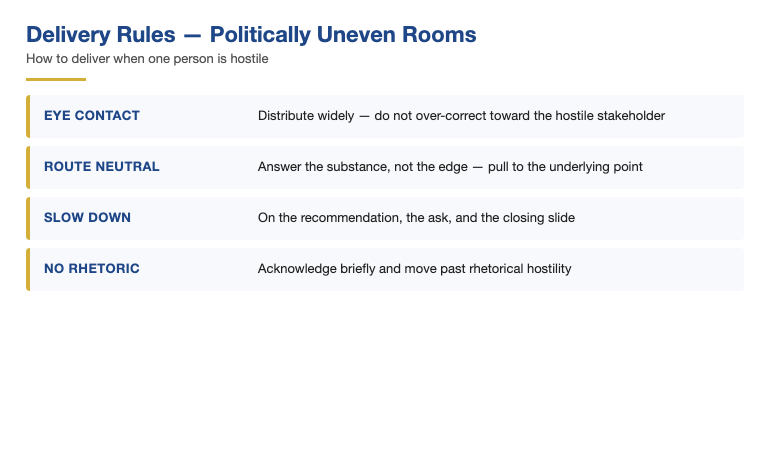
Rule two — route hostile questions back to the substance neutrally. When the hostile stakeholder asks a question with edge, answer the substance, not the edge. Do not push back on the framing. Do not concede the framing. Pull the conversation to the underlying point. “The question of timing is a fair one — here’s the timeline and the milestone we’re committing to.” The room will read the answer as composed. The hostile stakeholder loses the chance to escalate because there is nothing to escalate to.
Rule three — slow down on the key recommendations. Senior presenters under political pressure tend to speed up. The pressure pushes the pace. Resist it. Slow down on the recommendation, the ask, and the closing slide. The room reads pace as confidence. Slow, deliberate, unhurried delivery is read as senior. Fast delivery is read as nervous, even when the substance is strong.
Rule four — do not engage with rhetorical hostility. Some hostile stakeholders do not raise substantive objections. They raise tone questions, framing challenges, or rhetorical asides designed to destabilise the presenter. The right response is to acknowledge briefly and move on. “Fair point — we’ll touch on that in a moment.” Do not give a rhetorical challenge a substantive answer. The room will move past it. Engagement is what gives rhetorical hostility traction.
For senior presenters who experience meaningful anxiety about presenting in politically charged rooms, the issue is rarely confidence in the substance — it is the cognitive load of managing the dynamic. See the related discussion on building confidence in public speaking for the broader behavioural ground that makes politically uneven rooms easier to navigate.
What to do after the meeting
The work after a politically uneven meeting is structural, not relational. Trying to repair the relationship in the seventy-two hours after the meeting almost always backfires. The work is to lock in the decision and protect the proposal from political drift.
Send a precise written summary within twenty-four hours. What was decided, what was deferred, who owns what, and on what timeline. Send it to the chair, the sponsor, and any senior advocates. The hostile stakeholder gets the same summary as everyone else — no acknowledgement of the dynamic, no separate communication. The structural equivalence is part of how the dynamic gets managed. Anything that singles them out gives them new material to work with.
Brief your sponsor on what you observed. Not a complaint about the hostile stakeholder. A factual debrief on which arguments landed, which questions were raised, and where you think the proposal is most vulnerable to drift in execution. The sponsor will be able to apply that intelligence in subsequent conversations. Politically charged proposals tend to soften between approval and execution unless someone is actively holding the original recommendation in place.
Plan the next interaction with the hostile stakeholder professionally. Avoid them and the dynamic hardens. Over-engage and you signal that you read the dynamic, which gives them material. The neutral middle is to engage at the same level you would engage with any peer in their position — same email cadence, same meeting attendance, same professional courtesy. Over time, structural equivalence often does what relational repair cannot. The dynamic loses energy when it is not being fed.
Frequently asked questions
Should I ever raise the dynamic with the stakeholder directly?
Rarely. A direct conversation about the dynamic tends to harden it, particularly when the stakeholder is more senior. The exception is when the dislike is rooted in a specific, addressable misunderstanding that you have evidence of and can correct factually. Even then, the conversation is better held by your sponsor than by you. Most of the time, the work is structural — through the design of the presentation and the design of the room — rather than relational. Relationships at senior level shift over years, not over single conversations.
What if the hostile stakeholder is my chair?
Then your sponsor’s role becomes essential. The chair sets the tone, and a hostile chair makes the meeting structurally harder. You need a senior advocate who is willing to do the chairing-equivalent work for the proposal — framing the strategic context, endorsing the recommendation, moderating hostile questioning. If no such advocate is available, consider whether the meeting is the right venue. Some proposals need to be tested in a smaller room before being presented to a hostile chair-led one.
Is it ever worth refusing to present to someone who dislikes me?
Almost never. Refusing reads as fragile and confirms the worst version of the relationship. The exception is when the hostility is sustained, public, and damaging — at which point the issue is no longer the presentation but the working relationship, and the conversation needs to happen with HR or the chair, not in the deck. Within normal political dynamics, presenting through hostility builds standing. Refusing erodes it. Senior careers are largely made on the room you presented to, not on the rooms you avoided.
How do I prepare emotionally for a hostile room?
Treat the meeting as a structural exercise rather than a personal test. Do the case construction, do the room design, brief your sponsor and chair, surface the counter-argument, and walk in having done the work. The cognitive load of feeling personally exposed shrinks when the structural work has been done thoroughly. Most of the anxiety about hostile rooms comes from underprepared cases — not from the hostility itself. Preparation neutralises the dynamic more reliably than emotional regulation alone.
Maven cohort enrolment — open this month
The structured framework for senior professionals presenting in difficult rooms
Stop dreading the meeting before it starts. The Executive Buy-In Presentation System gives you the preparation framework that replaces last-minute panic with structured confidence — 7 self-paced modules, bonus Q&A calls (optional, recorded). £499, lifetime access.
- 7 self-paced modules — work through at your own pace, no deadlines
- Optional live Q&A calls — fully recorded, watch back any time
- Monthly cohort enrolment — enrol any time, start with the next cohort
- Lifetime access to all materials, no subscription, no expiry
£499 · Self-paced · Lifetime access · Next cohort enrolment opens monthly
The Winning Edge — weekly
One short note each Thursday on board-level presentation patterns, structural shortcuts, and the behaviours senior presenters use under scrutiny. Written for professionals who do not have time for newsletters that read like newsletters.
Want a starting point first? The free Executive Presentation Checklist covers the structural fundamentals senior presenters use before adapting for politically uneven rooms.
For a wider view of how dislike, distrust, and political resistance shape senior approval dynamics, see the related piece on stakeholder buy-in psychology — the human dynamics that determine how hostile relationships do and do not affect proposal outcomes.
Next step: Identify the next senior presentation where one stakeholder is likely to be hostile. Spend an hour writing down what they would say if they had a free hand to oppose. Build the deck so that case is already addressed before they have to make it. The political cost of opposing then transfers to them — and most senior figures will not pay it.
Mary Beth Hazeldine is the Owner & Managing Director of Winning Presentations. With 25 years of corporate banking experience at JPMorgan Chase, PwC, Royal Bank of Scotland, and Commerzbank, she advises senior professionals across financial services, healthcare, technology, and government on structuring presentations for high-stakes board meetings, investment committees, and executive sessions. She speaks German and works extensively with the German-speaking financial markets.