

Quick answer: The career-risk question — “if this fails, what happens to you?” — is a test of accountability ownership, not a literal interrogation. The 4-part answer that holds: acknowledge the personal stake honestly, separate it from the recommendation logic, name the governance reviews you have built in, and return the room to the decision criteria. Refusing to answer signals defensiveness. Over-explaining signals fragility. Owning the question briefly and redirecting to the substance signals senior judgement — which is what the question is testing.
JUMP TO:
Ngozi was 23 minutes into a board presentation recommending the closure of a UK manufacturing site and the consolidation of operations in Poland. The financial logic was strong. The HR plan was thorough. The risks were named. She had answered three or four substantive questions cleanly when the chair leaned forward and asked, in a tone that sounded almost casual: “Ngozi — if this fails, what happens to you?” The room went quiet. Ngozi felt her face flush. She had prepared for every operational, financial, and regulatory question. She had not prepared for this one. The pause she took was about four seconds. It felt much longer.
This question — or one of its many variations — appears more often in senior-level decision presentations than most presenters expect. It is rarely asked maliciously. It is almost always asked to test something specific about the presenter, not the recommendation. The question that seems personal is in fact the most professional question in the room. How a senior presenter answers it determines what the committee believes about their judgement, their ownership of the recommendation, and their fitness to be trusted with the next decision.
What follows is the structure that holds — and the three reflexive answers that consistently undermine the presenter who gives them.
If you want a structured framework for the questions that actually destabilise senior presenters:
The Executive Q&A Handling System covers the question patterns, response structures, and recovery techniques senior professionals use to stay composed when the room turns hostile.
What the question is actually testing
“If this fails, what happens to you?” is not asking for a job-description recap. It is testing four things at once.
One: ownership. Does the presenter believe in the recommendation enough to attach themselves to it personally? Recommendations from people who would not stand behind their own work get downgraded almost automatically. Senior committees notice when the presenter treats the recommendation as someone else’s idea they happen to be presenting.
Two: judgement under social pressure. The question is uncomfortable. How the presenter handles discomfort tells the committee how they will handle other pressure points — angry clients, regulatory challenges, internal political conflict. A presenter who collapses under a question they did not expect from a friendly board will collapse worse in a less friendly room.
Three: the absence of recklessness. The question gives the presenter a chance to demonstrate that they have considered the downside seriously. A presenter who has thought through what failure looks like — for the business, for them personally, for the team — has clearly engaged with the risks. A presenter who has not is either over-confident or under-prepared.
Four: governance maturity. Senior committees want to know what guardrails are in place if the recommendation goes wrong. The career-risk question is also an indirect way of asking: “What is the review mechanism? Who else is accountable? What is the off-ramp if this does not work?” Answers that name those mechanisms calmly signal someone who has built proper governance into the recommendation, not just enthusiasm.
Three answers that backfire
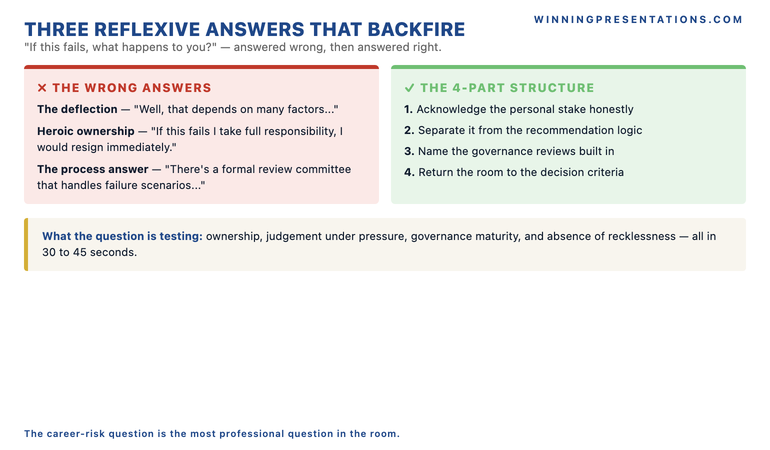
The deflection. “Well, that depends on many factors…” or “Let’s not get ahead of ourselves…” or “I’m sure we can manage any outcome…” Senior committees hear deflection immediately. The presenter is signalling that they do not want to engage with the risk personally. Trust drops. The committee starts wondering what else the presenter is glossing over.
Heroic ownership. “If this fails, I take full responsibility. I would resign immediately.” This sounds strong. It is actually weak. It is a performance of accountability rather than an analysis of it. It also frames the presenter as the load-bearing element of the recommendation — which is exactly what mature governance prevents. A senior committee does not want to hear that the recommendation rises or falls on one person’s continued employment.
Stop losing control of Q&A in the questions you did not prepare for.
The Executive Q&A Handling System gives you the question patterns, response structures, and recovery techniques senior professionals use to stay composed when the room turns hostile. Tough questions, calm authority, decision-safe answers in 45 seconds. £39, instant access.
- The hostile question patterns boards actually use (with response structures for each)
- The 45-second decision-safe answer template
- Bridging and blocking techniques for redirecting without sounding evasive
- The accountability and career-risk question playbook
- Recovery protocols for when an answer lands badly mid-Q&A
Get the Executive Q&A Handling System — £39 →
Designed for senior professionals presenting to boards, executive committees, and investment panels.
The process answer. “There’s a formal review committee that would assess any failure outcomes…” This dodges the question by hiding behind procedure. The committee asked what would happen to the presenter. The presenter answered with what would happen institutionally. The mismatch reads as evasion. The chair will usually press: “I asked about you specifically.” Now the presenter is on the back foot.
None of these three responses are unreasonable on their face. Each one is what a presenter under pressure naturally reaches for. That is precisely why the response has to be prepared in advance — under pressure, the reflexive answer wins over the deliberate one unless the deliberate answer is already loaded.
The 4-part response that holds
The structure below works because it does each of the four things the question is testing — ownership, judgement, downside-thinking, and governance — in roughly 30-45 seconds, without theatricality and without evasion.
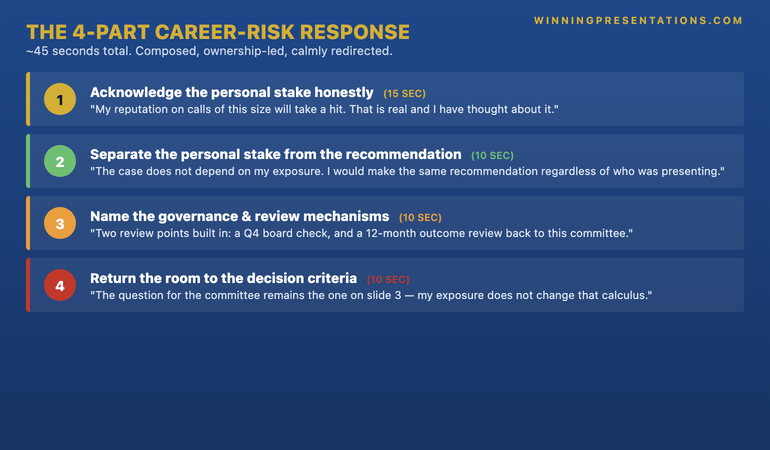
Part 1 — Acknowledge the personal stake honestly (10-15 seconds). “If this recommendation fails materially, my reputation as someone who can call decisions of this size will take a hit. That is real and I have thought about it.” This sounds simple. It is the most important sentence of the response. It demonstrates that the presenter has engaged with the question seriously, that they own the recommendation personally, and that they are not pretending to be detached from the outcome. Senior committees relax visibly when they hear this. The presenter has passed the ownership test.
Part 2 — Separate the personal stake from the recommendation logic (10 seconds). “But the case for the recommendation does not depend on my personal exposure to the downside. The financial logic is in the deck. The risks are named. The mitigations are real. I would make the same recommendation regardless of who was presenting it.” This separates the substance from the messenger. It signals that the recommendation has its own merit independent of the presenter’s career — which protects both the presenter and the integrity of the analysis.
Part 3 — Name the governance and review mechanisms (10 seconds). “We have built in two review points: a Q4 board check on vendor selection, and a 12-month outcome review reporting back to this committee. If the recommendation is going wrong, we will know early — and the committee will know early.” This addresses the maturity test. It signals that the presenter has thought about failure modes and built guardrails. The committee hears: this person has done the governance work, not just the advocacy work.
Part 4 — Return the room to the decision criteria (10 seconds). “The question for the committee remains the one on slide 3: do the projected returns and strategic fit justify the risk profile? My personal exposure does not change that calculus.” This redirects the conversation back to the substance. It also calmly signals to the committee that the presenter is not going to be drawn into a personal back-and-forth. The chair will almost always nod and move on at this point.
For more on the broader hostile-question patterns boards use — pile-on dynamics, leading questions, false dichotomies — see the hostile question playbook of board patterns and bridging versus blocking Q&A techniques.
Variations of the question
The question rarely arrives in the literal phrasing “if this fails, what happens to you?”. It usually appears in one of these variants. The 4-part structure works for all of them with minor adjustments to the language of Part 1.
“How exposed are you personally to this decision?” Same structure. Part 1 acknowledges the exposure honestly. The committee is testing whether the presenter has done the personal-risk math.
“What’s your downside here?” Slightly more aggressive framing. Part 1 needs to be slightly tighter and less elaborate. “My reputation on calls of this scale” is enough — do not embellish.
“If we say no, what does that mean for you?” The question’s mirror image. The committee is testing whether the presenter is asking for approval out of personal interest or organisational need. Part 1 acknowledges that no decision has personal implications, but the rest of the structure stays the same — the recommendation logic does not depend on the presenter’s reaction to a refusal.
“Are you the right person to be making this call?” The most direct version. Part 1 needs to acknowledge the premise honestly without becoming defensive. “It’s a fair question. The team and I have built this case carefully — happy to walk through the analytical framework if it would help the committee form a view on that.” This invites the committee to test the substance rather than dismissing the questioner.
For more on managing pile-on dynamics when one challenging question turns into three or four in succession, see the multiple-board-members pile-on de-escalation guide.
Preparing for the question before the meeting
The career-risk question almost always arrives unpredictably — there is no reliable signal that this is the meeting where it will be asked. The only effective preparation is to assume it might be asked at every senior-level decision presentation, and to load the 4-part response in advance.
Three preparation steps before any high-stakes presentation:
- Write your Part 1 sentence verbatim. What exactly will you say to acknowledge the personal stake honestly? “If this fails materially, my reputation on calls of this size will take a hit” works for many scenarios but you need your version, in your voice. Not generic. Specific to what is actually at stake for you.
- Identify the two governance mechanisms you will name in Part 3. Real ones. Not invented. If the recommendation does not have proper review mechanisms built in, fix that before you present it. The career-risk question can expose governance gaps just as easily as it tests the presenter.
- Practise saying the full 4-part response out loud, twice. The structure is short enough to be memorisable in the same way as your opening line. Saying it out loud is the difference between “I have a structure” and “I can deliver the structure under pressure”.
For the broader context of how this fits into the high-stakes decision presentation, see the partner article on the £10M decision slide — what must be on it, what must be off.
Frequently asked questions
Is the career-risk question a sign that the committee is hostile?
Almost never. It is more often a sign that the committee takes the recommendation seriously enough to test the presenter’s accountability for it. Hostile committees ask different questions — about methodology, source data, or alternative interpretations. The career-risk question signals that the substance has been accepted and the test is now about the messenger. Treat it as a positive signal, not a threat.
What if I genuinely am not personally exposed if this fails?
Say so honestly, but explain what you do own. “My direct exposure is limited — this is a team recommendation and the accountability sits at executive level. What I am responsible for is the quality of the analysis we are presenting today, and I stand behind that fully.” This works because it answers the question without either inflating or deflecting personal responsibility.
Should I show emotion when answering?
Brief, controlled acknowledgement is fine. A small pause before answering is appropriate. Anything more — visible upset, defensive tone, or theatrical intensity — undermines the response. The committee is watching how you regulate your reaction to a personal question. Composed regulation is the signal they are testing for.
What if I don’t know the answer to a follow-up?
“That’s a fair question and I’d want to come back to the committee with a considered answer rather than speculate now.” This works for any follow-up that genuinely catches you. Speculation under pressure damages credibility more than acknowledged uncertainty does. The committee respects the presenter who knows when not to invent an answer.
For the framework that secures buy-in before the question even arises:
The Executive Buy-In Presentation System covers the structure, psychology, and preparation that earn senior approval — 7 self-paced modules including the stakeholder analysis that often prevents hostile Q&A patterns from forming. £499, lifetime access.
The framework for the questions that destabilise senior presenters.
The Executive Q&A Handling System — designed for senior professionals presenting to boards, executive committees, and investment panels. Tough questions, calm authority, decision-safe answers in 45 seconds. £39, instant access.
Get The Winning Edge newsletter
A weekly note from Mary Beth on the structure, psychology, and preparation that earns senior approval. One idea, one application, one specific scenario — every Thursday morning.
Free reference: download the 10 Questions Every CFO Asks (with scripts) — covers the questions that overlap with the career-risk pattern in CFO and finance committee settings.
Next step: Before your next high-stakes presentation, write your Part 1 sentence verbatim. Practise the full 4-part response out loud, twice. Walk into the room knowing the answer is loaded.
About the author
Mary Beth Hazeldine is Owner & Managing Director of Winning Presentations Ltd, founded in London in 1990. With 24 years of corporate banking experience at JPMorgan Chase, PwC, Royal Bank of Scotland, and Commerzbank, she advises executives across financial services, healthcare, technology, and government on Q&A composure under board-level scrutiny.