

Quick answer: The “whose fault is this?” question in a crisis presentation looks like an accountability question. It is almost always a process question in disguise — the director is asking whether the organisation has a coherent view of where the failure originated, not asking the presenter to name an individual in the meeting. The senior leader who answers the surface question by naming a person damages the absent individual, signals poor judgement to the room, and invites a second-order question about why they were willing to throw a colleague under the bus on a board call. The leader who hears the underlying process question and answers that — with a clear ownership map and a clear timeline for the post-incident review — gives the director what they actually wanted and keeps the room. The technique is structural, not improvised, and it can be installed reliably with rehearsal.
JUMP TO:
In 2011 I watched a chief operating officer at a publicly-listed industrials manufacturer field a “whose fault is this?” question during a crisis presentation about a major operational failure at one of the firm’s overseas sites. The director who asked the question was the audit committee chair, not generally regarded as a hostile presence in the room, and the question came roughly twenty minutes into a thirty-minute presentation. The chief operating officer hesitated, then named the head of operations for the affected region. The room went very quiet. The chair closed the meeting shortly afterwards. The named head of operations — who, it turned out, had been substantially constrained by decisions made above her by the same chief operating officer’s own management chain — was reassigned within six weeks. The chief operating officer was reassigned within six months. The board’s read, from the moment the name was spoken, was not that the head of operations was the problem. It was that the chief operating officer’s judgement under pressure was not what they needed. The “whose fault is this?” question had been a process question in disguise. The chief operating officer had answered the surface question, and the answer cost him his role.
I have now watched approximately forty senior executives field some version of the “whose fault is this?” question in crisis presentations across financial services, healthcare, technology, and government. The pattern that separates the leaders who keep the room from the ones who lose it is whether they answer the surface question or the underlying process question. The directors asking the question are almost never asking for an individual’s name. They are asking whether the organisation has a coherent view of where the failure originated and a credible plan to find out if it does not. The leader who hears the question and reaches for a name is answering the version of the question their own anxiety constructed, not the version the director actually asked. The structural redirect that holds in the room is to acknowledge the question, name the ownership map at the organisational level, and commit to the post-incident review timeline.
(This article was created with AI assistance; all stories and insights are based on 35 years of real client work.)
The two senior leaders I want to focus on in this article fielded almost identical “whose fault is this?” questions during crisis presentations approximately three years apart, in different sectors, with different specific failures behind them. One named an individual within the first sentence of his answer and lost the room within ninety seconds. The other named the organisational ownership structure, the timeline for the post-incident review, and the named external party who would be leading the review — without naming any individual inside the firm — and held the room for the remaining ten minutes of the meeting. Neither of them was technically more accurate; the underlying failures were broadly similar in shape. The difference was that the second leader had heard the underlying process question and answered it, while the first had answered the surface question with a name. The room read the first as poor judgement under pressure and the second as senior thinking.
The structural redirects that hold under hostile crisis questioning:
The Executive Q&A Handling System covers the surface-versus-underlying-question diagnostic, the three-part redirect for “whose fault” questions, and the broader catalogue of structural responses to hostile board questions. £39, instant access.
Why the surface question is the trap
The surface question — “whose fault is this?” — is a trap precisely because it sounds like the question it is not. Read literally, it asks for the name of the individual or team responsible for the failure. The senior leader who has spent the previous forty-eight hours absorbing the news and constructing a mental model of what happened often has a name in mind. Under the pressure of the live moment, that name is close to the surface and easy to reach. The leader reaches for it because the literal question has invited the literal answer, and the leader’s preparation has put the name within easy reach. The trap is not that the leader is dishonest or careless; it is that the literal question has been constructed in a way that pulls the literal answer out of the leader’s mouth before the underlying question has been heard.
The board, however, is rarely asking the literal question. Directors at board level know that crisis failures almost never have a single accountable individual; they have ownership chains, control failures, decision-making gaps, and process breakdowns. A board director who has sat through five or six crisis briefings over their tenure understands this in their bones, and the question “whose fault is this?” is usually the verbal shorthand for a much more complex underlying question: does the organisation have a coherent view of where this originated, who is leading the investigation, and what timeline the board can expect for a fuller answer. The senior leader who hears the literal question is responding to the wrong version. The senior leader who hears the underlying question is responding to the version the director actually wanted answered.
The cost of answering the literal question is not just to the named individual, though that cost is real and often significant. The bigger cost is to the leader’s standing with the room. A senior leader who reaches for an individual’s name under board pressure is read by the room as someone who has not yet absorbed the organisational complexity of the failure, or who is under enough stress in the moment to be reaching for the easiest answer rather than the right answer. Neither read is good. The board sees the answer and updates its read of the leader’s judgement downward, often permanently. The named individual becomes a secondary casualty of a question that was not really about them in the first place.
What the director is actually asking
The director asking “whose fault is this?” in a crisis briefing is, in almost every case I have observed, asking some version of three underlying questions. The first underlying question is whether the organisation has a clear picture of where the failure originated — not in terms of an individual, but in terms of the process, the control, the decision point, or the system that allowed the failure to happen. The second is whether someone with appropriate seniority is leading the investigation into the failure, and whether that person has the authority to follow the failure wherever it leads, including upward. The third is what timeline the board can expect for a fuller answer than the one available in this meeting.
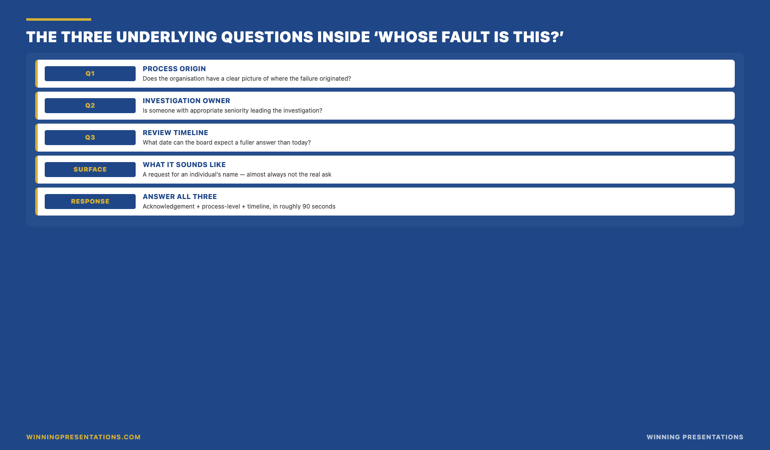
The senior leader who answers these three underlying questions has given the director exactly what they asked for, even though the surface question contained none of these elements. The director will almost always nod and move on. The room reads the answer as a board-level response to a board-level question. The leader who has named the process origin, the investigation owner, and the review timeline has signalled that the organisation has the failure under control at the level the board needs. The individual question — whose name is on the action item — has been correctly held back for the post-incident review, which is the appropriate forum for that conversation.
There is a fourth, less common variant: the director who genuinely is asking the literal question because they want a name. This is rare at well-functioning boards, and when it happens it is almost always a signal that something has gone wrong in the director’s read of the situation — perhaps the briefing has not landed cleanly, perhaps the director has prior context from outside the meeting, perhaps the director is testing the leader’s judgement deliberately. The senior leader’s response in this rare case is still not to name an individual; it is to acknowledge the literal question, redirect to the underlying process question, and let the chair manage the dynamic if the director persists. Naming an individual in this scenario rewards the worst version of the question and damages both the named individual and the room.
The three-part redirect that holds in the room
The three-part redirect is the structural response that addresses the underlying process question without dodging the surface question. It has three components delivered in sequence, ideally in one continuous answer of about ninety seconds. The first component is the acknowledgement: a single sentence recognising that accountability is a serious question. The second is the process-level answer: where the failure originated in terms of the system, process, or control, and who is currently leading the response. The third is the timeline: when the board can expect the full post-incident review and what its terms of reference will be.
The acknowledgement is short and direct. “Accountability is the right question, and it is one we are taking seriously.” That sentence does several things at once: it signals that the leader has heard the question rather than dodged it, it commits the organisation to addressing accountability rather than minimising it, and it buys the eight to ten seconds needed to begin the process-level answer. The leader who skips the acknowledgement and goes straight to the process-level answer is read by the room as evasive even when the substantive answer is good; the leader who acknowledges and then answers the underlying question is read as serious.
The process-level answer is the substantive part of the redirect. It names where the failure originated in terms of the system, process, or control involved, and it names the senior person currently leading the response. “The control that failed was the daily reconciliation in the Eastern European settlement workflow, which the operational risk team has confirmed had been operating as designed but was not calibrated to detect the specific pattern that emerged. The chief operating officer is leading the immediate response, and the chief risk officer is leading the post-incident review.” That sentence is six lines long, says nothing about any individual below the operating-committee level, and gives the board exactly what they need to know: the failure is understood at the process level, ownership is named at the appropriate senior level, and the response is already in motion.
The structural Q&A patterns that hold under crisis pressure.
The Executive Q&A Handling System covers the surface-versus-underlying-question diagnostic, the three-part redirect for accountability questions, and the broader catalogue of structural responses to hostile board questions. £39, instant access, lifetime access to materials.
- The surface-versus-underlying-question diagnostic for hostile board Q&A
- Structural redirects for accountability, blame, and ownership questions
- The audit-committee Q&A protocol for regulatory and crisis settings
- Instant download, lifetime access, no subscription
The timeline is the final component and the one that closes the redirect down without leaving the board uncertain about when they will hear more. “The post-incident review will report back to the board at the next scheduled meeting on the twenty-third, with full findings, named accountability where appropriate, and the remediation plan.” That sentence does two important things: it commits the organisation to naming accountability at the appropriate forum (the post-incident review report) rather than ducking it permanently, and it gives the board a specific date to hold the organisation to. The director who asked the original question almost always accepts the timeline as the right answer; the chair almost always moves the meeting on at that point.
The full three-part redirect, delivered cleanly, takes between sixty and ninety seconds and produces a substantively complete answer to the underlying question. It is the kind of response that senior leaders find easier to deliver after one or two practice rounds than they expect; the structural shape carries the answer once the components are clear in the leader’s head. See the Executive Q&A Handling System overview for the broader catalogue of structural Q&A responses, and the services page at our services overview for the senior leadership briefings that pair with it.
Recognising the director who is leaning in versus the one looking for a target
The three-part redirect works for the overwhelming majority of “whose fault is this?” questions because the overwhelming majority of those questions are underlying process questions in disguise. There is a small minority of cases — perhaps one in fifteen, in my observation — where a director is genuinely looking for an individual to hold accountable in the meeting itself, often for reasons that have more to do with their own positioning on the board than with the substance of the failure. Recognising the difference matters, because the response is slightly different in the rare second case.
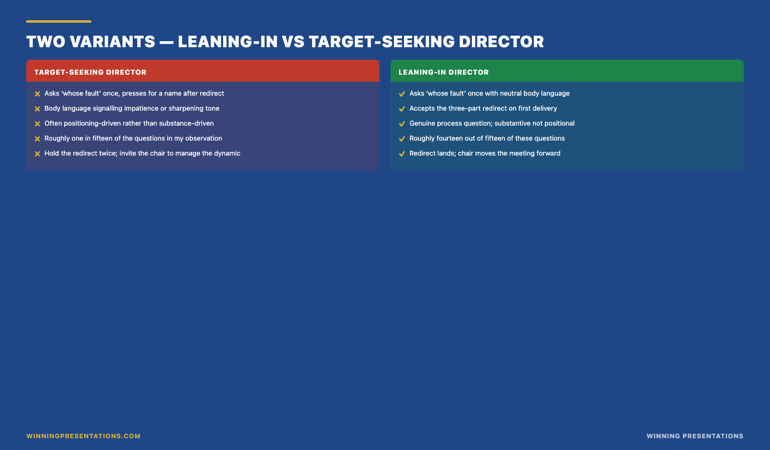
The signal that distinguishes the leaning-in director from the target-seeking director is the second round of questioning, not the first question itself. The leaning-in director asks the question, hears the three-part redirect, and almost always accepts it. They may ask one or two follow-up questions about the process-level answer or the review timeline, but those follow-ups are clarifying questions, not pressing questions. The target-seeking director asks the question, hears the redirect, and then asks the question again, often in slightly sharpened form. “I appreciate the process answer, but I am asking who specifically is responsible.” That second round is the diagnostic.
The senior leader’s response to the second round is to hold the three-part redirect with one small adjustment: a brief acknowledgement that the director’s question is heard, paired with a restatement of why the post-incident review is the appropriate forum for naming individual accountability. “I understand the question, and I want to make sure individual accountability is established with the rigour the situation deserves — which is why the post-incident review on the twenty-third is the right place to bring that back, with the named external party leading the review.” That answer does two things: it refuses to name an individual in the live meeting, and it signals to the rest of the room that the leader has the structural judgement to know when not to. The chair will almost always intervene at that point and move the meeting forward, having recognised the diagnostic the leader has run.
The leader who survives the second round of pressing without naming a name has demonstrated, in real time, the kind of judgement under pressure the board is hoping to see in their senior people. The leader who caves and names a name in the second round, even after holding the redirect in the first round, has shown the room that the structural judgement is breakable. The first version is what the board needs; the second is what the board fears. The structural redirect, held twice if necessary, is what produces the first outcome rather than the second.
For senior leaders who want the broader catalogue of structural Q&A patterns that pair with the three-part redirect — including the redirects for related crisis questions like “why didn’t we catch this sooner?”, “how confident are you in the rest of the controls?”, and “what assurance can you give the board this won’t happen again?” — pair the Q&A handling system with The Complete Presenter bundle (£99). The bundle includes the Q&A handling system plus six additional senior-presenter products, giving full coverage of the structural patterns across the senior board-presentation work. Most leaders working in crisis-prone roles use the bundle as their full reference library for the work.
Frequently asked questions
Is the Executive Q&A Handling System worth £39 if I already handle hostile questions well in normal board meetings?
The Q&A Handling System is most useful for the small minority of board questions where the structural pattern of the right answer is different from the leader’s instinctive answer. Most experienced senior presenters handle most questions well by default; the Q&A system is for the rare questions where the default instinct produces a worse outcome than a structural response would. The “whose fault is this?” question is the canonical example, but it is not the only one. The product is a reference catalogue of about thirty such patterns. If you face hostile questioning in board settings even once a quarter, the case for the £39 is straightforward; the value is in having the structural redirect installed before the question arrives rather than improvising it under live pressure.
What is the most common mistake senior leaders make when answering accountability questions in a crisis?
The most common mistake is treating the surface question as the literal question. The leader hears “whose fault is this?” and reaches for the most accurate answer at the individual level, often because they have spent the previous days constructing exactly that mental model. The board, in almost every case, is asking the underlying process question and reading the leader’s answer as a signal of judgement. Answering the literal question with an individual’s name signals weaker judgement under pressure than the room wants to see in a senior leader, regardless of whether the named individual is in fact partly responsible. The fix is to install the three-part redirect as the default response before the question arrives, so the leader’s instinct in the live moment is the structural redirect rather than the literal answer.
How long does it take to install the three-part redirect as a reliable default?
The three-part redirect can be drafted and rehearsed in about an hour and is usable in the next presentation. The structural shape is not difficult to memorise: acknowledgement, process-level answer with named senior owner, review timeline. The difficult part is using it under live pressure, where the leader’s instinct will pull toward the literal answer. Most senior leaders need to practise the redirect in one or two mock-question settings before it survives a real board meeting; after two or three live uses, it becomes the default. The Executive Q&A Handling System includes a structured rehearsal protocol for installing the redirect under realistic pressure conditions.
Does this approach work for regulators asking similar accountability questions?
Yes, with one adjustment. Regulators asking accountability questions in a supervisory engagement are often genuinely asking the underlying process question, but they are also building a formal record of the firm’s response. The three-part redirect works substantively, but the language is tightened slightly: “individual accountability will be established through the post-incident review, the terms of reference for which we will share with the supervisory team by the agreed date.” That tighter formulation gives the regulator the procedural assurance they need without exposing individuals in a setting that produces a formal record. The structural shape of the redirect is identical; the language is more formal.
What if a director presses past the second round of the redirect and the chair does not intervene?
This is rare but it does happen. The senior leader’s response is to hold the structural redirect for a third time, with a clear statement that individual accountability is being handled through the post-incident review and that the leader is not in a position to pre-empt that review in this meeting. “I understand the urgency of the question and I want to address it through the right forum. The post-incident review is the place where named accountability will be established, and I am not able to substitute for that process in this meeting.” That answer is direct, structurally complete, and does not name an individual. The chair will usually move the meeting on at that point, even if they had not intervened earlier. The leader who holds the redirect for three rounds has shown the room the judgement under pressure that the board is hoping to see.
The Winning Edge newsletter: weekly editorial on Q&A handling, crisis communication, and the structural patterns senior leaders use under hostile board questioning. Sent every Thursday morning to senior leaders presenting at board level.
Install the three-part redirect before your next crisis briefing.
The Executive Q&A Handling System covers the surface-versus-underlying-question diagnostic, the three-part redirect, and the broader catalogue of structural responses for senior board presenters. £39, instant access, lifetime access.
The next time you face “whose fault is this?” or any of its close cousins in a crisis briefing — “who let this happen?”, “who is responsible for the failure?”, “how could this have been missed?” — hear the underlying process question, not the surface accountability question. Acknowledge briefly. Answer at the process level with the senior owner named. Commit to the post-incident review timeline with a specific date. Hold the redirect through the second round if needed. The room reads the structural judgement, and the structural judgement is what board-level senior leaders are tested for in the live moment. For the full reference catalogue, see The Complete Presenter bundle.
ABOUT THE AUTHOR
Mary Beth Hazeldine is Owner & Managing Director of Winning Presentations. She has 24 years in corporate banking at JPMorgan Chase, PwC, Royal Bank of Scotland, and Commerzbank, and 16 years coaching senior professionals across financial services, healthcare, technology, and government. She advises senior leaders on Q&A handling under hostile board questioning, including the structural redirects for accountability and blame questions in crisis presentations.
Winning Presentations Ltd, founded in 1990, is a UK consultancy specialising in executive presentation methodology and senior leadership communication.