

Quick Answer
A pilot to contract presentation succeeds when it reframes your results as proof of commercial value — not just technical success. Structure it around three questions every decision-maker is silently asking: Did it do what we needed? Can it scale? What does the business case look like at full deployment? Answer those three questions clearly, and the path from POC to signed contract becomes considerably shorter.
In this article
Priya had spent four months running a technology pilot that had exceeded every success metric.
Adoption rates were up 34 percentage points above the baseline. User satisfaction scores were the highest her company had seen in three years. The internal team who’d trialled the system had stopped using the old process entirely — not because they were required to, but because the new approach was simply better.
And yet, when she stood in front of the steering committee to present the results and seek approval to roll out across all twelve business units, the room went quiet in the wrong way. The CFO leaned back. The Chief Operations Officer asked whether this had been tested at sufficient scale. The head of IT raised procurement complexity. After forty-five minutes, the committee agreed to “think about it” and reconvene in six weeks.
Priya’s pilot hadn’t failed. Her presentation had. She had built a case for the pilot’s success but had forgotten to build the case for the contract. Those are two entirely different presentations.
Presenting pilot results to a sceptical committee this month?
The Executive Slide System gives you the templates and frameworks to structure your business case — so decision-makers can see exactly what a full deployment looks like and why it makes commercial sense.
Why Successful Pilots Still Stall at Contract
The assumption behind most pilot presentations is that strong results speak for themselves. If the numbers are good, the contract should follow naturally. In practice, the opposite is frequently true: the better a pilot performs, the more complex the commercial conversation becomes.
There are three reasons a successful pilot stalls at the contract stage. First, the decision-making group often changes. The person who approved the pilot was typically a programme sponsor or operational lead. The full contract requires sign-off from finance, procurement, legal, and often the board — people who were not in the room during the pilot and have no emotional investment in its success.
Second, a pilot is a controlled environment. Stakeholders who weren’t involved know this, and they’re right to ask what happens when the constraints are removed: more users, more data, more edge cases, more integration complexity. Your pilot deck almost certainly doesn’t address this.
Third — and this is the one most presenters miss — decision-makers who weren’t involved in the pilot don’t just need to understand the results. They need to understand what they’re agreeing to. Scale, cost, implementation timeline, internal resource requirements, and ongoing support are all live questions. Your presentation needs to answer them before they’re asked.
The pilot programme results presentation is a technical document. The pilot to contract presentation is a commercial document. Most teams only build the first one.
The Three Questions Every Decision-Maker Is Asking
Before you design a single slide, write down the three questions that are running through every stakeholder’s mind in that room. Every element of your presentation should exist to answer one of these questions directly.
Question 1: Did it do what we actually needed?
This sounds obvious, but many pilot presentations report what happened rather than what was needed. If the business case for the pilot was “improve time-to-value for new client onboarding,” your results slide needs to show time-to-value data — not a selection of positive metrics that weren’t part of the original brief. Decision-makers who weren’t part of the pilot will look for the specific success criteria that were agreed upfront. If your results section doesn’t map directly to those criteria, you’ll face the question: “But does this actually solve the original problem?”
Question 2: Can it scale — and what does that involve?
The single biggest gap in pilot to contract presentations is the absence of a credible scale plan. Stakeholders who didn’t run the pilot need to see that you have thought through what deployment at full scale actually means: volume of users, integration points, implementation phases, internal change management requirements, and the realistic timeline for each. Without this, a successful pilot becomes a liability — it shows the thing works in a lab but doesn’t explain how it works in production.
Question 3: What is the business case at full deployment?
The ROI or business value calculation needs to be recalculated at scale, not extrapolated from the pilot. If the pilot involved fifty users and showed a specific efficiency gain, that gain at five hundred users is not simply ten times larger — there will be integration costs, change management overhead, and a transition period before the full value is realised. Decision-makers need to see a business case that accounts for full deployment costs, implementation timeline, and the point at which the investment becomes accretive. An honest, conservative model is significantly more persuasive than an optimistic extrapolation.
The Deck That Gets Your Pilot Approved at Scale
Structuring a pilot to contract presentation is one of the hardest things to get right — because it requires you to write for an audience who wasn’t in the room. The Executive Slide System — £39, instant access — gives you the templates and frameworks designed for exactly this scenario:
- Slide templates for programme approval and rollout business cases
- AI prompt cards to build your scale analysis and ROI model slide by slide
- Stakeholder-readiness frameworks for presenting to new decision-makers
- Executive summary templates that answer the three critical questions upfront
Get the Executive Slide System →
Designed for executives presenting commercial decisions to approval committees.
The Slide Structure That Converts POC Results
A pilot to contract presentation follows a different logic from a standard project update or results deck. Rather than moving chronologically through what happened, it moves commercially — from where we are now to what we’re recommending and why that recommendation makes financial and operational sense.
Here is a proven structure for this type of deck:
Slide 1 — Executive summary
This is your entire case on one slide: the original problem, the pilot result against each agreed success criterion, your recommendation (full deployment or a defined next phase), and the headline business case. Decision-makers who are pressed for time should be able to form a view from this slide alone. Everything that follows is supporting evidence.
Slides 2–3 — Results against original success criteria
Map every stated success criterion from the pilot approval to a specific result. Show the baseline, the target, and the actual outcome. If you exceeded some criteria and fell short on others, say so clearly. A presentation that only shows the wins loses credibility; a presentation that names the limitations and explains them builds it.
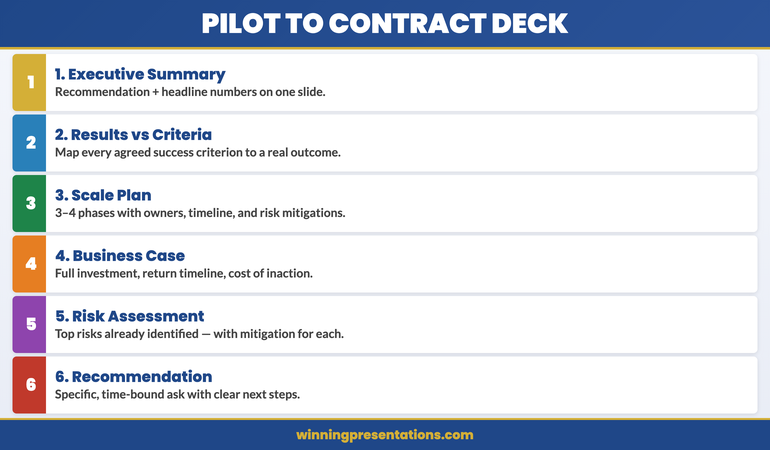
Slides 4–5 — Scale plan and implementation roadmap
Break deployment into three to four phases. Show what is required internally at each phase: resource, budget, timeline, and who owns what. Include the risks at each phase and how they will be mitigated. Decision-makers who were not involved in the pilot are particularly concerned about the transition — they have seen technology deployments fail at scale before. Your job is to show them you have thought through the entire journey, not just the destination.
Slides 6–7 — Business case at full scale
Build the investment case using the data you have, not the projections you’d like. Show the total cost of full deployment (including internal resource, change management, and integration), the expected return timeline, and the cost of inaction or delay. A well-constructed business case slide answers the question: “What happens if we don’t do this?” as clearly as “What happens if we do.”
Slide 8 — Risk assessment
This is a slide most presenters leave out, and its absence is noticed. Show the top four to six risks for full deployment and your mitigation approach for each. This is not an invitation for the committee to find problems — it’s a signal that you’ve already found them and planned for them. Committees approve proposals from people who demonstrate they understand the risks, not people who pretend the risks don’t exist.
Slide 9 — Recommendation and next steps
End with a specific, time-bound recommendation: what you are asking them to approve, by when, and what happens next if they do. Ambiguous endings are the enemy of contract approvals. “We recommend proceeding to full deployment by Q3, with phase one sign-off required by 30 April to maintain the implementation timeline” gives the committee something to say yes to.
The approach mirrors what the best stakeholder buy-in frameworks recommend: answer the questions in the room before they’re asked, then make the decision easy to say yes to.
If you need templates for any of these slide types, the Executive Slide System includes ready-to-use frameworks for programme approval decks, business case slides, and rollout roadmaps.
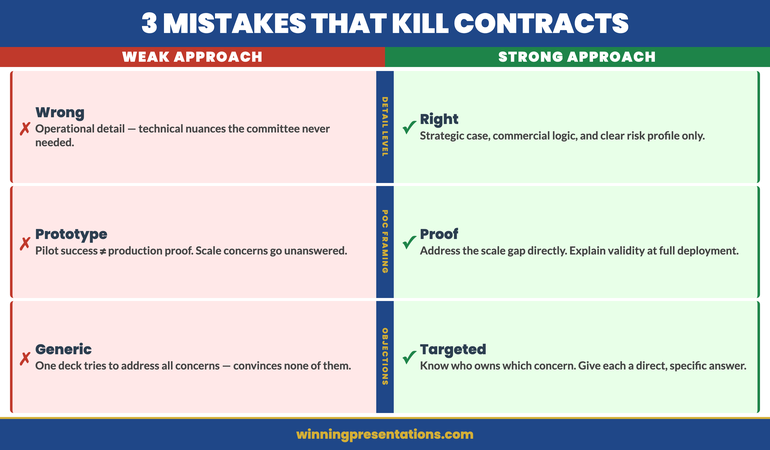
The Three Mistakes That Kill the Contract at the Finish Line
After reviewing dozens of pilot presentations, the patterns that cause contract stalls are remarkably consistent. Here are the three that come up most often.
Mistake 1: Presenting to the wrong level of detail
Pilot teams are close to the work. They know the nuance, the edge cases, the workarounds, and the technical challenges they overcame. The approval committee needs none of this. They need the strategic case, the commercial logic, and the risk profile. A presentation filled with operational detail signals to senior decision-makers that the presenter doesn’t understand the difference between informing and persuading. Strip it back. If the detail is needed, put it in the appendix and reference it only if asked.
Mistake 2: Treating the pilot as a proof of concept when the committee sees it as a prototype
In technical teams, “proof of concept” means the thing works. In commercial decision-making, it means “we tried something on a small scale to learn whether it was worth investing in at full scale.” Those are different definitions. When you present the results, explicitly address the prototype concern: yes, this was tested at limited scale; here is why the results are directionally valid at full deployment; here are the known differences and how we will manage them.
Mistake 3: Not knowing who owns the objection
The CFO’s concern about the business case is different from the COO’s concern about implementation complexity, which is different from the IT director’s concern about integration. A single presentation that tries to address all concerns simultaneously often addresses none of them convincingly. Where possible, identify who in the room holds which concern before you present, and ensure you have a specific, direct answer for each. The proof of concept presentation strategy that works is one tailored to the audience in the room, not the audience you imagined when you built the slides.
Handling Q&A When Stakeholders Push Back on Scale
Even a well-structured pilot to contract presentation will draw questions at the scale stage. Here is how to handle the most common challenges.
“Has this been tested at the scale you’re proposing?”
Don’t attempt to argue that the pilot is equivalent to full scale — it isn’t, and the committee knows it. Instead, acknowledge the scale difference directly and explain the basis for your confidence: benchmarking against similar implementations, vendor track record at scale, technical architecture analysis, or a phased deployment plan that limits exposure at each stage. The honest answer is almost always more persuasive than the defensive one.
“What happens if the integration is more complex than expected?”
Show your risk slide. If you don’t have a risk slide, promise one for the next conversation. More importantly, name the specific integration risks you have already identified, explain the mitigation approach for each, and be clear about what would trigger a pause or reassessment. Decision-makers are not asking because they want to stop the project — they are asking because they want to know you have a plan if something goes wrong.
“Can we see a cheaper or faster alternative?”
This question often signals that the business case hasn’t landed rather than genuine interest in alternatives. Before your next slide, restate the cost of inaction: what does the current process cost per year, what is the competitive risk of not deploying, and how does that compare to the investment you are proposing? If there are genuine alternatives worth considering, include them in an alternatives slide and explain why you have recommended this approach over the others.
See also how today’s related articles tackle adjacent challenges: structuring a technology roadmap presentation for the board, eliminating the habits that undermine your delivery credibility, and building a structured system to improve presentation skills at work.
Stop Losing Contracts After a Successful Pilot
The Executive Slide System — £39, instant access — includes the business case and programme approval templates that turn a successful pilot into a signed contract. Stop rebuilding these slides from scratch every time.
Get the Executive Slide System →
Designed for executives presenting commercial decisions to approval committees.
Frequently Asked Questions
How long should a pilot to contract presentation be?
For a steering committee or board approval, twelve to fifteen slides is the right target. The executive summary, results against criteria, scale plan, business case, risk assessment, and recommendation account for eight to ten core slides, with a further two to four for supporting analysis or appendix material. Anything longer and you risk losing the narrative; anything shorter and you risk leaving material questions unanswered. The goal is a deck that can be presented in twenty to thirty minutes with time left for Q&A.
What is the difference between a pilot results presentation and a pilot to contract presentation?
A pilot results presentation documents what happened and whether the pilot met its objectives. A pilot to contract presentation uses those results as evidence for a commercial recommendation. The results deck looks backwards; the contract deck looks forwards. Many teams make the mistake of delivering the same deck for both purposes, which leaves decision-makers without the information they need to approve the next stage.
How do you present a pilot that only partially met its objectives?
Directly and confidently. Identify the criteria that were met and those that weren’t. For the gaps, explain what caused them, whether they were within or outside the scope of the pilot, and how the full deployment plan addresses them. A partial success presented honestly is more persuasive than a selective success that leaves the committee wondering what you’re not telling them. Decision-makers have seen optimistic pilots before — the ones that build trust are the ones that acknowledge reality.
The Winning Edge — Weekly Presentation Intelligence
Every Thursday, I share one framework, one real-world example, and one practical technique drawn from 24 years of presenting in boardrooms across three continents. Join The Winning Edge newsletter →
Not ready for the full system? Start here instead: download the free Executive Presentation Checklist — a one-page reference covering the structure, opening, and slides every senior presentation needs before it goes to a committee.
About the Author
Mary Beth Hazeldine is the Owner & Managing Director of Winning Presentations. With 24 years of corporate banking experience at JPMorgan Chase, PwC, Royal Bank of Scotland, and Commerzbank, she advises executives across financial services, healthcare, technology, and government on structuring presentations for high-stakes funding rounds and approvals.