Tag: clinical hypnotherapy

22 Mar 2026
Executive standing calmly in corporate corridor before presentation, composed posture, soft lighting suggesting inner calm, modern office environment with navy and gold tones

The Body Scan Technique: 90 Seconds to Reset Your Nervous System Before Any Presentation

Ngozi had been rehearsing her investor pitch for six weeks. Everything was locked down—data, timings, even her opening joke. But thirty minutes before the call, she opened her laptop camera and her hands were shaking so badly she could barely read the screen. Not from doubt. From her nervous system reading the moment as a threat. The body scan technique was the first thing that reset that signal in under two minutes.

Quick Answer: The body scan technique is a 90-second nervous system reset that works by shifting your brain’s attention from threat detection to physical awareness. Instead of fighting anxiety with willpower or breathing exercises alone, a body scan interrupts the fight-or-flight loop at the somatic level—giving your prefrontal cortex enough space to regain control before you walk into the room.

Presenting this week and need a technique that works fast?

If breathing exercises haven’t been enough and your anxiety starts in your body before it reaches your mind, the body scan technique targets the physical layer where presentation fear actually lives. Conquer Speaking Fear is a programme built from clinical hypnotherapy approaches that include the body scan alongside deeper nervous system regulation techniques.

Explore Conquer Speaking Fear →

How Ngozi Discovered Body Scanning Under Pressure

Ngozi spent weeks preparing her Series A pitch. Financials perfect. Slide transitions polished. She could recite her story in her sleep. But thirty minutes before the Zoom call with three partners, her hands started shaking. Not trembling—visibly shaking. She could barely click her mouse. Her mind knew she was ready. Her nervous system didn’t agree. She’d heard about body scanning somewhere—a LinkedIn article, a podcast—and had nothing to lose. She gave herself ninety seconds. Shoulders down. Jaw unclenched. One slow breath. By the time the call started, her hands were steady and her voice was clear. She secured £1.2 million that day. The body scan was the first technique that told her nervous system it was safe to let her mind do its job.

Reset Your Nervous System Before Your Next Presentation—Without Medication

  • A programme using clinical hypnotherapy techniques to retrain your body’s response to presentation pressure—starting with the body scan and building to deeper nervous system regulation
  • Techniques designed for the 90 seconds before you present, not 90 minutes of meditation you don’t have time for
  • Methods that target the physical layer of anxiety (shaking, voice cracking, racing heart) because that’s where presentation fear actually lives
  • Evidence-based approaches from clinical hypnotherapy, not generic “just breathe” advice that hasn’t worked

Explore Conquer Speaking Fear →

Built from nervous system regulation techniques developed with clinical hypnotherapy methods—approaches that address the physical foundations of presentation anxiety.

Why Your Body Panics Before Your Mind Does

Presentation anxiety doesn’t start in your head. It starts in your body.

Your amygdala detects a threat—a room full of senior executives watching you—and triggers the sympathetic nervous system before your conscious mind even registers what’s happening. By the time you think “I’m nervous,” your body has already decided: heart rate up, muscles tense, blood diverted from your digestive system to your limbs, vocal cords tightening.

This is why telling yourself to “calm down” doesn’t work. Your conscious mind is trying to override a survival response that operates faster than thought. The body scan technique works because it doesn’t try to override anything. It redirects your brain’s attention from external threat scanning to internal body awareness—and that attention shift is enough to interrupt the cascade.

The neuroscience is straightforward: your brain can’t simultaneously scan for threats and observe its own physical sensations in detail. When you systematically notice “my shoulders are tense, my jaw is clenched, my hands are gripping,” you’re occupying the neural circuits that were busy amplifying the alarm signal. The fight-or-flight response doesn’t stop—but it drops to a level where your prefrontal cortex can function again.

The 90-Second Body Scan: Step by Step

You can do this standing in a corridor, sitting in a waiting area, or in the toilets two minutes before your slot. Nobody will notice. That’s the point.

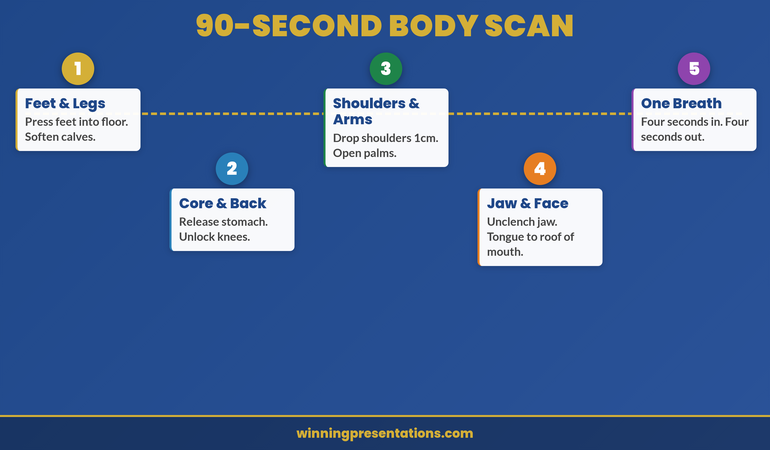
Seconds 1-15: Feet and legs. Press your feet deliberately into the floor. Notice the weight distribution—are you leaning forward? Shift back slightly. Feel the contact between your shoes and the ground. Notice your calf muscles. Are they braced? Let them soften. Not relax—soften. There’s a difference. Relaxing implies effort. Softening implies permission.

Seconds 16-30: Core and back. Notice your stomach. Is it clenched? Most anxious presenters brace their core without realising it—as if preparing for a physical impact. Let it release. Notice your lower back. If you’re standing, unlock your knees slightly. Your body will interpret this micro-adjustment as “we’re not in danger” because locked muscles signal threat readiness to your nervous system.

Seconds 31-50: Shoulders and arms. Drop your shoulders one centimetre. That’s all. Most people carry their shoulders closer to their ears when anxious—a defensive posture your body adopted before you noticed. Let your arms hang. If you’re holding notes or a laptop, set them down briefly. Open your palms for three seconds. Your nervous system reads open hands as “no threat detected.”

Seconds 51-70: Jaw and face. Unclench your jaw. Touch your tongue to the roof of your mouth—this is a clinical trick that relaxes the masseter muscle and sends a calm signal through the vagus nerve. Let your forehead smooth. If your brow is furrowed, it’s because your brain is in problem-solving mode. You don’t need to solve anything right now.

Seconds 71-90: One breath. Take one slow breath through your nose. Not deep—slow. Four seconds in, four seconds out. This single breath is the capstone, not the foundation. The body scan has already done the heavy lifting. The breath just confirms to your nervous system: we’re ready.

Five-step body scan technique roadmap showing Feet and Legs, Core and Back, Shoulders and Arms, Jaw and Face, and One Breath as sequential milestones for a 90-second nervous system reset

Why This Works When Breathing Exercises Don’t

When working with executives on presentation anxiety, the most common feedback is: “I tried breathing exercises and they didn’t fully resolve the physical symptoms.”

Here’s why. Breathing techniques target one symptom (rapid breathing) and hope the rest of the anxiety cascade follows. Sometimes it does. Often it doesn’t—because your body is still braced for impact in every other muscle group. You’ve slowed your breathing, but your shoulders are still at your ears, your jaw is still clenched, and your hands are still gripping the clicker like a weapon.

The body scan works differently. Instead of targeting one symptom, it addresses the entire physical anxiety pattern systematically. By the time you reach the breath at the end, your body has already shifted out of high alert. The breath becomes confirmation, not intervention.

There’s another reason. Breathing exercises require you to do something—and when you’re anxious, “doing something” can feel like another performance demand. The body scan asks you to notice, not to perform. Noticing is passive. Your anxiety can’t turn noticing into another source of pressure.

This distinction matters in the context of NLP anchoring techniques too. The body scan creates a foundation state that anchoring techniques can build on. Without the physical reset first, anchoring a confident state onto a tense body doesn’t hold.

Breathing Exercises Haven’t Been Enough?

The body scan is just the entry point. Conquer Speaking Fear builds the complete nervous system regulation system—body scan, reframing, and approaches from clinical hypnotherapy.

Explore the Programme →

When to Use the Body Scan (and When You Need Something Deeper)

The body scan is a pre-presentation tool. It works in the 90 seconds before you walk into the room. It doesn’t fix what happens the night before, the week before, or the career-long pattern that makes presenting feel dangerous.

Use the body scan when your anxiety is situational—it spikes before the presentation and settles afterward. It works well for quarterly reviews, team updates, client meetings, and any scenario where you know you can present competently but your body doesn’t seem to agree.

You need something deeper when the anxiety starts days before the presentation. When you’re losing sleep on Sunday night because of a Tuesday meeting. When you’re rehearsing not the content but the escape routes—which door is closest, what excuse gets you out. When the anxiety has shifted from “I’m nervous about this presentation” to “I’m a person who can’t present.”

That shift—from situational anxiety to identity-level anxiety—is where the body scan reaches its limit and clinical-grade techniques become necessary. The body scan can interrupt a fight-or-flight response. It can’t reprogram the belief system that triggers the response in the first place.

If this resonates, you’re not failing at anxiety management. You’re using the right technique for the wrong layer of the problem.

Making It Automatic: The 7-Day Practice Protocol

The body scan is a skill. Like any skill, it gets faster and more effective with practice. Here’s how to make it automatic before your next presentation.

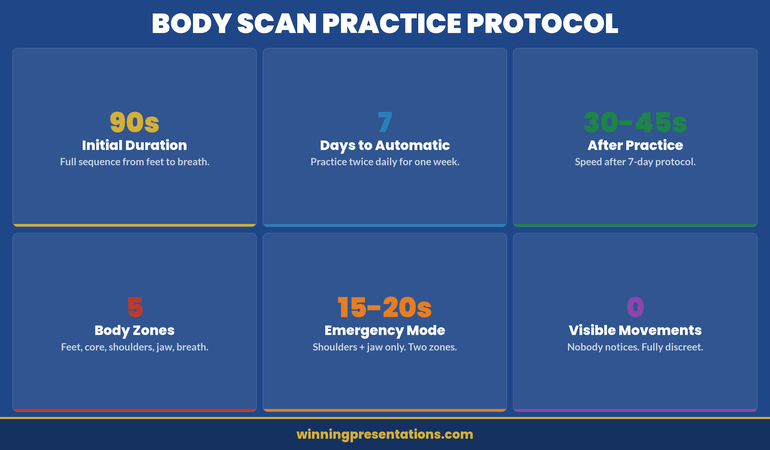
Days 1-2: Practice at home. Do the full 90-second body scan twice daily—morning and evening. You’re training the neural pathway, not managing anxiety. Do it when you’re already calm so your body learns the sequence without the interference of real stress.

Days 3-4: Practice in low-stakes moments. Before a team meeting. Before a phone call. Before opening your laptop in the morning. You’re teaching your body that the scan is a normal transition, not an emergency measure.

Days 5-6: Speed it up. By now, you know the sequence. Try completing it in 60 seconds, then 45. Your body will start anticipating each zone—feet, core, shoulders, jaw, breath—before you consciously direct attention there. This is the automaticity you need.

Day 7: Test under mild pressure. Use it before a slightly uncomfortable conversation—a feedback session, a negotiation, a meeting with someone senior. Not a boardroom presentation yet. This intermediate step builds confidence in the technique before high stakes demand it.

After seven days, most people report that the body scan takes 30-45 seconds and produces a noticeable shift in physical state. Some report that simply thinking “body scan” triggers a micro-release in their shoulders and jaw—the sequence has become a mental shortcut.

Dashboard infographic showing four key metrics of the body scan practice protocol: 90 seconds initial duration, 7 days to automaticity, 30-45 seconds after practice, and works in 5 body zones

Stop Dreading the Physical Symptoms That Derail Your Presentations

  • Programme that builds from the body scan technique to deeper nervous system regulation—so physical anxiety symptoms become manageable, then minimal
  • Clinical hypnotherapy methods that target the root cause, not just the symptoms—for executives who’ve tried breathing exercises and need something that goes further

Get Conquer Speaking Fear →

Designed to address the root patterns of presentation anxiety—because managing symptoms and resolving underlying patterns require different approaches.

People Also Ask

Can the body scan technique work for severe presentation anxiety?

The body scan is effective for situational anxiety—the spike that happens before a specific presentation. For severe, chronic presentation anxiety that starts days before the event and affects your career decisions, the body scan is a starting point but not a complete solution. Severe anxiety involves identity-level beliefs about yourself as a presenter, and those require deeper techniques like cognitive reframing and clinical-grade interventions.

Is the body scan technique the same as mindfulness meditation?

Related but different. Mindfulness body scans are typically 10-20 minutes and aim for deep relaxation. The presentation body scan is 90 seconds and aims for functional readiness—not relaxation, but a state where your nervous system is calm enough for your brain to perform. You don’t want to feel relaxed before a board presentation. You want to feel alert and in control. That’s a different target state.

What if I don’t have 90 seconds before my presentation?

After practising the full sequence for a week, most people can trigger a meaningful physical shift in 15-20 seconds by scanning just two zones: shoulders (drop them one centimetre) and jaw (unclench and touch tongue to roof of mouth). These two adjustments produce the largest nervous system response because they address the two most common anxiety holding patterns.

Is This Approach Right for You?

This is for you if:

  • Your presentation anxiety shows up physically—shaking hands, tight chest, racing heart, voice changes—before you’ve even started speaking
  • Breathing exercises help a little but don’t fully resolve the physical symptoms
  • You want a technique you can use discreetly in any setting, without anyone noticing
  • You’re willing to practise for 7 days to make the technique automatic

This is NOT for you if:

  • Your anxiety is primarily cognitive (racing thoughts, catastrophising) with minimal physical symptoms—you may benefit more from cognitive reframing techniques
  • You need a technique that works immediately with zero practice—the body scan requires a 7-day training period to become fast and automatic
  • Your presentation anxiety is managed well by current techniques—if what you’re doing works, keep doing it

Frequently Asked Questions

I’ve tried body scans before and they didn’t help with my presentation nerves. What’s different about this approach?

Most body scan techniques are adapted from meditation—they’re designed for deep relaxation and take 10-20 minutes. The presentation body scan is different in three ways: it’s 90 seconds (realistic before a meeting), it targets functional readiness rather than relaxation, and it’s sequenced to address the specific muscle groups that presentation anxiety affects most (jaw, shoulders, core). It’s a clinical intervention, not a wellness practice.

Can I combine the body scan with beta blockers or medication?

That’s a question for your doctor, not a presentation coach. What I can say is that many executives I’ve worked with used medication and somatic techniques simultaneously while building confidence in the body scan, then gradually relied less on medication as the technique became automatic. The body scan doesn’t conflict with medication—it works on a different layer of the anxiety response.

Will people notice I’m doing a body scan before presenting?

No. That’s the design advantage. Dropping your shoulders one centimetre, unclenching your jaw, and pressing your feet into the floor are invisible movements. You can do the full 90-second sequence while appearing to review your notes or check your phone. Nobody in the room will know you’re running a nervous system reset protocol. They’ll just notice that you look calm.

The Winning Edge — Weekly

Presentation confidence strategies, anxiety management techniques, and executive communication insights. One email weekly. Built for executives who take presenting seriously.

Join The Winning Edge

About the Author

Mary Beth Hazeldine is Owner & Managing Director of Winning Presentations. With 24 years of corporate banking experience at JPMorgan Chase, PwC, Royal Bank of Scotland, and Commerzbank, she advises executives across financial services, healthcare, technology, and government on structuring presentations for high-stakes funding rounds and approvals.

Book a discovery call | View services

20 Mar 2026
Split corporate scene showing confident executive at podium on one side and anxious professional in meeting room on other side representing stage fright versus social anxiety

Stage Fright vs Social Anxiety: Different Causes, Different Fixes (Why This Matters for Your Recovery)

Quick Answer: Stage fright is situational fear tied to public performance itself. Social anxiety is pervasive fear of judgment that bleeds into all social contexts. They require different diagnostic approaches and different recovery strategies. Misidentifying which one you have is why many executives feel stuck—applying the wrong fix to the wrong problem.

Diagnosis Matters More Than You Think

Thousands of executives spend months or years working on confidence-building tips when their real issue is nervous system regulation. Or they focus on breathing techniques when their problem is an identity-based anxiety spiral. The Conquer Speaking Fear programme uses clinical hypnotherapy and nervous system science—not generic presentation tips—to address the actual root cause of your anxiety.

Learn how nervous system regulation differs from confidence coaching →

The Audience Judgement Loop (11 Years)
An executive spent 11 years trapped in a thought loop: “They’re judging me. I’m not ready. I’ll embarrass myself.” He’d rehearse presentations obsessively, avoid eye contact, speak in a monotone—all the classic presentation anxiety patterns. Then he took a confidence-building course. More techniques. More rules. More ways to feel like he was doing it wrong. Nothing stuck. Six months later, nothing had changed. But when he finally reframed his problem, everything shifted. It wasn’t stage fright at all—it was social anxiety wearing a presentation mask. His real fear wasn’t the performance moment itself. It was the belief that people were evaluating his character, his intelligence, his worth. One reframing technique broke the 11-year cycle. But only after he correctly identified what he was actually fighting.

Stage Fright: The Performance Response

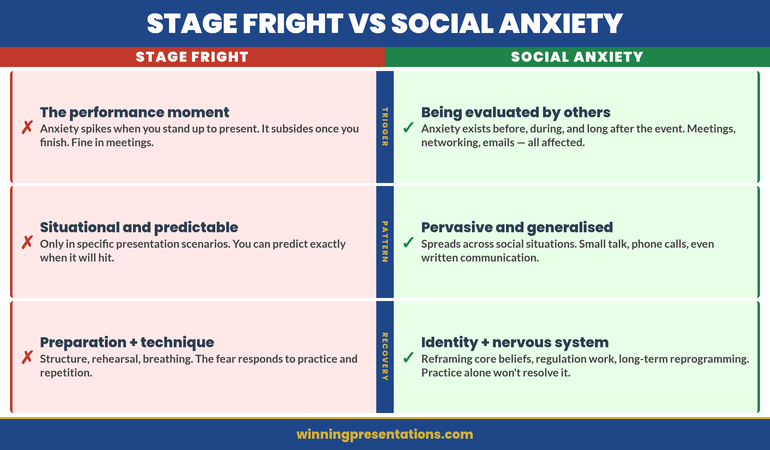
Stage fright is situational. It’s specific to the moment you’re in front of people to perform. The moment ends, the fear largely ends with it. An executive with stage fright might feel completely calm in a one-on-one conversation with the same person they’re nervous about presenting to. They feel fine in small team meetings but anxious at the quarterly town hall. They rehearse obsessively because they believe preparation will reduce the performance risk.

Stage fright is fundamentally a threat response. Your nervous system recognises a real, temporary situation where judgment is possible and reacts accordingly. Heart rate rises. Adrenaline flows. Your body is preparing to either perform at high stakes or escape the situation. This is not a broken response—it’s an ancient survival mechanism that happens to activate in modern performance contexts.

The physical symptoms are unmistakable: trembling hands, a dry mouth, butterflies in the stomach, a tight chest, racing thoughts. These symptoms typically spike 15 minutes before performance and subside within 10 minutes of finishing. An executive with pure stage fright might feel completely confident 30 minutes after a presentation ends.

Social Anxiety: The Identity Problem

Social anxiety is pervasive. It’s not about the specific performance moment—it’s about the belief that people are judging your character. An executive with social anxiety doesn’t feel calm in one-on-one conversations with colleagues they worry about. They don’t relax after the presentation ends because the anxiety isn’t tied to the performance—it’s tied to the interaction itself.

Social anxiety is fundamentally about evaluation of self. The fear isn’t “Will I mess up my words?” It’s “Do they think I’m competent?” or “Are they judging my character?” This creates a loop where the person interprets neutral social cues as criticism, avoids interactions that trigger anxiety, and then feels ashamed for avoiding them. The anxiety spreads across contexts—presentations, meetings, networking, even emails.

The physical symptoms of social anxiety are similar to stage fright on the surface, but the duration and trigger patterns differ completely. Someone with social anxiety might feel anxious hours before a presentation, during it, and for hours or days after—replaying every word, every moment, looking for evidence they were judged. The anxiety doesn’t turn off when the situation ends because the situation was never what the anxiety was really about.

Comparison infographic showing stage fright versus social anxiety across four dimensions: trigger, pattern, core fear, and recovery path with cross and check icons

The Diagnostic Framework: How to Tell the Difference

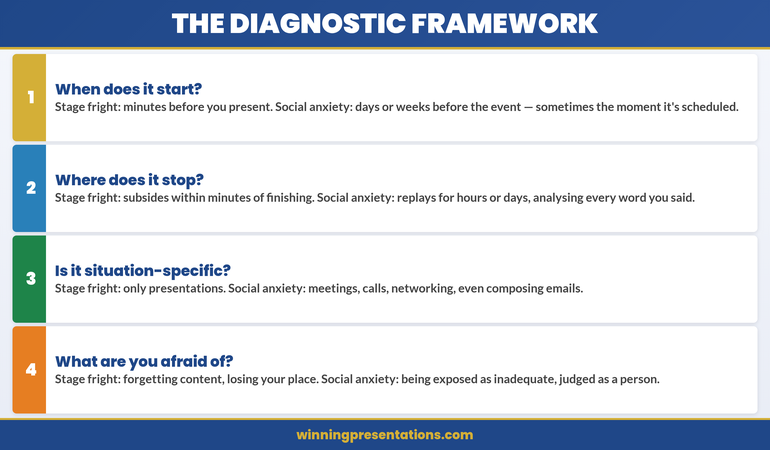
Here’s the clearest diagnostic tool. Imagine this scenario: You’re delivering a major presentation to your board. Afterwards, someone you respect pulls you aside and says, “That was great. Really clear.” How do you respond?

Stage fright response: “Thank you. I was so nervous. My hands were shaking.” Relief. The moment is over. By tomorrow, the anxiety has dissolved.

Social anxiety response: “Really? But I was rambling in the second section. I could tell they weren’t engaged. I probably sounded unprepared.” Doubt. Rumination. The anxiety shifts into self-criticism and evidence-gathering about your competence or likeability.

Stage fright is about the moment. Social anxiety is about your interpretation of what the moment says about you as a person. This distinction is critical because it changes everything about recovery.

Aspect Stage Fright Social Anxiety
Trigger Specific performance moment; high-stakes audience present Belief about judgment or social evaluation; present even in low-stakes social situations
Duration Minutes to an hour before and during; subsides quickly after Hours or days before; rumination after; context-independent
Core Fear “I will make a mistake or forget my words” “They are judging my character or competence”
Avoidance Pattern Avoids presentations; seeks small audiences or written formats Avoids social situations broadly; withdraws from colleagues; struggles in group settings
What Helps Preparation, practice, nervous system regulation in the moment Identity work, reframing beliefs about judgment, nervous system regulation + cognitive shifts

Why Your Recovery Path Depends on Which One You Have

This is where most executives get stuck. If you have stage fright and you spend your time building confidence and self-esteem, you’re missing the real problem: your nervous system is reacting to genuine stakes. You don’t need to think differently about yourself. You need your body to regulate more effectively in the moment.

If you have social anxiety and you spend your time practising presentation techniques and rehearsing, you’re treating a symptom, not a cause. You can memorise your whole deck word-for-word and still feel like a fraud in the moment because the anxiety isn’t about your preparation—it’s about whether people are judging you. More preparation actually feeds the anxiety because it’s rooted in the belief that you have to be perfect to deserve positive judgment.

Stage fright recovery focuses on nervous system regulation: breathing techniques that actually work, body awareness in high-stress moments, strategic visualisation tied to your actual nervous system state, and graduated exposure to the feared situation (presenting to larger audiences, higher stakes).

Social anxiety recovery focuses on reframing: examining the belief that judgment is dangerous, creating evidence that contradicts your anxiety narrative, building tolerance for being evaluated without needing to control the outcome, and regulating the nervous system as part of a larger identity shift.

Which one resonates? Get the specific framework.

Get Conquer Speaking Fear → £39

The Nervous System Component

Both conditions involve nervous system dysregulation, but in different patterns. Understanding this is essential because the fix depends on the pattern.

In stage fright, your nervous system is in a sympathetic (fight/flight) state during the performance. Your body has mobilised resources for threat response. This is actually functional—it’s giving you energy and alertness. The problem is that this activation feels terrible and makes it harder to access your executive function (clear thinking, smooth speech, memory access). The solution is to downregulate without losing the activation. You want calm focus, not panic or shutdown.

In social anxiety, your nervous system is in a dysregulated state before, during, and after social interaction because your mind is interpreting social evaluation as a threat to your identity. You might feel activated (anxiety, racing thoughts) or shut down (numbness, dissociation, inability to speak). The underlying problem is that your threat-detection system is misfiring—it’s treating social judgment as equivalent to physical danger. Breathing techniques help in the moment, but the real recovery happens when you rebuild the belief that judgment is survivable.

This is why clinical hypnotherapy and nervous system regulation techniques work so effectively for both conditions — they bypass the thinking mind (where social anxiety feeds itself with rumination) and work directly with the body’s threat response system. You’re not trying to think your way out of the problem. You’re teaching your nervous system a different pattern. Conquer Speaking Fear (£39) uses exactly this approach — clinical hypnotherapy techniques designed for executives, not generic relaxation exercises.

Four-step diagnostic framework infographic with questions to identify whether you have stage fright or social anxiety: when does it start, where does it stop, is it situation-specific, what are you afraid of

The Right Diagnosis Changes Everything

You can’t fix the wrong problem with the right techniques. Thousands of executives have spent years in generic confidence-building programmes, toastmasters clubs, and presentation-skills courses without lasting improvement. Why? Because they were never addressing the root nervous system pattern driving their anxiety. Conquer Speaking Fear uses clinical hypnotherapy and nervous system science—not presentation tips—to rewire how your body responds to high-stakes social situations. Different tools for stage fright. Different tools for social anxiety. Same outcome: calm, confident performance.

  • 30-day programme using clinical hypnotherapy techniques
  • Nervous system regulation specific to your anxiety pattern
  • Built for high-stakes executives and funding-round presentations

Get Conquer Speaking Fear → £39
Used by executives preparing for board presentations, funding pitches, and high-stakes approvals.

The Identity Loop: Why Social Anxiety Feels Inescapable

When an executive has social anxiety, they often don’t realise it—they think everyone experiences what they’re experiencing. In reality, their nervous system is caught in a loop where social situations activate the same threat response as physical danger. This creates a predictable pattern:

  1. Before a social/performance situation: Anticipatory anxiety (hours or days ahead)
  2. During: Heightened vigilance for signs of negative judgment
  3. After: Rumination and replaying of the interaction, looking for evidence they were judged poorly
  4. Conclusion: Self-blame and withdrawal, which temporarily reduces anxiety but reinforces the belief that judgment is dangerous
  5. Next situation: Baseline anxiety increases because avoidance has “confirmed” that the threat is real

This loop is why social anxiety often looks like a character flaw from the inside. It feels like you’re not confident enough, not prepared enough, not smart enough. It’s actually a nervous system pattern that’s running automatically, outside your conscious control. The more you try to think your way out of it, the worse it gets.

Stage fright doesn’t have this loop. You’re nervous in the moment. You perform. The anxiety stops. You don’t ruminate about it for days because your nervous system recognises the threat has passed. You might think about ways to improve your performance next time, but you’re not questioning your worth or competence based on the audience’s reaction.

Ready to break your pattern, whichever one it is?

Get Conquer Speaking Fear → £39

What Actually Changes in Recovery

For stage fright, what changes is your body’s response in the moment. Your heart rate might still rise—that’s fine. But you’re able to stay present, think clearly, and access your expertise despite the activation. You’re not fighting the anxiety. You’re regulating it enough to function at your best.

For social anxiety, what changes is the belief underneath the anxiety. You begin to understand that judgment is inevitable, survivable, and not a referendum on your worth. You build evidence that contradicts your anxiety narrative. You develop tolerance for being evaluated without needing to control the outcome or escape the situation. The nervous system follows the mind when the mind stops fighting the reality of social evaluation.

Both paths require specific techniques tied to your actual problem. Both lead to executives who can present to board rooms, lead all-hands meetings, and navigate high-stakes funding conversations without the anxiety controlling their performance.

Three Quick Questions to Clarify Your Pattern

  1. Do you feel anxious only in performance moments, or do you feel anxious about social evaluation in general? (Stage fright vs. social anxiety)
  2. Does your anxiety end when the presentation ends, or does it continue in rumination afterwards? (Stage fright vs. social anxiety)
  3. Are you avoiding presentations specifically, or are you withdrawing from social situations broadly? (Stage fright vs. social anxiety)

If your answers cluster toward performance-specific, moment-based anxiety, you likely have stage fright. If they cluster toward evaluation-based, pervasive anxiety, you likely have social anxiety. Many executives experience both, but one is usually dominant and driving the avoidance pattern.

Your Nervous System Doesn’t Care About Presentation Technique

Neither does recovery. The Conquer Speaking Fear programme bypasses the thinking mind and works directly with your nervous system using clinical hypnotherapy. You’ll learn the exact regulation techniques used by executives preparing for board presentations, funding rounds, and high-stakes approvals. Not generic confidence tips. Specific nervous system science. Different approach for different anxiety patterns. Same result.

  • Clinical hypnotherapy-based nervous system training
  • 30-day structured programme
  • Built for executives in high-stakes environments

Get Conquer Speaking Fear → £39
Thousands of executives have replaced anxiety with calm focus using these techniques.

The Real Cost of Misdiagnosis

An executive with social anxiety who spends a year perfecting their presentation skills without addressing the underlying belief about judgment will still feel like a fraud. An executive with stage fright who spends time in therapy exploring their childhood attachment style might feel better understood but no less anxious in the boardroom. The mismatch between the problem and the solution is why so many executives feel stuck after months or years of trying to fix themselves.

The diagnostic clarity matters more than you think. It’s not just about naming your problem correctly — it’s about directing your energy toward the actual fix. Your time is valuable. Your attention is limited. Applying the right solution to the right problem is how you move from stuck to free in weeks instead of years. Conquer Speaking Fear (£39) addresses both patterns with clinical hypnotherapy techniques matched to your specific nervous system response.

People Also Ask: Is stage fright the same as performance anxiety?

Stage fright is a form of performance anxiety, but they’re not identical. Performance anxiety is the broader category — it can apply to athletes, musicians, test-takers, and presenters. Stage fright is specifically the anxiety response triggered by presenting or speaking in front of an audience. The distinction matters because performance anxiety in other domains (sports, music) has different recovery paths than presentation-specific stage fright, which is tied to social evaluation in professional contexts.

People Also Ask: Can social anxiety develop later in life?

Yes. Many executives develop social anxiety in their 30s or 40s, often triggered by a promotion, a public failure, or increased visibility. The pattern can appear suddenly — you were fine presenting for years, and then a single bad experience rewired your threat response. This late-onset pattern is common in high-achieving professionals because their careers have placed them in increasingly high-stakes social situations. The nervous system reaches a tipping point.

People Also Ask: Should I see a therapist or use a self-guided programme?

It depends on severity. If your anxiety is significantly impairing your work (you’re avoiding meetings, turning down promotions, or experiencing physical symptoms daily), start with a qualified professional. If your anxiety is present but manageable — you can still present but it’s painful, or you ruminate after but can function — a structured programme like Conquer Speaking Fear can provide the specific nervous system techniques you need without the time commitment of weekly therapy.

Frequently Asked Questions

Can I have both stage fright and social anxiety at the same time?

Yes. Many executives have both. However, one is usually dominant and drives the avoidance pattern. Your recovery strategy should target the dominant pattern first. Often, when you address the dominant pattern with the right nervous system techniques, the secondary pattern naturally improves because you’ve rebuilt your confidence in social situations more broadly.

If I have stage fright, will breathing exercises actually help?

Breathing exercises help if they’re taught correctly and practised in advance. Most people learn a breathing technique once and then try to use it in a high-stress moment for the first time—which doesn’t work because your nervous system doesn’t recognise it as a safety signal. The techniques in Conquer Speaking Fear are designed to build nervous system recognition through repetition so they work when you need them.

How long does recovery actually take?

For stage fright, noticeable improvements often emerge within 2-3 weeks with consistent nervous system regulation practice. For social anxiety, the initial shift happens around the 3-week mark, with deeper integration and belief change building over 6-8 weeks. The Conquer Speaking Fear programme is structured as a 30-day intensive, which aligns with how nervous systems actually rewire.

Will I ever feel completely calm before a high-stakes presentation?

Possibly, but that’s not the goal. The goal is calm focus—where your nervous system is activated enough to perform at your best, but not so dysregulated that anxiety is controlling the experience. Most executives report that they still feel some activation before high-stakes situations, but it feels like energy rather than fear. The activation is working for them instead of against them.

Want the slides too?

Preparation reduces anxiety. The Executive Slide System (£39) includes confident-presenter templates designed to minimise preparation stress.

Stop Fighting the Wrong Problem

You’ve identified it. Now fix it. Conquer Speaking Fear uses clinical hypnotherapy and nervous system science to address the actual root of your anxiety—not generic confidence-building tips. Whether your issue is situational stage fright or pervasive social anxiety, this programme provides the specific framework and techniques for your pattern. Built for executives. Proven across thousands of high-stakes presentations.

  • Correct diagnosis leads to correct recovery path
  • 30-day programme with clinical hypnotherapy techniques
  • Nervous system regulation that actually works in real moments

Get Conquer Speaking Fear → £39
From board presentations to funding rounds: thousands of executives trust this approach.

Is This Right For You?

Conquer Speaking Fear is designed for executives who’ve tried the standard solutions—presentation skills courses, toastmasters, confidence-building workshops—and found that the anxiety either didn’t shift or came roaring back the moment stakes got real. It’s for anyone who recognises that their problem isn’t technique. It’s nervous system regulation and belief change. It’s for professionals in high-stakes environments: funding pitches, board presentations, all-hands meetings, investor calls, quarterly reviews where you’re being evaluated.

If your anxiety has started limiting your career opportunities, if you’re withdrawing from visibility, or if you’re spending hours ruminating after presentations, this programme will be valuable. The clinical hypnotherapy component accesses the parts of your nervous system that presentation skills training never touches.

Free resource: Download the Executive Presentation Checklist — a free PDF guide to preparing high-stakes presentations without the anxiety spiral.

About the Author

Mary Beth Hazeldine is the Owner & Managing Director of Winning Presentations. With 24 years of corporate banking experience at JPMorgan Chase, PwC, Royal Bank of Scotland, and Commerzbank, she has delivered high-stakes presentations in boardrooms across three continents.

A qualified clinical hypnotherapist and NLP practitioner, Mary Beth combines executive communication expertise with evidence-based techniques for managing presentation anxiety. She has trained thousands of executives and supported high-stakes funding rounds and approvals.

Book a discovery call | View services