

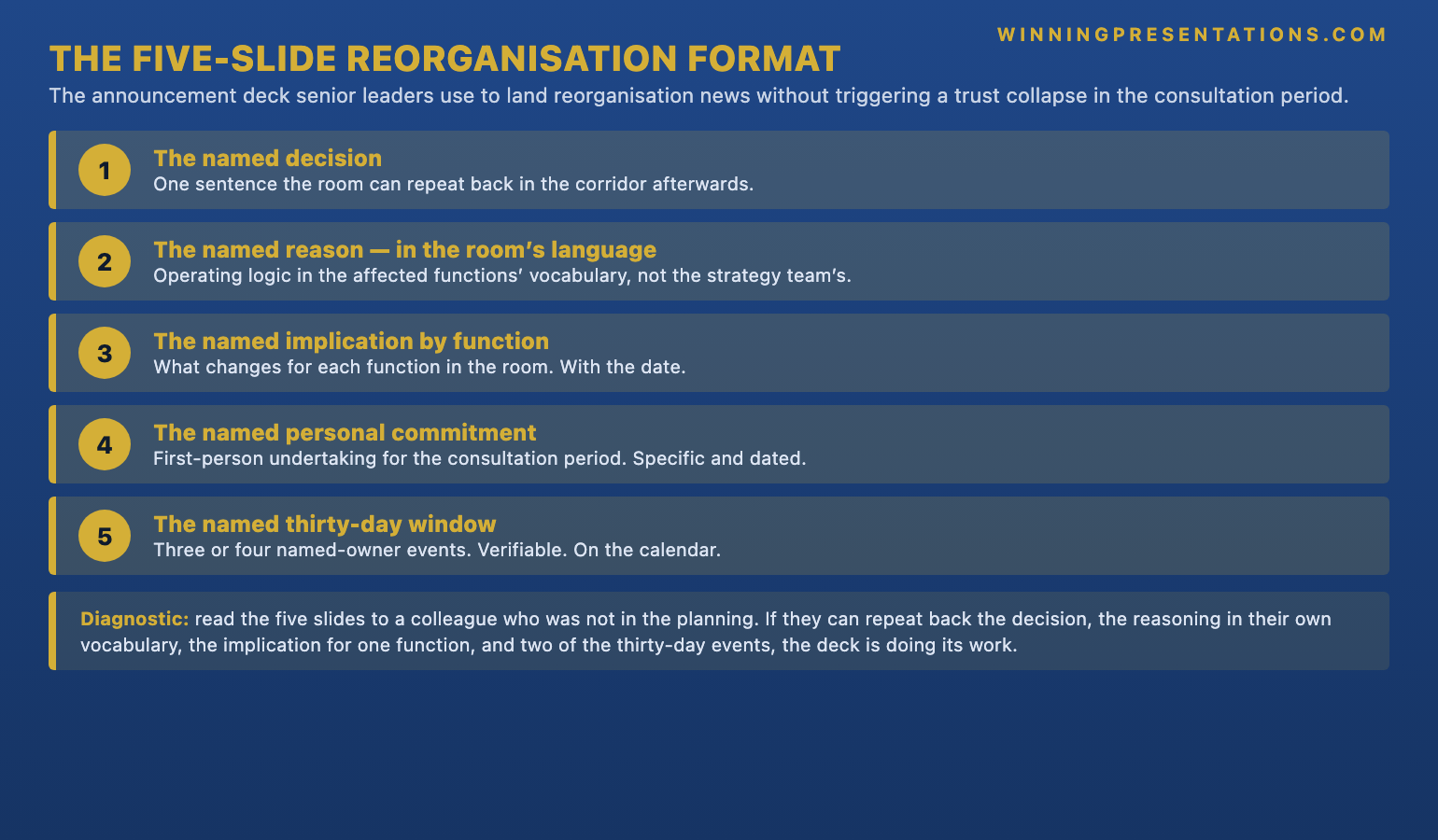
Quick answer: The change management presentation reorg leaders use in 2026 is decided on slide one and slide five. The five-slide format that has been working: (1) the named decision — what is being reorganised and by when, in one sentence the room can repeat in the corridor afterwards; (2) the named reason — the operating logic the executive committee used, in language the affected functions would themselves use, not the strategy team’s vocabulary; (3) the named implication — what changes for each function in the room, by name, with the date the change starts; (4) the named commitment — the specific personal undertaking the leader is putting their name against for the consultation period; (5) the named thirty days — the three or four follow-through events the room will see between now and the next all-hands. Five slides. Built last, read aloud once, delivered without softening. The leader who follows the format holds trust through the consultation period. The leader who buries the news on slide nine triggers a trust collapse that takes two quarters to repair.
JUMP TO:
- Why slide one decides the trust outcome
- Slide one: the named decision
- Slide two: the named reason in the room’s language
- Slide three: the named implication by function
- Slide four: the named personal commitment
- Slide five: the named thirty days
- The read-aloud diagnostic and the chief-of-staff test
- The collapse pattern: softened opening, buried implication
- Frequently asked questions
In autumn 2018, a newly-appointed group COO at one of the publicly-listed mid-cap industrials companies I worked alongside walked into the reorganisation all-hands she had been preparing for six weeks. The room held about 320 people in the company’s converted-warehouse division headquarters on the western edge of the city, with another 480 dialled in from the regional sites on the company’s video bridge. She had inherited a division operating-model review that the executive committee had signed off ten days earlier, and she had four weeks to deliver the announcement before the consultation window opened. Her first slide was a 16-box matrix headed “Operating Model Evolution: From Function-Led to Cross-Functional”, colour-coded across four tones of corporate teal, with eight footnoted definitions in seven-point font along the bottom edge and three diagonal arrows running across the matrix to indicate the “direction of travel”. She spent the first four minutes of the session walking the matrix corner to corner. By minute three I watched the long-serving chief of staff at the back of the room — a woman in her mid-50s who had effectively run the division through the previous leader’s final eighteen months — close the printed deck in her lap and start writing in pencil on the back cover. By minute five, a finance director seven rows back leaned across to a colleague and said something I could not hear; the colleague nodded, looked down at her phone, and did not look back up. The COO walked out of the session believing it had gone fine, because nobody had openly challenged her in the Q&A. Twelve weeks later, the consultation closed with the formal feedback document recording a deeper trust loss across the affected functions than the executive committee had budgeted for, and the COO spent the following two quarters trying to rebuild the working relationships the first slide had quietly damaged.
(This article was created with AI assistance; all stories and insights are based on 35 years of real client work.)
This piece walks through the five-slide reorganisation announcement format that newly-appointed senior leaders and long-tenured COOs alike are using in 2026 to land difficult organisational change without triggering the trust collapse the matrix-on-slide-one opening reliably produces. The format is structural, not motivational. It does not depend on the leader being a naturally gifted communicator, and it does not depend on the news being good. It depends on five specific slides being built, read aloud before the meeting, and delivered without the softening instinct that makes the matrix-on-slide-one opening so tempting. The article covers each of the five slides in detail, the read-aloud diagnostic that catches a weak first slide before it goes into the room, the chief-of-staff test that the second slide must pass, and the collapse pattern that the format is specifically built to prevent.
Before the next reorganisation announcement, a one-page structural check is worth a look.
The Executive Presentation Checklist walks through the openings senior leaders are using to land difficult change announcements — the named-decision opening, the implication-by-function layout, the personal-commitment line, and the thirty-day window close. Free download, no email gate.
Why slide one decides the trust outcome of the announcement
The first slide of a reorganisation announcement carries a structural job that most senior leaders, particularly newly-appointed ones, do not realise it has. The job is not to introduce the strategic framework, summarise the operating logic, recap the executive committee’s decision-making process, or signal the leader’s personal commitment to the people in the room. The job is to answer the question every person in the room is silently asking from the moment the slide goes up: “Is this the meeting where the change actually gets announced, or is this another scoping conversation with the announcement still ahead?” The room makes that judgement inside the first ninety seconds. It makes it from the first slide and the first two sentences off the leader’s lips. Once it has made the judgement, it does not revisit it for the rest of the session. The leader who buries the announcement on slide nine has already lost the room’s trust for the consultation period that follows, regardless of how thoughtfully the substantive content is constructed.
What the room is making in those first ninety seconds is not an analytical judgement but a fast pattern-match against every reorganisation announcement the people in the room have sat through across their careers. They are looking for a small number of things: is the leader naming what is changing or describing why a change might be necessary; is the language operational or aspirational; is there a date attached to the change or only a phase label; does the leader sound like they have come to deliver a decision or to socialise the thinking that led to it. These are not deliberate analytical checks. They are the same pattern-matches the room runs on every senior leader, every difficult announcement, and the first slide is the surface where those pattern-matches land. The five-slide format is built to answer all of them in ninety seconds, which is roughly the window before the room concludes the announcement is being deferred and starts running its own private speculation in the rows.
What the format replaces is the two default openings reorganisation leaders, particularly newly-appointed ones, reach for. The first is the operating-model matrix — the 16-box framework, the colour-coded direction-of-travel diagram, the four-pillar strategic narrative. The intent is to demonstrate that the executive committee’s thinking is structured and considered. The effect, in a room of people who already know a reorganisation has been signed off and have been waiting six weeks to hear the details, is to signal that the leader is more interested in defending the analytical work than in delivering its operational consequences. The second default is the journey-of-discovery opener — the timeline of the operating-model review, the named workstreams, the contributors thanked by name. The intent is to acknowledge the work and the people who did it. The effect is to delay the substantive announcement by a slide and a half, which is exactly the delay the room reads as evasion. Both defaults are slides the leader feels comfortable presenting; neither is a slide the room finds useful to receive. The five-slide format replaces them both with a sequence built around what the room actually needs in the first ten minutes.
Slide one: the named decision
Slide one names the decision. One sentence on the slide, said plainly, said first: “Today I am announcing the consolidation of the regional operations function into a single central operations team, effective from the start of the next financial year.” Or: “Today we are announcing the closure of the dedicated product-engineering team in the X division and the redeployment of its work into the platform-engineering function from October.” Or, in the harder versions: “Today I am announcing a reduction of approximately 180 roles across the division, with the consultation programme opening this afternoon.” The sentence names what the meeting is for, in vocabulary the affected functions would use rather than vocabulary the strategy team would use. The leader who cannot write this sentence in advance has not yet finished the work of deciding what the announcement is about, and no amount of subsequent slides will compensate.
The diagnostic for slide one is whether a person who has been on holiday for the previous month, returning that morning, could read the slide and immediately know what has been decided and when it starts. If yes, the slide is doing its work. If the returning colleague would need to read through slides two through five to find out, the first slide has failed and the deck will not recover. The most common failure mode is the conditional opening — “Today we are setting out the next stage of our operating-model evolution, which builds on the work the executive committee has been doing…” — a sentence that names a process rather than a decision. The fix is to write the sentence again, removing every word that signals process rather than commitment, until what is left is one sentence the returning colleague could repeat back, in the corridor afterwards, to a peer who was not in the session.
The hardest part of writing slide one, for most senior leaders, is the moment when the strategy team or the change-management consultant on the project wants to soften the sentence by adding context. The instinct is reasonable; the context will, in fact, be needed; it belongs on slide two. The slide-one sentence must stand alone. If the room reads the slide and cannot tell whether a decision has been announced or a discussion has been opened, the slide is wrong and the rest of the deck will inherit the ambiguity. The discipline of leaving slide one bare except for the one sentence is the single most important structural decision in the entire deck, and the one most often overruled by stakeholders who have not been in the room when reorganisation announcements get delivered.
Slide two: the named reason in the room’s language
Slide two names the reason. Two or three sentences on the slide, said in the language the affected functions would themselves use, not in the language the executive committee’s strategy team used in the operating-model paper. “The reason for consolidating regional operations is that the three regional teams have been running parallel versions of the same five processes for the last four years, the cost has been approximately twenty percent of the regional operating base, and the executive committee judged that a single team can run those processes more consistently and free regional capacity for the customer-facing work the regions were originally set up for.” That is a sentence a regional ops director would recognise as their own observation, expressed in their own words. The strategy team’s version of the same sentence — “the consolidation realises operating-model synergies through the de-duplication of process tier-three activities” — is the version that loses the room.
The discipline of slide two is the language translation. Most reorganisation decks arrive in front of the leader having been written by the strategy team or by the change-management firm engaged for the programme, in the vocabulary of operating-model design. That vocabulary is fine for the executive-committee paper that documented the decision. It is the wrong vocabulary for the room that the decision is being announced to. The leader’s job, in the days before the announcement, is to take the strategy team’s reasoning and translate it sentence by sentence into the operational vocabulary the affected functions actually use. The chief of staff in the back of the room reads slide two for that translation specifically — if the translation is honest, the chief of staff nods through the slide and the rest of the deck can land; if the translation is missing and the strategy team’s language has been pasted in unfiltered, the chief of staff registers the failure and the room follows their lead.
What the room is testing on slide two is not whether they agree with the reasoning but whether the leader respects them enough to explain the reasoning in their own vocabulary. The agreement is rarely the issue — reorganisations are usually announced after long enough lead-times that the affected functions have a fair idea why the change is happening. The respect signal is everything. The leader who explains the operating logic in the team’s vocabulary signals that the decision was made with the team’s reality in mind. The leader who reads the strategy team’s sentence aloud signals the opposite, regardless of the actual care that went into the decision. The translation work takes about two hours per slide and is the single most-skipped step in reorganisation deck preparation.
Slide three: the named implication by function
Slide three is the slide most often missing from the reorganisation decks senior leaders bring to me. It names what the decision means specifically for each affected function in the room, by name, with the date the change starts. “For the three regional operations directors and their teams, the implication is that the regional operations function is sunsetting on 31 March; team leads remain in role through to that date co-ordinating the handover into the new central team; individual contributors enter a consultation window opening this afternoon and running for the statutory minimum period; the redeployment process opens on 14 April with the new central operations team standing up on 1 May.” That is the level of specificity the implication slide requires for one of the affected functions. Each other affected function gets the same level of specificity on the same slide, or on a slide-three-A and slide-three-B if the page space requires.
The reason this slide is so often missing is that senior leaders frequently arrive at the announcement having internalised the strategic logic of the change and only half-thought-through the operational implications for each function. The matrix-on-slide-one opener and the journey-of-discovery opener are both, in part, displacement activities for the leader who has not yet done the work to know what each of the change sentences actually means for each function in the room. The discipline of writing slide three forces that work to happen before the meeting rather than during the consultation period. A change management presentation that aligns senior stakeholders before announcement day is built around the same implication-by-function discipline, in the planning phase rather than the announcement phase. The work is the same; the timing differs.
The mistake to avoid on slide three is the generic implication — “this change will mean different ways of working for everyone in the room over the coming year.” That sentence is unobjectionable, true in a vague sense, and useless to the room. It cannot be acted on, planned around, or held against the leader. The specific implication — the regional ops function sunsets 31 March, consultation opens this afternoon, the new central team stands up 1 May — is uncomfortable to write because it commits the leader to specific operational consequences on specific dates. That commitment is exactly what makes the room conclude the leader has done the work and is worth listening to through the consultation period. The implication slide is the slide that earns the room’s tolerance for the difficult content that follows.
A reorganisation announcement holds trust because the five slides are built right — not because the leader is naturally good at delivering difficult news.
The Executive Slide System is the slide library senior leaders are using to build the five-slide reorganisation announcement, the implication-by-function layout, the personal-commitment page, and the thirty-day window close that this format depends on — without rebuilding them from scratch every change cycle. 26 templates, 93 AI prompts, 16 scenario playbooks. Lifetime access, instant download. £39.
- 26 executive slide templates — including the named-decision opening, the implication-by-function layouts, the personal-commitment page, the thirty-day window close, and the reorganisation all-hands deep-dive structure
- 93 AI prompts — for translating strategy-team language into operational vocabulary, drafting the implication-by-function paragraphs, and stress-testing the personal-commitment sentence against a real audience in 30 minutes instead of three hours per session
- 16 scenario playbooks — reorganisation announcement, restructuring all-hands, operating-model change, board approval, quarterly business review, and other senior-leader meetings
- 7 checklists — including the read-aloud diagnostic for the first slide and the chief-of-staff test for the second
- Instant download — usable in the next reorganisation cycle
- Lifetime access, lifetime updates — £39
Slide four: the named personal commitment
Slide four names the personal commitment the leader is putting their name against for the consultation period. One sentence on the slide, said plainly: “I am committing personally to chairing the weekly review of consultation feedback through to the close of the window on 14 April, to publishing the redeployment options document by 28 April, and to writing personally to every individual whose role is at risk by the end of next week.” Or: “I am committing to running open office hours every Tuesday and Thursday in this building between now and 14 April, to publishing the new operating-model document by Friday this week, and to opening the technical-design consultation with the engineering leads on Monday.” The sentence is the answer to the unspoken question every senior person in the room is carrying through the difficult announcement: “What is this leader actually saying they will hold themselves to during the part of this where it gets hard?”
The reason this slide matters structurally is that it transfers the leader from the position of announcing a decision to the room into the position of co-ordinating its execution alongside the room. The shift is small in word count and large in consequence. A leader who walks through the operating-model logic is announcing; a leader who states what they will personally chair, publish, and write is co-ordinating. The room responds to the second posture in a way it does not respond to the first — not because the room is hostile to the announcement but because the affected functions know from experience that reorganisations land or fail in the consultation period, not in the announcement meeting. The leader who names personal commitments for the consultation period is signalling they understand where the real work happens, and the room calibrates accordingly.
The slide-four sentence has to be specific enough to be testable. “I will be personally engaged throughout the consultation period” is not a slide-four sentence; it is a sentence the room cannot hold the leader to and therefore discounts. “I am committing to chairing the weekly review on Wednesdays at 4pm in this room from next week through to 14 April” is a slide-four sentence; the room can mark the calendar, watch whether the leader actually chairs the review, and know within two weeks whether the personal commitment was real. Specificity is uncomfortable to write because it forecloses the leader’s optionality during the most operationally demanding period of the year. The optionality is exactly what makes the sentence useless to the room. Write the specific version.
When the reorganisation is the moment the affected functions decide whether to back the leader through the consultation period — a closure, a redeployment, a personally-defended restructure — the five slides only do part of the work.
The Executive Buy-In Presentation System is the self-paced programme senior leaders use to land difficult change beyond the first slide — the structured method for pre-handling the chief-of-staff and operating-sponsor audience, mapping the affected functions’ likely objections, and designing the consultation-period commitments so the announcement lands as a co-ordination rather than a presentation. 7 modules, self-paced with no mandatory session attendance, monthly cohort enrolment, optional recorded Q&A calls available to watch back anytime. Built on 24 years in corporate banking and 16 years coaching senior professionals through difficult announcements. £499, lifetime access to materials.
Slide five: the named thirty days
Slide five names the thirty days. Three or four bullets on the slide, each one a specific event with a date and an owner. “Between now and the next all-hands on 14 July, four things will land — the operating-model document published Friday this week, the consultation pack distributed Monday, the first round of function-by-function workshops opening the following Tuesday, and the consultation feedback document published the week of 14 April.” The slide answers the unspoken question every person in the room is asking on the way out: “When and how will I know whether what was said today actually happened?” The thirty-day window slide is the structural artefact that holds the leader to the tempo they have just set, and it is the slide the chief of staff in the back of the room photographs on their phone, because it is the slide they will use to check the leader’s follow-through over the consultation period.
The discipline of slide five is that every event named on the slide must have an owner attached and a date attached. “Consultation document published in late April” is not a slide-five bullet; “Consultation feedback document published Friday 14 April, owner: HR director” is. The owner attachment is the part most often softened — reorganisation programmes tend to be run by named consultants from a change-management firm whose names the room may not know, or by a workstream lead whose role title the room does not recognise. The fix is to attach a senior leader the room does know to every event, even if that leader is not doing the operational work, because the room reads named-owner accountability differently from named-workstream accountability. Naming the HR director, the COO, or the leader themselves against an event signals the event is being chaired at executive level. Naming a workstream lead the room has not met signals the opposite.
The other discipline of slide five is the limit. Three or four events maximum. The temptation, particularly with consultants in the room, is to populate the slide with eight or ten events covering every workstream of the programme. The slide collapses under the weight. The room cannot hold ten events in working memory over the corridor conversation that follows; it can hold three or four. The events selected for the slide should be the events the affected functions most need to see land, not the events the programme management office most needs the room to know about. The selection conversation between the leader and the programme office, in the days before the announcement, is one of the more frequently contested conversations in the deck preparation, and the leader who insists on three or four events makes the slide that lands.
The read-aloud diagnostic and the chief-of-staff test
The diagnostic that catches a weak five-slide deck before it goes into the room is brutal in its simplicity and worth applying without exception. Write the five slides. Read them aloud, one slide at a time, to a colleague who was not in the planning — a peer from a different function, a long-tenured operating director outside the affected workstreams, the leader’s own chief of staff if they were not the architect of the deck. After each slide, ask the colleague to repeat back, in their own words, what they just heard. If, by the end of slide five, the colleague can repeat the named decision, the named reason in their own vocabulary, the named implication for at least one affected function, the leader’s personal commitment, and at least two of the thirty-day events, the deck is doing its work. If any of those five elements come back garbled or missing, the corresponding slide is not yet right. Cut the line that drifted, rewrite the one that hedged, sharpen the one that was too generic, and run the diagnostic again. Three iterations typically takes ninety minutes and is the single most useful investment a leader can make in a reorganisation announcement.
The chief-of-staff test is the second diagnostic and the more painful one. Hand slide two specifically — the named reason in the room’s language — to a long-tenured chief of staff from one of the affected functions, not from the leader’s own office. Ask the chief of staff one question: “If I read this sentence to your team tomorrow, would they recognise the reasoning as something they themselves have observed, or would they say this is the head office talking?” The chief of staff’s answer is the most honest signal the leader will get before the announcement lands. If the answer is “they would recognise it”, the translation work has been done and the slide will hold. If the answer is “they would say this is the head office talking”, the translation has not happened, the strategy team’s vocabulary has leaked into the slide, and the deck will fail on slide two regardless of how strong slides three through five are. The fix is always to rewrite slide two with the chief of staff’s actual feedback in mind, then run the test again with a different chief of staff from a different affected function.
The contrast worth illustrating is between the COO opening described at the top of this piece and a different newly-appointed senior leader I worked alongside, this time a divisional managing director joining one of the European mid-market consumer-goods groups where I was supporting a difficult consolidation announcement in early 2020. The room was larger than the industrials session, around 410 people in the room and another 720 on the video bridge from the continental sites. He had spent three of his eight weeks in role specifically on the five slides. He opened with the named decision: one sentence, slide one, no matrix. He moved to slide two with the named reason in operational language he had personally translated from the operating-model paper over the previous week, working with the long-tenured operations chief of staff in his own office. Slide three named the implication by function for each of the three affected functions with the dates of the consultation milestones. Slide four named his personal commitment to chair the weekly review and to write personally to every named individual whose role was at risk. Slide five named four events with HR-director and COO owners across the thirty days. He spent eight minutes on the five slides, not three. He read each one aloud, deliberately, and stopped between slides. By the time he closed slide five, every phone in the room I could see was still face-down on the desk in front of its owner. He held the room through the 45-minute session, through the Q&A, and through the corridor conversations afterwards. The chief of staff at the back of that room — a long-tenured operations director with thirty years in the sector — closed her printed deck at the end of the session with a single line written in the margin of the first page: “He didn’t flinch.” The contrast between the two openings, fifteen months apart, was not about the leaders’ relative ability. It was about the structural decision each had made on the first slide and the work each had done on slide two.
The collapse pattern: softened opening, buried implication
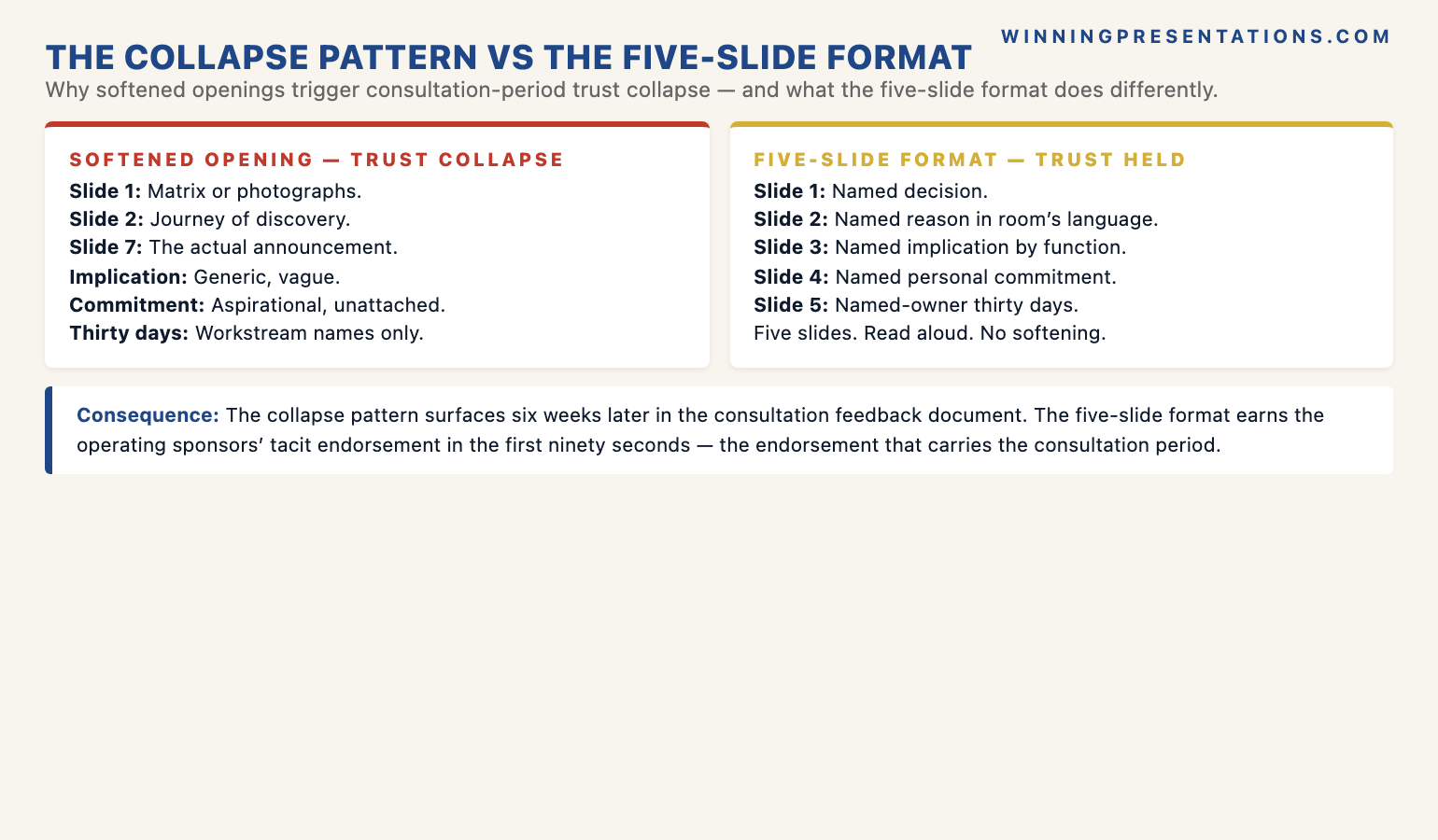
The collapse pattern is worth naming explicitly because it is the pattern the five-slide format is specifically built to prevent. The pattern has six steps and it plays out across the next two quarters, not the next ninety minutes, which is why most senior leaders do not recognise it as it is happening. Step one: the leader opens with a matrix or a journey-of-discovery slide rather than a named decision, and the room concludes within the first ninety seconds that the announcement is being deferred. Step two: the deck arrives at the substantive announcement on slide six or seven, by which point a third of the room has tuned out and a third of the remaining attention is on the timing of the deferred announcement rather than its content. Step three: the implication slide is generic — “this will mean changes for the way we work together” — because the leader has not done the per-function specificity work in advance, and the room reads the genericness as evasion. Step four: the personal commitment is absent or aspirational — “I am personally invested in supporting the team through this” — and the room reads the missing specificity as a leader who has not yet committed to the operational work of the consultation period.
Step five is where the damage compounds. The Q&A in the announcement meeting itself rarely surfaces the collapse, because the cultural pattern in most senior corporate environments is to defer the difficult questions to the next forum rather than ask them directly of a leader who has just delivered a major announcement. The leader walks out believing the announcement landed because nobody pushed back in the room. The restructuring presentation that gets the board comfortable before the announcement covers the upstream version of this dynamic in the executive-committee approval meeting; the downstream version of the same dynamic, in the all-hands announcement meeting that follows, is what step five describes. The questions that did not get asked in the room get asked over the next two weeks in the corridors, in the team huddles, in the one-to-ones with line managers, and the leader is not in any of those rooms to hear them. The line managers, who were in the announcement meeting and read the genericness of the implication slide and the absence of personal commitment, do not have answers to the questions and report up to the leader that “the team is processing the news”.
Step six is the consultation feedback. The formal feedback document, six to twelve weeks after the announcement, records a deeper trust loss across the affected functions than the executive committee had budgeted for. The leader is genuinely surprised because the announcement “went well”. The trust loss takes two quarters to repair, requires personal one-to-one engagement with the affected leaders the original announcement never reached, and absorbs operating bandwidth that was supposed to be deployed against the new operating model the reorganisation was designed to enable. The reorganisation, in operational terms, lands six months later than it would have done if the announcement had used the five-slide format. The cost is rarely accounted for inside the programme’s formal cost-benefit analysis, because it sits in the deferred-execution column rather than the announcement-execution column, but it is real and it shows up in the next two quarterly business reviews. The acquisition-integration board briefing structure covers the equivalent dynamic in M&A integration announcements, where the trust loss in the acquired-team announcement compounds across the integration timeline; the underlying pattern is the same and the structural fix is the same.
One thing to do before the next reorganisation announcement
Write the five slides last. Not first. The matrix-on-slide-one opener is the slide the leader writes when they start with the operating-model paper and work forwards. The five-slide format is what the leader writes when they start with the room’s ninety-second judgement and work backwards. Block ninety minutes the day before the announcement. Write the five slides in order. Read each one aloud to a colleague from a different function who was not in the planning. Hand slide two to a chief of staff from one of the affected functions and ask them whether the reasoning sounds like the room’s vocabulary or the head office’s. Iterate until the read-aloud test passes. Walk into the announcement with the five slides in front of you and the strategy team’s deck in your bag. Deliver the five slides. The consultation period that follows will be calibrated by the trust the announcement just built, and the difference between the two outcomes will not be visible in the room but will be visible in the formal feedback document twelve weeks later.
Frequently asked questions
Five slides feels light for a major reorganisation announcement. Won’t the room expect a fuller deck?
The room expects what is on the screen to match what is coming out of the leader’s mouth in the first ten minutes, and five slides match a ten-minute opening more cleanly than a 16-box matrix and a 24-slide deck ever can. The fuller-deck instinct comes from the strategy team and the change-management firm, both of whom have legitimate reasons to want their analytical work visible, and from the leader’s own anxiety about being seen to have skipped over the rigour of the operating-model review. Neither is the room’s instinct. Senior operating audiences read a five-slide opening as a leader who has compressed the message to what the room needs, which is a much harder discipline than expanding it. The fuller content the leader wants on the screen belongs in the appendix that follows slide five and gets walked through in the Q&A if the questions surface it, not in the announcement deck itself. Five slides do the announcement job. The remaining slides answer questions and that is a different job.
What is the most common mistake newly-appointed senior leaders make on a reorganisation announcement?
The most common mistake is leading with the operating-model matrix on slide one. The intent is to demonstrate that the decision was reached through structured analytical work and to give the room a framework to hold the implications inside. The effect, in a room of senior operating people who have been waiting six weeks to hear what was decided, is to signal that the leader is more interested in defending the analytical work than in delivering its operational consequences. The room reads the matrix-on-slide-one opening as deferral and tunes out by minute three. The fix is not to drop the matrix entirely; the fix is to move it to slide six or seven, after the five named slides have done the announcement work, and to use it then as the supporting framework for the questions that surface in the Q&A. The matrix is a good slide; it is the wrong first slide.
Does this format work when the reorganisation is being delivered in difficult circumstances such as redundancies or a forced closure?
It works particularly well in difficult circumstances, with a small adaptation in tone rather than structure. The five named slides stay the same: named decision, named reason in the room’s language, named implication by function, named personal commitment, named thirty-day window. The discipline in a difficult announcement is to keep slide one direct rather than soft, to keep slide three honest by naming the role-loss numbers rather than the workstream changes, and to keep slide four explicitly personal — the leader’s personal commitment to chair the weekly review, to publish the redeployment options on a specific date, to write personally to every affected individual. The format is more useful in difficult announcements than in routine ones because the room has already braced for the message and cannot tolerate evasion or padding. The leader who opens directly is respected by the affected functions. The leader who softens loses the room before the substantive content begins and inherits a deeper trust loss across the consultation period.
How does this differ for a small-team reorganisation versus a division-wide one?
The structure of the five slides does not change with audience size or scope; the level of granularity on slides three and five does. In a small-team reorganisation of thirty or forty people, slide three names the implication for each affected role rather than each affected function, and slide five names events at the named-individual level — one-to-ones scheduled with each affected person by a specific date, redeployment options published to each individual personally rather than to the function as a whole. In a division-wide reorganisation of several hundred people, slide three operates at function level and slide five at workstream level with named senior owners. The principle is the same: the room reads specificity as commitment and genericness as evasion. The granularity calibrates to what the room can hold, not to what the programme management office wants to communicate.
Won’t the operating sponsors in the room think the leader hasn’t prepared if the opening slide is this short?
The opposite reaction is the consistent one. Operating sponsors — the chiefs of staff, the long-serving operating directors, the senior HR business partners — have sat through more reorganisation announcements than the leader has, and they read a busy first slide as a sign that the leader is not yet sure what the announcement is about. A short, dense, decision-shaped first slide reads to those sponsors as evidence the leader has done the work to compress the message, which is much harder than expanding it. The pencil note in the back of the room — the small annotation the chief of staff makes during the opening — tends to be positive when the first slide is the named-decision opening. The format earns the operating sponsors’ tacit endorsement in the first ninety seconds, which is the endorsement that carries the rest of the announcement and the consultation period that follows.
The Winning Edge — weekly newsletter
The Winning Edge is a weekly (Thursday) newsletter for senior professionals who present at the executive level. One short email a week, focused on the structural moves that separate reorganisation announcements the room remembers from announcements it processes through into a consultation feedback document. Subscribe to The Winning Edge →
For the broader picture across slides, storytelling, confidence, and delivery, the seven-product Complete Presenter library is the bundle most senior leaders find useful as a single resource — £99 for everything, lifetime access.
About the author
Mary Beth Hazeldine is Owner & Managing Director of Winning Presentations Ltd. With 24 years of corporate banking experience at JPMorgan Chase, PwC, Royal Bank of Scotland, and Commerzbank, she advises executives across financial services, healthcare, technology, and government on structuring presentations for reorganisation announcements, board approvals, and high-stakes change communications.