

Quick answer: What C-suite executives want in presentations comes down to seven patterns: the recommendation first, the trade-off named, the resource implication explicit, the alternative considered, the risk acknowledged honestly, the controls visible, and the decision framed as a clear ask. Beneath the patterns is one expectation — that the presenter has thought about the proposal the way the room will read it. C-suite audiences reward audience-aware presenters and punish topic-driven ones, regardless of how strong the underlying analysis is.
Jump to:
The pattern is consistent across functions and industries. A function leader walks into the executive committee with a deck the function has worked on for weeks. The deck is rigorous. The slides are clean. The narrative is well-rehearsed. Twelve minutes in, the chair asks a question that the deck does not answer — what would the firm have to give up to make this happen — and the rest of the meeting becomes a conversation about a question the presenter had not framed for.
The frustration that follows is recognisable. The presenter knows the proposal. The proposal is sound. The deck explains it well. Why is the room asking a different question than the one the deck is set up to answer? The answer is structural. C-suite audiences are not reading the deck the presenter built. They are reading the deck through their own frame — the frame that allocates capital, makes trade-offs across functions, and decides what the organisation does and does not do.
What C-suite executives actually want in presentations is not a list of preferences. It is a small number of structural patterns. Seven patterns hold across functions, industries, and topics. Senior presenters who have done many C-suite meetings recognise them. First-time presenters often miss them, even when the underlying work is excellent. The patterns are the thing the deck has to be built around — not as an afterthought, but as the structural backbone.
If your last C-suite presentation didn’t land the way the work deserved
The Executive Buy-In Presentation System covers the structures senior professionals use when an executive committee decision rides on a single presentation. 7 self-paced modules including stakeholder analysis, case construction, and the slide structures that hold up under C-suite scrutiny. Monthly cohort enrolment, optional recorded Q&A sessions.
The frame the C-suite is reading from
A C-suite executive’s job is to allocate the firm’s scarcest resources — capital, executive attention, organisational change capacity — across competing claims. Every presentation is being read against that frame, whether the presenter knows it or not. A proposal that does not name what the firm is being asked to allocate is read as incomplete, even if the analysis behind it is excellent. A proposal that does name the allocation is read as decision-ready.
The reading happens fast. Most C-suite executives form a working assessment of a proposal within the first three slides. The remainder of the deck either confirms the assessment or has to fight against it. Decks built around the topic — what the project is, what the analysis showed, what the team did — produce a slow opening that loses the room before the case is on the table. Decks built around the decision — what is being asked, what trade-off is implied, what the room is being asked to give up — set the frame the room is already reading from.
Time pressure compounds the frame. C-suite agendas allocate twenty to forty minutes per topic. Within that, the discussion takes more than half. A presenter has twelve to fifteen minutes of content time, often less. The deck has to deliver the recommendation, the case, the trade-off, and the risk inside that window. There is no time for warm-up, methodology recap, or extended context. The frame is unforgiving — and that is why the patterns matter.
Seven patterns C-suite presenters recognise
The seven patterns are what experienced C-suite presenters do automatically. The deck contains all seven. The presenter speaks to all seven. The Q&A reinforces all seven. The patterns are not stylistic choices — they are structural requirements that match how the room reads.
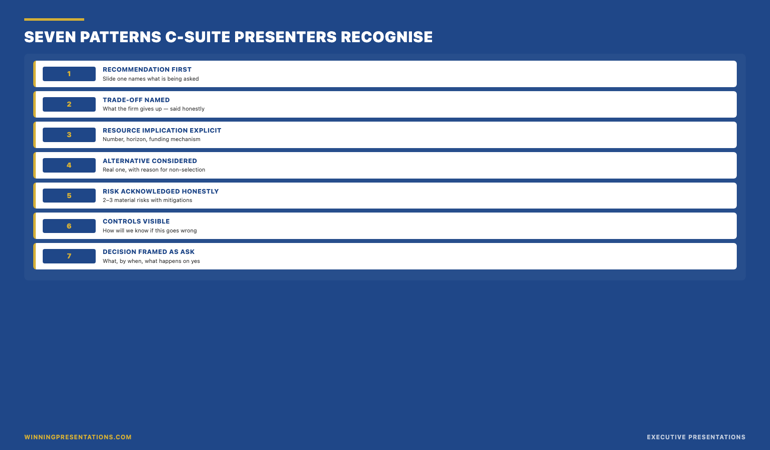
Pattern 1 — The recommendation arrives first. Slide one names what is being recommended, in commitment terms. Not the project. Not the analysis. The recommendation. The room reads the recommendation, decides what level of scrutiny to apply, and reads the rest of the deck through that lens. A recommendation that hides on slide nine is a recommendation that loses the room before the case appears.
Pattern 2 — The trade-off is named. Every C-suite proposal implies a trade-off — what the firm is choosing to do instead of, or in addition to, something else. Naming the trade-off explicitly is the strongest signal of strategic thinking a presenter can send. “This requires reallocating two FTEs from programme Y, which slows that programme by approximately one quarter.” The room hears the trade-off and reads the presenter as someone thinking across functions, not just within one. Hiding the trade-off, or pretending none exists, reads as operational naïveté.
Pattern 3 — The resource implication is explicit. Capital, headcount, executive attention, change capacity. Whatever resource the proposal consumes, the implication is named in commitment terms — the number, the time horizon, the funding mechanism. “£X over Y years, funded from Z, with a recurring run-rate of W after implementation.” Vague resource implications signal that the proposal is not yet ready for sign-off. Explicit ones move the conversation toward decision rather than toward clarification.
Pattern 4 — An alternative was considered, named, and rejected for a reason. CFOs and CEOs ask “why this over X” almost universally. Pre-empting the question on the deck signals that the comparison work has been done. Two or three alternatives, each with a brief reason for non-selection. The alternative slide is one of the highest-leverage slides in the deck — it converts what would have been a reactive Q&A moment into a proactive case-strengthening moment.
For senior leaders building decks for executive committee scrutiny
The Executive Buy-In Presentation System — the framework senior professionals use when an executive committee decision rides on a single presentation
Walk into your next executive committee with the structures the room is reading for. The Executive Buy-In Presentation System is a self-paced framework — 7 modules covering stakeholder analysis, case construction, and the slide structures that produce sign-off at C-suite level. Monthly cohort enrolment.
- 7 self-paced modules covering stakeholder analysis, case construction, and the structures that earn senior approval
- Optional live Q&A / coaching calls — fully recorded, watch back at your own pace
- No deadlines, no mandatory live attendance, lifetime access to materials
- Monthly cohort enrolment — enrol any time, start with the next cohort
£499 · Self-paced · Lifetime access to materials · Next cohort enrolment opens monthly
Pattern 5 — The risk is acknowledged honestly. The two or three material risks, named, with a stated mitigation for each. Not a comprehensive risk register. The C-suite is not testing whether the team has catalogued every possible risk — it is testing whether the team has decided which risks actually matter. Honest acknowledgement of the most material risk is one of the highest-trust moves a presenter can make. Hiding it, minimising it, or padding it with non-material risks is read as defensive — and the room treats defensive presenters more skeptically than honest ones.
Pattern 6 — The controls are visible. How the spend will be monitored, what the executive committee will see and when, what triggers a review or a course correction. The controls slide is often skipped, and it is the most consequential single slide for a C-suite audience. The case answers “is this worth doing?” — but the controls slide answers “how will we know if this goes wrong?” Without that answer, sign-off is structurally harder. With it, the conversation moves quickly toward yes.
Pattern 7 — The decision is framed as a clear ask. What is being asked of the executive committee, by when, and what will move forward immediately on approval. The decision slide is the conversation closer. “I am asking the committee to approve £X today, with implementation starting Q3, and committing the function to deliver Y by Q1.” Decks that end on a thank-you slide or a question slide tend to leak the close. Decks that end on a decision slide produce sign-off in the meeting more often than ones that don’t.
What the deck looks like when the patterns hold
A deck that holds all seven patterns has a recognisable shape. Eight to twelve slides. Recommendation on slide one, trade-off on slide two, case on slides three and four, alternative on slide five, risk on slide six, controls on slide seven, decision on slide eight. The narrative arc is the audience’s reading order, not the presenter’s analytical journey. Senior presenters tend to build decks in this shape almost without thinking. First-time presenters tend to build decks that walk through the analysis chronologically — and the chronology rarely matches what the room is reading for.
The slides themselves are restrained. One headline statement per slide. Three to five supporting bullet points or one chart that does the work. White space rather than density. The C-suite is reading at altitude — they are not searching for the data point on slide three, they are testing whether the proposal coheres. Slide density signals operational thinking. Slide restraint signals strategic thinking. The same content, presented at different densities, lands differently. The structural patterns of board presentations follow the same logic.
The narration is conversational, not didactic. The presenter is talking to peers, not lecturing. The opening sentence names what is being recommended. The next sentences walk the room through the trade-off and the case at the speed of conversation. The Q&A is treated as the substantive part of the meeting, not an afterthought — most decisions are actually made in the Q&A, not in the prepared remarks.
Slide templates aligned with the seven patterns
The Executive Slide System — board-ready templates for the C-suite deck shape
The Executive Slide System covers 26 slide templates, 93 AI prompts, and 16 scenario playbooks for senior presenters — including recommendation slides, trade-off layouts, alternative-considered structures, and decision-close formats designed for executive committee audiences. £39, instant download. Explore the slide system →
Four failure modes that read as operational
A presentation that misses the seven patterns tends to read as operational rather than strategic — and the executive committee responds by treating the presenter as the wrong altitude for the room. The four failure modes below are the most common ways this happens, and the fixes are usually structural rather than cosmetic.
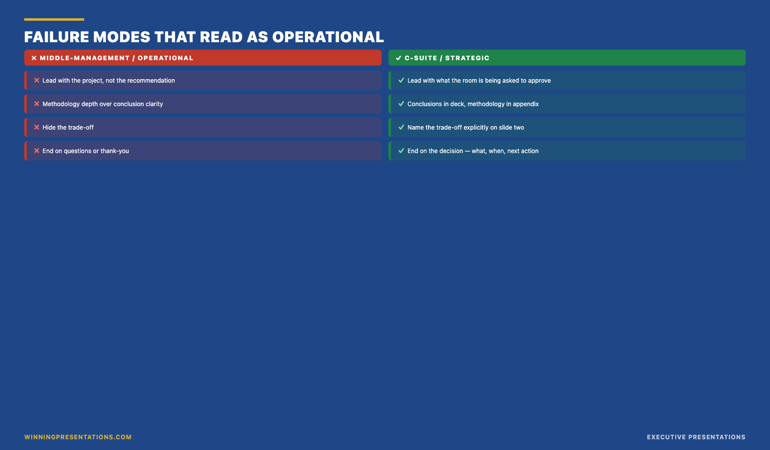
Failure mode one — leading with the project, not the recommendation. “Today I’d like to walk you through Project X” is an operational opening. The C-suite is not interested in the project. They are interested in the decision. The fix is to lead with what the room is being asked to approve. “Today I’m asking the committee to approve £X for an eighteen-month investment in Y, with first measurable outcome by Z.” The recommendation is the headline. The project is context that supports it.
Failure mode two — methodology depth instead of conclusion clarity. Walking the room through the analytical journey is the operational reflex — the presenter is most comfortable in the analysis, so they spend the most time there. The C-suite is not interested in the journey. They assume the analysis was rigorous. They want the conclusions and the trade-offs. The methodology belongs in the appendix or in a separate working document. The deck holds the conclusions.
Failure mode three — hiding the trade-off. Presenting a proposal as if no trade-off is implied — “this is great for the firm, here’s why” — reads as either naïve or evasive. The C-suite knows the proposal implies a trade-off. The question is whether the presenter knows. Naming the trade-off explicitly converts a moment of doubt into a moment of credibility. The trade-off is the most underused slide in C-suite decks.
Failure mode four — ending on questions, not the decision. “Questions?” is the operational close. It cedes the room to the chair and lets the meeting drift toward “let’s revisit”. The C-suite close is the decision slide — the ask, the timing, the next action. A clear close produces a clear answer. A vague close produces “let me think about it”, which is what most first-time presenters experience as the meeting concluding without a decision.
Frequently asked questions
Are the seven patterns the same for every C-suite, or do they vary by industry?
The patterns are remarkably consistent across financial services, healthcare, technology, and government. The vocabulary changes — “regulatory commitment” in financial services, “outcome data” in healthcare, “platform investment” in technology — but the structural patterns hold. Industries differ in tolerance for risk, in the weight given to controls, and in how the trade-off is framed (consumed capital in finance, opportunity cost in technology). The seven elements are present in all of them, even when the language differs.
If we only have ten minutes, which patterns can we drop?
None of them. All seven patterns can fit into ten minutes if the deck is restrained — recommendation (1 minute), trade-off (1 minute), case (3 minutes), alternative (1 minute), risk (1.5 minutes), controls (1 minute), decision (1.5 minutes). The compression discipline is what surfaces the cleanest version of each pattern. A ten-minute deck that hits all seven lands more strongly than a twenty-minute deck that hits five thoroughly. Time pressure forces clarity.
What if my proposal genuinely does not have a trade-off?
It does. Every executive committee decision implies a trade-off, even when the proposal looks self-funding or “no regrets”. The trade-off may be opportunity cost (executive attention spent on this rather than something else), change capacity (organisational bandwidth absorbed by this rather than another initiative), or precedent (approving this opens the door to similar requests). If the trade-off feels invisible, the search has not gone far enough yet. The room knows the trade-off is there. The presenter’s job is to name it before the room does.
Should the alternative slide actually present a real alternative we considered?
Yes — a real one. The alternative has to be plausible enough that the executive committee could imagine choosing it. A straw-man alternative is read instantly and damages credibility. The strongest alternative slides include the second-best option the team genuinely considered, with one or two sentences of why it was not selected. The work behind that slide is real work — and it usually strengthens the recommendation, because the comparison sharpens the reasons the chosen option is better.
Maven cohort enrolment — open this month
Build decks the C-suite is reading for, not the deck the function would build internally
The Executive Buy-In Presentation System teaches the case construction, stakeholder dynamics, and slide structures that match how executive committees read and decide. 7 self-paced modules. Monthly cohort enrolment.
£499 · Self-paced · Lifetime access · Optional recorded Q&A calls
The Winning Edge — weekly
One short note each Thursday on board-level presentation patterns, structural shortcuts, and the behaviours senior presenters use under scrutiny. Written for professionals who do not have time for newsletters that read like newsletters.
Want a structural starting point first? The free Executive Presentation Checklist covers the structural fundamentals senior presenters use before designing the deck.
For the companion piece on first-time C-suite preparation, see presenting to the C-suite for the first time — the seven-day protocol that gets the deck and the presenter ready in parallel.
Next step: Pull up your last C-suite deck. Check it against the seven patterns. Where the patterns are weak, the failure modes are usually present. The fixes are structural — moving the recommendation forward, adding the trade-off slide, replacing the methodology depth with the conclusions, ending on a decision rather than on questions. The next deck reads differently when it is built around the patterns rather than around the topic.
Mary Beth Hazeldine is the Owner & Managing Director of Winning Presentations. With 25 years of corporate banking experience at JPMorgan Chase, PwC, Royal Bank of Scotland, and Commerzbank, she advises senior professionals across financial services, healthcare, technology, and government on structuring presentations for high-stakes board meetings, executive committees, and investment sessions. She speaks German and works extensively with the German-speaking financial markets.