

Most client story slides in a presentation pitch fail because they present facts instead of telling a narrative. A logo, three bullet points, and a revenue figure gives your prospect nothing to feel. The fix is the Transformation Narrative — a 4-part structure (Situation → Struggle → Solution → Shift) that turns the same client data into a story your prospect sees themselves inside. This article shows you exactly how to build one.
In this article:
- Why Case Study Slides Get Ignored
- The 4-Part Transformation Narrative
- Part 1: Situation — Make Them Recognise Themselves
- Part 2: Struggle — The Moment That Nearly Broke It
- Part 3: Solution — What Actually Changed
- Part 4: Shift — The Measurable Transformation
- How to Deliver a Client Story in 90 Seconds
- FAQ
I watched a PwC partner present a “case study” slide to a room of twelve prospective clients. The slide had everything: a client logo, three bullet points of deliverables, and “£2.1M increase in annual revenue” at the bottom. Nobody reacted.
Then a second partner stood up — same client, same engagement, same results — and told it differently: “Their sales team was closing at 11%. Their CEO told us, ‘We have 90 days before the board replaces me.’ They’d tried three consultancies and were about to cancel the entire programme. We had one shot.”
The room leaned forward. People put their phones down. Someone asked a question before she’d finished.
Same client. Same facts. Same £2.1M. Completely different impact.
The difference? She didn’t present a case study. She told a client story. And the structure she used follows a pattern that neuroscience explains perfectly: case studies inform. Stories persuade. Your prospect doesn’t need to know about your client’s success — they need to feel it. Decisions are made emotionally and justified rationally. If your client story only speaks to the rational brain, you’ve already lost the pitch.
🚨 Pitching to a client this week? Pull up your case study slide right now. Does it lead with a logo and bullet points? If the answer is yes, your prospect will process it as marketing — not proof. That slide is costing you deals.
→ Need the narrative frameworks that turn flat case studies into stories prospects see themselves inside? Get the Business Storytelling System → £29
Why Case Study Slides in Your Client Story Presentation Pitch Get Ignored
The standard case study slide — logo, bullets, revenue figure — fails for three specific neurological reasons. Understanding these isn’t academic. It’s the difference between a prospect who nods politely and one who leans forward and asks “how?”
Reason 1: No emotional activation. Facts alone don’t trigger the brain’s decision-making circuitry. When you say “£2.1M revenue increase,” the prefrontal cortex processes it as information. When you say “their CEO had 90 days before the board replaced him,” the amygdala activates — because now there’s a person, a threat, and urgency. The neuroscience of business storytelling shows that decisions require emotional engagement first, then rational justification.
Reason 2: No self-recognition. A logo and bullet points are about your previous client. A story about someone drowning in the same problem your prospect has — that’s about them. The prospect stops evaluating your credentials and starts imagining their own transformation. That psychological shift is where deals close.
Reason 3: No tension. Without a struggle, there’s no story. “We helped Company X achieve Y” is a statement. “Company X was 90 days from leadership change, had failed with three consultancies, and was about to cancel — until we found what everyone else missed” is a narrative with tension. The brain is wired to resolve tension, which means your audience stays engaged until the resolution. Bullet points have no tension. They get scanned and forgotten.
How do you tell a client story in a pitch presentation?
The most effective client stories in pitch presentations follow a 4-part Transformation Narrative: Situation (the context your prospect recognises), Struggle (the specific moment of crisis or failure), Solution (what you did differently), and Shift (the measurable transformation with emotion attached). This structure works because it activates emotional processing before presenting rational evidence — which mirrors how buying decisions are actually made. The key is starting with the client’s pain, not your deliverables. For more on the psychology of persuasive delivery, see our guide to persuasive presentations.
The 4-Part Transformation Narrative for Client Stories
This is the structure that separates client stories that close deals from case studies that get forgotten. It works for pitches, proposals, capability decks, and any sales conversation where you need to prove you’ve delivered results.
The framework: Situation → Struggle → Solution → Shift.
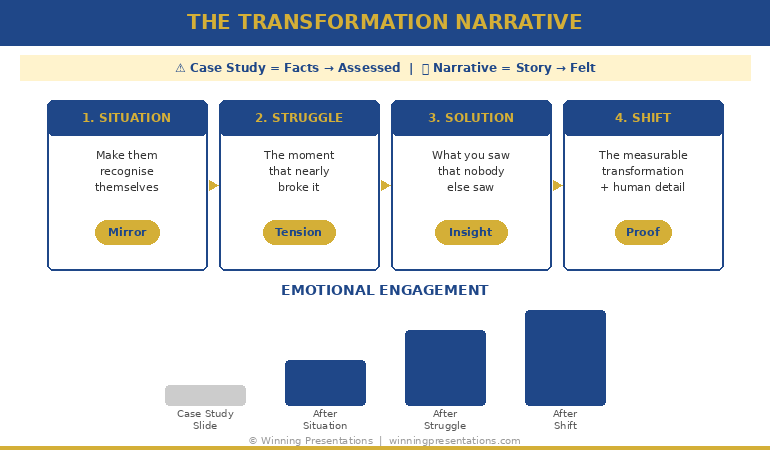
Each part has a specific job. Skip one, and the story collapses. Get all four right, and your prospect stops evaluating your proposal and starts imagining working with you.
Part 1: Situation — Make Them Recognise Themselves
The Situation isn’t background information. It’s a mirror. Your job is to describe your previous client’s world in terms your prospect recognises as their own.
This is where most client stories fail immediately. They start with: “ACME Corp is a global logistics company with 4,000 employees.” That’s a Wikipedia entry. Nobody leans forward for a Wikipedia entry.
Instead: “The VP of Operations was spending 40% of her week manually reconciling shipping data across three legacy systems that didn’t talk to each other. Her team was growing, but productivity was flat. She told us she’d stopped presenting operational metrics to the board because the numbers made her division look broken.”
Why this works: Your prospect has a VP of Operations. Your prospect has legacy systems. Your prospect has metrics they’d rather not present. They’re no longer hearing about ACME Corp — they’re hearing about themselves.
The formula:
- Name a role (not a company) — the person your prospect identifies with
- Describe a specific daily reality — not industry overview, but lived experience
- Include one emotional detail — what kept that person up at night
Flat Case Study vs. Pitch Story: Same Client, Different Impact
❌ The Flat Version (what most decks say):
“Global logistics company. Implemented data integration platform. Restructured reporting workflow. Result: 40% reduction in manual reconciliation time. £2.1M revenue increase.”
✅ The Pitch Story Version (Transformation Narrative):
“The VP of Operations was spending 40% of her week manually reconciling data. She’d stopped presenting metrics to the board because the numbers made her division look broken. They’d tried three consultancies. The CEO had 90 days. We realised the problem wasn’t the data — it was who owned it. Within six months, close rate went from 11% to 31%. The CEO presented those numbers to the board himself.”
Same facts. Same client. One gets scanned and forgotten. The other gets a follow-up question before you’ve finished telling it.
📋 10-Minute Prep: Turn Your Best Case Study Into a Pitch Story
- Pick your strongest client result — the one you mention in every pitch
- Write the Situation in one sentence: who was the person, and what was their daily reality?
- Find the Struggle: what nearly went wrong, or almost killed the project?
- Identify the Solution as an insight — what did you see that others missed?
- Write the Shift: the number + one human detail about what changed for the person
- Read it aloud and time it — if it’s under 90 seconds, it’s working
- Remove the client’s logo from the slide — tell the story first, show the logo after
Turn Every Client Win Into a Story That Closes the Next Deal
If your case study slides get polite nods but no engagement, the problem isn’t your results — it’s the narrative. The Business Storytelling System gives you 7 story frameworks including the Client Transformation structure, plus fill-in templates and AI prompts that build pitch-ready stories from your existing client data in minutes.
- The Transformation Narrative structure: Situation → Struggle → Solution → Shift — with fill-in worksheet
- 7 “Money Stories” for different pitch scenarios (origin, client win, failure lesson, contrarian insight, cost of inaction)
- The 60-Second Story Formula for delivering a client story in Q&A or meetings without slides
- 25 AI prompts that extract the emotional core from any client engagement data
What you get: 9 modules → 7 story frameworks → 42 fill-in templates → 14 worked examples → Story Bank system → 12-Point Story Audit → 25 AI prompts. Instant download.
Built from client pitches at JPMorgan, PwC, RBS, and Commerzbank — where the team that told the best client story won the mandate.
Part 2: Struggle — The Moment That Nearly Broke It
The Struggle is the most important part of the Transformation Narrative — and the part that bullet-point case studies eliminate entirely.
In standard case study format, the journey from problem to solution is a straight line: “Client had X problem. We implemented Y. Result was Z.” That’s a process summary. There’s no tension, no uncertainty, no risk. And without risk, there’s no story.
The Struggle introduces the moment where things nearly fell apart. The client almost walked away. The project hit an unexpected wall. The initial approach failed. Something had to change — and it wasn’t obvious what.
Going back to the PwC example: “They’d tried three different consultancies. They were about to cancel the entire transformation programme. We had one shot to prove the model worked.”
Why this works: Tension creates an open loop in the listener’s brain. The psychology of story delivery shows that unresolved tension keeps attention locked. Your prospect physically cannot disengage until they hear how the struggle resolved. That’s not persuasion technique — it’s neuroscience.
The formula:
- Name the specific obstacle — what went wrong or nearly went wrong
- Include a “nearly” moment — the point where the outcome was genuinely uncertain
- Make the stakes personal — not “the project was at risk” but “the CEO had 90 days”
A common objection: “But our client engagements don’t have dramatic moments.” Yes they do. You just haven’t looked for them. Every client had a moment of doubt, a competing priority, a budget challenge, a leadership change, or a deadline that nearly derailed the work. That’s your Struggle. The Business Storytelling System includes a Story Mining module with 18 extraction questions designed to find exactly these moments in any client engagement.
Why do case study slides fail in sales presentations?
Case study slides fail because they present outcomes without emotional context. A logo, three deliverables, and a revenue figure gives the prospect information they can evaluate rationally — and rational evaluation in a competitive pitch usually results in price comparison or deferral. Stories that include struggle, tension, and transformation activate emotional processing, which is where buying decisions actually originate. The format itself (bullet points on a slide) signals “here is data to assess” rather than “here is an experience to imagine yourself inside.” Replacing the case study slide with a 90-second spoken narrative using the same facts typically produces a dramatically different reaction.
Part 3: Solution — What Actually Changed
After the Struggle, the Solution answers one question: what did you see that nobody else saw?
This is not a list of deliverables. It’s not a methodology description. It’s the insight — the specific thing you understood about the client’s situation that led to the breakthrough. The more specific and unexpected this insight is, the more credible your story becomes.
Standard case study version: “We implemented a data integration platform and restructured the reporting workflow.”
Transformation Narrative version: “We realised the problem wasn’t the data — it was who owned it. Three departments were each building their own version of the truth. We didn’t integrate systems first. We put one person in charge of one number. Everything else followed.”
Why this works: The Solution, told as an insight, positions your team as the people who think differently — not just the people who execute competently. Every consultancy, agency, and service provider can list deliverables. Very few can articulate the unexpected insight that made the difference. That’s what your prospect is actually buying: your ability to see what others miss.
The formula:
- Lead with the insight, not the deliverable — what did you understand that others didn’t?
- Frame it as a counter-intuitive discovery — “the problem wasn’t X, it was Y”
- Keep it to one core idea — multiple insights dilute the story
Stop Losing Pitches Because Your Case Study Slide Bores the Room
Your competitor’s solution might be weaker — but if their client story makes the prospect feel something and yours doesn’t, they win the mandate. The Business Storytelling System gives you the narrative frameworks, templates, and AI prompts to turn every client win into a story that prospects remember and act on.
- The CLOSE Framework (Context → Limitation → Outcome → Solution → Evidence) for any client pitch scenario
- The Story Mining System — 6 extraction methods with 18 questions that find the struggle in any engagement
- Objection Story scripts — pre-built narratives for the 5 most common prospect pushbacks
- The 12-Point Story Audit — check every client story against the criteria that separate forgettable from unforgettable
Get the Business Storytelling System → £29
Used by consultants, sales teams, and account managers who pitch against competitors with bigger client lists — and win because their stories are better.
Part 4: Shift — The Measurable Transformation
The Shift is where your numbers finally appear — but with a critical difference from the standard case study. In a bullet-point format, the number stands alone: “£2.1M revenue increase.” In a Transformation Narrative, the number lands on top of emotional investment.
Your prospect has spent 60 seconds inside this client’s world. They’ve recognised themselves in the Situation. They’ve felt the tension of the Struggle. They’ve been impressed by the insight in the Solution. Now, when you deliver the number, it’s not abstract data — it’s the resolution of a story they’ve been living inside.
Standard case study version: “Result: £2.1M increase in annual revenue.”
Transformation Narrative version: “Within six months, their close rate went from 11% to 31%. Annual revenue increased by £2.1M. And the CEO? He presented those numbers to the board himself — the first operational presentation he’d given voluntarily in two years.”
Why this works: The number now carries emotional weight. It’s not just a metric — it’s the end of a story. And the personal detail (the CEO presenting voluntarily) makes it unforgettable. Facts inform. Stories with facts embedded in narrative persuade.
The formula:
- Lead with the metric that matters most to your prospect’s situation — not necessarily the biggest number
- Connect it back to the Struggle — show the distance between “nearly failed” and “succeeded”
- End with one human detail — what changed for the person, not just the organisation
The Business Storytelling System includes 14 worked examples across all 7 story types — each showing the full narrative arc from Situation through Shift, with the exact language choices annotated.
How to Deliver a Client Story in 90 Seconds
The Transformation Narrative doesn’t require a long presentation. In fact, the most powerful client stories in a pitch context are delivered in 90 seconds or less — spoken, not read from a slide.
Here’s the structure mapped to time:
- Situation (20 seconds): One sentence describing the person and their daily reality. “The VP of Operations was spending 40% of her week manually reconciling data across three systems.”
- Struggle (25 seconds): The obstacle and the “nearly” moment. “They’d tried three consultancies. The CEO had 90 days.”
- Solution (20 seconds): The insight — one counter-intuitive sentence. “We realised the problem wasn’t the data — it was who owned it.”
- Shift (25 seconds): The number plus one human detail. “Close rate from 11% to 31%. £2.1M. The CEO presented those numbers to the board himself.”
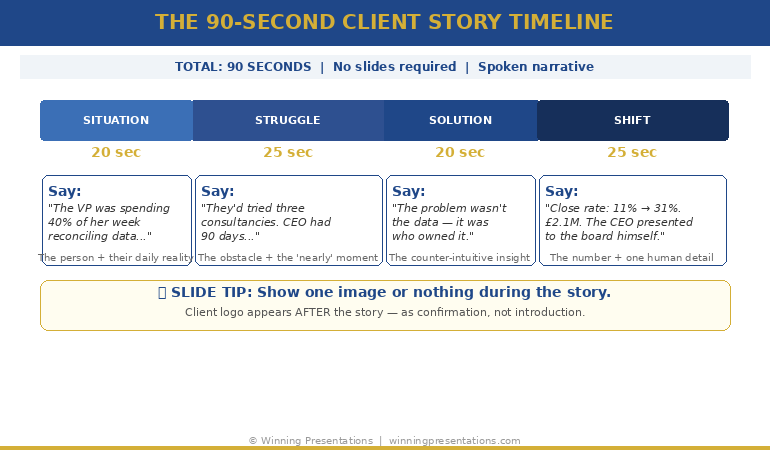
The slide behind you during this 90 seconds? One image. Or nothing at all. The client’s logo can appear after you finish the story — as confirmation, not introduction. When you lead with the story and follow with the logo, the prospect processes the logo as proof of what they just felt. When you lead with the logo, the prospect processes the story as marketing.
What makes a client story persuasive in a sales pitch?
Persuasive client stories share four elements: self-recognition (the prospect sees their own situation in the client’s world), genuine tension (a moment where the outcome was uncertain), a specific insight (what you saw that others missed), and an emotionally anchored result (a number connected to a human change, not just a metric). The most effective client stories in pitch presentations are told verbally in 90 seconds or less, with minimal or no slide support, because spoken narrative activates emotional processing while slide-based case studies activate analytical processing. The persuasive power comes from the structure, not the data.
Is This Right For You?
The Business Storytelling System is built for you if:
- You pitch to clients and your case study slides get polite nods but no engagement
- You have great client results but struggle to turn them into compelling narratives
- You’re competing against firms with bigger client lists and need your stories to work harder
- You want AI prompts that extract the emotional core from any client engagement data
It’s probably not right if you’re looking for slide design templates — the data storytelling framework covers the visual evidence side. This system is about the narrative structure behind the slides.
24 Years of Client Pitches. Every Story That Won a Mandate. Now in One System.
In corporate banking, every pitch is a competition — and the teams that win aren’t always the ones with the best solution. They’re the ones that tell the best story about their last client. The Business Storytelling System gives you the narrative frameworks, templates, and AI prompts I developed across thousands of client presentations at JPMorgan, PwC, RBS, and Commerzbank.
- 9 modules covering narrative psychology, story frameworks, mining techniques, delivery, and AI-powered story creation
- 7 “Money Story” types — each with fill-in templates and 2 worked examples (14 total)
- The Story Mining System — 6 extraction methods with 18 questions to find stories in any client data
- 25 AI prompts (10 generators + 5 refiners + 10 advanced) that build pitch-ready client stories from raw information
Get the Business Storytelling System → £29
Built from the client stories that won mandates in competitive banking pitches — including high-stakes funding rounds and competitive tenders.
Frequently Asked Questions
How do I use this structure if I can’t name the client?
You don’t need to name the client for the Transformation Narrative to work. “A global logistics company” or “a fintech startup in Series B” gives enough context for self-recognition. What matters is the specificity of the Situation, Struggle, and Shift — not the logo. In fact, in competitive pitches where confidentiality matters, unnamed stories often feel more credible because the prospect knows you’ll protect their information the same way. The structure works identically with or without the client name.
Can this structure work for internal presentations, not just sales?
Yes — and it often works even better internally. When you’re presenting a project update, a budget request, or a strategy recommendation, embedding a client or stakeholder story using the Transformation Narrative makes abstract business cases concrete. A finance committee evaluating your budget doesn’t want to hear deliverables. They want to hear the story of what happened last time — the struggle, the intervention, the measurable shift. That’s the same narrative psychology applied to a different audience.
What if my client engagement was straightforward with no real “struggle”?
Every engagement has a struggle — it just might not be dramatic. The client’s internal resistance to change. The competing priority that nearly killed the project. The moment the initial data came back different from expectations. The budget conversation that almost reduced scope. The Story Mining System in the Business Storytelling System includes 18 extraction questions specifically designed to surface the tension in seemingly smooth engagements. The struggle doesn’t need to be a crisis — it needs to be a moment of genuine uncertainty.
📬 Get weekly storytelling frameworks and pitch strategies that win client mandates.
Every week: one framework, one real example, zero theory. Join thousands of professionals who pitch, present, and persuade for a living.
🎯 Presenting to finance, not clients? If your next high-stakes presentation is a budget defence rather than a client pitch, the narrative structure shifts — but storytelling still wins. Read: Budget Defence Presentation: How to Protect Your Funding When Finance Wants Cuts
🎯 Need the full client presentation framework? If you’re building an entire client-facing deck (not just the story slides), this covers structure, slide order, and closing strategy: Client Presentations That Close (Not Just Impress)
Your next step: Take your best client win — the one you mention in every pitch — and rewrite it using the Situation → Struggle → Solution → Shift structure. Time yourself telling it out loud. If it’s under 90 seconds and your colleague asks a follow-up question, it’s working.
If you’re presenting to a client this week: your prospect is going to hear from your competitors too. Their slides will have bullet points and logos. The team that tells the best story about their last client wins the mandate. The Business Storytelling System (£29) gives you every framework, template, and AI prompt — ready to use before your next pitch. Instant download.
About the Author
Mary Beth Hazeldine is the Owner & Managing Director of Winning Presentations. With 24 years in corporate banking — including roles at JPMorgan Chase, PwC, Royal Bank of Scotland, and Commerzbank — she has trained thousands of executives in high-stakes presentations and supported high-stakes funding rounds and approvals. A qualified clinical hypnotherapist and NLP practitioner, Mary Beth combines boardroom experience with evidence-based psychology to help professionals present with authority and close with confidence.


