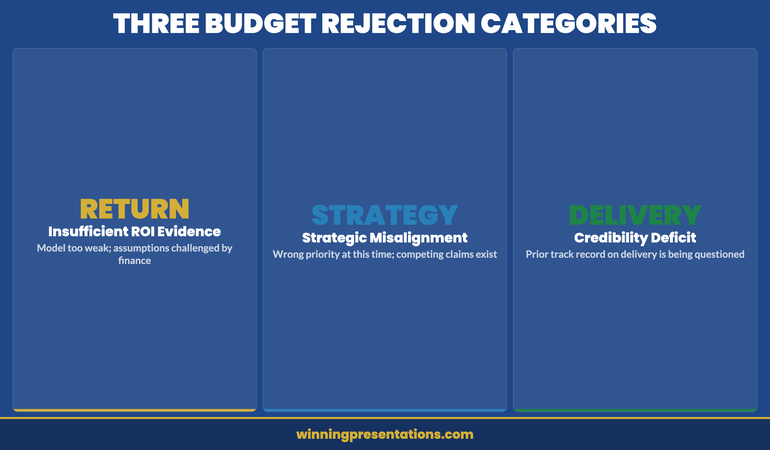
Quick Answer: A budget resubmission fails when you present the same deck again. Finance committees rejected your original request for specific reasons — usually around ROI evidence, timing, or lack of alternatives analysis. A successful resubmission acknowledges the rejection, isolates the exact objections raised, addresses each one with new evidence, and presents the project as stronger, not unchanged. The slides are secondary to the diagnostic work that happens before you open PowerPoint.
Henrik had prepared for six weeks. The CapEx request was airtight — or so he thought. When the finance committee rejected his £2.3 million infrastructure upgrade, the feedback was three lines: “ROI timeline unclear. Alternatives not sufficiently explored. Timing not aligned with current priorities.”
He was deflated. His instinct was to go back in three months with the same deck, slightly updated. His CFO stopped him. “They didn’t reject the project,” she said. “They rejected the presentation of it. That’s a different problem.”
That distinction changed everything. Henrik spent two weeks doing the diagnostic work the first submission skipped — mapping the committee’s actual concerns, building a phased ROI model, and including a genuine alternatives analysis. Six weeks later, the resubmission was approved. Not because the project had changed. Because the presentation finally spoke to what the committee needed to hear.
If your budget request has already been rejected
The Executive Slide System includes slide templates designed specifically for finance and approval presentations — including resubmission scenarios where you need to address prior objections and rebuild credibility with the same committee.
Why Most Budget Resubmissions Fail
The most common mistake in a budget resubmission is treating it as a resubmission. Executives go back with the same slides, the same narrative, and perhaps some updated figures — and are surprised when the committee says no again.
Finance committees have a specific memory of your previous presentation. They remember why they said no. When you return with something that looks largely unchanged, you signal either that you didn’t understand their objections, or that you understood them but couldn’t address them. Neither reading helps your case.
The second common mistake is addressing the wrong objections. Committees rarely tell you their real concerns in the formal feedback. “ROI timeline unclear” might actually mean “we don’t trust the assumptions in your model.” “Timing not aligned with current priorities” might mean “one board member has a competing project and has already lobbied against yours.” Understanding the surface objection and the underlying concern are different tasks.
A budget resubmission is not a second bite of the same apple. It is a new presentation built from a post-mortem of the first one. The executive who approaches it this way consistently outperforms the one who simply tries harder with the same material.
Executive Slide System
Structure the Resubmission So Finance Committees Say Yes
The Executive Slide System — £39, instant access — includes slide templates for finance and approval scenarios, AI prompt cards to rebuild your ROI narrative, and a scenario playbook for executives presenting to hostile or sceptical decision-makers. Designed for budget presentations where the first submission didn’t land and you need a structurally stronger case the second time.
- Slide templates for CapEx, opex, and budget approval presentations
- AI prompt cards to pressure-test your financial assumptions before the meeting
- Framework guides for structuring an objection-response narrative
- Scenario playbooks for finance committee, board, and investment committee presentations
Get the Executive Slide System →
Designed for executives facing second-attempt approval presentations.
Diagnosing What the Committee Actually Objected To
Before you change a single slide, you need to understand what the committee actually objected to. This requires going beyond the formal written feedback, which is almost always a sanitised version of the real conversation.
Request a debrief with the chair of the finance committee or the most senior sponsor in the room. Frame it as seeking guidance: “I want to ensure I’m addressing the committee’s concerns properly before resubmitting. Would you be willing to give me fifteen minutes to understand what would strengthen the case?” Most chairs will say yes — they want well-constructed proposals coming back, not the same weak ones.
In that conversation, listen for three things. First, which objections were raised by whom — understanding the political landscape inside the committee matters. Second, what the committee would need to see to be confident in the ROI assumptions — this tells you what new evidence to gather. Third, whether the timing objection is real or a proxy for something else. If one committee member is pushing a competing capital project, timing becomes a way to delay your proposal rather than reject it outright.
Once you have this diagnostic information, map each concern to a specific change you will make in the deck. If you cannot identify what change addresses each concern, the resubmission is not ready yet. The internal link between concern and response is what makes the resubmission feel genuinely responsive rather than cosmetically updated. See how this approach connects to the pre-meeting work described in The Follow-Up Deck: Why Most Approvals Die After the Meeting.
The Four Changes That Earn a Second Look
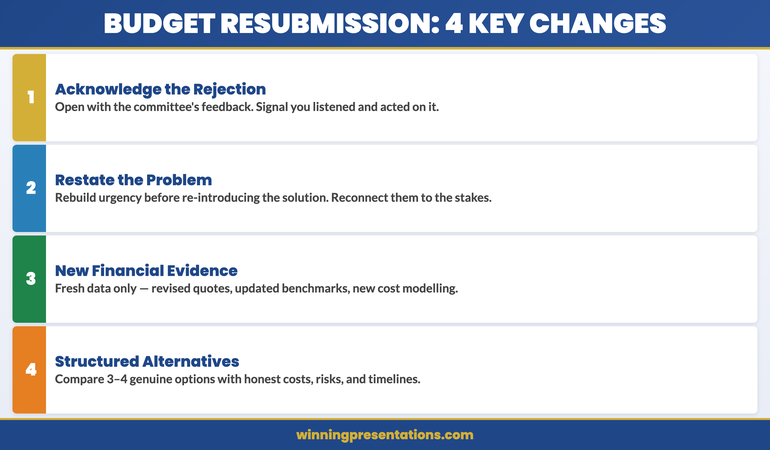
Not every resubmission needs a complete rebuild. Most need four targeted changes, each one designed to address a specific category of concern that finance committees raise when they reject a budget request.
1. Acknowledge the rejection explicitly. Open the resubmission by referencing the previous presentation and what you heard from the committee. “Following the committee’s feedback in February, this revised proposal addresses three specific areas: the ROI timeline, alternatives analysis, and alignment with the current capital priorities.” This signals that you listened, that you did the work, and that this is a genuinely improved version — not the same material with fresh slides.
2. Restate the problem, not the solution. Many rejected budget requests spend the first ten slides describing the solution — the system, the infrastructure, the initiative — before establishing why the problem matters. Committees who weren’t sold the first time need to be reconnected to the urgency of the problem before they can evaluate the solution on its merits. Rebuild the problem slide before you rebuild anything else.
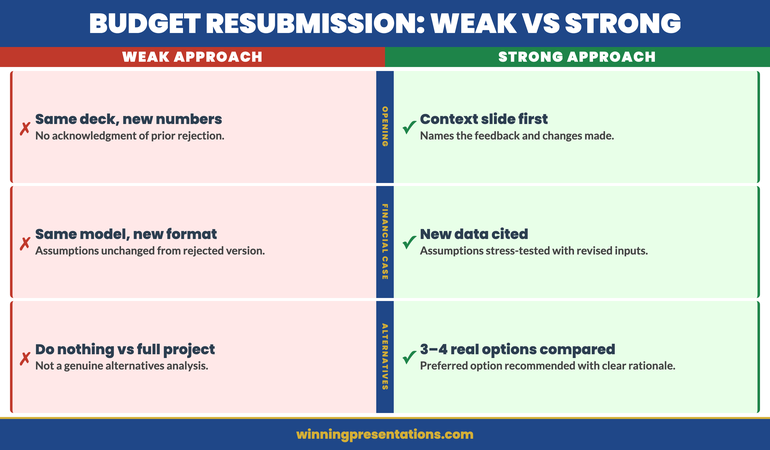
3. Introduce genuinely new financial evidence. If the ROI model was questioned, you need new inputs — not the same model with different formatting. Commission updated cost modelling, gather vendor quotes that support the assumptions, or bring in market benchmarks from a credible external source. The committee will recognise recycled figures dressed in new slides. New evidence signals that the financial case has been properly stress-tested.
4. Include a structured alternatives analysis. “We considered doing nothing, and also doing the project at half-scale” is not an alternatives analysis. A structured alternatives analysis presents three to four genuine options — including the do-nothing scenario — with honest comparative costs, risks, and timelines for each. This demonstrates that your preferred option is the recommended outcome of a rigorous process, not simply the option the team preferred from the start.
For a deeper look at how CapEx presentations are structured from the outset, see Capital Expenditure Presentation: The Slide Structure That Gets CapEx Approved.
If you need to rebuild the financial narrative quickly and ensure the slide structure meets finance committee expectations, the Executive Slide System includes prompt cards specifically designed for restructuring a presentation that didn’t land the first time.
Building Your Resubmission Case
A resubmission is not built in PowerPoint. It is built in the weeks of work that happen before you open a presentation tool. The slides are the output of a process — not the process itself.
Start by updating your stakeholder map. Between your first presentation and the resubmission, the political landscape inside the committee may have changed. New members may have joined. The CFO’s priorities may have shifted. A competing project may have been approved or rejected, which changes the available capital headroom. Your pre-meeting conversations should give you an updated picture of where support and opposition sit before you step into the room.
Next, rebuild the financial model with new inputs. If the committee questioned your assumptions, the only credible response is new data. If they challenged your implementation timeline, bring in updated project management assessments. If they were concerned about total cost of ownership, include a five-year cost comparison that previous models omitted. Every financial assumption that was challenged needs a corresponding piece of new evidence that wasn’t in the original submission.
Then update your risk section. Most first submissions understate implementation risk because project teams are optimistic about their own proposals. A resubmission that honestly names the risks — and then explains how each one is mitigated — signals intellectual rigour. Finance committees are more comfortable approving projects where the risk has been honestly assessed than projects where it appears to have been glossed over.
Finally, update your internal cross-references. If the resubmission references savings from a related initiative, or assumes integration with an existing system, those dependencies need to be named and confirmed in writing before the presentation. Assumptions that couldn’t be confirmed in the first submission should be confirmed before the second.
Structuring the Resubmission Deck
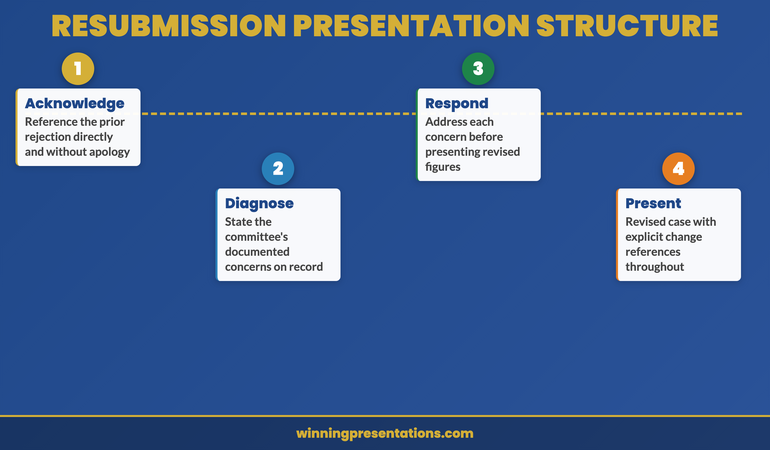
The structure of a resubmission deck differs from a first-pass budget request in one important way: the opening acknowledges the history. Committees who have already seen your proposal need to see that history acknowledged before they can engage with the updated case. A deck that opens as though the rejection never happened reads as either oblivious or evasive.
A resubmission deck structured for finance committees typically follows this sequence:
Slide 1 — Context slide: One line on when the original proposal was submitted and a single sentence on what feedback was received. This is not a defensive slide — it is a signalling slide. It says “I heard you, and this version responds to what I heard.”
Slides 2–3 — The problem: Rebuild the urgency of the business problem. Not the solution — the problem. What happens if this doesn’t get funded? What is the cost of delay, in concrete terms? If the committee didn’t feel the urgency the first time, this is where you earn it back.
Slides 4–5 — The updated ROI case: Present the revised financial model with its new inputs highlighted. Don’t bury the changes — surface them. “Since February, we have obtained revised vendor quotes and updated the model based on current market rates. The revised payback period is 3.2 years, compared to 4.1 years in the original submission.” Specificity here signals that the changes are real, not cosmetic.
Slide 6 — Alternatives analysis: Three or four genuine options, compared on cost, risk, and timeline. Recommend your preferred option at the end, with a brief rationale. Keep this slide to a grid — not paragraphs.
Slides 7–8 — Risk and mitigation: Name the top three implementation risks and the corresponding mitigation for each. If a risk was specifically raised by a committee member in the previous session, address it by name in this section.
Slide 9 — Implementation roadmap: Phased milestones, owners, and decision points. If the original timeline was challenged, show how the revised timeline is structured and what would trigger a go/no-go decision at each phase.
Slide 10 — The ask: One slide. The specific amount, the timing, and one sentence on what approval unlocks. For guidance on how this sequence connects to zero-based budget frameworks, see Zero-Based Budget Presentation: Justify Every Line to Finance.
Presenting the Resubmission Without Appearing Defensive
The tone of a resubmission matters as much as the content. Executives who come back into the room carrying resentment about the original rejection — even when that resentment is concealed — communicate it through their body language, their framing, and the way they handle questions.
The framing that works best is genuine curiosity about whether the case is now strong enough, not determination to get approval at all costs. “Following the feedback from February, we’ve done additional work that I’d like to walk you through” is a different energy from “We’ve addressed every concern that was raised.” The first is collaborative. The second is defensive.
When questions come, don’t pre-empt them with elaborate explanations of why the original model was correct. If the committee asks about a changed assumption, answer the question directly, then explain the new basis for that assumption. The order matters: answer first, explain second. Pre-emptive defensiveness reads as if you’re trying to win an argument rather than inform a decision.
Finally, be prepared to accept a partial approval. Finance committees sometimes approve a phased version of a project when they’re not ready to commit the full amount. If you have structured a phased option in your deck, you’re positioned to accept this outcome as a win rather than a compromise. “Yes to Phase 1, conditional review for Phase 2” can be a stronger outcome than a second outright rejection.
Ready to Rebuild the Case?
Slide Templates Designed for Finance Committee Presentations
The Executive Slide System — £39, instant access — gives you templates for CapEx, budget approval, and resubmission scenarios, plus AI prompt cards to restructure the financial narrative before you step back into the room.
Frequently Asked Questions
How long should I wait before resubmitting a rejected budget?
There is no fixed waiting period, but a resubmission submitted fewer than four weeks after rejection usually signals that insufficient diagnostic work has been done. The credibility of the resubmission depends on the quality of the changes, not the speed of the return. Most committees expect to see a resubmission at the next scheduled budget cycle — typically quarterly. If you have a compelling reason to return sooner, the context slide at the start of your deck should explain the timing rationale.
Should I request a pre-meeting with committee members before resubmitting?
Yes. Pre-meeting conversations with the committee chair and key decision-makers are one of the highest-value activities you can do before a resubmission. These conversations let you confirm that your revised case addresses the specific concerns that led to rejection, rather than the concerns you assumed were the issue. They also give you early signals about whether the timing is right and whether there are any political dynamics you need to account for in how you structure the presentation.
What if the rejection was politically motivated rather than financial?
Political rejections — where a committee member blocked the proposal for reasons unrelated to its financial merit — are common and require a different response to financial rejections. In this situation, the priority before resubmission is shoring up political support outside the meeting room. Identify who opposed the proposal and why, then work with your sponsor to either address their underlying concern or build a coalition of support strong enough that opposition becomes untenable. Resubmitting without addressing a political blockage produces the same result.
The Winning Edge — Free Weekly Newsletter
Practical frameworks for executives who present to boards, finance committees, and senior leadership. Every Thursday.
Not ready for the full system? Start here instead: download the free Executive Presentation Checklist — a one-page reference covering the structural elements finance committees look for in budget and approval presentations.
About the Author
Mary Beth Hazeldine is Owner & Managing Director of Winning Presentations. With 25 years of corporate banking experience at JPMorgan Chase, PwC, Royal Bank of Scotland, and Commerzbank, she advises executives across financial services, healthcare, technology, and government on structuring presentations for high-stakes funding rounds and approvals.