Tag: budget rejection

17 Apr 2026
A finance director presenting a revised budget proposal to a sceptical finance committee in a corporate boardroom, navy and dark tones, editorial photography style

Budget Resubmission Presentation: What Finance Committees Need to See

Quick Answer: A budget resubmission fails when you present the same deck again. Finance committees rejected your original request for specific reasons — usually around ROI evidence, timing, or lack of alternatives analysis. A successful resubmission acknowledges the rejection, isolates the exact objections raised, addresses each one with new evidence, and presents the project as stronger, not unchanged. The slides are secondary to the diagnostic work that happens before you open PowerPoint.

Henrik had prepared for six weeks. The CapEx request was airtight — or so he thought. When the finance committee rejected his £2.3 million infrastructure upgrade, the feedback was three lines: “ROI timeline unclear. Alternatives not sufficiently explored. Timing not aligned with current priorities.”

He was deflated. His instinct was to go back in three months with the same deck, slightly updated. His CFO stopped him. “They didn’t reject the project,” she said. “They rejected the presentation of it. That’s a different problem.”

That distinction changed everything. Henrik spent two weeks doing the diagnostic work the first submission skipped — mapping the committee’s actual concerns, building a phased ROI model, and including a genuine alternatives analysis. Six weeks later, the resubmission was approved. Not because the project had changed. Because the presentation finally spoke to what the committee needed to hear.

If your budget request has already been rejected

The Executive Slide System includes slide templates designed specifically for finance and approval presentations — including resubmission scenarios where you need to address prior objections and rebuild credibility with the same committee.

Explore the System →

Why Most Budget Resubmissions Fail

The most common mistake in a budget resubmission is treating it as a resubmission. Executives go back with the same slides, the same narrative, and perhaps some updated figures — and are surprised when the committee says no again.

Finance committees have a specific memory of your previous presentation. They remember why they said no. When you return with something that looks largely unchanged, you signal either that you didn’t understand their objections, or that you understood them but couldn’t address them. Neither reading helps your case.

The second common mistake is addressing the wrong objections. Committees rarely tell you their real concerns in the formal feedback. “ROI timeline unclear” might actually mean “we don’t trust the assumptions in your model.” “Timing not aligned with current priorities” might mean “one board member has a competing project and has already lobbied against yours.” Understanding the surface objection and the underlying concern are different tasks.

A budget resubmission is not a second bite of the same apple. It is a new presentation built from a post-mortem of the first one. The executive who approaches it this way consistently outperforms the one who simply tries harder with the same material.

Executive Slide System

Structure the Resubmission So Finance Committees Say Yes

The Executive Slide System — £39, instant access — includes slide templates for finance and approval scenarios, AI prompt cards to rebuild your ROI narrative, and a scenario playbook for executives presenting to hostile or sceptical decision-makers. Designed for budget presentations where the first submission didn’t land and you need a structurally stronger case the second time.

  • Slide templates for CapEx, opex, and budget approval presentations
  • AI prompt cards to pressure-test your financial assumptions before the meeting
  • Framework guides for structuring an objection-response narrative
  • Scenario playbooks for finance committee, board, and investment committee presentations

Get the Executive Slide System →

Designed for executives facing second-attempt approval presentations.

The Four Changes for a Successful Budget Resubmission infographic showing: Diagnose the Real Objection, Address with New Evidence, Reframe the Narrative, and Present the Alternatives

Diagnosing What the Committee Actually Objected To

Before you change a single slide, you need to understand what the committee actually objected to. This requires going beyond the formal written feedback, which is almost always a sanitised version of the real conversation.

Request a debrief with the chair of the finance committee or the most senior sponsor in the room. Frame it as seeking guidance: “I want to ensure I’m addressing the committee’s concerns properly before resubmitting. Would you be willing to give me fifteen minutes to understand what would strengthen the case?” Most chairs will say yes — they want well-constructed proposals coming back, not the same weak ones.

In that conversation, listen for three things. First, which objections were raised by whom — understanding the political landscape inside the committee matters. Second, what the committee would need to see to be confident in the ROI assumptions — this tells you what new evidence to gather. Third, whether the timing objection is real or a proxy for something else. If one committee member is pushing a competing capital project, timing becomes a way to delay your proposal rather than reject it outright.

Once you have this diagnostic information, map each concern to a specific change you will make in the deck. If you cannot identify what change addresses each concern, the resubmission is not ready yet. The internal link between concern and response is what makes the resubmission feel genuinely responsive rather than cosmetically updated. See how this approach connects to the pre-meeting work described in The Follow-Up Deck: Why Most Approvals Die After the Meeting.

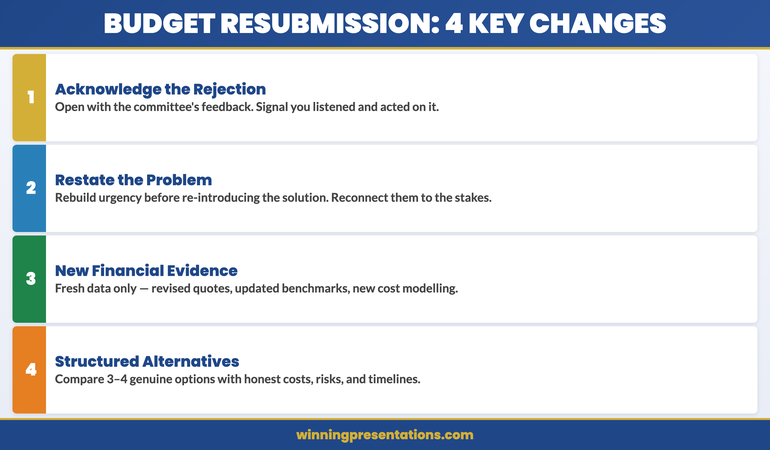
The Four Changes That Earn a Second Look

Not every resubmission needs a complete rebuild. Most need four targeted changes, each one designed to address a specific category of concern that finance committees raise when they reject a budget request.

1. Acknowledge the rejection explicitly. Open the resubmission by referencing the previous presentation and what you heard from the committee. “Following the committee’s feedback in February, this revised proposal addresses three specific areas: the ROI timeline, alternatives analysis, and alignment with the current capital priorities.” This signals that you listened, that you did the work, and that this is a genuinely improved version — not the same material with fresh slides.

2. Restate the problem, not the solution. Many rejected budget requests spend the first ten slides describing the solution — the system, the infrastructure, the initiative — before establishing why the problem matters. Committees who weren’t sold the first time need to be reconnected to the urgency of the problem before they can evaluate the solution on its merits. Rebuild the problem slide before you rebuild anything else.

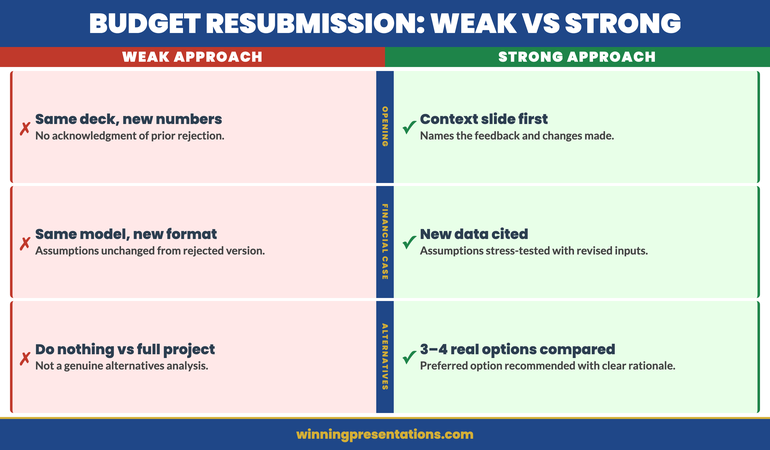
3. Introduce genuinely new financial evidence. If the ROI model was questioned, you need new inputs — not the same model with different formatting. Commission updated cost modelling, gather vendor quotes that support the assumptions, or bring in market benchmarks from a credible external source. The committee will recognise recycled figures dressed in new slides. New evidence signals that the financial case has been properly stress-tested.

4. Include a structured alternatives analysis. “We considered doing nothing, and also doing the project at half-scale” is not an alternatives analysis. A structured alternatives analysis presents three to four genuine options — including the do-nothing scenario — with honest comparative costs, risks, and timelines for each. This demonstrates that your preferred option is the recommended outcome of a rigorous process, not simply the option the team preferred from the start.

For a deeper look at how CapEx presentations are structured from the outset, see Capital Expenditure Presentation: The Slide Structure That Gets CapEx Approved.

If you need to rebuild the financial narrative quickly and ensure the slide structure meets finance committee expectations, the Executive Slide System includes prompt cards specifically designed for restructuring a presentation that didn’t land the first time.

Weak vs Strong Budget Resubmission comparison infographic showing the difference between cosmetic updates and diagnostic restructuring across four dimensions: problem framing, ROI evidence, alternatives analysis, and objection response

Building Your Resubmission Case

A resubmission is not built in PowerPoint. It is built in the weeks of work that happen before you open a presentation tool. The slides are the output of a process — not the process itself.

Start by updating your stakeholder map. Between your first presentation and the resubmission, the political landscape inside the committee may have changed. New members may have joined. The CFO’s priorities may have shifted. A competing project may have been approved or rejected, which changes the available capital headroom. Your pre-meeting conversations should give you an updated picture of where support and opposition sit before you step into the room.

Next, rebuild the financial model with new inputs. If the committee questioned your assumptions, the only credible response is new data. If they challenged your implementation timeline, bring in updated project management assessments. If they were concerned about total cost of ownership, include a five-year cost comparison that previous models omitted. Every financial assumption that was challenged needs a corresponding piece of new evidence that wasn’t in the original submission.

Then update your risk section. Most first submissions understate implementation risk because project teams are optimistic about their own proposals. A resubmission that honestly names the risks — and then explains how each one is mitigated — signals intellectual rigour. Finance committees are more comfortable approving projects where the risk has been honestly assessed than projects where it appears to have been glossed over.

Finally, update your internal cross-references. If the resubmission references savings from a related initiative, or assumes integration with an existing system, those dependencies need to be named and confirmed in writing before the presentation. Assumptions that couldn’t be confirmed in the first submission should be confirmed before the second.

Structuring the Resubmission Deck

The structure of a resubmission deck differs from a first-pass budget request in one important way: the opening acknowledges the history. Committees who have already seen your proposal need to see that history acknowledged before they can engage with the updated case. A deck that opens as though the rejection never happened reads as either oblivious or evasive.

A resubmission deck structured for finance committees typically follows this sequence:

Slide 1 — Context slide: One line on when the original proposal was submitted and a single sentence on what feedback was received. This is not a defensive slide — it is a signalling slide. It says “I heard you, and this version responds to what I heard.”

Slides 2–3 — The problem: Rebuild the urgency of the business problem. Not the solution — the problem. What happens if this doesn’t get funded? What is the cost of delay, in concrete terms? If the committee didn’t feel the urgency the first time, this is where you earn it back.

Slides 4–5 — The updated ROI case: Present the revised financial model with its new inputs highlighted. Don’t bury the changes — surface them. “Since February, we have obtained revised vendor quotes and updated the model based on current market rates. The revised payback period is 3.2 years, compared to 4.1 years in the original submission.” Specificity here signals that the changes are real, not cosmetic.

Slide 6 — Alternatives analysis: Three or four genuine options, compared on cost, risk, and timeline. Recommend your preferred option at the end, with a brief rationale. Keep this slide to a grid — not paragraphs.

Slides 7–8 — Risk and mitigation: Name the top three implementation risks and the corresponding mitigation for each. If a risk was specifically raised by a committee member in the previous session, address it by name in this section.

Slide 9 — Implementation roadmap: Phased milestones, owners, and decision points. If the original timeline was challenged, show how the revised timeline is structured and what would trigger a go/no-go decision at each phase.

Slide 10 — The ask: One slide. The specific amount, the timing, and one sentence on what approval unlocks. For guidance on how this sequence connects to zero-based budget frameworks, see Zero-Based Budget Presentation: Justify Every Line to Finance.

Presenting the Resubmission Without Appearing Defensive

The tone of a resubmission matters as much as the content. Executives who come back into the room carrying resentment about the original rejection — even when that resentment is concealed — communicate it through their body language, their framing, and the way they handle questions.

The framing that works best is genuine curiosity about whether the case is now strong enough, not determination to get approval at all costs. “Following the feedback from February, we’ve done additional work that I’d like to walk you through” is a different energy from “We’ve addressed every concern that was raised.” The first is collaborative. The second is defensive.

When questions come, don’t pre-empt them with elaborate explanations of why the original model was correct. If the committee asks about a changed assumption, answer the question directly, then explain the new basis for that assumption. The order matters: answer first, explain second. Pre-emptive defensiveness reads as if you’re trying to win an argument rather than inform a decision.

Finally, be prepared to accept a partial approval. Finance committees sometimes approve a phased version of a project when they’re not ready to commit the full amount. If you have structured a phased option in your deck, you’re positioned to accept this outcome as a win rather than a compromise. “Yes to Phase 1, conditional review for Phase 2” can be a stronger outcome than a second outright rejection.

Ready to Rebuild the Case?

Slide Templates Designed for Finance Committee Presentations

The Executive Slide System — £39, instant access — gives you templates for CapEx, budget approval, and resubmission scenarios, plus AI prompt cards to restructure the financial narrative before you step back into the room.

Get the Executive Slide System →

Frequently Asked Questions

How long should I wait before resubmitting a rejected budget?

There is no fixed waiting period, but a resubmission submitted fewer than four weeks after rejection usually signals that insufficient diagnostic work has been done. The credibility of the resubmission depends on the quality of the changes, not the speed of the return. Most committees expect to see a resubmission at the next scheduled budget cycle — typically quarterly. If you have a compelling reason to return sooner, the context slide at the start of your deck should explain the timing rationale.

Should I request a pre-meeting with committee members before resubmitting?

Yes. Pre-meeting conversations with the committee chair and key decision-makers are one of the highest-value activities you can do before a resubmission. These conversations let you confirm that your revised case addresses the specific concerns that led to rejection, rather than the concerns you assumed were the issue. They also give you early signals about whether the timing is right and whether there are any political dynamics you need to account for in how you structure the presentation.

What if the rejection was politically motivated rather than financial?

Political rejections — where a committee member blocked the proposal for reasons unrelated to its financial merit — are common and require a different response to financial rejections. In this situation, the priority before resubmission is shoring up political support outside the meeting room. Identify who opposed the proposal and why, then work with your sponsor to either address their underlying concern or build a coalition of support strong enough that opposition becomes untenable. Resubmitting without addressing a political blockage produces the same result.

The Winning Edge — Free Weekly Newsletter

Practical frameworks for executives who present to boards, finance committees, and senior leadership. Every Thursday.

Subscribe to The Winning Edge →

Not ready for the full system? Start here instead: download the free Executive Presentation Checklist — a one-page reference covering the structural elements finance committees look for in budget and approval presentations.

About the Author

Mary Beth Hazeldine is Owner & Managing Director of Winning Presentations. With 25 years of corporate banking experience at JPMorgan Chase, PwC, Royal Bank of Scotland, and Commerzbank, she advises executives across financial services, healthcare, technology, and government on structuring presentations for high-stakes funding rounds and approvals.

09 Apr 2026

Budget Resubmission Presentation: What to Change After the First Rejection

Quick Answer

A budget resubmission presentation should not simply re-present the original proposal with adjusted numbers. Finance committees that rejected your initial submission are looking for evidence that you understood why it was rejected, that you have addressed the underlying concerns, and that you can defend the revised case under scrutiny. The structure of the resubmission matters as much as the revised figures.

Kenji had been Head of Technology at a retail banking group for two years when his infrastructure modernisation budget was rejected at the April finance committee. The committee’s feedback was brief: the proposal lacked sufficient evidence of ROI, and the timeline was considered optimistic given the organisation’s recent delivery record on technology projects.

His initial response was to rebuild the financial model. He spent three weeks tightening the numbers, adding sensitivity analyses, and extending the timeline by six months. When he presented the revised proposal in June, the committee rejected it again. This time the feedback was different: the committee was not confident the business case addressed the fundamental question of why this investment was necessary now rather than in the next financial year.

The financial model had never been the problem. The problem was that Kenji’s original presentation had led with capability and features — what the infrastructure would be able to do — rather than with risk and consequence — what would happen if the current infrastructure was not replaced. The committee had rejected the framing of the proposal, not just the numbers. Until the resubmission addressed that framing, no amount of revised modelling would produce a different outcome.

Preparing a budget resubmission?

Before you rebuild the model, check whether your slide structure addresses what the committee actually rejected. The Executive Slide System includes financial presentation frameworks designed for approval meetings, including resubmissions after rejection. Explore the System →

Why Budgets Are Rejected and What Finance Actually Needs

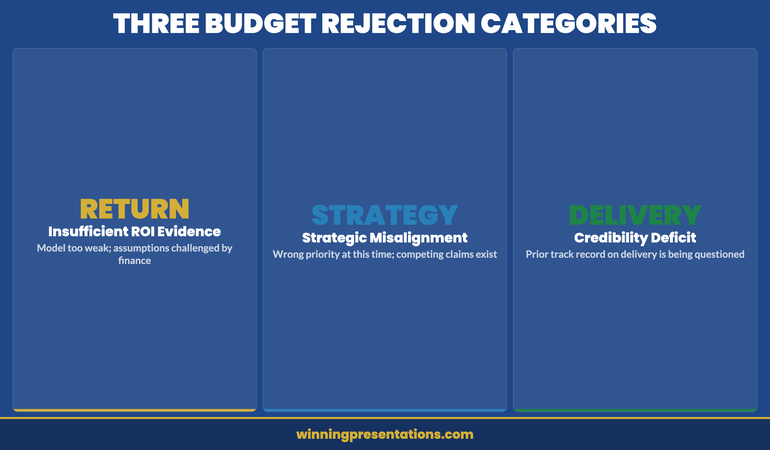
Budget rejections fall into three categories, and only one of them is actually about the numbers. Understanding which category your rejection belongs to determines what the resubmission needs to address.

The first category is insufficient evidence of return. The committee cannot see a credible path from the investment to a measurable outcome. This is a modelling and assumptions problem — and it is the only category where revising the financial model alone will resolve the issue. If you can provide tighter assumptions, stronger benchmarks, or a clearer articulation of how return will be measured and when, the resubmission has a direct path to approval.

The second category is strategic misalignment. The committee does not believe this investment is the right priority at this time, relative to other competing claims on the budget. No amount of modelling resolves this. The resubmission needs to demonstrate how this investment connects to the organisation’s current strategic priorities, and specifically why deferring it creates a worse outcome than approving it now.

The third category — the most common and the hardest to diagnose — is a credibility deficit. The committee is not confident that the presenter or their team can deliver what is being proposed. This is particularly acute when the organisation has a history of late or over-budget technology or infrastructure projects, which is a reason Kenji’s second submission failed. A resubmission that does not directly address the delivery confidence problem will not succeed, regardless of the quality of the financial model.

Most rejected budgets contain elements of all three. The task before the resubmission is to identify which is the dominant concern, because that determines the entire structure of the revised presentation.

Three categories of budget rejection: return evidence, strategic alignment, and delivery credibility

The First Move After Rejection

The first thing to do after a budget rejection is not to revise the proposal. It is to understand precisely what was rejected and why. This sounds obvious, but most post-rejection conversations focus on what the presenter thinks the committee meant, rather than on getting the committee’s actual concerns on record.

Request a debrief, ideally with the finance director or the committee chair, within a week of the decision. The question to ask is not “what would it take to get this approved?” — which puts the committee in the position of designing your resubmission — but rather “what specific concerns were unresolved at the point of decision?” This frames the conversation as a diagnostic rather than a negotiation, and experienced finance directors will give you considerably more useful feedback if they feel they are being asked to help you understand rather than being pressured to change their minds.

Document the feedback carefully. When the resubmission is eventually presented, the committee will compare what they said to what you addressed. If the resubmission does not map directly to the documented concerns, it signals that you either did not understand the feedback or chose to work around it — neither of which builds confidence.

What to Change — and What Not to Touch

There is a common instinct to make the resubmission significantly different from the original — to demonstrate responsiveness and effort. This instinct is partially right and partially dangerous. Substantial changes that address the committee’s documented concerns signal that you listened and acted. Substantial changes that go beyond what was asked signal either that you had doubts about the original proposal that you did not disclose, or that you are making changes to appear responsive rather than because they are substantively right.

Change the structure of the case if the rejection was about framing. If the committee rejected the proposal because the rationale was wrong — capability-led rather than risk-led, for example — restructure the argument, not just the slides. The committee will recognise a slide reshuffle; they will not recognise a genuinely different argument unless it is genuinely different.

Change the financial assumptions if they were specifically challenged. If the committee requested more conservative growth projections or questioned the cost assumptions, revise them with explicit references to what changed and why. Do not quietly update figures without acknowledging the change — the committee will notice the difference and will want to know why the original numbers were presented if these more cautious assumptions were available.

Do not change anything that was not the subject of feedback. Altering elements of the proposal that the committee did not question suggests uncertainty about the original position, and invites new questions about material that was previously settled.

For guidance on structuring the financial argument itself, the approach in zero-based budget presentations is directly applicable to resubmissions where the original proposal was rejected on return-evidence grounds — the discipline of justifying each line from first principles removes the assumption problem that often underlies the “insufficient ROI” rejection.

Executive Slide System

Build Financial Presentations That Get Budget Approval

The Executive Slide System provides structured frameworks for financial and budget presentations, including resubmissions after rejection. It includes slide templates for finance committee meetings, AI prompt cards to build the case quickly, and scenario guides for challenging approval environments.

  • Slide templates for budget and financial approval presentations
  • AI prompt cards to structure the resubmission argument
  • Framework guides for risk-led and return-led financial cases
  • Scenario playbooks for budget, capex, and resource allocation items

Get the Executive Slide System — £39

Designed for budget and financial presentations in regulated and corporate environments.

Structuring the Resubmission Presentation

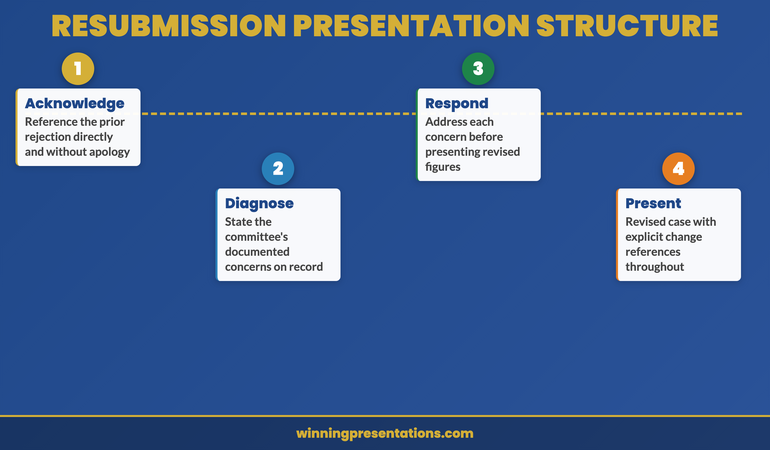
A budget resubmission presentation has a structural requirement that the original proposal does not: it must acknowledge the previous rejection before making the case. Presenting a revised budget as if the original was never rejected — simply updating the figures and re-presenting the slides — is the single most common structural error in resubmissions, and it consistently produces a worse reception than the original.

The committee knows this is a resubmission. Pretending otherwise reads as either oblivious or evasive. The structure that works is: acknowledgement, diagnosis, response, revised case.

Acknowledgement: Open with a brief, direct reference to the previous submission and its outcome. “This is a revised proposal for [project], following the committee’s decision in April. The original submission was rejected on two grounds, which I will address directly.” This signals that you are aware of the history, you are not defensive about it, and the resubmission is designed to resolve the specific concerns raised.

Diagnosis: State what you understood the committee’s concerns to be. If you had a debrief conversation, reference it. “Based on the feedback received from [name/role], the committee’s primary concerns were: [specific concerns].” This gives the committee the opportunity to confirm or correct your understanding before the revised case is presented, and it demonstrates that you conducted a genuine post-rejection diagnostic rather than simply revising the slides.

Response: Address each concern directly, in the order it was raised. Not buried in the appendix, not woven into the financial model — directly, as a standalone section that the committee can evaluate before the revised figures are presented. This is the part of the resubmission that most commonly gets cut for time, which is almost always a mistake. The committee’s concerns are the test the resubmission must pass; address them before asking for approval.

Revised case: Present the updated financial proposal, incorporating the changes made in response to the committee’s feedback, with explicit references to what changed and why.

For reference on how resource and financial proposals are typically structured for contested approval environments, the resource allocation presentation framework covers the argumentation approach that works when budgets are under direct competitive pressure.

The Three Objections to Address Before They Raise Them

In a resubmission, there are typically three objections that the committee will raise regardless of how comprehensively the original concerns were addressed. Addressing these proactively — before they are raised as questions — materially reduces the risk of a second rejection.

The first is: “Why should we approve this now rather than defer it to next year’s cycle?” This objection is almost always present when a budget was rejected once already. The committee may have approved an alternative proposal in the interim, making this one appear less urgent than it did six months ago. The resubmission needs a current-state argument: what has changed since the original submission, and how does that change affect the cost or risk of waiting a further twelve months?

The second is: “What gives us confidence the delivery will be successful?” This is particularly acute when the organisation has a track record of project overruns, or when the project scope has changed between the original and revised submissions. A resubmission that does not include a delivery confidence section — covering governance arrangements, milestone structure, and how delivery risk will be managed — will encounter this objection in the room.

The third is: “Is this the right amount?” After a rejection, committees are sensitive to whether the revised budget is genuinely right-sized or has simply been reduced to secure approval, with the expectation that a supplementary request will follow. If the budget has been reduced from the original, explain specifically what scope was removed to achieve the reduction, not just that the figure is lower.

Three pre-emptive objections for a budget resubmission: timing, delivery confidence, and budget sizing

Presenting the Revision Without Looking Defensive

The psychological challenge of a resubmission is presenting a revised case with full conviction when you know the committee has already said no once. The temptation is to over-qualify — to hedge the revised figures, acknowledge every uncertainty, and soften the recommendation. This reads as lack of confidence in the revised case, which is the last impression a resubmission needs to create.

The discipline is to hold the distinction between acknowledging the rejection and diminishing the recommendation. You can acknowledge the previous decision with directness and without apology, and then present the revised case with exactly the same conviction you would bring to a first submission. The rejection was of the previous case; this is a different case. It deserves to be presented as such.

Avoid two common tone errors. The first is apologetic framing — “I know you have concerns about this, and I hope this revised version addresses them” — which positions the presenter as petitioner rather than professional making a considered case. The second is over-confident dismissal — “I believe we have now resolved all the concerns raised” — which can read as arrogant and tends to provoke the committee into finding new concerns. The right tone is direct and measured: “The revised proposal addresses the specific concerns raised in April. Here is how.”

If the capital expenditure case involves significant infrastructure investment, the guidance in capital expenditure presentations covers how to frame large investment proposals in a way that holds up under scrutiny — including how to address delivery risk in the financial narrative itself rather than in a separate risk register that committees rarely read.

If your budget proposal has been rejected once and you are preparing the resubmission, the Executive Slide System includes financial presentation frameworks that address the structural requirements of a second-attempt approval, including how to lead with the committee’s previous concerns.

Executive Slide System

Slide Templates for Budget and Financial Approval Meetings

Structure your resubmission using frameworks designed for contested financial approvals — from the opening acknowledgement to the revised recommendation and delivery confidence section.

Get the Executive Slide System — £39

Designed for financial and budget presentations in corporate and regulated environments.

Frequently Asked Questions

How long should a budget resubmission presentation be?

A resubmission should typically be shorter than the original proposal, not longer. If the original was rejected because the case was unclear, adding more slides rarely resolves the problem — it usually compounds it. The acknowledgement-diagnosis-response-revised case structure can typically be delivered in eight to twelve slides, with supporting detail in the appendix. The committee has already read a version of this proposal; they do not need the full context again. They need to see that their specific concerns have been addressed and that the revised figures are sound.

Should you request a meeting with the finance director before the formal resubmission?

Yes, where possible. A pre-meeting with the finance director or a relevant committee member before the formal resubmission gives you the opportunity to test whether your revised case addresses their concerns before the formal meeting, and it signals engagement with the feedback process rather than a determination to push the proposal through regardless. It is not appropriate to use this meeting to lobby for approval — it is a diagnostic conversation, not a pre-vote. The question to ask is whether your diagnosis of the rejection matches their recollection of the discussion.

What should you do if the budget is rejected a second time?

Request a direct conversation with the committee chair or finance director to understand whether the objection is to this proposal specifically or to the priority of the investment in the current environment. If the committee has a fundamental view that the investment should not happen now — regardless of the quality of the case — no amount of revised modelling will change the outcome. The more productive path is to understand what conditions would need to change for the proposal to succeed, and to determine whether those conditions are likely to be met within a timeframe that makes the investment still relevant.

The Winning Edge — Weekly Newsletter

Each Thursday: one executive presentation insight, one structure, one practical tool. Read by executives across financial services, healthcare, technology, and infrastructure.

Subscribe to The Winning Edge

Preparing a budget or financial approval presentation? The Executive Presentation Checklist is a free download covering structure, language, and approval-readiness for finance committee and board presentations.

About the Author

Mary Beth Hazeldine is Owner and Managing Director of Winning Presentations. With 25 years of corporate banking experience at JPMorgan Chase, PwC, Royal Bank of Scotland, and Commerzbank, she advises executives across financial services, healthcare, technology, and government on structuring presentations for high-stakes funding rounds, board approvals, and governance reviews. View services | Book a discovery call