Tag: budget justification

29 Apr 2026
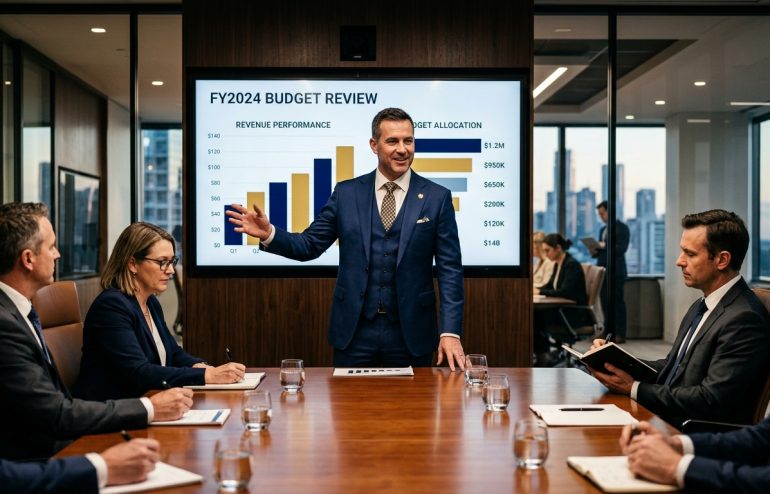
Man in a blue suit presents FY2024 Budget Review to colleagues around a conference table with a large display behind him.

Annual Budget Presentation: How to Defend Your Numbers When the CFO Pushes Back

Quick Answer

An annual budget presentation survives CFO scrutiny when every number connects to a business outcome and every assumption is stated openly. The executives who get their budgets approved are not the ones with the most detailed spreadsheets — they are the ones who anticipate the challenge questions, present clear trade-offs, and show what happens if funding is reduced. Structure your deck around defensibility, not justification.

Leila had rehearsed the numbers until she could recite them from memory.

Her department’s annual budget request was £2.8 million — a twelve per cent increase on the previous year, driven almost entirely by two new hires and a platform migration that had been deferred twice already. She had cost every line item, benchmarked salaries against market data, and built a phased implementation plan for the platform project. The deck was forty-one slides. She felt prepared.

The CFO let her get to slide nine before asking: “Leila, what happens if I give you two million instead of 2.8?”

She hesitated. She hadn’t built that slide. She had built the case for what she needed, not the case for what she would do with less. The next four minutes were improvised answers about which hires could be delayed and which platform costs were flexible — none of which she had modelled. The CFO made a note. Leila knew the note was not in her favour.

Three weeks later, the budget came back approved at £2.1 million — with no input from her on where the reduction should fall. The CFO had made the cuts himself, and they landed on the platform migration. The project that had already been deferred twice was deferred again.

The following year, Leila presented differently. She walked in with her request, her assumptions, and three pre-built scenarios showing exactly what each funding level would deliver and what it would sacrifice. The CFO asked fewer questions. The budget was approved at £2.6 million — and Leila chose where the £200,000 reduction fell.

Presenting your budget to the executive team this quarter?

The Executive Slide System includes templates for structuring budget requests, assumption frameworks, and trade-off slides — so you walk into the room with the scenarios your CFO is going to ask for.

Explore the Executive Slide System →

Why Budget Presentations Fail at the Executive Level

Most budget presentations at the executive level fail for one of three reasons — and none of them is having the wrong numbers.

The first failure is presenting a wish list rather than a business case. When a department head presents everything they want, ranked by internal priority, the CFO’s job becomes cutting — and they cut based on their own logic, not yours. The moment your presentation feels like a request rather than a strategic argument, you lose control of where the reductions land.

The second failure is treating assumptions as invisible. Every budget is built on assumptions: growth rates, headcount plans, vendor pricing, project timelines. When those assumptions are buried in the spreadsheet rather than stated explicitly, the CFO has to dig for them. CFOs who have to dig for assumptions assume the worst.

The third failure is having no contingency position. If your presentation contains only one number — the number you want — you have given the CFO a binary choice: approve or cut. Executives who present with pre-built scenarios retain influence over the outcome even when the total envelope is reduced. This is the same principle that underpins effective budget variance presentations — showing you have anticipated the conversation before it happens.

How long should an annual budget presentation be? Most effective budget presentations for CFO or executive committee review run between twelve and twenty slides. The main deck covers strategic context, key assumptions, the request, trade-off scenarios, and risks. Detailed line-item breakdowns belong in appendix slides or a pre-read document that the finance team can review independently.

How to Structure Your Assumptions So They Hold Up

The single most effective thing you can do to strengthen an annual budget presentation is to make your assumptions explicit, visible, and testable.

Create a dedicated assumptions slide — ideally the second or third slide in the deck, before any numbers appear. List every material assumption: revenue growth rate, headcount trajectory, vendor contract terms, project timelines, and inflation adjustments.

For each assumption, include three elements:

The assumption itself: “We are assuming a 6% increase in cloud infrastructure costs based on the current contract renewal trajectory.”

The basis: “This is based on the vendor’s published pricing roadmap and our usage growth over the last eighteen months.”

The sensitivity: “If the actual increase is 10% rather than 6%, the impact on the total budget is £140,000.”

This structure moves the CFO’s questioning from “Where did this number come from?” to “Do I agree with this assumption?” The first question puts you on the defensive. The second invites a collaborative conversation.
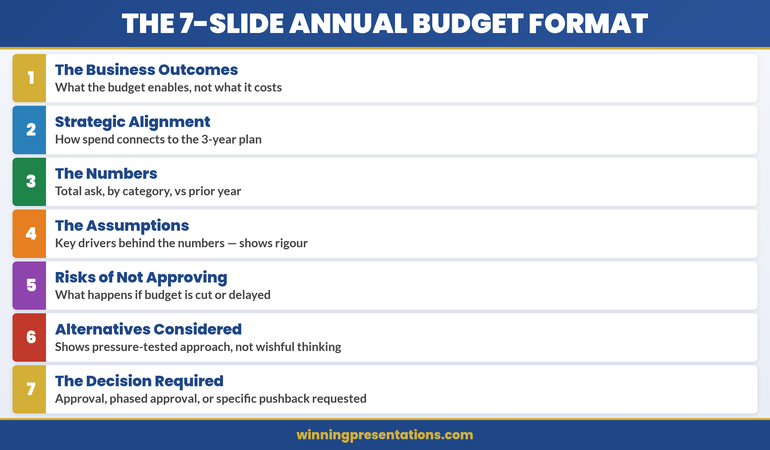
Budget assumption structure framework showing three elements per assumption: the assumption statement, supporting basis, and sensitivity analysis with example figures

The executives who defend their budgets most effectively are not the ones who hide their assumptions — they are the ones who surface them first, before anyone else has to ask. This mirrors the approach used in strong capital expenditure presentations, where every investment line connects to a stated planning assumption.

Walk Into Your Budget Review With the Slides Already Built

Structuring a budget presentation that survives CFO scrutiny takes preparation. The Executive Slide System — £39, instant access — gives you the frameworks to build it with confidence:

  • 26 slide templates for executive scenarios including budget approvals and financial cases
  • 93 AI prompts to structure assumptions, trade-offs, and contingency arguments
  • 16 scenario playbooks covering the conversations senior leaders actually have

Get the Executive Slide System →

Designed for executives presenting budget requests, investment cases, and financial proposals to senior leadership.

The Challenge Question Framework

CFOs and finance directors ask a predictable set of questions during budget reviews. The executives who lose budget are the ones who improvise answers. The executives who protect their numbers are the ones who have rehearsed them.

There are five challenge questions that appear in nearly every budget review conversation. Prepare a clear, concise answer for each one before you present.

1. “What happens if I give you 80% of this?” Your answer must be specific: “At 80% funding, we defer the platform migration to Q3 and reduce the contractor budget by two FTEs. Maintenance costs increase by approximately £45,000 per quarter.” Never answer with “we would have to look at that” — you should already have looked at it.

2. “Why is this more than last year?” Prepare a bridge slide that walks from last year’s approved budget to this year’s request. Show each incremental change: inflation, new initiatives, headcount, deferred items. The bridge makes the increase feel like the sum of specific decisions rather than a single large number.

3. “What are you not asking for that you should be?” This tests whether you are being strategic. Have a clear answer: “We considered a second analyst role but deferred it because automation should reduce the manual workload by Q3. If it doesn’t, we will raise this at mid-year review.”

4. “What is the cost of doing nothing?” For every significant budget line, articulate what happens if the investment is not made. This reframes your request from a cost to a risk mitigation decision.

5. “How confident are you in these numbers?” Answer with a confidence range, not a single assertion. “Personnel and infrastructure costs are contractually fixed. Project costs carry a plus-or-minus fifteen per cent range, reflected in the contingency provision.” A presenter who acknowledges uncertainty and has planned for it is more credible than one who claims total confidence.

What should you include in a budget presentation to the CFO? A strong CFO budget presentation includes: strategic context connecting the budget to business priorities, an explicit assumptions slide, a year-on-year bridge showing what changed and why, the core request with supporting detail, at least two alternative funding scenarios with trade-offs, a contingency provision, and a clear statement of what is at risk if funding is reduced or denied.

Building Contingency Slides That Show You Have Thought Ahead

The most strategically valuable slides in any budget presentation are the ones that never get presented. These are your contingency slides — the pre-built scenarios that sit behind your main request, ready to be pulled forward the moment the CFO asks “what if?”

Build three scenarios:

Scenario A — Full funding. This is your primary request. Everything you need, fully justified, with the business outcomes each investment delivers.

Scenario B — Reduced funding (typically 75–85% of the full request). Show exactly what gets deferred and what risk the reduction introduces: “At this level, we deliver the platform migration but defer the two new hires, delaying analytics capability by four months.”

Scenario C — Minimum viable funding (typically 60–70% of the full request). The floor. “At this level, we maintain current operations but defer all new initiatives. The deferred platform migration will cost approximately twenty per cent more when eventually undertaken.”

The purpose of these scenarios is not to negotiate against yourself. It is to retain control of the conversation. When the CFO asks for a reduction, you are the one who defines where the cut falls — not the finance team making decisions about your department without your input.

The Executive Slide System includes scenario planning templates and trade-off frameworks that make building these contingency slides straightforward, even under time pressure.

Presenting Trade-Offs Without Weakening Your Case

Many executives avoid presenting trade-offs because they fear it undermines their budget request. The opposite is true. A budget presentation that acknowledges trade-offs signals strategic maturity. A budget presentation that pretends every line item is equally critical signals a lack of prioritisation — and that is what makes CFOs reach for the red pen.

The framework for presenting trade-offs effectively has three components:

Categorise every budget line as “protect,” “flex,” or “defer.” Protect items are non-negotiable: contractual obligations, regulatory requirements, business-critical operations. Flex items have timing or scope flexibility. Defer items are valuable but can wait. When you present this openly, the CFO engages with your thinking rather than imposing their own.

Quantify the impact of each trade-off. “Deferring the CRM upgrade saves £180,000 this year but increases manual processing costs by £40,000 per quarter.” Trade-offs expressed in specific terms are far more useful than “this would have a negative impact on efficiency.”

Present trade-offs as decisions, not losses. “If we reduce the marketing technology budget by £90,000, we choose to delay the attribution project until the second half” positions the trade-off as a conscious strategic choice. “We would lose the attribution capability” positions it as a defeat. CFOs respond better to the first framing.
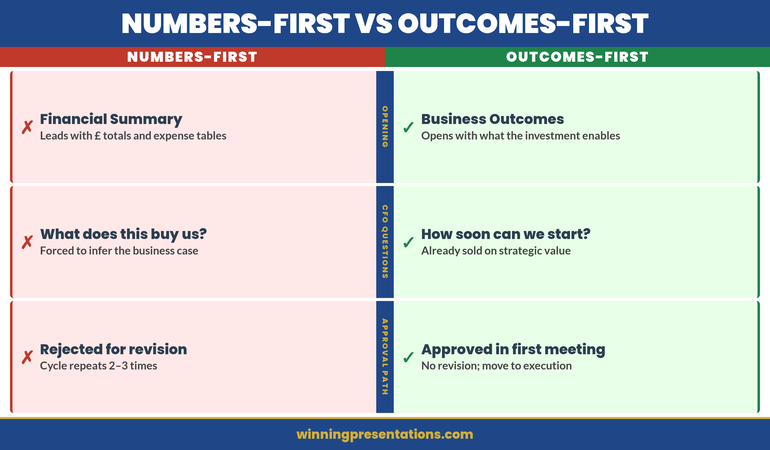
Trade-off presentation framework showing three categories: Protect items in green, Flex items in amber, and Defer items with impact quantification for each

This approach to presenting financial trade-offs is equally applicable to cost reduction presentations, where the ability to articulate what you are choosing and what you are sacrificing determines whether the audience trusts your judgement.

The Follow-Up Protocol That Protects Your Budget

The budget presentation does not end when you leave the room. What happens in the forty-eight hours after you present often determines the final outcome more than the presentation itself.

Within 24 hours: Send a one-page summary to every attendee restating your request, key assumptions, the recommended scenario, and any questions raised. This document becomes the reference point for the finance team’s internal discussion. If you do not provide it, the CFO’s notes become the reference point — and their notes may not reflect your framing.

Within 48 hours: Respond to every question raised during the presentation in writing, even if you answered it verbally. Written answers carry more weight in budget deliberations than remembered exchanges.

Before the final decision: Offer a fifteen-minute follow-up with the CFO. Position it as “I wanted to check whether anything needs further clarification” rather than “I want to make sure my budget is approved.” The first framing is helpful. The second is political.

How do you defend your budget when finance pushes back? The most effective budget defence is preparation, not persuasion. Before you present, build pre-modelled scenarios for reduced funding levels, state your assumptions explicitly with supporting evidence, and quantify the impact of every potential cut. When the pushback comes, you are not arguing — you are walking the CFO through analysis you have already completed. This shifts the dynamic from confrontation to collaboration.

See also today’s related articles on structuring a risk committee presentation, managing physical anxiety before high-stakes presentations, and presentation skills training for UK professionals.

Build Your Budget Deck in Half the Time

The Executive Slide System — £39, instant access — gives you ready-made templates for budget requests, assumption frameworks, and scenario slides. Stop building from scratch every budget cycle.

Get the Executive Slide System →

Designed for executives presenting budget requests, investment cases, and financial proposals.

Frequently Asked Questions

How do you structure a budget presentation for a CFO audience?

Start with strategic context that connects your budget to the organisation’s priorities. Follow with an explicit assumptions slide, a year-on-year bridge showing what changed, your core request with trade-off scenarios, and a contingency provision. End with a clear recommendation and the specific decision you are asking for. Keep the main deck under twenty slides and put detailed line items in an appendix.

How many budget scenarios should you present?

Three scenarios is the standard that works most effectively: full funding, reduced funding (75–85% of request), and minimum viable funding (60–70%). Each scenario should specify exactly what is delivered, what is deferred, and what the operational or strategic impact of the reduction is. This gives the CFO the information they need to make an informed allocation decision rather than an arbitrary cut.

What is the biggest mistake people make in budget presentations?

Presenting a single number without alternatives. When your budget deck contains only the amount you want, you force the CFO into a binary approve-or-cut decision — and the cuts will be made without your input. The executives who protect their budgets most effectively are the ones who present pre-modelled scenarios showing exactly where reductions would fall and what each reduction would cost the organisation.

The Winning Edge — Weekly Presentation Intelligence

Every Thursday, frameworks and techniques from 24 years of presenting in boardrooms, budget committees, and executive sessions. Join The Winning Edge →

Related reading: How to structure a risk committee presentation that earns confidence, not concern

About the Author

Mary Beth Hazeldine is the Owner & Managing Director of Winning Presentations. With 24 years of corporate banking experience at JPMorgan Chase, PwC, Royal Bank of Scotland, and Commerzbank, she advises executives across financial services, healthcare, technology, and government on structuring presentations for high-stakes scenarios.

Book a discovery call | View services

07 Apr 2026

Zero-Based Budget Presentation: Justify Every Line to Finance

Quick answer: A zero-based budget presentation requires you to justify every line of expenditure as if it were a new request — not a continuation of last year’s spend. The most effective structure leads with the business outcome each line of spending supports, layers evidence for the lines most likely to face scrutiny, and frames the final slide as a binary decision with named consequences on both sides.

Valentina had three months to prepare. As Head of Operations for a mid-sized healthcare technology firm, she had presented budget requests before — always with a roll-forward from the prior year, always with a modest increase ask, always with a CFO who pushed back on the headline number and then approved most of it anyway. This year was different.

The board had mandated a zero-based budget process across the business. Every department would start from zero. Every pound would need justification. The CFO had warned his team that he expected operational rigour, not PowerPoint creativity. Valentina’s first draft — which looked like every budget deck she had ever produced — came back with a single comment: “This doesn’t tell me why. Start again.”

The second version took a different approach. Instead of opening with a summary of last year’s spend and this year’s request, Valentina opened with the operational outcomes her department was responsible for delivering — and then showed the dependency map between each outcome and each line of expenditure. By the third slide, the CFO had stopped making notes and started asking questions. That was the shift. Questions meant he was thinking about approval, not rejection.

Zero-based budgeting presentations fail when they are structured like traditional budget decks. They succeed when they are structured like investment proposals — where every line earns its place through a direct link to business value.

Preparing for a budget approval meeting?

The Executive Slide System includes slide templates and framework guides designed for high-scrutiny financial presentations — structured to help you lead with business outcomes and build your evidence layer efficiently.

Explore the System →

Why Zero-Based Budgeting Changes the Presentation Challenge

In a traditional incremental budget review, the implicit question the presenter is answering is: “Is this year’s increase reasonable?” The prior year’s spend is treated as a baseline that has already been approved and therefore doesn’t need re-justification. Your task is to explain the delta.

Zero-based budgeting removes that baseline. The implicit question becomes: “Does this spend need to exist at all?” That is a fundamentally different challenge — and it requires a fundamentally different deck structure.

The risk for most budget presenters is that they approach zero-based reviews using the same architecture as traditional reviews. They lead with total spend, break it down by category, attach a growth percentage, and wait for questions. This structure fails in a zero-based environment because it answers the wrong question. It tells the finance team what you want to spend. It doesn’t tell them why each element needs to exist.

The zero-based budget presentation is closer in structure to a capital expenditure proposal than a standard departmental review. Both require you to justify spending as if it were new. Both benefit from a dependency-based argument structure rather than a category-summary format.

The Problem With Traditional Budget Decks

Most budget presentations are built around three implicit assumptions that zero-based processes invalidate:

Assumption one: prior approval implies ongoing necessity. In a traditional review, last year’s approved budget line carries an implicit endorsement. In a zero-based review, it carries no weight at all. If you can’t justify why the line exists from first principles, the finance team is entitled to cut it entirely.

Assumption two: category headers are self-explanatory. Headings like “personnel costs,” “software licences,” and “professional services” communicate what the money is spent on, not why the organisation needs to spend it. Finance teams conducting a genuine zero-based review will push beneath every category header to understand the operational rationale. Your deck should anticipate that push, not wait for it.

Assumption three: the total is the primary focus. In a zero-based environment, the individual lines matter more than the total. A finance team will often accept a higher total if each line has a credible business case, and reject a lower total if several lines appear unjustified. Presenting the total first invites the wrong conversation — a negotiation about the headline number rather than an evaluation of each component’s merit.

Understanding these assumptions allows you to invert the structure of your deck: lead with operational outcomes, link each spend line to a named outcome, and surface the total only after the dependency map is established.

The Five Slides Every ZBB Presentation Needs

The structure below has been designed for budget presentations where every line must earn its place. It works in CFO reviews, board budget sessions, and investment committee meetings where detailed scrutiny is expected.

Five-step framework for structuring a zero-based budget presentation for executive scrutiny

Slide one — Operational outcomes. List the three to five measurable outcomes your department is responsible for delivering in the coming year. These are the anchors for everything that follows. Every line of expenditure will be linked back to one of these outcomes. If you cannot connect a spend line to a named outcome, that line belongs in a separate conversation.

Slide two — Dependency map. Show visually how each outcome depends on specific categories of spend. This is the intellectual core of the zero-based argument. The finance team can see that removing a budget line doesn’t just save money — it removes a capability that supports a named business outcome.

Slide three — Line-by-line justification. For each budget line, provide: what it funds, which outcome it supports, what the operational impact would be if it were removed, and any market comparators or benchmarks that contextualise the cost.

Slide four — Flexion points. Pre-identify the lines where you have genuine flexibility — where reduced funding would reduce service levels rather than eliminate a capability. Offering controlled flexion is strategically effective: it demonstrates rigour and gives the finance team a managed choice rather than an adversarial negotiation.

Slide five — Decision frame. Present the final slide as a binary: fund at this level and deliver these outcomes, or fund at a reduced level and accept these named consequences. A clean decision frame is more persuasive than a plea — it positions your ask as a business decision, not a departmental request.

The Executive Slide System

Slide templates and framework guides designed for executive presentations that require financial justification and board-level scrutiny.

  • Slide templates designed for budget approval and financial review meetings
  • AI prompt cards to structure financial arguments quickly and clearly
  • Framework guides for presenting numbers to mixed executive audiences
  • Scenario playbooks for CFO, board, and investment committee decks

Get the Executive Slide System — £39

Designed for executives preparing for high-scrutiny financial presentations.

How to Justify Each Line Without Losing the Room

The risk in detailed budget presentations is that justification becomes a recitation. The presenter reads through each line in order, the finance team becomes passive, and by the time the high-scrutiny items appear the room has lost engagement. The most effective zero-based budget presenters sequence their justification by risk, not by category.

Prioritise the lines most likely to face challenge. Before the meeting, identify the two or three expenditure lines that are most likely to prompt sceptical questions. These are typically: new spend categories with no prior year comparator, lines that have grown significantly relative to the business, and costs that are difficult to benchmark externally. Cover these early — when the room is still engaged and you have the most credibility to defend them.

Use a consistent justification structure. For each line, use the same three-part format: what it funds, what operational outcome it supports, and what would change if it were removed. Consistency allows the finance team to evaluate each line on the same basis, which reduces the likelihood of tangential discussions about format rather than substance.

Separate baseline from growth. Even in a zero-based process, it is worth distinguishing between spend that maintains an existing capability and spend that funds new or expanded capabilities. Finance teams understand that some expenditure simply keeps the lights on. Presenting this distinction honestly prevents unnecessary scrutiny of maintenance costs that are not in dispute. For guidance on structuring financial forecasts more broadly, see this analysis of revenue forecast presentation structure.

Speak to consequences, not to effort. The instinct when defending a budget line is to describe how much work it represents or how carefully it was costed. Finance teams are rarely moved by evidence of effort. What moves them is clarity about the operational consequence of removing the line. “If this line is cut, we lose the capability to X, which affects outcome Y by Z” is a more effective justification than any description of how the number was calculated.

The Executive Slide System includes slide templates structured specifically for budget justification and financial approval presentations, with a dependency-map format built in.

Handling Finance Team Scrutiny in the Room

The finance team’s role in a zero-based budget review is to challenge assumptions and test the rigour of your justification. Experienced budget presenters treat this scrutiny as a feature of the process rather than an obstacle to their ask. The way you handle challenge in the room often matters more than the quality of your deck.

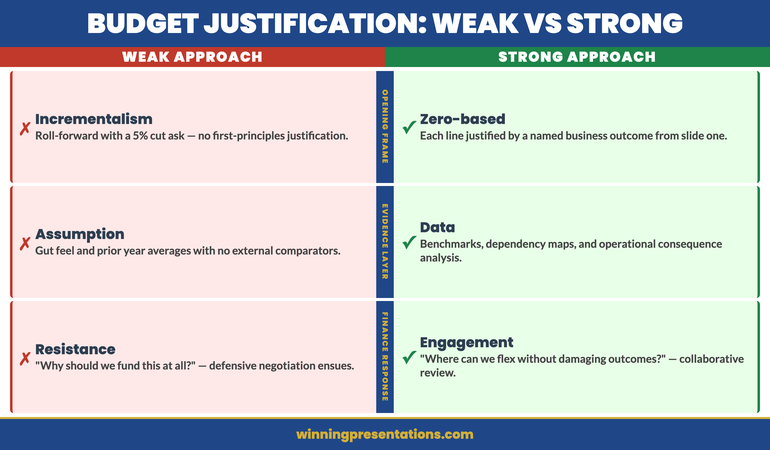
Comparison of weak versus strong approaches to budget justification in executive meetings

Anticipate the three most likely challenge questions. Before the meeting, write out the three questions you most hope the finance team does not ask. These are your highest-risk areas. Then prepare clear, direct answers — ideally supported by a backup slide in an appendix — so that when these questions arise you can answer them without hesitation or visible discomfort. Hesitation in a budget meeting is read as uncertainty about the justification.

Distinguish between questions that seek information and questions that signal scepticism. A question like “what would be the impact of reducing this line by 20%?” is typically exploratory — the finance team wants to understand the flexibility in the model. A question like “can you walk me through how you arrived at this number?” often signals that the number looks high. Reading the intent behind a question allows you to calibrate your response appropriately. For a more detailed treatment of reading hostile questions, see the companion article on preparing for hostile questioner scenarios.

Never concede on a line you haven’t analysed. In a budget meeting, there is social pressure to appear flexible when challenged. The impulse to say “we could probably reduce that” in response to scrutiny is understandable, but it is also dangerous. Agreeing to reduce a line you have not modelled creates a commitment you cannot necessarily honour and signals that the original ask was not fully thought through. If you need time to model the impact of a proposed reduction, say so and commit to a specific follow-up timeline. For context on how governance bodies interpret budget proposals, see this overview of governance update presentation structure.

What the CFO Is Actually Evaluating

Understanding what the CFO is evaluating — and what they are not evaluating — changes how you structure your preparation. Most budget presenters over-prepare on the numbers and under-prepare on the narrative. A CFO conducting a zero-based budget review is typically evaluating four things simultaneously:

Rigour of thinking. Have you genuinely started from zero, or have you repackaged last year’s spend with better-sounding labels? A CFO who has run multiple zero-based budget cycles can identify cosmetic zero-basing quickly. The test is whether you can explain the rationale for each line in plain language without reference to what was previously approved.

Calibration of the ask. Is the total consistent with what the finance team would expect given the operational scope of the department? A CFO isn’t just evaluating whether each individual line is justified — they’re also assessing whether the aggregate feels calibrated. An aggregate that feels high will invite more detailed scrutiny even if each line appears justifiable in isolation.

Quality of trade-off analysis. The best budget presentations include explicit trade-off analysis: what would the organisation gain from funding option A versus option B, and what would it forgo? A CFO wants to make a well-informed allocation decision, not simply accept or reject your proposal. Offering a structured trade-off gives them the material to make that decision — and makes you a more credible partner in the process.

Your credibility as an operational leader. The budget presentation is also a proxy for how well you understand your own function. A Head of Operations who can explain every significant line of their budget — its purpose, its dependency, its flexibility — signals operational competence that extends beyond the budget itself. This is also why the team performance review presentation that often follows a budget cycle matters: it shows whether operational commitments made during the budget process were delivered. See the companion piece on structuring a team performance review presentation for guidance on that conversation.

Building Your Evidence Layer Before the Meeting

The evidence layer in a zero-based budget presentation is the set of materials you have prepared to substantiate each justification — not all of which will appear in the main deck, but all of which you should be able to produce immediately if challenged. A strong evidence layer has three components:

External benchmarks. For your highest-cost lines, identify external comparators that contextualise the spend. Industry salary benchmarks, software licence cost comparisons, contractor day-rate market data — these allow you to position your spend relative to a reference point the finance team can validate independently. Benchmarks are more persuasive than self-referential justifications because they anchor the argument in market reality rather than internal preference.

Operational dependency documentation. For any line that might appear discretionary, document the specific operational process it supports. This is particularly important for overheads and enabling functions — costs that don’t produce a visible output but that underpin capabilities the business depends on. A clear dependency document answers the question “what would actually happen if we cut this?” before it is asked.

Appendix slides for the most likely challenge scenarios. Prepare three to five supplementary slides that address the questions most likely to come up in a detailed review. These are not part of the main presentation — they sit in an appendix and are surfaced only if the specific question arises. The discipline of preparing these slides also forces you to think through the most challenging aspects of your justification before you are in the room.

The presenter who arrives with an evidence layer — even if most of it is never shown — projects a qualitatively different level of preparation from the one who has only the deck. Finance teams notice the difference.

Build Your Next Budget Deck With the Right Structure

The Executive Slide System includes framework guides for structuring financial approval presentations — so you can build a dependency-based argument without starting from a blank slide.

View the Executive Slide System — £39

Designed for executives preparing high-scrutiny financial presentations.

Frequently Asked Questions

What is the difference between a zero-based budget presentation and a standard budget review?

A standard budget review typically treats the prior year’s spend as a baseline and focuses on justifying increases or decreases relative to that baseline. A zero-based budget presentation requires you to justify every line of expenditure as if it were a new request — with no assumed entitlement to prior year spend levels. This means structuring your deck around business outcomes and dependency maps rather than category summaries and year-on-year variances.

How should I handle a line that is difficult to justify in isolation but necessary as part of a broader function?

The key is to make the dependency visible rather than asserting it. If a line is genuinely necessary as part of a broader operational capability, your deck should show the full capability — not just the individual line — and demonstrate that the capability would be impaired without it. Dependency mapping is the most effective tool for this: it shows the finance team that the line isn’t discretionary, it is load-bearing.

What should I include in my appendix for a zero-based budget presentation?

Your appendix should contain the detailed justification for the three to five lines most likely to face scrutiny — including external benchmarks, operational dependency documentation, and the modelled impact of any proposed reduction. You should also include a sensitivity analysis showing how your total changes under two or three different funding scenarios. These materials should be prepared in advance and be immediately available if challenged, even if they are never formally presented.

The Winning Edge — Weekly Newsletter

Executive presentation strategy, delivered every Thursday. Practical frameworks for high-stakes meetings — no filler, no motivational content.

Subscribe to The Winning Edge

Free resource: Executive Presentation Checklist — a practical pre-meeting audit for high-stakes presentations.

About the Author

Mary Beth Hazeldine is Owner & Managing Director of Winning Presentations. With 24 years of corporate banking experience at JPMorgan Chase, PwC, Royal Bank of Scotland, and Commerzbank, she advises executives across financial services, healthcare, technology, and government on structuring presentations for high-stakes funding rounds and approvals. Connect at winningpresentations.com.

27 Feb 2026
An executive standing in a corporate boardroom defending a budget presentation with financial charts on screen while sceptical finance leaders seated on both sides evaluate the proposal

Budget Defence Presentation: How to Protect Your Funding When Finance Wants Cuts

A budget defence presentation when your team faces cuts is structurally different from a budget request. When finance has already decided to cut, presenting your original business case again won’t save your funding. You need to reframe the conversation from “justify this spend” to “here’s the cost of cutting it.” This article gives you the 4-slide defence framework that shifts the burden of proof from you to the person holding the axe.

The email arrived on a Tuesday afternoon: “We need to review your team’s Q3 operating budget. Please prepare a presentation for Thursday’s finance review.”

In corporate banking, I learned to decode that sentence. “Review” meant cuts. “Please prepare” meant justify your existence. And “Thursday” meant you have 48 hours to save six months of planned work.

At Royal Bank of Scotland, I watched a divisional head respond to exactly this scenario by re-presenting his original budget request — the same slides, the same business case, the same ROI projections. He spent 25 minutes explaining why the budget was needed. Finance spent 3 minutes cutting it by 30%.

The following quarter, a different director faced the same situation. She didn’t re-justify the spend. She opened with a single slide: “If you cut this budget, here’s exactly what stops.” Three revenue streams. Two client deliverables. One regulatory deadline. The conversation shifted from “convince us this is worth it” to “which of these consequences are we prepared to accept?”

Her budget survived intact. The difference wasn’t the quality of the data. It was the structure of the argument.

Here’s the truth nobody tells you about budget cuts: they aren’t decided by spreadsheets. They’re decided by dependency stories. The budget holders who survive aren’t the ones who fight hardest — they’re the ones who make cutting feel more dangerous than funding.

🚨 Facing a budget review this quarter? Quick check: does your first slide explain what you need the money for — or what happens if it’s taken away? If it’s the former, you’re presenting a budget request, not a budget defence. That’s a critical structural mistake. → Need the exact budget defence slide structure? Get the Executive Slide System → £39

Why Your First Instinct Is Wrong

When you’re told your budget is under review, the instinct is to defend it the same way you requested it — by making the positive case. Here’s why the spend is valuable. Here’s the ROI. Here’s what we’ll achieve.

That’s exactly backwards.

A budget request and a budget defence are fundamentally different presentations with different psychological dynamics. In a budget request, you’re selling an opportunity. The audience is evaluating potential gain. In a budget defence, someone has already decided to cut. They’re not evaluating opportunity — they’re looking for the least painful place to reduce spend.

If you present your opportunity case to an audience in cutting mode, you’re speaking a language they’re not listening in. They’ve already discounted the upside. What they haven’t calculated is the downside of cutting.

This is where most budget defence presentations fail. They try to re-sell value instead of quantifying consequences. And in 24 years of corporate banking — across JPMorgan Chase, PwC, Royal Bank of Scotland, and Commerzbank — I’ve never seen a re-sell win against a finance team that’s already in reduction mode.

How do you present a budget defence when finance wants to cut?

The most effective budget defence doesn’t argue for the value of your spend — it quantifies the cost of cutting it. Lead with consequences: what specifically stops, breaks, or gets delayed if this budget is reduced. Frame the conversation so that the finance team is evaluating the risk of cutting rather than the justification for spending. Include a dependency map showing which revenue streams, client deliverables, or compliance requirements are directly connected to the budget line under review. This shifts the burden of proof from you to the person proposing the cut.

Understanding how CFOs actually evaluate presentations is essential here — they’re trained to discount optimistic projections and focus on risk. Your defence needs to speak their language.

The 4-Slide Budget Defence Framework (When Cuts Are Already Planned)

This framework is built on a simple principle: don’t justify the spend, quantify the cut. It works because it aligns with how finance teams actually make reduction decisions — they’re looking for cuts with the lowest consequences, not the weakest business case.

Every slide in this framework moves the conversation away from “is this spend worth it?” toward “can we afford to cut this?” That’s a fundamentally different conversation — and one you’re much more likely to win.


Diagram showing the 4-Slide Budget Defence Framework: Cost of Cutting, Dependency Map, Alternative Cuts, and Protection Ask, with arrows showing the strategic flow from consequence to decision

Slide 1: The Cost of Cutting

Your opening slide is the most important slide in any budget defence. It sets the frame for the entire conversation. Get it wrong and you’re defending. Get it right and finance is evaluating risk.

The cost-of-cutting slide answers one question: “If this budget is reduced by [X]%, here’s exactly what stops.”

Not “here’s what might be affected.” Not “here’s what could be impacted.” Specifics. Revenue at risk. Client deliverables that will miss deadlines. Regulatory compliance that becomes uncertain. Headcount that gets cut — with names if appropriate, because numbers are abstract and people are real.

Here’s the structure:

  • Line 1: The specific budget amount under review
  • Line 2: The three most consequential things that stop if it’s cut
  • Line 3: The revenue or client relationship directly at risk
  • Line 4: The timeline — when consequences begin (usually sooner than finance expects)

When I helped a technology division at Commerzbank defend their infrastructure budget, we opened with: “Cutting this £1.2M reduces our transaction processing capacity by 15%. That affects 340 institutional client accounts. The first service degradation begins in 8 weeks.” The conversation changed immediately.

The key principle: consequences must be specific, quantified, and tied to things finance cares about — revenue, clients, compliance, and reputation. “Our team will be stretched” is not a consequence. “Three client deliverables miss their contractual deadline in Q4” is.

The Budget Defence Slides That Protect Your Team’s Funding

The Executive Slide System includes the Budget Request template — adaptable for defence presentations — plus 51 AI prompts that help you draft consequence-led slides in 25 minutes. Including the CFO Questions checklist that pre-answers every challenge finance will raise.

  • The budget slide structure that frames consequences, not justifications — the format CFOs respond to
  • AI prompts that role-play as a sceptical CFO, stress-testing your defence before the real meeting
  • The cost-of-inaction framework that shifts the burden of proof to the person proposing cuts
  • The 15-minute resubmission workflow for when your original budget was already rejected

What you get: Budget Request template → Dependency Map framework → CFO Questions checklist → ‘Sceptical CFO’ AI stress-test → Scenario Playbook with budget rejection recovery → Instant download, use it tonight.

Get the Executive Slide System → £39

The same budget structure that secured £4M+ in a single meeting — now available as a template with AI-powered drafting prompts.

Slide 2: The Dependency Map

The dependency map is the slide that makes finance pause. It shows — visually — every business function, revenue stream, and client commitment that connects to the budget line under review.

Most budget holders present their budget in isolation: “Here’s what my team does. Here’s what it costs.” That makes it easy to cut because the connections are invisible. A dependency map makes them visible — and suddenly cutting your budget means accepting consequences across multiple departments.

How to build a dependency map:

  • Place the budget line item in the centre
  • Draw direct connections to every revenue stream it supports (with specific £/$ amounts)
  • Draw connections to every client deliverable that depends on it (with names and deadlines)
  • Draw connections to any regulatory or compliance requirements it fulfils
  • Draw connections to other departments that rely on your team’s output

The visual is powerful because it transforms an abstract line item into a web of consequences. Finance can cut a number on a spreadsheet. It’s much harder to cut a node that connects to £2.3M in client revenue and a regulatory filing deadline.

If you’re already familiar with CFO-approved budget formats, the dependency map is the element that converts a budget request into a budget defence. The format stays similar. The framing changes everything.

The Executive Slide System includes frameworks for exactly this kind of visual argument — including the Problem-Solution-Benefit structure that works particularly well when framing budget consequences for finance audiences.

What should you include in a budget defence presentation?

An effective budget defence presentation should include four elements: the quantified cost of cutting (revenue at risk, client impact, timeline to consequences), a dependency map showing which business functions and revenue streams connect to the budget line, at least two alternative reduction options that are less damaging than the proposed cut, and a specific protection ask — the exact amount you need preserved and the conditions under which you’d accept a partial reduction. Avoid re-presenting your original business case or ROI projections. Finance has already discounted these. Focus entirely on what happens if the cut goes through.

Slide 3: The Alternative Cuts

This is the slide most budget defenders forget — and it’s the one that demonstrates strategic maturity.

When you present alternatives, you’re signalling three things to finance: you understand the organisation needs to reduce costs, you’re willing to participate in that process, and you’ve already done the analysis to find the least damaging path forward.

This is critical because finance teams rarely have the operational knowledge to know which cuts are truly damaging and which are manageable. They’re working from spreadsheets. You’re working from reality. If you don’t give them better options, they’ll default to the blunt instrument — which is usually an across-the-board percentage cut that treats discretionary and essential spend identically.

How to structure alternative cuts:

  • Option A: Defer [specific initiative] from Q3 to Q4. Saves £[X]. Impact: [specific but manageable consequence].
  • Option B: Reduce [specific budget line] by [%]. Saves £[X]. Impact: [specific but lower-risk consequence].
  • Option C: The proposed cut as-is. Saves £[X]. Impact: [the severe consequences from Slide 1].

Notice the structure. You’re presenting the proposed cut as Option C — the most damaging option — alongside two alternatives you can actually live with. Finance gets their saving. You control where the reduction lands.

A VP at PwC once told me: “The budget holders who survive cuts aren’t the ones who fight hardest. They’re the ones who give me better options.” That insight has informed every budget defence I’ve helped clients build since.

Stop Watching Your Budget Die in ‘Further Review’

The Executive Slide System includes budget-specific templates, the CFO Questions checklist, and AI prompts that stress-test your defence before the meeting. Build a consequence-led budget defence in 30 minutes.

  • The Budget Request template — adaptable for defence, resubmission, and annual review
  • The sensitivity analysis prompt: “What’s the impact if results are 20% below projection?”
  • The ‘sceptical CFO’ AI role-play that pressure-tests every number before you present
  • 6 checklists including the CFO Questions section that pre-answers finance challenges

Get the Executive Slide System → £39

Used by executives defending budgets at programme boards, finance reviews, and senior leadership — where the wrong structure means an automatic 20-30% cut.

Slide 4: The Protection Ask

Your final slide must do one thing: tell finance exactly what you need preserved and the conditions under which you’d accept a partial reduction.

This matters because budget review meetings often end without clear decisions. “We’ll take this away and come back to you” is the budget defence equivalent of silence after a presentation — it sounds neutral but usually means you lose.

The protection ask prevents that drift by forcing a specific conversation. Instead of “please don’t cut our budget,” you’re saying: “I need £[specific amount] protected to maintain [specific deliverables]. I can accept a £[specific amount] reduction if it’s applied to [specific budget line] rather than [essential budget line].”

The formula:

  • Protected amount: The non-negotiable number, tied to specific consequences from Slide 1
  • Acceptable reduction: The amount you can absorb, tied to the alternatives from Slide 3
  • Conditions: Where the reduction applies and what it means for deliverables
  • Decision request: Ask for the decision in this meeting — not “further review”

The specificity is the power. “Please protect our budget” is weak. “I need £840K of this £1.2M preserved to maintain our three largest client accounts. I can absorb £360K by deferring the platform migration to Q1 and reducing the contractor allocation by two FTEs” is a sentence finance can actually work with.

If you’ve used the CFO-approved budget request format before, the protection ask follows the same specificity principle — but inverted. Instead of asking for approval to spend, you’re asking for confirmation to protect.

How do you stop your budget from being cut?

You can’t always prevent cuts entirely — but you can control where they land. The most effective approach is to quantify the consequences of the proposed cut (making the risk visible), provide alternative reduction options that are less damaging (giving finance a better path), and make a specific protection ask that preserves your essential spend while conceding on discretionary items. The budget holders who consistently protect their funding aren’t the ones who argue loudest — they’re the ones who present the clearest analysis of what happens when cuts go wrong. Frame every number as a consequence, not a justification.

When to Deploy This (And When It’s Too Late)

The budget defence framework works best when deployed at the first signal of review — not after the decision has been made. If you receive an email about a “budget review” or “cost optimisation exercise,” start building your defence immediately. Don’t wait for the formal meeting invitation.

There’s also a pre-defence strategy that’s even more effective: the corridor conversation. Before the formal review meeting, find 15 minutes with the finance lead and walk them through your dependency map informally. This isn’t lobbying — it’s giving them the operational context they need to make a better decision. In my experience, 70% of budget defence outcomes are determined before the formal meeting.

When is it too late? If finance has already communicated the cut as a decision rather than a review, the framework shifts. You’re no longer defending — you’re negotiating the terms. At that point, Slides 3 and 4 (Alternative Cuts and Protection Ask) become your entire presentation. Skip the consequence framing — they’ve already accepted the consequences. Focus on where the reduction lands.

The Executive Slide System includes a Scenario Playbook with a specific “Budget Request Was Rejected” workflow — the 15-minute resubmission path for when your first attempt didn’t land.

Is This Right For You?

The Executive Slide System is built for you if:

  • You’re facing a budget review and need to defend your team’s funding against proposed cuts
  • You present to finance leaders, CFOs, or budget committees where slide structure determines outcomes
  • You’ve had a budget request rejected and need to resubmit with a stronger structure
  • You want AI prompts that role-play as a sceptical CFO to stress-test your defence before the real meeting

It’s probably not right if your budget is already approved and you’re looking for general presentation skills. In that case, the budget request template walkthrough may be more relevant.

24 Years Defending Budgets at JPMorgan, RBS, and Commerzbank. Every Lesson in One System.

I’ve sat on both sides of the budget table — presenting to finance committees and sitting on them. The Executive Slide System gives you the same structures, AI prompts, and checklists that senior executives use to protect their teams’ funding.

  • 22 templates (15 executive + 7 framework) including the Budget Request template
  • 51 AI prompts — including the ‘sceptical CFO’ stress-test and sensitivity analysis
  • The Scenario Playbook with the “Budget Was Rejected” 15-minute resubmission workflow
  • 6 checklists and guides including the CFO Questions section

Get the Executive Slide System → £39

Trained thousands of executives to present to finance leaders — including the presentations where your team’s survival depends on four slides.

Frequently Asked Questions

What if finance has already decided and the review is just a formality?

If the cut has already been communicated as a decision, shift your approach. Skip the consequence framing (they’ve accepted the consequences) and focus entirely on Slides 3 and 4: Alternative Cuts and the Protection Ask. Your goal is no longer to prevent the reduction — it’s to control where it lands. Present two or three specific alternatives that achieve the required saving while protecting your most essential deliverables. Finance teams generally prefer budget holders who engage constructively with the process over those who simply resist.

How specific should the consequences be on Slide 1?

As specific as possible. “Client service may be affected” is invisible to finance. “Three named client deliverables miss their contractual deadline in Q4, putting £2.3M in annual recurring revenue at risk” is a consequence that gets attention. Finance teams work in specifics — give them specifics. If you can attach a revenue number, a client name, a regulatory deadline, or a headcount impact to every consequence, your defence is dramatically stronger than an abstract case for value.

Should I present the dependency map as a visual or a table?

A visual — always. The power of the dependency map is that it makes hidden connections visible. A table lists items sequentially, which allows finance to evaluate each line individually and cut selectively. A visual shows the interconnections, making it clear that cutting one element affects three others. Use a simple node-and-connection layout with the budget line in the centre and consequences radiating outward. The messier it looks (within reason), the better — complexity is your ally when defending against simplistic across-the-board cuts.

📬 Get weekly executive presentation strategies that protect your decisions, your budget, and your team.

Every week: one framework, one real example, zero theory. Join thousands of professionals who present to senior leadership and finance.

Subscribe to the Winning Presentations newsletter →

🎯 Presenting to a committee and worried about the Q&A? If nobody asks questions after your budget defence, that’s not agreement — it’s disengagement. Read: No Questions After Your Presentation? That Silence Isn’t Approval

Your next step: Open your current budget slides. If the first slide explains what you need the money for rather than what happens if it’s taken away, rewrite it using the cost-of-cutting structure before your next finance review. That single change will shift the entire conversation from defence to decision.

If your budget review is in the next 7–10 days, the Executive Slide System (£39) gives you the budget defence slide structure, AI prompts, and CFO stress-test checklist you need — ready to use tonight. Instant download. Build your defence deck in 30 minutes.

About the Author

Mary Beth Hazeldine is the Owner & Managing Director of Winning Presentations. With 24 years in corporate banking — including roles at JPMorgan Chase, PwC, Royal Bank of Scotland, and Commerzbank — she has trained thousands of executives in high-stakes presentations and supported high-stakes funding rounds and approvals. A qualified clinical hypnotherapist and NLP practitioner, Mary Beth combines boardroom experience with evidence-based psychology to help professionals present with authority and close with confidence.