

Quick Answer
Presentation gestures undermine executive credibility when they are unconscious and driven by anxiety — self-touching, repetitive movements, or hands hidden below the table. They build credibility when they are intentional and match the pace of speech: open palms to signal transparency, contained gestures to signal precision, and deliberate pauses that give the body time to settle. The goal is not to choreograph movement — it is to stop nervous movement from speaking louder than your words.
In this article:
- Why gesture matters more than words in executive settings
- The four gesture zones every executive presenter needs to understand
- Grounding gestures vs distancing gestures
- How the boardroom table works for and against you
- Common gesture mistakes that undermine authority
- When nerves take over: recovering composure mid-presentation
- Frequently asked questions
Priya had been promoted to Director six months earlier and had presented to the executive leadership team twice since then. Both times, the feedback from her line manager was the same: technically excellent, but something feels slightly off in the room. People aren’t quite as convinced as they should be given the quality of the content.
The third time, her line manager sat in and watched. Afterwards, he asked her to watch a recording of the presentation — just the first three minutes, with the sound off.
What Priya saw startled her. She had no idea her hands were doing what they were doing. Throughout the opening — the part where she was most confident in her content — her left hand was touching her collar repeatedly, then her right hand was gripping the edge of the table, then both hands were clasped together in front of her. Her upper body was also subtly angled away from the most senior person in the room. She looked, she said afterwards, “like someone who was waiting to be told off.”
The content of those three minutes was strong. The body language was reading a completely different story — one of self-protection, uncertainty, and low status. And the people in that room, all of them experienced at reading people under pressure, were responding to the story they could see, not the one they could hear.
Gesture is not decoration. In executive presentations, it is a primary communication channel — and unlike the words you choose, it operates largely below conscious awareness. Understanding how to manage your own gesture patterns is one of the most direct routes to building the kind of credibility your content deserves.
Is anxiety affecting how you present physically?
If nerves are showing up in your body language — tight gestures, gripping, self-touching — Conquer Speaking Fear addresses the underlying anxiety that drives these physical patterns, not just the surface symptoms. Explore the Programme →
Why gesture matters more than words in executive settings
The research on non-verbal communication in high-stakes professional contexts is consistent: when verbal content and non-verbal signals are misaligned, audiences prioritise the non-verbal signal. They may not be able to articulate why they are unconvinced — “something felt off” is the most common description — but the misalignment registers and creates a vague but persistent sense of doubt.
In executive settings, this effect is amplified by the seniority of the audience. Senior leaders are experienced at reading people under pressure. They have spent careers in rooms where people present optimistic forecasts, defend difficult decisions, and ask for resources they may not be confident about. They have learned to use non-verbal cues as a reliability signal — not consciously, but through accumulated pattern recognition. When your gesture patterns signal anxiety, they read it as uncertainty about your content, whether or not that is what the anxiety is actually about.
The practical implication is that gesture management is not about performance. It is about alignment — ensuring that the credibility signals your body is sending are consistent with the quality of the case you are making. An executive with a genuinely strong case who presents with high-anxiety body language loses credibility they did not need to lose. An executive with a moderate case who presents with calm, grounded body language buys the room’s patience and attention.
For a related dimension of executive physical presence, see eye contact technique for presentations: how to hold the room without staring anyone down.
The four gesture zones every executive presenter needs to understand
Gesture research identifies four distinct spatial zones that matter for executive presenters. Understanding which zone your habitual gestures occupy — and what each zone communicates — is the starting point for deliberate gesture management.
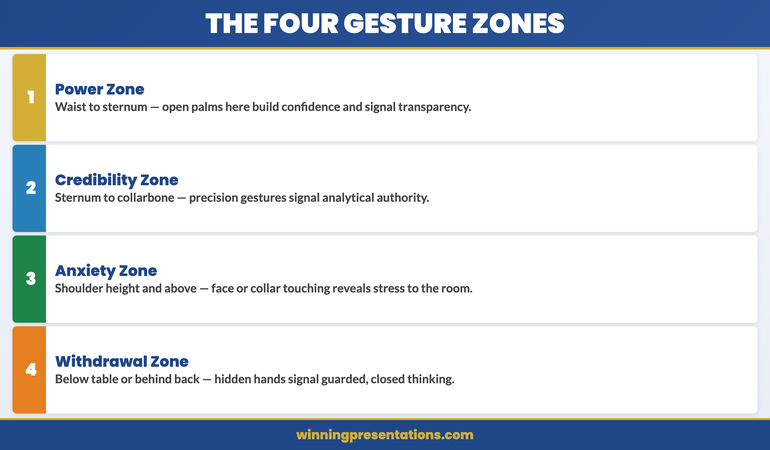
The power zone. This is the space between your waist and your sternum, directly in front of your body. Gestures made in this zone — open, visible, with palms facing up or facing the audience — signal confidence and transparency. Leaders who gesture naturally in this zone tend to be perceived as authoritative without being aggressive. This is the zone you want most of your visible gestures to occupy.
The credibility zone. Slightly higher than the power zone, between your sternum and your collarbone. Gestures here — particularly precision gestures, where fingers and thumb touch — signal analytical confidence and attention to detail. Finance directors and technical specialists instinctively use this zone when discussing numbers or complex systems. It reads as competence.
The anxiety zone. This is the space at or above shoulder height. Gestures that drift into this zone — touching your face, hair, or collar — are the clearest non-verbal signal of anxiety available to an audience. They are almost always involuntary and almost always noticed. If you know you have a habit of touching your face or neck when you are under pressure, this is the single most important thing to address.
The withdrawal zone. This is everything below the table or behind your back. Hands that disappear from view — clasped behind you, hidden below the desk line, shoved into pockets — signal that you are managing yourself rather than engaging with the room. The audience may not consciously notice, but the engagement deficit is real.
Conquer Speaking Fear
Address the Anxiety That’s Showing Up in Your Body
Anxiety-driven gestures are a symptom, not the problem. Conquer Speaking Fear — £39, instant access — is a 30-day programme built on nervous system regulation and clinical hypnotherapy techniques, designed for executives whose anxiety is showing up physically in high-stakes presentation settings.
- 30-day structured programme for presentation anxiety
- Nervous system regulation techniques for the days and hours before presenting
- Clinical hypnotherapy-based approaches for deep-rooted speaking fear
- In-the-moment composure strategies for when nerves spike unexpectedly
Designed for executives whose anxiety is limiting their professional presence and credibility.
Grounding gestures vs distancing gestures
Within the power and credibility zones, there is a further distinction that matters for executive presentations: the difference between grounding gestures and distancing gestures. Both types occur in the visible zone and neither is inherently anxious — but they communicate very different things about your relationship with your content and your audience.
Grounding gestures are gestures that move towards the audience or that are centred and contained. Open palms facing upward or toward the audience, a gesture that physically moves in the direction of a screen or a person, a deliberate downward motion that emphasises a point — these all create a sense of connection and presence. They say, in non-verbal terms: “I am here, I am engaged with you, and I want you to receive what I am saying.”
Distancing gestures are gestures that move away from the audience or that are turned inward. Palms facing down in a pressing motion (which can read as dismissive when overused), hands folded in front of the body (which creates a physical barrier), arms crossed (ditto), or gestures that stay close to the body’s centreline without extending outward — these all create a sense of separation. The speaker appears to be presenting from behind a physical boundary.
The practical intervention is to notice, before you begin any high-stakes presentation, what your default gesture pattern is when you are under moderate stress. Most people have one. If you tend toward contained, inward gestures, practise a single grounding gesture — an open, slow sweep toward the screen when referring to a slide, or an open palm toward the audience when making a key point. You do not need to overhaul your natural style. One intentional, grounded gesture per major content section is enough to shift how the room reads you.
For a broader framework on building executive presence before you walk into the room, see executive presence in presentations: the components that signal authority before you speak.
How the boardroom table works for and against you
A significant proportion of high-stakes executive presentations happen seated — board meetings, steering committees, investor briefings. The boardroom table changes the gesture landscape in ways that most presenters do not fully account for.
The table creates a natural boundary that can easily slide into the withdrawal zone. When you are seated, the temptation is to keep your hands below the table line — particularly if you are feeling anxious or uncertain. This removes your most important credibility signal from view entirely. The audience sees a talking head and infers, correctly, that the rest of the body is doing something it does not want observed.
The single most effective intervention in a seated executive presentation is to keep both hands visible above the table line at all times — resting lightly on the table or gesturing in the power zone above it. This alone shifts the impression from guarded to open, without requiring any additional gesture changes.
The table also creates opportunities. A deliberate, palm-down press on the table surface when making a firm point registers as decisive. A single fingertip placed on the table to enumerate a list point draws the audience’s eye and creates emphasis without the largeness of a standing gesture. Seated presenters who learn to use the table surface as part of their gesture repertoire typically find that their perceived authority increases significantly.
If anxiety is causing you to physically close down in presentations — hands hidden, gestures contracted, body angled away — Conquer Speaking Fear addresses the underlying nervous system response that drives those physical patterns, rather than treating the symptoms in isolation.
Common gesture mistakes that undermine authority
Five gesture patterns appear consistently across executives whose body language is undermining their credibility. These are not personality flaws — they are learned responses to the specific stress of presenting to senior audiences, and they can be addressed with awareness and practice.
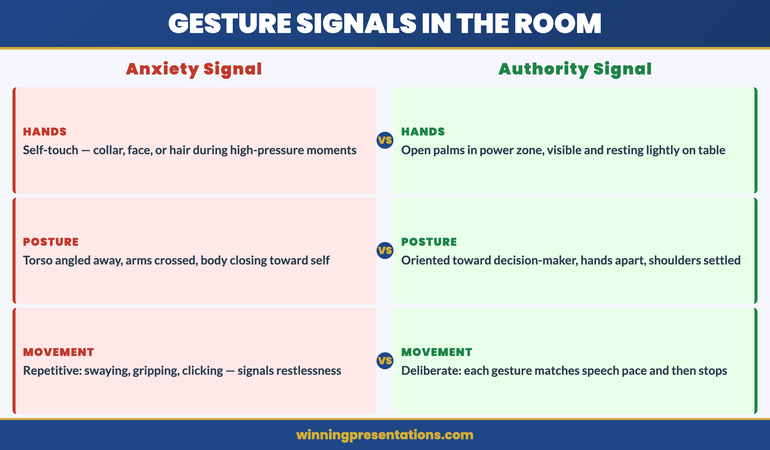
The self-touch. Touching the face, neck, collar, hair, or ear during a presentation is the most visible anxiety signal available to an audience. It happens when the nervous system is trying to self-soothe under pressure. Awareness is the first step — if you know you do this, you can create a simple circuit-breaker: when you feel the impulse, redirect the hand to a deliberate gesture in the power zone instead.
The grip. Gripping the edge of a table, a pen, a pointer, or your own hands together conveys tension directly. The knuckles whiten, the forearm tightens, and the audience reads physical effort where you intend conviction. If you need something to hold, use a pen lightly — not gripped. Better still, keep your hands free and resting lightly on the table.
The fig leaf. Hands clasped together below the waist (standing) or in the lap (seated) create a closed, self-protective posture. This is one of the most common default positions for presenters under stress, and one of the most damaging in terms of perceived authority. The fix is to simply part the hands — resting them separately on the table or thighs — which immediately creates a more open and settled impression.
The repetitive movement. Swaying, rocking, pen-clicking, tapping, or any other repeated physical action draws attention from the content and signals restlessness or anxiety. These behaviours are almost always invisible to the presenter and very visible to the audience. A recording of your last presentation, watched with the sound off for two minutes, will tell you definitively whether you have a repetitive movement pattern.
The turned body. Presenting with your body or torso angled away from the most senior person in the room — usually the person you find most intimidating — creates a subtle but consistent impression of avoidance. The most effective correction is deliberate: before you begin, physically orient your body toward the decision-maker rather than toward the screen or the room in general.
For morning routine techniques that help you arrive at presentations in a calmer physical state, see the morning presentation protocol that elite executives use to manage pre-presentation nerves.
When nerves take over: recovering composure mid-presentation
Even experienced executive presenters encounter moments mid-presentation when the nervous system spikes unexpectedly — an aggressive question, an unexpected technical failure, a silence that lasts too long. In these moments, the body tends to revert to its anxious default, and the gesture patterns described above will all try to activate at once.
The most effective in-the-moment recovery technique is what performance coaches call the reset breath — a single, deliberate, slow exhale before you respond. The exhale activates the parasympathetic nervous system, which moderates the acute stress response. It takes less than three seconds. To the audience it looks like a considered pause before a thoughtful response. To your nervous system, it is a circuit breaker.
Pair the reset breath with a deliberate physical reset: both hands visible and flat on the table, shoulders dropped rather than raised, body facing toward the questioner. This physical posture tells your nervous system that you are in a position of stability rather than threat — which further moderates the anxiety response.
The longer-term solution is not performance management but the underlying anxiety itself. Gesture problems in executive presentations are almost always a symptom of a presenting anxiety that has not been fully addressed at its root — the belief, often below conscious awareness, that this presentation is dangerous, that failure here will be catastrophic, that the audience is looking for reasons to dismiss you. Addressing that belief — rather than managing its physical expressions — is what creates lasting change.
Conquer Speaking Fear — £39
From Managed Symptoms to Genuine Confidence
Conquer Speaking Fear — £39, instant access — is a structured 30-day programme using nervous system regulation and clinical hypnotherapy techniques. Designed for executives whose anxiety is showing up physically — in gestures, posture, or in-the-moment composure — and who want lasting change, not coping strategies.
Designed for executives whose presentation anxiety is limiting their professional credibility.
Frequently Asked Questions
Should I rehearse specific gestures before a presentation?
Rehearsing specific gestures tends to make them look choreographed rather than natural — which creates a different kind of credibility problem. What is worth rehearsing is the absence of anxious gestures: recording yourself on your phone for five minutes while you walk through the opening of your presentation, then watching it back with the sound off to identify which anxiety patterns are active. Once you know what your default anxious gestures are, you can practise redirecting them rather than scripting replacements. The goal is not controlled performance — it is the physical calm that comes from a nervous system that is not in high alert.
Does gesture style need to change depending on the audience’s culture?
Cultural context does affect gesture norms, and this matters most in international or cross-cultural executive presentations. In general, contained gestures that stay in the power zone are culturally neutral — they read as professional and deliberate across most Western and Asian corporate cultures. What varies is the degree of expressiveness that is expected: some cultures read low gesture volume as composure, others as coldness or disengagement. If you are presenting to an audience from a culture significantly different from your own, the safest approach is to observe how your most respected counterparts in that culture gesture during presentations, and calibrate accordingly.
How long does it take to change habitual gesture patterns?
For most executives, awareness alone produces a noticeable change within three to five presentations. The anxious gesture pattern is habitual, not instinctive — which means it can be interrupted with conscious attention. What takes longer is the underlying anxiety that drives the pattern. If you find that the gestures return under high-pressure conditions even when you have worked hard to address them in lower-stakes settings, that is a signal that the anxiety itself needs to be addressed rather than just managed at the surface level.
The Winning Edge
Weekly executive communication insight — every Thursday
Practical, evidence-based analysis of presentation confidence, delivery, and body language for executives who present in high-stakes settings.
About the Author
Mary Beth Hazeldine — Owner & Managing Director, Winning Presentations
With 25 years of corporate banking experience at JPMorgan Chase, PwC, Royal Bank of Scotland, and Commerzbank, Mary Beth advises executives across financial services, healthcare, technology, and government on structuring presentations and managing the anxiety that limits their professional impact. Her approach draws on neuroscience, performance psychology, and 16 years of executive presentation training.