Tag: boardroom questions

17 Apr 2026
A male operations manager responding confidently to a question from a senior female executive in a high-level skip-level meeting, boardroom setting, composed and direct, editorial photography style

Skip-Level Meeting Q&A: Handling Questions From Senior Leadership

Quick Answer: Skip-level meetings — where your boss’s boss engages directly with you — carry a distinct Q&A dynamic. Senior leaders ask differently from your direct manager: they operate at a higher level of abstraction, they test your strategic thinking rather than your operational knowledge, and they pay close attention to how you handle uncertainty. Preparation requires mapping the questions they are likely to ask, practising responses that demonstrate judgement rather than just facts, and knowing how to redirect operational detail back to the strategic level without appearing evasive.

Tomás had run his division’s operations for three years. His direct manager trusted him completely. When the group CEO announced a series of skip-level conversations with senior managers, Tomás wasn’t particularly concerned. He knew his numbers. He knew his team. He had delivered consistently.

The CEO’s first question was: “If you had to restructure this division to be twenty percent more efficient without reducing output, where would you start?” Tomás answered with an operational plan — headcount distribution, process changes, technology investments. The CEO listened politely, then said: “That’s useful. I was asking where the biggest strategic constraint is.”

Tomás had answered the question he was comfortable with rather than the one that was asked. He had given operational detail in response to a request for strategic judgement. The CEO moved on. Tomás knew, walking out, that the conversation had not gone the way he needed it to.

It was a recoverable situation — Tomás followed up by email with a more strategic framing, and the CEO later described him positively in a talent review. But the preparation gap was clear: he had been ready for the operational meeting he expected, not the strategic conversation that actually happened.

If you have a skip-level meeting coming up

The Executive Q&A Handling System includes a framework for predicting the questions senior leaders ask, structuring your responses at the right level of abstraction, and handling the difficult moments — the stretch questions, the challenges to your assumptions, the questions you didn’t anticipate.

Explore the System →

Why Skip-Level Q&A Is Different From Any Other Meeting

Skip-level meetings — where a senior leader engages directly with someone two or more levels below them — serve a specific organisational function: they give senior leadership an unfiltered view of how the organisation thinks and operates below the layer of direct management. This purpose shapes every question a senior leader asks in these settings.

Your direct manager assesses whether you are executing well on defined objectives. A skip-level senior leader is assessing something different: whether you have the strategic thinking, the judgement under pressure, and the professional credibility to operate at the next level. They are using the conversation to calibrate your potential, not just your current performance.

This changes the preparation requirement significantly. Preparing for your direct manager’s questions means knowing your operational data deeply. Preparing for skip-level questions means being able to step above the operational data and discuss what it means at a strategic level — what the implications are, where the constraints lie, and what you would do if you were making the decisions rather than executing them.

The emotional dynamic is also different. Most executives are more comfortable being challenged by their direct manager — the relationship has context, history, and established trust. A senior leader who challenges an assumption in a skip-level meeting does so without that context. The challenge can feel more exposing, and the temptation to become defensive or to over-explain is higher. Knowing this in advance — and having specific strategies for managing it — is part of effective skip-level preparation.

Executive Q&A Handling System

Predict the Questions, Structure the Answers, Handle the Pressure

The Executive Q&A Handling System — £39, instant access — gives you a systematic approach to predicting the questions senior executives ask, structuring answers at the right level, and managing the high-pressure moments that define how you are perceived in the room. Designed for executives who present to, or are questioned by, decision-makers more senior than their direct line.

  • Question prediction frameworks for skip-level and senior leadership contexts
  • Response structure guides for strategic, operational, and challenge questions
  • Techniques for handling the questions you didn’t predict — without losing credibility
  • Scenario playbooks for investment committee, board, and skip-level meeting Q&A

Get the Q&A Handling System →

Designed for executives who are questioned by senior decision-makers in high-stakes contexts.
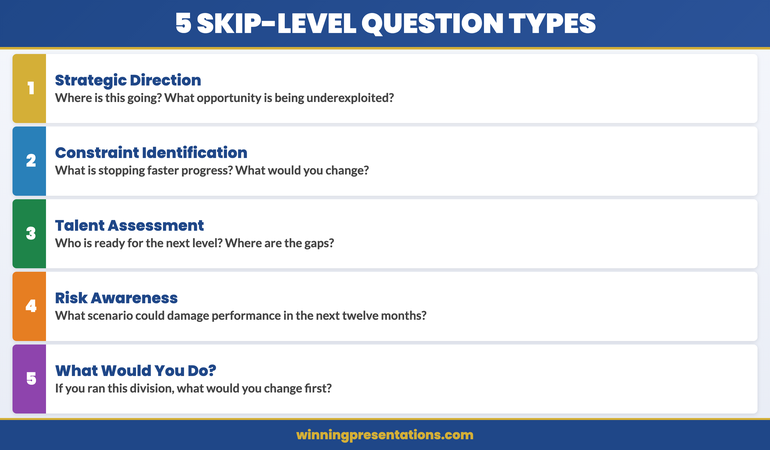

Five Skip-Level Question Types infographic showing: Strategic Direction, Constraint Identification, Talent and Team Assessment, Risk and Challenge, and What Would You Do Differently — the five categories senior leaders use in skip-level meetings

The Five Question Types Senior Leaders Use

Skip-level questions cluster into five recognisable types. Knowing these in advance allows you to prepare answers that operate at the right level — not too operational, not too vague.

1. Strategic direction questions. “Where do you see this business in three years?” or “What’s the biggest opportunity your team is underexploiting?” These questions invite you to demonstrate that you think above your day-to-day responsibilities. The trap is giving an operational answer — describing what your team does rather than where it should go. The strong response connects your area’s trajectory to the wider organisational strategy and names a specific opportunity or constraint that you believe is underweighted.

2. Constraint identification questions. “What’s stopping you from moving faster?” or “What would you change if you had the authority?” These are diagnostic questions. Senior leaders use them to identify organisational bottlenecks and to assess whether middle management has a clear view of what is holding back performance. The weak response is to describe a resource constraint — “we need more budget or headcount.” The strong response names a structural or strategic constraint — a process, a decision-making dependency, or a talent gap — and articulates what removing it would unlock.

3. Talent and team questions. “Who on your team is ready for the next level?” or “Where are the talent gaps that worry you most?” These questions assess your people judgement and your investment in your team’s development. Have a specific answer — naming individuals where relevant — and demonstrate that you think deliberately about succession and capability rather than managing the team as an undifferentiated group.

4. Risk and challenge questions. “What keeps you up at night?” or “What’s the scenario that could significantly damage performance in the next twelve months?” These questions test your risk awareness and your honesty about vulnerability. Executives who answer with reassurance — “we’re in good shape, I’m not particularly concerned” — miss the point. A thoughtful risk response names a genuine concern, explains the monitoring mechanism in place, and identifies the early-warning signal that would trigger action.

5. The “what would you do” question. “If you were running the division, what’s the first thing you’d change?” This is a test of strategic confidence and intellectual courage. The safest-seeming answer — “that’s not my decision to make” — is the one that signals you are not thinking above your role. The strong response articulates a clear view, grounds it in specific evidence, and frames it as a perspective rather than a criticism of current strategy.

A Preparation Framework That Works at Any Level

Effective skip-level preparation follows a three-layer structure. Each layer prepares you for a different type of question and a different dimension of the conversation.

Layer 1 — Know your brief. What does this senior leader already know about your area? What recent decisions or events have shaped their view of your division? What is their stated agenda for the skip-level series — are they gathering strategic input, conducting a talent assessment, or investigating a specific performance question? Knowing the context of the conversation lets you frame your answers in terms they will find relevant rather than comprehensive.

Layer 2 — Prepare your positions. For each of the five question types above, develop a clear, confident position. This is not a scripted answer — it is a considered point of view. On strategy: where does your area need to go and why? On constraints: what is genuinely holding back performance? On talent: who is ready for more and who needs development? On risk: what is the real exposure? On what you would change: what is your honest view?

Layer 3 — Anticipate the follow-up. Senior leaders who ask a question and get a polished first answer often follow up with something harder — a challenge to an assumption, a request for more specificity, or a question that follows the logic of your answer to an uncomfortable place. For each prepared position, ask yourself: what is the most challenging follow-up question this answer could generate, and what is my response? This is where most skip-level preparation fails: the first answer is prepared, the follow-up is not.

For the underlying approach to Q&A preparation in high-stakes settings, see The Q&A Briefing Document: The Five Sections Every Executive Needs Before a High-Stakes Q&A.

If your skip-level meeting involves formal Q&A — or if you want a systematic approach to predicting and preparing for the questions senior leaders ask — the Executive Q&A Handling System provides the question prediction and response structuring framework in one place.
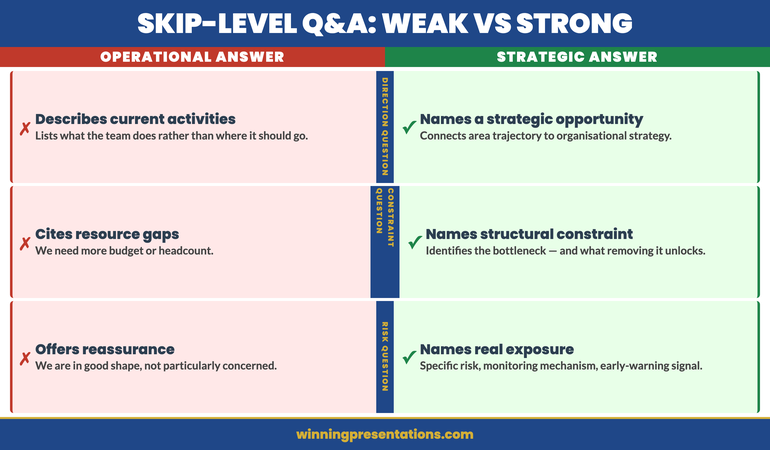

Weak vs Strong Skip-Level Q&A Responses comparison infographic showing three question types — Strategic Direction, Constraint Identification, and Risk Assessment — with examples of operational answers that miss the mark versus strategic answers that demonstrate senior-level thinking

Handling Questions in the Room

No matter how well you prepare, a skip-level meeting will generate at least one question you didn’t predict. How you handle the unpredicted question is often more revealing than how you handle the prepared ones.

When a question catches you off-guard, the effective response sequence is: pause briefly, clarify if necessary, then answer at the highest level you can before offering to follow up with more specificity. “That’s an important question. My current thinking is [position]. I’d want to check [specific data point] before I give you a more precise answer — can I send that through to you by end of week?” This response demonstrates intellectual honesty, shows that you distinguish between your current thinking and confirmed data, and keeps the conversation moving without bluffing.

When a senior leader challenges an assumption in your answer, don’t immediately capitulate or immediately defend. Both responses look weak — capitulation suggests you weren’t confident in your original position, and over-defence suggests you can’t distinguish between a good challenge and a bad one. Instead, engage with the challenge: “That’s a useful pushback. The reason I landed on [position] is [reasoning]. If [alternative factor the leader raised] is weighted more heavily, I can see how the answer changes.” This demonstrates that you can think in the room, not just recite prepared positions.

When you genuinely don’t know the answer to a question, say so clearly and briefly. “I don’t have that data to hand, but I can get it to you by [specific date]” is a stronger answer than a hedged, half-informed response that a senior leader will see through. The willingness to say “I don’t know” clearly — without excessive apology — is a mark of confidence, not of weakness. See also The Bridging Technique: How to Handle Difficult Questions Without Losing the Room.

The Three Traps That Derail Skip-Level Q&A

Understanding what derails other executives in skip-level meetings is as valuable as knowing what works. Three patterns come up consistently.

Trap 1: Trying to impress rather than inform. Skip-level conversations derail most often when the executive treats it as a performance — an opportunity to demonstrate how impressive they are — rather than as a dialogue. Senior leaders are highly attuned to impression management and discount it quickly. The executive who speaks plainly, admits uncertainty where it exists, and demonstrates genuine thinking is almost always more credible than the one who delivers polished answers that say less than they appear to.

Trap 2: Staying too close to your direct manager’s position. One of the purposes of skip-level meetings is for senior leadership to hear perspectives that may differ from what the management layer above you reports. If you align all your answers with your direct manager’s stated positions, you signal that you are a reliable executor rather than an independent thinker. Have a view. Where it differs from your manager’s, you can acknowledge the difference respectfully: “My manager and I have discussed this — my own read of the situation is slightly different, and I think both perspectives are legitimate.”

Trap 3: Over-managing upward. Some executives use skip-level meetings primarily to manage how they are perceived by the senior leader — steering away from topics where performance has been weak and toward areas of strength. Senior leaders recognise this pattern quickly. A question about a difficult area that gets redirected to a comfortable one signals that the executive is managing the conversation rather than engaging with it. Addressing a difficult topic directly — “I know Q3 performance in my area was below expectation. Here is my assessment of what happened and what we’ve changed” — is far more credible than a smooth deflection. For related techniques, see Regulatory Review Q&A: What Compliance Officers Actually Want to Hear.

After the Meeting: Following Through on What You Said

Skip-level meetings leave two kinds of residue: the impression you created in the room, and the commitments you made during the conversation. Both require active management after the meeting ends.

Within twenty-four hours, send a brief follow-up note to the senior leader’s PA or directly, depending on the level of formality. The note should do two things: thank them for the time and confirm any specific follow-up items you committed to. “Following our conversation this morning, I’ll send through the Q3 variance analysis by Friday and the talent pipeline summary by end of next week.” This demonstrates that you take the conversation seriously, that you are organised, and that commitments made in the room are honoured.

Deliver the follow-up items on time — or earlier. A commitment made to a senior leader that is late, or that requires chasing, signals unreliability at exactly the moment when you want to be creating the opposite impression. If something unexpected delays a follow-up item, communicate proactively rather than waiting to be asked.

After the meeting, brief your direct manager on what was discussed. This is professional protocol — your manager should not hear about the conversation through other channels — and it gives you the opportunity to get their input on whether your answers aligned with the division’s official positions. If you expressed a view that differs from your manager’s, this conversation is important: it surfaces the difference in a direct, constructive way rather than leaving it to emerge through the senior leader’s subsequent communications.

Prepare Systematically, Not Just Thoroughly

The Q&A System That Covers What You Can’t Predict

The Executive Q&A Handling System — £39, instant access — includes question prediction frameworks, response structuring guides, and techniques for handling the challenging moments that no amount of preparation fully eliminates. Designed for executives facing Q&A from senior leadership, investment committees, and boards.

Get the Q&A Handling System →

Frequently Asked Questions

Should I tell my direct manager about a skip-level meeting before it happens?

Yes, always. Attending a skip-level meeting without briefing your direct manager creates an unnecessary trust issue. Most managers understand that skip-level conversations are a normal organisational practice — but they expect to know about them. Before the meeting, let your manager know it is happening, ask if there are any topics you should be aware of, and agree on which areas you have authority to speak to independently. After the meeting, debrief them on what was discussed. This approach keeps the relationship with your manager intact while allowing you to have a genuine, direct conversation with the senior leader.

What if a senior leader asks me about a topic that falls outside my brief?

Acknowledge the boundary clearly and briefly, then offer what you can. “That sits primarily with [function or colleague]. My perspective, from what I observe in working with that team, is [observation].” This response demonstrates self-awareness about your scope without appearing unwilling to engage. Senior leaders often value the cross-functional perspective — your observation, clearly framed as an outside view, can be genuinely useful. The trap is either claiming authority you don’t have or refusing to engage with anything outside your immediate remit.

How should I handle a question where my honest answer reflects badly on the organisation?

Honesty is the correct approach, but framing matters. A response that simply delivers a critical assessment — “morale is poor and I don’t think the restructuring was handled well” — without context or solution-orientation is difficult for a senior leader to do anything with. The more useful framing names the issue, offers your assessment of its cause, and identifies what you believe would address it. This positions you as someone who is engaged with the problem rather than just observing it. Senior leaders generally value candour from executives who can pair it with constructive thinking.

The Winning Edge — Free Weekly Newsletter

Practical frameworks for Q&A handling, executive communication, and presenting to senior leadership. Every Thursday.

Subscribe to The Winning Edge →

About the Author

Mary Beth Hazeldine is Owner & Managing Director of Winning Presentations. With 25 years of corporate banking experience at JPMorgan Chase, PwC, Royal Bank of Scotland, and Commerzbank, she advises executives across financial services, healthcare, technology, and government on structuring presentations for high-stakes funding rounds and approvals.

17 Mar 2026
Technical presenter explaining a complex concept to non-technical executive board members using simple visual language, modern boardroom, navy and gold corporate aesthetic

When Non-Technical Executives Ask Technical Questions: How to Translate Under Pressure

Quick answer: When a non-technical executive asks a technical question, they’re often not asking for technical depth—they’re asking “Will this work, and can I trust it?” Translate the question into the business risk underneath. Answer the risk, not the jargon.

Stuck in the boardroom when a non-technical executive asks a technical question you weren’t expecting? The gap between their question and your knowledge isn’t the problem—your translation speed is. The Executive Q&A Handling System teaches you to diagnose what non-technical executives actually need to hear, and answer it instantly without condescension.

Master technical Q&A for non-technical audiences → £39

A CFO asked a technology director: “How confident are you in the architecture?” It sounded technical. The director launched into a fifteen-minute explanation of microservices, API scalability, and load balancing. The CFO’s eyes glazed over. What he’d actually asked was: “Can this project stay on time and on budget?”

They were speaking the same language but answering different questions. The director was answering the technical question. The CFO was asking the business question. The gap between them killed the conversation and signalled that the director didn’t understand what executives care about.

This happens constantly in boardrooms. A non-technical executive asks a question that sounds technical. The presenter answers the technical version, misses the real intent, and walks out of the room thinking “They don’t understand this.” What actually happened: the presenter didn’t understand what the executive needed.

The Role-Mismatch Problem in Q&A

Non-technical executives ask technical questions, but their frame of reference is different from yours. You’re thinking: “How do I explain this correctly?” They’re thinking: “Is this a risk I need to manage?”

This creates a consistent pattern:

The executive asks about a technical detail. Something like: “What’s the data migration strategy?” or “How are you handling the API integration?” or “What’s your backup procedure if the vendor disappears?”

The presenter hears a technical question. So they answer technically, diving into details about databases, authentication protocols, redundancy systems. They’re being thorough.

The executive stops listening. They’ve lost the thread. They don’t need to understand microservices—they need to know whether the project will survive if something goes wrong.

The presenter thinks the executive is unsophisticated. “They just don’t get it. They asked a technical question but couldn’t follow the technical answer.” False. The executive asked a risk question and the presenter gave a detail answer.

The real skill in boardroom Q&A isn’t technical knowledge—it’s recognising which question is really being asked underneath the words, and answering that one.

What Non-Technical Executives Really Ask

A non-technical executive asking technical questions is almost always asking one of these five things:

1. “Is this a known risk or an unknown one?” When they ask “How will you handle scalability?”, they’re really asking: “Is this a solved problem or are you building something we’ve never done before?” Known risks can be managed. Unknown risks are threats.

2. “Can I trust the people running this?” When they ask “What’s your testing framework?”, they’re assessing your rigour and competence. They’re asking: “Does this team know what they’re doing?” Not: “Explain your testing framework.”

3. “What happens when the worst-case scenario occurs?” When they ask “What’s your disaster recovery plan?”, they’re not asking for technical detail. They’re asking: “Have you thought about failure? Can this organisation survive a major problem?” They want assurance that you’ve considered risk.

4. “Is this going to cost us more than we’ve budgeted?” When they ask technical questions about dependencies, timelines, or integration complexity, they’re often asking: “Will we go over budget?” Hidden inside the technical question is a financial risk question.

5. “Are you sure about this?” Sometimes they’re just checking your confidence level. A wavering answer feels risky. A confident answer (even if the answer is “We’ll figure that out”) feels manageable.

Once you understand that non-technical questions are actually risk questions, your entire approach to Q&A changes. You’re no longer explaining technical detail—you’re demonstrating that you’ve thought through risk.

Translation matrix infographic mapping four common technical questions to their executive translations showing the business concern behind each technical inquiry

The Translation Framework: From Technical Question to Risk Answer

Here’s the framework that lets you answer in real time:

Step 1: Hear the question but don’t answer it yet. When a non-technical executive asks “How are you handling data security?”, pause for one breath. Don’t jump straight into explaining encryption or compliance frameworks.

Step 2: Identify the risk underneath. Ask yourself silently: “What’s the actual concern here?” Data security questions usually mean: “Could we get breached and expose customer data?” or “Are we compliant with regulations?” Occasionally: “Will security requirements slow down the project?”

Step 3: Lead with the risk answer, then give technical detail only if asked. Instead of explaining security architecture, say: “Our data is encrypted both in transit and at rest. We’re fully compliant with GDPR and ISO 27001. Those are the two regulatory requirements that matter most for this project.” You’ve answered the risk. Now the executive knows you’ve thought about it.

Step 4: Pause and check their reaction. If they nod and move on, you’re done. You answered what they needed. If they lean forward or ask a follow-up, then give technical detail. You’ve earned the space to be technical because you answered the risk first.

Example: The Data Migration Question

Non-technical executive asks: “Walk me through the data migration strategy. What if something goes wrong during the cutover?”

Wrong answer: “We’re using an ETL tool with three-phase validation. Source system remains live during Phase 1 and 2, then we cut over in Phase 3 with a 48-hour rollback window. We’ve built dual-write logic to ensure consistency…”

Right answer: “The biggest risk in migration is data loss or inconsistency during cutover. We’re protecting against that with a 48-hour rollback window and full data validation before we go live. We’ve done this type of migration four times. The parallel run adds two weeks to the timeline, but that’s worth it for safety. The only scenario where we’d cut over without the rollback window is if the business explicitly chooses speed over safety—but we’re not recommending that.”

The difference: The right answer acknowledges the real risk (data loss), explains how you’re managing it (rollback window, validation, proven methodology), and puts the safety/speed tradeoff on the executive’s desk. The executive now understands the situation and can make a decision. The wrong answer buries the executive in technical detail that doesn’t help them decide anything.

Three-layer translation framework infographic showing what they asked at the technical level what they actually want to know at the business level and how to answer with business impact first

Responding in Real Time Under Pressure

The challenge with translating technical questions for non-technical executives is doing it in real time. You can’t take ten minutes to think. The best Q&A prep happens before you present, by anticipating the questions and mapping the translation beforehand.

Pre-presentation work: Three days before presenting, list the technical questions you might get. For each one, write down: “The risk they’re probably asking about is…” Once you’ve identified the risk, you know how to answer the question without over-explaining.

In the moment: When the question lands, you have a mental template. Take a breath. Think: “Risk question or detail question?” Then answer the risk first, detail only if asked.

If you get stuck: Ask a clarifying question: “When you ask about security, are you mostly concerned about compliance, data breaches, or operational disruption?” This buys you thinking time and also forces them to clarify what they actually care about. Often, their answer tells you exactly what risk they’re worried about.

Common Traps to Avoid When Answering Non-Technical Executives

Trap 1: Using jargon as a confidence signal. When nervous, presenters often double down on technical language, thinking “If I sound more technical, I’ll sound more credible.” The opposite is true with non-technical audiences. Jargon makes you sound like you’re hiding something.

Trap 2: Assuming they need the depth they’re asking for. “How does the API handle rate limiting?” sounds like a deep technical question. It often means: “Can we support the volume of requests we’ll get?” Answer the volume concern, not the API question.

Trap 3: Over-answering from anxiety. When you’re nervous about being found out, you add detail. You explain things they didn’t ask for. You hope something you say will prove your competence. This backfires. They stop listening because there’s too much noise.

Trap 4: Treating non-technical people like they’re stupid. Condescension is felt instantly, even if you don’t mean it. “Oh, that’s a great question!” (tone: surprised they understand) or over-simplified answers that feel patronising. Respect their intelligence. Explain the concept clearly, not simply.

Trap 5: Giving a technical answer when they’re asking for confidence. Sometimes a non-technical executive asks a technical question because they want to assess your confidence. A confident, clear answer—even if it admits uncertainty on a detail—feels more trustworthy than a technically comprehensive answer that wavers.

Trap 6: Forgetting that risk tolerance changes the answer. The CFO asking about disaster recovery has a different risk tolerance than the CTO. CFO wants: “Will we lose money?” CTO wants: “Will we lose data?” Same technical question, different real question. You need to know who’s asking.

Master the Risk Translation Framework for Boardroom Q&A

The Executive Q&A Handling System teaches you a real-time translation formula: hear the technical question, identify the risk underneath, answer the risk. You’ll learn to diagnose which questions are actually asking about risk, cost, timeline, or confidence—and answer accordingly.

  • The five questions non-technical executives are really asking (and what each one needs)
  • Risk identification in real time: How to hear the business question underneath the technical words
  • The answer architecture: Lead with risk, follow with detail (only if asked)
  • Question anticipation workbook: Map likely technical questions and translate them before you present
  • Live response patterns: Clarifying questions that buy thinking time and reveal what they actually care about

Get the Q&A System → £39

Includes the “Question Translation Template”—map your technical questions to business risks before presenting.

Need a formula to answer technical questions from non-technical executives instantly?

Learn the Framework → £39

The Role Difference and Why It Matters

The core issue: executives and specialists live in different mental models. A specialist thinks: “How does this work?” An executive thinks: “What could go wrong with this, and can I manage it?”

Neither model is wrong. They’re just different. Your job in boardroom Q&A is to translate between them.

When a non-technical executive asks a technical question, they’re not asking you to teach them engineering. They’re asking you to confirm that you’ve thought about risk and that you can manage it. Answering the risk question does that. Answering the technical question (in technical depth) doesn’t.

In board-level Q&A especially, this pattern is consistent. Directors care about risk, return, and reputation. They’re asking technical questions because they want to know: “Are we safe? Can we trust this team? Will we lose money or face?”

The presenter who recognises this pattern and answers accordingly walks out of the boardroom looking like they understand executive priorities. The presenter who answers the technical question in technical depth walks out looking like they’re focused on engineering, not business.

Building a Pre-Presentation Question Map

You can’t prepare for every question, but you can prepare for the likely ones. Three days before presenting, do this work:

Step 1: Predict the technical questions you might get. Based on your presentation content, what technical details might someone want to explore? List them.

Step 2: For each question, identify the risk underneath. “They might ask about X. That probably means they’re worried about Y risk.” Write it down.

Step 3: Prepare the risk answer first, then the technical detail. If they ask, you can go technical. But you’ve got the risk answer locked.

Step 4: Identify which executive roles will be in the room and what they care about. CFO cares about cost and timeline. CIO cares about integration and disruption. Chief Commercial Officer cares about customer impact. Different roles ask the same technical question but care about different risks. Map it.

This work happens before you present. Once you’re in the room, you just execute the translation. You’ve already done the thinking.

The Complete Q&A System: From Prediction to Response

The Executive Q&A Handling System covers the entire journey: predicting questions, translating business intent, answering under pressure, handling hostility, and recovering from gaps in knowledge. The translation framework is just one piece—but it’s the one that unlocks boardroom credibility.

  • Risk translation formula: Technical question → business risk → confident answer
  • Role-based risk mapping: What each executive role actually cares about
  • Question prediction workbook: Build your anticipated Q&A before presenting
  • Live response framework: Clarifying questions, confidence signals, time-buying techniques
  • Handling the “I don’t know” moment: How to survive admitting uncertainty and maintain credibility

Get the Q&A System → £39

Includes real Q&A examples from boardroom presentations that reveal how executives ask business questions in technical language.

Ready to translate technical questions in real time during your next presentation?

Start Here → £39

People Also Ask

What if the executive’s question is actually technical and they want technical depth? That’s rare, but you’ll know it by their reaction. If you give the risk answer and they’re unsatisfied, they’ll push back or ask for more detail. Then you go technical. But assume they want the risk first and let them ask for technical depth if they need it.

Is it condescending to simplify technical concepts for non-technical executives? No—it’s respectful. Dumbing down is condescending. Translating is respectful. There’s a difference: simplify the language, not the concept. “We’ve built redundancy so if one system fails, another takes over” is simpler than “We’ve implemented active-active failover in a distributed architecture,” but it’s not dumb. It’s clear.

What if I genuinely don’t know the answer to their technical question? Answer honestly and pivot to what you do know. “I don’t have that specific data on me, but here’s what I do know: we’ve budgeted for this contingency, and our vendor’s track record suggests it won’t be an issue. Let me follow up with the exact detail.” You’ve answered the risk (we’ve planned for it) even though you don’t know the technical detail.

Is This Right For You?

✓ This is for you if:

You present technical solutions to non-technical executives and you want to answer their questions in a way that actually lands.
You’re worried about how to handle Q&A when the audience is less technical than you are.
You want to diagnose which question is really being asked underneath the technical words.

✗ Not for you if:

You’re presenting to technical audiences who genuinely want technical depth. (Different framework applies.)
You believe executives should understand technology at a technical level and you’re not interested in translating.

FAQ

What’s the difference between translating and dumbing down?

Translating respects the intelligence of the audience while simplifying the language. “We’re using load balancing to ensure the system handles peak traffic” is translated. “We make it so the traffic doesn’t get too heavy” is dumbed down. Translation: clear language, full concept. Dumbing down: oversimplified concept.

How do I know if a non-technical executive actually wants technical detail?

Watch their body language and listen to their follow-ups. If you give the risk answer and they look satisfied, you’re done. If they lean forward and ask more questions, they want depth. If they look confused, your translation missed the mark and you need to simplify further.

Should I ask the executive which type of answer they prefer?

Not usually—it can feel like you’re putting them on the spot or suggesting they wouldn’t understand. Default to the risk answer first, then gauge their reaction. If you really need to know, ask it indirectly: “Should I focus on the impact to timeline, or would you like me to walk through the technical approach?”

What if the non-technical executive is actually asking a trick question to catch me out?

Possible, but rare. More often, they’re just asking a genuine question in language that makes sense to them. Even if it’s a test of your knowledge, the risk-first answer works: it shows you think like an executive, not just like a specialist.

Related: Your Presentation Didn’t Fail — The Decision Was Already Made Before You Walked In — Understanding pre-decision dynamics helps you anticipate which questions matter to which executives.

Related: The ‘One More Thing’ That Ruins Good Presentations: Why Anxiety Makes You Add Content — Nervous presenters often over-answer Q&A from anxiety. The translation framework helps you answer precisely instead.

Translate Technical Questions Into Executive Answers

Your next boardroom Q&A will include at least one technical question from a non-technical executive. When it lands, you now have a framework: identify the risk underneath, answer the risk, offer technical detail only if asked.

This doesn’t require you to understand less about the technology. It requires you to understand what executives actually care about. That’s a business skill, not a technical one. And it’s the skill that separates presenters who get heard from presenters who get interrupted.

You’re presenting next Thursday? Start mapping your anticipated questions now. For each one, write: “The risk they’re probably worried about is…” Once you’ve identified the risk, you know how to answer the question—even in real time, even under pressure.

Join executives learning to bridge the gap between technical depth and executive clarity. Subscribe to The Winning Edge newsletter for weekly frameworks on boardroom communication.

About the Author

Mary Beth Hazeldine is the Owner & Managing Director of Winning Presentations. With 24 years of corporate banking experience at JPMorgan Chase, PwC, Royal Bank of Scotland, and Commerzbank, she has delivered high-stakes presentations in boardrooms across three continents.

A qualified clinical hypnotherapist and NLP practitioner, Mary Beth combines executive communication expertise with evidence-based techniques for managing presentation anxiety. She has trained thousands of executives and supported high-stakes funding rounds and approvals.

Book a discovery call | View services

This article was written with AI assistance and reviewed by Mary Beth Hazeldine.

16 Mar 2026
Tense steering committee meeting with an executive raising a difficult question while the presenter maintains composure, modern boardroom setting, navy and gold corporate aesthetic

Steering Committee Q&A: Why “We’ll Take That Offline” Is a Red Flag

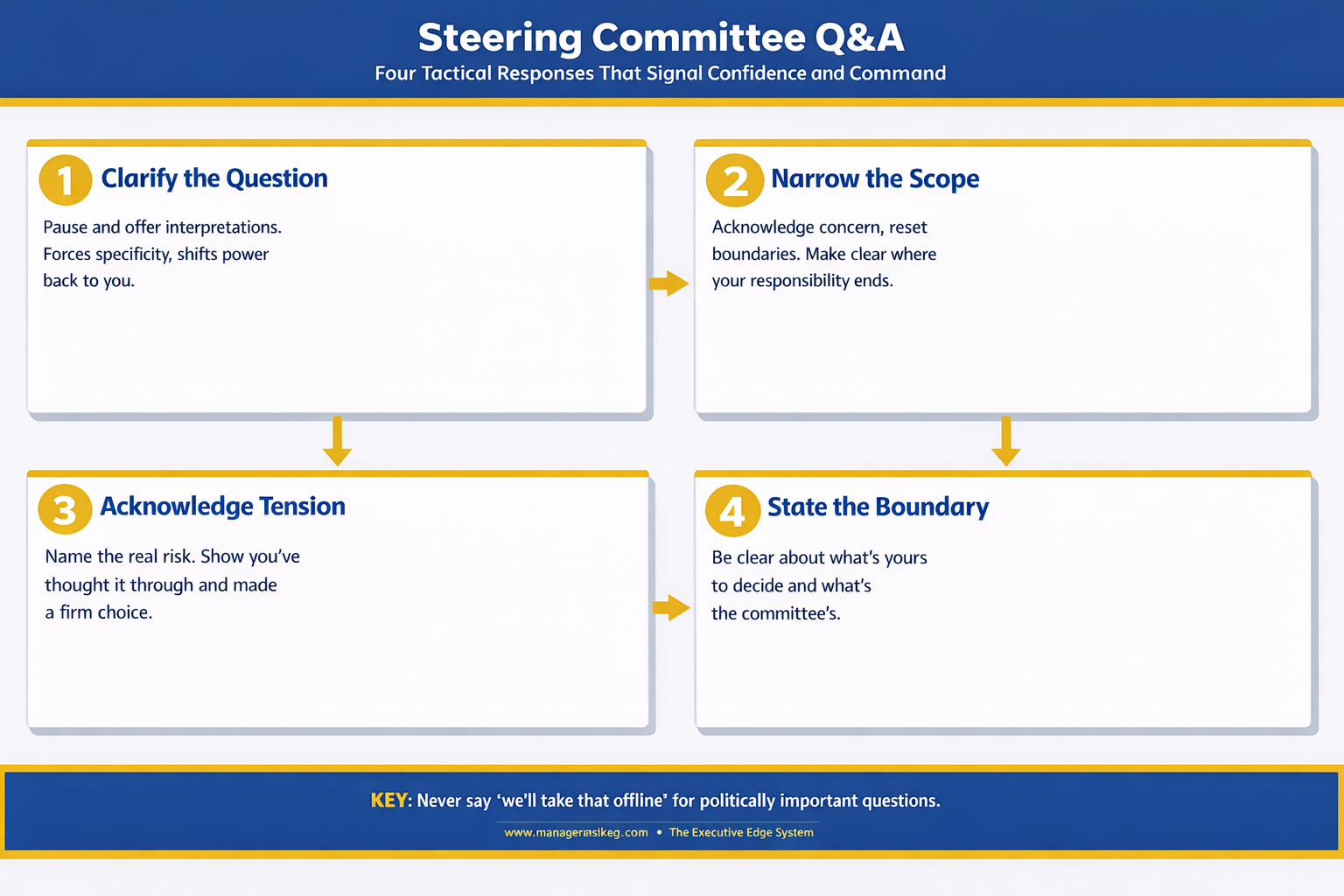
Quick Answer: Steering committees have different political dynamics than boards. When someone asks a tough question and you say “We’ll take that offline,” you’ve just signalled: “I don’t have a clear answer” or “I’m avoiding this in front of the group.” The steering committee reads that as weakness. The answer is to handle the question in the room—specifically, with one of four tactical approaches: clarify the question, narrow the scope, acknowledge the tension, or state the decision boundary. These techniques work because they demonstrate confidence and command.

Rescue Block: The steering committee is asking questions that feel hostile. Budget constraints. Scope questions. Political landmines. Your instinct is to defer: “We’ll take that offline and come back to you.” But the moment those words leave your mouth, the room sees you as avoiding, not confident. Steering committees are politically charged. Questions are tests. The executives want to see if you can think clearly under pressure. The Executive Q&A Handling System teaches you how to answer steering committee questions in the room with clarity and command.

It was Thursday. The steering committee for a major transformation initiative had 12 people in the room. Three were executives from the CFO’s office. Two were operational heads from different business units. The rest were middle managers and programme leads.

Sarah, the programme director, had presented the three-year implementation roadmap. Solid timeline. Clear milestones. Realistic budget.

Then the CFO’s deputy asked: “The timeline assumes we’ll maintain headcount through Year Two. What happens to the budget if the headcount freezes? Which workstreams get cut?”

It was a trap question disguised as a scenario. Behind it: political concern about a possible cost reduction that the CFO hadn’t publicly committed to. Sarah’s answer would signal whether she understood the political risk.

Sarah’s instinct was to defer: “We’ll take that offline and model the scenarios.”

But she’d been trained differently. She paused. She said: “That’s a critical assumption. Let me clarify what you’re asking: are you testing whether we’re exposed to a headcount freeze, or are you asking about the sequencing if a freeze happens?”

The CFO’s deputy leaned back. Slight nod. She’d asked a political test question, and Sarah had recognized it immediately. Sarah wasn’t avoiding. She was clarifying what was really being asked.

Sarah continued: “If it’s the exposure question, the answer is we’re exposed in Year Two onwards. If it’s the sequencing question, we’ve prioritised the client-facing work. But I want to be clear: that’s our view. This committee needs to decide whether that prioritisation aligns with the strategic direction.”

The CFO’s deputy nodded again. The room moved on. Sarah had answered the question not with data, but with political clarity. She’d shown: “I understand what you’re really asking. I’m not avoiding it. I’m making clear decisions about what’s yours to decide and what’s mine.”

That’s steering committee Q&A. It’s not about the answer to the literal question. It’s about reading the political intent and responding with clarity.

Why Steering Committee Q&A Is Different

A board of directors asks questions about governance, risk, and approval.

A steering committee asks questions about survival, territory, and resource competition.

These are different animals. Steering committees include people from multiple business units or functional areas. They all have resource interests. They all have competing priorities. They all have organizational power that overlaps with your project.

A question in a steering committee is never just a question. It’s always a statement of concern, a territory claim, or a political test.

“Does this affect my budget?” = I’m worried you’re taking my headcount or my spend.

“Have we talked to IT about this?” = I need to know if my friends in IT are aligned or if you’re going rogue.

“What happens if the business changes the strategy?” = I want to see if you’ll blow up if your plan changes, or if you’re flexible (and thus less of a threat).

Board questions test governance. Steering committee questions test political savvy and clarity.

Handling questions you don’t know the answer to is one skill. Handling steering committee questions where you DO know the answer but the question is politically loaded is a different skill entirely. You need to read the intent and respond to the intent, not just the words.

The “Offline” Red Flag and What It Signals

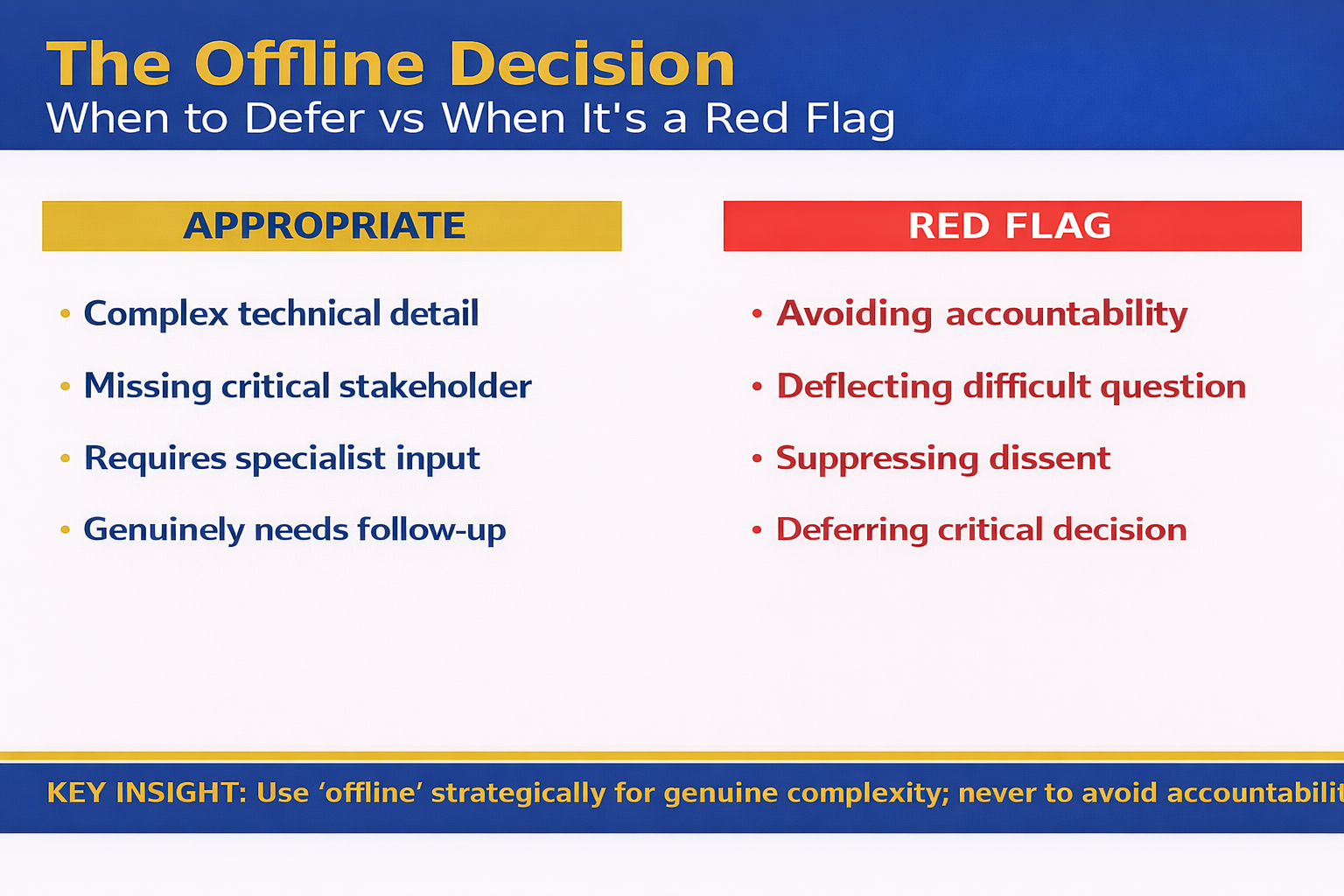
“We’ll take that offline” is a reasonable phrase in some contexts. If someone asks for a specific data point you don’t have at hand, deferring is fine.

But in a steering committee, when someone asks a question that’s politically important (about budget, scope, timeline, resource competition, strategic alignment), saying “We’ll take that offline” signals:

Signal 1: You’re avoiding. You don’t have a clear answer, or you’re uncomfortable giving it in front of the group. The committee reads this as: “You’re not as confident as you appeared.”

Signal 2: You don’t understand the political intent. If you did, you’d know that answering the question in the room matters. The person asking wants the room to hear that you’ve thought through this concern. Deferring suggests you don’t understand the political stakes.

Signal 3: You’re ceding authority. When you defer the answer, you’re saying: “This is something we’ll sort out separately, not something I’m committing to now.” The committee recognizes this as weak leadership.

Signal 4: You’re unreliable. Steering committees see deferred answers as commitments you’re backing away from. Even if you fully intend to follow up, the committee has already registered: “Not ready to commit.”

The best steering committee members never say “We’ll take that offline” in response to a politically important question. They answer the question in the room with clarity—either with a direct answer, or with a clear statement of the decision boundary.

Four Tactical Responses for Steering Committee Questions

Instead of deferring, you have four tactical moves that signal confidence and command.

Not every tactic works for every question. You learn to recognize which situation calls for which tactic. But each one keeps you in authority while addressing the actual concern underneath the question.

Tactic 1: Clarify the Question (Tactical Pause)

Use this when a question feels loaded but you’re not quite sure what’s really being asked.

The move: Pause. Say: “Let me clarify what you’re asking, because I want to make sure I’m answering the right thing.”

Then offer two or three possible interpretations of the question, and ask which one is the real concern.

Example: CFO’s deputy: “What happens to this timeline if we need to implement in two phases instead of three?”

You: “Are you asking whether we could compress the timeline? Or whether we’ve already planned for a phased approach? Or whether the budget changes if we phase it?”

What’s happening: you’re not avoiding the question. You’re showing that you’re thoughtful enough to know that different concerns might be hidden under the same words. You’re also forcing the questioner to be more specific, which shifts the power dynamic back to you.

The steering committee sees this as confidence, not deflection.

When to use: When the question feels politically charged but ambiguous. When you suspect the literal question isn’t the real concern. When you want to demonstrate that you’ve thought through multiple scenarios.

Tactic 2: Narrow the Scope (Reset Boundaries)

Use this when the question is trying to pull you into territory that’s not your responsibility.

The move: Acknowledge the question, but explicitly narrow the scope of what you’re answering for.

Example: Head of another business unit: “How are we going to manage the change impact on my team’s productivity during Year One?”

You: “That’s important. What we’re committing to is the implementation timeline and the resource plan on our side. How your team absorbs the change is something your leadership will need to decide. But we can absolutely provide you with the impact assessment so your team can plan for it.”

What’s happening: you’re not dismissing the concern. You’re making crystal clear where responsibility ends and theirs begins. You’re saying: “I own this part. You own that part. We’ll work together, but I’m not taking accountability for decisions that aren’t mine.”

This is power. The steering committee respects clarity about responsibility.

When to use: When someone is trying to make you responsible for outcomes that aren’t in your control. When the question reveals a territory battle. When you need to establish clear decision boundaries.

Tactic 3: Acknowledge the Tension (Show You’ve Thought It Through)

Use this when the question raises a real tension or risk that you’ve already considered.

The move: Don’t deny or minimize the concern. Acknowledge it directly. Then show that you’ve already thought through the implications and made a deliberate choice.

Example: Operations lead: “We’re taking on a lot of change concurrently. Won’t this distract from the quarterly close process?”

You: “Yes. You’ve identified a real tension. The concurrent timeline means we do have a distraction risk in Q2. We’ve made a deliberate choice to front-load the heavy work in Q1 and sequence the Q2 activities around your peak close period. That’s why the timeline is structured the way it is. We’ve weighed the distraction risk against the timeline pressure, and this is our answer.”

What’s happening: you’re not hand-waving away a legitimate concern. You’re showing: “I’ve thought about this. I’ve considered the risk. I’ve made an intentional choice. This is defensible.”

The steering committee sees this as credibility.

When to use: When the question raises a legitimate risk or tension. When you want to demonstrate that your proposal is thought-through, not naive. When you want to show that you’ve considered trade-offs and made intentional choices.

Tactic 4: State the Decision Boundary (Signal Authority)

Use this when the question is asking you to make a decision or commitment that isn’t yours to make.

The move: Be explicit about what decision is yours and what’s the committee’s. Don’t try to bridge that gap.

Example: CFO’s deputy: “If we get budget pressure, what will you cut?”

You: “That’s not my decision to make unilaterally. If budget pressure comes, we’d recommend to this committee what we’d cut first, based on risk and timeline impact. But the decision about what’s acceptable risk is yours. I can tell you what our recommendation would be, but I’m not going to make that trade-off call without this group.”

What’s happening: you’re not avoiding responsibility. You’re being explicit about where authority sits. You’re saying: “I’m competent in my area. You’re competent in yours. This question belongs to you.”

This is the clearest signal of authority. You’re comfortable not deciding things that aren’t yours to decide.

When to use: When the question is asking you to commit to something that requires board-level or steering committee approval. When you want to demonstrate that you understand governance and decision boundaries. When you want to avoid the trap of making promises that the committee will later challenge.

Decision matrix showing the four tactical responses to steering committee Q&A, with examples for each tactic and when to use them

Master the Political Dynamics of Steering Committee Q&A

Steering committees are different beasts than boards. The questions are political. The answers are leadership signals. The Executive Q&A Handling System teaches you how to read the political intent beneath steering committee questions and respond with four tactical moves that signal confidence and command.

  • Why “We’ll take that offline” signals weakness in steering committee settings
  • Four tactical responses that keep you in authority while addressing the real concern
  • How to read the political intent beneath loaded questions
  • How to clarify ambiguous questions without appearing defensive
  • How to state decision boundaries that respect authority without avoiding responsibility

Get the Executive Q&A System → £39

Used by programme directors, transformation leads, and business case owners facing steering committees. The tactical responses work because they work with committee psychology, not against it.

Stop deferring to “offline.” Answer with authority.

Get the System → £39

How to Predict Steering Committee Questions Before They’re Asked

The best steering committee performers don’t wait for questions. They predict them.

Every person on a steering committee has interests. Budget interests. Scope interests. Territory interests. Timeline interests. Risk concerns. The questions that get asked almost always relate to those interests.

Step 1: Map the committee members. Who are they? What business units do they represent? What would their concerns be if they were evaluating your proposal?

Step 2: List the likely concerns. Not about your proposal’s merit. About their interests. Budget pressure? Timeline risk? Scope creep that affects their area? Dependency on another team? Change management impact?

Step 3: Predict the questions. What question would each committee member ask if they wanted to surface their concern?

Step 4: Prepare your answer using one of the four tactics. Not a robotic answer. A tactical response that acknowledges the concern while maintaining your authority.

Step 5: Listen for the actual question. When someone asks a question you predicted, you’re not surprised. You’re ready with a response that signals confidence.

This preparation doesn’t mean you’re scripting responses. It means you’ve already thought through the political landscape. You know what concerns you’re going to face. You know which tactic fits which concern. When the question comes, you respond with authority because you’re not thinking for the first time in the moment.

The Difference Between Steering Committee Q&A and Board Q&A

A board asks: “Is this governed well? Are risks managed? Can we approve this?”

A steering committee asks: “Does this threaten my interests? Can I influence this? Do I understand what I’m committing to?”

Board Q&A is about reassurance. You’re proving that governance is sound.

Steering committee Q&A is about clarity. You’re proving that you understand the political terrain and you’re making intentional choices.

Board meeting Q&A techniques focus on explaining risk mitigation. Steering committee Q&A techniques focus on demonstrating political awareness.

This is why “We’ll take that offline” fails in steering committees. It signals: “I haven’t thought about the political dynamics of this question.” A board might accept that answer. A steering committee recognizes it as weakness.

Take it offline decision matrix infographic showing when deferring is appropriate versus when it is a red flag with specific scenarios for each category

Never Default to “Offline” Again

Steering committee members are evaluating you as a leader, not just your proposal. Every question is a test of your political awareness and your confidence. The Executive Q&A Handling System teaches you the four tactical moves that keep you in authority while addressing the real concern underneath loaded questions.

  • How to read the political intent beneath steering committee questions
  • The four tactical responses (clarify, narrow, acknowledge, boundary) and when to use each
  • How to predict steering committee questions before they’re asked
  • How to prepare answers that demonstrate confidence and command
  • Real examples from transformation initiatives, business cases, and strategic programmes

Get the Executive Q&A System → £39

Includes a question prediction worksheet and the four-tactic response framework with real boardroom examples.

Your next steering committee is your chance to show you understand the game.

Get the System → £39

Three Critical Questions About Steering Committee Q&A

What if I genuinely don’t know the answer to a steering committee question? Don’t pretend you know. Instead, say: “That’s a fair question. I don’t have that analysis right now, but I can see why it matters. Here’s what I’ll commit to: I’ll get you the answer, and I’ll bring it back to the steering committee so we can decide as a group.” You’re not deferring the question; you’re committing to a specific follow-up and a specific forum for the decision. The committee respects this more than “We’ll take it offline.”

What if my steering committee is very political and adversarial? The four tactics become even more important. Clarifying, narrowing, acknowledging, and stating decision boundaries are your protection against being tripped up. The more political the committee, the more important it is to be explicit about what you’re answering for and what you’re not. This prevents you from being pulled into territory that isn’t yours.

Can I use these tactics on a board, or are they strictly for steering committees? The tactics work on any committee, but the emphasis changes. Boards care more about governance and risk reassurance. Steering committees care more about political clarity and decision boundaries. You’d emphasise different aspects of the response depending on the audience, but the core technique is the same.

Is This Right For You?

✓ This is for you if: You present regularly to steering committees, you’ve noticed that some of your answers don’t land the way you expected, you want to improve your credibility in politically complex meetings, you’re often defending a proposal or a programme, you want to understand the political dynamics beneath the questions being asked.

✗ Not for you if: Your presentations are primarily to non-political audiences, you don’t face challenging Q&A, you’re comfortable with your current steering committee performance, you present only to supportive audiences.

The Signature Q&A System: Used by Steering Committee Leaders and Programme Directors

This is the Q&A architecture that works when the stakes are high and the committee is political. You’ll learn the four tactical responses, how to read political intent, how to predict questions before they’re asked, and how to maintain authority while addressing the real concerns beneath the questions.

  • Why steering committee Q&A is fundamentally different from board Q&A
  • The four tactical responses: clarify, narrow, acknowledge, decide boundary
  • How to read the political intent beneath loaded questions
  • Question prediction framework (map members, list concerns, predict questions)
  • How to prepare answers that signal confidence and command
  • Real examples from transformation initiatives, business cases, and strategic programmes
  • How to handle follow-up questions and maintain your position

Get the Executive Q&A System → £39

Programme directors, transformation leads, and business case owners use this system before every steering committee. The political dynamics get clearer every time you use it.

Frequently Asked Questions

How do I know if a question is really political or just a genuine inquiry?

Ask yourself: does this question reveal an interest or concern that affects the questioner directly? If yes, it’s political. The question might be framed as a general inquiry, but the person asking has something at stake. That stake is what you’re responding to. The four tactics work whether the question is purely political or genuinely interested, so you’re safe using them in either case.

What if I use one of these tactics and the questioner seems offended?

They’re not actually offended. They’re registering that you’ve recognized their political intent. That’s uncomfortable for people who don’t expect to be read so directly. But it’s also respectful—you’re taking their concern seriously enough to address it directly rather than deflecting. The discomfort passes quickly, and the respect remains.

Can I combine multiple tactics in a single answer?

Yes. You might clarify the question, acknowledge the tension, and state a decision boundary all in one response. As you get more comfortable with the tactics, you’ll develop a style that flows naturally and incorporates multiple moves. Start by mastering one tactic. Then combine them as your comfort grows.

Your Steering Committee Needs Your Clarity Now

Steering committees form to provide governance on strategic initiatives, transformation programmes, and business cases that span multiple functional areas. The political dynamics are real. The questions are tests. Your answers are leadership signals.

You have a steering committee coming up. Maybe next week. Maybe next month. When you walk into that room, you’ll either defer difficult questions with “We’ll take that offline,” or you’ll answer them with one of the four tactical moves.

The committee will recognise the difference immediately. And so will your credibility.

About the Author

Mary Beth Hazeldine is the Owner & Managing Director of Winning Presentations. With 24 years of corporate banking experience at JPMorgan Chase, PwC, Royal Bank of Scotland, and Commerzbank, she has delivered high-stakes presentations in boardrooms across three continents.

A qualified clinical hypnotherapist and NLP practitioner, Mary Beth combines executive communication expertise with evidence-based techniques for managing presentation anxiety. She has trained thousands of executives and supported high-stakes funding rounds and approvals.

Book a discovery call | View services

Resources From Winning Presentations

Subscribe to The Winning Edge, our weekly newsletter where we share Q&A strategies, real committee stories, and executive communication frameworks. Delivered every Monday.

Stop deferring questions to offline conversations. Start answering them in the room with clarity and command. Your next steering committee will show you what a difference the right tactical response makes.

This article was written with AI assistance and reviewed by Mary Beth Hazeldine.

10 Feb 2026
Executive confidently answering difficult question in boardroom presentation

How to Handle Difficult Questions in a Presentation: The 4-Part Executive System

The CFO leaned forward. “What’s the ROI, and how confident are you in that number?”

I knew the answer. I’d calculated it myself. But in that moment — with twelve executives watching — my mind went blank. I started talking. And talking. Sixty seconds of rambling later, I could see the energy draining from the room.

We lost the deal. Not because of the presentation. The deck was solid. The strategy was sound. We lost it in Q&A, in the space between a reasonable question and an answer that never quite landed.

That was fifteen years ago. Since then, I’ve helped hundreds of executives prepare for exactly these moments — the high-stakes questions that can make or break a decision. What I’ve learned: handling difficult questions is a skill, not a talent. And it’s entirely learnable.

Quick answer: Handle difficult presentation questions using the 4-part system: Forecast the questions before the meeting, Build executive-ready answers using the Headline → Reason → Proof → Close framework, Control the room with bridging phrases and deliberate pacing, and Protect the decision by capturing open loops. Most presenters fail in Q&A because they prepare their slides but not their answers.

Here’s what nobody tells you about executive presentations: the deck is the easy part. You control the narrative. You choose the sequence. You decide what to emphasise and what to minimise.

Q&A is different. Someone asks a question you didn’t anticipate. The room shifts. Suddenly you’re not presenting — you’re defending. And if you don’t have a system for handling that moment, even the best presentation can unravel in sixty seconds.

I’ve watched it happen to brilliant people. Subject matter experts who know their content cold but freeze when challenged. Senior leaders who’ve delivered the same presentation a dozen times but still dread the questions at the end.

The good news: there’s a system that works. I’ve used it myself and taught it to executives facing boards, investors, regulators, and hostile stakeholders. It doesn’t require you to predict every question. It requires you to be ready for any question.

Why Q&A Derails Good Presentations

Most presentation training focuses on delivery. Slide design. Story structure. Eye contact. Voice modulation. All important — but all useless if you lose the room in the last ten minutes.

Q&A derails presentations for predictable reasons:

You answer the question you heard, not the question they asked. Executive questions often have subtext. “What’s the timeline?” might really mean “I’m worried this will slip.” If you answer only the surface question, you miss the real concern.

You go too detailed. When challenged, the instinct is to prove you know your stuff. So you dive into methodology, caveats, edge cases. The executive wanted a 20-second answer. You gave them two minutes. Their eyes glaze over. Your credibility drops.

You get defensive. A sharp question feels like an attack. Your body language shifts. Your tone hardens. Now you’re in a confrontation instead of a conversation. Even if you “win” the exchange, you’ve lost the room.

You ramble while thinking. You don’t know the answer immediately, so you start talking to fill the silence. The longer you talk without landing somewhere, the less confident you appear.

You let one question derail the agenda. Someone asks about a tangent. You engage fully. Twenty minutes later, you’ve never returned to your core message, and the decision you needed hasn’t been made.

Every one of these failures is preventable. Not with more subject matter expertise — with a system.

The 4-Part System That Keeps You in Control

After years of coaching executives through high-stakes Q&A, I’ve distilled the approach into four parts. Each takes 10-20 minutes of preparation. Together, they transform how you handle difficult questions.

Part 1: Forecast the Questions (10 minutes)

Before every high-stakes presentation, spend 10 minutes forecasting the questions that could kill your decision.

Not every possible question — the dangerous ones. The questions that, if answered badly, will derail the meeting.

These cluster into six categories:

  • Money: “What’s the ROI?” / “Why is this the best use of budget?” / “What happens if costs overrun?”
  • Risk: “What could go wrong?” / “What’s your contingency?” / “Why should we believe this will work?”
  • Priorities: “Why this over other initiatives?” / “What are we saying no to?”
  • Time: “Why now?” / “What if we wait six months?” / “Can this be done faster?”
  • People: “Do we have the capability?” / “Who’s accountable?” / “What about the team impact?”
  • Credibility: “How do you know?” / “What’s this based on?” / “Who else has done this?”

Write down the 5-10 questions most likely to come from your specific audience. If you’re presenting to a CFO, weight toward Money and Risk. If you’re presenting to a board, weight toward Credibility and Priorities.

🎯 Get the Complete Q&A Preparation System

The Executive Q&A Handling System includes a question forecasting framework, a library of 50+ executive challenge questions organised by category, and a one-page prep sheet you can use before every high-stakes meeting. Stop dreading Q&A — start controlling it.

Get the Executive Q&A Handling System → £39

Instant download. Use it for your next presentation.

Part 2: Build Executive Answers (20 minutes)

For each forecasted question, write a headline answer using this framework:

Headline → Reason → Proof → Close

This structure keeps your answers between 20-45 seconds — long enough to be substantive, short enough to maintain attention.

Example question: “What’s the ROI and how confident are you?”

Headline: “We project 3.2x return within 18 months.”

Reason: “That’s based on conservative estimates of cost reduction in three areas.”

Proof: “We’ve validated these numbers with Finance and they align with what we saw in the pilot.”

Close: “I’m confident in the methodology. Happy to walk through the assumptions if helpful.”

Total time: 30 seconds. The executive got a clear answer, understood the basis, and has an option to go deeper if they want.

Write these out. Don’t just think them through — write them. The act of writing forces clarity. When the question comes live, you won’t remember the exact words, but you’ll remember the structure.

Part 3: Control the Room (Live)

When you’re in the room, three techniques keep you in control:

Pause before answering. A 2-3 second pause signals confidence, not uncertainty. It shows you’re considering the question rather than reacting to it. This is counterintuitive — most people rush to fill silence — but it transforms how you’re perceived.

Use bridging phrases. When a question is hostile or off-topic, bridge back to your message:

  • “That’s an important consideration. The way we’ve addressed it is…”
  • “I understand the concern. What I’d focus on is…”
  • “That’s worth exploring. Before we do, let me make sure we’ve covered…”

These phrases acknowledge the question without letting it hijack the conversation.

Park questions safely. Not every question needs an immediate answer. “I want to give that the attention it deserves. Can I come back to you with a fuller answer by Friday?” This is not weakness — it’s professionalism.

The Executive Q&A Handling System includes a complete library of bridging phrases and control techniques for live Q&A situations.

Part 4: Protect the Decision (After Q&A)

Q&A doesn’t end when the meeting ends. Questions create open loops — concerns raised, information promised, follow-ups needed. If these aren’t captured, decisions drift.

Within 24 hours of every high-stakes presentation, send a brief follow-up:

  • Questions raised and answers provided
  • Open items with owners and deadlines
  • Clear next steps toward the decision

This isn’t administrative busywork. It’s decision protection. It shows you’re organised, reliable, and driving toward action — exactly the qualities that make executives say yes.


4-part Q&A handling system showing Forecast, Build, Control, Protect framework

The 7 Question Types Executives Ask

Once you recognise the patterns, executive questions become predictable. Here are the seven types you’ll encounter most often:

1. The ROI Challenge: “What’s the return?” / “Justify this investment.” / “Why is this worth the money?”

2. The Risk Probe: “What could go wrong?” / “What’s your contingency?” / “What if this fails?”

3. The Trade-off Question: “Why this over X?” / “What are we not doing if we do this?” / “Is this the best option?”

4. The Timing Question: “Why now?” / “Can we wait?” / “Is this urgent?”

5. The Capability Question: “Can we actually do this?” / “Do we have the skills?” / “Who’s going to deliver?”

6. The Evidence Question: “How do you know?” / “What’s this based on?” / “Where’s the data?”

7. The Political Question: “Who else supports this?” / “What does [stakeholder] think?” / “Is this aligned with [initiative]?”

Before any high-stakes presentation, scan your content through these seven lenses. Where are you weakest? That’s where the tough questions will come.

📋 50+ Executive Challenge Questions — Ready to Use

The Executive Q&A Handling System includes a curated library of tough questions organised by category: Money, Risk, Trade-offs, Timing, Capability, Evidence, and Politics. Use it to stress-test every presentation before you deliver it.

Get the Executive Q&A Handling System → £39

Instant download. Includes response frameworks for each question type.

The Response Framework That Works Every Time

The Headline → Reason → Proof → Close framework works for most questions. But some situations need variations:

For Hostile Questions

When the tone is sharp or the question feels like an attack:

Acknowledge → Reframe → Answer → Bridge

“I understand why that’s a concern [acknowledge]. The way I’d frame it is [reframe]. Here’s what we’re doing [answer]. What matters most for this decision is [bridge].”

This defuses tension without being defensive. You’re not fighting the questioner — you’re redirecting the conversation.

For Complex Questions

When a question has multiple parts or requires nuance:

Clarify → Chunk → Answer → Check

“Let me make sure I understand — you’re asking about X and Y? [clarify] I’ll take those separately [chunk]. On X… On Y… [answer] Does that address what you were looking for? [check]”

Breaking complex questions into parts prevents rambling and ensures you actually answer what was asked.

For Questions You Weren’t Expecting

When something comes from left field:

Pause → Acknowledge → Partial Answer → Commit

“[Pause] That’s not something I’d considered from that angle [acknowledge]. My initial thought is [partial answer]. Let me give that more thought and come back to you with a fuller response by [date] [commit].”

This is far better than making something up or rambling while you think.

The response frameworks in the Executive Q&A Handling System include annotated examples for each situation — CFO scrutiny, risk challenges, political questions, and more.

How to Handle “I Don’t Know” Moments

The question every presenter dreads: what if you genuinely don’t know the answer?

First, recognise that this isn’t failure. No one knows everything. The executives asking questions don’t expect omniscience. What they do expect is honesty, competence, and follow-through.

Here’s how to handle it:

Don’t bluff. Executives detect BS instantly. A made-up answer destroys credibility far more than admitting uncertainty. If you don’t know, don’t pretend you do.

Don’t over-apologise. “I don’t know” is fine. “I’m so sorry, I really should know this, I can’t believe I don’t have that information” is weak. State it simply and move on.

Offer what you do know. “I don’t have the exact figure, but I know it’s in the range of X to Y based on [source]. I’ll confirm the precise number and send it by end of day.”

Commit to a specific follow-up. “Let me find out and get back to you by [specific time].” Then actually do it. Reliable follow-through builds more credibility than knowing everything on the spot.

Use the room. Sometimes the answer is in the room. “I don’t have that detail — Sarah, do you know?” This shows collaboration, not weakness.

The magic phrase: “I want to give you an accurate answer rather than a quick one. Let me confirm and get back to you.”

What Changes When You Have a System

I recently worked with a VP preparing for a board presentation. She’d delivered the same content twice before — and both times, Q&A had gone sideways. The board had concerns she couldn’t address cleanly, and the decision kept getting deferred.

We spent 90 minutes applying this system. We forecasted the likely questions (six of them, mostly in the Risk and Capability categories). We wrote headline answers for each. We practised bridging phrases for the one board member who always went off-topic.

The third presentation took 25 minutes. Q&A took 15 minutes. She answered every question in 30-45 seconds, using the frameworks. The decision was approved that day.

Same presenter. Same content. Same board. Different result — because she had a system.

🎯 Handle Tough Questions Like a Senior Leader

The Executive Q&A Handling System gives you everything you need to prepare for and control high-stakes Q&A: question forecasting frameworks, response templates, bridging phrases, a one-page prep sheet, and a decision capture sheet. Stop losing momentum in Q&A.

Get the Executive Q&A Handling System → £39

Instant download. A reusable system you’ll use for every high-stakes meeting.

If you also need deck templates: the Executive Slide System (£39) pairs well with Q&A preparation.

Frequently Asked Questions

How much time should I spend preparing for Q&A?

For a high-stakes presentation, spend 30-45 minutes on Q&A preparation: 10 minutes forecasting questions, 20 minutes writing headline answers, and 5-10 minutes reviewing bridging phrases. This investment pays off dramatically. Most presenters spend hours on slides and zero time on Q&A — then wonder why they lose momentum at the end.

What if someone asks a question I haven’t prepared for?

Use the Pause → Acknowledge → Partial Answer → Commit framework. A 2-3 second pause buys thinking time. Acknowledge the question is valid. Give the best partial answer you can. Commit to a specific follow-up if needed. This handles 90% of unexpected questions professionally.

How do I handle a questioner who’s clearly hostile?

Use Acknowledge → Reframe → Answer → Bridge. Don’t get defensive — it never helps. Acknowledge their concern as valid, reframe to the substance of the issue, give a clear answer, then bridge back to your core message. Stay calm, maintain eye contact, and keep your voice steady. Hostility often dissolves when met with professionalism.

Should I take questions during the presentation or save them for the end?

For executive audiences, it’s usually better to take questions as they arise — executives don’t like waiting. But set a boundary: “I’m happy to take questions as we go. If something requires a longer discussion, I’ll note it and we’ll come back to it at the end.” This keeps you in control while respecting their time.

📬 The Winning Edge Newsletter

Weekly frameworks for executive presentations and high-stakes communication. Join senior professionals who receive actionable techniques every week.

Subscribe free →

Related: If difficult questions trigger physical anxiety — racing heart, shallow breathing, mind going blank — the techniques in The Fight or Flight Hack I Learned From Hypnotherapy can help you stay calm under pressure.

You can have a perfect deck and still lose the room in Q&A. The difference between presenters who maintain control and those who don’t isn’t subject matter expertise — it’s preparation and system.

Forecast the questions. Build executive answers. Control the room with deliberate technique. Protect the decision with clear follow-through.

The next tough question doesn’t have to derail you. You just need a system.

About the Author

Mary Beth Hazeldine is the Owner & Managing Director of Winning Presentations. With 24 years of corporate banking experience, she has faced — and helped clients prepare for — high-stakes Q&A sessions with boards, investors, regulators, and senior leadership teams.

A qualified clinical hypnotherapist and NLP practitioner, Mary Beth combines executive communication expertise with evidence-based techniques for staying calm under pressure. She has trained thousands of executives in presentation skills and Q&A preparation.