
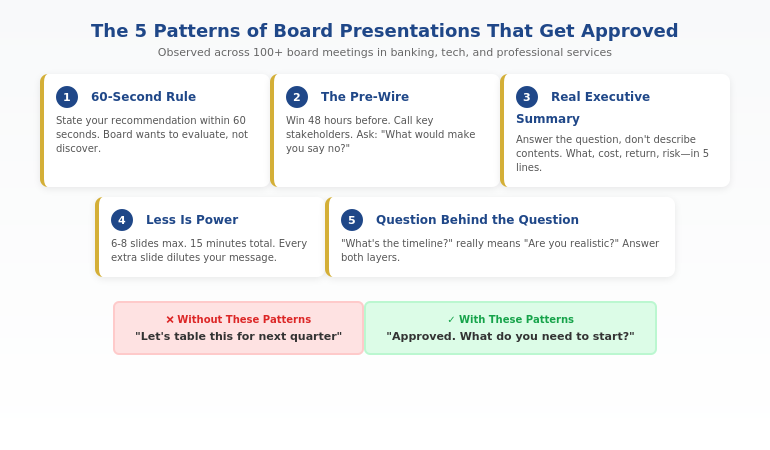
Quick answer: The board presentation best practices that actually matter aren’t about slide design or speaking technique. After watching more than 100 board presentations across banking, tech, and professional services, I found five patterns that separated the presentations that got approved from the ones that got “let’s table this.” Lead with your recommendation in the first 60 seconds. Pre-wire key stakeholders before you enter the room. Answer the question they’re actually asking, not the one you prepared for.
⚡ Board presentation in the next 48 hours? Do these 5 things:
These five patterns sit at the heart of any serious executive presentation training — slides matter, but the structural choices below are what actually move the room.
1. Put your recommendation on slide 1—not slide 12
2. Call your toughest stakeholder today and ask: “What would make you say no?”
3. Cut your deck to 6-8 slides maximum (you have 15 minutes, not 45)
4. Prepare for “What’s the risk?” and “What happens if we don’t?”
5. Rehearse your opening sentence until you can say it without slides
These five steps have saved more board presentations than any template.
If your board meeting is in the next 7 days, use this article as your run-of-show.
In this article:
What I Learned in the Room
In my 24 years in corporate banking—at JPMorgan Chase, PwC, Royal Bank of Scotland, and Commerzbank—I sat through more than 100 board presentations. Sometimes I was presenting. More often, I was watching.
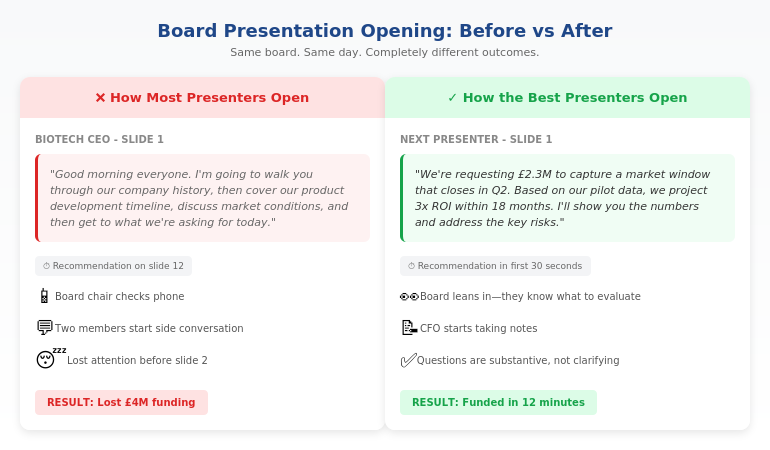
I watched a biotech CEO lose a £4M funding round in 11 words. His opening line was: “I’m going to walk you through our company history and then get to the ask.”
The board chair looked at her phone. Two members started side-conversations. He’d lost them before slide 2.
The next presenter—same board, same day—opened differently: “We’re requesting £2.3M to capture a market window that closes in Q2. Here’s why the math works.”
She got her funding in 12 minutes.
Same board. Same room. Completely different outcomes.
The difference wasn’t charisma. It wasn’t slide design. It was a set of patterns I started to notice again and again—board presentation best practices that nobody teaches but every successful presenter follows instinctively.
Here are the five that matter most.
⭐ Get Board-Ready Slides in 30 Minutes
Stop building presentations that get “let’s table this.” Use the slide structures built from patterns observed across 100+ board meetings in corporate banking, tech, and professional services.
The Executive Slide System includes:
- 12 decision-first slide templates for board presentations
- The “recommendation-first” opening structure
- CFO-ready financial summary layouts
- Risk/mitigation frameworks that pre-empt objections
Get the Executive Slide System → £39
Built from 24 years in corporate banking. Used by executives preparing for board meetings, investor pitches, and budget approvals.
Pattern 1: The 60-Second Rule
The best board presenters I watched all did the same thing: they stated their recommendation within the first 60 seconds.
Not context. Not background. Not “let me walk you through how we got here.”
Recommendation first.
What most presenters do:
“Good morning. I’m going to take you through our Q3 performance, then discuss market conditions, and then share our proposed direction for Q4.”
What the best presenters do:
“We’re requesting approval for a £500K expansion into the German market. Based on our Q3 pilot, we project 3x ROI within 18 months. I’ll show you the numbers and address the key risks.”
The board doesn’t want to discover your recommendation. They want to evaluate it. Give them the answer, then give them the evidence to test it.
This is the single most important of all board presentation best practices—and the one most people get backwards.
Learn more about board presentation structure and why decision-first ordering works.
Pattern 2: The Pre-Wire
Here’s what surprised me most: the best board presentations weren’t won in the boardroom. They were won in the 48 hours before.
Every presenter who consistently got approvals did the same thing—they pre-wired their key stakeholders.
That means:
- Calling the CFO before the meeting to understand their specific concerns
- Sending the CEO a 2-minute preview: “Here’s what I’m recommending and why”
- Asking the toughest critic: “What would make you say no?”
By the time they walked into the boardroom, the decision was 80% made. The presentation was confirmation, not persuasion.
The presenters who relied entirely on the meeting itself? They were always fighting uphill.
Pre-wire script that works:
“I’m presenting to the board on Tuesday about [X]. I’d value 5 minutes of your perspective beforehand—specifically, what concerns would you want me to address? I’d rather know now than be surprised in the room.”
Nobody ever says no to this request. And the intelligence you gather transforms your presentation.
Presenting to a board soon? The Executive Slide System includes pre-wire email templates alongside the slide structures—everything you need to win before you walk in the room. Get the templates →
Pattern 3: The Real Executive Summary
Almost every board presentation has an “executive summary” slide. Almost none of them are actually useful.
Most executive summaries are really “executive overviews”—they describe what the presentation contains rather than answering the question the board is asking.
Typical executive summary:
“This presentation covers our Q3 performance, market analysis, competitive landscape, and strategic recommendations.”
Effective executive summary:
“Q3 exceeded target by 12%. We recommend accelerating the Germany expansion by 6 months. Cost: £500K. Projected return: £1.5M by Q4 2027. Key risk: talent acquisition timeline.”
The second version answers what the board actually wants to know: What happened? What do you want? What does it cost? What do we get? What could go wrong?
For a deeper dive, see how to write an executive summary slide that actually drives decisions.
⭐ Executive Summary Templates That Actually Work
Stop writing “overview” slides that waste board members’ time. Get the decision-first executive summary structure used by presenters who consistently get approval.
Inside the Executive Slide System:
- The 5-line executive summary formula
- Board-ready recommendation slides
- Risk/mitigation layouts that build confidence
- Financial summary templates CFOs trust
Get Board-Ready Templates → £39
Instant download. Works with PowerPoint, Google Slides, and Keynote.
This pays for itself the first time you get “approved” instead of “let’s revisit this next quarter.”
Pattern 4: Less Is Power
The worst board presentations I watched had 30+ slides. The best had 6-8.
This isn’t about attention spans. It’s about signal-to-noise ratio.
Every slide you add dilutes your core message. Every “nice to have” data point competes with your “need to know” evidence. Every background slide steals time from the discussion that actually matters.
The presenters who got approvals were ruthless editors. They asked: “Does this slide move my recommendation forward or just make me feel thorough?”
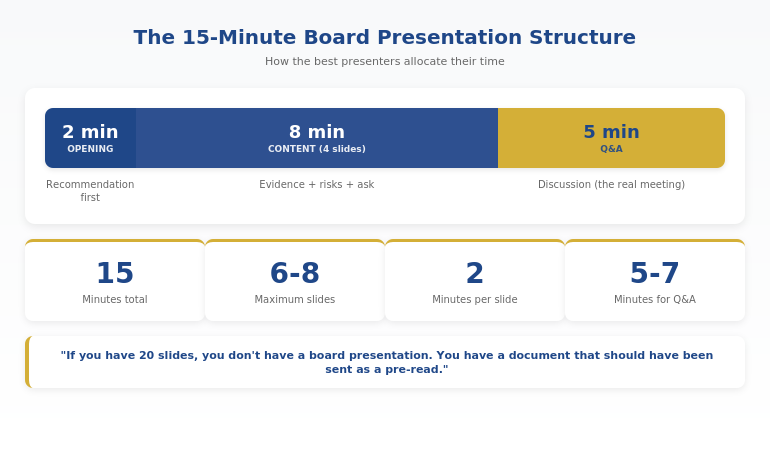
The board presentation math:
- You have 15-20 minutes (including Q&A)
- Plan for 2 minutes per slide maximum
- Reserve 5-7 minutes for questions
- That leaves room for 6-8 slides
If you have 20 slides, you don’t have a board presentation. You have a document that should have been sent as a pre-read.
Pattern 5: The Question Behind the Question
The best board presenters I watched never answered the literal question. They answered the question behind the question.
When a board member asks “What’s the timeline?”, they’re often really asking “Are you being realistic or optimistic?”
When they ask “Who’s leading this?”, they’re often really asking “Do you have the right talent to execute?”
When they ask “What are the risks?”, they’re often really asking “Have you thought this through or are you just excited?”
The presenters who got approvals had prepared for both layers. They answered the surface question quickly, then addressed the underlying concern.
Example:
Board member: “What happens if the German market doesn’t respond as expected?”
Effective answer: “If we miss adoption targets by more than 20% in Q1, we pause Phase 2 and reallocate budget to UK expansion. We’ve built explicit exit criteria into the plan.”
The surface question was about Germany. The real question was “Do you have a Plan B?” Answering both builds the confidence that gets approvals.
For more on handling board questions, see how to present to a board of directors.
Related: If board presentations feel high-stakes and the pressure triggers physical symptoms or anxiety, see how to manage fear of public speaking at work—especially the day-before protocol that helps you arrive composed.
Ready to build slides that follow these patterns? The Executive Slide System gives you the exact templates—recommendation-first structures, executive summaries that work, and risk layouts CFOs trust. Get the templates →
Common Questions About Board Presentations
What makes a good board presentation?
A good board presentation leads with a clear recommendation, provides evidence that addresses board members’ specific concerns, and respects their time. The best board presentation best practices focus on decision clarity rather than comprehensive information. Board members want to evaluate a recommendation, not discover it. Structure your presentation so they know your position within 60 seconds.
How long should a board presentation be?
Most board presentations should be 6-8 slides maximum, designed to fill 10-15 minutes including Q&A. You typically have 15-20 minutes total, and the discussion matters more than the presentation. Plan for 2 minutes per slide and reserve at least 5 minutes for questions. If your deck is longer, it’s a document—send it as a pre-read instead.
What do board members want to see?
Board members want to see: (1) your recommendation stated clearly upfront, (2) the financial impact and investment required, (3) the key risks and how you’ll mitigate them, and (4) the timeline and success metrics. They don’t want background context, market education, or comprehensive data. They want decision-ready information that lets them evaluate your recommendation.
⭐ Turn These Patterns Into Your Next Board Deck
You’ve seen what the best presenters do. Now build slides that follow the same patterns—recommendation-first structure, real executive summaries, and layouts that earn trust.
The Executive Slide System gives you:
- 12 board-ready slide templates
- Decision-first opening structures
- Executive summary frameworks that work
- Risk and financial layouts CFOs trust
Get the Executive Slide System → £39
Built from patterns observed across 100+ board presentations. Instant download, works immediately.
FAQ
How do I present to a board for the first time?
For your first board presentation: (1) Pre-wire at least one board member or your sponsor beforehand—ask what concerns to address. (2) Lead with your recommendation, not background. (3) Keep slides to 6-8 maximum. (4) Rehearse your opening sentence until you can deliver it confidently without notes. (5) Prepare for “What’s the risk?” and “What happens if we wait?”—these questions come up in almost every board meeting.
Should I use slides or speak without them?
Use slides, but use them as decision tools, not speaker notes. Each slide should answer one question the board needs resolved. Avoid reading from slides or using them as a script. The best board presenters can deliver their core message with or without the deck—slides support the argument, they don’t carry it.
How do I handle tough questions from board members?
Answer the question behind the question. When a board member challenges you, they’re usually testing whether you’ve thought through the risks, not attacking your recommendation. Acknowledge the concern, give a direct answer, then explain your mitigation plan. If you don’t know the answer, say so and commit to following up—credibility matters more than appearing to have all answers.
What’s the biggest mistake in board presentations?
Building up to your recommendation instead of leading with it. Most presenters spend 10 minutes providing context before revealing what they want—by which point they’ve lost the board’s attention. State your recommendation within 60 seconds, then use the rest of your time providing evidence and addressing concerns. Let them evaluate your position, not discover it.
📧 The Winning Edge Newsletter
Weekly board presentation strategies, executive communication insights, and practical frameworks from 24 years in corporate banking. No fluff—just what actually works in boardrooms.
📋 Free: Executive Presentation Checklist
A one-page checklist to run before any board presentation. Covers the 5 patterns above plus 10 additional “go/no-go” criteria. Download it, print it, use it before your next presentation.
Your Next Step
The five patterns above—the 60-second rule, the pre-wire, the real executive summary, the power of less, and answering the question behind the question—separate board presentations that get approved from ones that get “let’s table this.”
If you have a board presentation coming up, use the 48-hour rescue checklist at the top of this article. Then build slides that match these patterns using the Executive Slide System.
Your board wants to say yes. Make it easy for them.
About the Author
Mary Beth Hazeldine is the Owner & Managing Director of Winning Presentations and a former corporate banker with 24 years of experience at JPMorgan Chase, PwC, Royal Bank of Scotland, and Commerzbank. She has sat in more than 100 board meetings and helped executives secure approvals for budgets, expansions, and strategic initiatives totalling more than £250 million.
Mary Beth is also a qualified clinical hypnotherapist and NLP practitioner who helps executives manage presentation anxiety and build authentic confidence in high-stakes settings.