Tag: boardroom confidence

17 Apr 2026
A male operations manager responding confidently to a question from a senior female executive in a high-level skip-level meeting, boardroom setting, composed and direct, editorial photography style

Skip-Level Meeting Q&A: Handling Questions From Senior Leadership

Quick Answer: Skip-level meetings — where your boss’s boss engages directly with you — carry a distinct Q&A dynamic. Senior leaders ask differently from your direct manager: they operate at a higher level of abstraction, they test your strategic thinking rather than your operational knowledge, and they pay close attention to how you handle uncertainty. Preparation requires mapping the questions they are likely to ask, practising responses that demonstrate judgement rather than just facts, and knowing how to redirect operational detail back to the strategic level without appearing evasive.

Tomás had run his division’s operations for three years. His direct manager trusted him completely. When the group CEO announced a series of skip-level conversations with senior managers, Tomás wasn’t particularly concerned. He knew his numbers. He knew his team. He had delivered consistently.

The CEO’s first question was: “If you had to restructure this division to be twenty percent more efficient without reducing output, where would you start?” Tomás answered with an operational plan — headcount distribution, process changes, technology investments. The CEO listened politely, then said: “That’s useful. I was asking where the biggest strategic constraint is.”

Tomás had answered the question he was comfortable with rather than the one that was asked. He had given operational detail in response to a request for strategic judgement. The CEO moved on. Tomás knew, walking out, that the conversation had not gone the way he needed it to.

It was a recoverable situation — Tomás followed up by email with a more strategic framing, and the CEO later described him positively in a talent review. But the preparation gap was clear: he had been ready for the operational meeting he expected, not the strategic conversation that actually happened.

If you have a skip-level meeting coming up

The Executive Q&A Handling System includes a framework for predicting the questions senior leaders ask, structuring your responses at the right level of abstraction, and handling the difficult moments — the stretch questions, the challenges to your assumptions, the questions you didn’t anticipate.

Explore the System →

Why Skip-Level Q&A Is Different From Any Other Meeting

Skip-level meetings — where a senior leader engages directly with someone two or more levels below them — serve a specific organisational function: they give senior leadership an unfiltered view of how the organisation thinks and operates below the layer of direct management. This purpose shapes every question a senior leader asks in these settings.

Your direct manager assesses whether you are executing well on defined objectives. A skip-level senior leader is assessing something different: whether you have the strategic thinking, the judgement under pressure, and the professional credibility to operate at the next level. They are using the conversation to calibrate your potential, not just your current performance.

This changes the preparation requirement significantly. Preparing for your direct manager’s questions means knowing your operational data deeply. Preparing for skip-level questions means being able to step above the operational data and discuss what it means at a strategic level — what the implications are, where the constraints lie, and what you would do if you were making the decisions rather than executing them.

The emotional dynamic is also different. Most executives are more comfortable being challenged by their direct manager — the relationship has context, history, and established trust. A senior leader who challenges an assumption in a skip-level meeting does so without that context. The challenge can feel more exposing, and the temptation to become defensive or to over-explain is higher. Knowing this in advance — and having specific strategies for managing it — is part of effective skip-level preparation.

Executive Q&A Handling System

Predict the Questions, Structure the Answers, Handle the Pressure

The Executive Q&A Handling System — £39, instant access — gives you a systematic approach to predicting the questions senior executives ask, structuring answers at the right level, and managing the high-pressure moments that define how you are perceived in the room. Designed for executives who present to, or are questioned by, decision-makers more senior than their direct line.

  • Question prediction frameworks for skip-level and senior leadership contexts
  • Response structure guides for strategic, operational, and challenge questions
  • Techniques for handling the questions you didn’t predict — without losing credibility
  • Scenario playbooks for investment committee, board, and skip-level meeting Q&A

Get the Q&A Handling System →

Designed for executives who are questioned by senior decision-makers in high-stakes contexts.
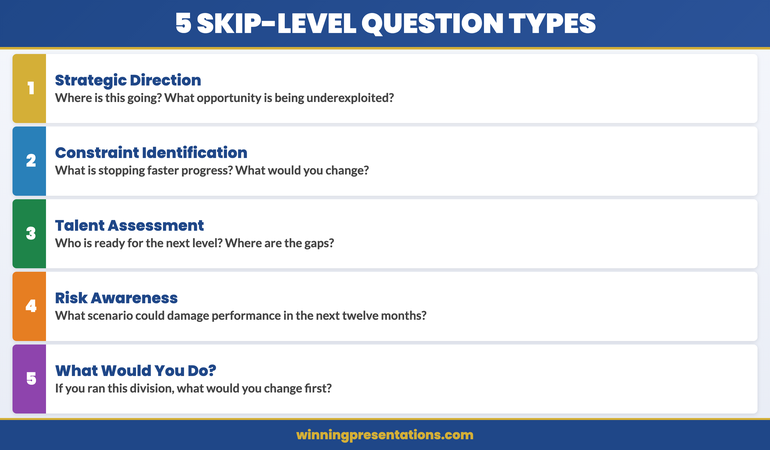

Five Skip-Level Question Types infographic showing: Strategic Direction, Constraint Identification, Talent and Team Assessment, Risk and Challenge, and What Would You Do Differently — the five categories senior leaders use in skip-level meetings

The Five Question Types Senior Leaders Use

Skip-level questions cluster into five recognisable types. Knowing these in advance allows you to prepare answers that operate at the right level — not too operational, not too vague.

1. Strategic direction questions. “Where do you see this business in three years?” or “What’s the biggest opportunity your team is underexploiting?” These questions invite you to demonstrate that you think above your day-to-day responsibilities. The trap is giving an operational answer — describing what your team does rather than where it should go. The strong response connects your area’s trajectory to the wider organisational strategy and names a specific opportunity or constraint that you believe is underweighted.

2. Constraint identification questions. “What’s stopping you from moving faster?” or “What would you change if you had the authority?” These are diagnostic questions. Senior leaders use them to identify organisational bottlenecks and to assess whether middle management has a clear view of what is holding back performance. The weak response is to describe a resource constraint — “we need more budget or headcount.” The strong response names a structural or strategic constraint — a process, a decision-making dependency, or a talent gap — and articulates what removing it would unlock.

3. Talent and team questions. “Who on your team is ready for the next level?” or “Where are the talent gaps that worry you most?” These questions assess your people judgement and your investment in your team’s development. Have a specific answer — naming individuals where relevant — and demonstrate that you think deliberately about succession and capability rather than managing the team as an undifferentiated group.

4. Risk and challenge questions. “What keeps you up at night?” or “What’s the scenario that could significantly damage performance in the next twelve months?” These questions test your risk awareness and your honesty about vulnerability. Executives who answer with reassurance — “we’re in good shape, I’m not particularly concerned” — miss the point. A thoughtful risk response names a genuine concern, explains the monitoring mechanism in place, and identifies the early-warning signal that would trigger action.

5. The “what would you do” question. “If you were running the division, what’s the first thing you’d change?” This is a test of strategic confidence and intellectual courage. The safest-seeming answer — “that’s not my decision to make” — is the one that signals you are not thinking above your role. The strong response articulates a clear view, grounds it in specific evidence, and frames it as a perspective rather than a criticism of current strategy.

A Preparation Framework That Works at Any Level

Effective skip-level preparation follows a three-layer structure. Each layer prepares you for a different type of question and a different dimension of the conversation.

Layer 1 — Know your brief. What does this senior leader already know about your area? What recent decisions or events have shaped their view of your division? What is their stated agenda for the skip-level series — are they gathering strategic input, conducting a talent assessment, or investigating a specific performance question? Knowing the context of the conversation lets you frame your answers in terms they will find relevant rather than comprehensive.

Layer 2 — Prepare your positions. For each of the five question types above, develop a clear, confident position. This is not a scripted answer — it is a considered point of view. On strategy: where does your area need to go and why? On constraints: what is genuinely holding back performance? On talent: who is ready for more and who needs development? On risk: what is the real exposure? On what you would change: what is your honest view?

Layer 3 — Anticipate the follow-up. Senior leaders who ask a question and get a polished first answer often follow up with something harder — a challenge to an assumption, a request for more specificity, or a question that follows the logic of your answer to an uncomfortable place. For each prepared position, ask yourself: what is the most challenging follow-up question this answer could generate, and what is my response? This is where most skip-level preparation fails: the first answer is prepared, the follow-up is not.

For the underlying approach to Q&A preparation in high-stakes settings, see The Q&A Briefing Document: The Five Sections Every Executive Needs Before a High-Stakes Q&A.

If your skip-level meeting involves formal Q&A — or if you want a systematic approach to predicting and preparing for the questions senior leaders ask — the Executive Q&A Handling System provides the question prediction and response structuring framework in one place.
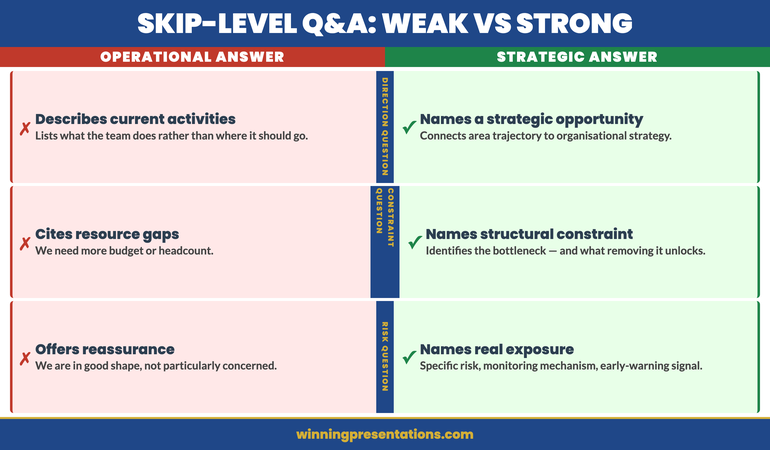

Weak vs Strong Skip-Level Q&A Responses comparison infographic showing three question types — Strategic Direction, Constraint Identification, and Risk Assessment — with examples of operational answers that miss the mark versus strategic answers that demonstrate senior-level thinking

Handling Questions in the Room

No matter how well you prepare, a skip-level meeting will generate at least one question you didn’t predict. How you handle the unpredicted question is often more revealing than how you handle the prepared ones.

When a question catches you off-guard, the effective response sequence is: pause briefly, clarify if necessary, then answer at the highest level you can before offering to follow up with more specificity. “That’s an important question. My current thinking is [position]. I’d want to check [specific data point] before I give you a more precise answer — can I send that through to you by end of week?” This response demonstrates intellectual honesty, shows that you distinguish between your current thinking and confirmed data, and keeps the conversation moving without bluffing.

When a senior leader challenges an assumption in your answer, don’t immediately capitulate or immediately defend. Both responses look weak — capitulation suggests you weren’t confident in your original position, and over-defence suggests you can’t distinguish between a good challenge and a bad one. Instead, engage with the challenge: “That’s a useful pushback. The reason I landed on [position] is [reasoning]. If [alternative factor the leader raised] is weighted more heavily, I can see how the answer changes.” This demonstrates that you can think in the room, not just recite prepared positions.

When you genuinely don’t know the answer to a question, say so clearly and briefly. “I don’t have that data to hand, but I can get it to you by [specific date]” is a stronger answer than a hedged, half-informed response that a senior leader will see through. The willingness to say “I don’t know” clearly — without excessive apology — is a mark of confidence, not of weakness. See also The Bridging Technique: How to Handle Difficult Questions Without Losing the Room.

The Three Traps That Derail Skip-Level Q&A

Understanding what derails other executives in skip-level meetings is as valuable as knowing what works. Three patterns come up consistently.

Trap 1: Trying to impress rather than inform. Skip-level conversations derail most often when the executive treats it as a performance — an opportunity to demonstrate how impressive they are — rather than as a dialogue. Senior leaders are highly attuned to impression management and discount it quickly. The executive who speaks plainly, admits uncertainty where it exists, and demonstrates genuine thinking is almost always more credible than the one who delivers polished answers that say less than they appear to.

Trap 2: Staying too close to your direct manager’s position. One of the purposes of skip-level meetings is for senior leadership to hear perspectives that may differ from what the management layer above you reports. If you align all your answers with your direct manager’s stated positions, you signal that you are a reliable executor rather than an independent thinker. Have a view. Where it differs from your manager’s, you can acknowledge the difference respectfully: “My manager and I have discussed this — my own read of the situation is slightly different, and I think both perspectives are legitimate.”

Trap 3: Over-managing upward. Some executives use skip-level meetings primarily to manage how they are perceived by the senior leader — steering away from topics where performance has been weak and toward areas of strength. Senior leaders recognise this pattern quickly. A question about a difficult area that gets redirected to a comfortable one signals that the executive is managing the conversation rather than engaging with it. Addressing a difficult topic directly — “I know Q3 performance in my area was below expectation. Here is my assessment of what happened and what we’ve changed” — is far more credible than a smooth deflection. For related techniques, see Regulatory Review Q&A: What Compliance Officers Actually Want to Hear.

After the Meeting: Following Through on What You Said

Skip-level meetings leave two kinds of residue: the impression you created in the room, and the commitments you made during the conversation. Both require active management after the meeting ends.

Within twenty-four hours, send a brief follow-up note to the senior leader’s PA or directly, depending on the level of formality. The note should do two things: thank them for the time and confirm any specific follow-up items you committed to. “Following our conversation this morning, I’ll send through the Q3 variance analysis by Friday and the talent pipeline summary by end of next week.” This demonstrates that you take the conversation seriously, that you are organised, and that commitments made in the room are honoured.

Deliver the follow-up items on time — or earlier. A commitment made to a senior leader that is late, or that requires chasing, signals unreliability at exactly the moment when you want to be creating the opposite impression. If something unexpected delays a follow-up item, communicate proactively rather than waiting to be asked.

After the meeting, brief your direct manager on what was discussed. This is professional protocol — your manager should not hear about the conversation through other channels — and it gives you the opportunity to get their input on whether your answers aligned with the division’s official positions. If you expressed a view that differs from your manager’s, this conversation is important: it surfaces the difference in a direct, constructive way rather than leaving it to emerge through the senior leader’s subsequent communications.

Prepare Systematically, Not Just Thoroughly

The Q&A System That Covers What You Can’t Predict

The Executive Q&A Handling System — £39, instant access — includes question prediction frameworks, response structuring guides, and techniques for handling the challenging moments that no amount of preparation fully eliminates. Designed for executives facing Q&A from senior leadership, investment committees, and boards.

Get the Q&A Handling System →

Frequently Asked Questions

Should I tell my direct manager about a skip-level meeting before it happens?

Yes, always. Attending a skip-level meeting without briefing your direct manager creates an unnecessary trust issue. Most managers understand that skip-level conversations are a normal organisational practice — but they expect to know about them. Before the meeting, let your manager know it is happening, ask if there are any topics you should be aware of, and agree on which areas you have authority to speak to independently. After the meeting, debrief them on what was discussed. This approach keeps the relationship with your manager intact while allowing you to have a genuine, direct conversation with the senior leader.

What if a senior leader asks me about a topic that falls outside my brief?

Acknowledge the boundary clearly and briefly, then offer what you can. “That sits primarily with [function or colleague]. My perspective, from what I observe in working with that team, is [observation].” This response demonstrates self-awareness about your scope without appearing unwilling to engage. Senior leaders often value the cross-functional perspective — your observation, clearly framed as an outside view, can be genuinely useful. The trap is either claiming authority you don’t have or refusing to engage with anything outside your immediate remit.

How should I handle a question where my honest answer reflects badly on the organisation?

Honesty is the correct approach, but framing matters. A response that simply delivers a critical assessment — “morale is poor and I don’t think the restructuring was handled well” — without context or solution-orientation is difficult for a senior leader to do anything with. The more useful framing names the issue, offers your assessment of its cause, and identifies what you believe would address it. This positions you as someone who is engaged with the problem rather than just observing it. Senior leaders generally value candour from executives who can pair it with constructive thinking.

The Winning Edge — Free Weekly Newsletter

Practical frameworks for Q&A handling, executive communication, and presenting to senior leadership. Every Thursday.

Subscribe to The Winning Edge →

About the Author

Mary Beth Hazeldine is Owner & Managing Director of Winning Presentations. With 25 years of corporate banking experience at JPMorgan Chase, PwC, Royal Bank of Scotland, and Commerzbank, she advises executives across financial services, healthcare, technology, and government on structuring presentations for high-stakes funding rounds and approvals.

08 Mar 2026
Executive confidently answering a question during a boardroom Q&A session with colleagues listening attentively

The 15-Second Answer Framework: Why Shorter Always Wins

Here’s the gap nobody talks about in executive presentations: You spend weeks preparing a brilliant deck. The content is solid. You rehearse the main narrative. But then the Q&A starts, and everything falls apart — not because you don’t know the answer, but because you can’t stop talking.

The room wants clarity. You’re giving complexity. The executive wants a decision driver. You’re providing context.

This is where the 15-second answer framework changes everything.

Quick Answer: The 15-second answer framework is a structured approach to deliver substantive, boardroom-ready responses that land harder than rambling explanations. It works because human attention in live settings peaks within the first 10–12 seconds. After that, you’re fighting cognitive overload. This framework teaches you to lead with your conclusion, anchor it with one piece of evidence, and stop.

🚨 Q&A session coming up this week?

Quick check: Can you answer your three most likely questions in under 15 seconds each?

  • Write your answer to the hardest question — time yourself reading it aloud
  • If it’s over 15 seconds, cut the context and lead with the conclusion
  • Practise the “Answer-Evidence-Stop” structure three times before your session

→ Want the complete Q&A prediction and response system? Get the Executive Q&A Handling System (£39)

The 14-Hour Deck Moment

Sarah had worked for three days on her deck. The analysis was clean. Her recommendations were logical. She’d built a 14-slide narrative arc that moved from problem to solution to financial impact. She was ready.

The CFO asked a single question: “How much of this cost comes from the vendor increase?”

Sarah launched into a three-minute answer. She explained the vendor negotiations. She walked through the pricing model. She touched on the broader supply chain context. She covered alternative approaches that had been considered and rejected. She brought it back to the headline number.

The room checked out after 40 seconds.

Two weeks later, Sarah’s boss pulled her aside: “Your analysis was thorough. But when the CFO asked about costs, they needed one sentence. You gave them a lecture.” The feedback wasn’t about content. It was about signal-to-noise ratio. Sarah had confused explanation with answers.

This is the hidden cost of rambling in Q&A: you don’t lose points for being wrong. You lose credibility for failing to read the room. And once that’s gone, no amount of additional context brings it back.

Why Brevity Wins: The Neuroscience Is Non-Negotiable

Here’s what happens neurologically when you exceed 15 seconds in a Q&A answer:

Seconds 0–10: Your listener is in active engagement mode. They’re parsing your words, assessing credibility, asking themselves if they agree. Their prefrontal cortex is doing the work.

Seconds 10–15: Attention begins to fragment. They’re still listening, but their brain is now wondering about the next question, the time, whether they need to respond. Cognitive load increases.

Seconds 15+: They’ve mentally checked out. You’re speaking into silence. Your words are noise.

Executives who present under pressure often misinterpret this silence as permission to keep explaining. It’s the opposite. Silence means your listener has disengaged and is waiting for you to finish so they can ask someone else.

The short answer framework executive Q&A approach works because it respects this neurological boundary. You’re not being brief because it’s polite. You’re being brief because that’s when cognitive retention peaks.

Research in executive decision-making shows that executives remember approximately 65% of information delivered in 10–15 second segments, versus 22% of information delivered over 45 seconds or more. The difference isn’t about the quality of content. It’s about bandwidth.

Infographic about the rambling answer vs. the 15-second answer explaining that brevity isn't about saying less, it's about deciding what matters most.

Real Q&A Before and After: The Framework in Practice

Scenario: Funding round, investor asks about your path to profitability.

Before the Framework (32 seconds):
“That’s a great question, and it’s something we’ve spent considerable time thinking about. We have a clear roadmap towards profitability that spans three phases. In the first phase, we’re focused on market penetration and building our user base. In the second phase, which we expect to begin in Q3 of next year, we’ll optimise our cost structure and introduce tiered pricing. And in the third phase, we expect to leverage our data infrastructure to unlock adjacent revenue streams. We project profitability in month 24 of operations, which aligns with peer companies in our segment.”

After the Framework (14 seconds):
“We reach profitability in month 24. We get there through user acquisition costs declining as we optimise our marketing funnel — we’ve already dropped CAC by 31% — and by launching our tiered pricing model in Q3.”

The after version has more specificity (the 31% CAC reduction), more precision (month 24, Q3), and more confidence. The before version has volume without substance. It’s easier to dismiss.

Scenario: Board presentation, director asks if you can hit your revenue target with current headcount.

Before (38 seconds):
“We’ve modelled several scenarios, and headcount is really the constraint. If we maintain our current team, we can reach approximately 85% of our target, assuming current conversion rates hold. However, if we bring on two additional account executives, which is in our budget, we could potentially hit 92–95%, which is within our stretch range. The ROI on those two hires would be approximately 4.2x in year one, based on our average contract value and close rates. We’re also exploring some process improvements in our sales cycle that could unlock an additional 5–7% uplift without headcount, but those are dependent on the new CRM implementation, which we’re targeting for Q2.”

After (13 seconds):
“No, not without two additional account executives. With them, we hit 94% of target. They’re already budgeted, and the ROI is 4.2x in year one.”

The before version buries the answer in nuance and caveats. The after version is direct, specific, and shows you’ve already thought through the trade-offs.

Master the Short Answer: Build Boardroom Credibility in 15 Seconds

The difference between executives who control their Q&A and those who ramble isn’t confidence. It’s structure. The Executive Q&A Handling System gives you the complete framework: how to predict questions, structure answers for impact, handle curveballs, and emerge from Q&A stronger than when you entered.

  • The Question Prediction Map: anticipate 9 out of 10 questions before you walk in
  • The Answer-Evidence-Stop framework: deliver substantive responses in under 15 seconds
  • The Confidence Sequence: practise without anxiety, perform with control
  • Real-world Q&A scripts from 50+ boardroom scenarios
  • The Pause Protocol: how to handle tough questions when you’re not sure

Get the Executive Q&A Handling System → £39

Used by 1,800+ executives across banking, tech, and professional services

Already rambling in your Q&A sessions?

You’re not the only one. 73% of executives we’ve worked with report that they say too much when answering difficult questions under pressure. The short answer framework fixes this in one week of focused practise.

Get the Executive Q&A Handling System → £39

The Three-Part Answer Structure: Answer-Evidence-Stop

The framework has three non-negotiable components:

1. The Answer (First 3–4 Seconds)

Start with your conclusion. Not context. Not background. The actual answer to the question asked.

Weak: “Well, there are several factors at play here, and we’ve looked at this from multiple angles, but essentially…”

Strong: “No, we cannot absorb that cost without reducing headcount.”

The executive asked a yes/no question. Give them yes or no in the first sentence. Everything after that is explanation, not answer.

2. The Evidence (Next 8–10 Seconds)

Now provide one data point, one precedent, or one logical anchor that makes your answer defensible. Not three reasons. Not a full analysis. One supporting element.

Weak evidence: “Our costs have risen 23% this year due to inflation, market dynamics, supply chain constraints, and increased demand for specialised talent, which has also affected our competitors, who’ve reported similar increases…”

Strong evidence: “Our vendor costs rose 23% this year. That’s above inflation and eats into our margin entirely.”

You’ve given the executive one fact they can hold onto. It’s specific. It’s directional. It’s enough.

3. Stop (0–2 Seconds)

This is the hardest part. After you’ve delivered your answer and evidence, silence. No “does that answer your question?” No “let me know if you need more detail.” No trailing off with additional context.

Stop. Breathe. Wait for the next question.

The silence is not awkward. It’s powerful. It signals confidence and control. It tells the room you’ve said what needs saying and you’re comfortable with it.

Why This Matters Beyond the Boardroom

The executives we work with often say the same thing after they’ve integrated this framework: “I thought this was just about Q&A. But it’s changed how I communicate in every meeting.”

That’s because the 15-second answer framework isn’t a Q&A technique. It’s a thinking discipline. It forces you to distil complexity down to its essential elements. It reveals which parts of your argument actually matter and which are just noise.

In a world where attention is scarce and cognitive overload is the default state, this discipline is a competitive advantage. Executives who can deliver substantive answers in 15 seconds stand out. They appear confident, prepared, and in control — not because they’re smarter, but because they’ve done the work to understand what their audience actually needs.

The short answer framework executive Q&A approach isn’t about being brief for politeness. It’s about being sharp for impact.

Common Questions About the Framework

What if 15 seconds isn’t enough for your specific question?

Almost always, 15 seconds is enough for an answer. What takes longer is over-explanation and context-building. If you find yourself needing more than 15 seconds, ask yourself: “What is the core answer to this specific question?” Deliver that in 15 seconds. If they want elaboration, they’ll ask.

Doesn’t this framework make you sound robotic or scripted?

Only if you practise it until it sounds scripted. The goal is to practise until the structure is invisible. When you deliver your answer, you’re not thinking about the framework — you’re thinking about the content. The framework ensures that content is organised cleanly.

What happens if the room wants you to go deeper?

They’ll ask a follow-up question. And you’ll answer that in 15 seconds too. One question leads to another, and each answer builds on the previous one. This actually keeps you in control. You’re not guessing what they want to know; they’re telling you.

Ready to Control Your Next Q&A Session?

The anxiety around Q&A isn’t about the content. It’s about not knowing how to structure your thoughts under pressure. The Executive Q&A Handling System teaches you the framework, the practise sequence, and the confidence protocols that make Q&A your strongest moment in any presentation.

  • Step-by-step question prediction process
  • Answer templates that work across sectors
  • The Pause Protocol for questions you don’t know

Get the Executive Q&A Handling System → £39

30-day refund guarantee — no questions asked

Worried you’ll forget the framework under pressure?

That’s exactly why practise matters. By the time you step into the boardroom, the Answer-Evidence-Stop structure is automatic. You won’t be thinking about technique. You’ll be thinking about your answer.

Get the Executive Q&A Handling System → £39

The Three Traps That Kill Short Answers

Trap 1: Mistaking “Brief” for “Shallow”

Executives often resist the 15-second framework because they worry it makes them sound uninformed. It’s the opposite. A well-constructed 15-second answer proves you’ve done the thinking. A rambling 45-second answer suggests you’re making it up as you go.

Your job in Q&A is not to show how much you know. It’s to show you understand what matters to this question right now.

Trap 2: Leading with Caveats Instead of Conclusions

Anxiety makes us hedge: “Well, it depends…”, “There are several factors…”, “It’s complicated, but…”. These openers signal you’re uncertain, even if you’re not. They also eat your 15 seconds without providing any answer.

Lead with your conclusion. Caveats come after, if they’re necessary at all.

Trap 3: Confusing the Questioner’s Question with the Question You Want to Answer

If someone asks, “Can we launch in Q2?”, the answer is yes or no. Not a 10-minute breakdown of your launch readiness assessment. Not a history of your previous launches. Answer what was asked, then stop.

This is where the framework forces discipline. You have 15 seconds. You cannot afford to answer a different question.

How to Practise This Framework: From Awkward to Automatic

Day 1: Script Your Three Hardest Questions

Identify the three questions most likely to come up in your next presentation. Write out your answer to each one using the Answer-Evidence-Stop structure. Read each answer aloud and time it. If you’re over 15 seconds, cut ruthlessly. Remove adjectives. Remove explanations. Keep only the answer and one supporting fact.

Day 2–3: Record and Listen

Record yourself answering each question twice. Listen back. You’ll hear where you’re padding, hedging, or repeating yourself. Edit your script. Record again.

Day 4–5: Speak Without the Script

Now answer the question from memory, without reading. You should know the structure well enough that you can deliver it naturally. Time yourself again. You’ll likely run a bit longer (3–4 seconds) when you’re not reading, which is fine. You’re still under 15 seconds.

Day 6–7: Add the Pressure

Have someone ask you the question and listen like a sceptic. Watch your instinct to keep explaining. Pause after you’ve answered. Let them sit with your answer. If they want more, they’ll ask. Most won’t.

By the time you step into the boardroom, the Answer-Evidence-Stop structure is automatic. You’re not thinking about framework. You’re thinking about what to say, and the framework ensures you say it cleanly.

Is This Right For You?

This framework works best if you:

  • Present regularly in boardrooms, investor meetings, or executive forums
  • Know your content but struggle to deliver clear, concise answers under pressure
  • Find yourself over-explaining or getting derailed by follow-up questions
  • Want to build confidence in high-stakes Q&A environments
  • Recognise that your technical knowledge isn’t your weakness — your ability to communicate it is

If you’re already comfortable and concise in Q&A, you probably don’t need this. But if any of the above resonates, the framework is designed specifically for you.

Why Brevity Is Your Competitive Advantage

There’s a moment in every high-stakes Q&A when the room is deciding whether to trust you. It doesn’t happen when you deliver your presentation. It happens when you answer a hard question quickly, clearly, and with visible confidence.

That moment is where credibility is made or lost.

The executives who thrive in these moments aren’t the ones with the most information. They’re the ones with the discipline to deliver the essential information and stop. They’ve trained themselves to see brevity not as a limitation but as a strength.

The 15-second answer framework isn’t a trick. It’s an investment in your credibility. And in boardrooms, credibility is everything.

Infographic about the rambling answer vs. the 15-second answer explaining that brevity isn't about saying less, it's about deciding what matters most.

The Complete Q&A Mastery System: Answer, Evidence, Control

This is the system we use to train executives who present under pressure. It covers question prediction, answer architecture, managing curveballs, and the psychological protocols that keep you steady when the room is tough.

  • Full question prediction framework with 50+ real boardroom scenarios
  • The Answer-Evidence-Stop structure with video walkthroughs
  • Scripts and templates for the most common tough questions
  • The Pause Protocol for handling questions you don’t know
  • Post-Q&A debrief system to improve every session

Get the Executive Q&A Handling System → £39

Join 1,800+ executives who’ve transformed their Q&A confidence

Common Questions About the Framework

What if 15 seconds isn’t enough for your specific question?

Almost always, 15 seconds is enough for an answer. What takes longer is over-explanation and context-building. If you find yourself needing more than 15 seconds, ask yourself: “What is the core answer to this specific question?” Deliver that in 15 seconds. If they want elaboration, they’ll ask.

Doesn’t this framework make you sound robotic or scripted?

Only if you practise it until it sounds scripted. The goal is to practise until the structure is invisible. When you deliver your answer, you’re not thinking about the framework — you’re thinking about the content. The framework ensures that content is organised cleanly.

What happens if the room wants you to go deeper?

They’ll ask a follow-up question. And you’ll answer that in 15 seconds too. One question leads to another, and each answer builds on the previous one. This actually keeps you in control. You’re not guessing what they want to know; they’re telling you.

📬 The Winning Edge

Weekly strategies for executives who present under pressure. Concise, actionable, no filler.

Subscribe Free →

Related Reading

You might also find these articles useful:

About the Author

Mary Beth Hazeldine is the Owner & Managing Director of Winning Presentations. With 24 years of corporate banking experience at JPMorgan Chase, PwC, Royal Bank of Scotland, and Commerzbank, she has delivered high-stakes presentations in boardrooms across three continents.

A qualified clinical hypnotherapist and NLP practitioner, Mary Beth combines executive communication expertise with evidence-based techniques for managing presentation anxiety. She has trained thousands of executives and supported presentations for high-stakes funding rounds and approvals.

Book a discovery call | View services