Quick answer: When an executive asks “is this your own work?” about a templated slide, the question is almost never about provenance. It is about whether you can defend the slide’s substance. The decision-safe answer separates form from content: “The layout is from a senior template library I use. The analysis and the recommendation are mine — happy to walk through how I reached them.” Calm, honest, and immediately redirected to the substance. The executive moves on; you have lost no ground.
In this article
Markus is a finance director who, after a strong first half of a board presentation, ran into a question he had not prepared for. A non-executive director, peering over reading glasses at a slide showing a competitor benchmarking matrix, said: “This is a very polished slide. Is this your own work?”
Markus felt the room shift. He had used a template, lightly customised, and the question had landed exactly on the slide where he had done the least personal design work. He fumbled. “Well, I, the template was, the underlying data is mine, but the format — yes, well, partly, I — sorry, can I —” The chair stepped in to move the meeting along. Markus recovered later, but for the next ten minutes the room’s confidence in his preparation had visibly dropped. The substance of the slide was excellent. The question that derailed him was about its provenance.
This question is increasingly common as senior presenters move toward template-driven workflows. It feels disproportionately threatening because it implicates not just the slide but your competence as the presenter. The good news: a calm, well-structured response neutralises it in under twenty seconds and often shifts your standing in the room slightly upward, not downward. Knowing the response in advance is the difference.
If executive questions destabilise you mid-presentation
The Executive Q&A Handling System gives you the structured response patterns for the questions senior audiences actually ask — including the meta-questions about provenance, methodology, and authority. Tough questions, calm authority, decision-safe answers in 45 seconds.
What the question actually means in the room
The first thing to understand is that “is this your own work?” almost never means what it literally says. Senior executives do not actually care whether you laid out the slide yourself in PowerPoint. They have all used templates, McKinsey decks, BCG frameworks, and consultant-prepared exhibits across decades of careers. The question is a probe.
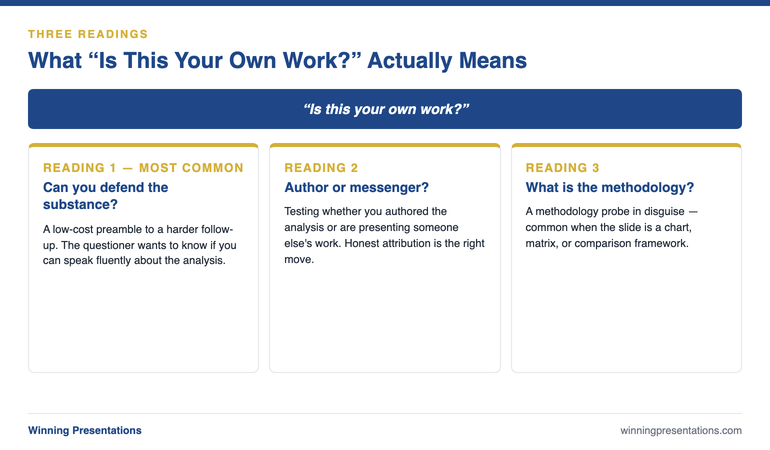
What it is probing depends on the questioner, but it is usually one of three things. First: can you defend the slide’s content under follow-up scrutiny? The question is a low-cost preamble to a harder question that may or may not arrive. Second: do you understand the slide deeply enough to be the right person presenting it? Some senior executives use the question to test whether the presenter is the author of the analysis or merely the messenger of someone else’s work. Third, occasionally: is this slide built on solid methodology? When the slide contains a chart or matrix, the question can be a request for methodology disclosure dressed as a question about ownership.
What it almost never is: a literal question about whether you used a template. A senior executive asking that question literally would not be a senior executive for long. So when you hear the question, your first job is not to answer the literal version. It is to identify which underlying probe the question is doing — and answer that.
Three readings of the question — and which one to answer
Reading one: “Can you defend the substance?” This is the most common reading, and the safest default if you are uncertain. The questioner is testing whether you can speak fluently about the analysis, the assumptions, the data sources, and the implications. The right response separates form from content — acknowledging the template framing briefly, then redirecting to the substance you can defend.
Reading two: “Are you the author or the messenger?” This is a more probing version of the question and it sometimes arrives when a junior team member presents work that has obvious signs of senior-team involvement (very polished slides, language that sounds borrowed, charts that look professionally produced). The right response acknowledges contributions explicitly and confidently — there is nothing wrong with collaborative work, and the executive knows it. The wrong response is to over-claim authorship, which usually crumbles under follow-up.
Reading three: “What is the methodology?” When the slide is a chart, matrix, or comparison, the question is sometimes a methodology probe in disguise. The right response addresses the methodology briefly, even if the questioner did not explicitly ask for it — because addressing it pre-emptively often closes the door on the harder follow-up that was about to arrive.
You will rarely know with certainty which reading is in play. The decision-safe response answers all three at once.
The three answers that quietly damage you
Wrong answer one: defensive overclaim. “Yes, absolutely, I designed every slide myself.” Two problems. First, if any follow-up reveals otherwise — a colleague mentions in passing that they helped, the design has a tell, the questioner already knows you used a template — you have lost credibility on something far more important than the original question. Second, defensiveness signals that you treat the question as a threat. Senior executives notice when minor questions trigger disproportionate defensive responses; it adjusts their estimate of your composure.
Wrong answer two: dismissive deflection. “I am not sure what you mean — can we move on?” or any variant that refuses to engage. This reads as evasive, regardless of the questioner’s actual intent, and it tends to encourage the questioner to ask harder follow-up questions to see what you are avoiding. Deflection in a senior room never closes a door; it almost always opens a worse one.
Wrong answer three: the rambling concession. Markus’s stumbled answer falls in this category — too much information delivered too uncertainly. The questioner asked a binary-feeling question and received a paragraph of qualifying caveats. Senior audiences interpret this as either a confidence problem or a trying-to-hide-something problem. Neither is what you want to communicate.
The decision-safe response, broken down
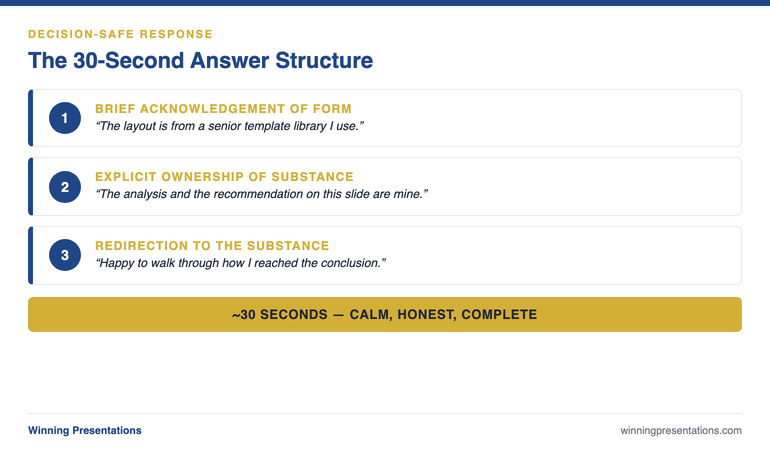
The decision-safe response has three components delivered in roughly twenty seconds.
Component one: brief acknowledgement of form. “The layout is from a senior template library I use.” Twelve words. Honest. Closes the literal question.
Component two: explicit ownership of substance. “The analysis and the recommendation on this slide are mine.” Twelve words. Asserts authorship of the part the executive actually cares about.
Component three: redirection to the substance. “Happy to walk through how I reached the conclusion.” Or, if you sense the methodology reading: “Happy to walk through the data sources and the methodology.” Eight to twelve words. Invites the harder question rather than waiting for it, on your own terms.
Total: roughly thirty seconds, calm, confident, complete. The executive almost always says “no, that is fine, please continue” — because the question has been answered well and there is nothing left to probe. Occasionally the executive accepts the invitation: “Yes, walk us through it.” That is the version of the conversation you want, because you are now in territory you control.
The components are flexible. You can soften them, swap order, or use different words. The structure is what matters: form + substance + invitation. Practise the structure once; the words come naturally in the room.
Stop being destabilised by senior questions
The Executive Q&A Handling System teaches the structured response patterns for the questions senior audiences actually ask — provenance, methodology, scope, alternatives, downside. Calm authority, decision-safe answers, in 45 seconds. Designed for board, audit committee, and investment committee scrutiny.
- The structured response patterns for the most common executive question types
- The pause-pace-redirect technique that gives you composure under pressure
- Scenario playbooks for hostile questions, methodology probes, and challenge follow-ups
- £39, instant download, lifetime access
Get the Executive Q&A System — £39 →
Designed for senior professionals presenting to boards, executive committees, and investment panels.
Handling harder follow-up questions
Sometimes the question is the start of a longer probe. Three follow-ups arrive often enough that they are worth pre-empting.
Follow-up one: “Then who else was involved?” Honest, direct, brief. “I built the analysis with [name], who runs the modelling team. The recommendation is mine.” Naming collaborators is not a weakness; pretending you worked alone is. Senior audiences trust presenters who attribute clearly. The presenter who says “the team built this together and I am presenting it” is not diminished — they are understood to be a senior leader who knows how senior work gets done.
Follow-up two: “Walk me through the methodology.” If you have the answer prepared, deliver it crisply: data sources, time frame, key assumptions, sensitivity analysis. If you do not, do not invent. “The methodology is documented in the appendix slide on page 14, and I can walk you through it now if helpful — or in the back-pocket Q&A after this section.” Offering an option respects the chair’s time and gives the questioner agency.
Follow-up three: “How confident are you in the conclusion?” The hardest of the three because it asks you to disclose your own uncertainty publicly. The right answer is honest and calibrated, not falsely confident. “I am highly confident in the directional conclusion. The magnitude has more uncertainty — the sensitivity range we tested is plus or minus 18%, and the implications hold across that range. Below that range, the recommendation would change.” Calibrated confidence is the senior register. Either overclaiming or hedging weakens you.
How to prevent the question from arriving in the first place
The question arrives most often on slides where the design polish exceeds the apparent depth of the presenter’s engagement with the content. Three preventive practices reduce the frequency dramatically.
Practice one: rewrite every word on every slide. If the language on the slide is plainly yours — your phrasing, your sentence structure, your turn of mind — the slide does not feel templated to the audience even when it is. The question rarely fires when the voice on the slide is unmistakeably the voice of the person speaking.
Practice two: deliver the slide with specific, concrete commentary. Generic walk-throughs (“as you can see, this shows our progress on the strategic priorities”) signal a presenter standing outside the slide. Specific commentary (“the shift you see between Q2 and Q3 in the third row is what we have been calling the cost-mix effect — about £3.2 million of it is just the relabelling we agreed last meeting; the rest is genuine”) signals a presenter standing inside it. Specificity is the strongest signal of authorship.
Practice three: name the methodology before you are asked. Pre-emptively saying “the methodology behind this matrix is documented in the appendix; I am happy to walk through it now if useful, or after this section” closes the methodology door before it can become an interrogation. Some senior questioners only ask about provenance because they want to ask about methodology and they are using the lighter question as a runway. Removing the runway often removes the harder question.
The combination — your voice on the slide, your specific commentary aloud, and methodology pre-empted — makes the “is this your own work?” question vanishingly rare. When it does arrive, the decision-safe response handles it. Both layers together mean the question stops being a destabiliser.
For the closely-related psychological dimension — the gap between deck polish and felt ownership before the meeting starts — see the partner article on template anxiety and confidence recovery.
If you want a complete library of structured response patterns for the questions executives actually ask, the Executive Q&A Handling System (£39) covers methodology probes, hostile challenges, scope tests, alternatives challenges, and the meta-questions like provenance — with the response structures that hold under pressure.
The full Q&A response library
The Executive Q&A Handling System covers the response patterns for hostile, methodology, scope, alternatives, and meta-questions — every major question type senior audiences ask. £39, instant download.
Built for senior professionals across financial services, technology, and consulting.
FAQ
What if the executive presses harder after my decision-safe response?
That is good news, not bad. Pressing harder means the executive is engaged. The decision-safe response invites engagement on terms you control — methodology, analysis, recommendation — so harder follow-ups land in territory you have prepared for. The presenter who fears the follow-up is usually the presenter who has not prepared the substance underneath the slide. The presenter who welcomes it is the one whose preparation runs deeper than the slide’s surface.
Should I disclose the template source by name?
Usually no — and never under direct cross-examination. “A senior template library I use” is the right level of detail. Naming the specific source invites a tangent (“oh, I have heard of those, are they any good?”) that distracts from your substance. Keep the response moving toward the analysis, where your authority lives.
Does this work the same way for hostile questioners?
Yes, with a small adjustment. Hostile questioners sometimes use the provenance question as a setup for a harder challenge. The structured response holds — form, substance, redirection — but expect the follow-up to come quickly. The pause-pace-redirect technique (a brief pause before answering, measured pace through the answer, deliberate redirection at the end) does much of the work to keep you composed under hostility.
What if I genuinely cannot defend the slide because someone else built it?
Then say so, calmly. “This slide was built by [name] in the modelling team — I can give you the high-level interpretation, and [name] is on the line if you want to go deeper into the methodology.” Honest attribution under pressure is a senior move. Pretending to authorship you do not have is the move that ends careers when it is discovered.
Get The Winning Edge — weekly
One sharp, story-led idea every Thursday on executive presentation craft, the live psychology of the room, and the small decisions that change how senior audiences receive you. Read by senior professionals across financial services, technology, and consulting.
Not ready for the full system? Start here instead: download the free Executive Presentation Checklist — a one-page reference covering the structural moves that hold any executive deck together, before any question arrives.
Practise the response once. Out loud, in front of a wall, with the three components in order. The next time the question arrives in a senior room, you will be ready — and the executive who asked it will move on to the next agenda item, with the room’s confidence in you slightly higher than it was a minute ago.
About the author. Mary Beth Hazeldine is Owner & Managing Director of Winning Presentations Ltd, founded 1990. With 24 years of corporate banking experience at JPMorgan Chase, PwC, Royal Bank of Scotland, and Commerzbank, she advises executives across financial services, healthcare, technology, and government on structuring presentations for high-stakes funding rounds and approvals.