

Quick answer: The follow-up email after a board presentation is the second half of the decision conversation, not a courtesy. It works in four short paragraphs: restate the decision, surface the trade-offs the room weighed, anchor the language a yes can be defended with, and propose a specific next step with a date. Sent within 24 hours, the email turns ambiguous closes (“let us think about it”) into structured decisions (“approve by Friday or schedule a follow-up”). The deck does the first half. The email does the second.
JUMP TO:
- Why the email is half the decision
- Paragraph 1: Restate the decision in one line
- Paragraph 2: Surface the trade-offs the room weighed
- Paragraph 3: Anchor the language a yes can be defended with
- Paragraph 4: Propose the specific next step
- Timing, distribution, and the silent rules
- What not to do
- Frequently asked questions
Hiroshi, a regional managing director at a global asset manager, sent his usual post-board follow-up email at 9:42 the morning after his quarterly presentation. The email was twelve paragraphs long. It thanked the committee for their time. It summarised the discussion. It attached the slides, the appendix, and a revised financial model the committee had asked for in passing. It closed with “happy to discuss any follow-up questions, and we look forward to your guidance”. By the end of the week, two committee members had replied with thanks. Nobody addressed the £42m capital request the meeting had been about. Three weeks later the proposal was still listed as “under consideration”.
The slides had done their job. The presentation had run cleanly. What failed was the email. Twelve paragraphs of summary gave the committee nothing they had to act on. The decision had been left ambiguous in the room — “let us think about it” — and the email did nothing to close it. A different email — four short paragraphs, sent within 24 hours, structured as a decision-closing instrument rather than a courtesy — could have produced a different outcome. Decisions that get backed almost always have a written companion to the slides. Decisions that get deferred almost always do not.
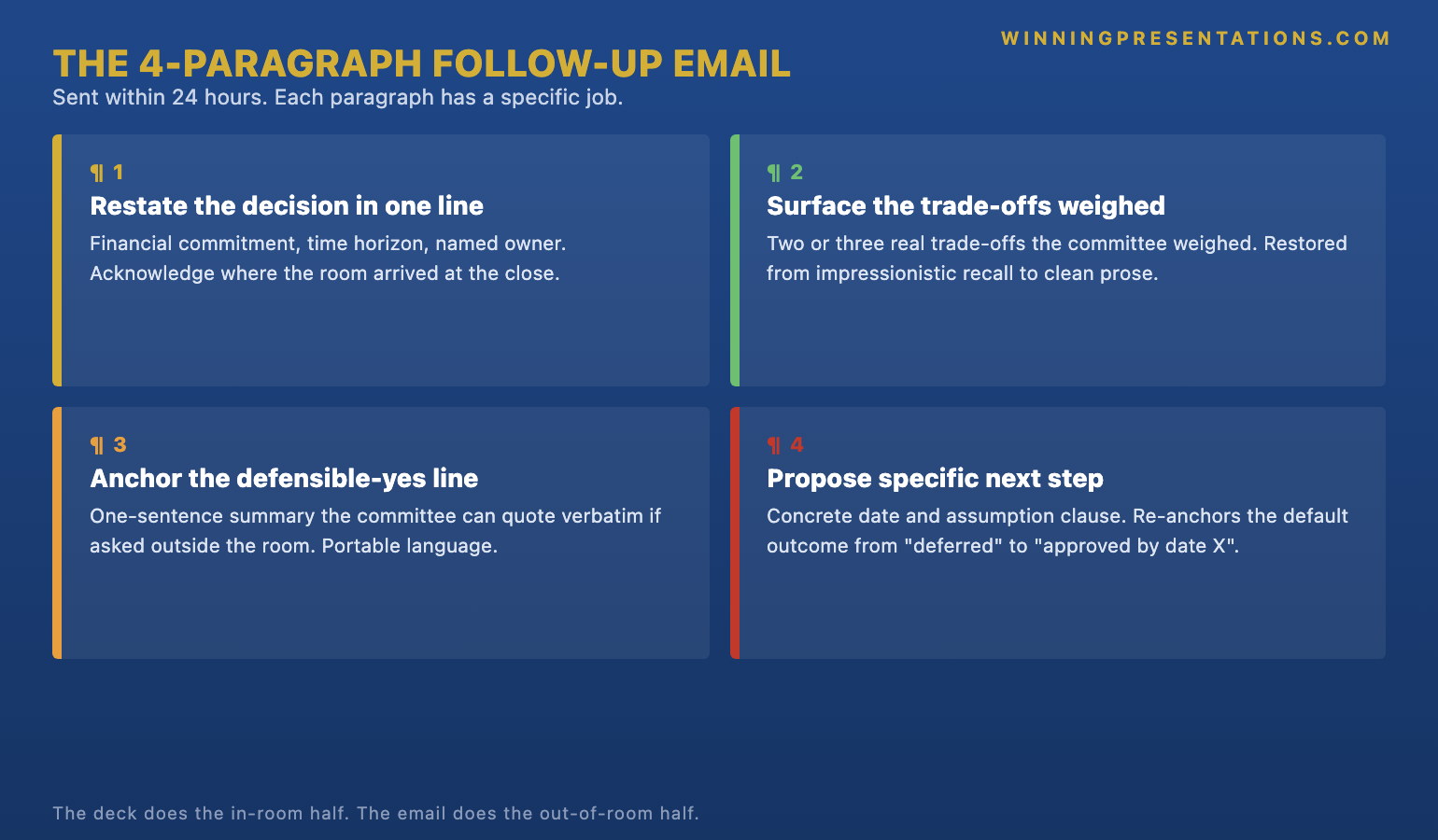
The senior professionals who consistently turn presentations into decisions treat the follow-up email as part of the presentation. The deck handles the in-room conversation. The email handles the out-of-room one — the days when committee members re-evaluate, defend the decision to peers, and decide whether to back, defer further, or push back. The four-paragraph format below is the structural pattern that works. It is short. It is written for the committee, not for the team. And it has a specific job in each paragraph.
If the in-room presentation and the follow-up email are part of the same problem:
The Executive Buy-In Presentation System is a self-paced Maven course covering both halves — the deck structure that frames the decision in the room, and the post-meeting moves that close it. Designed for senior professionals presenting decisions to boards and executive committees.
Why the email is half the decision
Most senior leaders treat the follow-up email as administrative — a thank-you, a summary, an attachment. The committee’s view of the same email is different. They read it the morning after the meeting, when the in-room conversation has receded and the practical question is whether to back the decision, ask for more, or quietly let it slide. The email arrives at exactly that decision moment. If it gives them nothing to react to, the path of least resistance is to do nothing. That is how proposals slip from “under consideration” into permanent purgatory.
The structural opportunity is precisely that the committee is in decision posture when they read the email. The deck has been delivered. The discussion has happened. The next move is theirs. An email that hands them a clean instrument for that next move — restated decision, named trade-offs, defensible language, specific next step — does the committee a favour they will register. An email that hands them a 600-word recap leaves them with no clear handle. The recap is for the team. The email is for the committee.
This is also where reason 6 in the partner article on why boards delay decisions after presentations gets resolved. Committees defer when they cannot easily defend a yes outside the room. The follow-up email is where the senior leader supplies the language the committee can use. Done well, the email is read by committee members and quietly forwarded to the senior independent director, the chair, or the CFO with nothing more than “FYI — clear summary of where we are”. That forwarding is the seed of a backed decision.
Paragraph 1: Restate the decision in one line
Paragraph one opens with the decision the committee is being asked to take, restated in one sentence. Not the project. Not the discussion. The decision. Same shape as slide one of the in-room deck: financial commitment, time horizon, named owner.
The full paragraph is two sentences. The first sentence is the decision request. The second sentence acknowledges where the room arrived at the close — “the discussion confirmed alignment on the strategic direction; the committee asked for a tighter view on phasing before formal approval”. The acknowledgement matters. It is the email’s signal that the leader has heard the room accurately. Senior committees pay attention to whether their feedback was registered. An email that ignores the close and re-pitches the original case reads as tone-deaf and dampens whatever momentum the meeting created.
The temptation is to soften the decision sentence by burying it in context — “following yesterday’s productive discussion of the regional growth strategy, I wanted to summarise…” — but the soft opening is exactly what loses the decision. Keep the decision sentence first. The committee can read everything else. They cannot ignore the first line.
Turn deferred decisions into backed ones.
The Executive Buy-In Presentation System is a self-paced Maven programme — 7 modules covering the structure, psychology, and post-presentation moves that close decisions at senior levels. Optional bonus Q&A calls are recorded, watch back anytime. New cohort opens every month. £499, lifetime access to materials.
- 7 self-paced modules covering the deck structure, the in-room moves, and the post-meeting follow-up
- Frameworks for stakeholder mapping, trade-off framing, and decision close
- Optional bonus Q&A calls with Mary Beth — recorded and accessible anytime
- Designed for senior professionals presenting strategic decisions to boards and executive committees
Paragraph 2: Surface the trade-offs the room weighed
Paragraph two names the two or three trade-offs the committee actually weighed in the meeting. Not the analysis. Not the options. The trade-offs. This is the same paragraph as slide two of the in-room deck, restated in prose form for the post-meeting reader.
The structural value of paragraph two is that it makes the discussion legible to committee members who may not remember it cleanly. Senior committees often have four or five items on their agenda; by 11pm the previous night, the trade-off discussion has compressed in memory. A clean prose statement — “the discussion identified two principal trade-offs: the £42m commitment against current-year operating margin, and the in-house build path against the existing partnership extension” — restores the structure. The committee can re-engage with the actual choice rather than the impressionistic recall of it.
Paragraph two is also where the leader can quietly correct any drift that happened in the meeting. If a committee member raised a trade-off that was not actually a live trade-off — for example, a comparison to a path the team had already evaluated and rejected — paragraph two is the place to gently re-frame. Not by contradicting the committee member, but by re-stating the actual trade-offs cleanly. The committee member reads paragraph two and either accepts the re-framing (most often) or comes back with a corrected view. Either is preferable to leaving the drift unaddressed.
Paragraph 3: Anchor the language a yes can be defended with
Paragraph three is the paragraph most leaders skip and the committee most needs. It supplies the one-sentence summary of why the recommendation is the right path forward — the language a committee member can use when asked, by a peer or a stakeholder, why this decision was the right one.
The sentence reads as a headline, not as analysis. “We are recommending the platform investment because the unit-cost trajectory is unsustainable beyond two years and the in-house build is the cheapest credible option once external partnership costs are accounted for.” Or: “We are recommending the regional expansion because the demographic shift in the target markets gives a five-year window that closes if we do not move within the next 18 months.” The sentence is portable. It can be quoted verbatim in a side conversation, in a private write-up, or in the senior independent director’s notes for the next chair conversation.
The defensible-yes sentence is what reason 6 in the partner article addresses — committees defer when they cannot articulate why they would say yes. The follow-up email is the structural answer. By writing the sentence for them, the leader removes the most quiet, most under-diagnosed friction in board decisions. The sentence does not feel like much when the leader writes it. It often does the heaviest lifting in the entire decision sequence.
Paragraph 4: Propose the specific next step
Paragraph four converts the email into an instrument. It proposes a specific next step with a specific date. Not “happy to discuss further”. Something concrete: “I will assume the proposal moves to formal approval at the meeting on the 14th unless the committee identifies a specific area for sharpening before then. If a sharpening discussion would be helpful, I am free for a 30-minute call this week with [named senior independent director] and [named CFO] to walk through phasing in more detail.”
For the slide structures behind the in-room half of the conversation:
The Executive Slide System (£39, instant access) is a separate Gumroad resource — 26 slide templates, 93 AI prompts, and 16 scenario playbooks for senior decision presentations. Pairs with the Buy-In Programme as the structural toolkit for the deck itself.
The structural insight here is the assumption clause. “I will assume the proposal moves to formal approval … unless…” is doing serious work. It re-anchors the default outcome from “deferred indefinitely” to “approved by date X”. Committees that disagree with the assumed default will respond — and a written response is exactly the structured engagement the email is designed to produce. Committees that do not respond have implicitly signalled assent. The proposal advances. The senior leader is no longer waiting on ambiguous post-meeting silence; they are waiting on either a formal approval or an explicit objection, both of which are useful.
The named alternative — a 30-minute call with two specific committee members — gives the cautious member a way out that does not require them to derail the whole proposal. They can request the call, get their concern addressed, and the proposal still lands at the next meeting. The leader who offers the named alternative reads as senior, accommodating, and in command of the process — three signals that often matter more in the post-meeting period than the deck did in the meeting itself.
Timing, distribution, and the silent rules
The email goes out within 24 hours, ideally before 10am the morning after the meeting. The committee’s memory of the discussion is freshest in that window. After 48 hours, the impressionistic recall has hardened, and re-framing in paragraph two becomes harder to land.
The distribution list is the same as the meeting attendees, plus the company secretary or board administrator who will be tracking the decision in the formal record. Do not add stakeholders who were not in the meeting. Adding the chief HR officer or a regional CFO who was not present reads as expanding the committee, which most chairs find irritating. If a stakeholder needs to see the email, send them a separate forward — short, contextualised, and not on the committee thread.
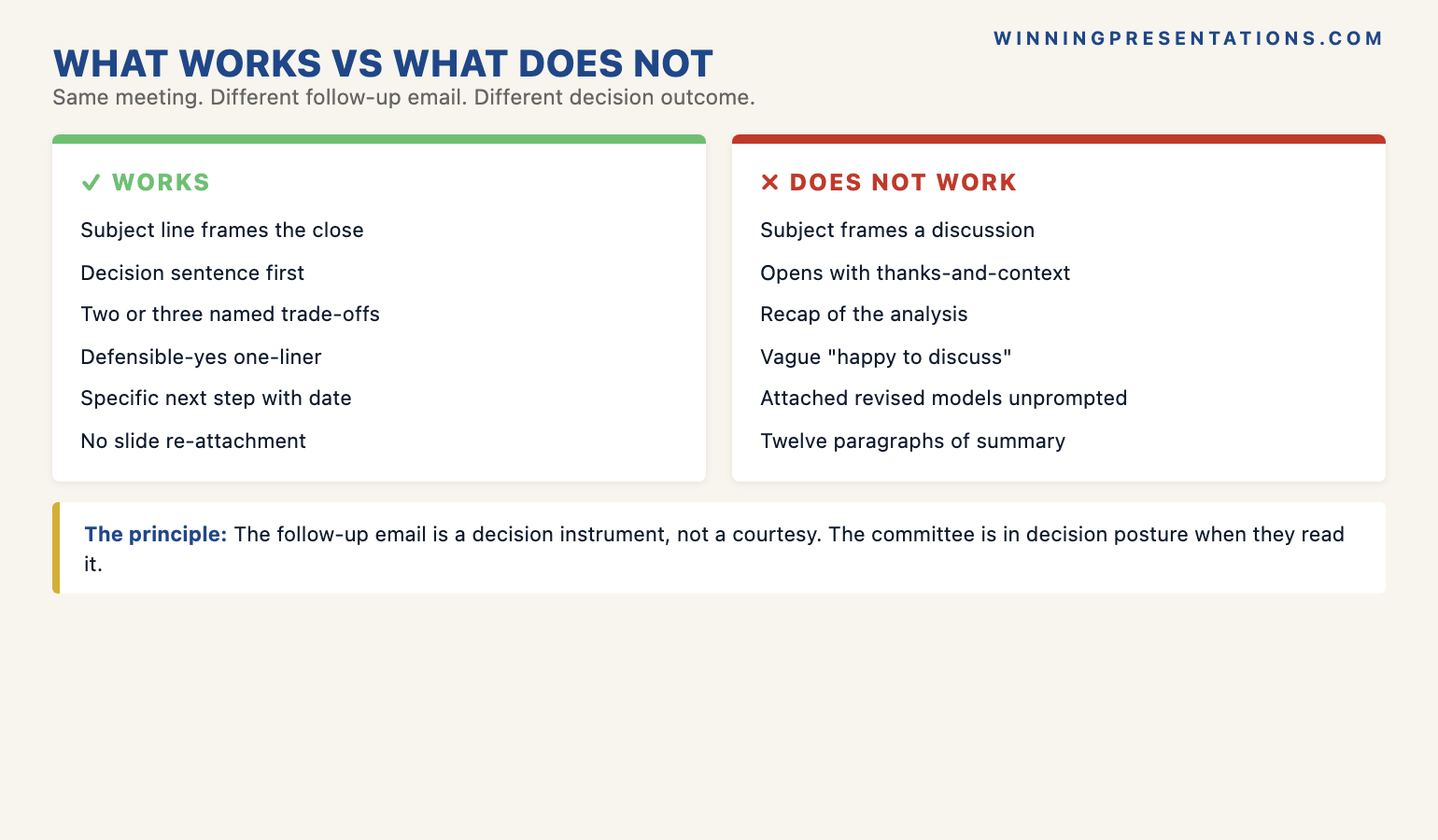
Three silent rules that matter. Do not attach the slides — they have already been distributed, and re-attaching signals defensiveness. Do not attach a revised financial model unless the committee specifically requested one in the meeting; revisions sent unprompted read as the team’s restless polishing rather than as a response to the room. Do not write a subject line that frames the email as a discussion (“regional strategy follow-up — questions and discussion”) — write one that frames it as the close (“regional strategy decision — proposed next step by 14th”). The subject line is what determines whether the email is opened on the morning it arrives or saved for later. “Saved for later” is functionally the same as deleted.
What not to do
The most common follow-up email failure is the recap. Twelve paragraphs summarising the discussion, attaching everything, closing with “let me know your thoughts”. The committee skims the first paragraph, notices nothing actionable, and moves on. The proposal does not advance.
The second-most-common failure is the apology. “We could perhaps have presented some elements more clearly” is the kind of line senior leaders write under a misguided sense that humility makes the next conversation easier. It does the opposite. It re-opens questions the committee had already accepted, signals defensiveness, and gives the committee an excuse to defer further pending “the clearer version”. The disciplined move is to write the email as if the meeting was good — because it usually was — and to focus the structural content on what happens next.
The third failure is asking the committee what they want. “We would welcome guidance on how the committee would like to proceed” reads as a leader who has lost command of the process. The four-paragraph email proposes the next step. The committee either accepts it, modifies it, or pushes back. All three are progress. None of them are deferral by default.
For the upstream discipline of how the in-room deck sets up the email’s job, see the 15-minute board presentation template and the related framework on how to structure executive decisions.
Close decisions instead of summarising meetings.
The Executive Buy-In Presentation System (£499, lifetime access) covers the post-presentation moves that turn deferred decisions into backed ones — the email format, the stakeholder follow-ups, and the language patterns that make a yes feel defensible. 7 self-paced modules, monthly cohort enrolment, optional recorded Q&A calls.
Frequently asked questions
What if the meeting ended in a clear yes — do I still send the email?
Yes, with one adjustment. Paragraph one opens with the confirmed decision rather than the requested decision: “the committee approved the £42m platform investment as set out, with phase-1 commitment by end of Q3 and named delivery owner accountable for the 18-month plan.” Paragraphs two through four still have a job. Paragraph two restates the trade-offs the committee weighed and accepted. Paragraph three supplies the one-line language they can use externally. Paragraph four proposes the first concrete next step with a date. A confirmed yes still benefits from the structural summary — committee members will use it in their own follow-up communications, and the formal record will reference it.
Should the email be from me personally or from the team?
From you personally. The committee read the deck as your case in the room; the follow-up email reads as your continuation of that case. A team-signed email feels like the team is hedging, and it dilutes the senior leader’s voice at exactly the moment when ownership matters. If the team has done significant work behind the proposal, acknowledge that briefly in paragraph two (“the team’s analysis of the phasing scenarios is summarised in the appendix circulated before the meeting”) rather than co-signing the email itself. The committee will associate the proposal with you regardless; the email should reflect that.
What if a committee member emails me first, before I have sent the follow-up?
Reply briefly and warmly to the committee member, acknowledge their question or comment, and tell them the formal follow-up will go out within 24 hours. Then send the four-paragraph follow-up to the full committee on the original timeline. Do not let the unsolicited reply pull the formal follow-up into a bilateral conversation — that is precisely how proposals fragment into private exchanges that never become committee decisions. The structural discipline is to keep the formal follow-up on the formal channel and reply to side conversations separately.
How do I write paragraph 3 if I am genuinely not sure why my recommendation is right?
If you cannot write the defensible-yes sentence cleanly, the proposal is not ready to be in front of a board. Paragraph three is the test for whether the underlying case is actually decidable. A proposal that cannot be summarised in one line of “we are recommending X because Y” needs more upstream work — usually on the trade-offs, not on the analytical depth. Spend a half-day with a senior peer drafting the sentence aloud. The exercise often reveals that the strategy itself is not yet at decision-ready clarity. Better to discover that before the next presentation than after another deferral.
The Winning Edge — weekly newsletter
The Winning Edge is a weekly newsletter for senior professionals who present at the executive level. One short email a week, focused on the structural moves that separate decks committees back from decks they defer. Subscribe to The Winning Edge →
Not ready for the full Buy-In Programme? Start here instead: download the free Executive Presentation Checklist — a one-page reference for the structural moves senior leaders run before every committee deck.
About the author
Mary Beth Hazeldine is Owner & Managing Director of Winning Presentations Ltd. With 24 years of corporate banking experience at JPMorgan Chase, PwC, Royal Bank of Scotland, and Commerzbank, she advises executives across financial services, healthcare, technology, and government on structuring presentations for high-stakes funding rounds, board approvals, and strategic decisions.