Tag: board preparation

23 May 2026
Featured image for First Board Presentation Checklist: 31 Points Senior Pros Use

First Board Presentation Checklist: 31 Points Senior Pros Use

Quick answer: A first board presentation checklist is a structured pre-flight review covering pre-read, slide structure, Q&A preparation, room behaviour, and post-meeting follow-up. The 31-point version below is the one senior professionals work through in the seven days before a board meeting. It is not a creative exercise. It is a discipline. Most preventable mistakes in first board presentations are checklist failures, not skill failures.

Adaeze had been promoted to Group Director four months earlier. Her first board presentation was a quarterly review of a regional turnaround that her team had worked on for eighteen months. She knew the numbers. She had rehearsed the deck three times with her direct reports. The only piece of preparation she had not done was the structured one.

Forty-five minutes into the presentation, the chair asked a question she had not anticipated. Not a hard one. A procedural one — what was the page reference in the pre-read? Adaeze did not know. She had not opened the pre-read pack since circulating it. The question stalled the meeting for ninety seconds. The board was patient. It was also unmistakably noting that the new director was not on top of her own paperwork.

The error was not technical. It was structural. Adaeze had prepared the content of her presentation but had not prepared the meeting. A 31-point checklist would have caught it. So would the other six things her checklist would have caught and that the meeting did not surface but the board observers noticed.

A first board presentation checklist is not glamorous. It is not what people post about on LinkedIn. It is, however, what separates senior professionals who survive their first board outing from senior professionals who spend the next quarter recovering credibility they did not need to lose.

Before your first board outing

The Executive Slide System is the structured slide library senior presenters use to build board-ready decks without starting from a blank PowerPoint. 26 templates, 93 AI prompts, 16 scenario playbooks. Designed for first-time and recurring board presenters.

Explore the system →

Why a checklist beats a final-day rehearsal

Most senior professionals over-invest in rehearsing the deck and under-invest in checking the meeting. The asymmetry is psychological. Rehearsal feels productive — you can hear yourself improving. Checklist work feels mechanical — you cannot hear improvement, you can only avoid mistakes. The board, however, notices the second category much more reliably than the first.

A board has seen hundreds of presentations. A polished delivery does not earn extra credit. A messy pre-read, a stale piece of data, a contradicted financial figure, an unanswered procedural question — all of these stand out. The bar is not eloquence. The bar is preparation that holds up under scrutiny from people who have read the pack and remember the last meeting.

The 31-point checklist below is grouped into five categories that match the order in which board scrutiny actually happens: pre-read first, slides second, Q&A third, behaviour fourth, follow-up fifth. The points are deliberately specific. Vague checklist items get ignored. Specific ones get done.

Points 1 to 7: pre-read and pack

The pre-read is read. Most first-time presenters assume it is not. That assumption ends careers. Senior board members, particularly non-executive directors, often spend more time in the pre-read than in the meeting. Your slides are a summary of something they have already absorbed.

1. Re-read your own pre-read forty-eight hours before the meeting. Not skim. Read. The point is to know exactly what page covers what topic so you can reference back without searching.

2. Confirm every figure in the pre-read matches the figure in the deck. One contradicted number is a credibility hit that takes weeks to recover.

3. Note the three places where the pre-read invites a question. Caveats, footnotes, and forward-looking statements are where boards probe. Have an answer for each.

4. Check the pack version sent to the board against the version in your possession. Late edits sometimes do not propagate. Bring the version the board has, not the version you wrote.

5. Confirm the order of items on the agenda. Late shuffles happen. Walking in expecting to be third when you are now first costs you composure.

6. Identify the chair’s typical opening question. Most chairs have one. A senior peer or your sponsor will know what it is. Prepare for it explicitly.

7. Know who else is presenting before you. Their content shapes the room you walk into. If they cover material adjacent to yours, plan a one-line handoff.
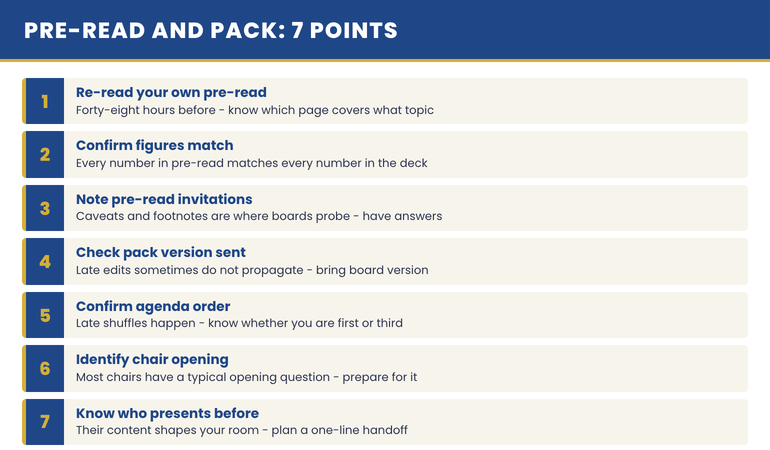
Infographic showing the seven pre-read and pack checklist items grouped into pre-meeting preparation tasks for a first board presentation

For senior professionals presenting to their board for the first time

Build board-ready slides without starting from a blank PowerPoint

The Executive Slide System gives you the structures senior presenters use for board-level decks. 26 templates covering board updates, strategic proposals, and quarterly reviews. 93 AI prompts for tightening copy at executive altitude. 16 scenario playbooks for the situations first-time board presenters most often face.

  • 26 templates designed for board, executive committee, and investment panel presentations
  • 93 AI prompts for sharpening slide language without losing executive tone
  • 16 scenario playbooks covering quarterly reviews, strategic proposals, and committee updates
  • Instant download, lifetime access, designed for repeat use across multiple board cycles

£39 · Instant access · Designed for executive board scenarios

Get the Executive Slide System →

Points 8 to 15: slide structure

Boards do not reward slide design. They penalise slide failure. The bar is not impressive — it is the absence of distractions that pull attention away from the substance. The eight points below are the structural items that, if missed, will be the only thing the board remembers about your deck.

8. Lead with the conclusion on slide one. The Pyramid Principle is not optional at board level. The first slide states the recommendation. The remaining slides defend it.

9. Build for fifteen minutes maximum, even if you have thirty. The board will spend the rest in Q&A. Over-running the deck reads as poor judgement of the room.

10. Use one chart per slide, never two. Two charts per slide invites the board to compare them. The comparison is rarely the one you intended.

11. Spell out every acronym on first use. Even acronyms the board uses internally. NEDs and external advisors may not. Acronyms exclude.

12. Footnote every external source. If you do not, someone will ask. The question itself reads as a credibility test.

13. Number every page. Page references are how board members navigate. A deck without page numbers is a deck the board cannot easily reference.

14. Prepare an appendix three times the length of the main deck. Senior presenters rarely use appendices in the room. The signal that one exists is the credibility move. Be ready to reference page A-12.

15. Print three paper copies before walking in. Tablets fail. Wi-Fi fails. Projectors fail. Paper does not. The board will read paper if offered.

The structural points above are why most senior presenters keep a working board presentation template on hand rather than rebuilding a deck from a blank slide each time. The structure does not change. The content does. Reusing the structure reduces the chance of forgetting one of the eight points above.

Points 16 to 22: Q&A preparation

The board makes its decision in Q&A, not in the slides. The slides give the room a vocabulary. The questions reveal whether the recommendation has held up. Most first-time presenters under-prepare this section by a factor of three.

16. Write down the seven questions you most fear being asked. Then prepare a 45-second answer to each. The seven you fear are usually the seven you will be asked.

17. Prepare a structured response to “what is the worst case?” Most boards will ask. The right answer is a number with a confidence band, followed by what you would do at that point.

18. Prepare a structured response to “what would change your view?” A non-answer here is fatal. The right answer is two or three explicit conditions that would shift your recommendation.

19. Know which board members will be sceptical and why. A senior peer will brief you. The reasons are usually historic, political, or personal. Prepare to address each, briefly, by name.

20. Prepare for “what does the CFO/CEO think?”. The board is checking your political coverage. Name the senior endorsements you actually have. Distinguish formal sign-off from informal support. Never overstate.

21. Have one specific data point you have not put in the deck. Use it in Q&A only. The signal that you know the data beyond what is on the slides is the strongest credibility move available to a first-time presenter.

22. Rehearse stopping at forty-five seconds per answer. Most failed first board outings are death by long answer. The discipline is to stop, even if the silence feels uncomfortable.
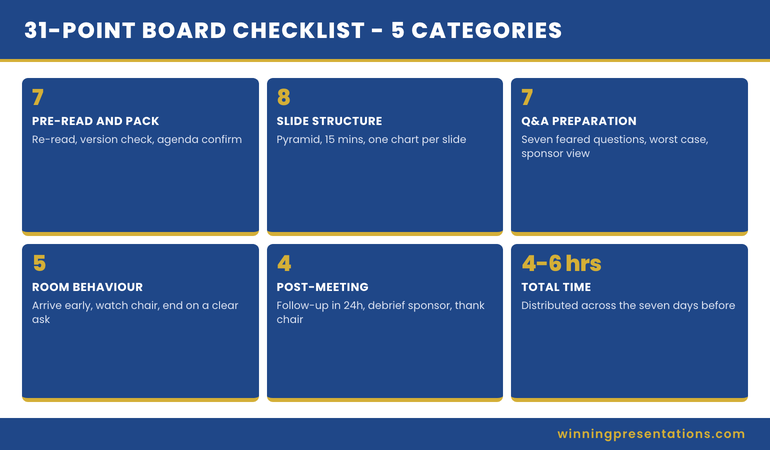
Diagram showing the 31-point first board presentation checklist organised into five categories: pre-read, slides, Q&A, room behaviour, and follow-up

Companion piece for first-time presenters

First board presentation as a new director

The 31-point checklist focuses on the meeting itself. The companion piece on first board presentations as a new director covers the political and relationship work that runs in the weeks before — equally important and often skipped by first-time presenters who focus only on the deck.

Points 23 to 27: room behaviour

First impressions in the boardroom are made in the first ninety seconds. Five behavioural items disproportionately shape the room’s read of a new presenter. They are not skills. They are habits a checklist enforces.

23. Arrive ten minutes early, settle, do not chat. Use the time to get oriented in the room, not to network. The board is watching how you arrive.

24. Greet the chair by name on entry. Then sit when invited. Standing too long signals nerves. Sitting too quickly signals presumption.

25. Speak at three quarters of your usual pace. Boards process more slowly than they appear to. Pace is the single most controllable element of room presence and the most often miscalibrated.

26. Watch the chair, not the slides. Glances at the chair signal that you are reading the room. Glances at the slides signal that you are presenting at it. The difference is visible.

27. End on a clear ask. Whether decision, endorsement, or input — name what you are asking the board for. Most first-time presenters trail off. The board is uncertain whether the meeting concluded.

Points 28 to 31: post-meeting follow-up

The meeting ends. The work does not. The four items below shape whether the board carries forward a positive or neutral impression into the next cycle.

28. Send any committed follow-up within 24 hours. If you said “I will come back with X by Friday”, the board is watching the timestamp. Speed of response is itself a credibility signal.

29. Debrief with your sponsor within forty-eight hours. What worked, what did not, what to adjust before next quarter. The patterns repeat. Capture them while the meeting is fresh.

30. Send a short thank-you to the chair. Three sentences. Acknowledge any specific input. Do not ask for further commentary. Thank-yous read as professional. Requests read as needy.

31. Update your own checklist for next time. Add anything the meeting surfaced that the 31 points missed. Boards differ. Your version becomes more useful with each cycle.

Used together, the 31 points represent perhaps four to six hours of structured preparation in the week before a first board outing. That investment is small relative to the credibility consequences of skipping it. A senior peer once described the discipline as “the difference between a presentation that ages well in the board’s memory and one that ages badly”. A checklist tilts the odds towards the first.

Frequently asked questions

Should I use the 31-point checklist for every board meeting or only the first?

Use it for the first three. After that, most senior presenters drop to a personalised twelve-point version that captures the items they personally most often miss. The full 31 are designed to catch the failures specific to inexperience. Once the experience is built, a tighter checklist is more practical.

How long does the checklist take to run before a meeting?

Roughly four to six hours of structured preparation, distributed across the seven days before the meeting — not as one block. Pre-read review takes one to two hours. Slide structure check takes one. Q&A preparation takes two to three. Room behaviour and follow-up are quick.

What if my first board presentation is in three days, not seven?

Prioritise points 1 to 5 (pre-read), points 8 to 12 (slide structure), and points 16 to 18 (Q&A preparation). The behavioural and follow-up points carry less risk if abbreviated. Three focused hours on those fifteen items is better than spreading thinly across all 31.

Is a 31-point checklist excessive for a routine update presentation?

Not for a first one. Routine board updates feel low-stakes to the presenter and are usually the highest-stakes meeting on the board’s calendar that day. The asymmetry of stakes is the reason the checklist exists. After three to four cycles, an abbreviated version is appropriate.

If your first board outing is in the next six weeks

Stop building from a blank slide. Start from a structure designed for board scrutiny.

The Executive Slide System is the board-deck library senior presenters keep on hand for repeat use across cycles. The structures are designed for the kind of scrutiny boards apply — Pyramid-led, one chart per slide, footnoted sources, scenario-mapped appendices. The investment is one-time. The application is every meeting.

  • 26 templates covering board updates, quarterly reviews, and strategic proposals
  • 93 AI prompts for tightening slide copy at executive altitude
  • 16 scenario playbooks covering the situations first-time board presenters most often face
  • Instant download, lifetime access, no subscription, no expiry

£39 · Instant access · Designed for executive board scenarios

Get the Executive Slide System →

The Winning Edge — weekly

One short note each Thursday on board-level presentation patterns, structural shortcuts, and the behaviours senior presenters use under scrutiny. Written for professionals who do not have time for newsletters that read like newsletters.

Subscribe to The Winning Edge →

Want a starting point first? The free Executive Presentation Checklist covers the structural fundamentals before you commit to a paid system.

For a wider view of how this fits into board-level presentation work, see the companion article on open board meeting presentations.

Next step: Pick the date of your next board presentation. Block four hours across the seven days before. Run points 1 to 7 on day six, points 8 to 15 on day five, points 16 to 22 on day three, points 23 to 31 on day one. That is your checklist for the meeting.

Mary Beth Hazeldine is the Owner & Managing Director of Winning Presentations. With 24 years of corporate banking experience at JPMorgan Chase, PwC, Royal Bank of Scotland, and Commerzbank, she advises senior professionals across financial services, healthcare, technology, and government on structuring presentations for high-stakes board meetings, investment committees, and executive sessions. She speaks German and works extensively with the German-speaking financial markets.

02 Apr 2026
Non-executive director preparing for first board meeting in a modern corporate boardroom

Non-Executive Director Board Presentation: What to Prepare for Your First Meeting

Your first board meeting as a non-executive director is not a presentation you deliver—it’s a performance you shape. The difference between earning credibility and appearing out of your depth comes down to preparation strategy, not slide polish. Here’s what actually matters.

Annika arrived at her first board meeting as a newly appointed NED at a mid-cap technology firm feeling confident. She’d spent the previous week refining a ten-slide deck on her area of expertise—cybersecurity governance. She’d colour-coded the risk matrix, added trend analysis charts, even included a benchmarking comparison. Within two minutes of the chair opening the meeting, she realised her error. The board wasn’t waiting for a lecture. They were watching to see whether she understood the rhythm of governance, whether she listened before speaking, and whether her questions raised the calibre of discussion. Her perfect slides sat unopened whilst the chair moved straight to strategic priorities. Annika spent the first meeting listening, asking two precisely angled questions, and learning the board’s decision-making patterns. By month three, her contribution was so trusted that the board sought her perspective first on governance matters.

Already preparing for your first board? The Executive Slide System includes board-ready templates and scenario guides built for exactly this situation.

Why Most Non-Executive Directors Over-Prepare the Wrong Material

The instinct is understandable but misplaced. New NEDs often treat their first meeting like an audition. They prepare comprehensive presentations, position papers, or detailed briefings—everything they’d present in an executive role. But a non-executive director board preparation process is fundamentally different. The board chair and executive team have already synthesised the data. What the board needs from you is not information but perspective—independent assessment shaped by governance duty, not operational pressure.

Most first-meeting mistakes stem from confusing two separate preparation tracks: operational mastery and governance readiness. Operational mastery is deep subject knowledge. Governance readiness is understanding the board’s decision-making context, the strategic tensions in the room, and the questions that matter at board level. New NEDs frequently invest 80% of preparation energy in operational detail and 20% in governance positioning. This ratio is exactly backwards.

Consider what the chair is actually assessing during your first meeting. Are you asking questions that probe strategy rather than restate operational status? Can you spot the unspoken tensions between board members? Do you listen before you speak, or do you compete for airtime? Will you respect confidentiality and fiduciary duty? Can you challenge constructively without creating conflict? None of these signals come from a polished slide deck.

Master Your First Board Meeting as a Non-Executive Director

The Executive Slide System gives you board-ready templates, scenario guides, and decision-making frameworks—so your first contribution raises the quality of governance dialogue, not just fills airtime.

  • ✓ Board-ready presentation templates for governance updates
  • ✓ AI prompt cards to structure your governance perspective fast
  • ✓ Executive scenario guides for high-stakes board decisions

Get the Executive Slide System → £39

Designed for executives preparing high-stakes presentations

The Three Documents Every NED Must Read Before the Meeting

Board papers arrive in abundance. Most NEDs skim them. Smart ones prioritise ruthlessly. You need three documents, read thoroughly, before your first meeting. Everything else is supplementary.

Document 1: The Board Charter and Governance Framework. This defines your statutory and fiduciary responsibilities. Read it. Know it. Many NEDs skip this because it feels like compliance tedium. It’s not. The charter defines what “governance” actually means in your organisation—what decisions the board retains, which it delegates, where your scrutiny must be sharpest. You cannot ask intelligent governance questions without understanding these boundaries.

Document 2: The Last Three Board Minutes. Not to learn the detail, but to understand the rhythm and priorities. What topics consumed 80% of discussion time? What decisions took four meetings versus one? Where was there tension or disagreement? Where did the executives defer to the board for a decision? These patterns reveal where the real governance pressure sits. Your questions should align with these priorities, not drift into tangential areas.

Document 3: The Strategic Plan and Board Scorecard. The five-year strategy and the single-page metrics that the chair and executives track obsessively. You need to understand: What outcomes matter most? What are the three to four strategic risks the board is actively monitoring? What metrics would trigger a governance intervention? This becomes the lens through which you assess every board paper. A question about expense management that doesn’t connect to strategic risk is wasted airtime. A question that probes whether an initiative still aligns with strategy is governance.

These three documents take perhaps six to eight hours to read properly. That is your preparation. Not creating slides. Not drafting position papers. Reading, absorbing, and internalising the governance context.

Your First Board Contribution: When to Speak and When to Listen

The psychology of first impressions in the boardroom is unforgiving. Speak too much and you appear to lack confidence in your judgment—filling silence with noise. Speak too little and you appear uncertain of your role or value. Speak on the wrong topic and you reveal that you haven’t yet grasped what the board actually cares about.

Your first substantive contribution should come only after you’ve heard the full board discussion on a topic. Listen to how the chair frames the issue. Notice which executives are defensive and which are transparent. Observe which board members ask probing questions and which accept what they’re told. Then, when you speak, you’re adding to a conversation you understand, not inserting yourself into unfamiliar territory.

The first NED contribution that earns respect typically fits one of three patterns. First: you ask a clarifying question that surfaces an assumption the board hadn’t named. Not a challenge, not a directive—a genuine question that sharpens thinking. Second: you note a governance gap—something the board has discussed but not yet connected to fiduciary duty or risk policy. Third: you offer a perspective from your specific expertise that the internal team cannot, framed as context for the board’s decision rather than a recommendation.

Avoid at all costs: repeating what’s already been said, asking for information the board papers already provided, and offering opinions on operational detail. These signals tell the board that you’re not yet calibrated to governance level.

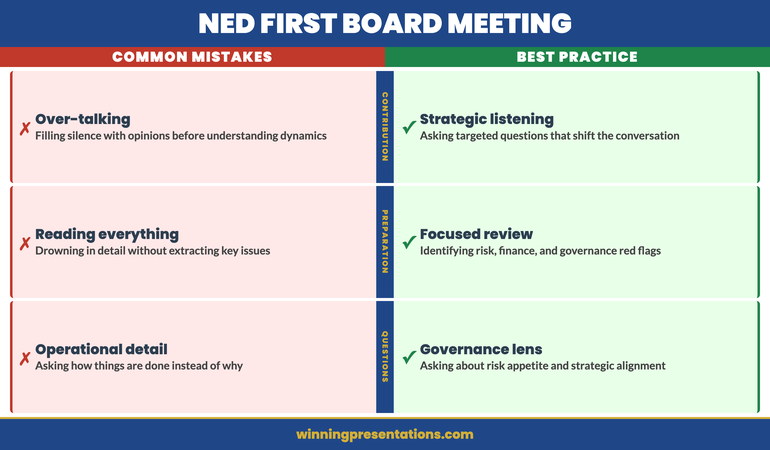
Comparison of common NED first board meeting mistakes versus best practice approaches across contribution,

Building a Board-Ready Slide for Your First Substantive Update

Eventually, you will have a governance topic to present—perhaps in month two or three, once you’ve established credibility. The slide discipline at board level is not what most executives expect. The mistake new NEDs make is assuming board presentations follow the same visual intensity as operational presentations. They don’t.

A board-ready slide is sparse by design. It contains a clear headline—usually a decision or governance question, not a topic name. It contains two to four data points that directly support that headline. It contains no decorative charts, gradients, or visual flourish. The entire purpose of the slide is to communicate one governance-level insight in under ninety seconds. Executives often treat slides as a prop for their narrative. Board members treat slides as a decision tool. The difference is vast.

Your first substantive update as a NED should follow this structure: one slide stating the governance issue, one slide showing the three strategic options with their board-level trade-offs, one slide naming your governance assessment and recommended board action. That’s it. No background. No process explanation. No “how we got here” narrative. The board already knows the operational history. They need your governance lens on what matters.

You can find detailed board-ready slide templates in the board presentation best practices guide, which walks through the specific templates that senior NEDs and chairs use routinely.

The Governance Lens: What Sets Non-Executive Questions Apart

One question reveals whether you’re operating at governance level or operational level: the questions you ask. An operational question asks “how?” A governance question asks “why should the board approve this, and what are we collectively risking if we don’t?” These sound different because they are different.

During the first meeting, you’ll hear executives present an update or a decision. Your peers will ask follow-up questions. Many of those questions are perfectly competent and miss the point entirely. They probe implementation detail, timeline nuance, or tactical adjustment. None of those move governance forward. A governance question at board level connects the proposal to four things: strategic alignment, risk appetite, fiduciary duty, and stakeholder impact. You don’t need to mention all four in one question. You need to ensure that every question you ask probes at least one of them.

For example: An executive proposes expanding into a new geographic market. An operational question is “What’s the timeline?” A governance question is “How does this expansion align with our strategic priority for profitability versus growth, and what’s our risk tolerance if the market adoption rate is half what we’ve forecast?” The governance question assumes knowledge of the board’s strategic priorities and risk framework. It surfaces the trade-off the board must own. It invites a discussion of governance, not implementation.

Questions framed this way—particularly in your first meeting—signal that you’ve done the homework, you understand the board’s strategic context, and you’re not here to micro-manage operations. You’re here to strengthen governance. That distinction, communicated in your first three questions, determines how the board perceives your value for the next three years.

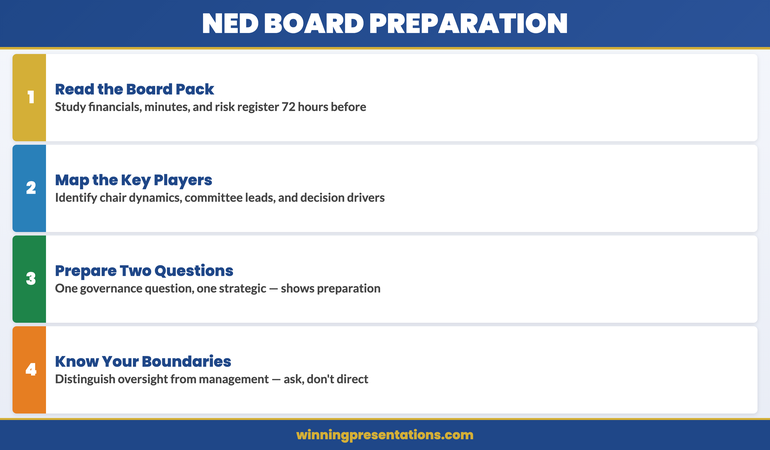
Four-step NED board preparation framework showing reading the board pack, mapping key players, preparing questions, and knowing governance boundaries

Common Mistakes That Undermine a Non-Executive Director’s First Board Impression

Mistake 1: Speaking Confidently About Things You Don’t Yet Understand. The boardroom rewards intellectual honesty. If you don’t understand the context of a decision, say so. Ask the question. Take the note. Don’t bluff. New NEDs who attempt to mask uncertainty by talking more actually reduce their credibility. A simple “I want to understand the risk assumption here before we move forward” signals competence and governance discipline.

Mistake 2: Treating Board Papers as Reference Material Rather Than Strategy Documents. Skim reading board papers is a common shortcut. Then you arrive at the meeting, and mid-discussion realise you’ve missed the thread. Someone refers back to a decision from three months ago. You don’t remember the context. You’re now operating blind. Read board papers with a notebook and a highlighter. Mark the three strategic tensions in each paper. Mark the sentences where the executive is asking for a board decision versus informing the board of a decision already made. These annotations take ten minutes and determine whether you’re engaged or adrift in the conversation.

Mistake 3: Assuming Your Expertise Automatically Translates to Board-Level Authority. Many new NEDs have deep expertise in their specialist domain—technology, finance, operations, healthcare. They assume this expertise gives them licence to direct or override in meetings. Wrong. Expertise is context. Governance is authority. The board values your expertise as perspective on governance matters, not as permission to make decisions or direct the executive team. The distinction matters intensely. Confuse them and you’ll be seen as boundary-crossing rather than governance-focused.

Mistake 4: Preparing to Present Rather Than Preparing to Govern. This is the Annika mistake at the start of this article. You spend weeks creating a beautiful presentation on your subject area. But your job as a NED is not to educate the board on your expertise. It’s to govern the organisation on behalf of shareholders or stakeholders. If your preparation is centred on “what can I teach this board,” you’ve misunderstood the role. Preparation should centre on “what governance questions does this organisation face, and how can I add clarity to the board’s decision-making?”

Mistake 5: Talking About Your Appointment or Your Perspective Without Being Asked. Some new NEDs spend their first meeting explaining their background or positioning their independent perspective. The board doesn’t care. They care about governance. Your independence and expertise will be evident through the questions you ask and the judgement you demonstrate. Talking about these things directly reads as insecurity.

If you want to dig deeper into the structure of board presentations and the difference between board papers and board presentations, this resource breaks down each format and when each one is appropriate.

Your First Board Needs Governance Clarity, Not Perfect Slides

Prepare strategically, ask questions that matter, and establish yourself as governance-focused from day one. The Executive Slide System includes everything you need—templates, scenario guides, and decision frameworks—for £39.

Get the System Now → £39

FAQ: Your First Board Meeting as a Non-Executive Director

What should I do if I disagree with a board decision in my first meeting?

Disagreement is governance. The mistake is how you express it. In your first meeting, if you have a genuine governance concern (not just a different opinion), state it clearly but briefly, then respect the board’s decision. Document your dissent in the minutes if you believe it’s a material risk. Do not debate at length or attempt to persuade. You’re establishing that you’ll contribute independent judgment, not that you’ll fight for your position. Over time, your judgment earns weight. In month one, respect the chair and the decision-making process, even if you’d choose differently.

How much should I prepare beyond reading the board papers?

Read the three core documents thoroughly (charter, recent minutes, strategic plan). Read the current month’s board papers carefully. Beyond that, do not prepare a presentation or briefing document. Do not draft remarks or position statements. Preparation beyond reading signals anxiety and misunderstanding of the role. Your preparation is intellectual, not creative. You’re building governance context, not a narrative.

What’s the difference between a good governance question and a bad one in the first meeting?

A good governance question surfaces a strategic trade-off, probes risk assumptions, or connects a proposal to the board’s fiduciary duty and strategic priorities. It assumes you’ve done the homework and understand context. A bad governance question asks for information that’s already in the papers, probes operational detail rather than governance, or attempts to demonstrate expertise rather than strengthen the board’s decision. The best first-meeting questions are short, assume knowledge, and invite the board to address a governance gap that’s real but unnamed.

The Winning Edge

Weekly insights on executive presentations, slide strategy, and boardroom communication.

Subscribe Free

New to governance presentations? Download the Executive Slide System checklist for a quick NED board preparation framework.

Once you’ve navigated your first board, the next challenge is embedding yourself in the governance rhythm. Many new NEDs ask how to transition from observation to meaningful contribution within the first ninety days. Our guide to presentations in your first ninety days covers the communication milestones that build your board credibility beyond the first meeting.

About the author

Mary Beth Hazeldine, Owner & Managing Director, Winning Presentations. With 24 years of corporate banking experience at JPMorgan Chase, PwC, Royal Bank of Scotland, and Commerzbank, she advises executives across financial services, healthcare, technology, and government on structuring presentations for high-stakes funding rounds and approvals.